- Market Value (2025): USD 4.8 Bn
- Estimated Value (2026): USD 5.03 Bn
- Forecast Value (2036): USD 8.08 Bn
- CAGR (2026-2036): 4.9%
What is the DSLR Cameras Market forecast to be worth by 2036?
USD 5.03 billion in 2026 to USD 8.08 billion by 2036 at a 4.9% CAGR.
- As per Fact.MR analysis, the DSLR cameras market was valued at USD 4.8 billion in 2025.
- The DSLR cameras market is projected to increase from USD 5.03 billion in 2026 to USD 8.08 billion by 2036 as the installed base supports camera and accessory purchases.
- A 4.9% CAGR is forecast from 2026 to 2036. Customer retention depends on lens compatibility and camera handling preferences alongside competing mirrorless choices.
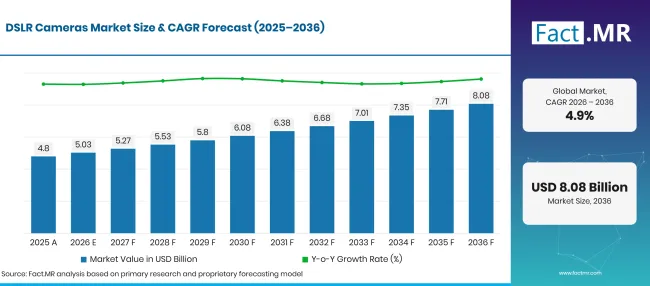
Factmr Dslr Cameras Market Forecast Global | Source: Fact.MR
| Year | Basis | Market Value (USD billion) |
|---|---|---|
| 2025 | Actual | 4.8 |
| 2026 | Estimate | 5.03 |
| 2036 | Forecast | 8.08 |
| CAGR 2026 to 2036 | Forecast period | 4.9% |
Source: Fact.MR analysis. Updated Oct 30, 2026
What are the defining numbers behind DSLR Cameras Market growth?
The forecast implies USD 3.1 billion in additional market value between 2026 and 2036.
- Demand Drivers in the Market
- Photographers with existing DSLR lenses often compare the price of a replacement body with the cost of moving to another camera system. Keeping a familiar lens mount and set of controls can make the current equipment practical for longer, particularly in studio and field work.
- Retailers have fewer new DSLR models to choose from as manufacturers focus more heavily on mirrorless equipment.
- Students and hobbyists use optical viewfinders and direct controls to learn how exposure and composition affect a photograph. Entry-class DSLRs support interchangeable lenses, while used models can offer a lower-cost way to start.
- Professional photographers often keep DSLR equipment when dependable battery operation and familiar handling fit established assignments. The choice usually depends on total system cost and whether existing flashes or specialized lenses remain suitable.
- Online product research helps shoppers compare camera specifications before visiting a dealer or ordering a kit. A camera purchase may involve checking shutter condition and warranty terms, so clear listings and knowledgeable support remain valuable.
- Key Segments Analyzed
- by Performance Type: Entry-class is projected to account for 47.2% of 2026 sales as people new to DSLR photography look for accessible interchangeable-lens equipment.
- by Application: Amateur Users are forecast to represent 58.7% in 2026, reflecting learning, personal travel photography and long-term use of an existing camera kit.
- by Distribution Channel: Online Stores are estimated to hold 52.4% in 2026 because shoppers can review body specifications and compare bundled lens options.
- Analyst Opinion at Fact.MR
- Shambhu Nath Jha, Principal Consultant at Fact.MR, states, “Existing lenses are a major part of the DSLR purchasing decision. A photographer with a complete compatible kit compares replacement bodies differently from someone buying an interchangeable-lens camera for the first time.”
- Strategic Implications
- camera manufacturers should keep lens and accessory compatibility visible in product information so existing users can assess replacement costs.
- specialist retailers should make body condition and warranty coverage easy to compare, particularly where stock includes older DSLR models.
- Online stores should show accurate kit contents and mount details so shoppers can identify which lenses and accessories fit a camera.
- Service providers should maintain clear repair information and spare-part availability because long equipment life affects the value of a DSLR system.
Germany has a projected 5.6% CAGR, followed by Brazil at 5.1%. The USA is forecast at 4.6%, while the UK is estimated at 4.1%. Japan follows at 3.7%.
How does the DSLR Cameras Market break down by segment?
Entry-class accounts for 47.2%; Amateur Users for 58.7%; Online Stores for 52.4% in 2026.
Which Performance Type dominates?
Entry-class is expected to represent 47.2% of 2026 value.
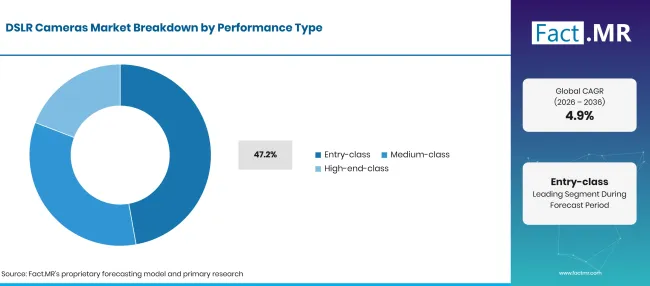
Dslr Cameras Market Breakdown Performance Type | Source: Fact.MR
| Performance Type | Share (2026) |
|---|---|
| Entry-class (Leading segment) | 47.2% |
| Other segments combined | 52.8% |
| Total | 100.0% |
Source: Fact.MR analysis. Updated Oct 30, 2026
entry-class cameras appeal to people taking their first steps with interchangeable lenses. A basic DSLR lets a user learn optical viewfinder shooting and adjust settings directly. Medium-class models suit more frequent use and provide further control options. High-end-class bodies meet the needs of photographers who expect more demanding handling and system performance.
What leads the Application segment?
Amateur Users are estimated to account for 58.7% of 2026 value.
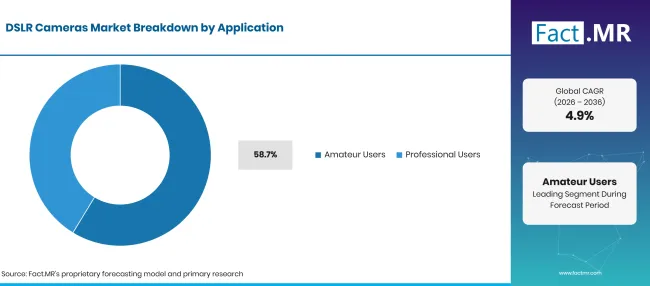
Dslr Cameras Market Breakdown Application | Source: Fact.MR
| Application | Share (2026) |
|---|---|
| Amateur Users (Leading segment) | 58.7% |
| Other segments combined | 41.3% |
| Total | 100.0% |
Source: Fact.MR analysis. Updated Oct 30, 2026
amateur photographers buy DSLR cameras for personal projects and skill development. Many assess the cost of a camera together with a lens that meets their preferred subject matter. Professional users make a different decision: equipment reliability and working familiarity often count more than the lowest entry price.
How does Distribution Channel shape demand?
Online Stores are projected to capture 52.4% of 2026 value.
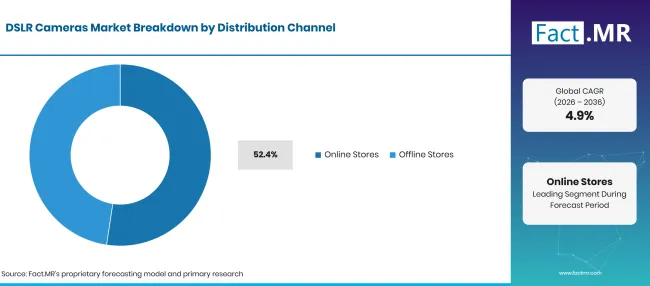
Dslr Cameras Market Breakdown Distribution Channel | Source: Fact.MR
| Distribution Channel | Share (2026) |
|---|---|
| Online Stores (Leading segment) | 52.4% |
| Other segments combined | 47.6% |
| Total | 100.0% |
Source: Fact.MR analysis. Updated Oct 30, 2026
online stores allow photographers to compare sensor formats and current prices without visiting several shops. The channel also gives owners a way to find compatible lenses and older model accessories. Offline stores remain relevant when the purchase needs hands-on testing or service advice. Eurostat reported in its 2026 digitalisation publication that 78% of EU internet users purchased or ordered goods online during 2025 [4].
What is accelerating DSLR Cameras Market adoption, and what is holding it back?
Lens ownership supports repeat purchases; mirrorless substitution limits DSLR shipments.
Drivers Impact Analysis
| DRIVER | (~) % IMPACT ON CAGR | GEOGRAPHIC RELEVANCE | IMPACT TIMELINE |
|---|---|---|---|
| Existing DSLR lens collections | +1.0% | North America, Europe, Japan | Medium term (2–4 years) |
| Affordable entry-class ownership | +0.8% | Global | Short term (<= 2 years) |
| Specialist optical viewfinder preferences | +0.7% | North America, Europe, Japan | Long term (>= 4 years) |
| Online product comparison | +0.5% | Global | Short term (<= 2 years) |
| Repair and accessory availability | +0.4% | Global | Medium term (2–4 years) |
Source: Fact.MR analysis. Updated Oct 30, 2026
Opportunity Impact Analysis
| OPPORTUNITY | (~) % IMPACT ON CAGR | GEOGRAPHIC RELEVANCE | IMPACT TIMELINE |
|---|---|---|---|
| Certified pre-owned camera sales | +0.8% | North America, Europe, Japan | Medium term (2–4 years) |
| Bundles for photography learners | +0.6% | Global | Short term (<= 2 years) |
| Specialist lenses and accessories | +0.5% | Global | Medium term (2–4 years) |
| Service and refurbishment support | +0.4% | Global | Long term (>= 4 years) |
Source: Fact.MR analysis. Updated Oct 30, 2026
Restraints Impact Analysis
| RESTRAINT | (~) % IMPACT ON CAGR | GEOGRAPHIC RELEVANCE | IMPACT TIMELINE |
|---|---|---|---|
| Competition from mirrorless cameras | -0.8% | Global | Long term (>= 4 years) |
| Reduced DSLR production options | -0.6% | Global | Medium term (2–4 years) |
| Availability of recent models | -0.5% | Global | Short term (<= 2 years) |
| System switching and replacement costs | -0.4% | Global | Medium term (2–4 years) |
Source: Fact.MR analysis. Updated Oct 30, 2026
Which countries are scaling the DSLR Cameras Market through 2036?
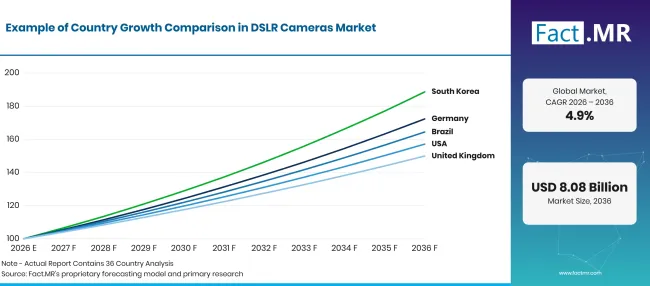
Dslr Cameras Market Growth Index | Source: Fact.MR
| Country | CAGR (2026 to 2036) |
|---|---|
| Germany | 5.6% |
| Brazil | 5.1% |
| USA | 4.6% |
| UK | 4.1% |
| Japan | 3.7% |
Source: Fact.MR analysis. Updated Oct 30, 2026
What supports Germany’s DSLR camera market?
5.6% CAGR, associated with online research and established camera ownership.
German photographers with established DSLR systems often compare body replacement prices against the cost of switching lens mounts. Camera shops can help by checking compatibility and offering a clear account of shutter condition and repair options.
How is Brazil developing DSLR camera demand?
5.1% CAGR, linked to digital shopping access and entry-level value.
Brazilian photography enthusiasts often start with the total cost of a working DSLR kit, including a suitable lens. Clear pictures of the camera body and accurate descriptions of lens compatibility help shoppers compare new and used equipment. In July 2026, the Brazilian Institute of Geography and Statistics reported that 95.0% of households had internet access in 2025 [5].
What shapes the DSLR cameras market in the USA?
4.6% CAGR, tied to existing lens systems and specialist retail.
The United States has a substantial established DSLR user base, including photographers who continue to work with lenses already suited to their camera bodies. Specialist dealers help these customers assess used-body condition and compare available repairs with replacement equipment. In February 2026, the Camera & Imaging Products Association reported 690,911 worldwide DSLR shipments during 2025 [1].
How does the UK DSLR market develop?
4.1% CAGR, influenced by digital retail and lens compatibility.
UK camera retailers compete through detailed online product listings and advice on compatible lenses for photographers already using DSLR equipment. For someone buying a first camera, a carefully described used kit can make the purchase easier to understand. The Office for National Statistics reported in October 2026 that internet sales accounted for 27.5% of total Great Britain retail sales in 2025 [6].
What supports DSLR demand in Japan?
3.7% CAGR, connected with manufacturer heritage and installed equipment.
Japan remains closely connected to the DSLR category through domestic camera brands and established lens systems. Nikon continues to publish product information for its D850 DSLR, including the optical viewfinder and F-mount lens compatibility [3]. In September 2026, Ricoh Imaging announced that it was ending production of its existing PENTAX K-series digital SLR models while developing a new series [2].
Who leads the DSLR Cameras Market?
Canon Inc. and Nikon Corporation retain recognizable DSLR product and lens ecosystems. Ricoh Imaging Company Ltd. represents PENTAX DSLR equipment and has announced a transition to a newly conceived DSLR line. Their commercial positions are shaped by product availability and the usefulness of existing lens mounts.
Nikon’s official catalog continues to show D7500, D780 and D850 models. The remaining names associated with premium camera photography require careful separation by product architecture: Phase One, Leica and Hasselblad are associated with specialist or medium-format systems and should not automatically be presented as suppliers of current mass-market DSLR bodies.
Which companies are the key providers?
Key companies include Canon Inc.; Nikon Corporation; Ricoh Imaging Company Ltd. / PENTAX; Phase One A/S; Leica Camera AG; and Hasselblad AB.
- Canon Inc.
- Nikon Corporation
- Ricoh Imaging Company Ltd. / PENTAX
- Phase One A/S
- Leica Camera AG
- Hasselblad AB
Bibliography
- [1] Camera & Imaging Products Association. (2026, February 2). Production, shipment of digital still camera: December and January–December 2025.
- [2] Ricoh Imaging Company, Ltd. (2026, September 9). PENTAX digital SLR cameras aim for a new stage.
- [3] Nikon Corporation. (n.d.). D850. Nikon Consumer. Retrieved October 28, 2026, from
- [4] Eurostat. (2026, April 23). Digitalisation in Europe – 2026 edition.
- [5] Instituto Brasileiro de Geografia e Estatística. (2026, July 2). Internet chega a 95% de domicílios do país em 2025
- [6] Office for National Statistics. (2026, October 23). Internet sales as a percentage of total retail sales (ratio) (%)
This Report Answers
- The report examines how the existing DSLR lens base influences replacement purchases and the selection of camera bodies.
- Performance analysis compares entry-class cameras with equipment intended for regular enthusiast and specialist use.
- Application analysis distinguishes amateur customers from professional photographers who maintain established working systems.
- Distribution analysis reviews how online comparison and specialist in-store advice shape camera purchases.
- Country analysis covers Germany, Brazil, the USA, the UK and Japan using separate forecast rates.
What does the DSLR Cameras Market cover?
The market covers camera bodies built around a digital single-lens reflex optical design and their consumer or professional kits. Products are grouped by performance class and application. Revenue assessment follows the sale of DSLR products through online and offline channels.
What is included in the scope?
Entry-class models used by beginners are included together with medium-class and high-end-class DSLR bodies. Cameras sold with compatible lenses as a kit are covered when the camera is the primary product. Amateur and professional applications are included.
What is excluded from the scope?
Mirrorless interchangeable-lens cameras and fixed-lens compact cameras are excluded from DSLR camera revenue. Smartphones are also excluded. Standalone lenses and accessories sold separately are outside the camera-body definition. Film SLR bodies do not count as digital single-lens reflex cameras.
How Was the Analysis Built?
The analysis draws on 120+ sources, 35+ company portfolios, 25+ countries, and more than 20 industry interviews.
- Primary Research: Primary research includes discussions with manufacturers, service providers, technology developers, distributors, end users, and subject-matter experts. These conversations examine purchasing priorities, product adoption, operational challenges, approval requirements, competitive positioning, and the factors that influence wider market acceptance.
- Desk Research: Desk research covers government statistics, regulatory publications, company filings, trade data, technical studies, industry associations, standards, public policy, and other authoritative sources. Every source used in the analysis is documented in the bibliography.
- Market Sizing and Forecasting: Market estimates combine historical performance, demand indicators, pricing and volume trends, segment shares, company participation, country-level growth, adoption patterns, investment activity, and barriers to market expansion.
- Data Validation and Update Cycle: Findings are validated by comparing primary interviews with public data, company activity, regulatory changes, trade patterns, and industry developments. Regular updates review new product launches, capacity changes, partnerships, approvals, and shifts in commercial adoption.
Segmentation
What is the report’s scope and coverage?
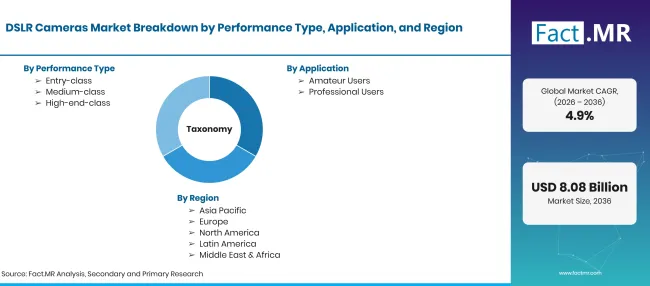
Factmr Dslr Cameras Market Taxonomy | Source: Fact.MR
| Attribute | Details |
|---|---|
| Quantitative Units | USD billion |
| Market Definition | Digital single-lens reflex camera bodies and camera kits using a reflex mirror and optical through-the-lens viewfinder. |
| Performance Type | Entry-class; Medium-class; High-end-class |
| Application | Amateur Users; Professional Users |
| Distribution Channel | Online Stores; Offline Stores |
| Regions Covered | North America; Latin America; Western Europe; Eastern Europe; East Asia; South Asia & Pacific; Middle East & Africa |
| Countries Covered | Germany; Brazil; USA; UK; Japan |
| Companies Profiled | Canon Inc.; Nikon Corporation; Ricoh Imaging Company Ltd. / PENTAX; Phase One A/S; Leica Camera AG; Hasselblad AB |
| Forecast Period | 2026 to 2036 |
| Approach | Camera body and kit revenue analysis, camera shipment evidence, distribution patterns and product portfolio assessment |
Source: Fact.MR analysis. Updated Oct 30, 2026
How is the market segmented?
-
By Performance Type
- Entry-class
- Medium-class
- High-end-class
-
By Application
- Amateur Users
- Professional Users
-
By Distribution Channel
- Online Stores
- Offline Stores
-
By Region
- North America
- Latin America
- Western Europe
- Eastern Europe
- East Asia
- South Asia & Pacific
- Middle East & Africa
Frequently Asked Questions
How big is the DSLR Cameras Market in 2026?
What is the CAGR of the DSLR Cameras Market from 2026 to 2036?
Which performance type leads the DSLR Cameras Market?
Which application leads the DSLR Cameras Market?
Who are the leading companies in the DSLR Cameras Market?
Who worked on this report


Preview the report firsthand - request a free sample
Free SampleGet the brochure for pricing and purchase details
Download PDF