- Market Value (2025): USD 519.1 Mn
- Estimated Value (2026): USD 551.7 Mn
- Forecast Value (2036): USD 1013.5 Mn
- CAGR (2026-2036): 6.3%
What is the Dynamic Truck and Trailer Suspension Market forecast to be worth by 2036?
The market is estimated at USD 551.7 million in 2026 and is forecast to reach USD 1,013.5 million by 2036, at a 6.3% CAGR.
- The market was valued at USD 519.1 million in 2025.
- Demand is projected to rise from USD 551.7 million in 2026 to USD 1013.5 million in 2036.
- The 6.3% CAGR outlook reflects spending on truck and trailer suspension performance, application-specific hardware and replacement demand.
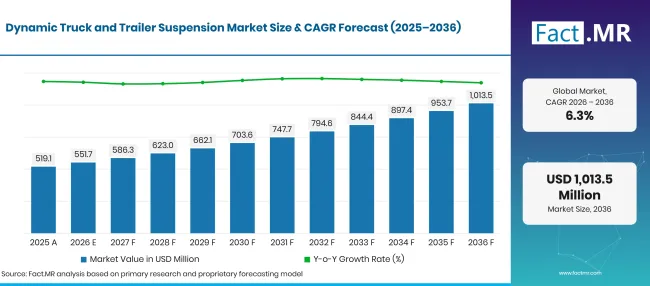
Dynamic Truck And Trailer Suspension Market Forecast Global | Source: Fact.MR
| Year | Basis | Market value in USD million |
|---|---|---|
| 2025 | Actual | 519.1 |
| 2026 | Estimate | 551.7 |
| 2036 | Forecast | 1013.5 |
| CAGR 2026 to 2036 | Forecast period | 6.3% |
Source: Fact.MR analysis. Updated Oct 26, 2026
What are the defining numbers behind Dynamic Truck and Trailer Suspension Market growth?
The forecast represents USD 461.8 million of additional annual market revenue between 2026 and 2036. Air suspension accounts for 42.3% of the 2026 market, while OEM supply represents 54.9%. That combination directs attention to vehicle specification decisions and the servicing of suspension systems already installed.
- Demand Drivers in the Market
- Changing payloads create a practical case for more controlled suspension response. A fleet carrying mixed loads needs to assess behaviour at dispatch and near the end of a delivery round. Fact.MR expects purchasing decisions to reward systems that cope with both conditions without imposing an excessive weight or maintenance penalty.
- Loading operations provide a separate reason to specify height adjustment. The commercial benefit arises when the truck or trailer can be positioned consistently for coupling and cargo transfer. Buyers should assess the time saved across their own depot cycle, especially where equipment is exchanged between tractors or used at several loading bays.
- Workshop familiarity influences the recurring order. The U.S. suspension requirements explicitly address axle alignment, damaged springs and the condition of air systems. [6] This gives maintenance teams concrete reasons to replace worn hardware. Suppliers that provide correct fitment information alongside parts can make that replacement work less disruptive.
- Chassis integration is becoming a more valuable part of the offer. In September 2026, ZF presented an improved OptiRide Smart Pneumatic Actuator capable of hosting application software without an external ECU. [11] Fact.MR sees a commercial opening where a supplier can reduce installation complexity while retaining the functions a fleet actually uses.
- Key Segments Analyzed
- By Product Type: Air Suspension holds 42.3% of the market in 2026; leaf spring and coil spring configurations serve different load and packaging requirements.
- By Vehicle Type: Light Commercial Vehicles account for 41.8%, placing delivery-truck ride and payload compromises within the core purchasing base.
- By Sales Channel: OEM supply represents 54.9%, with the aftermarket serving replacement and suitable upgrade requirements.
- By Application: On-Road use contributes 59.1%, while Off-Road demand places greater emphasis on clearance, attachment strength and serviceability.
- Analyst Opinion at Fact.MR
- Shambhu Nath Jha, Sr. Consultant, Fact.MR
- The sale should begin with the vehicle duty cycle. Adding electronic control has limited commercial value if a fleet cannot maintain the pneumatic circuit or obtain a replacement sensor promptly. Equally, a basic suspension can become expensive when its ride characteristics are poorly matched to the cargo. Fact.MR expects suppliers to make stronger progress by documenting the operating conditions their equipment can support and by giving workshops a clear route from diagnosis to repair. Integration support and parts availability are likely to influence repeat orders as strongly as the initial component specification.
- Strategic Implications
- Truck manufacturers should establish the suspension envelope before finalising body and auxiliary-equipment layouts. Mounting points, clearance and access for replacement must remain workable across the intended vehicle variants. A specification that is convenient for assembly but awkward to repair transfers cost to the customer.
- Trailer builders can organise their range around a manageable set of validated running-gear combinations. Common service parts help customers maintain mixed fleets, while clearly separated on-road and severe-duty specifications reduce the risk of fitting a lighter assembly to an unsuitable route.
- Fleet procurement teams should compare the suspension premium with cargo sensitivity and workshop capacity. A route trial should include empty running and representative loading conditions. The relevant question is whether performance remains useful over the complete working day.
- Aftermarket distributors should hold kits against exact suspension families and ride heights. Selling a correctly matched damper, bush and fitting package can reduce repeat workshop visits. Inventory decisions should follow the local vehicle population and maintenance schedule rather than the widest possible catalogue.
Germany has the highest forecast CAGR among the five countries examined at 8.0%. Brazil follows at 7.5% and the United Kingdom at 7.2%. The United States is projected to grow at 6.9%, while Japan records 4.4%. These markets call for different offers, ranging from running-gear specification and tyre compatibility to replacement support and disciplined vehicle integration.
How does the Dynamic Truck and Trailer Suspension Market break down by segment?
The 2026 segment leaders are Air Suspension at 42.3%, Light Commercial Vehicles at 41.8%, OEM at 54.9% and On-Road at 59.1%.
Why does air suspension hold the largest product share?
Air Suspension represents 42.3% of market revenue in 2026.
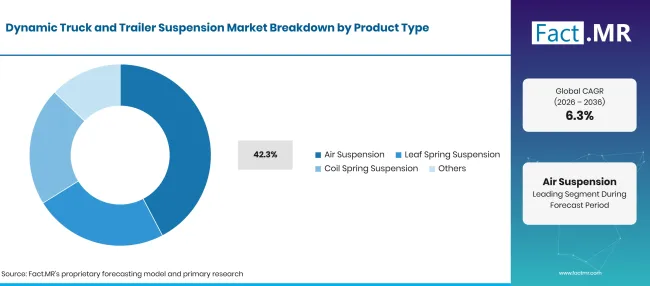
Dynamic Truck And Trailer Suspension Market Breakdown Product Type | Source: Fact.MR
| Product type | Share in 2026 |
|---|---|
| Air Suspension | 42.3% |
| Other segments combined | 57.7% |
| Total | 100.0% |
Source: Fact.MR analysis. Updated Oct 26, 2026
Air suspension gives vehicle designers a way to match the supporting system to changing operating loads. The sales discussion extends beyond the bellows to the valves, damping and installation geometry. A buyer comparing air springs should therefore consider how the complete assembly behaves after the body and payload are added. Leaf spring systems retain a place where mechanical simplicity and workshop familiarity carry more weight. Coil spring configurations answer other packaging and ride requirements. Fact.MR expects product selection to remain application-specific; a sophisticated control package cannot compensate for an unsuitable basic suspension layout.
What makes light commercial vehicles a substantial buying group?
Light Commercial Vehicles account for 41.8% of the market in 2026.
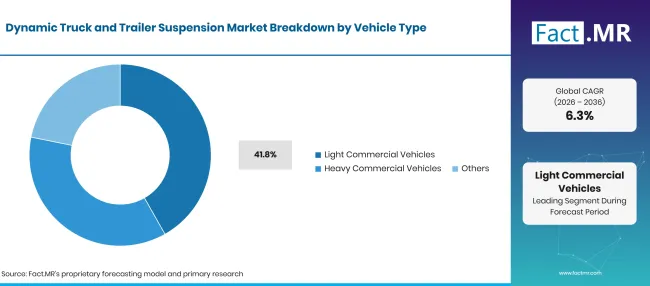
Dynamic Truck And Trailer Suspension Market Breakdown Vehicle Type | Source: Fact.MR
| Vehicle type | Share in 2026 |
|---|---|
| Light Commercial Vehicles | 41.8% |
| Other segments combined | 58.2% |
| Total | 100.0% |
Source: Fact.MR analysis. Updated Oct 26, 2026
For a delivery truck, the payload changes during the shift while the vehicle must still fit the same loading access and body layout. A specification chosen solely for maximum load can create an unattractive compromise during lighter running. Buyers need to consider spring and damping behaviour together when comparing automotive shock absorbers and complete suspension offers. Heavy commercial vehicles introduce different considerations around axle-group loads, trailer compatibility and long service intervals. The light commercial share consequently supports a broad range of carefully matched products rather than one universal premium specification.
How does OEM purchasing influence system design?
OEM supply contributes 54.9% of the market in 2026.
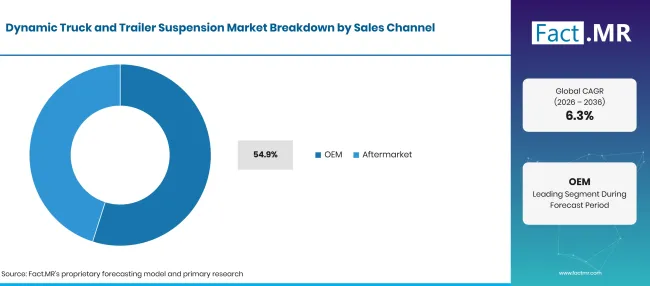
Dynamic Truck And Trailer Suspension Market Breakdown Sales Channel | Source: Fact.MR
| Sales channel | Share in 2026 |
|---|---|
| OEM | 54.9% |
| Other segments combined | 45.1% |
| Total | 100.0% |
Source: Fact.MR analysis. Updated Oct 26, 2026
A factory installation allows the suspension supplier to agree mounting and control requirements before the vehicle reaches the fleet. That timing matters because later changes may require new brackets, pneumatic routing or a revised calibration. The wider supply of heavy-duty air suspension components provides the parts base, but the customer still needs an assembly that fits the chosen platform. OEM business therefore rewards engineering support and consistent production delivery. Aftermarket suppliers address a different decision: whether a repair restores the original behaviour and whether an upgrade is technically suitable for the particular vehicle.
Why do on-road applications take the larger share?
On-Road applications represent 59.1% of revenue in 2026.
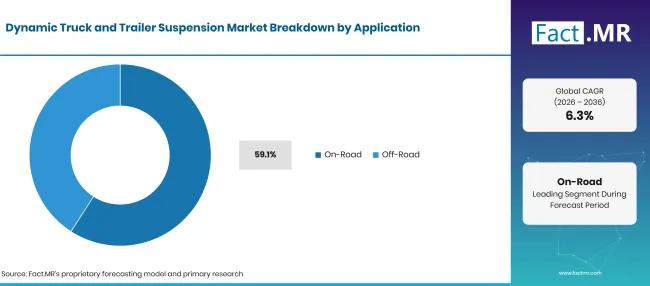
Dynamic Truck And Trailer Suspension Market Breakdown Application | Source: Fact.MR
| Application | Share in 2026 |
|---|---|
| On-Road | 59.1% |
| Other segments combined | 40.9% |
| Total | 100.0% |
Source: Fact.MR analysis. Updated Oct 26, 2026
On-road procurement is shaped by repeatable service schedules and the condition of the components that hold the axle in position. The durability of automotive suspension bushes sits within that wider assessment because wear can change the behaviour of an otherwise serviceable assembly. Off-road purchases require a different balance. Clearance around vulnerable components and the loads transmitted through mounting points become central to the specification. Fact.MR expects customers with mixed road and site work to favour a suspension matched to the harsher part of the route, provided the resulting weight and ride compromise remains acceptable.
What is accelerating adoption, and what is holding it back?
The most persuasive upgrades solve an identifiable operating problem such as repeated cargo disturbance, slow loading adjustments or costly component replacement. The buying decision becomes harder when control hardware increases the invoice and the workshop needs unfamiliar diagnostic procedures. Fleet replacement timing also limits how quickly an attractive specification reaches the installed vehicle population. The following assessments describe the potential influence of individual market conditions on the forecast.
Drivers Impact Analysis
| DRIVER | (~) % IMPACT ON CAGR | GEOGRAPHIC RELEVANCE | IMPACT TIMELINE |
|---|---|---|---|
| More consistent ride across variable payloads | +0.8% | Europe, United States, Japan | 2026 to 2030 |
| OEM integration of suspension controls | +0.4% | Germany, United States, Japan | 2027 to 2032 |
| Replacement of worn suspension assemblies | +0.7% | Global | 2026 to 2029 |
| Height adjustment for loading and coupling | +0.4% | Europe, North America | 2026 to 2030 |
| Air suspension specified with suitable tyre configurations | +0.3% | Brazil, selected export markets | 2027 to 2031 |
Source: Fact.MR analysis. Updated Oct 26, 2026
Opportunity Impact Analysis
| OPPORTUNITY | (~) % IMPACT ON CAGR | GEOGRAPHIC RELEVANCE | IMPACT TIMELINE |
|---|---|---|---|
| Suspension packages for electrified truck platforms | +0.5% | Europe, Japan, United States | 2028 to 2036 |
| Application-matched aftermarket repair kits | +0.7% | United States, United Kingdom, Brazil | 2026 to 2030 |
| Modular running gear for specialist trailers | +0.3% | Europe, Brazil, Asia Pacific | 2027 to 2033 |
| Simpler diagnostic and calibration access | +0.4% | Global | 2027 to 2032 |
Source: Fact.MR analysis. Updated Oct 26, 2026
Restraints Impact Analysis
| RESTRAINT | (~) % IMPACT ON CAGR | GEOGRAPHIC RELEVANCE | IMPACT TIMELINE |
|---|---|---|---|
| Purchase premium for more complex systems | -0.6% | Brazil, cost-sensitive global fleets | 2026 to 2030 |
| Air leakage and specialist repair requirements | -0.4% | Global | 2026 to 2032 |
| Delayed truck and trailer replacement | -0.7% | Europe, United States | 2026 to 2029 |
| Vehicle-specific retrofit constraints | -0.3% | Global | 2027 to 2036 |
Source: Fact.MR analysis. Updated Oct 26, 2026
Which countries are shaping suspension purchases through 2036?
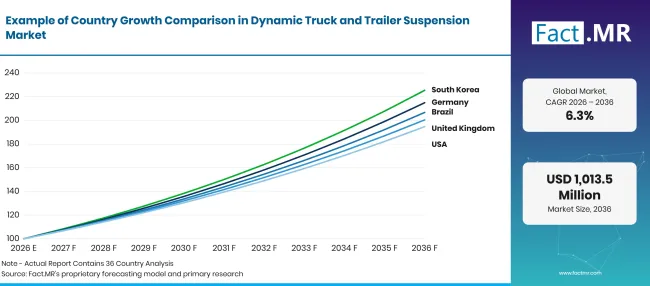
Dynamic Truck And Trailer Suspension Market Growth Index | Source: Fact.MR
| Country | CAGR 2026 to 2036 |
|---|---|
| Germany | 8.0% |
| Brazil | 7.5% |
| United States | 6.9% |
| United Kingdom | 7.2% |
| Japan | 4.4% |
Source: Fact.MR analysis. Updated Oct 26, 2026
How does Germany reward a carefully specified running gear?
Germany is forecast to record a 8.0% CAGR, with technical approval and vehicle integration central to supplier selection.
European approval rules give substance to the distinction between air suspension and an equivalent alternative. The consolidated vehicle-construction requirements specify damping and sprung-mass response criteria for demonstrating equivalence. [5] A supplier entering German vehicle programmes should make the compliance of the chosen configuration easy to establish. Fact.MR sees the stronger proposition in a validated family of assemblies that can serve several chassis variants without creating unnecessary parts complexity. This is especially relevant when a trailer builder wants to adjust ride height or axle arrangement while retaining familiar installation and servicing procedures. The forecast favours engineering support that remains available after the initial approval.
Where does Brazil create a specific opening for pneumatic suspension?
Brazil carries a 7.5% CAGR outlook; selected tyre conversions create a direct specification link to air suspension.
CONTRAN Resolution 913 permits specified wide-base tyres to replace dual wheels on trucks and trailers when the vehicle has pneumatic suspension and respects the applicable axle-load limits. Axles originally equipped with single wheels are treated separately. [2] This is a defined purchasing circumstance, so the useful offer is a compatible vehicle package with clear fitment and load documentation. A broad claim that every fleet must convert would misread the requirement. Fact.MR expects suppliers to gain more traction by working with trailer manufacturers and fleet workshops on the configurations where the combination makes operational sense. Local parts support remains central to making a more demanding specification affordable over its service life.
What makes serviceability commercially decisive in the United States?
The United States is projected to expand at a 6.9% CAGR, with maintainable suspension hardware and dependable replacement supply supporting demand.
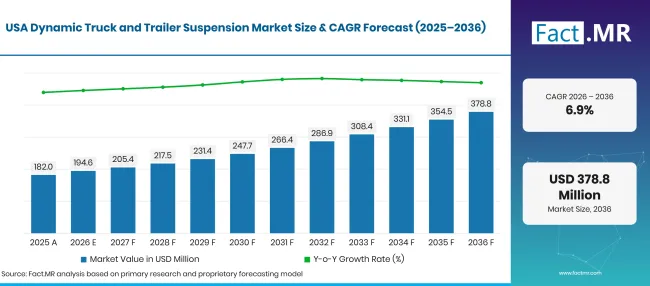
Dynamic Truck And Trailer Suspension Market Forecast Usa | Source: Fact.MR
Under 49 CFR 393.207, air cannot enter the suspension circuit until the braking system reaches at least 55 psi. The rule also limits suspension leakage to 3 psi over five minutes at normal operating pressure. [6] These conditions focus the fleet discussion on valves, connections and the integrity of the complete circuit. A premium assembly that is difficult to diagnose can lose its advantage during repair. The better commercial offer combines the suspension hardware with clear service information and readily available replacement items. Suppliers should distinguish routine restoration of an existing vehicle from a conversion that changes its original configuration, since the customer is buying a different level of technical responsibility in each case.
Can better diagnosis strengthen the United Kingdom aftermarket?
The United Kingdom has a 7.2% CAGR forecast, with inspection-led maintenance creating a practical route to replacement sales.
The DVSA inspection manual effective from April 2026 distinguishes serious suspension leakage from lesser defects. It also allows certain deflated or displaced bellows to be corrected safely through suspension controls before they are treated as a deficiency. [4] That detail matters commercially: replacing a sound part after an incomplete diagnosis adds cost without resolving the real problem. Fact.MR expects workshops to value suppliers that help them identify the cause and restore the correct ride height. For distributors, the opportunity is to connect stock availability with usable diagnostic guidance. A narrower range of reliably identified repair kits may serve a fleet better than a large catalogue whose fitment information leaves the technician to investigate further.
How do approved axle configurations shape the Japanese opportunity?
Japan is forecast to grow at 4.4%, with specific tractor configurations offering a focused route into higher-value suspension specifications.
Japan's May 2025 special-vehicle handbook describes an 11.5-tonne drive-axle allowance for certified two-axle tractors in specified semitrailer combinations. It identifies vehicles meeting the relevant safety requirements, including configurations with air suspension, as eligible; other axles remain subject to a 10-tonne limit. [8] Eligibility rests on the approved combination, which makes coordination between the tractor supplier, trailer builder and operator commercially significant. Fact.MR expects suspension providers to target those identifiable applications with clear fitment and load documentation. The opportunity depends on matching the actual transport configuration and permitted operation. A supplier can then build repeat business around the service requirements of that defined vehicle population rather than proposing a broad fleet-wide change.
Who supplies the Dynamic Truck and Trailer Suspension Market?
Competition combines complete running-gear suppliers with specialists in pneumatic components and electronic control. Hendrickson supplies mechanical, elastomeric and air suspension systems, while BPW offers modular trailer running gear through its ECO Air range. [7] [1] SAF-HOLLAND supplies axle and suspension assemblies and includes York within its group. York offers both mechanical and air suspension families, giving that group several routes into regional trailer specifications. [9] [10] Continental participates through ContiTech air-spring technology. ZF supplies electronically controlled suspension solutions and associated control capabilities. [3] [11]
Recent products illustrate different ways to compete. In June 2026, SAF-HOLLAND extended its CBXA AeroBeam fixed-frame line with the CBXAS25 and CBXAS30 models for trailer applications. [9] Hendrickson announced STEERTEK NXT front axle and suspension availability on specified Pierce, HME and E-One fire-and-rescue chassis in July 2025. [7] The first expands a trailer product family; the second addresses a demanding vocational fitment. Fact.MR expects both approaches to remain commercially useful where a supplier can support the complete assembly and its maintenance requirements.
A fleet can buy a component on price only when fitment and function are already settled. Where the application is less familiar, the supplier must answer questions about installation, operating limits and servicing. Competition therefore differs between replacement bellows, matched mechanical systems and an electronically controlled package. Treating those offers as interchangeable obscures where each supplier creates value.
Which companies are the key providers?
Key Companies: Hendrickson USA, L.L.C., SAF-HOLLAND SE (including York Transport Equipment), BPW Bergische Achsen KG, Continental AG (through ContiTech), and ZF Friedrichshafen AG.
- Hendrickson USA, L.L.C.
- SAF-HOLLAND SE, including York Transport Equipment
- BPW Bergische Achsen KG
- Continental AG, through ContiTech
- ZF Friedrichshafen AG
Bibliography
- [1] BPW Bergische Achsen KG (n.d.). BPW ECO Air: One for all.
- [2] Conselho Nacional de Trânsito (2022, March 28). Resolução CONTRAN nº 913, de 28 de março de 2022: Dispõe sobre o uso de pneus em veículos. Diário Oficial da União, April 1, 2022, Section 1, p. 94.
- [3] Continental AG (2024, July 29). New rubber compound for air springs from Continental cuts CO2 footprint by more than half.
- [4] Driver and Vehicle Standards Agency (2026, April 1). Heavy goods vehicle (HGV) inspection manual. Section 48: Suspension.
- [5] European Commission (2021, March 31). Commission Implementing Regulation (EU) 2021/535 of 31 March 2021. Consolidated text of January 1, 2025.
- [6] Federal Motor Carrier Safety Administration (n.d.). 49 CFR § 393.207: Suspension systems. Electronic Code of Federal Regulations.
- [7] Hendrickson (2025, July 31). STEERTEK NXT launched for fire and rescue.
- [8] Ministry of Land, Infrastructure, Transport and Tourism (2025, May). Special vehicle passage handbook [Japanese-language handbook]. Chubu Regional Development Bureau.
- [9] SAF-HOLLAND SE (2026, June 4). SAF-HOLLAND completes CBXA AeroBeam fixed frame suspension series with new CBXAS25, CBXAS30 models.
- [10] York Transport Equipment (n.d.). Trailer axles and suspension manufacturer.
- [11] ZF Friedrichshafen AG (2026, September 14). IAA 2026: ZF Commercial Vehicle Solutions delivers growth in times of transformation.
This Report Answers
- How does payload variation influence the choice between air and mechanical suspension?
- What separates OEM integration requirements from aftermarket repair demand?
- Where do loading operations and service access strengthen the case for an upgraded system?
- How do country-level technical requirements influence the commercial offer?
- Which suppliers compete through complete running gear, pneumatic components or electronic control?
What does the Dynamic Truck and Trailer Suspension Market cover?
The market covers truck and trailer suspension equipment used to support loads and control vehicle movement. It considers mechanical and pneumatic configurations alongside suitable electronic control functions. Demand is examined through the vehicle application and the channel through which equipment reaches the operator. This gives the forecast a commercial boundary around suspension purchases rather than the full value of the vehicle or trailer.
What is included in the scope?
Included products comprise air, leaf spring, coil spring and other suspension configurations sold for the relevant truck and trailer applications. The analysis includes OEM installation and aftermarket replacement or suitable upgrades. Associated control and mounting hardware is considered when it forms part of the suspension offer. On-road and off-road uses are assessed separately because operating conditions change the required combination of ride performance, clearance and durability.
What is excluded from the scope?
Passenger-car, motorcycle, rail and standalone bus suspension sales are outside the truck and trailer boundary. Complete vehicle sales, freight services and workshop labour are excluded. Axles, brakes and tyres are considered only as application context unless supplied as identifiable suspension-related hardware. A supplier participating in several vehicle-component markets is assessed here for its relevant suspension offer.
How Was the Analysis Built?
The analysis draws on 120+ sources, 35+ company portfolios, 25+ countries, and more than 20 industry interviews.
- Primary Research: Primary research includes discussions with manufacturers, service providers, technology developers, distributors, end users, and subject-matter experts. These conversations examine purchasing priorities, product adoption, operational challenges, approval requirements, competitive positioning, and the factors that influence wider market acceptance.
- Desk Research: Desk research covers government statistics, regulatory publications, company filings, trade data, technical studies, industry associations, standards, public policy, and other authoritative sources. Every source used in the analysis is documented in the bibliography.
- Market Sizing and Forecasting: Market estimates combine historical performance, demand indicators, pricing and volume trends, segment shares, company participation, country-level growth, adoption patterns, investment activity, and barriers to market expansion.
- Data Validation and Update Cycle: Findings are validated by comparing primary interviews with public data, company activity, regulatory changes, trade patterns, and industry developments. Regular updates review new product launches, capacity changes, partnerships, approvals, and shifts in commercial adoption.
Segmentation
What is the report's scope and coverage?
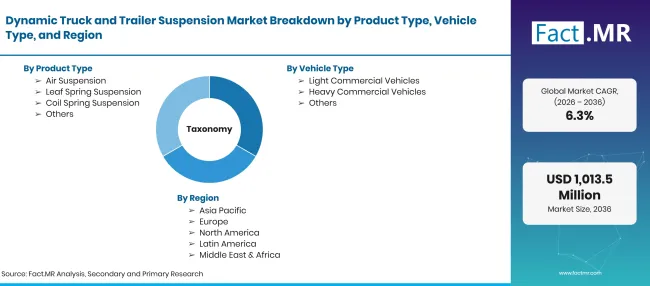
Dynamic Truck And Trailer Suspension Market Taxonomy 1 | Source: Fact.MR
| Attribute | Details |
|---|---|
| Quantitative units | USD million |
| Market definition | Suspension systems and associated hardware that manage ride, load support and wheel movement in trucks and trailers. |
| Product type | Air Suspension; Leaf Spring Suspension; Coil Spring Suspension; Others |
| Vehicle type | Light Commercial Vehicles; Heavy Commercial Vehicles; Others |
| Sales channel | OEM; Aftermarket |
| Application | On-Road; Off-Road |
| Regions covered | North America; Latin America; Western Europe; Eastern Europe; East Asia; South Asia & Pacific; Middle East & Africa |
| Countries covered | Germany; Brazil; United States; United Kingdom; Japan |
| Companies profiled | Hendrickson; SAF-HOLLAND, including York; BPW; Continental through ContiTech; ZF |
| Forecast period | 2026 to 2036 |
| Approach | Assessment of vehicle duty cycles, suspension architectures, fitment channels, maintenance requirements and country demand conditions. |
Source: Fact.MR analysis. Updated Oct 26, 2026
How is the market segmented?
-
By Product Type
- Air Suspension
- Leaf Spring Suspension
- Coil Spring Suspension
- Others
-
By Vehicle Type
- Light Commercial Vehicles
- Heavy Commercial Vehicles
- Others
-
By Sales Channel
- OEM
- Aftermarket
-
By Application
- On-Road
- Off-Road
-
By Region
- North America
- Latin America
- Western Europe
- Eastern Europe
- East Asia
- South Asia & Pacific
- Middle East & Africa
Frequently Asked Questions
How big is the dynamic truck and trailer suspension market in 2026?
What is the forecast value and growth rate through 2036?
Which suspension product has the largest 2026 share?
Which sales channel leads?
Which country has the fastest forecast growth among those examined?
Who worked on this report


Preview the report firsthand - request a free sample
Free SampleGet the brochure for pricing and purchase details
Download PDF