- Market Value (2025): USD 8.1 Bn
- Estimated Value (2026): USD 8.9 Bn
- Forecast Value (2036): USD 22.7 Bn
- CAGR (2026-2036): 9.8%
What is the E-Commerce Returns and Reverse Logistics Packaging Market forecast to be worth by 2036?
USD 8.9 billion to USD 22.7 billion by 2036 at a 9.8% CAGR.
- The e-commerce returns and reverse logistics packaging market reached USD 8.1 billion in 2025.
- Demand is projected to increase from USD 8.9 billion in 2026 to USD 22.7 billion by 2036. 9.8% CAGR
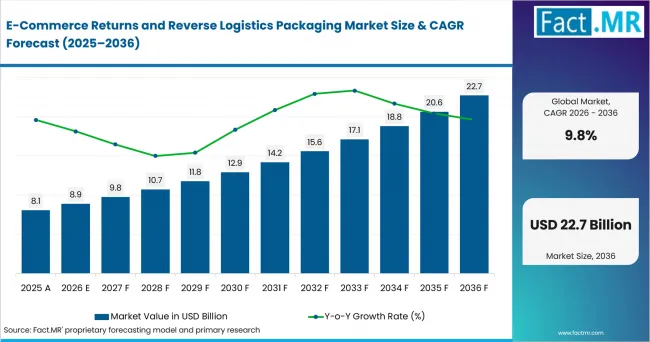
E Commerce Returns And Reverse Logistics Packaging Market Value Analysis | Source: Fact.MR
What are the defining numbers behind E-Commerce Returns and Reverse Logistics Packaging Market growth?
An absolute opportunity of USD 13.7 billion is expected between 2026 and 2036.
- Demand Drivers in the Market
- Online purchasing generates structurally higher return volumes than store-based retail because customers cannot physically inspect fit, colour or product condition before ordering. The European Environment Agency estimates that around 20% of clothing purchased online in Europe is returned, with online return rates reaching as much as three times those of physical stores. This creates recurring demand for packaging that can survive outbound delivery and be reused for the return journey.
- Consumer-protection rules make returns an embedded part of e-commerce operations. In the UK, customers purchasing online generally have 14 days after receiving an item to cancel and another 14 days to return it. Retailers therefore need packaging that allows products to be resealed and transported back without requiring entirely new materials.
- Returned products must be inspected and directed toward resale, refurbishment, recycling or disposal. OECD research identifies reverse supply chains as essential to circular business models because they recover products and materials that would otherwise leave the economic system. Packaging that protects returned goods and carries usable identification data improves the likelihood that products can be resold or processed efficiently.
- Environmental losses associated with poorly managed returns are increasing pressure for reusable packaging. The European Environment Agency estimates that between 22% and 43% of clothing returned after an online purchase is destroyed. Better return packaging can reduce additional product damage during transit and preserve more inventory for resale.
- Extended producer responsibility is shifting more packaging responsibility toward producers and retailers. Under this approach, businesses bear greater responsibility for packaging across its life cycle, including downstream waste. This supports demand for return systems that reduce single-use material consumption and keep packaging in circulation for several delivery cycles.
- Key Segments Analyzed
- Reusable Return Packaging holds 38.0% of the Packaging Format segment in 2026, supported by the need for packaging that can protect products across both outbound and return journeys.
- Parcel Returns account for 41.0% of the Return Processing segment in 2026 as most e-commerce returns move through standard courier and postal networks.
- Apparel & Fashion represents 43.0% of the End-use Industry segment in 2026, reflecting high return volumes linked to size, fit and style preferences.
- E-commerce Retailers hold 40.0% of the Customer Type segment in 2026 because they directly manage return policies, reverse fulfilment and resale recovery.
- Corrugated Paperboard accounts for 39.0% of the Packaging Material segment in 2026 due to its protective strength, recyclability and suitability for repeated parcel handling.
- Analyst Opinion at Fact.MR
- Shambhu Nath Jha, Principal Consultant at Fact.MR, states, “E-Commerce Returns and Reverse Logistics Packaging companies need to show how the product fits each use case rather than compete on generic claims. Leading positioning supports premium demand, but repeat sales are expected to depend on consistent quality, clear documentation and a measurable outcome.”
- Strategic Implications
- Brand owners should position offerings by application fit rather than generic capability claims. Clearer articulation of the specific use case and the supporting evidence is expected to shorten the buying decision and strengthen pricing power.
- Suppliers can strengthen retention by documenting specification, compliance and performance in simple customer-facing materials. Transparent documentation reduces evaluation friction and supports repeat purchasing, particularly in compliance-heavy regions.
- Distributors should plan channel strategies around the leading segment and the fastest-growing use cases. Aligning inventory, pricing and promotion with the share leaders is expected to improve margin capture.
- Pricing strategy should reflect the value of documented outcomes rather than raw capacity. Differentiating on reliability, compliance and committed service levels is expected to protect margins against lower-cost substitutes.
How does the E-Commerce Returns and Reverse Logistics Packaging Market break down by segment?
The market is segmented by Packaging Format, Return Processing, End-use Industry, Customer Type, Packaging Material, and Region
Why does Reusable Return Packaging lead Packaging Format?
Reusable Return Packaging is projected to account for a 38.0% share in 2026.
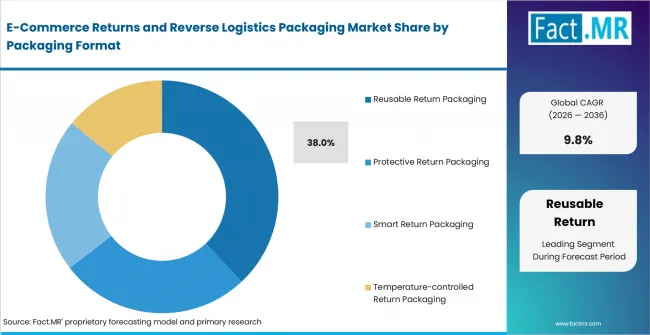
E Commerce Returns And Reverse Logistics Packaging Market Analysis By Packaging Format | Source: Fact.MR
Reusable formats lead because e-commerce packaging may need to protect the same product during outbound delivery and its return to the retailer. Resealable mailers and reusable shipping boxes allow customers to send products back without finding replacement packaging, while retailers receive goods in a format designed for handling and inspection.
Regulation is also moving packaging design toward reuse. Under the EU Packaging and Packaging Waste Regulation, reusable packaging must be designed for multiple rotations under normal conditions while meeting safety and recyclability requirements. This supports investment in formats that remain functional after opening and can withstand repeated transport.
Why do Parcel Returns lead Return Processing?
Parcel Returns are projected to account for a 41.0% share in 2026.
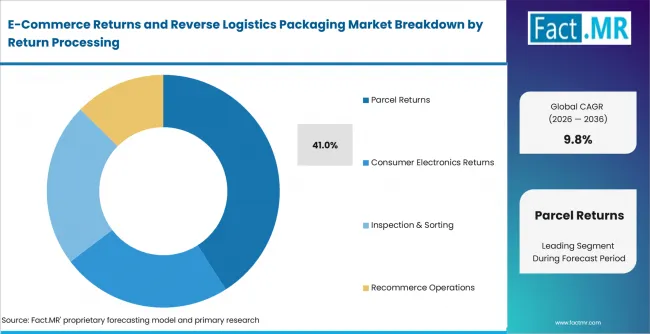
E Commerce Returns And Reverse Logistics Packaging Market Analysis By Return Processing | Source: Fact.MR
Parcel Returns lead because most consumer e-commerce orders are delivered as individual packages through courier or postal networks. When customers return these products, the same parcel infrastructure is commonly used for collection, transportation and delivery to a warehouse or processing centre.
This creates demand for packaging that can be resealed and carry return labels without compromising the original product. Parcel-compatible formats also simplify consolidation because retailers can receive and sort returned units using existing fulfilment infrastructure rather than operating a separate collection system.
Why does Apparel & Fashion lead End-use Industry?
Apparel & Fashion is projected to account for a 43.0% share in 2026.
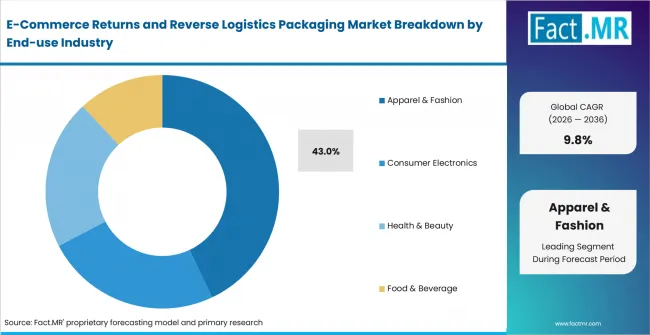
E Commerce Returns And Reverse Logistics Packaging Market Analysis By End Use Industry | Source: Fact.MR
Apparel and Fashion lead because customers cannot fully assess fit and appearance before receiving an online order. The European Environment Agency estimates that approximately 20% of clothing and 30% of footwear purchased online in Europe is returned. About 70% of these returns are linked to fit or style, creating a recurring requirement for packaging that supports convenient return shipment and protects products for potential resale.
The category also experiences frequent multi-item ordering, where consumers purchase several sizes or styles before retaining one option. Return packaging therefore becomes part of the normal fulfilment cycle rather than an occasional exception.
Why do E-commerce Retailers lead Customer Type?
E-commerce Retailers are projected to account for a 40.0% share in 2026.
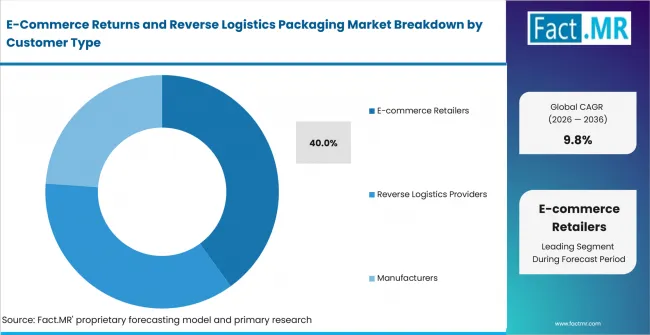
E Commerce Returns And Reverse Logistics Packaging Market Analysis By Customer Type | Source: Fact.MR
E-commerce retailers lead because they carry the direct operational and financial responsibility for customer returns. They must provide return instructions and receive products before deciding whether each unit can be restocked, refurbished or diverted to recycling.
Retailers also need packaging that preserves product condition during the reverse journey. Damaged return packaging can reduce the resale value of an otherwise usable item and increase inspection or repacking costs. Formats that are easy to open and reseal help retailers standardize returns while reducing the amount of replacement packaging supplied to customers.
Why does Corrugated Paperboard Lead Packaging Material?
Corrugated Paperboard is projected to account for a 39.0% share in 2026.
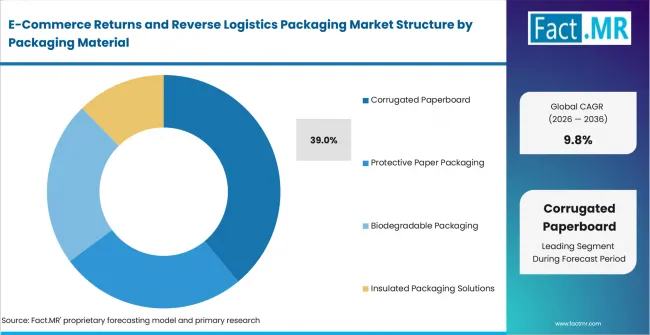
E Commerce Returns And Reverse Logistics Packaging Market Analysis By Packaging Material | Source: Fact.MR
Corrugated paperboard leads because it offers sufficient strength for parcel transport while remaining easy to fold and label. Boxes can be manufactured in several dimensions and reinforced for heavier products, making the material suitable for returns across apparel and consumer electronics.
Its established recycling infrastructure also supports adoption. The U.S. Environmental Protection Agency estimated that corrugated boxes had a recycling rate of 96.5% in 2018, compared with 80.9% for paper and paperboard packaging overall. This gives retailers a widely recoverable material for return packaging, although damaged boxes may still require replacement before another shipping cycle.
What is accelerating E-Commerce Returns and Reverse Logistics Packaging Market adoption, and what is holding it back?
Drivers Impact Analysis
| DRIVER | (~) % IMPACT ON CAGR | Global | Short term (<= 2 years) |
|---|---|---|---|
| Adoption and integration | +1.6% | Global | Short term (<= 2 years) |
| DRIVER | (~) % IMPACT ON CAGR | USA; Germany; UK | Short term (<= 2 years) |
| Regulatory and compliance support | +1.4% | USA; Germany; UK | Short term (<= 2 years) |
| DRIVER | (~) % IMPACT ON CAGR | Global | Medium term (2-4 years) |
| Channel and access expansion | +1.1% | Global | Medium term (2-4 years) |
| DRIVER | (~) % IMPACT ON CAGR | USA; UK; Canada | Medium term (2-4 years) |
| Clear specification and documentation | +0.9% | USA; UK; Canada | Medium term (2-4 years) |
| DRIVER | (~) % IMPACT ON CAGR | Global | Long term (>= 4 years) |
| Cost and efficiency gains | +0.6% | Global | Long term (>= 4 years) |
Source: Fact.MR analysis. Updated Aug 6, 2026
Opportunity Impact Analysis
| OPPORTUNITY | (~) % IMPACT ON CAGR | Global | Medium term (2-4 years) |
|---|---|---|---|
| Emerging application expansion | +1.0% | Global | Medium term (2-4 years) |
| OPPORTUNITY | (~) % IMPACT ON CAGR | USA; UK; Germany | Medium term (2-4 years) |
| Premium and specialist positioning | +0.8% | USA; UK; Germany | Medium term (2-4 years) |
| OPPORTUNITY | (~) % IMPACT ON CAGR | Global | Long term (>= 4 years) |
| Channel and partner expansion | +0.7% | Global | Long term (>= 4 years) |
| OPPORTUNITY | (~) % IMPACT ON CAGR | USA; Canada; Singapore | Long term (>= 4 years) |
| Standards and compliance alignment | +0.5% | USA; Canada; Singapore | Long term (>= 4 years) |
Source: Fact.MR analysis. Updated Aug 6, 2026
Restraints Impact Analysis
| RESTRAINT | (~) % IMPACT ON CAGR | Global | Short term (<= 2 years) |
|---|---|---|---|
| Cost and complexity | -1.1% | Global | Short term (<= 2 years) |
| RESTRAINT | (~) % IMPACT ON CAGR | USA; UK; Germany | Short term (<= 2 years) |
| Specification and compliance checks | -0.9% | USA; UK; Germany | Short term (<= 2 years) |
| RESTRAINT | (~) % IMPACT ON CAGR | Import-dependent markets | Medium term (2-4 years) |
| Substitution by lower-cost alternatives | -0.7% | Import-dependent markets | Medium term (2-4 years) |
| RESTRAINT | (~) % IMPACT ON CAGR | Global | Long term (>= 4 years) |
| Supply chain and pricing pressure | -0.5% | Global | Long term (>= 4 years) |
Source: Fact.MR analysis. Updated Aug 6, 2026
Which countries are scaling the E-Commerce Returns and Reverse Logistics Packaging Market fastest?
- USA: Retailers expect merchandise returns to reach USD 849.9 billion in 2025, with online returns accounting for 19.3% of digital sales. This high return intensity supports demand for resealable packaging and formats that protect products during the reverse journey.
- Germany: Approximately 5.5 million tonnes of packaging waste collected through Germany’s dual systems was recycled in 2024. The country’s established recovery infrastructure supports return packaging designed for material separation and repeated handling.
- UK: Distance-selling rules require retailers to accommodate cancellations and product returns even when goods are not defective. This makes return-ready packaging an operational requirement for online retailers rather than an occasional customer-service measure.
- Canada: Canadian retail e-commerce sales increased by 67.9% between February 2020 and July 2022 and remained above pre-pandemic levels. The expanded base of online orders creates a larger continuing flow of parcels requiring return labels and protective reverse-shipping formats.
- Japan: Japan regularly updates its legal guidance for electronic commerce, including the treatment of returns in mail-order transactions. Clearer digital-commerce rules encourage retailers to formalize return processes and use packaging that supports product identification and resale assessment.
- Australia: Around 3 million tonnes of packaging is sent to landfill annually in Australia. Regulatory reform focused on packaging reuse and recovery is increasing the relevance of return formats that remain functional across several logistics movements.
- Singapore: Approximately 186,000 e-commerce parcels were delivered daily in Singapore in 2023, generating as much as 15,900 tonnes of mailing packaging during the year. The scale of parcel packaging has led to dedicated national guidance on reducing e-commerce packaging waste, supporting reusable and right-sized return solutions.
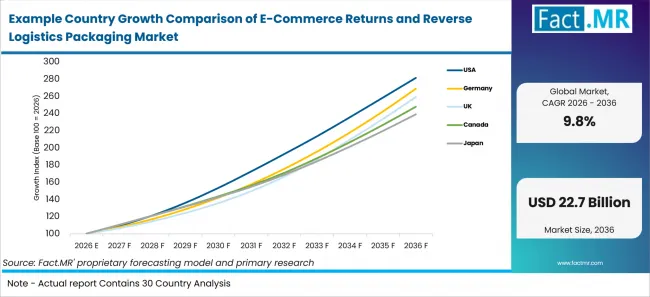
Example Country Growth Comparison Of E Commerce Returns And Reverse Logistics Packaging Market | Source: Fact.MR
| Country | CAGR (2026-2036) |
|---|---|
| USA | 10.9% |
| Germany | 10.4% |
| UK | 10.0% |
| Canada | 9.5% |
| Japan | 9.1% |
| Australia | 8.7% |
| Singapore | 8.2% |
Source: Fact.MR analysis. Updated Aug 6, 2026
What is driving USA’s growth through 2036?
The USA is forecast to expand at a 10.9% CAGR from 2026 to 2036.
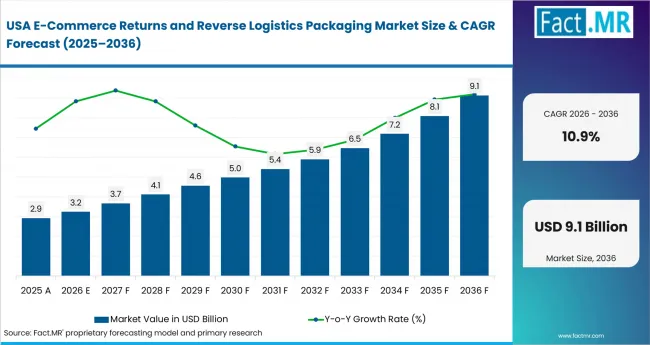
E Commerce Returns And Reverse Logistics Packaging Market Country Value Analysis | Source: Fact.MR
Growth is supported by retailers’ need to recover value from returned merchandise while controlling packaging and handling costs. Reverse-logistics packaging helps preserve product condition during return transit, which improves the likelihood that an item can be restocked or refurbished instead of written off. The country’s extensive parcel-delivery infrastructure also makes return-by-mail and carrier drop-off practical across a broad geographic market.
What is driving Germany’s growth through 2036?
Germany is forecast to expand at a 10.4% CAGR from 2026 to 2036.
Germany’s packaging-recovery system creates a favourable environment for recyclable and reusable return formats. The German Environment Agency reported a 68.5% packaging recycling rate in 2022, while more than half of municipal waste is collected separately for material recovery. Retailers therefore have a strong operational reason to select return packaging that can enter established paper and packaging recovery streams after use.
What is driving the UK’s growth through 2036?
The UK is forecast to expand at a 10.0% CAGR from 2026 to 2036.
Growth is being shaped by producer responsibility and material-cost pressure. The UK recycled 64.1% of its packaging waste in 2024, with paper and cardboard recording a 74.3% recycling rate. The Plastic Packaging Tax also increases the cost of taxable plastic packaging, encouraging retailers to assess reusable mailers and paper-based return formats more carefully.
What is driving Canada’s growth through 2036?
Canada is forecast to expand at a 9.5% CAGR from 2026 to 2036.
The need to keep packaging materials out of disposal streams is supporting more recoverable return formats. Statistics Canada recorded 8.59 million tonnes of materials diverted from disposal in its latest waste-diversion dataset. However, packaging represented 43.8% of plastic leaked into the environment in 2021, reinforcing the need for packaging that can be reused or reliably recovered after a return.
What is driving Japan’s growth through 2036?
Japan is forecast to expand at a 9.1% CAGR from 2026 to 2036.
Japan’s high-density urban distribution networks make parcel returns operationally feasible, while its circular-economy policy direction supports the collection and recycling of used plastics by distribution and retail sectors. Retailers therefore require compact return packaging that is easy to reseal and sort while preserving products for resale.
What is driving Australia’s growth through 2036?
Australia is forecast to expand at an 8.7% CAGR from 2026 to 2036.
Packaging reform is increasing pressure on retailers to select formats designed around reuse and material recovery. Australia recorded a national resource-recovery rate of 66% in 2022–2023, but reuse accounted for only 0.2%. This gap creates room for return-packaging systems that extend packaging life before materials enter recycling or disposal channels.
What is driving Singapore’s growth through 2036?
Singapore is forecast to expand at an 8.2% CAGR from 2026 to 2036.
Limited disposal capacity makes packaging reduction and reuse commercially relevant. Packaging accounts for around one-third of Singapore’s domestic waste, and businesses covered by mandatory reporting must submit information on the packaging they introduce into the market and their reduction plans. These requirements support return packaging that uses fewer materials and can complete more than one delivery cycle.
Who leads the E-Commerce Returns and Reverse Logistics Packaging Market?
DS Smith Plc is positioned as a leading provider, supported by its experience in corrugated packaging and retail supply chains. Smurfit Westrock, Mondi and International Paper compete through large paper-based packaging portfolios, while Sealed Air, Pregis and Ranpak focus on protective solutions designed to reduce damage during outbound and return transportation.
DSV, FedEx and UPS participate from the logistics side of the market. Their role extends beyond packaging supply to include return collection, transportation and routing of products toward restocking, refurbishment or disposal. This gives logistics providers an advantage where retailers want packaging and reverse fulfilment managed through a connected service.
Competition centres on whether the packaging can survive two transport movements, remain easy for the customer to reseal and preserve the product’s resale value. Material recovery is another important consideration. The European Union generated 79.7 million tonnes of packaging waste in 2023 and recycled 67.5% of it, increasing pressure on suppliers to offer return formats that can be reused or enter established recycling streams.
The market remains fragmented because requirements differ sharply by product. Apparel retailers need lightweight resealable mailers, while electronics sellers require stronger protective packaging. Temperature-sensitive returns introduce another set of insulation and handling requirements. Providers with a broad material portfolio and access to reverse-logistics networks are therefore better placed to serve large multichannel retailers.
Which companies are the key providers?
Key companies include DS Smith Plc; Smurfit Westrock plc; Mondi plc; Sealed Air Corporation; Pregis LLC; Ranpak Holdings Corp.; International Paper Company; DSV A/S; FedEx Corporation; and United Parcel Service, Inc.
- DS Smith Plc
- Smurfit Westrock plc
- Mondi plc
- Sealed Air Corporation
- Pregis LLC
- Ranpak Holdings Corp.
- International Paper Company
- DSV A/S
- FedEx Corporation
- United Parcel Service, Inc
Bibliography
- Australian Government, Department of Climate Change, Energy, the Environment and Water. (2024). National Waste and Resource Recovery Report 2024.
- European Commission, Eurostat. (2025). Packaging Waste Statistics.
- European Environment Agency. (2024). The Destruction of Returned and Unsold Textiles in Europe’s Circular Economy.
- European Environment Agency. (2024). Many Returned and Unsold Textiles End Up Destroyed in Europe.
- European Parliament and Council of the European Union. (2025). Regulation (EU) 2025/40 on Packaging and Packaging Waste.
- Federal Environment Agency, Germany. (2024). Packaging Consumption Decreased in 2022 and Recycling Rate Increased.
- Government of the United Kingdom. (2025). UK Statistics on Waste.
- Government of the United Kingdom. (2026). Accepting Returns and Giving Refunds: The Law.
- Japan Ministry of Economy, Trade and Industry. (2024). Japan Statement on Resource Circulation and the Collection and Recycling of Used Plastics.
- National Environment Agency, Singapore. (2026). Mandatory Packaging Reporting.
- OECD. (2022). Securing Reverse Supply Chains for a Resource-Efficient and Circular Economy. OECD Publishing.
- Statistics Canada. (2025). Physical Flow Account for Plastic Material, 2021.
- U.S. Environmental Protection Agency. (2025). Containers and Packaging: Product-Specific Data.
This Report Answers
- The report provides strategic intelligence on the E-Commerce Returns and Reverse Logistics Packaging Market across the covered segments that shape product positioning.
- Segment analysis covers the leading segments and their share within the 2026 market.
- Country outlook evaluates the highest-growth markets and the wider regional comparison.
- Competitive analysis profiles the named providers in the e-commerce returns and reverse logistics packaging space.
- Application assessment covers the covered use cases with attention to channel access and product fit.
What does the E-Commerce Returns and Reverse Logistics Packaging Market cover?
E-Commerce Returns and Reverse Logistics Packaging products are sold across the covered segments and applications.
The E-Commerce Returns and Reverse Logistics Packaging Market covers products identified by the covered segments and sold in the assessed formats for the leading applications. The assessment includes the leading segments, the segment share leaders and the countries that drive the fastest growth. Other uses are included when the product is sold within the assessed scope.
What is included in the scope?
E-Commerce Returns and Reverse Logistics Packaging is assessed across the covered segments and regions with company coverage tied to named providers.
The scope includes the covered segments and regions. Coverage spans the leading segments and the application base that drives demand. The country view includes the listed countries and their projected growth, while the regional view covers North America, Latin America, Europe, East Asia, South Asia and Pacific, and the Middle East and Africa. Company coverage includes the named providers listed in the competitive section.
What is excluded from the scope?
Products outside the assessed segments and applications are outside this market.
The scope excludes products that do not sit within the covered segments. General alternatives and adjacent categories are outside the scope unless sold within the assessed definition. Related services and supporting equipment that are not directly tied to the covered product are excluded, keeping the market sizing consistent with the stated definition.
How Was the Analysis Built?
The analysis draws on 120+ sources and 35+ company portfolios. It covers 25+ countries and more than 20 industry interviews.
- Primary Research: Primary research includes discussions with manufacturers and service providers. It covers distributors, end users and subject-matter experts. These conversations examine purchasing priorities and channel requirements.
- Desk Research: Desk research covers official statistics and regulatory publications. It reviews company literature, trade data and standards. Every source used in the analysis is documented in the bibliography.
- Market Sizing and Forecasting: Market estimates combine historical performance with demand indicators. The model reviews pricing trends, segment shares and country-level growth. Barriers to market expansion are tested before the forecast is finalized.
- Data Validation and Update Cycle: Findings are validated by comparing interviews with public data and company activity. Regular updates review launches, sourcing shifts and changes in customer adoption.
Segmentation
What is the report's scope and coverage?
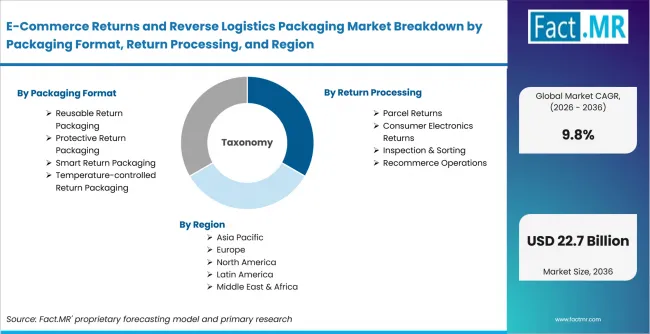
E Commerce Returns And Reverse Logistics Packaging Market Breakdown By Packaging Format, Return Processing, And Region | Source: Fact.MR
| Attribute | Details |
|---|---|
| Quantitative Units | USD billion in 2026 to USD billion by 2036 at a CAGR |
| Market Definition | E-Commerce Returns and Reverse Logistics Packaging products sold across the covered segments and applications |
| Segments Covered | Packaging Format; Return Processing; End-use Industry; Customer Type; Packaging Material |
| Regions Covered | North America; Latin America; Europe; East Asia; South Asia and Pacific; Middle East and Africa |
| Countries Covered | USA; Germany; UK; Canada; Japan; Australia; Singapore |
| Key Companies Profiled | DS Smith Plc; Smurfit Westrock plc; Mondi plc; Sealed Air Corporation; Pregis LLC; and others |
| Forecast Period | 2026 to 2036 |
| Approach | Hybrid top-down and bottom-up approach using segment demand; share; country growth; channel visibility; pricing; and company portfolio review |
Source: Fact.MR analysis. Updated Aug 6, 2026
How is the market segmented?
-
By Packaging Format
- Reusable Return Packaging
- Reusable Shipping Boxes
- Return Mailers
- Protective Return Packaging
- Cushioned Mailers
- Return Inserts
- Smart Return Packaging
- QR-enabled Packaging
- RFID-enabled Packaging
- Temperature-controlled Return Packaging
- Insulated Return Boxes
- Thermal Return Mailers
- Reusable Return Packaging
-
By Return Processing
- Parcel Returns
- Consumer Parcel Returns
- Prepaid Return Labels
- Consumer Electronics Returns
- Refurbishment Returns
- Exchange Orders
- Inspection & Sorting
- Automated Quality Inspection
- Product Grading
- Recommerce Operations
- Product Refurbishment
- Resale Preparation
- Parcel Returns
-
By End-use Industry
- Apparel & Fashion
- Online Fashion Retail
- Footwear
- Consumer Electronics
- Home Appliances
- Home & Living
- Health & Beauty
- Cosmetics
- Personal Care
- Food & Beverage
- Online Grocery
- Meal Kit Delivery
- Apparel & Fashion
-
By Customer Type
- E-commerce Retailers
- Global Online Retailers
- Marketplace Sellers
- Brand-owned Online Stores
- Third-party Logistics Providers
- Fulfillment Service Providers
- Reverse Logistics Providers
- Return Processing Centers
- Refurbishment Centers
- Manufacturers
- Brand Manufacturers
- Resale Platforms
- E-commerce Retailers
-
By Packaging Material
- Corrugated Paperboard
- Recycled Corrugated Board
- Kraft Paper
- Protective Paper Packaging
- Molded Fiber Packaging
- Recyclable Protective Wrap
- Biodegradable Packaging
- Compostable Paper Materials
- Fiber-based Cushioning
- Insulated Packaging Solutions
- Reusable Thermal Liners
- Phase Change Packaging Materials
- Corrugated Paperboard
-
By Region
- North America
- Latin America
- Western Europe
- Eastern Europe
- East Asia
- South Asia and Pacific
- Middle East & Africa
Frequently Asked Questions
Which Packaging Format leads the market?
Which Return Processing leads the market?
Which End-use Industry leads the market?
Which Customer Type leads the market?
Which Packaging Material leads the market?
Which country records the highest listed CAGR?
What is the primary driver in this market?
What is the main restraint?
Which companies are included in the market assessment?
Who worked on this report


Preview the report firsthand - request a free sample
Free SampleGet the brochure for pricing and purchase details
Download PDF