- Market Value (2025): USD 9.4 Bn
- Estimated Value (2026): USD 11.2 Bn
- Forecast Value (2036): USD 67.5 Bn
- CAGR (2026-2036): 19.7%
What is the Agentic Artificial Intelligence in Retail and Ecommerce Market forecast to be worth by 2036?
The market is projected to grow from USD 11.2 billion in 2026 to USD 67.5 billion by 2036, registering a CAGR of 19.7%.
- The Agentic Artificial Intelligence in Retail and Ecommerce market reached USD 9.4 billion in 2025.
- Demand is forecast to increase from USD 11.2 billion in 2026 to USD 67.5 billion by 2036.
- The market is expected to advance at a CAGR of 19.7% from 2026 to 2036, adding an absolute dollar opportunity of USD 56.3 billion.
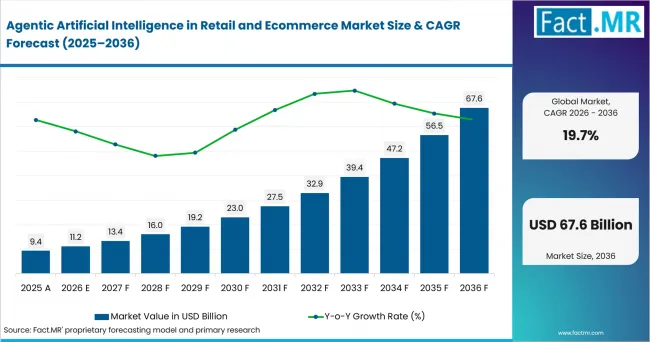
Agentic Artificial Intelligence In Retail And Ecommerce Market Value Analysis | Source: Fact.MR
What are the defining numbers behind Agentic Artificial Intelligence in Retail and Ecommerce Market growth?
An absolute dollar opportunity of USD 56.3 billion is expected between 2026 and 2036.
- Demand Drivers in the Market
- Retailers are under pressure to meet shoppers where product discovery is moving. Adobe Digital Insights reported in April 2026 that traffic from AI sources to U.S. retail sites grew 393% year over year during the first quarter of 2026 and converted 42% better than other traffic in March 2026, showing that AI tools are becoming a meaningful path into the retail funnel.
- This does not mean every retailer needs a fully autonomous checkout; it shows that AI tools are becoming a meaningful path into the retail funnel, so retailers respond by buying agents that can answer product questions and preserve context.
- Platform vendors are embedding agents in commerce workflows. Salesforce announced Agentforce for Retail in January 2025 with modern point-of-sale, and Adobe launched Experience Platform Agent Orchestrator in March 2025, giving retailers a low-friction path to agentic experiences.
- Rising ecommerce activity broadens the base. The U.S. Census Bureau reported in May 2026 that e-commerce accounted for 16.9% of retail sales in the first quarter of 2026, and METI reported in August 2025 that Japan’s B2C e-commerce market reached JPY 26.1 trillion in 2024.
- Retailers are connecting agents to trusted product data and transaction flows. Google Cloud launched an agentic commerce solution with PayPal in October 2025, and NVIDIA released a blueprint for AI retail shopping assistants in January 2025, expanding the ecosystem.
- Agents reduce catalog and service friction by grounding answers in approved product data and passing selected items into checkout or service workflows, which supports conversion gains without forcing shoppers through rigid filters.
- Key Segments Analyzed
- Shopping Assistant Agents anchor the AI Agent Category segment with a 40.0% share in 2026, because product discovery creates the clearest link between an agent interaction and retail revenue.
- Personalized Shopping leads the Retail Function segment, taking 37.0% of demand in 2026, as agents can apply context at the moment a shopper is deciding what to buy.
- E-commerce Retailers is the dominant End-use Sector at 46.0% in 2026, reflecting the scale of online product discovery and transaction activity.
- Large Retail Enterprises lead the Customer Type segment with a 43.0% share in 2026, as they manage enough transactions to justify integration and governance cost.
- Cloud-native AI Agents anchors the Deployment Framework segment with a 49.0% share in 2026.
- Analyst Opinion at Fact.MR
- Shambhu Nath Jha, Senior Consultant at Fact.MR, states: “Retail is where agentic AI most directly meets revenue, because product discovery creates a measurable link between an agent interaction and a purchase. Shopping Assistant Agents already hold 40.0% of the market in 2026, and AI-mediated shopping traffic gives buyers a clear basis for funding governed agents. But the gap between a convincing demonstration and a controlled production deployment remains wide. Fragmented product data and weak control over autonomous actions delay approval, so agent-ready catalogs, governed transaction tools, and interoperable frameworks that improve a defined retail outcome will capture the largest share of spend.”
- Strategic Implications
- Commerce platform vendors should make agent-ready catalogs and governed transaction tools core, so agents can ground answers in approved product data and complete checkouts safely.
- Retailers should connect identity, permissions, and audit logs to agents from the start, because autonomous actions may affect customer orders and commercial decisions.
- Experience vendors should tie agents to conversion, service time, fulfillment, and returns outcomes, since a business case linked to a defined retail metric drives approval.
- Channel and service investment should follow the fastest-growing country markets, including the USA, UK, and Singapore, while matching data architecture and governance to local retail conditions.
- Providers should ensure interoperability across reasoning and commercial-record systems, because large retailers often combine a cloud platform for reasoning with another system for the commercial record.
How does the Agentic Artificial Intelligence in Retail and Ecommerce Market break down by segment?
The market is structured across five analytical dimensions plus region. Shopping Assistant Agents leads the AI Agent Category segment. Personalized Shopping leads the Retail Function segment. E-commerce Retailers leads the End-use Sector segment. Large Retail Enterprises leads the Customer Type segment. Cloud-native AI Agents leads the Deployment Framework segment. Regionally, USA, UK, Singapore, Canada, Germany, Australia, Japan anchor the demand base.
Why do Shopping Assistant Agents lead AI Agent Category?
Shopping Assistant Agents is projected to account for a 40.0% share in 2026.
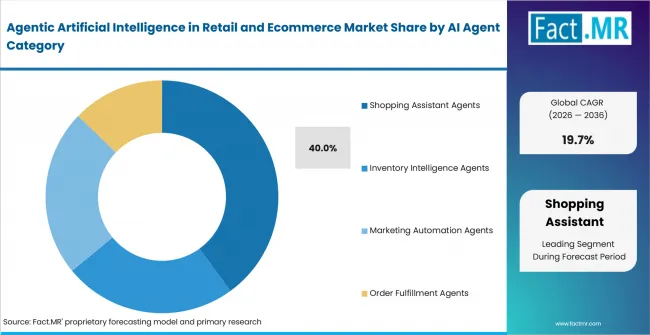
Agentic Artificial Intelligence In Retail And Ecommerce Market Analysis By Ai Agent Category | Source: Fact.MR
Shopping Assistant Agents sit closest to the customer decision. They can translate broad intent into product criteria and compare the available assortment, and their value rises when they can use current inventory and customer context instead of static content. This gives retailers a direct path from engagement to conversion and reduces navigation work for large catalogs. Adoption is strongest where the agent can ground each answer in approved product data and pass a selected item into checkout or service workflows. Salesforce announced in January 2025 prebuilt guided shopping skills for product search, recommendations, cart actions, and conversational checkout.
Why does Personalized Shopping lead Retail Function?
Personalized Shopping is projected to account for a 37.0% share in 2026.
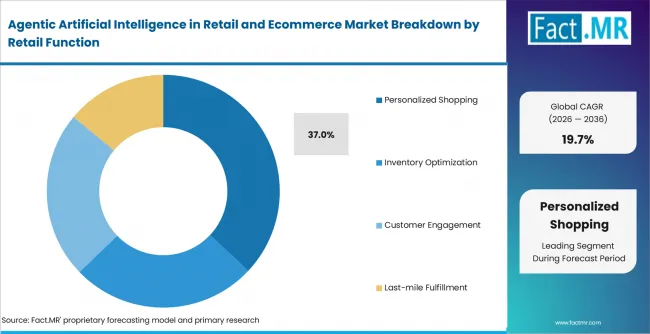
Agentic Artificial Intelligence In Retail And Ecommerce Market Analysis By Retail Function | Source: Fact.MR
Personalized Shopping leads because retail agents can apply context at the moment a shopper is deciding what to buy. Conventional recommendation engines rank items from historical signals, while agentic systems can ask follow-up questions, adjust the search plan, and explain why a product fits a stated need. This interaction is useful in categories where specifications or style preferences create decision friction. The commercial value is the ability to narrow choice while preserving brand rules and available stock, so retailers prioritize applications that connect customer context with trusted product content. Adobe announced a Product Advisor Agent and Brand Concierge in March 2025 for personalized product discovery and conversational brand experiences.
Why do E-commerce Retailers lead End-use Sector?
E-commerce Retailers is projected to account for a 46.0% share in 2026.
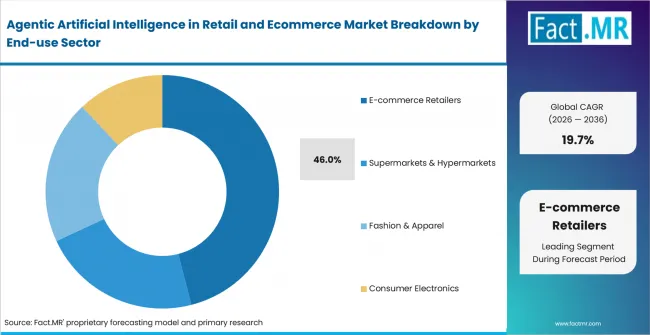
Agentic Artificial Intelligence In Retail And Ecommerce Market Analysis By End Use Sector | Source: Fact.MR
E-commerce retailers lead the End-use Sector because their entire shopping journey is digital, giving them the highest opportunity to place an agent at the point of product discovery and transaction. They run large catalogs, frequent promotions, and high return volumes that generate the case workloads where agents deliver measurable value, and they can instrument the funnel to tie agent interactions directly to conversion. This data-rich, digital-first environment makes e-commerce the earliest and largest adopter of shopping assistant, personalized merchandising, and service agents.
Why do Large Retail Enterprises lead Customer Type?
Large Retail Enterprises is projected to account for a 43.0% share in 2026.
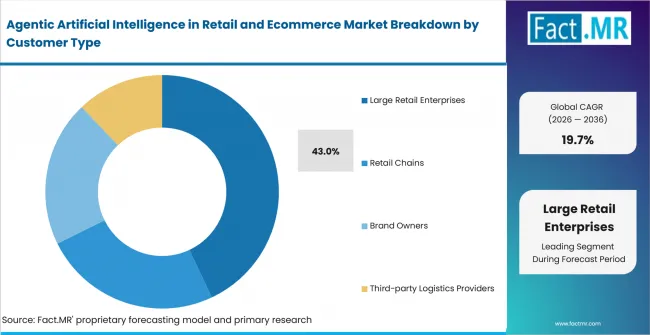
Agentic Artificial Intelligence In Retail And Ecommerce Market Analysis By Customer Type | Source: Fact.MR
Large retail enterprises hold the leading position because they manage enough transactions to justify integration costs and have multiple workflows that can share one agent foundation. A shopping agent may begin in product discovery and later use the same identity controls for service or returns. Large retailers can fund data engineering and model evaluation before rollout and run controlled pilots across selected brands or regions, but their scale raises the governance threshold. Microsoft stated in January 2025 that Copilot Studio was used by more than 100,000 organizations and offered over 1,400 plugins and connectors for enterprise integration, supporting the platform depth large retailers require.
What is accelerating Agentic Artificial Intelligence in Retail and Ecommerce Market adoption, and what is holding it back?
Drivers Impact Analysis
| Driver | % Impact on CAGR | Geographic Relevance | Impact Timeline |
|---|---|---|---|
| Retailers need to convert conversational intent into product discovery and completed transactions | +0.8% | Global | Near term |
| Rapid growth of AI-mediated shopping traffic giving retailers a measurable basis for agent funding | +0.7% | Global | Near term |
| Commerce platforms embedding agents and connectors into retail workflows | +0.6% | North America, Europe | Mid term |
| Rising ecommerce activity broadening the base of transaction-ready retailers | +0.5% | Global | Long term |
Source: Fact.MR analysis. Updated Aug 10, 2026
Restraints Impact Analysis
| Restraint | % Impact on CAGR | Geographic Relevance | Impact Timeline |
|---|---|---|---|
| Gap between a convincing demonstration and a controlled production deployment | -0.6% | Global | Mid term |
| Fragmented product data and inconsistent permissions delaying approval | -0.4% | Global | Near term |
| Integration and monitoring costs exceeding the value created by the targeted workflow | -0.3% | North America, Europe | Mid term |
Source: Fact.MR analysis. Updated Aug 10, 2026
Which countries are scaling the Agentic Artificial Intelligence in Retail and Ecommerce Market fastest?
- The United States leads the pace of expansion as large retailers purchase agentic AI through commerce platforms and cloud programs tested against high transaction volumes, with the Census Bureau reporting in May 2026 that e-commerce accounted for 16.9% of retail sales in the first quarter of 2026.
- The United Kingdom is scaling as retailers connect new customer-facing technology to established omnichannel and consumer service processes, with the Office for National Statistics updating its monthly internet sales reporting in July 2026.
- Singapore is advancing through a concentrated digital ecosystem and public support for moving from packaged tools to more specialized agents, with IMDA reporting that SME AI adoption rose from 4.2% to 14.5% in 2024.
- Canada is growing through a cautious business-case process for customer service agents and marketing automation, with Statistics Canada reporting in September 2025 that 34.8% of businesses planning AI use expected virtual agents or chatbots.
- Germany is expanding through deployments that integrate with established ERP and commerce systems while preserving strong data controls, with Destatis reporting in November 2025 that 26% of German enterprises used AI and 54% used paid cloud services.
- Australia is building demand as retailers use AI to manage customer engagement and supply chain variability across a dispersed market, with ABS reporting in June 2026 that 12% of businesses used AI in 2024-25 and 59% reported supply chain disruption.
- Japan is adopting where service quality and accurate product information matter across complex category assortments, with METI reporting in August 2025 that Japan’s B2C e-commerce market reached JPY 26.1 trillion in 2024.
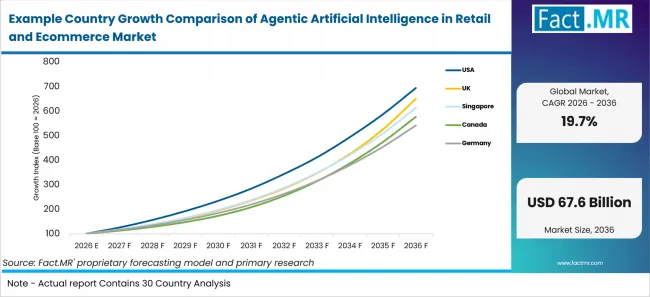
Example Country Growth Comparison Of Agentic Artificial Intelligence In Retail And Ecommerce Market | Source: Fact.MR
Country-wise CAGR Forecast (2026-2036)
| Country | CAGR |
|---|---|
| USA | 21.4% |
| UK | 20.6% |
| Singapore | 19.9% |
| Canada | 19.2% |
| Germany | 18.4% |
| Australia | 17.8% |
| Japan | 17.1% |
Source: Fact.MR analysis. Updated Aug 10, 2026
What is driving the Agentic Artificial Intelligence in Retail and Ecommerce Market in the USA?
USA is projected to register a 21.4% CAGR through 2036, supported by commerce platform adoption and high transaction volumes.
Large American retailers purchase agentic AI through commerce platforms and cloud programs that can be tested against high transaction volumes. The U.S. Census Bureau reported in May 2026 that e-commerce accounted for 16.9% of retail sales in the first quarter of 2026, giving U.S. retailers the transaction base and data needed to scale governed shopping and service agents.
What is driving the Agentic Artificial Intelligence in Retail and Ecommerce Market in the UK?
The UK is projected to register a 20.6% CAGR through 2036, supported by omnichannel and consumer-service integration.
British retailers typically connect new customer-facing technology to established omnichannel and consumer service processes. The Office for National Statistics updated its monthly internet sales reporting in July 2026 and continued monthly reporting by store type, giving UK retailers and agents a consistent data basis for omnichannel deployment.
What is driving the Agentic Artificial Intelligence in Retail and Ecommerce Market in Singapore?
Singapore is projected to register a 19.9% CAGR through 2036, supported by a concentrated digital ecosystem and SME AI adoption.
Retailers in Singapore can use a concentrated digital ecosystem and public support to move from packaged tools to more specialized agents. IMDA reported in October 2025 that SME AI adoption rose from 4.2% to 14.5% in 2024, signaling a broadening base of digitally ready retailers for agentic commerce.
What is driving the Agentic Artificial Intelligence in Retail and Ecommerce Market in Canada?
Canada is projected to register a 19.2% CAGR through 2036, supported by cautious business-case adoption of service and marketing agents.
Canadian retailers evaluate customer service agents and marketing automation through a cautious business-case process. Statistics Canada reported in September 2025 that 34.8% of businesses planning AI use expected virtual agents or chatbots, indicating a strong pipeline for agentic service deployment.
What is driving the Agentic Artificial Intelligence in Retail and Ecommerce Market in Germany?
Germany is projected to register an 18.4% CAGR through 2036, supported by ERP and commerce integration with strong data controls.
German retailers favor deployments that integrate with established ERP and commerce systems while preserving strong data controls. Destatis reported in November 2025 that 26% of German enterprises used AI and 54% used paid cloud services, providing the integration and cloud base for governed agent deployment.
What is driving the Agentic Artificial Intelligence in Retail and Ecommerce Market in Australia?
Australia is projected to register a 17.8% CAGR through 2036, supported by customer-engagement and supply chain applications.
Australian retailers use AI to manage customer engagement and supply chain variability across a geographically dispersed market. The Australian Bureau of Statistics reported in June 2026 that 12% of businesses used AI in 2024-25 and 59% reported supply chain disruption, supporting agents that help coordinate inventory and fulfillment across distance.
What is driving the Agentic Artificial Intelligence in Retail and Ecommerce Market in Japan?
Japan is projected to register a 17.1% CAGR through 2036, supported by service quality and accurate product information.
Japanese retailers place high value on service quality and accurate product information across complex category assortments. METI reported in August 2025 that Japan’s B2C e-commerce market reached JPY 26.1 trillion in 2024 and the merchandising EC ratio reached 9.8%, providing a large base for conversational and personalized shopping agents.
Who leads the Agentic Artificial Intelligence in Retail and Ecommerce Market?
The competitive landscape is divided by the system boundary each company controls. Cloud and commerce platform providers supply model access and connectors to customer and order data. Experience and enterprise application vendors embed agents inside marketing and commerce workflows, connecting planning and fulfillment. Infrastructure and transformation providers help retailers build governed deployments across several vendor environments.
Microsoft Corporation, Amazon Web Services, Inc., Google LLC, Salesforce, Inc., and Oracle Corporation compete through cloud scale, commerce applications, and enterprise connectors. IBM Corporation, Adobe Inc., and SAP SE compete through customer data, experience orchestration, planning, and transaction workflows. NVIDIA Corporation, Accenture plc, and Infosys Limited add infrastructure and transformation support
Which companies are the key providers?
Key companies profiled in the Agentic Artificial Intelligence in Retail and Ecommerce market include Microsoft Corporation, Amazon Web Services, Inc., Google LLC, Salesforce, Inc., Oracle Corporation, IBM Corporation, Adobe Inc., SAP SE, NVIDIA Corporation, Accenture plc, and Infosys Limited.
- Microsoft Corporation
- Amazon Web Services, Inc.
- Google LLC
- Salesforce, Inc.
- Oracle Corporation
- IBM Corporation
- Adobe Inc.
- SAP SE
- NVIDIA Corporation
- Accenture plc
- Infosys Limited
Bibliography
- U.S. Census Bureau. (2026, May 18). Quarterly Retail E-Commerce Sales.
- Office for National Statistics. (2026, July 24). Retail Sales Index Internet Sales.
- Infocomm Media Development Authority. (2025, October 6). Annual Report and Singapore Digital Economy Report 2025.
- Statistics Canada. (2025, September 11). Analysis on Expected Use of Artificial Intelligence by Businesses in Canada, Third Quarter of 2025.
- Federal Statistical Office of Germany. (2025, November 24). Companies Using Artificial Intelligence Technologies by Employment Size Class.
- Australian Bureau of Statistics. (2026, June 25). Characteristics of Australian Business, 2024-25 Financial Year.
- Ministry of Economy, Trade and Industry of Japan. (2025, August 26). Results of FY2024 E-Commerce Market Survey Compiled.
- Salesforce. (2025, January 10). Salesforce Unveils Agentforce for Retail and Retail Cloud with Modern POS.
- Adobe. (2025, March 18). Adobe Launches Adobe Experience Platform Agent Orchestrator.
- Adobe Digital Insights. (2026, April 16). U.S. Retailers See Surge in AI Traffic, but Many Websites Are Not Entirely Readable by Machines.
- NVIDIA. (2025, January 10). NVIDIA Announces Blueprint for AI Retail Shopping Assistants.
- Google Cloud. (2026, January 11). A New Era of Agentic Commerce Is Here.
- Google Cloud and PayPal. (2025, October 27). Introducing an Agentic Commerce Solution for Merchants from PayPal and Google Cloud.
- Microsoft. (2025, January 9). Retail Ready: Agentic AI Built for the Future of Retail.
- SAP. (2026, January 12). Redefining the Path to Loyalty-Led Growth with SAP Order Management Services.
This Report Answers
- The report provides strategic intelligence on the Agentic Artificial Intelligence in Retail and Ecommerce Market across the segment categories that drive industrial and enterprise purchasing behavior.
- Segment analysis identifies Shopping Assistant Agents as the leading sub-segment within the AI Agent Category segment, with a 40.0% share in 2026.
- Regional outlook evaluates USA, UK and Singapore while Canada, Germany complete the country growth comparison.
- Competitive analysis profiles Microsoft Corporation, Amazon Web Services, Inc. and Google LLC alongside Salesforce, Inc. and Oracle Corporation, followed by additional active providers within the category.
- Category assessment covers demand across primary segment groupings within the market, evaluated by value (USD) and share.
- Use-case assessment covers key application areas and end-use sectors identified in the market analysis.
What does the Agentic Artificial Intelligence in Retail and Ecommerce Market cover?
The Agentic Artificial Intelligence in Retail and Ecommerce Market covers the systems, services, and software categories defined by AI Agent Category, Retail Function, End-use Sector and related market attributes.
The Agentic Artificial Intelligence in Retail and Ecommerce Market covers the full range of products and services segmented by AI Agent Category, Retail Function, End-use Sector, Customer Type, and Deployment Framework within the 2026-2036 forecast horizon. Coverage includes Shopping Assistant Agents, the largest sub-segment within the AI Agent Category segment, and extends across all primary categories identified in the report.
The market differs from adjacent consumer or industrial categories because commercial value comes from the function and performance requirements captured within the supplied segmentation framework. Commodity components and general-purpose categories remain outside the boundary unless they are explicitly formulated or configured for the defined market application.
What is included in the scope?
Agentic Artificial Intelligence in Retail and Ecommerce Market products and services deployed across the major segment categories and geographies profiled in the report.
The scope includes all product categories segmented by AI Agent Category, Retail Function, End-use Sector, Customer Type, and Deployment Framework covered through secondary research, supplier validation, and demand modeling. Shopping Assistant Agents, the leading sub-segment within the AI Agent Category segment, is included with full value and share analysis alongside the complete set of profiled countries, companies, and end-use applications identified in the report.
What is excluded from the scope?
Commodity inputs, general-purpose goods, and unrelated service lines are outside the scope.
The scope excludes products and services that are not specifically designed, configured, or deployed for the Agentic Artificial Intelligence in Retail and Ecommerce Market. General-purpose or horizontal categories that may be used incidentally across multiple markets are excluded unless they are sold within a product or service bundle specific to the market under analysis. Adjacent categories and standalone commodity components remain outside the boundary unless their principal commercial function falls within the supplied segmentation framework.
How was the analysis built?
Fact.MR combines desk research with supplier, buyer and expert validation to define the market boundary and test segment adoption, pricing, deployment and regional demand assumptions. Company portfolios, product and technology documentation, regulatory material, industry publications and interview input are reconciled with activity-level data and country-level conditions before forecasts are updated.
Forecasts are validated through supplier checks, industry interviews, and demand-side input that tests assumptions on adoption, product trends, pricing, and regional dynamics. Portfolio mapping, regional demand assessments, and distributor feedback help confirm market direction. Ongoing monitoring of regulatory developments and competitive product launches supports continuous model and forecast updates.
- Primary Research:
- 120+ sources, 40+ company portfolios, 25+ countries, 20+ interviews.
- Desk Research:
- Primary research includes interviews with product managers, technology suppliers, system integrators, procurement specialists, and end-user organizations. Input from domain experts, application engineers, and sales teams involved in product specification, deployment, and commercialization is evaluated alongside buyer feedback on purchasing criteria, adoption drivers, and competitive evaluation.
- Data Validation and Update Cycle:
- Forecasting uses activity-level data, product adoption rates, attachment ratios, application demand, technology penetration curves, and average pricing benchmarks. Models also incorporate regulatory impact, regional adoption patterns, technology substitution effects, and format or deployment preferences across end-use applications and geographies.
- Market-Sizing and Forecasting:
- Desk research draws on company reports, investor presentations, product specifications, press releases, patent filings, and third-party market data. Government publications, regulatory filings, standards documentation, and industry body reports are also reviewed. News monitoring and business intelligence sources are systematically evaluated to track product launches, partnership activity, and competitive positioning.
- Desk research draws on company reports, investor presentations, product specifications, press releases, patent filings, and third-party market data. Government publications, regulatory filings, standards documentation, and industry body reports are also reviewed. News monitoring and business intelligence sources are systematically evaluated to track product launches, partnership activity, and competitive positioning.
Segmentation
What is the report’s scope and coverage?
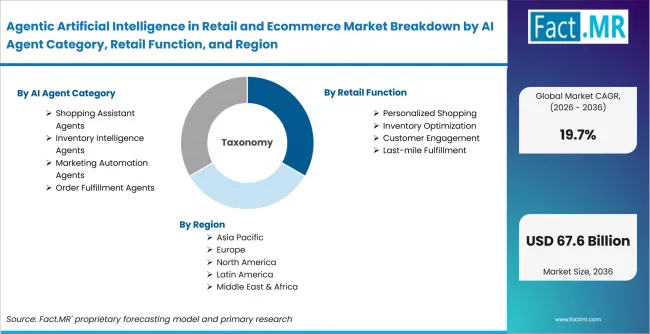
Agentic Artificial Intelligence In Retail And Ecommerce Market Breakdown By Ai Agent Category, Retail Function, And Region | Source: Fact.MR
| Attribute | Details |
|---|---|
| Forecast Period | 2026-2036 |
| Base Year | 2025 |
| Market Value, 2026 | USD 11.2 billion |
| Market Value, 2036 | USD 67.5 billion |
| CAGR, 2026-2036 | 19.7% |
| Absolute Dollar Opportunity | USD 56.3 billion |
| Key Regions Covered | USA, UK, Singapore, Canada, Germany, Australia, Japan, and more than twenty-five additional countries in the full report |
Source: Fact.MR analysis. Updated Aug 10, 2026
How is the market segmented?
-
AI Agent Category:
- Shopping Assistant Agents
- Product Discovery Agents
- Conversational Commerce Agents
- Inventory Intelligence Agents
- Demand Forecasting Agents
- Warehouse Optimization Agents
- Marketing Automation Agents
- Campaign Optimization Agents
- Dynamic Pricing Agents
- Order Fulfillment Agents
- Order Routing Agents
- Return Processing Agents
- Shopping Assistant Agents
-
Retail Function:
- Personalized Shopping
- Product Recommendations
- Virtual Shopping Assistance
- Inventory Optimization
- Stock Replenishment
- Order Allocation
- Customer Engagement
- Loyalty Management
- Promotional Campaigns
- Last-mile Fulfillment
- Return Management
- Reverse Logistics
- Personalized Shopping
-
End-use Sector:
- E-commerce Retailers
- Online Marketplaces
- Direct-to-Consumer Brands
- Supermarkets & Hypermarkets
- Department Stores
- Convenience Stores
- Fashion & Apparel
- Fashion Retailers
- Luxury Retail
- Consumer Electronics
- Electronics Retailers
- Home & Living Retail
- E-commerce Retailers
-
Customer Type:
- Large Retail Enterprises
- Global Retail Chains
- Marketplace Operators
- Retail Chains
- Regional Retailers
- Franchise Operators
- Brand Owners
- Digital Marketing Teams
- Brand Managers
- Third-party Logistics Providers
- Fulfillment Partners
- Logistics Service Providers
- Large Retail Enterprises
-
Deployment Framework:
- Cloud-native AI Agents
- Public Cloud
- Private Cloud
- Hybrid AI Infrastructure
- On-premises Deployment
- Edge-enabled AI
- Multi-agent Orchestration
- Agent Coordination Layer
- Context-aware AI
- Foundation Model Integration
- Knowledge Graph Integration
- Vector-based Retrieval
- Cloud-native AI Agents
-
Region:
- North America
- Latin America
- Western Europe
- Eastern Europe
- East Asia
- South Asia and Pacific
- Middle East & Africa
Frequently Asked Questions
What is the Agentic Artificial Intelligence in Retail and Ecommerce market size in 2026?
At what CAGR is the Agentic Artificial Intelligence in Retail and Ecommerce market expected to grow?
What is the projected Agentic Artificial Intelligence in Retail and Ecommerce market size by 2036?
Which country leads the Agentic Artificial Intelligence in Retail and Ecommerce market?
Which is the leading segment in the Agentic Artificial Intelligence in Retail and Ecommerce market?
What is driving growth in the Agentic Artificial Intelligence in Retail and Ecommerce Market?
Who are the key players in the Agentic Artificial Intelligence in Retail and Ecommerce Market?
Who worked on this report


Preview the report firsthand - request a free sample
Free SampleGet the brochure for pricing and purchase details
Download PDF