- Market Value (2025): USD 5.3 Bn
- Estimated Value (2026): USD 5.7 Bn
- Forecast Value (2036): USD 10.3 Bn
- CAGR (2026-2036): 6.2%
What is the Easy-Peel Lidding Systems Market forecast to be worth by 2036?
USD 5.7 Billion in 2026 to USD 10.3 Billion by 2036 at a 6.2% CAGR.
- The Easy-Peel Lidding Systems Market reached USD 5.3 Billion in 2025.
- Demand is projected to increase from USD 5.7 Billion in 2026 to USD 10.3 Billion by 2036.
- The market is forecast to record 6.2% CAGR from 2026 to 2036 as dairy brands, ready-meal packers, and specialty food processors standardize clean peel performance.
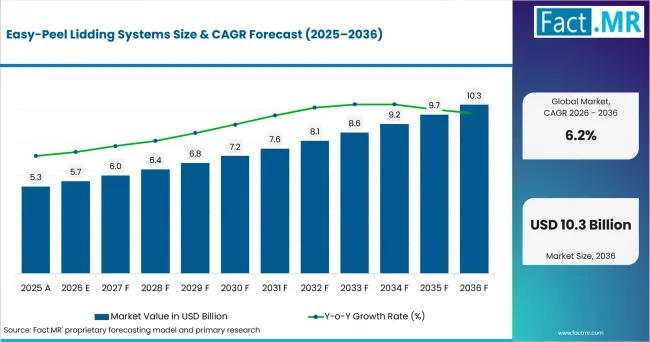
Easy Peel Lidding Systems Value Analysis | Source: Fact.MR
What are the defining numbers behind Easy-Peel Lidding Systems Market growth?
An absolute opportunity of USD 4.7 Billion is expected between 2026 and 2036.
- Demand Drivers in the Market
- Dairy cup manufacturers need lidding that releases cleanly and keeps the film intact. USDA National Agricultural Statistics Service reported in April 2026 that U.S. milk production reached 232 billion pounds in 2025.
- Ready-meal packers need retort and chilled tray formats that balance seal integrity with a predictable opening force for older consumers and single-serve meals.
- Brand owners need tamper cues paired with manageable opening force, especially where portioned cheese, meat, and prepared-food trays rely on frequent household use.
- Medical and specialty food producers need peel systems that support controlled opening. Smooth lid release helps protect pack handling and reduces the risk of fiber tear or product spillover.
- Key Segments Analyzed
- By Seal Mechanism: Peelable sealant is expected to hold 37.0% share in 2026 because it gives converters a direct route to controlled seal strength.
- By Base Film: PET is projected to account for 33.0% share in 2026 as brands value stiffness, clarity, and machinability on cup and tray lines.
- By Opening Performance: Clean peel is anticipated to capture 34.0% share in 2026 due to its role in reducing residue and lid tearing during use.
- By Application: Dairy cups are estimated to represent 31.0% share in 2026 owing to high repeat purchasing and wide use of heat-sealed single-serve packs.
- Analyst Opinion at Fact.MR
- Shambhu Nath Jha, Principal Consultant at Fact.MR, states, “Easy-peel lidding is increasingly judged at the point of opening as well as at the sealing station. Food brands are expected to pay closer attention to peel force and seal-window tolerance as chilled cups and trays move through automated filling lines. Suppliers that combine film expertise with application testing are better placed to win qualification work.”
- Strategic Implications
- Converters should document peel-force ranges by substrate and filling temperature so food brands can shorten repeat line trials. The European Commission stated in August 2026 that PPWR requirements making packaging recyclable under the Regulation’s design-for-recycling framework will apply from 2030.
- Film producers should align PET, PP, and PE grades with common cup materials to reduce seal-window variation across dairy and ready-meal packs.
- Food brands should test clean peel performance after chilled storage and heat treatment because opening defects can appear after distribution stress.
- Packaging teams should treat easy opening as a consumer-experience specification alongside material selection at the end of pack design.
France is projected to record 7.1% CAGR through 2036 due to tighter packaging recovery pressure and strong prepared-food channels. China is anticipated to advance at 6.4% as dairy and chilled-food output keeps expanding. The USA and Japan are each expected to post 5.9%, supported by convenience meals and packaged dairy. Germany is forecast to reach 5.7% as recyclable tray and lid structures influence material selection.
How does the Easy-Peel Lidding Systems Market break down by segment?
Peelable sealant leads Seal Mechanism at 37.0%; PET leads Base Film at 33.0%.
Which Seal Mechanism dominates?
Peelable sealant is expected to hold 37.0% share in 2026.
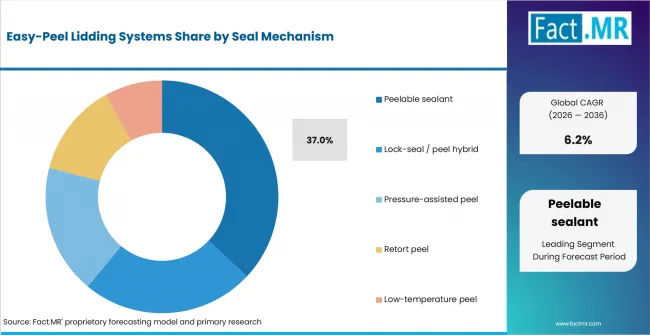
Easy Peel Lidding Systems Analysis By Seal Mechanism | Source: Fact.MR
Peelable sealants are expected to remain widely selected because converters can tune bond strength while keeping the broader lid structure stable. The structure supports a controlled sealing window on high-speed lines and allows clean consumer opening.
The format is especially relevant in dairy cups and ready-meal trays where secure sealing and smooth release must work together. USDA Economic Research Service reported in June 2026 that U.S. food spending reached USD 2.51 trillion in 2025.
What leads the Base Film segment?
PET is projected to account for 33.0% share in 2026.
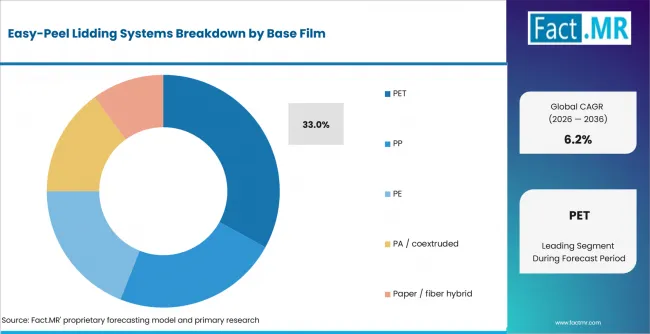
Easy Peel Lidding Systems Analysis By Base Film | Source: Fact.MR
PET is projected to retain a prominent base-film role because it combines clarity, stiffness, and heat resistance. These traits support printed and transparent lids across dairy cups and prepared-food trays.
Brands use PET when shelf appearance and line speed carry equal weight. Its compatibility with laminated and coextruded structures helps converters serve chilled food and specialty applications on common production platforms.
How does Opening Performance shape demand?
Clean peel is anticipated to capture 34.0% share in 2026.
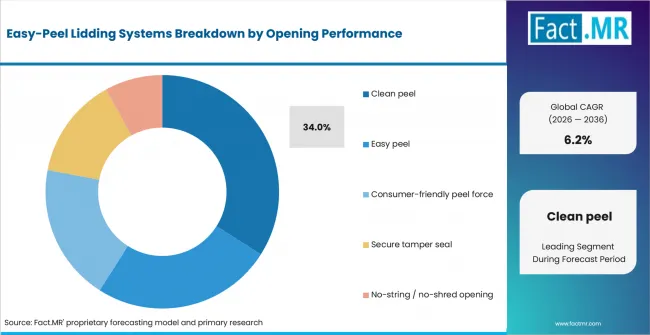
Easy Peel Lidding Systems Analysis By Opening Performance | Source: Fact.MR
Clean peel is anticipated to lead the opening-performance segment because it directly affects the consumer experience. Consistent release reduces film strings, uneven tears, and residue around the rim.
Clean release is expected to support production quality as well. Predictable opening helps brands reduce complaints linked to splashing and torn rims after chilled storage and distribution.
What supports Dairy cups within Application?
Dairy cups are estimated to represent 31.0% share in 2026.
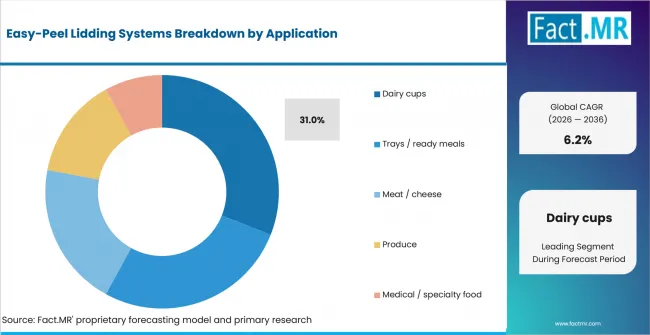
Easy Peel Lidding Systems Analysis By Application | Source: Fact.MR
Dairy cups are estimated to remain the primary application because single-serve yogurt, desserts, and cultured products need fast sealing and tidy opening. The compact pack format makes lid quality highly visible to the shopper.
High filling volumes make seal-window stability central to supplier selection. Dairy brands therefore evaluate peel force together with line speed and storage performance before approving a lidding structure.
What is accelerating Easy-Peel Lidding Systems Market adoption, and what is holding it back?
Demand is expected to rise through convenience food formats and cleaner opening expectations. Adoption is shaped by material compatibility, recycling requirements, and qualification work for demanding pack formats.
Drivers Impact Analysis
| DRIVER | (~) % IMPACT ON CAGR | GEOGRAPHIC RELEVANCE | IMPACT TIMELINE |
|---|---|---|---|
| Single-serve dairy and desserts | +1.4% | North America, Europe, East Asia | Short term (<= 2 years) |
| Ready-meal tray sealing | +1.1% | Europe, USA, Japan | Medium term (2-4 years) |
| Clean peel and no-shred opening | +0.9% | Global | Short term (<= 2 years) |
| Paper and fiber hybrid lids | +0.6% | Europe, North America | Long term (>= 4 years) |
Opportunity Impact Analysis
| OPPORTUNITY | (~) % IMPACT ON CAGR | GEOGRAPHIC RELEVANCE | IMPACT TIMELINE |
|---|---|---|---|
| Mono-material and recycle-ready lids | +1.0% | Europe, North America | Medium term (2-4 years) |
| High-barrier peel lidding for chilled meals | +0.8% | Europe, Japan | Long term (>= 4 years) |
| Accessible opening formats for older consumers | +0.5% | Japan, Germany, France | Medium term (2-4 years) |
Restraints Impact Analysis
| RESTRAINT | (~) % IMPACT ON CAGR | GEOGRAPHIC RELEVANCE | IMPACT TIMELINE |
|---|---|---|---|
| Seal failure risk across mixed substrates | -0.6% | Global | Short term (<= 2 years) |
| Recycling and material separation pressure | -0.5% | Europe, Japan | Medium term (2-4 years) |
| Higher validation cost for retort and medical packs | -0.3% | North America, Europe | Long term (>= 4 years) |
Which countries are scaling the Easy-Peel Lidding Systems Market through 2036?
- The country comparison spans 1.4 percentage points across the forecast period.
- France remains 0.7 percentage point above China as prepared-food channels and packaging recovery requirements shape lid design.
- China remains 0.5 percentage point above the USA as packaged-food retail and chilled distribution expand across urban markets.
- The USA and Japan share a 5.9% CAGR, with demand shaped by dairy packaging scale and convenience-food formats.
- Germany closes the displayed range at 5.7% as ready-meal production and recyclable pack design influence material selection.
Comparable CAGRs can create different entry conditions due to cup materials, food-channel structure, recycling systems, and line qualification practices. Full report coverage includes North America, Latin America, Western Europe, Eastern Europe, East Asia, South Asia & Pacific, Middle East & Africa.
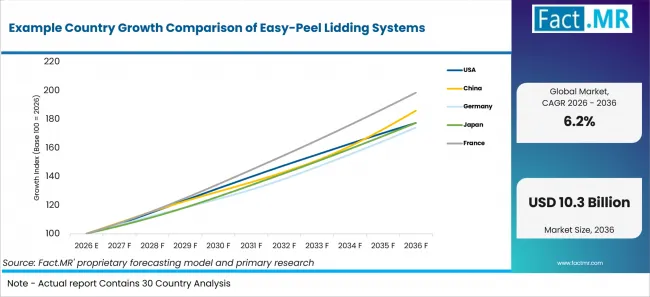
Example Country Growth Comparison Of Easy Peel Lidding Systems | Source: Fact.MR
| Country | CAGR (2026-2036) |
|---|---|
| France | 7.1% |
| China | 6.4% |
| USA | 5.9% |
| Japan | 5.9% |
| Germany | 5.7% |
What supports France adoption?
7.1% CAGR, supported by prepared-food demand and material-recovery requirements.
French brands are expected to place clean opening alongside seal reliability for dairy cups and prepared-food trays. Insee's August 28, 2026 release revised June 2026 household food consumption growth to 0.7%. Easy-peel systems are therefore expected to gain attention where convenience and tidy opening are evaluated together.
How is China scaling demand?
6.4% CAGR, driven by packaged-food retail and chilled distribution.
China's urban food channels are expected to expand the use of sealed cups and trays for dairy, desserts, and prepared foods. The National Bureau of Statistics reported in January 2026 that, among online retail sales of physical goods, food increased 14.5% in 2025. Converters are therefore expected to prioritize seal consistency across high-volume packaging runs.
What supports USA adoption?
5.9% CAGR, backed by large-scale food manufacturing and dairy packaging activity.
U.S. food manufacturers are expected to maintain broad demand for cup and tray lidding across dairy and prepared-food lines. The U.S. Census Bureau reported in September 2026 that food manufacturing generated USD 1,054.3 billion in value of shipments in 2024. Easy-peel grades are expected to benefit where line speed and consumer opening are evaluated together.
How does Japan perform?
5.9% CAGR, led by processed-food scale and consumer-friendly opening requirements.
Japan's convenience-food and single-serve channels are expected to support precise peel-force specifications across compact packs. USDA Foreign Agricultural Service reported in April 2026 that Japan's food processing sector was valued at USD 174 billion in 2025. Lidding suppliers are expected to compete on clean release and dependable sealing across chilled formats.
What is supporting Germany's adoption?
5.7% CAGR, supported by ready-meal production and recyclable pack design.
German ready-meal producers are expected to keep tray-lid compatibility central to packaging qualification. Destatis reported in January 2026 that Germany produced 1.7 million tonnes of ready meals in 2024. Suppliers are expected to gain ground by pairing reliable peel performance with material structures suited to current recovery requirements.
Who leads the Easy-Peel Lidding Systems Market?
Amcor participates through flexible lidding and food-packaging structures designed around seal performance and controlled opening characteristics. In March 2026, Amcor announced a new production line at its Lugo di Vicenza site for high-barrier recycle-ready films used in lidding and pouches.
Klöckner Pentaplast is active through rigid films and tray-related packaging platforms that connect with lidding compatibility. Constantia Flexibles supplies flexible packaging structures for food and healthcare applications, while Coveris and Winpak compete through film conversion and specialty lidding formats.
Competition centers on seal-window control and substrate matching. Barrier performance, print quality, food-contact documentation, and application testing are expected to shape supplier selection across dairy cups, ready meals, and specialty food packs.
Which companies are the key providers?
Key companies include Amcor (including Berry Global legacy operations); Klöckner Pentaplast; Constantia Flexibles; Coveris; and Winpak.
- Amcor (including Berry Global legacy operations)
- Klöckner Pentaplast
- Constantia Flexibles
- Coveris
- Winpak
Bibliography
- U.S. Department of Agriculture, National Agricultural Statistics Service. (2026, April). Milk production, disposition, and income 2025 summary.
- European Commission, Directorate-General for Environment. (2026, August 11). New EU packaging rules start to apply, including restrictions on PFAS in food-contact packaging.
- Zeballos, E., & Sinclair, W. (2026, June 11). Total U.S. food spending reached $2.51 trillion in 2025. U.S. Department of Agriculture, Economic Research Service.
- INSEE. (2026, August 28). Household consumption of goods increased again in July 2026 (+0.5% after +0.6%). Informations rapides, No. 213.
- National Bureau of Statistics of China. (2026, January 20). Total retail sales of consumer goods in December 2025.
- U.S. Census Bureau. (2026, September 3). Census Bureau releases new Annual Integrated Economic Survey data.
- U.S. Department of Agriculture, Foreign Agricultural Service. (2026, April 1). Food processing ingredients annual (Report No. JA2026-0012).
- Statistisches Bundesamt (Destatis). (2026, January 14). Produktion von Fertiggerichten binnen fünf Jahren mengenmäßig um 25,6 % gestiegen [Production of ready meals increased by 25.6% in volume within five years].
- Amcor plc. (2026, March 9). Amcor’s expanded facility in Italy will meet demand for recyclable packaging.
- Amcor plc. (2025, April 30). Amcor completes combination with Berry Global; Positioned to significantly enhance value for customers and shareholders.
This Report Answers
- The report explains where easy-peel lidding systems are used across seal mechanism, base film, opening performance, and application.
- Segment analysis identifies the primary subsegments and the operational reasons brands prioritize clean opening and line stability.
- Country analysis examines the listed markets and the food packaging mechanisms supporting lidding demand. The fresh food packaging assessment provides related context for tray and film use across chilled distribution.
- Competitive analysis reviews current providers across flexible packaging, tray lidding, rigid films, and specialty food-contact structures. Smart blister lidding provides a related healthcare reference where controlled opening and seal integrity remain central.
- Application analysis assesses how dairy cups, ready meals, meat, cheese, produce, and medical foods shape peel-force requirements.
What does the Easy-Peel Lidding Systems Market cover?
The Easy-Peel Lidding Systems Market covers films, laminates, and coated lid structures that seal to cups or trays and release with controlled force. It includes peelable sealants, hybrid seal systems, retort peel structures, and low-temperature peel formats used in food and specialty applications.
The assessment covers PET, PP, PE, PA coextruded structures, and paper or fiber hybrid lids. Demand is assessed across dairy cups, ready meals, meat and cheese packs, produce formats, and medical or specialty food packaging.
What is included in the scope?
The scope includes flexible lidding materials sold to food packers, converters, packaging distributors, and brand owners. It includes materials designed for clean peel, easy peel, tamper sealing, and no-string or no-shred opening.
It includes sealant layers, laminated structures, coated films, and application-tested lids used on thermoformed trays, rigid cups, and prepared-food packaging. Supplier analysis focuses on companies with active packaging portfolios and food-contact capability.
What is excluded from the scope?
The scope excludes ordinary rigid caps, snap-fit lids, standard foil closures lacking peel functionality, and general flexible packaging films outside controlled-opening use. Machinery sold separately from lidding materials is outside the market boundary.
General labels, shrink sleeves, and printed films are excluded when sealing and peel-release functionality is absent. Adhesives and coatings are included when they form part of a lidding system.
How Was the Analysis Built?
The analysis draws on 120+ sources, 35+ company portfolios, 25+ countries, and more than 20 industry interviews.
- Primary Research: Primary research includes discussions with packaging converters, food producers, material developers, distributors, end users, and subject-matter experts. These conversations examine purchasing priorities, product adoption, operational challenges, approval requirements, competitive positioning, and the factors that influence wider market acceptance.
- Desk Research: Desk research covers government statistics, regulatory publications, company filings, trade data, technical studies, industry associations, standards, public policy, and other authoritative sources. Selected supporting sources are documented in the bibliography.
- Market Sizing and Forecasting: Market estimates combine historical performance, demand indicators, pricing and volume trends, segment shares, company participation, country-level growth, adoption patterns, investment activity, and barriers to market expansion.
- Data Validation and Update Cycle: Findings are validated by comparing primary interviews with public data, company activity, regulatory changes, trade patterns, and industry developments. Regular updates review new product launches, capacity changes, partnerships, approvals, and shifts in commercial adoption.
What is the report’s scope and coverage?
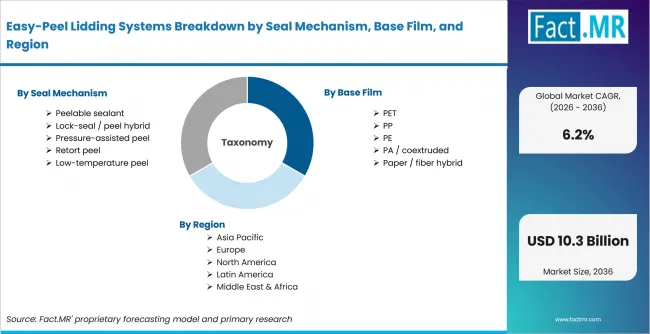
Easy Peel Lidding Systems Breakdown By Seal Mechanism, Base Film, And Region | Source: Fact.MR
| Attribute | Details |
|---|---|
| Quantitative Units | USD Billion |
| Market Definition | Lidding films and structures designed to seal cups or trays securely while allowing controlled, clean, and consumer-friendly opening. |
| Seal Mechanism | Peelable sealant; Lock-seal / peel hybrid; Pressure-assisted peel; Retort peel; Low-temperature peel |
| Base Film | PET; PP; PE; PA / coextruded; Paper / fiber hybrid |
| Opening Performance | Clean peel; Easy peel; Consumer-friendly peel force; Secure tamper seal; No-string / no-shred opening |
| Application | Dairy cups; Trays / ready meals; Meat / cheese; Produce; Medical / specialty food |
| Regions Covered | North America; Latin America; Western Europe; Eastern Europe; East Asia; South Asia & Pacific; Middle East & Africa |
| Countries Covered | United States; China; Germany; Japan; France |
| Key Companies Profiled | Amcor (including Berry Global legacy operations); Klöckner Pentaplast; Constantia Flexibles; Coveris; Winpak |
| Forecast Period | 2026 to 2036 |
| Approach | Hybrid top-down and bottom-up approach using application demand, film conversion activity, country-level food packaging indicators, segment shares, and provider portfolio review. |
How is the market segmented?
-
By Seal Mechanism
- Peelable sealant
- Lock-seal / peel hybrid
- Pressure-assisted peel
- Retort peel
- Low-temperature peel
-
By Base Film
- PET
- PP
- PE
- PA / coextruded
- Paper / fiber hybrid
-
By Opening Performance
- Clean peel
- Easy peel
- Consumer-friendly peel force
- Secure tamper seal
- No-string / no-shred opening
-
By Application
- Dairy cups
- Trays / ready meals
- Meat / cheese
- Produce
- Medical / specialty food
-
By Region
- North America
- Latin America
- Western Europe
- Eastern Europe
- East Asia
- South Asia & Pacific
- Middle East & Africa