- Market Value (2025): USD 155.0 Mn
- Estimated Value (2026): USD 170.0 Mn
- Forecast Value (2036): USD 420.0 Mn
- CAGR (2026-2036): 9.5%
What is the Recyclable Lidding Coatings Market forecast to be worth by 2036?
USD 170.0 million in 2026 to USD 420.0 million by 2036, at a 9.5% CAGR.
- The Recyclable Lidding Coatings Market crossed USD 155.0 million in 2025.
- Demand is projected to increase from USD 170.0 million in 2026 to USD 420.0 million by 2036 as lidding film producers move more trial grades into repeat orders.
- The market is forecast to record a 9.5% CAGR from 2026 to 2036 because peelable seals and recycler-facing evidence become linked in procurement records.
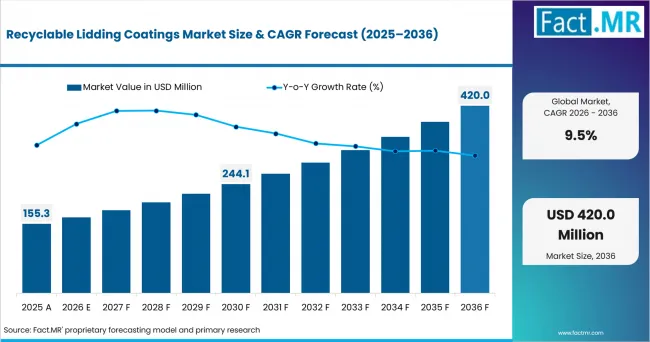
Recyclable Lidding Coatings Market Market Value Analysis | Source: Fact.MR
What are the defining numbers behind Recyclable Lidding Coatings Market growth?
USD 250.0 million absolute opportunity is projected through 2036, led by PET and Peelable alongside Mono-material recyclability routes.
- Demand Drivers in the Market
- Film companies need coatings that leave PET flakes cleaner after the lid is removed and the material is washed under real-use conditions.
- Tray makers need peelable seals that work on dairy cups and ready-meal packs without changing existing production lines.
- Food companies are giving more attention to packs made from one main material because approval now also depends on recycling results.
- Healthcare packaging companies need coatings that protect sterile packs and still meet strict record and review requirements.
- Test labs now play a bigger role because plant trials reveal sealing problems more quickly than product data sheets.
- Key Segments Analyzed
- By Lid Substrate: PET is estimated to hold 36% share in 2026 supported by its fit with tray and cup recycling trials.
- By Seal Type: Peelable is projected to account for 36% share in 2026 as converters test lids that separate cleanly from trays.
- By Application: Dairy cups are anticipated to capture 32% share in 2026 due to repeat use of lidding films in chilled food packs.
- By Recyclability Route: Mono-material is estimated to represent 39% share in 2026 because film producers prefer simpler approval routes.
- By Buyer Type: Lidding film producers are forecast to account for 40% share in 2026 driven by direct control over coating selection.
- Analyst Opinion at Fact.MR
- Shambhu Nath Jha, Senior Analyst at Fact.MR, states, “Recyclable lidding coatings are becoming a qualification market that extends beyond basic seal performance. Commercial approval is expected to favor companies that prove peel strength, wash behavior, and production-line fit during the same customer trial. Technical teams are expected to support coating adjustment, recycling review, and final plant validation before regular use begins.”
- Strategic Implications
- Coating companies need to test PET trays with the same lid material used in actual production.
- Film companies can check peelable seals after chilled storage and at normal packing speeds.
- Packaging companies need to compare single-material and wash-off options before changing an approved pack.
- Distributors can keep test records and compliance documents ready, since missing information often slows repeat orders.
Germany is anticipated to advance at a 10.9% CAGR through 2036 as EU packaging rules keep recyclability evidence in procurement records. Brazil is estimated to record a 9.9% CAGR by 2036 because dairy and meat-tray packaging expands coating trials. The United States is forecast to post a 9.0% CAGR from 2026 to 2036 supported by converter trials and brand-owner packaging reviews.
How does the Recyclable Lidding Coatings Market break down by segment?
PET leads at 36% by Lid Substrate, and Peelable leads at 36% by Seal Type in 2026.
How does Lid Substrate shape demand?
PET is projected to hold 36% share in 2026.
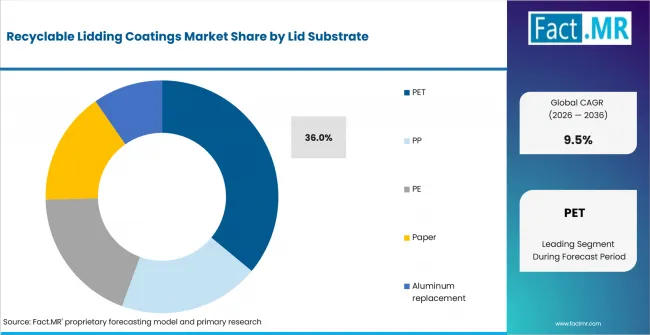
Recyclable Lidding Coatings Market Analysis By Lid Substrate | Source: Fact.MR
PET keeps its lead because recyclers already review tray and cup formats through established plastics guidance. PP follows in flexible packs where converters want lower density and heat resistance. PE serves film routes where mono-material design carries more weight. Paper and Aluminum replacement remain narrower choices when the pack design shifts away from rigid plastic.
Where is Seal Type demand strongest?
Peelable leads with 36% share in 2026.
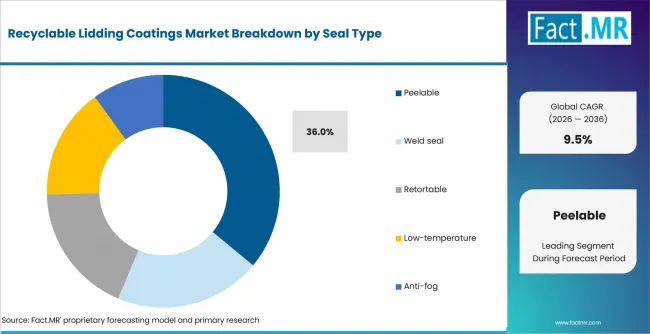
Recyclable Lidding Coatings Market Analysis By Seal Type | Source: Fact.MR
Converter teams choose Peelable grades when a lid has to open cleanly without leaving residue on the tray rim. Weld seal remains useful when stronger closure is required for retort or heavy handling. Retortable and Low-temperature options serve separate processing needs. Anti-fog coatings support visible chilled packs where product clarity affects shelf checks.
What supports Application adoption?
Dairy cups account for 32% share in 2026.
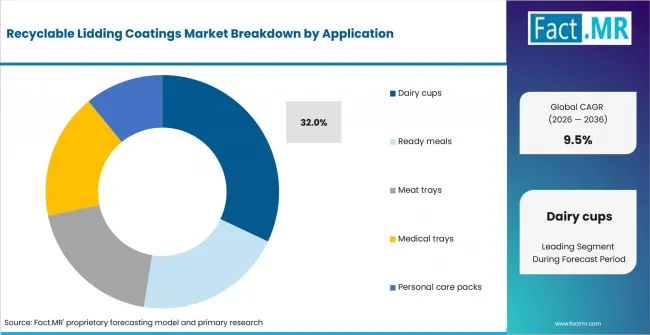
Recyclable Lidding Coatings Market Analysis By Application | Source: Fact.MR
Dairy cup programs usually give coating suppliers a steady trial route because pack geometry and filling conditions are familiar. Ready meals need stronger thermal stability because reheating and transport add stress. Meat trays need seal integrity under chilled display. Medical trays and Personal care packs require tighter documentation before material substitution.
Which Recyclability Route dominates?
Mono-material is projected to hold 39% share in 2026.
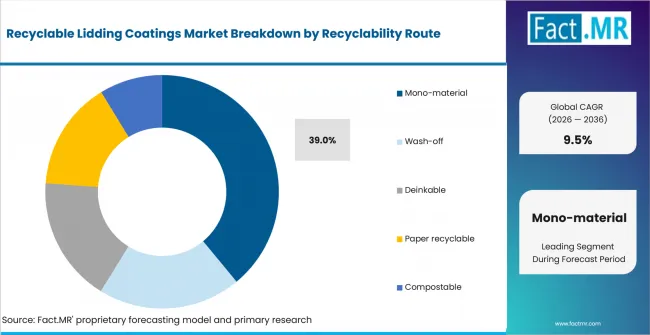
Recyclable Lidding Coatings Market Analysis By Recyclability Route | Source: Fact.MR
Mono-material designs reduce the number of material interfaces that converters must explain during approval. Wash-off remains relevant where labels and adhesives must separate during washing. Deinkable and Paper recyclable routes serve packs that move through fiber or print-heavy recovery systems. Compostable is narrower because end-of-life infrastructure is uneven across countries.
What leads the Buyer Type segment?
Lidding film producers account for 40% share in 2026.
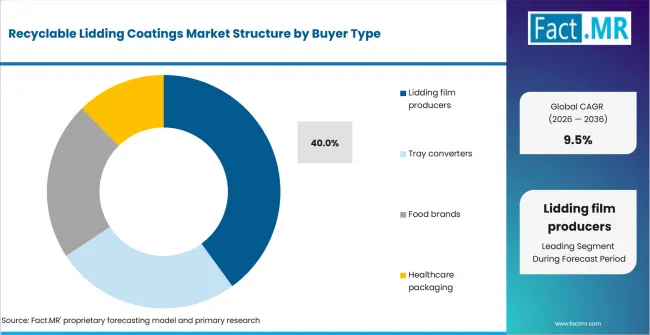
Recyclable Lidding Coatings Market Analysis By Buyer Type | Source: Fact.MR
Lidding film producers usually control coating selection before a tray converter or food brand reviews the final pack. Tray converters follow when the coating decision is tied to forming and sealing equipment. Food brands influence qualification by setting packaging targets. Healthcare packaging teams move more slowly because validation documents have to protect sterile-pack performance.
What is accelerating Recyclable Lidding Coatings Market adoption, and what is holding it back?
Flake-quality targets are anticipated to drive market growth, and qualification cost is expected to restrain the pace.
Drivers Impact Analysis
| DRIVER | (~) % IMPACT ON CAGR | GEOGRAPHIC RELEVANCE | IMPACT TIMELINE |
|---|---|---|---|
| Flake quality control in PET | +0.8% | China and export suppliers | Medium term (2-4 years) |
| Label release testing | +0.6% | Europe and North America | Short term (<= 2 years) |
| Mono-material lidding approval programs | +0.5% | Asia Pacific | Medium term (2-4 years) |
| Local support near label converters | +0.4% | Global | Long term (>= 4 years) |
Source: Fact.MR analysis. Updated Jul 16, 2026
- Flake quality control in PET: Film producers are expected to qualify coatings that leave less residue after washing. The driver is strongest where trays and cups enter PET recovery streams.
- Label release testing: RecyClass-style testing is projected to pull more supplier work into peel force and wash behavior. This creates a longer qualification route but gives converters a clearer approval standard.
- Mono-material lidding approval programs: Converters are anticipated to favor structures that reduce mixed-material risk. The route suits teams that want fewer changes across current lines.
- Local support near label converters: Technical service is expected to shorten the gap between sample approval and plant use. This support carries weight when filling-line conditions vary by site.
Opportunity Impact Analysis
| OPPORTUNITY | (~) % IMPACT ON CAGR | GEOGRAPHIC RELEVANCE | IMPACT TIMELINE |
|---|---|---|---|
| Grades tuned for Mono-material lidding | +0.5% | Global | Medium term (2-4 years) |
| Application labs for Peelable | +0.4% | Asia Pacific and Europe | Short term (<= 2 years) |
| Rule-ready documentation | +0.4% | Europe and United Kingdom | Medium term (2-4 years) |
| Local trials with bottle washers | +0.3% | India and Brazil | Long term (>= 4 years) |
Source: Fact.MR analysis. Updated Jul 16, 2026
- Grades tuned for Mono-material lidding: A coating grade that works across film and tray combinations reduces qualification runs. Repeatable peel and wash behavior is expected to decide commercial approval.
- Application labs for Peelable: Regional labs are expected to help converters adjust coat weight and seal temperature. This reduces the number of failed trials before commercial production begins.
- Rule-ready documentation: Documentation packs are anticipated to become a sales tool because converters need evidence for brand audits. Clear testing documentation helps projects move faster during brand and converter review.
- Local trials with bottle washers: Trial partnerships are forecast to support adoption where wash-water load is a direct concern. Bottle-washer feedback makes coating claims easier to check.
Restraints Impact Analysis
| RESTRAINT | (~) % IMPACT ON CAGR | GEOGRAPHIC RELEVANCE | IMPACT TIMELINE |
|---|---|---|---|
| Qualification cost | -0.4% | Global processors | Medium term (2-4 years) |
| Fit limits in Peelable | -0.3% | Global | Short term (<= 2 years) |
| Documentation burden | -0.3% | Europe and North America | Medium term (2-4 years) |
| Scale-up risk | -0.2% | High-volume plants | Long term (>= 4 years) |
Source: Fact.MR analysis. Updated Jul 16, 2026
- Qualification cost: Each pack change is expected to add trial runs and documentation work. High-volume food lines avoid changes unless the recycling benefit is visible.
- Fit limits in Peelable: Peel force is anticipated to remain a restraint when tray material and lid film do not match. Small coat-weight changes often alter opening behavior during chilled storage and transport.
- Documentation burden: Food and healthcare packaging teams are expected to delay adoption when testing documentation lacks recycling and food-contact detail. That delay is most visible in Europe and North America.
- Scale-up risk: Plant trials are forecast to expose seal defects that were not visible in lab work. This makes commercial approval slower for new coating grades.
Which countries are scaling Recyclable Lidding Coatings Market fastest?
Germany 10.9%, Brazil 9.9%, United States 9.0%
.webp "Top Country Growth Comparison Recyclable Lidding Coatings Market Cagr (2026 2036)")
Top Country Growth Comparison Recyclable Lidding Coatings Market Cagr (2026 2036) | Source: Fact.MR
Regional analysis covers East Asia; South Asia; Europe; Latin America; and North America.
| COUNTRY | CAGR |
|---|---|
| Germany | 10.9% |
| Brazil | 9.9% |
| United States | 9.0% |
Source: Fact.MR analysis. Updated Jul 16, 2026
What underpins Germany’s growth?
10.9% CAGR, owing to packaging-waste requirements and detailed product documentation.
Germany has a demanding approval environment where recyclability evidence influences coating selection. The market is anticipated to post a 10.9% CAGR from 2026 to 2036 as packaging companies place greater weight on wash-off performance, material compatibility, and clear technical records during supplier review.
What is driving Brazil’s growth through 2036?
9.9% CAGR, supported by food production and plastic-packaging conversion.
Brazilian demand is linked to dairy cups and meat trays where chilled storage can quickly expose weak seal or peel performance. The market is estimated to expand at a 9.9% CAGR from 2026 to 2036 as food-packaging companies increase local testing of coatings across plastic and paper-based lidding structures.
How is the United States scaling demand?
9.0% CAGR, supported by PET qualification work and packaging reviews.
The United States has a large tray and container industry where coating changes must satisfy packaging specifications and recycling guidance. The market is forecast to record a 9.0% CAGR from 2026 to 2036 as companies expand PET trials and compare peel strength, wash behavior, and production-line fit before approving recyclable lidding coatings.
Who leads the Recyclable Lidding Coatings Market?
Bostik and Henkel lead direct recyclable lidding coating coverage, while ACTEGA and Mitsui Chemicals strengthen heat-seal, packaging-film, and specialty resin capabilities.
Competition is expected to favor companies that can show both strong coating performance and clear recycling results. Companies with experience across PET, PE, paper, and single-material packs are likely to hold a stronger position. Bostik focuses on heat-seal and reseal products for trays and lidding films. Its products are useful where packs need to open cleanly and still support recycling goals.
Henkel works in packaging coatings and heat-seal coatings for paper. Its recent work supports food-contact packs and packaging that is easier to recycle. ACTEGA supplies coatings, sealants, inks, and adhesives for flexible and rigid packs. Its products are used in lidding and blister packs that need reliable sealing and coating support. Mitsui Chemicals add more options for packaging films and special resin products.
Which companies are the key providers?
Bostik and Henkel are key providers. ACTEGA is also profiled. Mitsui Chemicals completes the company set.
- Bostik
- Henkel
- ACTEGA
- Mitsui Chemicals
How is the market segmented?
-
By Lid Substrate
- PET
- PP
- PE
- Paper
- Aluminum replacement
-
By Seal Type
- Peelable
- Weld seal
- Retortable
- Low-temperature
- Anti-fog
-
By Application
- Dairy cups
- Ready meals
- Meat trays
- Medical trays
- Personal care packs
-
By Recyclability Route
- Mono-material
- Wash-off
- Deinkable
- Paper recyclable
- Compostable
-
By Buyer Type
- Lidding film producers
- Tray converters
- Food brands
- Healthcare packaging
-
Regional Breakdown
-
North America
- United States
- Canada
-
Europe
- Germany
- United Kingdom
- France
- Italy
- Spain
-
Asia Pacific
- Japan
- South Korea
- Australia
-
Central and South America
- Brazil
- Argentina
- Mexico
- Chile
-
Middle East and Africa
- UAE
- Saudi Arabia
- South Africa
-
Bibliography
- Bostik. (2024, December 3). Arkema finalizes the acquisition of Dow’s flexible packaging laminating adhesives business.
- European Parliament & Council of the European Union. (2025, January 22). Regulation (EU) 2025/40 of the European Parliament and of the Council of 19 December 2024 on packaging and packaging waste, amending Regulation (EU) 2019/1020 and Directive (EU) 2019/904, and repealing Directive 94/62/EC. Official Journal of the European Union.
- Kuraray America, Inc. (2026, March 18). Designing for circularity: Advancing recyclable packaging on Global Recycling Day 2026.
- National Bureau of Statistics of China. (2026). Industrial production operation in March 2026.
- United States Environmental Protection Agency. (2026, March 13). Plastics: Material-specific data.
This Report Addresses
- The report provides strategic intelligence on Recyclable Lidding Coatings across Lid Substrate and Seal Type choices that shape lidding-film qualification programs.
- Segment analysis covers PET and Peelable as the share leaders within the 2026 market structure.
- Regional outlook evaluates US, Germany, France, UK and 30+ countries.
- Competitive analysis profiles Bostik and Henkel alongside ACTEGA and Mitsui Chemicals as active providers across coatings, sealing materials, and packaging resins.
- Recyclability assessment covers Mono-material and Wash-off routes alongside Deinkable, Paper recyclable, and Compostable options.
- Use-case assessment covers Dairy cups and Ready meals alongside Meat trays, Medical trays, and Personal care packs.
What does the Recyclable Lidding Coatings Market cover?
Peelable and weld-seal coatings used to support recyclable lids across trays, cups, blister packs, and mono-material packaging structures.
The Recyclable Lidding Coatings Market covers coatings and sealants designed to close packages while supporting the intended recycling route. Coverage includes products used on PET, PP, PE, Paper, and Aluminum replacement lids across food, healthcare, and personal-care packaging.
The market differs from general packaging coatings because commercial value depends on both sealing performance and recycling compatibility. Standard coatings without a defined heat-seal or recyclability function remain outside the market boundary.
What is included in the scope?
Recyclable lidding coatings used across flexible and semi-rigid packaging qualification programs.
The scope includes Peelable and Weld seal coatings alongside Retortable, Low-temperature, and Anti-fog options. Coverage spans Dairy cups, Ready meals, Meat trays, Medical trays, and Personal care packs. Mono-material, Wash-off, Deinkable, Paper recyclable, and Compostable routes are included when the coating supports the stated end-of-life design. The analysis also covers demand from Lidding film producers, Tray converters, Food companies, and Healthcare packaging manufacturers.
What is excluded from the scope?
General packaging films and coatings without a defined lidding or recycling function are outside the scope. The scope excludes uncoated lid films, tray substrates, packaging machinery, and standard laminating adhesives sold without a heat-seal coating function. Pressure-sensitive label adhesives and cold-seal systems are excluded because their activation and application routes differ from recyclable lidding coatings. Finished trays, cups, and packaged food products are also excluded unless coating revenue is reported separately.
How was the analysis built? 120+ sources, 40+ company portfolios, 25+ countries, 20+ interviews.
- Primary Research: Primary research includes discussions with manufacturers, service providers, technology developers, distributors, end users, procurement teams, and subject-matter experts. These conversations examine purchasing priorities, product adoption, operational challenges, approval requirements, competitive positioning, and the factors that influence wider market acceptance.
- Desk Research: Desk research covers government statistics, regulatory publications, company filings, trade data, technical studies, industry associations, standards, public policy, and other authoritative sources. Every source used in the analysis is documented in the bibliography.
- Market Sizing and Forecasting: Market estimates combine historical performance, demand indicators, pricing and volume trends, segment shares, company participation, country-level growth, adoption patterns, investment activity, and barriers to market expansion.
- Data Validation and Update Cycle: Findings are validated by comparing primary interviews with public data, company activity, regulatory changes, trade patterns, and industry developments. Regular updates review new product launches, capacity changes, partnerships, approvals, procurement trends, and shifts in commercial adoption.
Segmentation
What is the report’s scope and coverage?
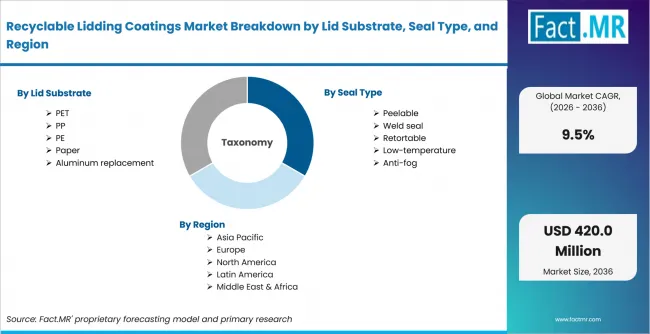
Recyclable Lidding Coatings Market Breakdown By Lid Substrate, Seal Type, And Region | Source: Fact.MR
| Attribute | Details |
|---|---|
| Quantitative Units | USD Million in 2026 to USD Million by 2036 at CAGR |
| Market Definition | Coatings and sealants designed to support recyclable lidding structures used across trays, cups, blister packs, and mono-material packaging |
| Lid Substrate | PET; PP; PE; Paper; Aluminum Replacement |
| Seal Type | Peelable; Weld Seal; Retortable; Low-temperature; Anti-fog |
| Application | Dairy Cups; Ready Meals; Meat Trays; Medical Trays; Personal Care Packs |
| Recyclability Route | Mono-material; Wash-off; Deinkable; Paper Recyclable; Compostable |
| Buyer Type | Lidding Film Producers; Tray Converters; Food Brands; Healthcare Packaging |
| Regions Covered | North America; Europe; Asia Pacific; Central and South America; Middle East and Africa |
| Countries Covered | Germany; Brazil; United States |
| Key Companies Profiled | Bostik; Henkel; ACTEGA; Mitsui Chemicals |
| Forecast Period | 2026 to 2036 |
| Approach | Hybrid top-down and bottom-up approach using lidding-film production; tray and cup packaging activity; coating attachment rates; peelable-seal adoption; mono-material packaging trials; wash-off and deinking requirements; application qualification cycles; production-line compatibility; and company validation |
Source: Fact.MR analysis. Updated Jul 16, 2026
Frequently Asked Questions
Which Lid Substrate leads the Recyclable Lidding Coatings Market?
Which Seal Type leads the Recyclable Lidding Coatings Market?
Which Application leads the Recyclable Lidding Coatings Market?
Which Recyclability Route leads the market?
Which Buyer Type leads the Recyclable Lidding Coatings Market?
How does Germany perform in the Recyclable Lidding Coatings Market?
How does the United States perform in the Recyclable Lidding Coatings Market?
What is the primary driver in the Recyclable Lidding Coatings Market?
What is the main restraint in the Recyclable Lidding Coatings Market?
Why is Peelable important?
Why do lidding-film producers lead demand?
Who worked on this report


Preview the report firsthand - request a free sample
Free SampleGet the brochure for pricing and purchase details
Download PDF