Solvent Systems for Closed-Loop Plastics Recycling Market

Solvent Systems for Closed-Loop Plastics Recycling Market Size and Share Forecast Outlook 2026 to 2036

Solvent systems for closed-loop plastics recycling market is projected to grow from USD 0.7 billion in 2026 to USD 1.4 billion by 2036, at a CAGR of 7.9%. Polar aprotic solvents & proprietary dissolution solvents (PET focus) will dominate with a 26.0% market share, while PET (bottles, trays) will lead the polymer targeted segment with a 40.0% share.

Solvent Systems for Closed-Loop Plastics Recycling Market Forecast and Outlook 2026 to 2036

The global solvent systems for closed-loop plastics recycling market is projected to reach USD 1.42 billion by 2036. The market is valued at USD 0.66 billion in 2026 and is set to rise at a CAGR of 7.9% during the assessment period. By solvent & chemistry type, polar aprotic solvents & proprietary dissolution solvents (PET focus) hold a leading 26% share. PET (bottles, trays) represents the dominant polymer targeted at 40%, while dissolution-precipitation is the primary process flow at 55.00%. Food-contact & bottle-grade re-polymer (closed-loop PET) is the leading end-use & recycled product, accounting for 36.0% market share.

Key Takeaways from the Solvent Systems for Closed-Loop Plastics Recycling Market

  • Market Value for 2026: USD 0.66 Billion
  • Market Value for 2036: USD 1.42 Billion
  • Forecast CAGR (2026-2036): 7.9%
  • Leading Solvent & Chemistry Type Share (2026): Polar Aprotic Solvents & Proprietary Dissolution Solvents (PET focus) (26%)
  • Leading Polymer Targeted Share (2026): PET (bottles, trays) (40%)
  • Leading Process Flow Share (2026): Dissolution-precipitation (55.00%)
  • Leading End-Use & Recycled Product Share (2026): Food-contact & bottle-grade re-polymer (closed-loop PET) (36.0%)
  • Key Players in the Market: APK, Polystyvert, Eastman, Polymateria

Solvent Systems For Closed Loop Plastics Recycling Market Market Value Analysis

Defining trends involve the development of highly selective, low-temperature solvent systems capable of dissolving target polymers from complex waste streams while leaving contaminants and other polymers behind. Innovation is rapidly advancing in solvent + antisolvent and temperature-swing systems for purifying mixed polyolefins and polystyrene. Integration of these solvent systems with advanced distillation and recovery units is critical for achieving true closed-loop economics and producing virgin-quality recyclate.

Regulatory frameworks mandating recycled content in packaging (especially for food-contact) and policies penalizing landfill/incineration are the primary market drivers. Extended Producer Responsibility (EPR) schemes and bans on hard-to-recycle plastics are creating urgent demand for advanced recycling solutions, positioning solvent-based purification as a key technology to meet stringent quality and sustainability targets.

Solvent Systems for Closed-Loop Plastics Recycling Market

Metric Value
Market Value (2026) USD 0.66 Billion
Market Forecast Value (2036) USD 1.42 Billion
Forecast CAGR (2026-2036) 7.9%

Category

Category Segments
Solvent & Chemistry Type Polar aprotic solvents & proprietary dissolution solvents (PET focus), Solvent and antisolvent systems (SA route), Temperature-swing & selective solvent systems, Green solvent families (DES & low-toxicity solvents for dissolution), Non-aqueous solvometallurgical blends (for mixed waste), Solvent blends for polyolefin dissolution (PS/PP selective solvents), Solvent recovery & purification consumables (reclaimer chemicals)
Polymer Targeted PET (bottles, trays), PS (expanded & rigid polystyrene), Polyolefins (PP & PE multi-layer film via selective solvents), PVC & mixed engineered plastics (specialist solvent routes), Mixed & multi-layer film & composites (task-specific solvent systems)
Process Flow Dissolution-precipitation, Solvent–Antisolvent (precipitation via antisolvent), Temperature-swing & selective crystallization, Solvometallurgical & non-aqueous solvent routes (specialty)
End-Use & Recycled Product Food-contact & bottle-grade re-polymer (closed-loop PET), Film & flexible packaging (reprocessed films), Rigid packaging & consumer goods (PS, PP parts), Automotive & industrial quality resins, Textile & fiber feedstock (recycled polymer for fibers)
Region North America, Latin America, Western Europe, Eastern Europe, East Asia, South Asia & Pacific, MEA

Segmental Analysis

By Solvent & Chemistry Type, Which System is Pioneering Food-Grade PET Recycling?
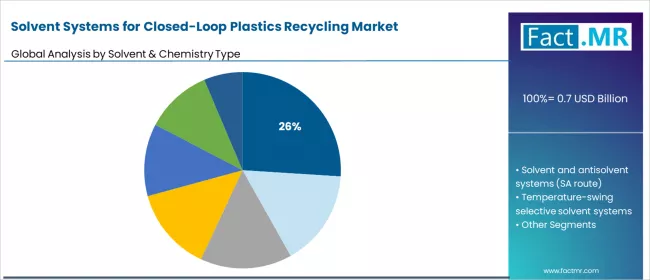
Solvent Systems For Closed Loop Plastics Recycling Market Analysis By Solvent & Chemistry Type

Polar aprotic solvents & proprietary dissolution solvents (PET focus) lead the segment with a 26% share. This dominance is due to their effectiveness in selectively dissolving post-consumer PET at relatively low temperatures, enabling the removal of dyes, additives, and contaminants to produce recycled PET (rPET) that meets stringent food-contact safety standards. These solvent systems are the core technology behind several commercial-scale, closed-loop bottle-to-bottle recycling processes.

By Polymer Targeted, Which Material Represents the Largest Volume and Regulatory Priority for Advanced Recycling?

Solvent Systems For Closed Loop Plastics Recycling Market Analysis By Polymer Targeted

PET (bottles, trays) commands the largest polymer targeted share at 40%. PET is a high-volume, high-value packaging polymer with clear regulatory-driven targets for recycled content, particularly in food and beverage applications. Mechanical recycling faces quality degradation limits, making solvent-based purification the leading technological pathway to achieve the purity levels required for closed-loop, food-grade rPET, thus driving massive investment and adoption.

By Process Flow, Which Foundational Method is Most Prevalent in Commercial Operations?

Solvent Systems For Closed Loop Plastics Recycling Market Analysis By Process Flow

Dissolution-precipitation represents the leading process flow at 55.00%. This well-understood method, where the target polymer is dissolved in a solvent, filtered to remove contaminants, and then precipitated out through a change in conditions such as temperature, and addition of anti-solvent, forms the backbone of most commercial solvent-based recycling plants. Its scalability and effectiveness for polymers like PET and PS make it the incumbent and most widely deployed advanced recycling process.

By End-Use & Recycled Product, Which Output Carries the Highest Value and Stringent Requirements?
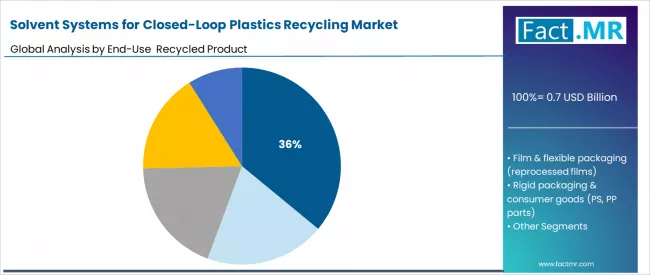
Solvent Systems For Closed Loop Plastics Recycling Market Analysis By End Use Recycled Product

Food-contact & bottle-grade re-polymer (closed-loop PET) is the dominant end-use at 36.0%. Producing recycled resin that is approved for direct food contact represents the pinnacle of quality and value in plastic recycling. It commands significant price premiums over non-food grade recyclate and is essential for brand owners to meet sustainability commitments. Solvent systems are uniquely positioned to deliver this high-value output, making it the primary economic driver for the technology.

What are the Drivers, Restraints, and Key Trends of the Solvent Systems for Closed-Loop Plastics Recycling Market?

Market growth is driven by legally binding targets for recycled plastic content in packaging, especially within the EU. Corporate sustainability pledges from major FMCG brands to use post-consumer recycled plastic are creating guaranteed demand. The technical limitations of mechanical recycling for food-grade and multi-layer materials necessitate advanced solutions. Furthermore, rising oil prices improve the economic competitiveness of advanced recycling outputs.

A significant restraint is the high capital intensity required to build integrated solvent-based recycling plants with efficient solvent recovery loops. Operational complexity and energy use for solvent distillation can influence process economics. Regulatory hurdles for approving new solvent systems for food-contact applications are lengthy and costly. Competition from emerging chemical recycling technologies like pyrolysis also segments investment and market attention.

Key trends include the development of "designer" solvent blends for specific waste streams, such as multi-layer flexible packaging. There is a strong push towards green chemistry principles, utilizing bio-based or Deep Eutectic Solvents (DES). Integration of solvent recycling with AI-powered process control to optimize yield and purity is emerging. Furthermore, strategic partnerships between solvent technology licensors, chemical companies, and waste management firms are accelerating commercialization.

Analysis of the Solvent Systems for Closed-Loop Plastics Recycling Market by Key Countries
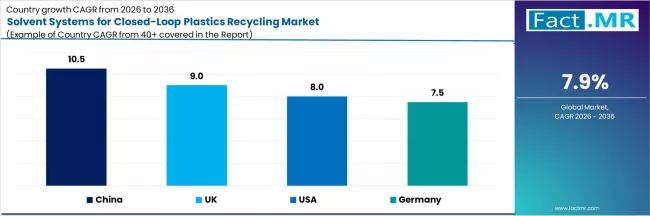
Solvent Systems For Closed Loop Plastics Recycling Market Cagr Analysis By Country

Country CAGR (2026-2036)
China 10.50%
UK 9.00%
USA 8.00%
Germany 7.50%
Japan 6.00%

How does China's War on Plastic Waste and Massive PET Market Drive Market Leadership?

China leads with a 10.50% CAGR, driven by its "Double Carbon" goals and comprehensive policies to tackle plastic pollution, including ambitious mandates for recycled content. As the world's largest producer and consumer of PET, China has a monumental waste stream and a strong domestic push to build advanced recycling infrastructure. National chemical companies are actively developing and scaling solvent-based technologies to create a circular economy for plastics domestically.

Why is the UK's Advanced EPR Legislation and Chemical Industry Expertise a Key Driver?

Some of the world’s most progressive Extended Producer Responsibility (EPR) regulations and Plastic Packaging Tax, which financially incentivize the use of recycled content, fuel the UK’s 9.00% growth. The UK's strong chemical engineering sector and presence of technology innovators are facilitating the deployment of solvent-based recycling plants to meet these regulatory demands and process difficult-to-recycle domestic waste streams.

What Role does the USA's Large-scale PET Recycling Goals and Corporate Commitments Play?

Solvent Systems For Closed Loop Plastics Recycling Market Country Value Analysis

The USA's 8.00% growth is sustained by significant corporate commitments from beverage and food brands to incorporate recycled plastic. While federal regulation is less stringent, state-level policies and voluntary goals are creating a strong market pull. Investments are flowing into solvent-based purification to upgrade the existing rPET flake stream to food-grade quality and to recycle materials currently not handled by mechanical systems.

How does Germany's Engineering Prowess and Strict Circular Economy Law Influence the Market?

Germany's 7.50% growth reflects its engineering leadership and the stringent enforcement of the EU's circular economy package. Germany's strong waste management infrastructure and chemical industry are ideally positioned to develop and implement sophisticated solvent recovery and recycling processes. The focus is on high efficiency, integration with existing sorting infrastructure, and producing outputs that meet the highest quality standards for automotive and technical applications.

What Factors Underpin Japan's Focus on High-Efficiency Technology and Packaging Waste?

Japan's 6.00% growth is motivated by its need for space-efficient, high-tech solutions to manage packaging waste in a densely populated country with limited landfill space. Japanese companies are leaders in developing precise, efficient chemical processes. There is significant R&D into solvent systems for recycling complex plastic waste from electronics and automobiles, aligning with the country's focus on technological innovation and resource security.

Competitive Landscape of the Solvent Systems for Closed-Loop Plastics Recycling Market
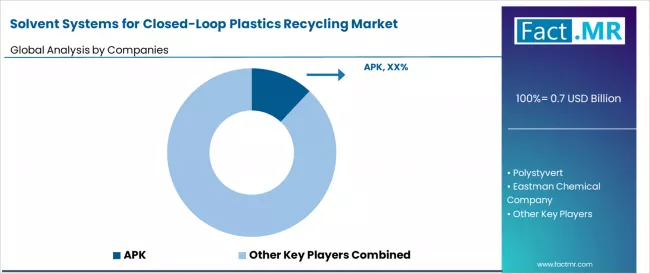
Solvent Systems For Closed Loop Plastics Recycling Market Analysis By Company

The competitive landscape features specialized technology startups competing with established chemical and materials giants. Pure-play technology firms like APK (Newcycling®) and Polystyvert compete by licensing their proprietary solvent-based purification processes for specific polymers including polyolefins and PS to waste management companies or brand owners.

Integrated chemical companies like Eastman (molecular recycling) and Polymateria compete by developing their own solvent technologies and building or partnering in recycling facilities to produce certified recycled materials for their downstream product portfolios. Competition revolves around the efficiency and selectivity of the solvent chemistry, the scalability and energy efficiency of the integrated process, and securing long-term supply agreements for waste feedstock and offtake for the purified polymer.

Key Players in the Solvent Systems for Closed-Loop Plastics Recycling Market

  • APK
  • Polystyvert
  • Eastman Chemical Company
  • Polymateria Ltd.

Scope of Report

Items Values
Quantitative Units USD Billion
Solvent & Chemistry Type Polar aprotic & proprietary solvents (PET), Solvent + antisolvent systems, Temperature-swing systems, Green solvent families, Non-aqueous solvometallurgical blends, Polyolefin dissolution blends, Solvent recovery consumables
Polymer Targeted PET, PS, Polyolefins, PVC & engineered plastics, Mixed & multi-layer film
Process Flow Dissolution-precipitation, Solvent and Antisolvent, Temperature-swing crystallization, Solvometallurgical routes
End-Use & Recycled Product Food-contact bottle-grade PET, Film & flexible packaging, Rigid packaging & goods, Automotive/industrial resins, Textile fiber feedstock
Key Countries China, UK, USA, Germany, Japan
Key Companies APK, Polystyvert, Eastman Chemical Company, Polymateria Ltd.
Additional Analysis Analysis of solvent recovery rates & energy consumption, decontamination efficacy for odor/color, regulatory pathway for food-contact approval, process economics vs. virgin production, and lifecycle assessment (LCA) compared to mechanical recycling and pyrolysis.

Solvent Systems for Closed-Loop Plastics Recycling Market by Segments

  • Solvent & Chemistry Type :

    • Polar aprotic solvents & proprietary dissolution solvents (PET focus)
    • Solvent and antisolvent systems (SA route)
    • Temperature-swing & selective solvent systems
    • Green solvent families (DES & low-toxicity solvents for dissolution)
    • Non-aqueous solvometallurgical blends (for mixed waste)
    • Solvent blends for polyolefin dissolution (PS/PP selective solvents)
    • Solvent recovery & purification consumables (reclaimer chemicals)
  • Polymer Targeted :

    • PET (bottles, trays)
    • PS (expanded & rigid polystyrene)
    • Polyolefins (PP & PE multi-layer film via selective solvents)
    • PVC & mixed engineered plastics (specialist solvent routes)
    • Mixed & multi-layer film & composites (task-specific solvent systems)
  • Process Flow :

    • Dissolution-precipitation
    • Solvent–Antisolvent (precipitation via antisolvent)
    • Temperature-swing & selective crystallization
    • Solvometallurgical & non-aqueous solvent routes (specialty)
  • End-Use & Recycled Product :

    • Food-contact & bottle-grade re-polymer (closed-loop PET)
    • Film & flexible packaging (reprocessed films)
    • Rigid packaging & consumer goods (PS, PP parts)
    • Automotive & industrial quality resins
    • Textile & fiber feedstock (recycled polymer for fibers)
  • Region :

    • North America

      • USA
      • Canada
    • Latin America

      • Brazil
      • Mexico
      • Rest of Latin America
    • Western Europe

      • Germany
      • UK
      • France
      • Italy
      • Spain
      • BENELUX
      • Rest of Western Europe
    • Eastern Europe

      • Poland
      • Russia
      • Czech Republic
      • Rest of Eastern Europe
    • East Asia

      • China
      • Japan
      • South Korea
      • Rest of East Asia
    • South Asia & Pacific

      • India
      • Indonesia
      • Australia
      • Rest of South Asia & Pacific
    • MEA

      • GCC Countries
      • South Africa
      • Rest of MEA

Table of Content

  1. Executive Summary
    • Global Market Outlook
    • Demand to side Trends
    • Supply to side Trends
    • Technology Roadmap Analysis
    • Analysis and Recommendations
  2. Market Overview
    • Market Coverage / Taxonomy
    • Market Definition / Scope / Limitations
  3. Market Background
    • Market Dynamics
      • Drivers
      • Restraints
      • Opportunity
      • Trends
    • Scenario Forecast
      • Demand in Optimistic Scenario
      • Demand in Likely Scenario
      • Demand in Conservative Scenario
    • Opportunity Map Analysis
    • Product Life Cycle Analysis
    • Supply Chain Analysis
    • Investment Feasibility Matrix
    • Value Chain Analysis
    • PESTLE and Porter’s Analysis
    • Regulatory Landscape
    • Regional Parent Market Outlook
    • Production and Consumption Statistics
    • Import and Export Statistics
  4. Global Market Analysis 2021 to 2025 and Forecast, 2026 to 2036
    • Historical Market Size Value (USD Million) Analysis, 2021 to 2025
    • Current and Future Market Size Value (USD Million) Projections, 2026 to 2036
      • Y to o to Y Growth Trend Analysis
      • Absolute $ Opportunity Analysis
  5. Global Market Pricing Analysis 2021 to 2025 and Forecast 2026 to 2036
  6. Global Market Analysis 2021 to 2025 and Forecast 2026 to 2036, By Solvent & Chemistry Type
    • Introduction / Key Findings
    • Historical Market Size Value (USD Million) Analysis By Solvent & Chemistry Type, 2021 to 2025
    • Current and Future Market Size Value (USD Million) Analysis and Forecast By Solvent & Chemistry Type, 2026 to 2036
      • Polar aprotic solvents & proprietary dissolution solvents (PET focus)
      • Solvent and antisolvent systems (SA route)
      • Temperature-swing selective solvent systems
      • Green solvent families (DES low-toxicity solvents for dissolution)
      • Non-aqueous solvometallurgical blends (for mixed waste)
      • Solvent blends for polyolefin dissolution (PSPP selective solvents)
      • Solvent recovery & purification consumables (reclaimer chemicals)
    • Y to o to Y Growth Trend Analysis By Solvent & Chemistry Type, 2021 to 2025
    • Absolute $ Opportunity Analysis By Solvent & Chemistry Type, 2026 to 2036
  7. Global Market Analysis 2021 to 2025 and Forecast 2026 to 2036, By Polymer Targeted
    • Introduction / Key Findings
    • Historical Market Size Value (USD Million) Analysis By Polymer Targeted, 2021 to 2025
    • Current and Future Market Size Value (USD Million) Analysis and Forecast By Polymer Targeted, 2026 to 2036
      • PET (bottles, trays)
      • PS (expanded & rigid polystyrene)
      • Polyolefins (PP PE multi-layer film via selective solvents)
      • PVC & mixed engineered plastics (specialist solvent routes)
      • Mixed multi-layer film & composites (task-specific solvent systems)
    • Y to o to Y Growth Trend Analysis By Polymer Targeted, 2021 to 2025
    • Absolute $ Opportunity Analysis By Polymer Targeted, 2026 to 2036
  8. Global Market Analysis 2021 to 2025 and Forecast 2026 to 2036, By Process Flow
    • Introduction / Key Findings
    • Historical Market Size Value (USD Million) Analysis By Process Flow, 2021 to 2025
    • Current and Future Market Size Value (USD Million) Analysis and Forecast By Process Flow, 2026 to 2036
      • Dissolution-precipitation
      • Solvent–Antisolvent (precipitation via antisolvent)
      • Temperature-swing selective crystallization
      • Solvometallurgical non-aqueous solvent routes (specialty)
    • Y to o to Y Growth Trend Analysis By Process Flow, 2021 to 2025
    • Absolute $ Opportunity Analysis By Process Flow, 2026 to 2036
  9. Global Market Analysis 2021 to 2025 and Forecast 2026 to 2036, By End-Use Recycled Product
    • Introduction / Key Findings
    • Historical Market Size Value (USD Million) Analysis By End-Use Recycled Product, 2021 to 2025
    • Current and Future Market Size Value (USD Million) Analysis and Forecast By End-Use Recycled Product, 2026 to 2036
      • Food-contact bottle-grade re-polymer (closed-loop PET)
      • Film & flexible packaging (reprocessed films)
      • Rigid packaging & consumer goods (PS, PP parts)
      • Automotive & industrial quality resins
      • Textile & fiber feedstock (recycled polymer for fibers)
    • Y to o to Y Growth Trend Analysis By End-Use Recycled Product, 2021 to 2025
    • Absolute $ Opportunity Analysis By End-Use Recycled Product, 2026 to 2036
  10. Global Market Analysis 2021 to 2025 and Forecast 2026 to 2036, By Region
    • Introduction
    • Historical Market Size Value (USD Million) Analysis By Region, 2021 to 2025
    • Current Market Size Value (USD Million) Analysis and Forecast By Region, 2026 to 2036
      • North America
      • Latin America
      • Western Europe
      • Eastern Europe
      • East Asia
      • South Asia and Pacific
      • Middle East & Africa
    • Market Attractiveness Analysis By Region
  11. North America Market Analysis 2021 to 2025 and Forecast 2026 to 2036, By Country
    • Historical Market Size Value (USD Million) Trend Analysis By Market Taxonomy, 2021 to 2025
    • Market Size Value (USD Million) Forecast By Market Taxonomy, 2026 to 2036
      • By Country
        • USA
        • Canada
        • Mexico
      • By Solvent & Chemistry Type
      • By Polymer Targeted
      • By Process Flow
      • By End-Use Recycled Product
    • Market Attractiveness Analysis
      • By Country
      • By Solvent & Chemistry Type
      • By Polymer Targeted
      • By Process Flow
      • By End-Use Recycled Product
    • Key Takeaways
  12. Latin America Market Analysis 2021 to 2025 and Forecast 2026 to 2036, By Country
    • Historical Market Size Value (USD Million) Trend Analysis By Market Taxonomy, 2021 to 2025
    • Market Size Value (USD Million) Forecast By Market Taxonomy, 2026 to 2036
      • By Country
        • Brazil
        • Chile
        • Rest of Latin America
      • By Solvent & Chemistry Type
      • By Polymer Targeted
      • By Process Flow
      • By End-Use Recycled Product
    • Market Attractiveness Analysis
      • By Country
      • By Solvent & Chemistry Type
      • By Polymer Targeted
      • By Process Flow
      • By End-Use Recycled Product
    • Key Takeaways
  13. Western Europe Market Analysis 2021 to 2025 and Forecast 2026 to 2036, By Country
    • Historical Market Size Value (USD Million) Trend Analysis By Market Taxonomy, 2021 to 2025
    • Market Size Value (USD Million) Forecast By Market Taxonomy, 2026 to 2036
      • By Country
        • Germany
        • UK
        • Italy
        • Spain
        • France
        • Nordic
        • BENELUX
        • Rest of Western Europe
      • By Solvent & Chemistry Type
      • By Polymer Targeted
      • By Process Flow
      • By End-Use Recycled Product
    • Market Attractiveness Analysis
      • By Country
      • By Solvent & Chemistry Type
      • By Polymer Targeted
      • By Process Flow
      • By End-Use Recycled Product
    • Key Takeaways
  14. Eastern Europe Market Analysis 2021 to 2025 and Forecast 2026 to 2036, By Country
    • Historical Market Size Value (USD Million) Trend Analysis By Market Taxonomy, 2021 to 2025
    • Market Size Value (USD Million) Forecast By Market Taxonomy, 2026 to 2036
      • By Country
        • Russia
        • Poland
        • Hungary
        • Balkan & Baltic
        • Rest of Eastern Europe
      • By Solvent & Chemistry Type
      • By Polymer Targeted
      • By Process Flow
      • By End-Use Recycled Product
    • Market Attractiveness Analysis
      • By Country
      • By Solvent & Chemistry Type
      • By Polymer Targeted
      • By Process Flow
      • By End-Use Recycled Product
    • Key Takeaways
  15. East Asia Market Analysis 2021 to 2025 and Forecast 2026 to 2036, By Country
    • Historical Market Size Value (USD Million) Trend Analysis By Market Taxonomy, 2021 to 2025
    • Market Size Value (USD Million) Forecast By Market Taxonomy, 2026 to 2036
      • By Country
        • China
        • Japan
        • South Korea
      • By Solvent & Chemistry Type
      • By Polymer Targeted
      • By Process Flow
      • By End-Use Recycled Product
    • Market Attractiveness Analysis
      • By Country
      • By Solvent & Chemistry Type
      • By Polymer Targeted
      • By Process Flow
      • By End-Use Recycled Product
    • Key Takeaways
  16. South Asia and Pacific Market Analysis 2021 to 2025 and Forecast 2026 to 2036, By Country
    • Historical Market Size Value (USD Million) Trend Analysis By Market Taxonomy, 2021 to 2025
    • Market Size Value (USD Million) Forecast By Market Taxonomy, 2026 to 2036
      • By Country
        • India
        • ASEAN
        • Australia & New Zealand
        • Rest of South Asia and Pacific
      • By Solvent & Chemistry Type
      • By Polymer Targeted
      • By Process Flow
      • By End-Use Recycled Product
    • Market Attractiveness Analysis
      • By Country
      • By Solvent & Chemistry Type
      • By Polymer Targeted
      • By Process Flow
      • By End-Use Recycled Product
    • Key Takeaways
  17. Middle East & Africa Market Analysis 2021 to 2025 and Forecast 2026 to 2036, By Country
    • Historical Market Size Value (USD Million) Trend Analysis By Market Taxonomy, 2021 to 2025
    • Market Size Value (USD Million) Forecast By Market Taxonomy, 2026 to 2036
      • By Country
        • Kingdom of Saudi Arabia
        • Other GCC Countries
        • Turkiye
        • South Africa
        • Other African Union
        • Rest of Middle East & Africa
      • By Solvent & Chemistry Type
      • By Polymer Targeted
      • By Process Flow
      • By End-Use Recycled Product
    • Market Attractiveness Analysis
      • By Country
      • By Solvent & Chemistry Type
      • By Polymer Targeted
      • By Process Flow
      • By End-Use Recycled Product
    • Key Takeaways
  18. Key Countries Market Analysis
    • USA
      • Pricing Analysis
      • Market Share Analysis, 2025
        • By Solvent & Chemistry Type
        • By Polymer Targeted
        • By Process Flow
        • By End-Use Recycled Product
    • Canada
      • Pricing Analysis
      • Market Share Analysis, 2025
        • By Solvent & Chemistry Type
        • By Polymer Targeted
        • By Process Flow
        • By End-Use Recycled Product
    • Mexico
      • Pricing Analysis
      • Market Share Analysis, 2025
        • By Solvent & Chemistry Type
        • By Polymer Targeted
        • By Process Flow
        • By End-Use Recycled Product
    • Brazil
      • Pricing Analysis
      • Market Share Analysis, 2025
        • By Solvent & Chemistry Type
        • By Polymer Targeted
        • By Process Flow
        • By End-Use Recycled Product
    • Chile
      • Pricing Analysis
      • Market Share Analysis, 2025
        • By Solvent & Chemistry Type
        • By Polymer Targeted
        • By Process Flow
        • By End-Use Recycled Product
    • Germany
      • Pricing Analysis
      • Market Share Analysis, 2025
        • By Solvent & Chemistry Type
        • By Polymer Targeted
        • By Process Flow
        • By End-Use Recycled Product
    • UK
      • Pricing Analysis
      • Market Share Analysis, 2025
        • By Solvent & Chemistry Type
        • By Polymer Targeted
        • By Process Flow
        • By End-Use Recycled Product
    • Italy
      • Pricing Analysis
      • Market Share Analysis, 2025
        • By Solvent & Chemistry Type
        • By Polymer Targeted
        • By Process Flow
        • By End-Use Recycled Product
    • Spain
      • Pricing Analysis
      • Market Share Analysis, 2025
        • By Solvent & Chemistry Type
        • By Polymer Targeted
        • By Process Flow
        • By End-Use Recycled Product
    • France
      • Pricing Analysis
      • Market Share Analysis, 2025
        • By Solvent & Chemistry Type
        • By Polymer Targeted
        • By Process Flow
        • By End-Use Recycled Product
    • India
      • Pricing Analysis
      • Market Share Analysis, 2025
        • By Solvent & Chemistry Type
        • By Polymer Targeted
        • By Process Flow
        • By End-Use Recycled Product
    • ASEAN
      • Pricing Analysis
      • Market Share Analysis, 2025
        • By Solvent & Chemistry Type
        • By Polymer Targeted
        • By Process Flow
        • By End-Use Recycled Product
    • Australia & New Zealand
      • Pricing Analysis
      • Market Share Analysis, 2025
        • By Solvent & Chemistry Type
        • By Polymer Targeted
        • By Process Flow
        • By End-Use Recycled Product
    • China
      • Pricing Analysis
      • Market Share Analysis, 2025
        • By Solvent & Chemistry Type
        • By Polymer Targeted
        • By Process Flow
        • By End-Use Recycled Product
    • Japan
      • Pricing Analysis
      • Market Share Analysis, 2025
        • By Solvent & Chemistry Type
        • By Polymer Targeted
        • By Process Flow
        • By End-Use Recycled Product
    • South Korea
      • Pricing Analysis
      • Market Share Analysis, 2025
        • By Solvent & Chemistry Type
        • By Polymer Targeted
        • By Process Flow
        • By End-Use Recycled Product
    • Russia
      • Pricing Analysis
      • Market Share Analysis, 2025
        • By Solvent & Chemistry Type
        • By Polymer Targeted
        • By Process Flow
        • By End-Use Recycled Product
    • Poland
      • Pricing Analysis
      • Market Share Analysis, 2025
        • By Solvent & Chemistry Type
        • By Polymer Targeted
        • By Process Flow
        • By End-Use Recycled Product
    • Hungary
      • Pricing Analysis
      • Market Share Analysis, 2025
        • By Solvent & Chemistry Type
        • By Polymer Targeted
        • By Process Flow
        • By End-Use Recycled Product
    • Kingdom of Saudi Arabia
      • Pricing Analysis
      • Market Share Analysis, 2025
        • By Solvent & Chemistry Type
        • By Polymer Targeted
        • By Process Flow
        • By End-Use Recycled Product
    • Turkiye
      • Pricing Analysis
      • Market Share Analysis, 2025
        • By Solvent & Chemistry Type
        • By Polymer Targeted
        • By Process Flow
        • By End-Use Recycled Product
    • South Africa
      • Pricing Analysis
      • Market Share Analysis, 2025
        • By Solvent & Chemistry Type
        • By Polymer Targeted
        • By Process Flow
        • By End-Use Recycled Product
  19. Market Structure Analysis
    • Competition Dashboard
    • Competition Benchmarking
    • Market Share Analysis of Top Players
      • By Regional
      • By Solvent & Chemistry Type
      • By Polymer Targeted
      • By Process Flow
      • By End-Use Recycled Product
  20. Competition Analysis
    • Competition Deep Dive
      • APK
        • Overview
        • Product Portfolio
        • Profitability by Market Segments (Product/Age /Sales Channel/Region)
        • Sales Footprint
        • Strategy Overview
          • Marketing Strategy
          • Product Strategy
          • Channel Strategy
      • Polystyvert
      • Eastman Chemical Company
      • Polymateria Ltd.
  21. Assumptions & Acronyms Used
  22. Research Methodology

List Of Table

  • Table 1: Global Market Value (USD Million) Forecast by Region, 2021 to 2036
  • Table 2: Global Market Value (USD Million) Forecast by Solvent & Chemistry Type, 2021 to 2036
  • Table 3: Global Market Value (USD Million) Forecast by Polymer Targeted, 2021 to 2036
  • Table 4: Global Market Value (USD Million) Forecast by Process Flow, 2021 to 2036
  • Table 5: Global Market Value (USD Million) Forecast by End-Use Recycled Product, 2021 to 2036
  • Table 6: North America Market Value (USD Million) Forecast by Country, 2021 to 2036
  • Table 7: North America Market Value (USD Million) Forecast by Solvent & Chemistry Type, 2021 to 2036
  • Table 8: North America Market Value (USD Million) Forecast by Polymer Targeted, 2021 to 2036
  • Table 9: North America Market Value (USD Million) Forecast by Process Flow, 2021 to 2036
  • Table 10: North America Market Value (USD Million) Forecast by End-Use Recycled Product, 2021 to 2036
  • Table 11: Latin America Market Value (USD Million) Forecast by Country, 2021 to 2036
  • Table 12: Latin America Market Value (USD Million) Forecast by Solvent & Chemistry Type, 2021 to 2036
  • Table 13: Latin America Market Value (USD Million) Forecast by Polymer Targeted, 2021 to 2036
  • Table 14: Latin America Market Value (USD Million) Forecast by Process Flow, 2021 to 2036
  • Table 15: Latin America Market Value (USD Million) Forecast by End-Use Recycled Product, 2021 to 2036
  • Table 16: Western Europe Market Value (USD Million) Forecast by Country, 2021 to 2036
  • Table 17: Western Europe Market Value (USD Million) Forecast by Solvent & Chemistry Type, 2021 to 2036
  • Table 18: Western Europe Market Value (USD Million) Forecast by Polymer Targeted, 2021 to 2036
  • Table 19: Western Europe Market Value (USD Million) Forecast by Process Flow, 2021 to 2036
  • Table 20: Western Europe Market Value (USD Million) Forecast by End-Use Recycled Product, 2021 to 2036
  • Table 21: Eastern Europe Market Value (USD Million) Forecast by Country, 2021 to 2036
  • Table 22: Eastern Europe Market Value (USD Million) Forecast by Solvent & Chemistry Type, 2021 to 2036
  • Table 23: Eastern Europe Market Value (USD Million) Forecast by Polymer Targeted, 2021 to 2036
  • Table 24: Eastern Europe Market Value (USD Million) Forecast by Process Flow, 2021 to 2036
  • Table 25: Eastern Europe Market Value (USD Million) Forecast by End-Use Recycled Product, 2021 to 2036
  • Table 26: East Asia Market Value (USD Million) Forecast by Country, 2021 to 2036
  • Table 27: East Asia Market Value (USD Million) Forecast by Solvent & Chemistry Type, 2021 to 2036
  • Table 28: East Asia Market Value (USD Million) Forecast by Polymer Targeted, 2021 to 2036
  • Table 29: East Asia Market Value (USD Million) Forecast by Process Flow, 2021 to 2036
  • Table 30: East Asia Market Value (USD Million) Forecast by End-Use Recycled Product, 2021 to 2036
  • Table 31: South Asia and Pacific Market Value (USD Million) Forecast by Country, 2021 to 2036
  • Table 32: South Asia and Pacific Market Value (USD Million) Forecast by Solvent & Chemistry Type, 2021 to 2036
  • Table 33: South Asia and Pacific Market Value (USD Million) Forecast by Polymer Targeted, 2021 to 2036
  • Table 34: South Asia and Pacific Market Value (USD Million) Forecast by Process Flow, 2021 to 2036
  • Table 35: South Asia and Pacific Market Value (USD Million) Forecast by End-Use Recycled Product, 2021 to 2036
  • Table 36: Middle East & Africa Market Value (USD Million) Forecast by Country, 2021 to 2036
  • Table 37: Middle East & Africa Market Value (USD Million) Forecast by Solvent & Chemistry Type, 2021 to 2036
  • Table 38: Middle East & Africa Market Value (USD Million) Forecast by Polymer Targeted, 2021 to 2036
  • Table 39: Middle East & Africa Market Value (USD Million) Forecast by Process Flow, 2021 to 2036
  • Table 40: Middle East & Africa Market Value (USD Million) Forecast by End-Use Recycled Product, 2021 to 2036

List Of Figures

  • Figure 1: Global Market Pricing Analysis
  • Figure 2: Global Market Value (USD Million) Forecast 2021 to 2036
  • Figure 3: Global Market Value Share and BPS Analysis by Solvent & Chemistry Type, 2026 and 2036
  • Figure 4: Global Market Y to o to Y Growth Comparison by Solvent & Chemistry Type, 2026 to 2036
  • Figure 5: Global Market Attractiveness Analysis by Solvent & Chemistry Type
  • Figure 6: Global Market Value Share and BPS Analysis by Polymer Targeted, 2026 and 2036
  • Figure 7: Global Market Y to o to Y Growth Comparison by Polymer Targeted, 2026 to 2036
  • Figure 8: Global Market Attractiveness Analysis by Polymer Targeted
  • Figure 9: Global Market Value Share and BPS Analysis by Process Flow, 2026 and 2036
  • Figure 10: Global Market Y to o to Y Growth Comparison by Process Flow, 2026 to 2036
  • Figure 11: Global Market Attractiveness Analysis by Process Flow
  • Figure 12: Global Market Value Share and BPS Analysis by End-Use Recycled Product, 2026 and 2036
  • Figure 13: Global Market Y to o to Y Growth Comparison by End-Use Recycled Product, 2026 to 2036
  • Figure 14: Global Market Attractiveness Analysis by End-Use Recycled Product
  • Figure 15: Global Market Value (USD Million) Share and BPS Analysis by Region, 2026 and 2036
  • Figure 16: Global Market Y to o to Y Growth Comparison by Region, 2026 to 2036
  • Figure 17: Global Market Attractiveness Analysis by Region
  • Figure 18: North America Market Incremental Dollar Opportunity, 2026 to 2036
  • Figure 19: Latin America Market Incremental Dollar Opportunity, 2026 to 2036
  • Figure 20: Western Europe Market Incremental Dollar Opportunity, 2026 to 2036
  • Figure 21: Eastern Europe Market Incremental Dollar Opportunity, 2026 to 2036
  • Figure 22: East Asia Market Incremental Dollar Opportunity, 2026 to 2036
  • Figure 23: South Asia and Pacific Market Incremental Dollar Opportunity, 2026 to 2036
  • Figure 24: Middle East & Africa Market Incremental Dollar Opportunity, 2026 to 2036
  • Figure 25: North America Market Value Share and BPS Analysis by Country, 2026 and 2036
  • Figure 26: North America Market Value Share and BPS Analysis by Solvent & Chemistry Type, 2026 and 2036
  • Figure 27: North America Market Y to o to Y Growth Comparison by Solvent & Chemistry Type, 2026 to 2036
  • Figure 28: North America Market Attractiveness Analysis by Solvent & Chemistry Type
  • Figure 29: North America Market Value Share and BPS Analysis by Polymer Targeted, 2026 and 2036
  • Figure 30: North America Market Y to o to Y Growth Comparison by Polymer Targeted, 2026 to 2036
  • Figure 31: North America Market Attractiveness Analysis by Polymer Targeted
  • Figure 32: North America Market Value Share and BPS Analysis by Process Flow, 2026 and 2036
  • Figure 33: North America Market Y to o to Y Growth Comparison by Process Flow, 2026 to 2036
  • Figure 34: North America Market Attractiveness Analysis by Process Flow
  • Figure 35: North America Market Value Share and BPS Analysis by End-Use Recycled Product, 2026 and 2036
  • Figure 36: North America Market Y to o to Y Growth Comparison by End-Use Recycled Product, 2026 to 2036
  • Figure 37: North America Market Attractiveness Analysis by End-Use Recycled Product
  • Figure 38: Latin America Market Value Share and BPS Analysis by Country, 2026 and 2036
  • Figure 39: Latin America Market Value Share and BPS Analysis by Solvent & Chemistry Type, 2026 and 2036
  • Figure 40: Latin America Market Y to o to Y Growth Comparison by Solvent & Chemistry Type, 2026 to 2036
  • Figure 41: Latin America Market Attractiveness Analysis by Solvent & Chemistry Type
  • Figure 42: Latin America Market Value Share and BPS Analysis by Polymer Targeted, 2026 and 2036
  • Figure 43: Latin America Market Y to o to Y Growth Comparison by Polymer Targeted, 2026 to 2036
  • Figure 44: Latin America Market Attractiveness Analysis by Polymer Targeted
  • Figure 45: Latin America Market Value Share and BPS Analysis by Process Flow, 2026 and 2036
  • Figure 46: Latin America Market Y to o to Y Growth Comparison by Process Flow, 2026 to 2036
  • Figure 47: Latin America Market Attractiveness Analysis by Process Flow
  • Figure 48: Latin America Market Value Share and BPS Analysis by End-Use Recycled Product, 2026 and 2036
  • Figure 49: Latin America Market Y to o to Y Growth Comparison by End-Use Recycled Product, 2026 to 2036
  • Figure 50: Latin America Market Attractiveness Analysis by End-Use Recycled Product
  • Figure 51: Western Europe Market Value Share and BPS Analysis by Country, 2026 and 2036
  • Figure 52: Western Europe Market Value Share and BPS Analysis by Solvent & Chemistry Type, 2026 and 2036
  • Figure 53: Western Europe Market Y to o to Y Growth Comparison by Solvent & Chemistry Type, 2026 to 2036
  • Figure 54: Western Europe Market Attractiveness Analysis by Solvent & Chemistry Type
  • Figure 55: Western Europe Market Value Share and BPS Analysis by Polymer Targeted, 2026 and 2036
  • Figure 56: Western Europe Market Y to o to Y Growth Comparison by Polymer Targeted, 2026 to 2036
  • Figure 57: Western Europe Market Attractiveness Analysis by Polymer Targeted
  • Figure 58: Western Europe Market Value Share and BPS Analysis by Process Flow, 2026 and 2036
  • Figure 59: Western Europe Market Y to o to Y Growth Comparison by Process Flow, 2026 to 2036
  • Figure 60: Western Europe Market Attractiveness Analysis by Process Flow
  • Figure 61: Western Europe Market Value Share and BPS Analysis by End-Use Recycled Product, 2026 and 2036
  • Figure 62: Western Europe Market Y to o to Y Growth Comparison by End-Use Recycled Product, 2026 to 2036
  • Figure 63: Western Europe Market Attractiveness Analysis by End-Use Recycled Product
  • Figure 64: Eastern Europe Market Value Share and BPS Analysis by Country, 2026 and 2036
  • Figure 65: Eastern Europe Market Value Share and BPS Analysis by Solvent & Chemistry Type, 2026 and 2036
  • Figure 66: Eastern Europe Market Y to o to Y Growth Comparison by Solvent & Chemistry Type, 2026 to 2036
  • Figure 67: Eastern Europe Market Attractiveness Analysis by Solvent & Chemistry Type
  • Figure 68: Eastern Europe Market Value Share and BPS Analysis by Polymer Targeted, 2026 and 2036
  • Figure 69: Eastern Europe Market Y to o to Y Growth Comparison by Polymer Targeted, 2026 to 2036
  • Figure 70: Eastern Europe Market Attractiveness Analysis by Polymer Targeted
  • Figure 71: Eastern Europe Market Value Share and BPS Analysis by Process Flow, 2026 and 2036
  • Figure 72: Eastern Europe Market Y to o to Y Growth Comparison by Process Flow, 2026 to 2036
  • Figure 73: Eastern Europe Market Attractiveness Analysis by Process Flow
  • Figure 74: Eastern Europe Market Value Share and BPS Analysis by End-Use Recycled Product, 2026 and 2036
  • Figure 75: Eastern Europe Market Y to o to Y Growth Comparison by End-Use Recycled Product, 2026 to 2036
  • Figure 76: Eastern Europe Market Attractiveness Analysis by End-Use Recycled Product
  • Figure 77: East Asia Market Value Share and BPS Analysis by Country, 2026 and 2036
  • Figure 78: East Asia Market Value Share and BPS Analysis by Solvent & Chemistry Type, 2026 and 2036
  • Figure 79: East Asia Market Y to o to Y Growth Comparison by Solvent & Chemistry Type, 2026 to 2036
  • Figure 80: East Asia Market Attractiveness Analysis by Solvent & Chemistry Type
  • Figure 81: East Asia Market Value Share and BPS Analysis by Polymer Targeted, 2026 and 2036
  • Figure 82: East Asia Market Y to o to Y Growth Comparison by Polymer Targeted, 2026 to 2036
  • Figure 83: East Asia Market Attractiveness Analysis by Polymer Targeted
  • Figure 84: East Asia Market Value Share and BPS Analysis by Process Flow, 2026 and 2036
  • Figure 85: East Asia Market Y to o to Y Growth Comparison by Process Flow, 2026 to 2036
  • Figure 86: East Asia Market Attractiveness Analysis by Process Flow
  • Figure 87: East Asia Market Value Share and BPS Analysis by End-Use Recycled Product, 2026 and 2036
  • Figure 88: East Asia Market Y to o to Y Growth Comparison by End-Use Recycled Product, 2026 to 2036
  • Figure 89: East Asia Market Attractiveness Analysis by End-Use Recycled Product
  • Figure 90: South Asia and Pacific Market Value Share and BPS Analysis by Country, 2026 and 2036
  • Figure 91: South Asia and Pacific Market Value Share and BPS Analysis by Solvent & Chemistry Type, 2026 and 2036
  • Figure 92: South Asia and Pacific Market Y to o to Y Growth Comparison by Solvent & Chemistry Type, 2026 to 2036
  • Figure 93: South Asia and Pacific Market Attractiveness Analysis by Solvent & Chemistry Type
  • Figure 94: South Asia and Pacific Market Value Share and BPS Analysis by Polymer Targeted, 2026 and 2036
  • Figure 95: South Asia and Pacific Market Y to o to Y Growth Comparison by Polymer Targeted, 2026 to 2036
  • Figure 96: South Asia and Pacific Market Attractiveness Analysis by Polymer Targeted
  • Figure 97: South Asia and Pacific Market Value Share and BPS Analysis by Process Flow, 2026 and 2036
  • Figure 98: South Asia and Pacific Market Y to o to Y Growth Comparison by Process Flow, 2026 to 2036
  • Figure 99: South Asia and Pacific Market Attractiveness Analysis by Process Flow
  • Figure 100: South Asia and Pacific Market Value Share and BPS Analysis by End-Use Recycled Product, 2026 and 2036
  • Figure 101: South Asia and Pacific Market Y to o to Y Growth Comparison by End-Use Recycled Product, 2026 to 2036
  • Figure 102: South Asia and Pacific Market Attractiveness Analysis by End-Use Recycled Product
  • Figure 103: Middle East & Africa Market Value Share and BPS Analysis by Country, 2026 and 2036
  • Figure 104: Middle East & Africa Market Value Share and BPS Analysis by Solvent & Chemistry Type, 2026 and 2036
  • Figure 105: Middle East & Africa Market Y to o to Y Growth Comparison by Solvent & Chemistry Type, 2026 to 2036
  • Figure 106: Middle East & Africa Market Attractiveness Analysis by Solvent & Chemistry Type
  • Figure 107: Middle East & Africa Market Value Share and BPS Analysis by Polymer Targeted, 2026 and 2036
  • Figure 108: Middle East & Africa Market Y to o to Y Growth Comparison by Polymer Targeted, 2026 to 2036
  • Figure 109: Middle East & Africa Market Attractiveness Analysis by Polymer Targeted
  • Figure 110: Middle East & Africa Market Value Share and BPS Analysis by Process Flow, 2026 and 2036
  • Figure 111: Middle East & Africa Market Y to o to Y Growth Comparison by Process Flow, 2026 to 2036
  • Figure 112: Middle East & Africa Market Attractiveness Analysis by Process Flow
  • Figure 113: Middle East & Africa Market Value Share and BPS Analysis by End-Use Recycled Product, 2026 and 2036
  • Figure 114: Middle East & Africa Market Y to o to Y Growth Comparison by End-Use Recycled Product, 2026 to 2036
  • Figure 115: Middle East & Africa Market Attractiveness Analysis by End-Use Recycled Product
  • Figure 116: Global Market - Tier Structure Analysis
  • Figure 117: Global Market - Company Share Analysis

- FAQs -

How big is the solvent systems for closed-loop plastics recycling market in 2026?

The global solvent systems for closed-loop plastics recycling market is estimated to be valued at USD 0.7 billion in 2026.

What will be the size of solvent systems for closed-loop plastics recycling market in 2036?

The market size for the solvent systems for closed-loop plastics recycling market is projected to reach USD 1.4 billion by 2036.

How much will be the solvent systems for closed-loop plastics recycling market growth between 2026 and 2036?

The solvent systems for closed-loop plastics recycling market is expected to grow at a 7.9% CAGR between 2026 and 2036.

What are the key product types in the solvent systems for closed-loop plastics recycling market?

The key product types in solvent systems for closed-loop plastics recycling market are polar aprotic solvents & proprietary dissolution solvents (pet focus), solvent and antisolvent systems (sa route), temperature-swing selective solvent systems, green solvent families (des low-toxicity solvents for dissolution), non-aqueous solvometallurgical blends (for mixed waste), solvent blends for polyolefin dissolution (pspp selective solvents) and solvent recovery & purification consumables (reclaimer chemicals).

Which polymer targeted segment to contribute significant share in the solvent systems for closed-loop plastics recycling market in 2026?

In terms of polymer targeted, PET (bottles, trays) segment to command 40.0% share in the solvent systems for closed-loop plastics recycling market in 2026.

Solvent Systems for Closed-Loop Plastics Recycling Market