- Forecast Value (2036): 760.0 Mn
- CAGR (2036): 10.3%
What is the smart blister lidding market forecast to be worth by 2036?
USD 285.0 million in 2026 to USD 760.0 million by 2036, at 10.3% CAGR.
- The smart blister lidding market crossed a valuation of USD 260.0 million in 2025.
- Sales are expected to rise from USD 285.0 million in 2026 to USD 760.0 million by 2036.
- The market is forecast to record 10.3% CAGR from 2026 to 2036 due to package-level verification and patient information access needs.
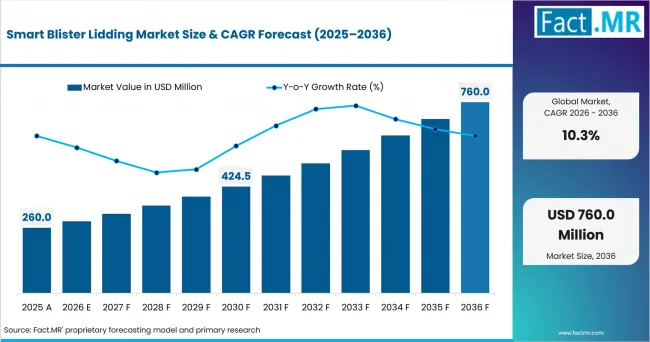
Smart Blister Lidding Market Market Value Analysis | Source: Fact.MR
What are the defining numbers behind smart blister lidding growth?
USD 475.0 million absolute opportunity by 2036, led by India and China.
- Demand Drivers in the Market
- Pharma brands need lidding that carries identity data without changing approved blister cavities.
- Contract packagers require print validation before code-ready lidding enters high-speed blister lines.
- Retail pharmacy chains need readable pack data after cartons and leaflets are separated from blister cards.
- Clinical-trial teams use dose-level lidding to reduce kit handling error and batch reconciliation risk.
- Key Segments Analyzed
- By Material: Aluminium foil is expected to hold 38.0% share in 2026 owing to sealing familiarity and barrier performance.
- By Drug Format: Tablets are projected to account for 44.0% share in 2026 supported by high use in oral solid-dose packs.
- By End User: Pharma brands are anticipated to hold 45.0% share in 2026 due to control over artwork and authentication requirements.
- By Connectivity Method: Printed 2D codes are forecast to capture 41.0% share in 2026 attributable to low conversion cost.
- By Pack Function: Authentication is expected to hold 39.0% share in 2026 led by pharmacy verification needs.
- By Sales Channel: Direct supply is estimated to account for 57.0% share in 2026 supported by qualified supplier programs.
- By Geography: India is projected to record 11.8% CAGR through 2036 owing to regulated-market pharmaceutical exports.
- Analyst Opinion at Fact.MR
- Shambhu Nath Jha, Senior Analyst at Fact.MR, states, “Smart blister lidding is becoming a control point for medicine packs. Pharma packaging teams are asking whether each blister lid can seal well, carry trusted code data, and support patient instructions. Suppliers that prove both pack protection and code readability should gain early account access.”
- Strategic Implications
- Pharma brands should evaluate smart lidding before artwork changes are locked for regulated markets.
- Contract packagers need line-trial evidence before offering smart lidding on commercial dose packs.
- Converters should pair barrier testing with code readability checks to defend premium pricing.
- Authentication partners need packaging-process expertise before selling into primary medicine packs.
Connected lidding sits inside the wider pharmaceutical packaging value chain. The U.S. Food and Drug Administration states that the Drug Supply Chain Security Act is designed to identify and trace certain prescription drugs at the package level. This supports demand for blister lids that can carry reliable product identity data.
India is projected to record 11.8% CAGR through 2036 due to export-facing pharmaceutical production. China is expected to expand at 11.4% CAGR through 2036 owing to domestic medicine traceability upgrades. The United States is forecast to grow at 10.7% CAGR through 2036 supported by package-level tracing. The United Kingdom is expected to advance at 10.4% CAGR through 2036 attributable to labeling changes after the Windsor Framework. Germany is projected to rise at 10.0% CAGR through 2036 led by EU verification systems. Japan is forecast at 9.8% CAGR through 2036 reflecting conservative pack validation. France is expected to post 9.6% CAGR through 2036 driven by life-sciences packaging upgrades.
How does the smart blister lidding market break down by segment?
Aluminium foil leads at 38.0%; tablets lead at 44.0%..
Which material dominates?
Aluminium foil holds 38.0% share in 2026.
Aluminium foil is expected to hold 38.0% share in 2026 owing to proven barrier behavior and push-through performance. Pharma packagers use foil when drug stability and readable code zones must be validated together. The wider pharmaceutical blister packs base also keeps foil specifications familiar to pharma packers.
PET and PE structures gain selective use where recyclability goals or patient-opening needs matter. Plastic lidding films compete where converters can prove seal reliability and code durability on existing lines.
Which drug format dominates?
Tablets account for 44.0% share in 2026.
Tablets are projected to account for 44.0% share in 2026 supported by routine unit-dose blistering in branded and generic medicines. Smart lidding adds authentication and patient information access without changing the tablet. Cold form blister packaging keeps lidding performance important for sensitive oral-dose products.
Capsules and lozenges follow due to steady blister use in prescription and OTC channels. Related medical flexible packaging activity supports converter investment in healthcare-grade print control and barrier layers.
Which end user dominates?
Pharma brands hold 45.0% share in 2026.
Pharma brands are anticipated to hold 45.0% share in 2026 due to control over artwork and safety copy. Brand owners also absorb the commercial risk if a scan code fails at pharmacy or patient level.
Contract development and manufacturing organizations follow due to their role in packaging medicines for several clients. They need supplier documentation that can pass customer quality review before commercial pack release.
Which connectivity method dominates?
Printed 2D codes lead with 41.0% share in 2026.
Printed 2D codes are forecast to capture 41.0% share in 2026 attributable to lower unit cost and compatibility with current artwork workflows. GS1 states that GS1 DataMatrix is the 2D data carrier used in healthcare.
NFC tags remain smaller due to component cost and extra validation work. They are most relevant in premium therapies that include tamper-evidence features and connected patient support.
Which pack function dominates?
Authentication holds 39.0% share in 2026.
Authentication is expected to hold 39.0% share in 2026 led by faster check needs at wholesalers and pharmacies. The World Health Organization reported that at least one in ten medicines in low and middle-income countries are substandard or falsified. This keeps anti-counterfeit packaging relevant for medicine packs with visible verification surfaces.
Which sales channel dominates?
Direct supply accounts for 57.0% share in 2026.
Direct supply is estimated to account for 57.0% share in 2026 supported by qualified supplier programs and batch-level traceability. Pharma buyers prefer direct converter relationships when artwork security and line validation are involved.
Distributor supply remains useful for short runs and clinical packs. Large programs move toward direct contracts when pharmacy repackaging systems and retail verification workflows require supplier accountability.
What is accelerating smart blister lidding demand, and what is holding it back?
Package-level traceability drives demand; line validation cost restrains adoption.
A main driver is patient information access. EMA describes ePI in terms of authorized product information adapted for electronic handling and web-based delivery. Blister lids can provide a small physical surface that directs patients to approved information when cartons are discarded.
The main restraint is the cost of validating codes on high-speed blister lines. Buyers must prove that ink placement and seal strength do not create rejection risk during batch release.
Where do the biggest smart blister lidding opportunities sit?
Authentication-ready foil, ePI access and clinical-dose validation.
- Authentication-Ready Foil: Converters can build foil structures that carry readable codes and pass seal testing.
- Electronic Product Access: Pharma brands can add patient information links when artwork refresh cycles open.
- Clinical-Dose Validation: Contract packagers can use smart lidding to improve trial kit control and dose tracking.
Which countries are scaling smart blister lidding fastest?
India 11.8%, China 11.4%, United States 10.7%, United Kingdom 10.4%, Germany 10.0%, Japan 9.8%, France 9.6%.
.webp "Top Country Growth Comparison Smart Blister Lidding Market Cagr (2026 2036)")
Top Country Growth Comparison Smart Blister Lidding Market Cagr (2026 2036) | Source: Fact.MR
Based on regional analysis, the smart blister lidding market is segmented into North America, Europe, East Asia, South Asia, Latin America, and Middle East and Africa complete the regional scope.
| Country | CAGR |
|---|---|
| India | 11.8% |
| China | 11.4% |
| United States | 10.7% |
| United Kingdom | 10.4% |
| Germany | 10.0% |
| Japan | 9.8% |
| France | 9.6% |
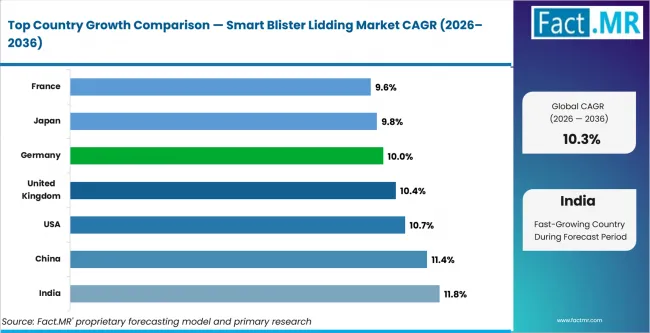
Smart Blister Lidding Market Cagr Analysis By Country | Source: Fact.MR
What is powering India’s lead?
11.8% CAGR, supported by regulated-market pharmaceutical exports.
India has a large oral solid-dose manufacturing base that sells into regulated markets. The Press Information Bureau reported that India exports pharmaceutical products to 191 countries. India is projected to record 11.8% CAGR through 2036 due to export-facing pack qualification and multilingual artwork needs. Suppliers with validated printing and foil conversion capacity gain better access to pharma clusters in Gujarat and Maharashtra.
How is China scaling smart lidding demand?
11.4% CAGR, driven by medicine traceability upgrades.
China buyers prioritize local sourcing and short lead times when changing primary packaging. The National Medical Products Administration states that whole-lifecycle drug regulation is being strengthened under reforms published in March 2025. China is expected to expand at 11.4% CAGR through 2036 owing to traceability upgrades and oral solid-dose scale. Local technical service near plants in Jiangsu and Zhejiang is a supplier advantage.
What supports the United States outlook?
10.7% CAGR, supported by package-level tracing requirements.
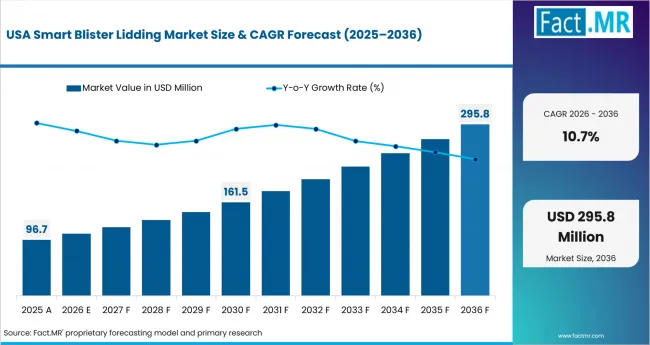
Smart Blister Lidding Market Country Value Analysis | Source: Fact.MR
United States pharma buyers use traceability rules to review how each medicine pack carries identifiers. The United States is forecast to grow at 10.7% CAGR through 2036 supported by package-level tracing and pharmacy channel exposure. Buyers favor suppliers that connect code quality with barrier performance and documentation.
Why is the United Kingdom important for smart blister lidding?
10.4% CAGR, due to United Kingdom-only pack changes.
United Kingdom packaging decisions are shaped by separate pack rules after the Windsor Framework. Government guidance states that medicines for the UK market must bear UK-only labeling from January 1 2025. The United Kingdom is expected to advance at 10.4% CAGR through 2036 attributable to artwork refresh and pharmacy channel simplification. Suppliers that understand Medicines and Healthcare products Regulatory Agency expectations can win during pack redesign.
What underpins Germany’s growth?
10.0% CAGR, backed by EU verification systems and converter depth.
Germany’s role is shaped by EU verification rules and a strong pharma packaging supplier base. The European Medicines Verification Organisation states that EMVS connects national systems across Europe and covers medicine supply-chain actors. Germany is projected to rise at 10.0% CAGR through 2036 led by verification infrastructure and converter depth. Buyers expect code integrity and seal stability to be proven before supplier change.
Why does Japan remain a measured smart lidding market?
9.8% CAGR, supported by conservative pack validation and prescription medicine scale.
Japanese pack buyers place high weight on quality review and patient-facing clarity. The U.S. International Trade Administration reported in November 2025 that prescription drugs account for about 93% of Japan’s pharmaceutical market. Japan is forecast at 9.8% CAGR through 2036 reflecting conservative validation and medicine packaging controls. Suppliers must show that code placement does not reduce readability of required medicine information.
How does France support smart blister lidding demand?
9.6% CAGR, supported by life-sciences packaging upgrades.
France combines EU medicine information alignment with domestic life-sciences investment. The U.S. International Trade Administration reported in May 2026 that France’s medical devices turnover was about USD 41.6 billion in 2024. France is expected to post 9.6% CAGR through 2036 driven by life-sciences packaging upgrades and EU verification expectations. Lidding suppliers gain when they support French language requirements and export pack programs together.
Who leads the smart blister lidding landscape?
Amcor, Constantia Flexibles and TekniPlex Healthcare lead through barrier depth and pharma packaging access.
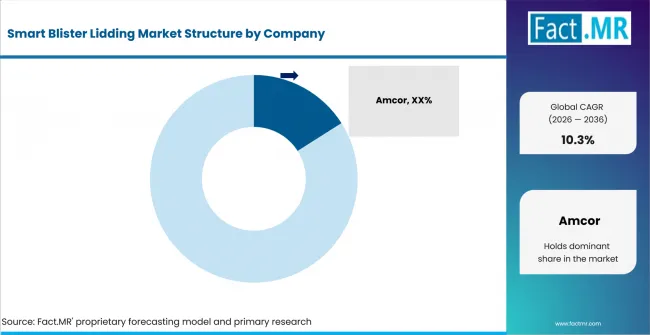
Smart Blister Lidding Market Analysis By Company | Source: Fact.MR
Smart blister lidding suppliers compete on seal performance and code reliability before they compete on price. Amcor and Constantia Flexibles bring healthcare packaging depth. TekniPlex Healthcare is directly relevant through blister lidding and barrier materials. Related pharmaceutical contract packaging activity supports demand for suppliers that can handle short runs and brand-specific artwork.
Huhtamaki remain important through recyclable blister structures and specialty films. ACG and UFlex add India-linked foil and security-packaging depth.
Providers that combine foil conversion and secure print control are better placed. Specialist printers can win where authentication requirements are complex but material volume is modest. Large converters gain when they can prove code readability and barrier strength in line trials.
Which companies are the key players?
Amcor and Constantia Flexibles are key players. Huhtamaki and ACG are also included. TekniPlex Healthcare are active suppliers. UFlex are also profiled.
- Amcor
- Constantia Flexibles
- Huhtamaki
- ACG
- TekniPlex Healthcare
- UFlex
Bibliography
- U.S. Food and Drug Administration. (2025, October 16). Drug Supply Chain Security Act. FDA.
- European Medicines Agency. (2024, December 16). Electronic product information report: Experience gained from creation of ePI during regulatory procedures for EU human medicines. EMA.
- World Health Organization. (2024, December 3). Substandard and falsified medical products. WHO.
- GS1. (2025). 2D barcodes in healthcare. GS1.
- European Medicines Verification Organisation. (2026, February 9). Celebrating seven years of the European Medicines Verification System. EMVO.
- Press Information Bureau. (2026, March 21). India’s pharmaceuticals in global healthcare. Government of India.
- National Medical Products Administration. (2025, March 25). Opinions of the General Office of the State Council on comprehensively deepening the reform of drug and medical device regulation. NMPA.
- Department of Health Northern Ireland. (2025, February 21). Windsor Framework: Disapplication of EU Falsified Medicines Directive Q&A. Government of the United Kingdom.
- U.S. International Trade Administration. (2025, November 20). Japan - Pharmaceuticals. U.S. Department of Commerce.
- U.S. International Trade Administration. (2026, May 22). France - Healthcare and life sciences. U.S. Department of Commerce.
- TekniPlex Healthcare. (2026, May 12). TekniPlex Healthcare to present recyclable blister packaging solutions at The Pharma Days 2026. TekniPlex Healthcare.
- Constantia Flexibles. (2024, February 16). Constantia Flexibles announces acquisition of Aluflexpack. Constantia Flexibles.
This Report Addresses
- Strategic intelligence on smart blister lidding across material and drug format.
- Segment analysis covering aluminium foil, tablets, pharma brands, and printed 2D codes.
- Regional outlook covering India, China, the United States, the United Kingdom, Germany, Japan, and France.
- Competitive analysis of Amcor and Constantia Flexibles plus TekniPlex Healthcare and ACG.
- Packaging assessment covering barrier performance and code readability.
- Regulatory assessment covering DSCSA and electronic product information plus European medicines verification.
- Primary interviews and supplier checks support the forecast with official source review.
What does the smart blister lidding market cover?
Connected and authentication-ready lidding materials used on pharmaceutical blister packs.
The smart blister lidding market covers blister pack lids that combine sealing performance with pack-level information functions. It includes aluminium foil and laminate lidding used for tablets and capsules. The market differs from standard lidding due to buyer payment for code readiness and patient communication value.
What is included in the scope?
Blister lidding materials with authentication and patient information functions.
The scope includes aluminium foil and paper-backed lidding. It covers PET and PE laminate lidding plus PVC-free and high-barrier lidding. It also includes printed 2D codes and serialized artwork zones. NFC tag placement and QR access layers are included when they are built into the blister lid.
What is excluded from the scope?
Plain lidding without traceability functions and non-blister packaging formats.
The scope excludes plain blister lidding sold without authentication or connected information. It excludes cartons and labels that do not seal blister cavities. It also excludes drug product revenue and software-only adherence apps that do not require a smart lidding interface.
How was the analysis built?
100+ sources, 35+ company portfolios, 25+ countries, and 20+ interviews.
- Primary Research: Primary research includes interviews with pharmaceutical packaging buyers and contract packagers. It includes input from foil converters and line-validation specialists.
- Desk Research: Desk research reviews traceability guidance from regulators and medicine verification bodies. It covers company product lines and smart-packaging launches.
- Market-Sizing and Forecasting: Forecasting uses the 2026 market anchor and a premium allocation above ordinary blister lidding. Traceability rules and patient information upgrades support the market assessment.
- Data Validation and Update Cycle: Forecasts are validated through supplier checks and parent-market comparison. Company activity and official regulatory updates help confirm market direction.
What is the report’s scope and coverage?
| Attribute | Details |
|---|---|
| Quantitative Units | USD Million in 2026 to USD Million by 2036 at CAGR |
| Market Definition | Connected and authentication-ready lidding materials used on pharmaceutical blister packs |
| Material | Aluminium foil, paper-backed lidding, PET laminate, PE laminate, PVC-free films, high-barrier laminates |
| Drug Format | Tablets, capsules, lozenges, OTC packs, clinical-trial dose packs |
| End User | Pharma brands, CDMOs, contract packagers, hospitals, retail pharmacy chains |
| Connectivity Method | Printed 2D codes, serialized artwork, NFC tags, QR access, tamper-evident identifiers |
| Pack Function | Authentication, patient information access, adherence support, recall readiness, clinical dose tracking |
| Sales Channel | Direct supply, converter partnerships, distributor supply, CDMO bundled supply, pharmacy procurement |
| Regions Covered | North America, Europe, East Asia, South Asia, Latin America, Middle East and Africa |
| Countries Covered | India, China, United States, United Kingdom, Germany, Japan, France |
| Key Companies Profiled | Amcor, Constantia Flexibles, Huhtamaki, ACG, TekniPlex Healthcare, UFlex |
| Forecast Period | 2026 to 2036 |
| Approach | Hybrid top-down and bottom-up approach using parent packaging checks, supplier validation and regulatory trigger analysis |
How is the market segmented?
-
By Material:
- Aluminium foil
- Paper-backed lidding
- PET laminate
- PE laminate
- PVC-free films
- High-barrier laminates
-
By Drug Format:
- Tablets
- Capsules
- Lozenges
- OTC packs
- Clinical-trial dose packs
-
By End User:
- Pharma brands
- CDMOs
- Contract packagers
- Hospitals
- Retail pharmacy chains
-
By Connectivity Method:
- Printed 2D codes
- Serialized artwork
- NFC tags
- QR access
- Tamper-evident identifiers
-
By Pack Function:
- Authentication
- Patient information access
- Adherence support
- Recall readiness
- Clinical dose tracking
-
By Sales Channel:
- Direct supply
- Converter partnerships
- Distributor supply
- CDMO bundled supply
- Pharmacy procurement
-
By Region:
- North America
- United States
- Canada
- Mexico
- Latin America
- Brazil
- Argentina
- Rest of Latin America
- Europe
- Germany
- United Kingdom
- France
- Italy
- Spain
- Rest of Europe
- Asia Pacific
- China
- India
- Japan
- South Korea
- ASEAN
- Middle East and Africa
- GCC Countries
- South Africa
- UAE
- Rest of Middle East and Africa
- North America