- Market Value (2025): USD 118.6 Mn
- Estimated Value (2026): USD 140.0 Mn
- Forecast Value (2036): USD 733.0 Mn
- CAGR (2026-2036): 18.0%
What is the Edible Algae Films Market forecast to be worth by 2036?
USD 140.0 million in 2026 to USD 733.0 million by 2036 at an 18.0% CAGR.
- The edible algae films market reached USD 118.6 million in 2025.
- Demand is projected to increase from USD 140.0 million in 2026 to USD 733.0 million by 2036.
- The market is forecast to record 18.0% CAGR from 2026 to 2036 as produce packers, foodservice operators and snack brands specify edible or compostable barrier layers.
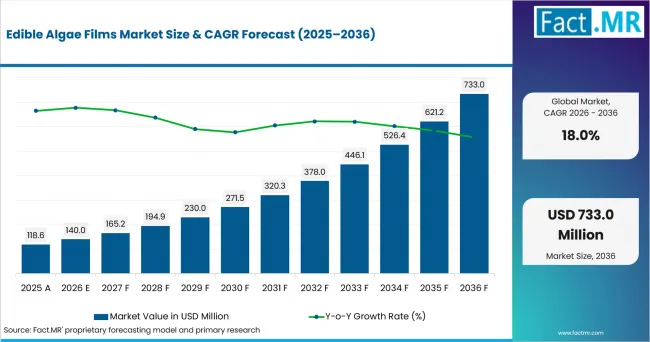
Edible Algae Films Market Value Analysis | Source: Fact.MR
What are the defining numbers behind Edible Algae Films Market growth?
USD 593.0 million absolute opportunity by 2036, led by brown seaweed alginate, flexible film and produce coatings.
- Demand Drivers in the Market
- Produce packers need edible coatings that slow moisture loss while reducing film overwrap on fresh fruit and vegetables.
- Foodservice operators need seaweed-coated trays and liners where PFAS-free barriers must still handle sauces and hot meals.
- Seasoning and snack brands need soluble sachets that reduce small plastic packs while keeping powders protected before use.
- FAO reported total global fisheries and aquaculture production of aquatic animals and algae at 235 million tonnes in 2024; aquaculture alone produced about 141 million tonnes including algae.
- Key Segments Analyzed
- By Feedstock: Brown seaweed alginate is expected to hold 34.0% share in 2026 due to film-forming behavior and broad use in food hydrocolloids.
- By Format: Flexible film is projected to account for 46.0% share in 2026 as brands test wrappers, sachets and thin protective layers.
- By Application: Produce coatings are anticipated to capture 47.0% share in 2026 owing to direct use on fruit and vegetable surfaces.
- By Barrier Function: Moisture control is estimated to represent 41.0% share in 2026 because freshness loss often starts with dehydration or condensation.
- Analyst Opinion at Fact.MR
- Shambhu Nath Jha, Principal Consultant at Fact.MR, states, “Edible algae films occupy the narrow space between food ingredients and packaging conversion. The market is expected to reward suppliers that prove barrier performance under real food-contact conditions. Stronger suppliers should combine feedstock control, migration documentation and converter-ready coatings.”
- Strategic Implications
- Film developers should qualify moisture, oxygen and grease performance on real food formats before claiming broad plastic replacement.
- Food brands should separate edible-film trials by use case, since produce coatings and sachets need different shelf-life evidence.
- Converters should test seaweed coatings on existing paperboard and flexible-film equipment to reduce approval and scale-up risk.
- Retailers should require food-contact, allergen and end-of-life documentation before national shelf rollout.
South Korea is projected to record 21.7% CAGR through 2036 owing to seaweed exports and foodservice conversion. Germany is expected to post 18.3% as recycling pressure raises interest in algae-coated board. Japan is anticipated to advance at 17.4% due to export food packaging and seaweed familiarity. The UK is forecast to hold 17.1% with food manufacturing creating early channels. The USA is estimated at 15.7% because food spending supports a wider testing base.
How does the Edible Algae Films Market break down by segment?
Brown seaweed alginate leads Feedstock at 34.0%; Flexible film leads Format at 46.0%.
Which Feedstock leads?
Brown seaweed alginate is expected to hold 34.0% share in 2026.
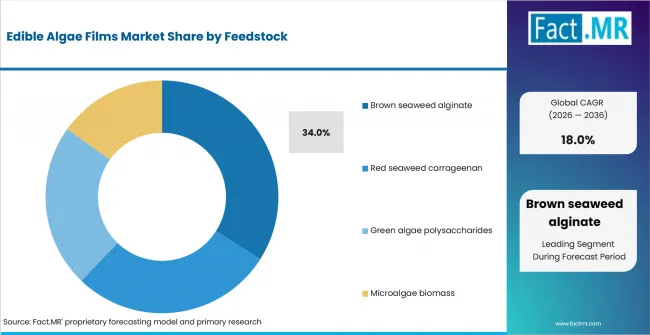
Edible Algae Films Market Analysis By Feedstock | Source: Fact.MR
Brown seaweed alginate leads because it forms stable gels and films under relatively mild processing conditions. Its film-forming properties support coatings, thin wrappers and edible layers for heat-sensitive foods. Producers also value its compatibility with water-based processing, which supports development across food packaging and protective coating applications.
What leads the Format segment?
Flexible film is projected to account for 46.0% share in 2026.
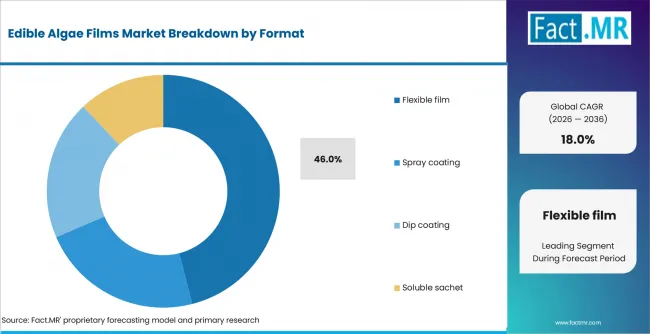
Edible Algae Films Market Analysis By Format | Source: Fact.MR
Flexible film leads because it fits familiar wrapping, sachet and portion-pack applications without requiring a complete packaging redesign. Producers can test algae-based films as thin functional layers within existing formats. This approach supports gradual adoption while allowing converters to evaluate sealing, barrier performance, handling and shelf-life requirements.
How does Application shape demand?
Produce coatings are anticipated to capture 47.0% share in 2026.
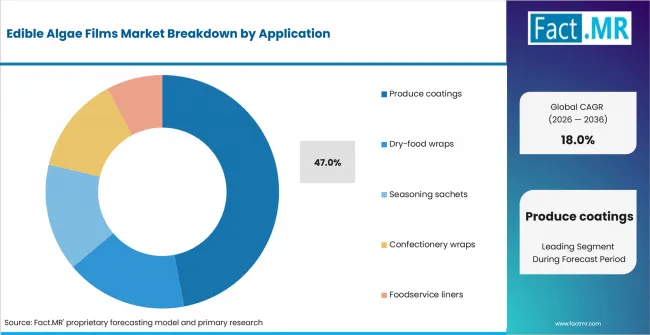
Edible Algae Films Market Analysis By Application | Source: Fact.MR
Produce coatings lead where algae films are applied directly to fruit and vegetable surfaces. The coating must slow moisture loss without changing taste or appearance. Retailers value the format when it reduces overwrap on high-turnover produce lines.
What supports Barrier Function demand?
Moisture control is estimated to represent 41.0% share in 2026.
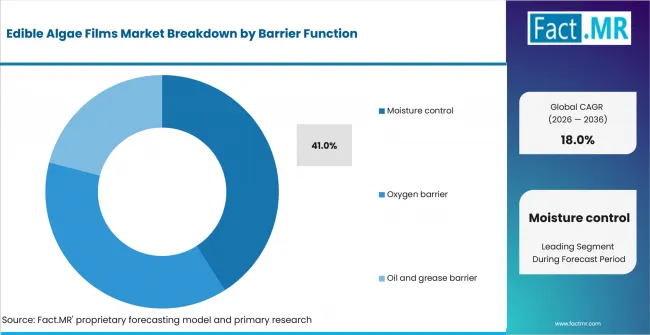
Edible Algae Films Market Analysis By Barrier Function | Source: Fact.MR
Moisture control leads since water transfer quickly affects produce texture and dry-food crispness. Algae films must balance vapor resistance with safe contact where a film is eaten or dissolved. Oxygen barrier and oil or grease barrier uses remain relevant where recipes need stronger protection.
What is accelerating Edible Algae Films Market adoption, and what is holding it back?
Demand is expected to rise through produce coatings, flexible films and plastic-reduction rules. Growth is limited by food-contact approvals, feedstock variability and scale-up costs.
Drivers Impact Analysis
| DRIVER | (~) % IMPACT ON CAGR | GEOGRAPHIC RELEVANCE | IMPACT TIMELINE |
|---|---|---|---|
| Produce coating demand for fresh food | +1.8% | North America, Europe, East Asia | Short term (<= 2 years) |
| Plastic packaging policy and tax pressure | +1.5% | Europe, United Kingdom, Japan | Medium term (2-4 years) |
| Foodservice conversion to plastic-free barriers | +1.1% | United Kingdom, USA, Germany | Medium term (2-4 years) |
| Soluble sachets for portioned foods | +0.8% | Asia Pacific, North America | Long term (>= 4 years) |
Source: Fact.MR analysis. Updated Aug 21, 2026
- Produce coating demand is expected to rise where retailers need thin protective layers that reduce dehydration and visible overwrap on fresh items.
- Plastic packaging policy is expected to raise trial urgency where food brands need credible alternatives before tax or compliance costs harden.
- Foodservice conversion is anticipated to support algae-coated paperboard when venues need plastic-free barriers that still handle wet and hot foods.
Opportunity Impact Analysis
| OPPORTUNITY | (~) % IMPACT ON CAGR | GEOGRAPHIC RELEVANCE | IMPACT TIMELINE |
|---|---|---|---|
| Seaweed-coated foodservice board | +1.3% | United Kingdom, Europe, USA | Short term (<= 2 years) |
| Soluble sachets for seasonings and concentrates | +1.0% | East Asia, North America | Medium term (2-4 years) |
| Converter partnerships for barrier coatings | +0.9% | Europe, North America | Long term (>= 4 years) |
Source: Fact.MR analysis. Updated Aug 21, 2026
- Seaweed-coated board is expected to give foodservice operators a route to replace plastic liners while keeping familiar trays and boxes.
- Soluble sachets are projected to create room for algae films in dry powders, seasoning blends and measured foodservice ingredients.
- Converter partnerships are expected to shorten scale-up because coating behavior must be proven on commercial equipment.
Restraints Impact Analysis
| RESTRAINT | (~) % IMPACT ON CAGR | GEOGRAPHIC RELEVANCE | IMPACT TIMELINE |
|---|---|---|---|
| Food-contact approval work by formulation | -0.7% | Global | Short term (<= 2 years) |
| Moisture sensitivity in wet foods | -0.6% | North America, Europe, East Asia | Medium term (2-4 years) |
| Variable seaweed quality and hydrocolloid pricing | -0.5% | East Asia, Europe | Long term (>= 4 years) |
Source: Fact.MR analysis. Updated Aug 21, 2026
- Food-contact approval work is expected to slow rollouts because each formulation needs evidence on migration, intended use and shelf-life behavior.
- Moisture sensitivity is anticipated to limit use in wet foods when algae films soften before the product reaches the consumer.
- Feedstock variability is likely to affect film strength and barrier repeatability when species, harvest season or processing method changes.
Which countries are scaling the Edible Algae Films Market through 2036?
- The country comparison spans 6.0 percentage points across the five profiled markets.
- South Korea remains 3.4 percentage points above Germany, reflecting export-oriented seaweed processing and foodservice packaging trials.
- Germany remains 0.9 percentage point above Japan, supported by dual-system packaging recycling and retailer interest in coated board.
- Japan remains 0.3 percentage point above the UK, owing to premium food exports and municipal recycling discipline.
- The UK remains 1.4 percentage points above the USA, with food manufacturing scale and Plastic Packaging Tax reporting raising substitution pressure.
- The USA closes the displayed range because broad food spending is balanced by food-contact review and feedstock scale-up.
Comparable CAGRs create different entry conditions due to seaweed supply, food-contact rules, packaging policy and converter readiness. Full report coverage includes North America, Latin America, Western Europe, Eastern Europe, East Asia, South Asia & Pacific, Middle East & Africa.
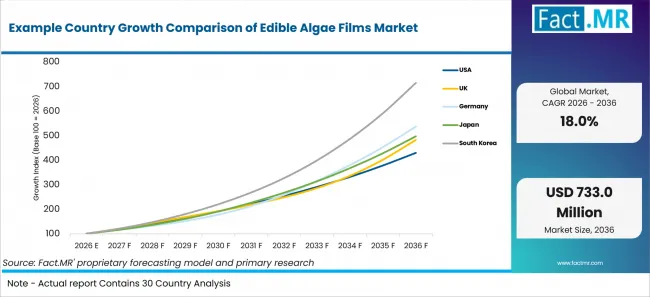
Example Country Growth Comparison Of Edible Algae Films Market | Source: Fact.MR
| Country | CAGR (2026-2036) |
|---|---|
| South Korea | 21.7% |
| Germany | 18.3% |
| Japan | 17.4% |
| United Kingdom | 17.1% |
| United States | 15.7% |
Source: Fact.MR analysis. Updated Aug 21, 2026
What supports South Korea adoption?
21.7% CAGR, supported by seaweed exports and foodservice packaging conversion.
South Korea’s growth is supported by its established seaweed industry and foodservice market. The Ministry of Oceans and Fisheries reported in January 2026 that gim exports reached USD 1.13 billion in 2025, while the Ministry of Data and Statistics reported in February 2026 that restaurants and hotels accounted for 15.8% of household consumption expenditure in 2025. Korean converters are expected to adapt alginate and carrageenan technologies for soluble sachets and coated packaging.
What supports Germany adoption?
18.3% CAGR, backed by packaging recycling pressure and retail food channels.
Germany’s growth reflects strong packaging-recycling activity and a large retail market. Umweltbundesamt and the Central Agency Packaging Register reported in January 2026 that around 5.5 million tonnes of packaging waste collected through Germany’s dual systems was recovered in 2024. Destatis reported in February 2026 that real retail turnover increased 2.7% in 2025. Seaweed-derived high-barrier coatings are being developed for paper-based packaging, including food applications, while Destatis reported that prices for restaurant and accommodation services increased 3.8% in 2025.
How is Japan scaling demand?
17.4% CAGR, reinforced by premium food exports and recycling discipline.
Japan’s growth is supported by expanding food exports and established recycling practices. MAFF reported that agriculture, forestry, fisheries and food exports increased 12.8% to JPY 1.7005 trillion in 2025, while the Ministry of the Environment reported a 19.3% municipal-waste recycling rate in FY2024. Familiarity with seaweed may support edible coatings and soluble films for premium foods.
What supports the United Kingdom’s growth?
17.1% CAGR, driven by food manufacturing depth and packaging-tax pressure.
The United Kingdom’s growth reflects its large food-manufacturing base and policy pressure on conventional plastic packaging. ONS reported that food manufacturing represented 22.9% of total UK manufacturers’ sales in 2025, while HMRC reported that 38% of declared plastic-packaging tonnage was taxable under Plastic Packaging Tax in 2024 to 2025. Seaweed-coated boxes and algae barriers may gain pilot use in foodservice applications.
What supports USA adoption?
15.7% CAGR, supported by food spending and seaweed aquaculture planning.
The USA’s growth is supported by its large food market and expanding interest in domestic seaweed aquaculture. USDA ERS reported that total U.S. food spending reached USD 2.51 trillion in 2025, while NOAA NCCOS identified 77 Aquaculture Opportunity Area options across 10 study areas in the Gulf of Alaska with potential for seaweed and shellfish aquaculture. Produce packers are expected to test edible coatings for freshness applications.
Who leads the Edible Algae Films Market?
Notpla shows the clearest direct relevance through seaweed-coated foodservice packaging and venue-scale deployment, while Sway, Evoware and FlexSea broaden the competitive field across flexible films, edible formats and marine-biomass materials.
Notpla supports commercial adoption through seaweed-based coatings designed for foodservice packaging. Sway contributes seaweed-derived flexible packaging materials, while Evoware extends the market through edible and seaweed-based packaging formats. FlexSea adds marine-biomass film development and flexible material capabilities. Competition is expected to center on food-contact performance, barrier reliability, converter compatibility and the ability to scale algae-based materials into practical packaging applications.
Which companies are the main providers?
Key companies include Notpla; Sway; Evoware; FlexSea.
- Notpla
- Sway
- Evoware
- FlexSea
Bibliography
- Food and Agriculture Organization of the United Nations. (2026, June 16).
- U.S. Environmental Protection Agency. (2026, July 31). U.S. recycling infrastructure assessment and state data collection reports.
- Office for National Statistics. (2026, July 24). UK manufacturers' sales by product: 2025.
- HM Revenue & Customs. (2025, August 28). Plastic Packaging Tax (PPT) statistics commentary.
- Department for Environment, Food & Rural Affairs. (2025, July 23). UK statistics on waste.
- German Environment Agency. (2026, January 27). Facts against myths: Packaging waste recycling in Germany is working.
- Statistisches Bundesamt. (2026, January 7). Einzelhandelsumsatz im Jahr 2025 real voraussichtlich um 2,4 % höher als im Vorjahr [Retail turnover in 2025 expected to be 2.4% higher in real terms than in the previous year].
- Federal Statistical Office (Destatis). (2026, January 16). Correction: Inflation rate at +2.2% in 2025.
- Ministry of the Environment, Government of Japan. (2026, March 27). Municipal solid waste generation and disposal in FY2024.
- Ministry of Data and Statistics. (2026, February 26). Household income and expenditure trends in the fourth quarter of 2025 (Including household expenditure trends in 2025).
This Report Answers
- The report explains edible algae film use across feedstock, format, application and barrier function.
- Segment analysis identifies leading subsegments and why food brands prioritize them.
- Country analysis examines the policy, foodservice and seaweed-supply mechanisms supporting adoption.
- Competitive analysis reviews providers across seaweed-coated board, flexible film, edible formats and soluble sachets.
- Application analysis assesses how barrier functions influence purchase decisions.
What does the Edible Algae Films Market cover?
The Edible Algae Films Market covers algae-derived films and coatings used in direct food-contact applications. It includes alginate and carrageenan systems, produce coatings, soluble sachets and coated foodservice formats.
The scope connects with edible packaging where the pack is designed for safe contact or direct consumption. Feedstock analysis links closely to alginate barrier films since brown seaweed alginate leads the material split. Food applications overlap with sustainable food packaging when coatings protect produce, dry foods or foodservice packs.
What is included in the scope?
The scope includes commercial or pilot-scale edible algae films, food-contact seaweed coatings, soluble sachet films and algae-derived barrier layers. It includes flexible film, spray coating, dip coating and soluble sachet formats used in food packaging.
Flexible and layered formats are compared with compostable laminate packaging materials only where algae layers serve a barrier role. Polymer substitution is adjacent to bioplastics for packaging when algae ingredients are blended into bio-based film systems.
What is excluded from the scope?
The scope excludes conventional plastic films without algae content, algae ingredients sold without packaging function, raw edible seaweed and pharmaceutical films outside food packaging.
General biodegradable packs are excluded unless they contain an algae film or coating, even when they fall within biodegradable packaging material categories. Broader sustainable packaging is referenced only when the pack uses algae-derived edible film functionality.
How Was the Analysis Built?
The analysis draws on 120+ sources and 35+ company portfolios. It also covers 25+ countries and more than 20 industry interviews.
- Primary Research: Primary research includes discussions with converters, food brands and algae processors. It also covers coating developers, distributors and foodservice buyers.
- Desk Research: Desk research covers government statistics, regulatory publications and company announcements. It also reviews technical studies, trade data, standards and public policy.
- Market Sizing and Forecasting: Market estimates combine historical performance, demand indicators and segment shares. The model also reviews country growth, adoption patterns and barriers.
- Data Validation and Update Cycle: Findings are validated by comparing interviews with public data, company activity, regulatory changes and commercial adoption. Updates review product launches, partnerships and procurement shifts.
Segmentation
What is the report’s scope and coverage?
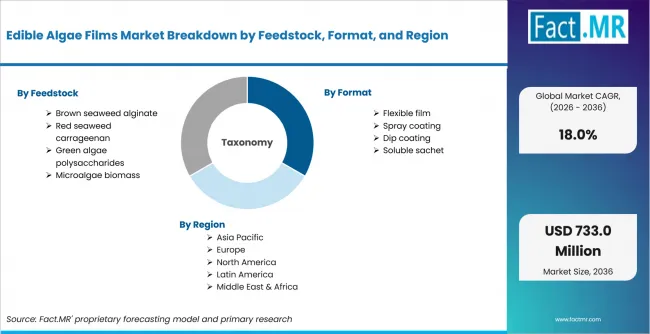
Edible Algae Films Market Breakdown By Feedstock, Format, And Region | Source: Fact.MR
| Attribute | Details |
|---|---|
| Quantitative Units | USD million |
| Market Definition | Edible algae films are algae-derived films, coatings and soluble formats used for food-contact packaging, produce protection and foodservice barrier applications. |
| Feedstock | Brown seaweed alginate; Red seaweed carrageenan; Green algae polysaccharides; Microalgae biomass |
| Format | Flexible film; Spray coating; Dip coating; Soluble sachet |
| Application | Produce coatings; Dry-food wraps; Seasoning sachets; Confectionery wraps; Foodservice liners |
| Barrier Function | Moisture control; Oxygen barrier; Oil and grease barrier |
| Regions Covered | North America; Latin America; Western Europe; Eastern Europe; East Asia; South Asia & Pacific; Middle East & Africa |
| Countries Covered | United States; United Kingdom; Germany; Japan; South Korea |
| Companies Profiled | Notpla; Sway; Evoware; FlexSea |
| Forecast Period | 2026 to 2036 |
| Approach | Hybrid top-down and bottom-up approach using food-contact packaging use cases, algae feedstock availability, country adoption signals, segment shares and provider portfolio review. |
Source: Fact.MR analysis. Updated Aug 21, 2026
How is the market segmented?
-
By Feedstock
- Brown seaweed alginate
- Red seaweed carrageenan
- Green algae polysaccharides
- Microalgae biomass
-
By Format
- Flexible film
- Spray coating
- Dip coating
- Soluble sachet
-
By Application
- Produce coatings
- Dry-food wraps
- Seasoning sachets
- Confectionery wraps
- Foodservice liners
-
By Barrier Function
- Moisture control
- Oxygen barrier
- Oil and grease barrier
-
By Region
- North America
- Latin America
- Western Europe
- Eastern Europe
- East Asia
- South Asia & Pacific
- Middle East & Africa
Frequently Asked Questions
How big is the edible algae films market in 2026?
What is the CAGR of the edible algae films market from 2026 to 2036?
Which feedstock leads the edible algae films market?
Which format leads the edible algae films market?
Who are the main companies in the edible algae films market?
Who worked on this report


Preview the report firsthand - request a free sample
Free SampleGet the brochure for pricing and purchase details
Download PDF