- Base Value(2025): 1.5 Bn
- Estimated Value(2026): 1.6 Bn
- Forecast Value (2036): 2.4 Bn
- CAGR (2026 - 2036): 4.3%
Edible Oil Cans Market Forecast and Outlook 2026 to 2036
In 2025, the edible oil cans market was valued at USD 1.5 billion. Based on Fact.MR analysis, demand for edible oil cans is estimated to reach USD 1.6 billion in 2026 and USD 2.4 billion by 2036, reflecting a CAGR of 4.3% during the forecast period. Market growth is supported by rising packaged edible oil consumption, expansion of organized retail, and increasing preference for larger pack sizes in household and foodservice channels.
The market adds approximately USD 0.9 billion in value over the forecast window, reflecting steady, distribution-led expansion rather than rapid volume acceleration. Early-period growth is supported by rising use of HDPE and tinplate cans for bulk edible oil distribution in Asia. Mid-period performance aligns with increased adoption of lightweight plastic cans and improved barrier properties to enhance shelf life. In the later years, value growth is shaped by capacity upscaling toward 10-20 liter and above formats for institutional buyers, while regulatory pressure on material recyclability influences design and material mix.
China leads growth at 6.2% CAGR, supported by high edible oil consumption volumes and bulk packaging demand. India follows at 5.8%, driven by urbanization and growth in branded edible oil sales. Brazil records 4.8% aligned with food processing and retail expansion. Germany grows at 4.5%, while the United States at 4.2% remains replacement-driven with stable consumption patterns. The United Kingdom at 3.9% and Japan at 3.5% reflect mature markets constrained by slower volume growth and established alternative packaging formats.
Edible Oil Cans Market
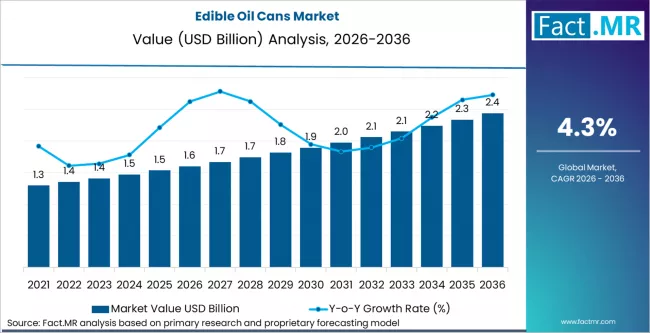
Edible Oil Cans Market Market Value Analysis | Source: Fact.MR
| Metric | Value |
|---|---|
| Market Value (2026) | USD 1.6 billion |
| Forecast Value (2036) | USD 2.4 billion |
| Forecast CAGR (2026-2036) | 4.3% |
Source: Fact.MR analysis. Updated Feb 26, 2026
Edible Oil Cans Market Definition
The edible oil cans market covers rigid metal containers used for packaging, storage, and transportation of edible oils intended for human consumption. These cans are commonly manufactured from tinplate or steel and are designed to protect oil quality by limiting exposure to light, air, and contamination. They are used across retail, food service, and bulk supply chains for products such as cooking oil, vegetable oil, and specialty edible oils. Food contact safety, packaging materials, and labeling requirements are regulated by authorities including the US Food and Drug Administration and national food safety regulators. [1]
Edible Oil Cans Market Inclusions
The report covers global and regional market size estimates in volume and value terms with a forecast period from 2026 to 2036. Segmentation includes can capacity, material type, coating and lining type, application across retail and bulk packaging, and end use covering household consumption, food service, and industrial buyers. The scope also includes regional demand patterns, pricing benchmarks, and international trade flows for metal packaging products used for edible oils.
Edible Oil Cans Market Exclusions
The scope excludes plastic bottles, flexible pouches, glass containers, and composite packaging formats used for edible oils. Bulk storage tanks and intermediate containers used at refineries are not included. Packaging for non-edible oils such as lubricants and industrial oils is excluded. Filling machinery, labeling equipment, transport services, consumer retail operations, laboratory packaging trials, and prototype container designs without commercial deployment are also outside the scope.
Edible Oil Cans Market Research Methodology
- Primary Research: Primary research involved interviews with edible oil can manufacturers, metal packaging suppliers, edible oil producers, and food packaging procurement managers.
- Desk Research: Desk research used food contact material regulations and packaging guidance issued by the US Food and Drug Administration and the Food Safety and Standards Authority of India, along with national edible oil production statistics and company annual reports.
- Market Sizing and Forecasting: Market sizing applied a hybrid top down and bottom up model using edible oil production volumes, packaging format shares, can size distribution, and replacement demand across retail and bulk segments.
- Data Validation and Update Cycle: Outputs were cross checked against food safety compliance records, trade statistics, packaging material disclosures, and publicly available production data, with updates applied when verified public sources issue revisions.
Summary of Edible Oil Cans Market
- Market Definition
- The edible oil cans market refers to rigid metal and plastic containers used for packaging, storage, and distribution of edible oils across retail, foodservice, and bulk supply chains, designed to protect oil quality and comply with food contact safety standards.
- Demand Drivers
- Rising packaged edible oil consumption in Asia, particularly in China and India, increases demand for durable mid- to large-capacity cans suited for household and institutional use.
- Food contact and packaging material regulations enforced directly influence can material selection, coatings, and compliance costs for manufacturers.
- Expansion of organized retail and wholesale distribution channels favors jerry cans and larger formats that support efficient handling, stacking, and long-distance transport under standardized packaging norms.
- Key Segments Analyzed
- Jerry cans lead with about 55% share due to resealability, ease of handling, and suitability for 5020 liter household and commercial packs.
- Metal cans account for roughly 30% share, driven by superior light and oxygen barrier performance for bulk and institutional edible oil distribution.
- Asia Pacific represents the fastest-growing region, led by China and India, while Europe, the United States, and Japan remain replacement-driven and mature.
- Analyst Opinion at Fact.MR
- Shambhu Nath Jha, Principal Consultant at Fact.MR, opines, ‘CXOs will find this report useful for evaluating how food safety regulations, retail packaging formats, and bulk distribution requirements are shaping material choices, capacity mix, and long-term investment decisions in the edible oil cans market.’
- Strategic Implications / Executive Takeaways
- Manufacturers should prioritize jerry can designs optimized for 10020 liter and above capacities targeting foodservice and institutional buyers.
- Compliance-led investment in food-grade coatings and linings remains critical to sustain contracts with branded edible oil producers.
- Regional production alignment in Asia Pacific can improve logistics efficiency and cost competitiveness.
- Methodology
- Market sizing is derived from edible oil production volumes, packaging format shares, and can capacity distribution.
- Validation uses food safety compliance records, packaging regulations, and trade statistics.
- Forecasts apply repeatable top-down and bottom-up models anchored in verified consumption and packaging data.
Segmental Analysis
Edible Oil Cans Market Analysis by Material Type
Edible Oil Cans Market Analysis By Material Type | Source: Fact.MR
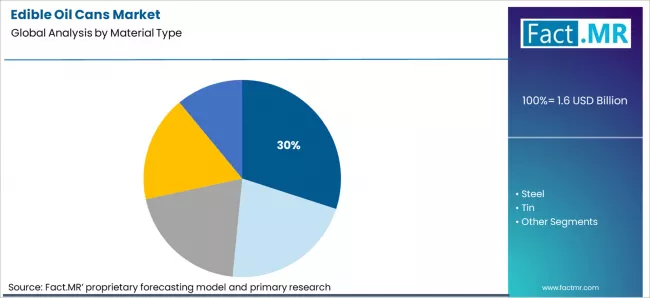
Based on Fact.MR analysis, consumption of metal edible oil cans is estimated to hold 30% share of the global market. Fact.MR analysts note that metal containers remain relevant due to strength, light barrier properties, and suitability for bulk packaging formats. As per Fact.MR, metal cans address manufacturer requirements for extended shelf stability, resistance to oxygen exposure, and compatibility with filling lines used in large-scale edible oil processing facilities across regional distribution networks worldwide today serving wholesale and institutional buyers in many markets.
- Food safety framework: Packaging materials used for edible oils must comply with food contact regulations. [2]
- Barrier performance: Fact.MR analysts note metal packaging limits light exposure that affects oil stability.
- Bulk handling: Metal containers support stacking and long-distance transport in distribution chains.
Edible Oil Cans Market Analysis by Product Type
Edible Oil Cans Market Analysis By Product Type | Source: Fact.MR
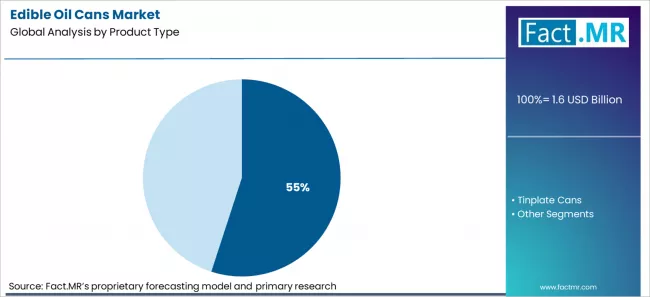
Based on Fact.MR analysis, consumption of jerry cans is estimated to hold 55% share of the global edible oil cans market. Fact.MR analysts note that jerry cans lead due to ease of handling, resealable closures, and suitability for multi-liter household and commercial packaging sizes. As per Fact.MR, this product type addresses distributor and retailer needs for durable, spill-resistant containers that maintain structural integrity during storage and transport across wholesale, retail, and institutional supply channels worldwide today.
- Packaging compliance: Food packaging containers must meet labeling and material safety requirements under national regulations. [3]
- Retail suitability: Fact.MR analysts note jerry cans are widely used for mid-volume edible oil sales.
- Transport efficiency: Jerry cans support efficient palletization and stacking during shipment.
Edible Oil Cans Market Drivers, Restraints, And Opportunities
Fact.MR analysis indicates that the edible oil cans market exists as a packaging solutions segment supporting edible oil supply chains, where steel and tinplate cans provide stable, hygienic, and corrosion-resistant containers for bulk and retail edible oils. As per Fact.MR assessment, packaging formats for edible oils are influenced by food safety and material contact regulations such as those overseen by the U.S. Food and Drug Administration (FDA) food contact substance regulations, which define requirements for materials intended to come into contact with food [4]. Fact.MR analysts observe that the current market scale is linked to established edible oil consumption patterns in Asia, Africa, and Middle Eastern markets where tinplate and steel cans are preferred for their shelf-life stability, resistance to oxidation, and ability to preserve quality during storage and transport.
Fact.MR is of the opinion that the market is transitioning between conventional large-format tinplate edible oil cans and diversified packaging formats such as PET bottles and composite cartons that respond to cost and convenience considerations. Based on Fact.MR assessment, traditional cans continue to account for significant volume in bulk and institutional supply channels due to durability, resistance to leakage, and ease of transport, while demand also grows in retail segments where consumer convenience plays a greater role. Edible oil cans generally carry pricing that reflects material costs and can manufacturing complexity, which can support realised value even where shipment volumes grow at a measured pace. Fact.MR analysis suggests that near-term market progression will be shaped by balancing durability, cost, and consumer preference dynamics.
- Food contact material regulations: Fact.MR analysts note that compliance with U.S. FDA food contact substance regulations for packaging materials influences how manufacturers design and qualify edible oil cans intended to come into contact with food products.
- Shift toward convenience formats: Based on Fact.MR assessment, rising consumer preference for convenient packaging such as pourable PET bottles and lightweight composite cartons influences demand alongside traditional can formats.
- Asia Pacific consumption growth: Fact.MR opines that growing edible oil consumption across China, India, and Southeast Asia supports regional demand for edible oil cans in bulk supply chains and institutional distribution.
Regional Analysis
Based on regional assessment, the edible oil cans sector is analyzed across North America, Europe, East Asia, South Asia, Latin America, and other key consumption regions, spanning more than 40 countries. Regional performance varies according to edible oil consumption volumes, packaging material preferences, regulatory standards for food-grade containers, and growth in organized retail and bulk oil distribution channels.
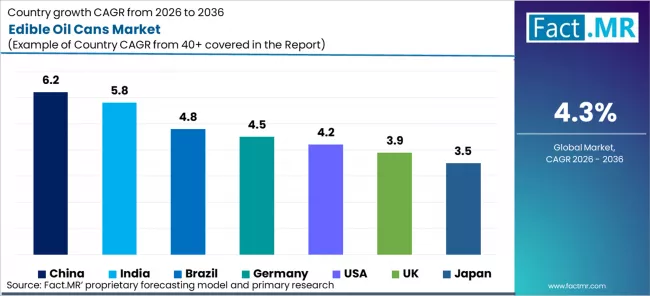
Edible Oil Cans Market Cagr Analysis By Country | Source: Fact.MR
| Country | CAGR |
|---|---|
| China | 6.2% |
| India | 5.8% |
| Brazil | 4.8% |
| Germany | 4.5% |
| United States | 4.2% |
| United Kingdom | 3.9% |
| Japan | 3.5% |
Source: Fact.MR analysis. Updated Feb 26, 2026
Source: Fact.MR analysis, based on proprietary forecasting models and primary research.
Asia Pacific Edible Oil Cans Market Analysis
Asia Pacific operates as a high volume food packaging driven edible oil cans region supported by strong household consumption and large scale edible oil refining capacity. Demand is shaped by retail packaging standards food safety compliance and expansion of organized distribution networks. Adoption is concentrated in China and India where metal and plastic cans serve household and bulk segments. Growth reflects urban population expansion branded oil sales and packaging modernization across regional refining and distribution ecosystems.
- China: Demand for edible oil cans in China is projected to rise at 6.2% CAGR through 2036. Consumption is supported by large scale edible oil production branded retail packaging and growth of organized distribution channels, as per Fact.MR.
- India: Demand for edible oil cans in India is projected to rise at 5.8% CAGR through 2036. Usage reflects strong household oil consumption and increasing adoption of standardized packaged formats in retail markets, according to Fact.MR.
Fact.MR’s analysis of the Edible Oil Cans Market in Asia Pacific consists of country-wise assessment that includes China and India. Readers can find packaging demand trends refining capacity insights and retail distribution references.
Europe Edible Oil Cans Market Analysis
Europe functions as a mature food packaging market for edible oil cans shaped by retail regulation labeling standards and stable consumption patterns. Demand is influenced by private label penetration sustainability oriented packaging preferences and established supermarket networks. Adoption is concentrated in Germany and the United Kingdom where metal cans and rigid packaging formats serve household and foodservice applications. Market activity reflects replacement demand brand differentiation and compliance with regional food safety requirements across structured retail environments.
- Germany: Demand for edible oil cans in Germany is projected to rise at 4.5% CAGR through 2036. Usage reflects stable household oil consumption and organized supermarket distribution channels, as per Fact.MR.
- United Kingdom: Demand for edible oil cans in the United Kingdom is projected to rise at 3.9% CAGR through 2036. Adoption is supported by established retail networks and packaged cooking oil sales, according to Fact.MR.
Fact.MR’s analysis of the Edible Oil Cans Market in Europe consists of country-wise assessment that includes Germany and the United Kingdom. Readers can find retail packaging trends and consumption structure insights.
North America Edible Oil Cans Market Analysis
North America operates as a consumption oriented edible oil cans market supported by packaged food demand and established retail supply chains. Demand is shaped by household cooking oil usage private label brands and foodservice packaging needs. Adoption is centered in the United States where metal and rigid packaging formats serve retail and institutional channels. Market activity reflects stable replacement demand brand positioning and steady packaged oil sales across supermarkets warehouse clubs and ecommerce platforms nationally.
- United States: Demand for edible oil cans in the United States is projected to rise at 4.2% CAGR through 2036. Usage reflects packaged cooking oil consumption and strong penetration of organized retail and foodservice channels, as per Fact.MR.
Fact.MR’s analysis of the Edible Oil Cans Market in North America consists of country-wise assessment that includes the United States. Readers can find packaged food demand patterns and retail structure references.
Latin America Edible Oil Cans Market Analysis
Latin America functions as a growing packaged food and edible oil market influenced by rising urban consumption and expanding retail networks. Demand for edible oil cans is shaped by household cooking patterns branded oil sales and modernization of distribution systems. Adoption is concentrated in Brazil where metal and rigid containers support retail and bulk segments. Growth reflects population expansion increased packaged oil penetration and strengthening supermarket infrastructure across urban centers regionwide.
- Brazil: Demand for edible oil cans in Brazil is projected to rise at 4.8% CAGR through 2036. Usage reflects steady household oil consumption and expansion of packaged formats within organized retail channels, according to Fact.MR.
Fact.MR’s analysis of the Edible Oil Cans Market in Latin America consists of country-wise assessment that includes Brazil. Readers can find consumption trends retail modernization insights and packaging demand references.
Japan Edible Oil Cans Market Analysis
Japan operates as a mature and quality driven edible oil cans market supported by stable household consumption and established food safety compliance. Demand is influenced by compact packaging formats retail standards and steady supermarket distribution. Market activity reflects replacement demand and consistent packaged oil sales rather than volume expansion.
- Japan: Demand for edible oil cans in Japan is projected to rise at 3.5% CAGR through 2036. Usage reflects stable packaged oil consumption and established retail distribution systems, as per Fact.MR.
Fact.MR’s analysis of the Edible Oil Cans Market in Japan consists of country-wise assessment that includes Japan. Readers can find retail demand patterns and packaging structure insights.
Competitive Landscape of Edible Oil Cans Market
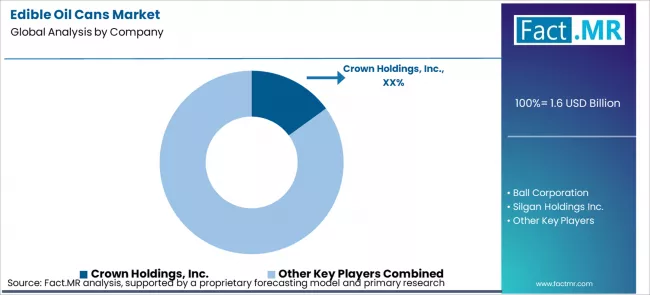
Edible Oil Cans Market Analysis By Company | Source: Fact.MR
As per Fact.MR analysis, the 2026 edible oil cans market is defined by validated packaging durability, regulatory compliance, and supply chain reliability, which determine competitive advantage. Crown Holdings, Inc. and Ball Corporation lead with high-quality metal cans and verified corrosion resistance, which strengthens adoption in global edible oil supply chains. Silgan Holdings Inc. and Ardagh Group S.A. focus on multi-layered coatings and consistent sealing performance, which reduces product spoilage and improves shelf-life. CCL Industries Inc. and Kian Joo Can Factory emphasize scalable production and adherence to food safety standards, which enhances OEM and brand trust. Parekhplast India Limited and Yee Lee Corporation Bhd provide regionally optimized packaging solutions with validated material compatibility, which supports emerging market growth. CAN-PACK S.A., Toyo Seikan Group Holdings, Ltd., and Huber Packaging Group GmbH offer specialized coatings and lightweight cans, which improve logistics efficiency. Massilly Group, Trivium Packaging, Mauser Packaging Solutions, and Greif, Inc. ensure consistent quality control and multi-region compliance, which supports high-volume contracts. Time Technoplast Limited, Manaksia Limited, and CPMC Holdings Limited provide flexible and sustainable packaging solutions, which reinforce adoption in eco-conscious markets. Across the market, validated material durability, regulatory adherence, and supply chain continuity form enduring competitive moats, reducing reliance on pricing or isolated product features.
Recent Industry Developments
- Ball Corporation (Jan 2026): Scaled its India operations with a $60M facility investment in Sri City, focusing on high-growth aluminum demand. The expansion utilizes retort technology to extend shelf life for oil-based and dairy products while maintaining nutritional integrity. [5]
- Greif, Inc. (Jan 2026): Reorganized its business into Innovative Closure Solutions, specifically targeting the high-end industrial oil segment. The firm achieved $65M in cost-optimization savings, reallocating capital to sustainable fiber and metal packaging for bulk food grade oils. [6]
Key Players in Edible Oil Cans Market
- Crown Holdings, Inc.
- Ball Corporation
- Silgan Holdings Inc.
- Ardagh Group S.A.
- CCL Industries Inc.
- Kian Joo Can Factory Berhad
- Parekhplast India Limited
- Yee Lee Corporation Bhd
- CAN-PACK S.A.
- Toyo Seikan Group Holdings, Ltd.
- Huber Packaging Group GmbH
- Massilly Group
- Trivium Packaging
- Mauser Packaging Solutions
- Greif, Inc.
- Time Technoplast Limited
- Manaksia Limited
- CPMC Holdings Limited
References
- [1] U.S. Food and Drug Administration. (2024). Food ingredients and packaging: Food contact materials. U.S. Department of Health and Human Services; Food Safety and Standards Authority of India. (2024). Food packaging regulations and standards. FSSAI.
- [2] U.S. Food and Drug Administration. (2024). Food contact substances (FCS) program: Regulatory framework and compliance. U.S. Department of Health and Human Services.
- [3] U.S. Food and Drug Administration. (2024). Food labeling guide: Packaging, containers, and compliance requirements. U.S. Department of Health and Human Services.
- [4] U.S. Food and Drug Administration. (2024). Packaging and food contact substances: Safety assessment and regulatory oversight. U.S. Department of Health and Human Services.
- [5] Ball Corporation. (2026). Ball expands aluminum packaging capacity in India to support retort and food-grade applications [Press release]. Ball Corporation.
- [6] Greif, Inc. (2026). Greif announces strategic reorganization and investment focus on sustainable metal and fiber packaging [Earnings and strategy update]. Greif, Inc.
This Report Addresses
- Market intelligence to support structured strategic decision making across global edible oil packaging and container manufacturing ecosystems
- Market size estimation and ten-year revenue forecasts from 2026 to 2036, supported by validated edible oil production data, packaging format penetration, and replacement demand benchmarking
- Growth opportunity assessment across metal and plastic can formats with focused evaluation of capacity shifts toward mid and large volume packs driven by household, foodservice, and institutional demand
- Segment and regional revenue forecasts covering material type, product type, capacity range, and application across retail, bulk distribution, and foodservice supply chains
- Competitive strategy assessment including manufacturing scale, material compliance capability, supply reliability, and cost positioning across regional can producers
- Packaging performance and food contact compliance tracking aligned with national and international food safety regulations governing materials, coatings, and labeling
- Regulatory impact analysis covering food contact material standards, recyclability requirements, and distribution driven packaging specifications across major consuming regions
- Market report delivery in PDF, Excel, PowerPoint, and interactive dashboard formats for executive, commercial, and operational use
Segmentation
Scope of the Report
| Metric | Value |
|---|---|
| Quantitative Units | USD 1.6 billion (2026) to USD 2.4 billion (2036), CAGR 4.3% |
| Market Definition | The edible oil cans market covers rigid containers used for packaging, storage, and transportation of edible oils intended for human consumption. Cans are commonly metal (steel, tinplate, aluminum) or plastic (HDPE, LDPE, PVC, PP, PET) and protect oil quality by limiting light, oxygen, and contamination exposure. Food contact safety and labeling are regulated by national authorities such as the US FDA and FSSAI. |
| Material Type Segmentation | Metal (Steel, Tin, Aluminum), Plastic (HDPE, LDPE, PVC, PP, PET) |
| Product Type Segmentation | Jerry Cans, Tinplate Cans |
| Capacity Segmentation | Less Than 5 Liters, 5-10 Liters, 10-20 Liters, 20 Liters And Above |
| Regions Covered | Asia Pacific, Europe, North America, Latin America, Middle East & Africa |
| Countries Covered | India, China, Japan, South Korea, Indonesia, Australia & New Zealand, ASEAN, Rest of Asia Pacific, Germany, Italy, France, United Kingdom, Spain, Benelux, Nordics, Central & Eastern Europe, Rest of Europe, United States, Canada, Mexico, Brazil, Argentina, Chile, Rest of Latin America, Kingdom of Saudi Arabia, United Arab Emirates, South Africa, Turkey, Rest of Middle East & Africa |
| Key Companies Profiled | Crown Holdings, Inc., Ball Corporation, Silgan Holdings Inc., Ardagh Group S.A., CCL Industries Inc., Kian Joo Can Factory Berhad, Parekhplast India Limited, Yee Lee Corporation Bhd, CAN-PACK S.A., Toyo Seikan Group Holdings, Ltd., Huber Packaging Group GmbH, Massilly Group, Trivium Packaging, Mauser Packaging Solutions, Greif, Inc., Time Technoplast Limited, Manaksia Limited, CPMC Holdings Limited |
| Forecast Period | 2026 to 2036 |
| Approach | Hybrid top-down and bottom-up modeling validated with primary interviews of can manufacturers, edible oil producers, and packaging procurement managers; cross-checked with production volumes, material usage data, and regulatory compliance records. |
Source: Fact.MR analysis. Updated Feb 26, 2026
Edible Oil Cans Market Analysis by Segments
-
By Material Type:
- Metal
- Steel
- Tin
- Aluminum
- Plastic
- High Density Polyethylene (HDPE)
- Low Density Polyethylene (LDPE)
- Poly Vinyl Chloride (PVC)
- Polypropylene (PP)
- Polyethylene Terephthalate (PET)
-
By Product Type:
- Jerry Cans
- Tinplate Cans
-
By Capacity:
- Less Than 5 Liters
- 5-10 Liters
- 10-20 Liters
- 20 Liters and Above
-
Region
- Asia Pacific
- India
- China
- Japan
- South Korea
- Indonesia
- Australia & New Zealand
- ASEAN
- Rest of Asia Pacific
- Europe
- Germany
- Italy
- France
- United Kingdom
- Spain
- Benelux
- Nordics
- Central & Eastern Europe
- Rest of Europe
- North America
- United States
- Canada
- Mexico
- Latin America
- Brazil
- Argentina
- Chile
- Rest of Latin America
- Middle East & Africa
- Kingdom of Saudi Arabia
- United Arab Emirates
- South Africa
- Turkey
- Rest of Middle East & Africa
- Asia Pacific
Frequently Asked Questions
How large is the edible oil cans market in 2026?
What will the global edible oil cans market size be by 2036?
What is the expected CAGR of the edible oil cans market during 2026–2036?
How much absolute value is the market expected to add during 2026–2036?
What is primarily driving growth in the edible oil cans market?
Why are distribution logistics so important in edible oil can selection?
Which product type leads the edible oil cans market?
Why do jerry cans dominate edible oil packaging in mid-to-large sizes?
What share do metal edible oil cans hold globally?
Why do metal cans remain relevant despite plastic growth?
Which material types are included in the edible oil cans market?
Which region is the fastest-growing for edible oil cans?
Which country is expected to grow the fastest in the forecast period?
What is driving China’s higher growth rate?
How fast is India expected to grow in edible oil cans demand?
What is the growth outlook for Brazil in this market?
How do mature markets like Japan and the UK differ in growth profile?
How is pack-size preference changing over the forecast period?
What role does regulation play in edible oil can demand and design?
What are the most important strategic priorities for manufacturers in this market?
Who worked on this report


Preview the report firsthand - request a free sample
Free SampleGet the brochure for pricing and purchase details
Download PDF