- Base Value(2025): 14.1 Bn
- Estimated Value(2026): 15.5 Bn
- Forecast Value (2036): 39.5 Bn
- CAGR (2026 - 2036): 3.8%
Bioplastics for Packaging Market Forecast 2026 to 2036
In 2025, the bioplastics for packaging market was valued at USD 14.1 billion. Based on Fact MR's analysis, demand for bioplastics in packaging is estimated to grow to USD 15.5 billion in 2026 and USD 39.5 billion by 2036. FMR projects a CAGR of 3.8% during the forecast period.
The absolute dollar growth from 2026 to 2036 is USD 24 billion. This growth is driven by increasing consumer demand for sustainable packaging solutions, growing environmental awareness, and government regulations aimed at reducing plastic waste. Bioplastics are seen as an eco-friendly alternative to traditional plastics, particularly in the packaging industry. However, challenges such as higher production costs, limited raw material availability, and competition from conventional plastics may affect growth in some regions.
As Mariagiovanna Vetere, Global Public Affairs Director of NatureWorks LLC, noted regarding the growth of bioplastics in packaging, ‘We expect to see continued growth in packaging applications that take advantage of the unique performance and sustainability attributes only found in biopolymers made with renewable carbon like our Ingeo PLA.’
India leads with a CAGR of 10.9%, supported by growing demand for sustainable packaging solutions in various industries. China follows with a 10.5% CAGR, driven by strong environmental policies and the increasing adoption of bioplastics in the manufacturing sector. Germany grows at 9%, benefiting from strong demand for eco-friendly packaging solutions in Europe. The USA grows at 8%, reflecting rising demand for sustainable packaging options in consumer goods. France shows growth at 7%, supported by consumer trends favoring environmentally friendly products and packaging solutions.
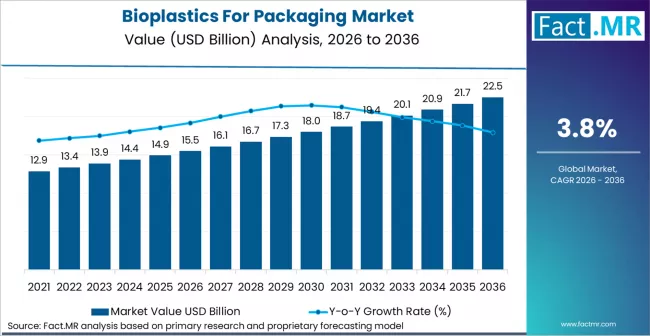
Bioplastics For Packaging Market Market Value Analysis | Source: Fact.MR
| Metric | Value |
|---|---|
| Estimated Value in (2026E) | USD 15.5 billion |
| Forecast Value in (2036F) | USD 39.5 billion |
| Forecast CAGR (2026 to 2036) | 3.8% |
Source: Fact.MR analysis. Updated Mar 3, 2026
Bioplastics for Packaging Market Definition
The bioplastics for packaging market involves the production and sale of biologically derived or biodegradable plastic materials used to manufacture packaging solutions that reduce reliance on conventional fossil‑based plastics.
Market Inclusions
This report covers global and regional market sizes for bioplastics in packaging over a defined forecast period, including material types (PLA, PHA, starch blends), application segments (flexible packaging, rigid containers, films), and end‑use industries (food & beverage, consumer goods, healthcare).
Market Exclusions
The scope excludes conventional petroleum‑based plastics without biobased or biodegradable certification and finished products where bioplastic usage is incidental and not separately quantified.
Research Methodology
- Primary Research: Interviews were conducted with material producers, packaging manufacturers, and sustainability specialists.
- Desk Research: Data was sourced from industry reports, trade association publications, and regulatory filings.
- Market‑Sizing and Forecasting: A hybrid model combining top‑down packaging demand forecasts with bottom‑up production and revenue data was used.
- Data Validation and Update Cycle: Findings were validated through expert review and aligned with recent production, adoption, and trade figures.
Summary of the Bioplastics for Packaging Market
- Market Definition
- The Bioplastics for Packaging Market focuses on the production and use of biodegradable and bio-based plastic materials used in packaging. This market addresses the demand for sustainable packaging solutions across various industries such as food and beverages, pharmaceuticals, and consumer goods. Key materials in this market include bio-based polyethylene terephthalate (Bio PET), polylactic acid (PLA), polyhydroxyalkanoates (PHA), and others. The market is driven by regulatory pressure to reduce plastic waste and growing consumer demand for environmentally friendly alternatives.
- Demand Drivers
- Sustainability Concerns: Increasing environmental awareness is driving demand for sustainable packaging materials. Bioplastics, which reduce reliance on fossil-based plastics, offer a viable alternative.
- Regulatory Mandates: Governments worldwide are introducing regulations to limit single-use plastics, accelerating the demand for bioplastics in packaging.
- Consumer Preferences: A growing number of consumers prefer eco-friendly products and packaging, which is further boosting bioplastics adoption.
- Key Segments Analyzed
- Material: Bio PET is expected to dominate the material segment with 43.6% of the market share in 2026. It is preferred for its recyclability and similar properties to conventional PET.
- Application: Bottles will capture the largest market share at 49.2%, driven by the demand for eco-friendly packaging solutions in the beverage and food industries.
- Geography: India, China, and Germany are expected to lead in bioplastics adoption, with India growing at a 10.9% CAGR.
- Analyst Opinion at FMR
- Shambhu Nath Jha, Principal Consultant at Fact MR, emphasized the growth of bioplastics in packaging, stating, “As demand for eco-friendly packaging solutions continues to rise, we expect bioplastics to play a critical role in reducing plastic waste and meeting sustainability targets across industries.”
- Strategic Implications/Executive Takeaways
- Policy Compliance: Companies should focus on meeting sustainability regulations to remain competitive, particularly in packaging for food, beverages, and consumer goods.
- Technological Innovation: Investment in bio-based materials and production technologies will be crucial to meeting the growing demand for sustainable packaging solutions.
- Regional Focus: Expansion in emerging markets like India and China, where environmental concerns and demand for eco-friendly products are rapidly increasing, offers significant growth opportunities.
- Methodology
- Primary research conducted with material producers, packaging manufacturers, and sustainability specialists.
- Desk research from industry reports, trade associations, and regulatory filings.
- Market sizing using top-down packaging demand forecasts and bottom-up production and revenue data.
Segmental Analysis
Bioplastics for Packaging Market Analysis by Application
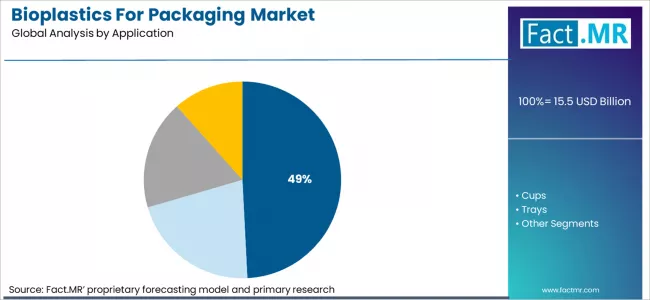
Bioplastics For Packaging Market Analysis By Application | Source: Fact.MR
- Market Overview: Bottles are projected to hold 49.2% of the bioplastics for packaging market by 2026. Bioplastics, particularly bio-based PET, are increasingly used in the production of bottles for beverages, household products, and other liquids due to their sustainability and recycling benefits.
- Demand Drivers:
- Sustainability Concerns and Regulatory Pressure: The growing environmental concerns surrounding plastic waste, along with regulatory pressures to reduce the use of traditional plastics, are driving the demand for bioplastics, especially in packaging applications like bottles.
- Recyclability and Reduced Carbon Footprint: Bio PET is recyclable and has a lower carbon footprint compared to conventional PET, making it an attractive option for consumers and manufacturers focused on sustainability. This is particularly relevant in beverage and consumer goods packaging, where demand for eco-friendly alternatives is increasing.
- Consumer Demand for Eco-Friendly Products: As consumers become more environmentally conscious, there is a growing preference for products packaged in materials that have a lower environmental impact. Bioplastics for bottles meet these preferences, increasing their adoption in the market.
Bioplastics For Packaging Market Analysis by Material
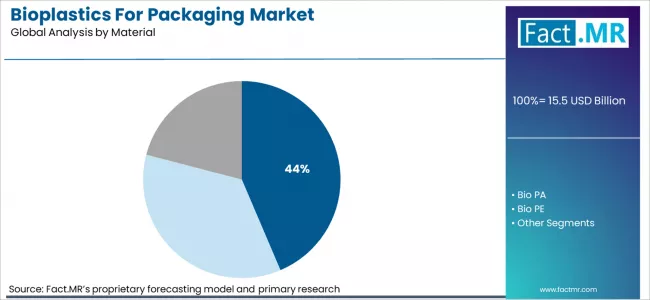
Bioplastics For Packaging Market Analysis By Material | Source: Fact.MR
- Market Overview: Bio PET (Bio-based Polyethylene Terephthalate) is expected to capture 43.6% of the market share by 2026. Bio PET, derived from renewable sources like sugarcane, is a key material in the bioplastics for packaging market due to its similar properties to traditional PET, making it a suitable substitute for various packaging applications.
- Demand Drivers:
- Renewable Resource Utilization: Bio PET is made from renewable plant-based materials, which reduces dependence on fossil fuels and lowers carbon emissions associated with plastic production. This sustainability advantage is driving its adoption across multiple industries.
- Compatibility with Existing Recycling Systems: Bio PET can be recycled using the same processes as conventional PET, which simplifies its integration into existing recycling infrastructure. This compatibility makes it a popular choice among packaging manufacturers looking to reduce their environmental impact.
- Performance and Versatility: Bio PET offers the same strength, clarity, and durability as traditional PET, making it ideal for packaging applications such as bottles, containers, and films. Its performance characteristics make it an attractive option for companies transitioning to more sustainable packaging solutions.
Bioplastics for Packaging Market Drivers, Restraints, and Opportunities
FMR analysts observe that the bioplastics for packaging market is a growth‑aligned, sustainability‑driven segment shaped by rising regulatory pressure to reduce plastic waste and consumer demand for environmentally preferable materials. Historically, conventional petroleum‑based plastics dominated packaging due to cost and performance; as policies like single‑use plastic bans and voluntary corporate sustainability targets have spread, structural demand has emerged for biobased and biodegradable alternatives that lower lifecycle environmental impact. The 2026 valuation reflects this shift, with uptake tied to regulatory alignment, brand commitments, and expanding applications that move beyond niche use into mainstream packaging formats.
While demand for conventional plastics remains large in cost‑sensitive segments, bioplastics that meet defined environmental standards and performance expectations are gaining share. These advanced materials often carry higher per‑unit prices, contributing to net market value growth even as volumes grow in a transitional environment where cost and performance still influence selection. The market exists because packaging value chains increasingly balance material functionality with compliance and sustainability criteria.
- Regulatory Waste Mandates: Policies such as single‑use plastic bans and compostability labeling requirements push brands toward certified bioplastics that meet specific environmental criteria.
- Corporate Sustainability Demand: Consumer goods companies adopt bioplastics to meet ESG goals and reduce carbon or waste footprints, replacing conventional polymers in premium and mid‑tier packaging lines.
- Regional Adoption Trends: In Europe and North America, stringent packaging waste and recycling policies accelerate bioplastics uptake, while Asia‑Pacific shows rapid growth as infrastructure and consumer awareness expand.
Regional Analysis
The market analysis covers key global regions, including South Asia, East Asia, Western Europe, and North America. It is segmented geographically, with specific market dynamics for each region. The full report provides a detailed market attractiveness analysis.
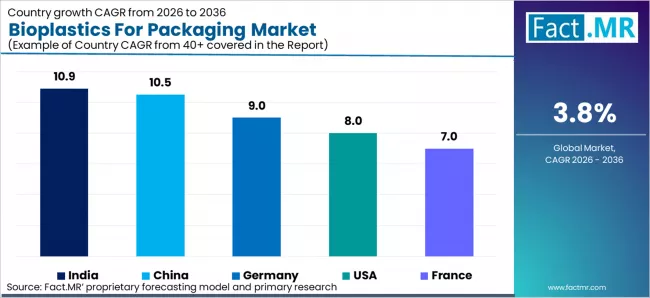
Bioplastics For Packaging Market Cagr Analysis By Country | Source: Fact.MR
| Country | CAGR (2026-2036) |
|---|---|
| India | 10.9% |
| China | 10.5% |
| Germany | 9% |
| USA | 8% |
| France | 7% |
Source: Fact.MR analysis. Updated Mar 3, 2026
Source: Fact MR (FMR) analysis, based on proprietary forecasting model and primary research.
South Asia
In South Asia, India leads the demand for bioplastics in packaging, driven by growing environmental awareness, government initiatives promoting sustainability, and the increasing adoption of eco-friendly packaging solutions.
- India: Demand for bioplastics in packaging in India is projected to rise at 10.9% CAGR through 2036. India’s growing focus on sustainable packaging and rising consumer preference for eco-friendly products continue to fuel market growth.
East Asia
In East Asia, China is a key market for bioplastics in packaging, supported by the country’s large manufacturing base, increasing demand for sustainable packaging solutions, and growing environmental regulations.
- China: Demand for bioplastics in packaging in China is projected to rise at 10.5% CAGR through 2036. China’s rapid industrialization, strong focus on environmental sustainability, and government-led initiatives continue to boost the demand for bioplastics in packaging.
Western Europe
In Western Europe, Germany is the leading market for bioplastics in packaging, driven by strong sustainability regulations, consumer demand for green packaging solutions, and a focus on reducing plastic waste.
- Germany: Demand for bioplastics in packaging in Germany is projected to rise at 9% CAGR through 2036. Germany’s robust regulatory frameworks, growing demand for sustainable packaging solutions, and increased focus on reducing plastic waste continue to support market growth.
- France: Demand for bioplastics in packaging in France is projected to rise at 7% CAGR through 2036. France’s push for green packaging and rising consumer awareness of environmental issues continue to drive steady market growth.
North America
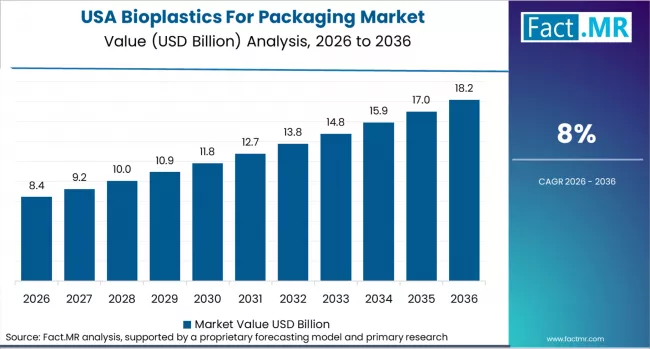
Bioplastics For Packaging Market Country Value Analysis | Source: Fact.MR
In North America, the USA is a significant market for bioplastics in packaging, driven by growing consumer demand for environmentally friendly packaging and the rising adoption of bioplastics in various industries.
- USA: Demand for bioplastics in packaging in the U.S. is projected to rise at 8% CAGR through 2036. The USA’s strong demand for sustainable packaging solutions and growing regulatory support for bioplastics contribute to the steady growth of the market.
Fact MR's analysis of the bioplastics for packaging market in South Asia, East Asia, Western Europe, North America consists of country-wise assessments that include India, China, Germany, the USA, and France. Readers can find detailed trends, regulatory updates, and company-specific investments shaping the market’s growth in these countries.
How Are Key Players Competing in the Bioplastics for Packaging Market?
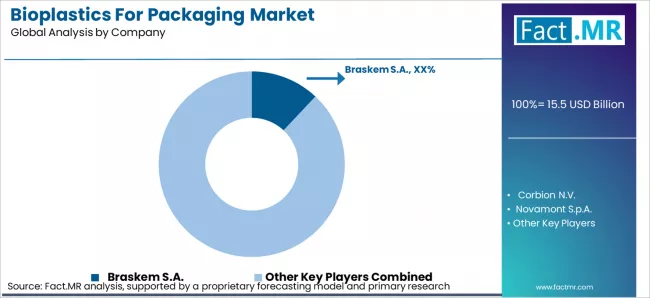
Bioplastics For Packaging Market Analysis By Company | Source: Fact.MR
In the Bioplastics for Packaging market, major players like Braskem S.A., Corbion N.V., and Novamont S.p.A. lead the charge with innovations in bio-based plastics, contributing to sustainability goals across packaging sectors. NatureWorks LLC is notable for producing Ingeo biopolymer, used in a variety of packaging applications. Amcor plc and Mondi Group focus on developing environmentally friendly packaging solutions, offering bioplastics alternatives to traditional fossil-based materials. Tetra Pak is making strides in creating renewable and recyclable packaging, while ALPLA Werke and Berry Global are shifting to bioplastics for bottles and food containers. Uflex Ltd. and Toray Industries continue to explore bioplastics for flexible packaging. Meanwhile, Plastipak Holdings and Virent, Inc. are working on technologies for producing biodegradable plastics. Companies like Danimer Scientific and SECOS Group are making breakthroughs in compostable bioplastics. This competitive market sees a variety of firms working toward reducing plastic waste and carbon footprints through bioplastics innovations.
Recent Industry Developments
- Avantium "Releaf" PEF Market Debut
- Avantium confirmed in late 2025 that its flagship plant in Delfzijl, Netherlands, has entered the final start-up phase, with full-scale commercial operations of Releaf (PEF) set for Q1 2026. This 100% plant-based, fully recyclable polymer is positioned as a superior alternative to PET, offering 10x better oxygen barriers and 15x better $CO_{2}$ barriers, significantly extending the shelf life of carbonated beverages and perishables.
- NatureWorks Ingeo™ Extend Launch
- In March 2025, NatureWorks expanded its portfolio with the Ingeo™ Extend platform. This new grade of PLA is designed specifically for biaxially oriented (BOPLA) films, allowing manufacturers to achieve production speeds and stretch ratios (up to 7x) previously only possible with polypropylene (BOPP). The material is engineered to biodegrade up to 8x faster than standard PLA, targeting the difficult-to-recycle snack and candy wrapper market.
- TotalEnergies Corbion Label-Free PLA Bottle
- In February 2026, TotalEnergies Corbion launched a label-free Luminy® PLA bottle in the South Korean market. By using embossed branding directly on the bottle wall, the design eliminates the need for plastic labels-a major contaminant in recycling streams. This allows the bottles to be chemically recycled via hydrolysis into pure lactic acid monomers, creating a true closed-loop "bottle-to-bottle" system.
Key Players of the Bioplastics for Packaging Market
- Braskem S.A.
- Corbion N.V.
- Novamont S.p.A.
- NatureWorks LLC
- Amcor plc
- Mondi Group
- Tetra Pak International S.A.
- ALPLA Werke Alwin Lehner GmbH & Co. KG
- Berry Global Group, Inc.
- Uflex Ltd.
- Toray Industries, Inc.
- BARBIER Group (Barbier Group France)
- Jolybar Group (Jolybar International)
- Biome Bioplastics Limited
- Plastipak Holdings, Inc.
- Virent, Inc.
- SECOS Group Limited
- Evo & Co. (Evo Group Ltd / Evo & Co brand)
- Danimer Scientific, Inc.
- Mitsubishi Chemical Group Corporation
Report Scope
| Metric | Value |
|---|---|
| Quantitative Units | USD 15.5 billion (2026) to USD 39.5 billion (2036), at a CAGR of 3.8% |
| Market Definition | The bioplastics for packaging market includes the use of biodegradable and renewable bioplastics in packaging applications across various industries such as food, beverages, cosmetics, and pharmaceuticals. |
| By Material | Bio PET (Bio-based Polyethylene Terephthalate), Bio PA (Bio-based Polyamide), Bio PE (Bio-based Polyethylene), Bio-PP (Bio-based Polypropylene), Bio-PS (Bio-based Polystyrene), PLA (Polylactic Acid), PHA (Polyhydroxyalkanoates), Starch Blends, Others (PCL, PBAT, etc.) |
| By Application | Bottles, Cups, Trays, Clamshell, Films, Bags, Pouches & Sachets, Others (Jars, Cans, etc.) |
| By End-Use | Food & Beverages, Cosmetics & Personal Care, Pharmaceuticals, Consumer Goods, Industrial Goods, Others (Automotive, Electrical & Electronics) |
| Regions Covered | North America, Latin America, Europe, East Asia, South Asia, Oceania, Middle East and Africa |
| Countries Covered | United States, Canada, Mexico, Brazil, Argentina, Germany, France, United Kingdom, Italy, Spain, China, India, Japan, South Korea, Indonesia, Australia, and 40+ countries |
| Key Companies Profiled | Braskem S.A., Corbion N.V., Novamont S.p.A., NatureWorks LLC, Amcor plc, Mondi Group, Tetra Pak International S.A., ALPLA Werke Alwin Lehner GmbH & Co. KG, Berry Global Group, Inc., Uflex Ltd., Toray Industries, Inc., BARBIER Group (Barbier Group France), Jolybar Group (Jolybar International), Biome Bioplastics Limited, Plastipak Holdings, Inc., Virent, Inc., SECOS Group Limited, Evo & Co. (Evo Group Ltd / Evo & Co brand), Danimer Scientific, Inc., Mitsubishi Chemical Group Corporation |
| Forecast Period | 2026 to 2036 |
| Approach | Hybrid top-down and bottom-up market modeling validated through primary interviews with manufacturers and supported by trade data benchmarking and market research. |
Source: Fact.MR analysis. Updated Mar 3, 2026
Bibliographies
- Amcor plc. (2025). Bio-based and recyclable packaging solutions incorporating bioplastics. Amcor plc.
- Braskem S.A. (2025). Bio-based polyethylene and renewable polymer solutions for packaging applications. Braskem S.A.
- Corbion N.V. (2025). Development of renewable and biodegradable bioplastics for sustainable packaging. Corbion N.V.
- NatureWorks LLC. (2025). Ingeo™ biopolymer applications for packaging and performance materials. NatureWorks LLC.
- Novamont S.p.A. (2025). Bio-based plastics and compostable materials for packaging solutions. Novamont S.p.A.
- NatureWorks. (2025/2026, March). Ingeo™ Extend introduced to enhance biodegradability of biaxially oriented PLA (BOPLA) films [Press release]. NatureWorks.
- Polimerica. (2025/2026, September). Avantium confirms start-up of Delfzijl PEF plant for Releaf commercial operations in early 2026 [Industry report]. Polimerica.
- Sustainability MEA. (2026, February 28). TotalEnergies Corbion launches label-free PLA bottle in South Korea [Industry coverage]. Sustainability MEA.
This report addresses
- Market Intelligence enabling comprehensive assessment of leading countries and service segments across the Bioplastics for Packaging Market globally.
- Market Volume (Sales Units) estimates and 10-year revenue forecasts from 2026 to 2036, validated through material production data, demand modeling, and country-specific packaging insights.
- Growth Opportunity Mapping across material categories (Bio PET, PLA, PHA), application segments (bottles, bags, films), and regions.
- Segment and Regional Revenue Forecasts by material, application, end-user industry, and geography across 40+ countries.
- Competition Strategy Analysis covering dealer network structure, recent developments, product portfolio, USPs, and market share analysis.
- Product and Regulatory Compliance Tracking aligned with sustainability standards, material certifications, and packaging regulations.
- Regulatory Impact Analysis addressing global environmental mandates, sustainability initiatives, and evolving packaging material standards.
- Report Delivery in PDF, Excel, PowerPoint, and interactive dashboard formats for executive, procurement, and operational planning use.
Segmentation
Bioplastics for Packaging Market Key Segments
-
Material
- Bio PET (Bio-based Polyethylene Terephthalate)
- Bio PA (Bio-based Polyamide)
- Bio PE (Bio-based Polyethylene)
- Bio-PP (Bio-based Polypropylene)
- Bio-PS (Bio-based Polystyrene)
- PLA (Polylactic Acid)
- PHA (Polyhydroxyalkanoates)
- Starch Blends
- Others (PCL, PBAT, etc.)
-
Application
- Bottles
- Cups
- Trays
- Clamshell
- Films
- Bags
- Pouches & Sachets
- Others (Jars, Cans, etc.)
-
End-Use Industry
- Food & Beverages
- Cosmetics & Personal Care
- Pharmaceuticals
- Consumer Goods
- Industrial Goods
- Others (Automotive, Electrical & Electronics)
-
Region
- North America
- USA
- Canada
- Mexico
- Europe
- Germany
- UK
- France
- Italy
- Spain
- Nordic Countries
- BENELUX
- Rest of Europe
- Asia Pacific
- China
- Japan
- South Korea
- India
- Australia
- Rest of Asia Pacific
- Latin America
- Brazil
- Argentina
- Rest of Latin America
- Middle East and Africa
- Kingdom of Saudi Arabia
- United Arab Emirates
- South Africa
- Rest of Middle East and Africa
- Other Regions
- Oceania
- Central Asia
- Other Markets
- North America
Frequently Asked Questions
How large is the demand for Bioplastics in Packaging in the global market in 2026?
What will be the market size of Bioplastics in Packaging in the global market by 2036?
What is the expected demand growth for Bioplastics in Packaging in the global market between 2026 and 2036?
Which application is expected to dominate the market?
Which region is expected to show the highest growth rate for Bioplastics in Packaging?
How significant is the growth outlook for China in this market?
What is the growth outlook for Germany in the Bioplastics for Packaging market?
What is the growth forecast for the United States in the Bioplastics for Packaging market?
What is the growth forecast for France in the Bioplastics for Packaging market?
Which company is identified as a leading player in the Bioplastics for Packaging market?
What are Bioplastics in Packaging used for?
What does the Bioplastics for Packaging market include in this report?
How is the market forecast developed in this report?
What is meant by the Bioplastics for Packaging market in this report?
Who worked on this report


Preview the report firsthand - request a free sample
Free SampleGet the brochure for pricing and purchase details
Download PDF