- Market Value (2025): USD 121.8 Mn
- Estimated Value (2026): USD 145.0 Mn
- Forecast Value (2036): USD 826.0 Mn
- CAGR (2026-2036): 19.0%
What is the Edible Fungus Coatings Market forecast to be worth by 2036?
USD 145.0 million in 2026 to USD 826.0 million by 2036 at a 19.0% CAGR.
- The edible fungus coatings market reached USD 121.8 million in 2025.
- Demand is projected to increase from USD 145.0 million in 2026 to USD 826.0 million by 2036.
- The market is forecast to record 19.0% CAGR from 2026 to 2036.
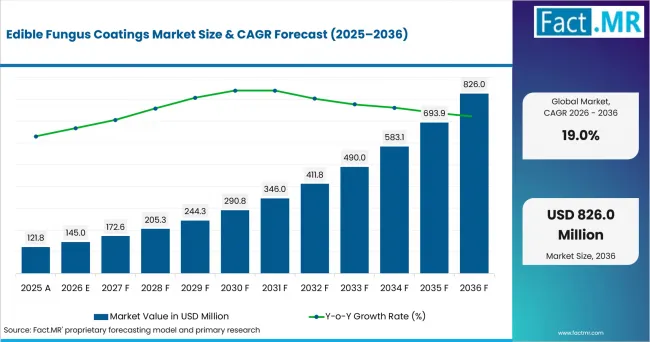
Edible Fungus Coatings Market Value Analysis | Source: Fact.MR
What are the defining numbers behind Edible Fungus Coatings Market growth?
An absolute opportunity of USD 681.0 million is expected between 2026 and 2036.
- Demand Drivers in the Market
- Produce packers need edible barriers that slow moisture loss during retail handling. Regulation (EU) 2025/40 will, from 1 January 2030, restrict specified single-use plastic packaging for pre-packed unprocessed fresh fruit and vegetables below 1.5 kg, subject to the exemptions set out in the Regulation.
- Formulators need blendable coatings that combine fungus-derived inputs with proteins and polysaccharides.
- Foodservice kitchens need short-use dip and sachet formats for cut produce that travels between preparation areas and service counters.
- Export brands need coatings that preserve appearance during long routes because produce value falls quickly when dehydration or surface darkening appears.
- Key Segments Analyzed
- By Material: Bio-polymer blends are expected to hold 41.0% share in 2026 because they give formulators room to tune strength and barrier behavior.
- By Format: Flexible film is projected to account for 44.0% share in 2026 as packers need coating layers that cover uneven produce surfaces.
- By Barrier Function: Moisture is anticipated to represent 44.0% share in 2026 since water loss remains the clearest quality failure in fresh produce.
- By Application: Produce is estimated to capture 42.0% share in 2026 owing to the direct link between coating performance and retail shelf life.
- Analyst Opinion at Fact.MR
- Shambhu Nath Jha, Principal Consultant at Fact.MR, states, “Edible fungus coatings draw attention because the commercial test is crop-level proof. The market is expected to reward suppliers that document moisture control, oxygen barrier behavior and sensory neutrality in the same trial. Qualified suppliers should combine formulation science with simple line integration so packers avoid a separate production bottleneck.”
- Strategic Implications
- Formulators should publish crop-level moisture and oxygen results so brand teams compare coatings against waxes, edible packaging formats and plastic wraps.
- Produce packers should test flexible film and spray formats on high-shrink crops before extending coating use to broader product lines.
- Foodservice distributors should evaluate dip and sachet formats where cut fruit and salad components are prepared near the point of service.
- Coating suppliers should keep label, allergen and food-contact documentation ready for retailers that review ingredients early in qualification.
South Korea is expected to post 22.9% CAGR through 2036 supported by export-led food processing. Germany is projected to record 19.3% CAGR through vegetable production scale and retail quality discipline. Japan is forecast to reach 18.4% CAGR through food-loss reduction pressure. The UK is anticipated to hold 18.0% CAGR through horticulture output and retailer waste programs. The USA is estimated to advance at 16.6% CAGR through a large produce base and crop-specific validation routines.
How does the Edible Fungus Coatings Market break down by segment?
Bio-polymer blends lead Material at 41.0%; flexible film leads Format at 44.0%.
Which Material dominates?
Bio-polymer blends are expected to hold 41.0% share in 2026.
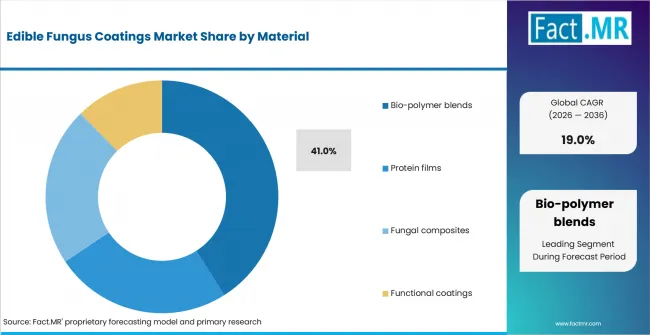
Edible Fungus Coatings Market Analysis By Material | Source: Fact.MR
Bio-polymer blends lead material selection because coating suppliers need to adjust film strength without changing the full application process. Blends are also practical for trials on produce with different respiration rates. A berry, avocado or cucumber line rarely needs the same film profile, so suppliers use blend design to match the crop before packers approve wider use.
What leads the Format segment?
Flexible film is projected to account for 44.0% share in 2026.
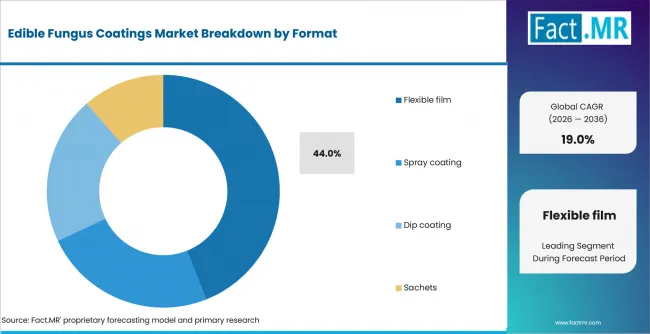
Edible Fungus Coatings Market Analysis By Format | Source: Fact.MR
Flexible film leads format demand because edible coatings must cover uneven food surfaces during washing, drying and distribution. Spray coating and dip coating remain useful in packhouses where equipment is already set up for liquid application. Flexible films retain the larger share because suppliers tune them for whole produce, cut produce and snack surfaces.
How does Barrier Function shape demand?
Moisture is anticipated to lead with 44.0% share in 2026.
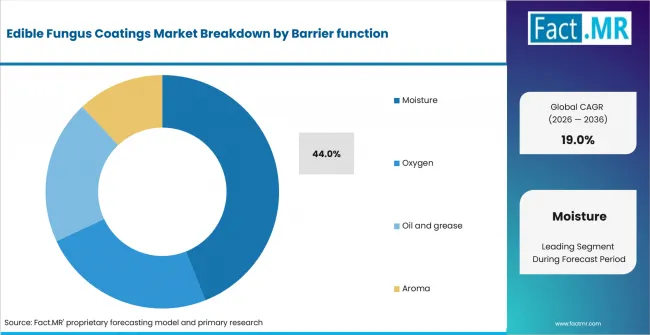
Edible Fungus Coatings Market Analysis By Barrier Function | Source: Fact.MR
Moisture protection leads because dehydration is the quality failure that shoppers notice first. The same reasoning is visible in post-harvest decay control systems, where water loss and surface spoilage both affect markdown timing. Oxygen, oil and grease, and aroma functions carry greater weight in snacks, dairy and foodservice formats. Moisture remains the main barrier target because produce weight, firmness and visual freshness change quickly during open display.
What supports Produce within Application?
Produce is estimated to capture 42.0% share in 2026.
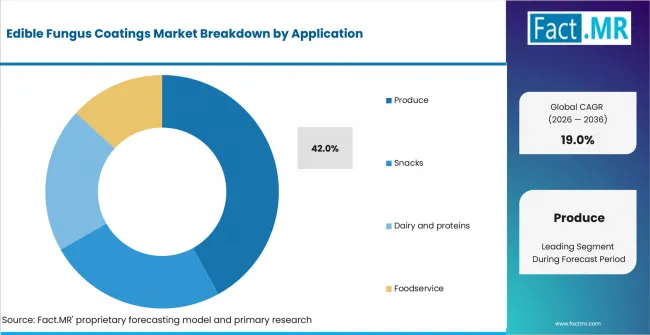
Edible Fungus Coatings Market Analysis By Application | Source: Fact.MR
Produce leads application use because fruit and vegetables have exposed surfaces and active respiration after harvest. USDA NASS reported in May 2026 that utilized production of the 21 estimated U.S. noncitrus fruit crops totaled 15.8 million tons in 2025. This diverse production base provides multiple crop-specific application opportunities for coating technologies, whose performance can vary according to fruit type, cultivar, maturity, and other commodity-specific characteristics.
What is accelerating Edible Fungus Coatings Market adoption, and what is holding it back?
Demand is expected to rise through produce shelf-life needs and bio-polymer formulation work.
Drivers Impact Analysis
| DRIVER | (~) % IMPACT ON CAGR | GEOGRAPHIC RELEVANCE | IMPACT TIMELINE |
|---|---|---|---|
| Produce shelf-life protection | +2.1% | Global | Short term (<= 2 years) |
| Bio-polymer blend formulation compatibility | +1.5% | North America, Europe, East Asia | Medium term (2-4 years) |
| Fresh produce packaging reduction | +1.2% | Europe, North America | Medium term (2-4 years) |
| Foodservice prepared produce handling | +0.8% | North America, East Asia | Long term (>= 4 years) |
- Produce shelf-life protection: Fresh produce loses value when moisture, bruising or browning becomes visible. Coatings that slow these changes are expected to gain attention where markdown losses are easy to measure.
- Bio-polymer blend formulation compatibility: Blendable systems help formulators adjust film strength and barrier function without redesigning the full application process. This supports trials across produce, snacks and foodservice formats.
- Fresh produce packaging reduction: Retailers and food brands are looking for surface protection that reduces dependence on extra wrapping. Biodegradable packaging materials show how packaging rules push brands toward lower-waste formats.
- Foodservice prepared produce handling: Cut fruit and vegetables need short-term quality protection after preparation. Dip and sachet formats fit kitchens that handle produce close to final service.
Opportunity Impact Analysis
| OPPORTUNITY | (~) % IMPACT ON CAGR | GEOGRAPHIC RELEVANCE | IMPACT TIMELINE |
|---|---|---|---|
| Spray and dip systems for packhouses | +1.3% | Global | Medium term (2-4 years) |
| Fungal composite barriers for snacks | +1.0% | Europe, East Asia | Long term (>= 4 years) |
| Export produce coating trials | +0.9% | East Asia, North America | Short term (<= 2 years) |
- Spray and dip systems for packhouses: Application systems that fit existing washing and drying lines are expected to lower qualification work for growers and packers.
- Fungal composite barriers for snacks: Fungal composites are anticipated to support snack formats that need oil and aroma control while keeping the contact layer edible.
- Export produce coating trials: Export channels offer a practical route for suppliers because longer distribution routes make shelf-life performance easier to quantify.
Restraints Impact Analysis
| RESTRAINT | (~) % IMPACT ON CAGR | GEOGRAPHIC RELEVANCE | IMPACT TIMELINE |
|---|---|---|---|
| Crop-specific validation cost | -0.8% | Global | Short term (<= 2 years) |
| Sensory and labeling review | -0.6% | Europe, North America | Medium term (2-4 years) |
| Application process control | -0.5% | Global | Long term (>= 4 years) |
- Crop-specific validation cost: A coating that performs well on one crop often requires a separate test record on another. Suppliers need crop-level evidence before retail approval.
- Sensory and labeling review: Product teams must show that the coating preserves flavor, odor, color and consumer trust at retail display.
- Application process control: Some coatings need controlled drying and storage conditions. Variable packhouse environments are expected to slow commercial scale-up when film uniformity changes.
Which countries are scaling the Edible Fungus Coatings Market through 2036?
- The country comparison spans 6.3 percentage points between South Korea and the USA across the forecast period.
- South Korea remains 3.6 percentage points above Germany through export-led food processing and faster packaging trials.
- Germany remains 0.9 percentage point above Japan because vegetable production scale supports crop-specific coating work.
- Japan remains 0.4 percentage point above the UK through food-loss policy and premium produce handling needs.
- The UK remains 1.4 percentage points above the USA as domestic horticulture and retailer waste programs support trials.
- The USA closes the displayed range through a large produce base and crop-specific validation routines.
Comparable CAGRs are expected to create different entry conditions due to crop mix, export exposure, retail quality rules and food-contact review. Full report coverage includes North America, Latin America, Western Europe, Eastern Europe, East Asia, South Asia & Pacific, Middle East & Africa.
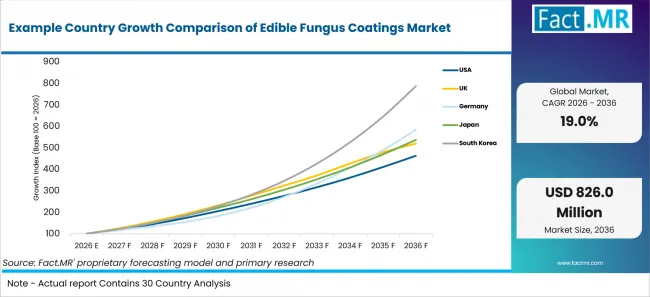
Example Country Growth Comparison Of Edible Fungus Coatings Market | Source: Fact.MR
| Country | CAGR (2026-2036) |
|---|---|
| South Korea | 22.9% |
| Germany | 19.3% |
| Japan | 18.4% |
| UK | 18.0% |
| USA | 16.6% |
How is South Korea developing demand?
22.9% CAGR, supported by food export scaling and manufacturing demand.
South Korea’s export-facing food processors evaluate coatings by packhouse fit and destination-market shelf life. MAFRA reported in January 2026 that K-Food+ exports reached USD 13.62 billion in 2025, including USD 10.41 billion in agri-food exports encompassing fresh and processed foods. MFDS reported in May 2026 that Korea’s food-industry production reached KRW 119.74 trillion in 2025, up 4.3% year over year, indicating a substantial domestic processing base for food-technology applications.
What supports Germany adoption?
19.3% CAGR, backed by vegetable production scale and retail quality discipline.
Germany’s vegetable growers and packers work in a market where retail appearance standards are strict. Destatis reported in February 2026 that German agricultural holdings harvested 4.5 million tonnes of vegetables in 2025 across 131,700 hectares of cultivation, providing a sizeable production base for crop-specific food-coating applications. Suppliers that document coating behavior on onions, cucumbers, berries and cut vegetables are better placed for retail qualification.
How is Japan scaling demand?
18.4% CAGR, led by food-loss pressure and premium produce handling.
Japan’s produce channels place a high value on appearance, texture and portion-level quality. Japan’s Ministry of the Environment reported in June 2026 that an estimated 4.61 million tonnes of food loss and waste were generated in FY2024, excluding inedible parts. MAFF reported that 2.37 million tonnes came from food-related businesses, including manufacturing, wholesale, retail and foodservice, while highlighting measures such as extending best-before dates to reduce business-sector food loss. Edible coatings fit best where suppliers prove neutral taste and clear food-contact status before national rollout.
What supports UK growth?
18.0% CAGR, backed by horticulture output and retailer waste-reduction programs.
UK produce packers are testing shelf-life tools against a measured domestic horticulture base. Defra’s Horticulture statistics 2025, updated on June 25, 2026, reported 2.6 million tonnes of home-produced vegetables and 577 thousand tonnes of home-produced fruit in 2025.
How does the USA perform?
16.6% CAGR, shaped by large produce supply and crop-specific validation.
The USA gives edible coating suppliers a wide produce base and a detailed qualification path. USDA NASS reported in May 2026 that the value of utilized production for 21 U.S. noncitrus fruit crops totaled USD 19.0 billion in 2025. USDA ERS updated its Fruit and Tree Nuts Yearbook Tables in February 2026, providing commodity-level data on production, prices, crop value, trade, acreage and other market indicators that can inform crop-level market analysis. Commercial uptake is expected to depend on evidence by crop and channel.
Who leads the Edible Fungus Coatings Market?
Mori provides an edible silk-protein coating that slows oxidation and dehydration across food applications. Its spray, dip and glaze use cases provide an adjacent benchmark for invisible surface protection and application design.
Sufresca offers natural edible coatings for fresh produce, including dry coatings for tomatoes, cucumbers and peppers. Mantrose-Haeuser Co., Inc. and NatureSeal broaden the comparison through edible coatings, fresh-cut produce shelf-life systems and food packaging coatings.
Which companies are the key providers?
Key companies include Mori, Sufresca, Mantrose-Haeuser Co., Inc., and NatureSeal.
- Mori
- Sufresca
- Mantrose-Haeuser Co., Inc.
- NatureSeal
Bibliography
- Department for Environment, Food & Rural Affairs. (2026, June 25). Horticulture statistics 2025. GOV.UK.
- Statistisches Bundesamt. (2026, February 26). Gemüseernte erreicht 2025 neuen Höchststand [Vegetable harvest reaches a new high in 2025].
- Antonopoulos, I. (2025, April 10). Packaging and Packaging Waste Regulation and food waste [Presentation]. European Commission, Directorate-General for Environment.
- Regulation (EU) 2025/40 of the European Parliament and of the Council of 19 December 2024 on packaging and packaging waste, amending Regulation (EU) 2019/1020 and Directive (EU) 2019/904, and repealing Directive 94/62/EC. (2025). Official Journal of the European Union, L, 2025/40.
- Ministry of Agriculture, Food and Rural Affairs. (2026, January 20). Exports of K-Food Plus reached USD 13.6 billion in 2025, up 5.1% year-over-year.
- U.S. Department of Agriculture, National Agricultural Statistics Service. (2026, May 1). Noncitrus Fruits and Nuts 2025 Summary.
- U.S. Department of Agriculture, Economic Research Service. (2026, February 10). Fruit and Tree Nuts Data - Fruit and Tree Nuts Yearbook Tables.
This Report Answers
- The report explains where edible fungus coatings are used across material, format, barrier function and application.
- Segment analysis identifies the leading subsegments and the practical reasons packers prioritize them.
- Country analysis examines the listed markets and the production or waste-reduction mechanisms supporting coating trials.
- Competitive analysis reviews providers across edible coatings, fresh-cut produce systems and adjacent food-safety coatings.
- Application analysis assesses how moisture control, oxygen behavior and food-contact review influence purchase decisions.
What does the Edible Fungus Coatings Market cover?
The Edible Fungus Coatings Market covers food-safe coatings, edible films and surface protection formats used to preserve food quality. It includes fungus-linked coating systems, bio-polymer blends and functional films that overlap with bioplastics for packaging where food-contact performance is central.
The assessment covers produce, snacks, dairy and proteins, and foodservice applications. Demand is assessed across material, format and barrier function, with regional coverage across the standard geography set.
What is included in the scope?
The scope includes commercial edible coatings, flexible edible films, spray coatings, dip coatings and sachet formats used directly on or near food. It also includes functional coatings that target moisture, oxygen, oil and grease, or aroma protection.
Included suppliers sell coating materials, application-ready systems or fresh-cut produce treatment products. Company coverage focuses on current providers that support food-contact review, crop trials and processor qualification.
What is excluded from the scope?
The scope excludes standard plastic packaging sold without edible coating functionality. It also excludes decorative food paints, industrial coatings and sanitation coatings when the coating is used only on facility surfaces.
General packaging films are outside the scope unless the film is designed as an edible or food-contact barrier layer. Conventional waxes are treated only as a benchmark for comparison.
How Was the Analysis Built?
The analysis draws on 120+ sources, 35+ company portfolios, 25+ countries, and more than 20 industry interviews.
- Primary Research: Primary research includes discussions with manufacturers, coating formulators, produce packers, foodservice operators, distributors and procurement teams. These conversations examine purchasing priorities, product adoption, operational requirements, approval needs, competitive positioning and factors that influence market acceptance.
- Desk Research: Desk research covers government statistics, regulatory publications, company materials, trade data, technical studies, industry associations, standards and public policy. Every source used in the analysis is documented in the bibliography.
- Market Sizing and Forecasting: Market estimates combine historical performance, demand indicators, pricing and volume trends, segment shares, company participation, country-level growth, adoption patterns, investment activity and barriers to expansion.
- Data Validation and Update Cycle: Findings are validated by comparing primary interviews with public data, company activity, regulatory changes, trade patterns and industry developments. Regular updates review new product launches, capacity changes, partnerships, approvals, procurement trends and commercial adoption.
What is the report’s scope and coverage?
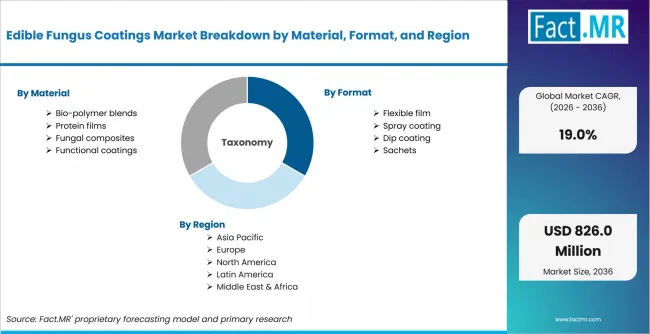
Edible Fungus Coatings Market Breakdown By Material, Format, And Region | Source: Fact.MR
| Attribute | Details |
|---|---|
| Quantitative Units | USD million |
| Market Definition | Edible fungus coatings are food-safe surface layers, films and coating systems using fungus-linked or bio-polymer inputs to protect food quality through moisture, oxygen, oil, grease or aroma control. |
| Material | Bio-polymer blends; Protein films; Fungal composites; Functional coatings |
| Format | Flexible film; Spray coating; Dip coating; Sachets |
| Barrier Function | Moisture; Oxygen; Oil and grease; Aroma |
| Application | Produce; Snacks; Dairy and proteins; Foodservice |
| Regions Covered | North America; Latin America; Western Europe; Eastern Europe; East Asia; South Asia & Pacific; Middle East & Africa |
| Countries Covered | USA; UK; Germany; Japan; South Korea |
| Key Companies Profiled | Mori; Sufresca; Mantrose-Haeuser Co., Inc.; NatureSeal |
| Forecast Period | 2026 to 2036 |
| Approach | Hybrid top-down and bottom-up approach using crop-level coating trials; food-contact review; segment shares; country adoption; and provider portfolio review. |
How is the market segmented?
-
By Material:
- Bio-polymer blends
- Protein films
- Fungal composites
- Functional coatings
-
By Format:
- Flexible film
- Spray coating
- Dip coating
- Sachets
-
By Barrier Function:
- Moisture
- Oxygen
- Oil and grease
- Aroma
-
By Application:
- Produce
- Snacks
- Dairy and proteins
- Foodservice
-
By Region:
- North America
- Latin America
- Western Europe
- Eastern Europe
- East Asia
- South Asia & Pacific
- Middle East & Africa