Food-Grade Post-Harvest Decay Control Coating Market
Food-Grade Post-Harvest Decay Control Coating Market Size and Share Forecast Outlook 2026 to 2036
Food-grade post-harvest decay control coating market is projected to grow from USD 0.6 billion in 2026 to USD 2.5 billion by 2036, at a CAGR of 15.0%. Edible Wax & Lipid-Based Coatings will dominate with a 37.0% market share, while fruits (citrus, apples, berries) will lead the produce type segment with a 46.0% share.
Food-Grade Post-Harvest Decay Control Coating Market Forecast and Outlook 2026 to 2036
The global food-grade post-harvest decay control coating market is projected to reach USD 2.48 billion by 2036. The market is valued at USD 0.61 billion in 2026 and is set to rise at a CAGR of 15.0% during the assessment period.
By coating material, edible wax & lipid-based coatings hold a leading 37% share. Fruits represent the dominant produce type at 46%, while fungal & bacterial decay suppression is the primary function, accounting for 39% market share.
Key Takeaways from the Food-Grade Post-Harvest Decay Control Coating Market
- Market Value for 2026: USD 0.61 Billion
- Market Value for 2036: USD 2.48 Billion
- Forecast CAGR (2026-2036): 15.0%
- Leading Coating Material Type Share (2026): Edible Wax & Lipid-Based Coatings (37%)
- Leading Produce Type Share (2026): Fruits (46%)
- Leading Primary Function Share (2026): Fungal & Bacterial Decay Suppression (39%)
- Key Players in the Market: Apeel Sciences, AgroFresh Solutions, Pace International, Citrosol Group, Xeda International
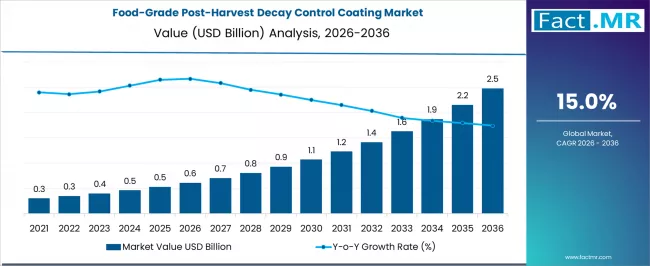
Defining trends involve the development of multi-functional, plant-derived coatings that combine passive barrier properties with active antimicrobial and antioxidant release. Innovation is rapidly advancing in nano-encapsulation of natural preservatives within biopolymer matrices for controlled release throughout the supply chain. Integration of these coatings with smart packaging indicators to monitor produce freshness in real-time is becoming a key value proposition.
Regulatory frameworks and consumer demand are shifting decisively away from synthetic preservatives, creating accelerated pathways for GRAS (Generally Recognized As Safe) and organic-compliant coating formulations. Policies aimed at reducing global food waste and enhancing the circular economy act as significant market catalysts, with edible coatings seen as a critical technology for extending shelf-life and maintaining nutritional quality without chemical residues.
Food-Grade Post-Harvest Decay Control Coating Market
| Metric | Value |
|---|---|
| Market Value (2026) | USD 0.61 Billion |
| Market Forecast Value (2036) | USD 2.48 Billion |
| Forecast CAGR (2026-2036) | 15.0% |
Category
| Category | Segments |
|---|---|
| Coating Material Type | Edible Wax & Lipid-Based Coatings, Chitosan & Biopolymer Coatings, Plant-Extract & Antimicrobial Blends, Protein & Polysaccharide Films, Others |
| Produce Type | Fruits (Citrus, Apples, Berries), Vegetables, Tropical Fruits, Others |
| Primary Function | Fungal & Bacterial Decay Suppression, Moisture Loss & Shelf-Life Extension, Oxidation & Color Preservation, Export & Cold-Chain Compliance, Others |
| Region | North America, Latin America, Western Europe, Eastern Europe, East Asia, South Asia & Pacific, MEA |
Segmental Analysis
By Coating Material Type, Which Technology Offers the Broadest Commercial Provenance?

Edible wax and lipid-based coatings lead the segment with a 37% share. This dominance is rooted in their long history of safe use, cost-effectiveness, and excellent moisture barrier properties. Derived from natural sources like carnauba, shellac, and beeswax, they form a semi-permeable membrane that slows respiration and transpiration. Their compatibility with existing dip-and-dry or spray application lines in packing houses makes them the incumbent and most widely adopted solution for staple fruits like apples and citrus.
By Produce Type, Which Category Bears the Highest Economic Loss from Post-Harvest Spoilage?

Fruits command the largest produce type share at 46%. Fruits are highly perishable, climacteric products with high respiration rates and susceptibility to mechanical damage and fungal attacks (e.g., Botrytis, Penicillium). The significant value loss from spoilage of high-value crops like berries, citrus, and stone fruits creates a powerful economic incentive for protective coatings. Extending their marketable life by even a few days translates to massive reductions in waste and expanded geographic distribution.
By Primary Function, What is the Most Critical Biological Threat to Managed Produce?

Fungal and bacterial decay suppression is the leading function at 39%. Microbial rot is the primary cause of post-harvest losses worldwide. Coatings engineered for this function often incorporate food-grade antimicrobial agents (e.g., citrus extracts, sorbates) or utilize materials like chitosan, which has innate antifungal properties. By creating a hostile microenvironment on the produce surface and sealing wounds, these coatings directly target the leading driver of spoilage, offering the most direct protection for quality and safety.
What are the Drivers, Restraints, and Key Trends of the Food-Grade Post-Harvest Decay Control Coating Market?
Market expansion is driven by the global imperative to reduce food waste, estimated at over 30% for fruits and vegetables. Intense consumer demand for clean-label, residue-free produce displaces synthetic post-harvest chemicals. The growth of long-distance export supply chains requires technologies that preserve quality over extended transit times. Increasing regulations restricting synthetic fungicides further propel the adoption of food-grade alternatives.
A significant restraint is the variable performance of natural coatings compared to synthetic fungicides under high disease pressure or suboptimal storage conditions. The incremental cost per unit of produce can be a barrier for low-margin commodities. Technical challenges in achieving uniform application and maintaining functional integrity under high humidity persist. Consumer unfamiliarity with the concept of an "edible coating" may also require educational efforts.
Key trends include the development of "super-blends" combining waxes, biopolymers, and natural antimicrobials for synergistic effects. The rise of CRISPR-edited produce with enhanced innate shelf-life is influencing coating requirements. There is a strong push for water-based, solvent-free coating formulations to improve sustainability. Integration with dynamic atmosphere storage and blockchain for traceability is also emerging.
Analysis of the Food-Grade Post-Harvest Decay Control Coating Market by Key Countries
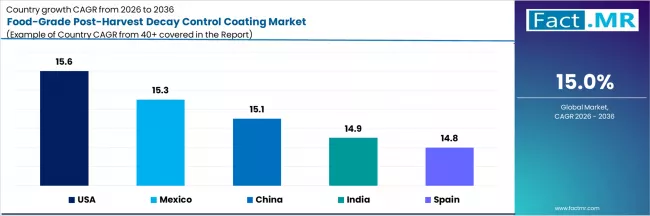
| Country | CAGR (2026-2036) |
|---|---|
| USA | 15.60% |
| Mexico | 15.30% |
| China | 15.10% |
| India | 14.90% |
| Spain | 14.80% |
How does the USA's Focus on Food Waste Reduction and Premium Produce Drive Market Leadership?
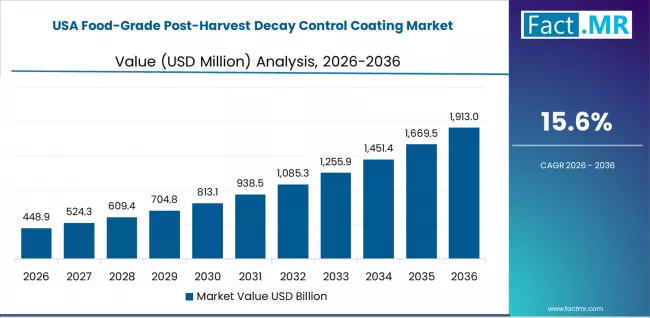
The USA leads with a 15.60% CAGR, driven by a strong national focus on reducing food waste, powerful retailer demands for extended shelf-life, and a high-value produce sector. Consumer preference for organic and clean-label products accelerates the shift from synthetic to food-grade coatings. Technological innovation from domestic leaders like Apeel Sciences, combined with the need to maintain quality across a vast domestic distribution network, solidifies its advanced market status.
Why is Mexico's Role as a Major Perishables Exporter a Key Driver?
Mexico's 15.30% growth is fueled by its critical role as a year-round exporter of fresh vegetables, berries, and tropical fruits to the US and Canada. Maintaining quality and compliance with stringent international MRL (Maximum Residue Limit) standards during long-haul transit is paramount. Coatings that suppress decay and reduce dependence on post-harvest fungicides are essential tools for Mexican exporters to secure market access and preserve premium value.
What Factors Underpin China's Massive Domestic Production and Growing Quality Demands?
China's 15.10% growth is motivated by the need to manage post-harvest losses across its enormous domestic production of fruits and vegetables, a key food security concern. Rising domestic consumer expectations for quality and safety are pushing the industry beyond traditional methods. Government support for agri-tech and reducing waste, coupled with investments in modern cold-chain infrastructure, is driving adoption of advanced coating technologies for apples, citrus, and a growing berry sector.
How does India's Efforts to Curb Post-Harvest Losses and Boost Exports Influence Adoption?
India's 14.90% growth is anchored in the critical need to address some of the world's highest post-harvest loss rates in fruits and vegetables. Government initiatives and private sector investments aim to modernize the supply chain. For high-value export commodities like mangoes, pomegranates, and grapes, food-grade coatings are increasingly adopted as a necessary technology to meet phytosanitary standards, survive long sea voyages, and compete in premium international markets.
What Role does Spain's European Export Hub Status Play in the Market?
Spain's 14.80% growth reflects its position as the "orchard of Europe," a leading exporter of citrus, stone fruits, and vegetables. To dominate the highly competitive EU market, Spanish producers must guarantee superior shelf-life, visual appearance, and taste. The use of sophisticated coatings, often integrated with precision dosing technology from firms like Citrosol, is a standard practice to maintain the reputation and profitability of Spanish produce across the continent.
Competitive Landscape of the Food-Grade Post-Harvest Decay Control Coating Market
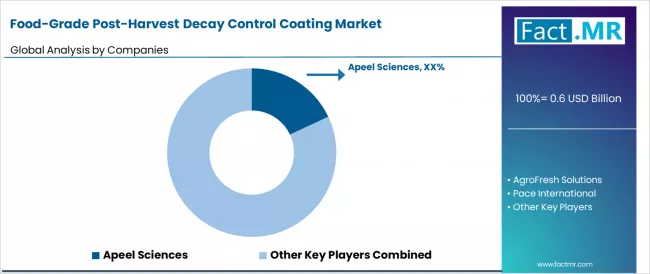
The competitive landscape is bifurcated between innovative start-ups disrupting the category with novel formulations and established post-harvest specialty companies expanding into bio-based solutions. Technology pioneers like Apeel Sciences compete with proprietary, plant-derived coating platforms that offer radically extended shelf-life, positioning their product as a branded value-add for retailers.
Established players like AgroFresh Solutions, Pace International, and Citrosol Group leverage their deep relationships with global packers and exporters, integrating new food-grade coatings into their existing portfolios of storage management and application equipment. Competition centers on proving efficacy under commercial conditions, achieving regulatory approvals across key markets, and demonstrating a clear return on investment through reduced shrink and expanded market reach for clients.
Key Players in the Food-Grade Post-Harvest Decay Control Coating Market
- Apeel Sciences
- AgroFresh Solutions
- Pace International
- Citrosol Group
- Xeda International
Scope of Report
| Items | Values |
|---|---|
| Quantitative Units | USD Billion |
| Coating Material Type | Edible Wax & Lipid-Based Coatings, Chitosan & Biopolymer Coatings, Plant-Extract & Antimicrobial Blends, Protein & Polysaccharide Films, Others |
| Produce Type | Fruits (Citrus, Apples, Berries), Vegetables, Tropical Fruits, Others |
| Primary Function | Fungal & Bacterial Decay Suppression, Moisture Loss & Shelf-Life Extension, Oxidation & Color Preservation, Export & Cold-Chain Compliance, Others |
| Key Countries | USA, Mexico, China, India, Spain |
| Key Companies | Apeel Sciences, AgroFresh Solutions, Pace International, Citrosol Group, Xeda International |
| Additional Analysis | Analysis of respiration rate modulation, impact on nutritional content retention, compatibility with organic certification, application technology (spray/dip/fog), and cost-benefit analysis of reduced waste versus coating cost. |
Food-Grade Post-Harvest Decay Control Coating Market by Segments
-
Coating Material Type :
- Edible Wax & Lipid-Based Coatings
- Chitosan & Biopolymer Coatings
- Plant-Extract & Antimicrobial Blends
- Protein & Polysaccharide Films
- Others
-
Produce Type :
- Fruits (Citrus, Apples, Berries)
- Vegetables
- Tropical Fruits
- Others
-
Primary Function :
- Fungal & Bacterial Decay Suppression
- Moisture Loss & Shelf-Life Extension
- Oxidation & Color Preservation
- Export & Cold-Chain Compliance
- Others
-
Region :
-
North America
- USA
- Canada
-
Latin America
- Mexico
- Brazil
- Argentina
- Rest of Latin America
-
Western Europe
- Spain
- Italy
- France
- Germany
- UK
- BENELUX
- Rest of Western Europe
-
Eastern Europe
- Poland
- Russia
- Czech Republic
- Rest of Eastern Europe
-
East Asia
- China
- Japan
- South Korea
- Rest of East Asia
-
South Asia & Pacific
- India
- Indonesia
- Australia
- Rest of South Asia & Pacific
-
MEA
- South Africa
- GCC Countries
- Rest of MEA
-
Table of Content
- Executive Summary
- Global Market Outlook
- Demand to side Trends
- Supply to side Trends
- Technology Roadmap Analysis
- Analysis and Recommendations
- Market Overview
- Market Coverage / Taxonomy
- Market Definition / Scope / Limitations
- Market Background
- Market Dynamics
- Drivers
- Restraints
- Opportunity
- Trends
- Scenario Forecast
- Demand in Optimistic Scenario
- Demand in Likely Scenario
- Demand in Conservative Scenario
- Opportunity Map Analysis
- Product Life Cycle Analysis
- Supply Chain Analysis
- Investment Feasibility Matrix
- Value Chain Analysis
- PESTLE and Porter’s Analysis
- Regulatory Landscape
- Regional Parent Market Outlook
- Production and Consumption Statistics
- Import and Export Statistics
- Market Dynamics
- Global Market Analysis 2021 to 2025 and Forecast, 2026 to 2036
- Historical Market Size Value (USD Million) Analysis, 2021 to 2025
- Current and Future Market Size Value (USD Million) Projections, 2026 to 2036
- Y to o to Y Growth Trend Analysis
- Absolute $ Opportunity Analysis
- Global Market Pricing Analysis 2021 to 2025 and Forecast 2026 to 2036
- Global Market Analysis 2021 to 2025 and Forecast 2026 to 2036, By Coating Material Type
- Introduction / Key Findings
- Historical Market Size Value (USD Million) Analysis By Coating Material Type, 2021 to 2025
- Current and Future Market Size Value (USD Million) Analysis and Forecast By Coating Material Type, 2026 to 2036
- Edible Wax & Lipid-Based Coatings
- Chitosan & Biopolymer Coatings
- Plant-Extract & Antimicrobial Blends
- Protein & Polysaccharide Films
- Others
- Edible Wax & Lipid-Based Coatings
- Y to o to Y Growth Trend Analysis By Coating Material Type, 2021 to 2025
- Absolute $ Opportunity Analysis By Coating Material Type, 2026 to 2036
- Global Market Analysis 2021 to 2025 and Forecast 2026 to 2036, By Produce Type
- Introduction / Key Findings
- Historical Market Size Value (USD Million) Analysis By Produce Type, 2021 to 2025
- Current and Future Market Size Value (USD Million) Analysis and Forecast By Produce Type, 2026 to 2036
- Fruits (Citrus, Apples, Berries)
- Vegetables
- Tropical Fruits
- Others
- Fruits (Citrus, Apples, Berries)
- Y to o to Y Growth Trend Analysis By Produce Type, 2021 to 2025
- Absolute $ Opportunity Analysis By Produce Type, 2026 to 2036
- Global Market Analysis 2021 to 2025 and Forecast 2026 to 2036, By Primary Function
- Introduction / Key Findings
- Historical Market Size Value (USD Million) Analysis By Primary Function, 2021 to 2025
- Current and Future Market Size Value (USD Million) Analysis and Forecast By Primary Function, 2026 to 2036
- Fungal & Bacterial Decay Suppression
- Moisture Loss & Shelf-Life Extension
- Oxidation & Color Preservation
- Export & Cold-Chain Compliance
- Fungal & Bacterial Decay Suppression
- Y to o to Y Growth Trend Analysis By Primary Function, 2021 to 2025
- Absolute $ Opportunity Analysis By Primary Function, 2026 to 2036
- Global Market Analysis 2021 to 2025 and Forecast 2026 to 2036, By Region
- Introduction
- Historical Market Size Value (USD Million) Analysis By Region, 2021 to 2025
- Current Market Size Value (USD Million) Analysis and Forecast By Region, 2026 to 2036
- North America
- Latin America
- Western Europe
- Eastern Europe
- East Asia
- South Asia and Pacific
- Middle East & Africa
- Market Attractiveness Analysis By Region
- North America Market Analysis 2021 to 2025 and Forecast 2026 to 2036, By Country
- Historical Market Size Value (USD Million) Trend Analysis By Market Taxonomy, 2021 to 2025
- Market Size Value (USD Million) Forecast By Market Taxonomy, 2026 to 2036
- By Country
- USA
- Canada
- Mexico
- By Coating Material Type
- By Produce Type
- By Primary Function
- By Country
- Market Attractiveness Analysis
- By Country
- By Coating Material Type
- By Produce Type
- By Primary Function
- Key Takeaways
- Latin America Market Analysis 2021 to 2025 and Forecast 2026 to 2036, By Country
- Historical Market Size Value (USD Million) Trend Analysis By Market Taxonomy, 2021 to 2025
- Market Size Value (USD Million) Forecast By Market Taxonomy, 2026 to 2036
- By Country
- Brazil
- Chile
- Rest of Latin America
- By Coating Material Type
- By Produce Type
- By Primary Function
- By Country
- Market Attractiveness Analysis
- By Country
- By Coating Material Type
- By Produce Type
- By Primary Function
- Key Takeaways
- Western Europe Market Analysis 2021 to 2025 and Forecast 2026 to 2036, By Country
- Historical Market Size Value (USD Million) Trend Analysis By Market Taxonomy, 2021 to 2025
- Market Size Value (USD Million) Forecast By Market Taxonomy, 2026 to 2036
- By Country
- Germany
- UK
- Italy
- Spain
- France
- Nordic
- BENELUX
- Rest of Western Europe
- By Coating Material Type
- By Produce Type
- By Primary Function
- By Country
- Market Attractiveness Analysis
- By Country
- By Coating Material Type
- By Produce Type
- By Primary Function
- Key Takeaways
- Eastern Europe Market Analysis 2021 to 2025 and Forecast 2026 to 2036, By Country
- Historical Market Size Value (USD Million) Trend Analysis By Market Taxonomy, 2021 to 2025
- Market Size Value (USD Million) Forecast By Market Taxonomy, 2026 to 2036
- By Country
- Russia
- Poland
- Hungary
- Balkan & Baltic
- Rest of Eastern Europe
- By Coating Material Type
- By Produce Type
- By Primary Function
- By Country
- Market Attractiveness Analysis
- By Country
- By Coating Material Type
- By Produce Type
- By Primary Function
- Key Takeaways
- East Asia Market Analysis 2021 to 2025 and Forecast 2026 to 2036, By Country
- Historical Market Size Value (USD Million) Trend Analysis By Market Taxonomy, 2021 to 2025
- Market Size Value (USD Million) Forecast By Market Taxonomy, 2026 to 2036
- By Country
- China
- Japan
- South Korea
- By Coating Material Type
- By Produce Type
- By Primary Function
- By Country
- Market Attractiveness Analysis
- By Country
- By Coating Material Type
- By Produce Type
- By Primary Function
- Key Takeaways
- South Asia and Pacific Market Analysis 2021 to 2025 and Forecast 2026 to 2036, By Country
- Historical Market Size Value (USD Million) Trend Analysis By Market Taxonomy, 2021 to 2025
- Market Size Value (USD Million) Forecast By Market Taxonomy, 2026 to 2036
- By Country
- India
- ASEAN
- Australia & New Zealand
- Rest of South Asia and Pacific
- By Coating Material Type
- By Produce Type
- By Primary Function
- By Country
- Market Attractiveness Analysis
- By Country
- By Coating Material Type
- By Produce Type
- By Primary Function
- Key Takeaways
- Middle East & Africa Market Analysis 2021 to 2025 and Forecast 2026 to 2036, By Country
- Historical Market Size Value (USD Million) Trend Analysis By Market Taxonomy, 2021 to 2025
- Market Size Value (USD Million) Forecast By Market Taxonomy, 2026 to 2036
- By Country
- Kingdom of Saudi Arabia
- Other GCC Countries
- Turkiye
- South Africa
- Other African Union
- Rest of Middle East & Africa
- By Coating Material Type
- By Produce Type
- By Primary Function
- By Country
- Market Attractiveness Analysis
- By Country
- By Coating Material Type
- By Produce Type
- By Primary Function
- Key Takeaways
- Key Countries Market Analysis
- USA
- Pricing Analysis
- Market Share Analysis, 2025
- By Coating Material Type
- By Produce Type
- By Primary Function
- Canada
- Pricing Analysis
- Market Share Analysis, 2025
- By Coating Material Type
- By Produce Type
- By Primary Function
- Mexico
- Pricing Analysis
- Market Share Analysis, 2025
- By Coating Material Type
- By Produce Type
- By Primary Function
- Brazil
- Pricing Analysis
- Market Share Analysis, 2025
- By Coating Material Type
- By Produce Type
- By Primary Function
- Chile
- Pricing Analysis
- Market Share Analysis, 2025
- By Coating Material Type
- By Produce Type
- By Primary Function
- Germany
- Pricing Analysis
- Market Share Analysis, 2025
- By Coating Material Type
- By Produce Type
- By Primary Function
- UK
- Pricing Analysis
- Market Share Analysis, 2025
- By Coating Material Type
- By Produce Type
- By Primary Function
- Italy
- Pricing Analysis
- Market Share Analysis, 2025
- By Coating Material Type
- By Produce Type
- By Primary Function
- Spain
- Pricing Analysis
- Market Share Analysis, 2025
- By Coating Material Type
- By Produce Type
- By Primary Function
- France
- Pricing Analysis
- Market Share Analysis, 2025
- By Coating Material Type
- By Produce Type
- By Primary Function
- India
- Pricing Analysis
- Market Share Analysis, 2025
- By Coating Material Type
- By Produce Type
- By Primary Function
- ASEAN
- Pricing Analysis
- Market Share Analysis, 2025
- By Coating Material Type
- By Produce Type
- By Primary Function
- Australia & New Zealand
- Pricing Analysis
- Market Share Analysis, 2025
- By Coating Material Type
- By Produce Type
- By Primary Function
- China
- Pricing Analysis
- Market Share Analysis, 2025
- By Coating Material Type
- By Produce Type
- By Primary Function
- Japan
- Pricing Analysis
- Market Share Analysis, 2025
- By Coating Material Type
- By Produce Type
- By Primary Function
- South Korea
- Pricing Analysis
- Market Share Analysis, 2025
- By Coating Material Type
- By Produce Type
- By Primary Function
- Russia
- Pricing Analysis
- Market Share Analysis, 2025
- By Coating Material Type
- By Produce Type
- By Primary Function
- Poland
- Pricing Analysis
- Market Share Analysis, 2025
- By Coating Material Type
- By Produce Type
- By Primary Function
- Hungary
- Pricing Analysis
- Market Share Analysis, 2025
- By Coating Material Type
- By Produce Type
- By Primary Function
- Kingdom of Saudi Arabia
- Pricing Analysis
- Market Share Analysis, 2025
- By Coating Material Type
- By Produce Type
- By Primary Function
- Turkiye
- Pricing Analysis
- Market Share Analysis, 2025
- By Coating Material Type
- By Produce Type
- By Primary Function
- South Africa
- Pricing Analysis
- Market Share Analysis, 2025
- By Coating Material Type
- By Produce Type
- By Primary Function
- USA
- Market Structure Analysis
- Competition Dashboard
- Competition Benchmarking
- Market Share Analysis of Top Players
- By Regional
- By Coating Material Type
- By Produce Type
- By Primary Function
- Competition Analysis
- Competition Deep Dive
- Apeel Sciences
- Overview
- Product Portfolio
- Profitability by Market Segments (Product/Age /Sales Channel/Region)
- Sales Footprint
- Strategy Overview
- Marketing Strategy
- Product Strategy
- Channel Strategy
- AgroFresh Solutions
- Pace International
- Citrosol Group
- Xeda International
- Others
- Apeel Sciences
- Competition Deep Dive
- Assumptions & Acronyms Used
- Research Methodology
List Of Table
- Table 1: Global Market Value (USD Million) Forecast by Region, 2021 to 2036
- Table 2: Global Market Value (USD Million) Forecast by Coating Material Type, 2021 to 2036
- Table 3: Global Market Value (USD Million) Forecast by Produce Type, 2021 to 2036
- Table 4: Global Market Value (USD Million) Forecast by Primary Function, 2021 to 2036
- Table 5: North America Market Value (USD Million) Forecast by Country, 2021 to 2036
- Table 6: North America Market Value (USD Million) Forecast by Coating Material Type, 2021 to 2036
- Table 7: North America Market Value (USD Million) Forecast by Produce Type, 2021 to 2036
- Table 8: North America Market Value (USD Million) Forecast by Primary Function, 2021 to 2036
- Table 9: Latin America Market Value (USD Million) Forecast by Country, 2021 to 2036
- Table 10: Latin America Market Value (USD Million) Forecast by Coating Material Type, 2021 to 2036
- Table 11: Latin America Market Value (USD Million) Forecast by Produce Type, 2021 to 2036
- Table 12: Latin America Market Value (USD Million) Forecast by Primary Function, 2021 to 2036
- Table 13: Western Europe Market Value (USD Million) Forecast by Country, 2021 to 2036
- Table 14: Western Europe Market Value (USD Million) Forecast by Coating Material Type, 2021 to 2036
- Table 15: Western Europe Market Value (USD Million) Forecast by Produce Type, 2021 to 2036
- Table 16: Western Europe Market Value (USD Million) Forecast by Primary Function, 2021 to 2036
- Table 17: Eastern Europe Market Value (USD Million) Forecast by Country, 2021 to 2036
- Table 18: Eastern Europe Market Value (USD Million) Forecast by Coating Material Type, 2021 to 2036
- Table 19: Eastern Europe Market Value (USD Million) Forecast by Produce Type, 2021 to 2036
- Table 20: Eastern Europe Market Value (USD Million) Forecast by Primary Function, 2021 to 2036
- Table 21: East Asia Market Value (USD Million) Forecast by Country, 2021 to 2036
- Table 22: East Asia Market Value (USD Million) Forecast by Coating Material Type, 2021 to 2036
- Table 23: East Asia Market Value (USD Million) Forecast by Produce Type, 2021 to 2036
- Table 24: East Asia Market Value (USD Million) Forecast by Primary Function, 2021 to 2036
- Table 25: South Asia and Pacific Market Value (USD Million) Forecast by Country, 2021 to 2036
- Table 26: South Asia and Pacific Market Value (USD Million) Forecast by Coating Material Type, 2021 to 2036
- Table 27: South Asia and Pacific Market Value (USD Million) Forecast by Produce Type, 2021 to 2036
- Table 28: South Asia and Pacific Market Value (USD Million) Forecast by Primary Function, 2021 to 2036
- Table 29: Middle East & Africa Market Value (USD Million) Forecast by Country, 2021 to 2036
- Table 30: Middle East & Africa Market Value (USD Million) Forecast by Coating Material Type, 2021 to 2036
- Table 31: Middle East & Africa Market Value (USD Million) Forecast by Produce Type, 2021 to 2036
- Table 32: Middle East & Africa Market Value (USD Million) Forecast by Primary Function, 2021 to 2036
List Of Figures
- Figure 1: Global Market Pricing Analysis
- Figure 2: Global Market Value (USD Million) Forecast 2021 to 2036
- Figure 3: Global Market Value Share and BPS Analysis by Coating Material Type, 2026 and 2036
- Figure 4: Global Market Y to o to Y Growth Comparison by Coating Material Type, 2026 to 2036
- Figure 5: Global Market Attractiveness Analysis by Coating Material Type
- Figure 6: Global Market Value Share and BPS Analysis by Produce Type, 2026 and 2036
- Figure 7: Global Market Y to o to Y Growth Comparison by Produce Type, 2026 to 2036
- Figure 8: Global Market Attractiveness Analysis by Produce Type
- Figure 9: Global Market Value Share and BPS Analysis by Primary Function, 2026 and 2036
- Figure 10: Global Market Y to o to Y Growth Comparison by Primary Function, 2026 to 2036
- Figure 11: Global Market Attractiveness Analysis by Primary Function
- Figure 12: Global Market Value (USD Million) Share and BPS Analysis by Region, 2026 and 2036
- Figure 13: Global Market Y to o to Y Growth Comparison by Region, 2026 to 2036
- Figure 14: Global Market Attractiveness Analysis by Region
- Figure 15: North America Market Incremental Dollar Opportunity, 2026 to 2036
- Figure 16: Latin America Market Incremental Dollar Opportunity, 2026 to 2036
- Figure 17: Western Europe Market Incremental Dollar Opportunity, 2026 to 2036
- Figure 18: Eastern Europe Market Incremental Dollar Opportunity, 2026 to 2036
- Figure 19: East Asia Market Incremental Dollar Opportunity, 2026 to 2036
- Figure 20: South Asia and Pacific Market Incremental Dollar Opportunity, 2026 to 2036
- Figure 21: Middle East & Africa Market Incremental Dollar Opportunity, 2026 to 2036
- Figure 22: North America Market Value Share and BPS Analysis by Country, 2026 and 2036
- Figure 23: North America Market Value Share and BPS Analysis by Coating Material Type, 2026 and 2036
- Figure 24: North America Market Y to o to Y Growth Comparison by Coating Material Type, 2026 to 2036
- Figure 25: North America Market Attractiveness Analysis by Coating Material Type
- Figure 26: North America Market Value Share and BPS Analysis by Produce Type, 2026 and 2036
- Figure 27: North America Market Y to o to Y Growth Comparison by Produce Type, 2026 to 2036
- Figure 28: North America Market Attractiveness Analysis by Produce Type
- Figure 29: North America Market Value Share and BPS Analysis by Primary Function, 2026 and 2036
- Figure 30: North America Market Y to o to Y Growth Comparison by Primary Function, 2026 to 2036
- Figure 31: North America Market Attractiveness Analysis by Primary Function
- Figure 32: Latin America Market Value Share and BPS Analysis by Country, 2026 and 2036
- Figure 33: Latin America Market Value Share and BPS Analysis by Coating Material Type, 2026 and 2036
- Figure 34: Latin America Market Y to o to Y Growth Comparison by Coating Material Type, 2026 to 2036
- Figure 35: Latin America Market Attractiveness Analysis by Coating Material Type
- Figure 36: Latin America Market Value Share and BPS Analysis by Produce Type, 2026 and 2036
- Figure 37: Latin America Market Y to o to Y Growth Comparison by Produce Type, 2026 to 2036
- Figure 38: Latin America Market Attractiveness Analysis by Produce Type
- Figure 39: Latin America Market Value Share and BPS Analysis by Primary Function, 2026 and 2036
- Figure 40: Latin America Market Y to o to Y Growth Comparison by Primary Function, 2026 to 2036
- Figure 41: Latin America Market Attractiveness Analysis by Primary Function
- Figure 42: Western Europe Market Value Share and BPS Analysis by Country, 2026 and 2036
- Figure 43: Western Europe Market Value Share and BPS Analysis by Coating Material Type, 2026 and 2036
- Figure 44: Western Europe Market Y to o to Y Growth Comparison by Coating Material Type, 2026 to 2036
- Figure 45: Western Europe Market Attractiveness Analysis by Coating Material Type
- Figure 46: Western Europe Market Value Share and BPS Analysis by Produce Type, 2026 and 2036
- Figure 47: Western Europe Market Y to o to Y Growth Comparison by Produce Type, 2026 to 2036
- Figure 48: Western Europe Market Attractiveness Analysis by Produce Type
- Figure 49: Western Europe Market Value Share and BPS Analysis by Primary Function, 2026 and 2036
- Figure 50: Western Europe Market Y to o to Y Growth Comparison by Primary Function, 2026 to 2036
- Figure 51: Western Europe Market Attractiveness Analysis by Primary Function
- Figure 52: Eastern Europe Market Value Share and BPS Analysis by Country, 2026 and 2036
- Figure 53: Eastern Europe Market Value Share and BPS Analysis by Coating Material Type, 2026 and 2036
- Figure 54: Eastern Europe Market Y to o to Y Growth Comparison by Coating Material Type, 2026 to 2036
- Figure 55: Eastern Europe Market Attractiveness Analysis by Coating Material Type
- Figure 56: Eastern Europe Market Value Share and BPS Analysis by Produce Type, 2026 and 2036
- Figure 57: Eastern Europe Market Y to o to Y Growth Comparison by Produce Type, 2026 to 2036
- Figure 58: Eastern Europe Market Attractiveness Analysis by Produce Type
- Figure 59: Eastern Europe Market Value Share and BPS Analysis by Primary Function, 2026 and 2036
- Figure 60: Eastern Europe Market Y to o to Y Growth Comparison by Primary Function, 2026 to 2036
- Figure 61: Eastern Europe Market Attractiveness Analysis by Primary Function
- Figure 62: East Asia Market Value Share and BPS Analysis by Country, 2026 and 2036
- Figure 63: East Asia Market Value Share and BPS Analysis by Coating Material Type, 2026 and 2036
- Figure 64: East Asia Market Y to o to Y Growth Comparison by Coating Material Type, 2026 to 2036
- Figure 65: East Asia Market Attractiveness Analysis by Coating Material Type
- Figure 66: East Asia Market Value Share and BPS Analysis by Produce Type, 2026 and 2036
- Figure 67: East Asia Market Y to o to Y Growth Comparison by Produce Type, 2026 to 2036
- Figure 68: East Asia Market Attractiveness Analysis by Produce Type
- Figure 69: East Asia Market Value Share and BPS Analysis by Primary Function, 2026 and 2036
- Figure 70: East Asia Market Y to o to Y Growth Comparison by Primary Function, 2026 to 2036
- Figure 71: East Asia Market Attractiveness Analysis by Primary Function
- Figure 72: South Asia and Pacific Market Value Share and BPS Analysis by Country, 2026 and 2036
- Figure 73: South Asia and Pacific Market Value Share and BPS Analysis by Coating Material Type, 2026 and 2036
- Figure 74: South Asia and Pacific Market Y to o to Y Growth Comparison by Coating Material Type, 2026 to 2036
- Figure 75: South Asia and Pacific Market Attractiveness Analysis by Coating Material Type
- Figure 76: South Asia and Pacific Market Value Share and BPS Analysis by Produce Type, 2026 and 2036
- Figure 77: South Asia and Pacific Market Y to o to Y Growth Comparison by Produce Type, 2026 to 2036
- Figure 78: South Asia and Pacific Market Attractiveness Analysis by Produce Type
- Figure 79: South Asia and Pacific Market Value Share and BPS Analysis by Primary Function, 2026 and 2036
- Figure 80: South Asia and Pacific Market Y to o to Y Growth Comparison by Primary Function, 2026 to 2036
- Figure 81: South Asia and Pacific Market Attractiveness Analysis by Primary Function
- Figure 82: Middle East & Africa Market Value Share and BPS Analysis by Country, 2026 and 2036
- Figure 83: Middle East & Africa Market Value Share and BPS Analysis by Coating Material Type, 2026 and 2036
- Figure 84: Middle East & Africa Market Y to o to Y Growth Comparison by Coating Material Type, 2026 to 2036
- Figure 85: Middle East & Africa Market Attractiveness Analysis by Coating Material Type
- Figure 86: Middle East & Africa Market Value Share and BPS Analysis by Produce Type, 2026 and 2036
- Figure 87: Middle East & Africa Market Y to o to Y Growth Comparison by Produce Type, 2026 to 2036
- Figure 88: Middle East & Africa Market Attractiveness Analysis by Produce Type
- Figure 89: Middle East & Africa Market Value Share and BPS Analysis by Primary Function, 2026 and 2036
- Figure 90: Middle East & Africa Market Y to o to Y Growth Comparison by Primary Function, 2026 to 2036
- Figure 91: Middle East & Africa Market Attractiveness Analysis by Primary Function
- Figure 92: Global Market - Tier Structure Analysis
- Figure 93: Global Market - Company Share Analysis
- FAQs -
How big is the food-grade post-harvest decay control coating market in 2026?
The global food-grade post-harvest decay control coating market is estimated to be valued at USD 0.6 billion in 2026.
What will be the size of food-grade post-harvest decay control coating market in 2036?
The market size for the food-grade post-harvest decay control coating market is projected to reach USD 2.5 billion by 2036.
How much will be the food-grade post-harvest decay control coating market growth between 2026 and 2036?
The food-grade post-harvest decay control coating market is expected to grow at a 15.0% CAGR between 2026 and 2036.
What are the key product types in the food-grade post-harvest decay control coating market?
The key product types in food-grade post-harvest decay control coating market are edible wax & lipid-based coatings, chitosan & biopolymer coatings, plant-extract & antimicrobial blends, protein & polysaccharide films and others.
Which produce type segment to contribute significant share in the food-grade post-harvest decay control coating market in 2026?
In terms of produce type, fruits (citrus, apples, berries) segment to command 46.0% share in the food-grade post-harvest decay control coating market in 2026.