Electric Boat Market

Electric Boat Market Size and Share Forecast Outlook 2025 to 2035

Electric boat market is projected to grow from USD 7.5 billion in 2025 to USD 27.0 billion by 2035, at a CAGR of 13.7%. Leisure Boats will dominate with a 42.1% market share, while outboard electric propulsion will lead the propulsion type segment with a 46.0% share.

Electric Boat Market Forecast and Outlook 2025 to 2035

The global electric boat market is projected to grow from USD 7.5 billion in 2025 to approximately USD 27.0 billion by 2035, recording an extraordinary absolute increase of USD 19.5 billion over the forecast period. This translates into a total growth of 260.3%, with the market forecast to expand at a compound annual growth rate (CAGR) of 13.7% between 2025 and 2035.

Quick Stats on Electric Boat Market

  • Electric Boat Market Value (2025): USD 7.5 billion
  • Electric Boat Market Forecast Value (2035): USD 27.0 billion
  • Electric Boat Market Forecast CAGR (2025 to 2035): 13.7%
  • Leading Boat Type in Electric Boat Market: Leisure Boats (42.1%)
  • Leading Propulsion Type in Electric Boat Market: Outboard Electric Propulsion (46.0%)
  • Leading Battery Type in Electric Boat Market: Lithium-ion Batteries (64.2%)
  • Leading Power Source in Electric Boat Market: 10-50 kW (41.0%)
  • Key Growth Regions in Electric Boat Market: Asia Pacific, North America, and Europe
  • Key Players in Electric Boat Market: Yamaha Motor Co., Ltd., Vision Marine Technologies, Duffy Electric Boat Company, RAND Boats ApS, SVP Yachts d.o.o. (Greenline), ElectraCraft, Inc., Frauscher Bootswerft GmbH, X Shore AB, Pure Watercraft Inc., Volvo Penta Corporation

Electric Boat Market Market Value Analysis

The market is expected to grow by over 3.6X during this period, supported by exponential demand for zero-emission marine transportation solutions, rising adoption of advanced electric propulsion technologies, and growing emphasis on sustainable boating innovation and marine electrification optimization across global recreational and commercial waterway operations.

The electric boat market is positioned for substantial expansion, driven by increasing recognition of marine environmental pollution challenges, growing regulatory pressure for emission-free watercraft with enhanced sustainability standards, and rising adoption of advanced battery technologies across recreational boating and commercial marine practices globally.

The market demonstrates robust fundamentals supported by expanding marine electrification infrastructure networks, maritime professionals' focus on decarbonization protocols, and rising recognition of electric boat solutions as critical marine components in achieving enhanced environmental performance outcomes, operational efficiency capabilities, and silent operation effectiveness within modern sustainable boating architectures across diverse waterway applications.

Market growth is underpinned by technological innovations in electric propulsion procedures, particularly advanced outboard electric motor systems and lithium-ion battery integration, which offer enhanced power density, improved operational range, and superior compatibility with comprehensive marine electrification protocols prevalent in contemporary boating practices.

Marine manufacturers increasingly prioritize electric boat designs that deliver optimal balance between performance characteristics, operational reliability, and lifecycle cost-effectiveness while adhering to increasingly stringent environmental standards and emission reduction requirements across global marine markets.

The convergence of recreational boating electrification in developed regions, commercial ferry expansion in urban waterways, and specialized marine tourism development in emerging markets creates multifaceted growth opportunities for electric boat manufacturers and marine transportation operators.

The electric boat landscape is experiencing transformative changes as manufacturers develop sophisticated propulsion architectures including advanced outboard electric systems, optimized inboard configurations, and innovative hybrid-solar integrated platforms that enable superior efficiency and extended range performance.

These technological advancements are complemented by evolving battery capabilities encompassing high-energy-density lithium-ion cells, advanced battery management systems, and innovative fast-charging infrastructure that significantly improve operational viability and commercial applicability outcomes.

The integration of autonomous navigation technologies and smart marine connectivity further expands market opportunities for electric boat applications, particularly benefiting sustainable tourism initiatives and urban water transport sectors where emission elimination remains critical.

Between 2025 and 2030, the electric boat market is projected to expand from USD 7.5 billion to USD 14.3 billion, demonstrating strong foundational growth driven by global marine emission regulation implementation, increasing awareness of electric propulsion advantages, and initial deployment of advanced battery technologies across recreational and commercial marine platforms. This growth phase establishes market infrastructure, validates electric propulsion performance protocols, and creates comprehensive charging networks supporting global marine electrification operations.

From 2030 to 2035, the market is forecast to reach USD 27.0 billion, driven by mature electric marine technology penetration, next-generation battery systems requiring sophisticated energy management, and comprehensive integration of autonomous vessel methodologies demanding enhanced electrification capabilities. Growing adoption of zero-emission port initiatives, specialized marine operator training programs, and coastal environmental protection framework expansion will drive demand for comprehensive electric boat solutions with enhanced range profiles and seamless marine infrastructure integration functionality.

Electric Boat Market Key Takeaways

Metric Value
Estimated Value (2025E) USD 7.5 billion
Forecast Value (2035F) USD 27.0 billion
Forecast CAGR (2025 to 2035) 13.7%

Why is the Electric Boat Market Growing?

Market expansion is being supported by the exponential increase in marine environmental awareness and the corresponding need for sophisticated zero-emission propulsion solutions in watercraft applications across global maritime operations. Marine sports enthusiasts are increasingly focused on advanced electric boat technologies that can eliminate emissions, reduce noise pollution, and optimize operational efficiency while meeting stringent regulatory requirements.

The proven efficacy of electric propulsion systems in various recreational and commercial marine applications makes them an essential component of comprehensive marine decarbonization strategies and sustainable boating programs. The growing emphasis on marine emission reduction standards and electric propulsion integration is driving demand for advanced electric boat solutions that meet stringent environmental specifications and operational requirements for waterway applications.

Preference for reliable, high-performance electric propulsion systems that can ensure consistent vessel performance is creating opportunities for innovative battery technologies and customized power management solutions. The rising influence of zero-emission zones in harbors and coastal waters and sustainable marine tourism principles is also contributing to increased adoption of certified electric boat products across different vessel categories and marine transportation systems requiring advanced electrification technology.

Opportunity Pathways - Electric Boat Market

The electric boat market represents a transformative growth opportunity, expanding from USD 7.5 billion in 2025 to USD 27.0 billion by 2035 at a 13.7% CAGR. As marine operators prioritize emission elimination, operational efficiency enhancement, and environmental excellence in complex waterway environments, electric boat solutions have evolved from a niche alternative propulsion to an essential marine component enabling precise power delivery, comprehensive emission reduction strategies, and multi-application electrification operations across recreational boating platforms and commercial ferry applications.

The convergence of climate change mitigation acceleration, increasing regulatory pressure penetration, advanced marine battery technology integration, and stringent port emission mandates creates momentum in demand. High-performance lithium-ion battery systems offering superior energy density, cost-effective outboard propulsion solutions balancing functionality with economics, and specialized vessels for leisure applications will capture market premiums, while geographic expansion into high-growth Asian waterway electrification markets and emerging sustainable tourism ecosystems will drive volume leadership. Marine manufacturer emphasis on performance reliability and environmental compliance provides structural support.

  • Pathway A - Leisure Boats Segment Dominance: Leading with 42.1% market share, leisure boat applications drive primary demand through recreational boating requirements requiring comprehensive emission-free propulsion capabilities for waterway enjoyment optimization. Advanced electric leisure boat designs enabling improved silent operation, enhanced environmental credentials, and superior user experience command premium positioning from boat buyers requiring stringent performance specifications and sustainability commitment. Expected revenue pool: USD 3.2-11.4 billion.
  • Pathway B - Outboard Electric Propulsion Leadership: Dominating with 46.0% market share through optimal balance of installation flexibility and performance versatility, outboard electric propulsion applications serve most electric boat requirements while meeting diverse vessel demands. This propulsion category addresses both retrofit opportunities and new vessel integration expectations, making it the preferred configuration for marine manufacturers and boat operators seeking comprehensive electrification capabilities. Opportunity: USD 3.4-12.4 billion.
  • Pathway C - Asian Market Acceleration: China (16.0% CAGR) and India (15.3% CAGR) lead global growth through inland waterway electrification, urban water transport expansion, and marine environmental infrastructure capability advancement. Strategic partnerships with local boat operators, technology localization expertise, and charging infrastructure optimization enable the expansion of electric boat applications in major river transport and coastal tourism hubs. Geographic expansion upside: USD 6.8-13.2 billion.
  • Pathway D - Lithium-ion Battery Segment: Lithium-ion battery systems with 64.2% market share serve critical energy storage applications requiring high power density for diverse electric vessel operations. Optimized battery chemistries supporting extended range, rapid charging requirements, and proven cycle life effectiveness maintain significant volumes from boat manufacturers and marine operators. Revenue potential: USD 4.8-17.3 billion.
  • Pathway E - Advanced Propulsion Systems & Battery Innovation: Companies investing in next-generation motor technologies, solid-state battery development, and integrated solar-electric systems gain competitive advantages through enhanced performance delivery and extended operational range. Advanced capabilities enabling fast-charging compatibility and modular battery specifications capture premium marine partnerships. Technology premium: USD 2.1-6.5 billion.
  • Pathway F - Charging Infrastructure & Marine Service Excellence: Specialized marine charging station networks, strategic marina partnerships, and comprehensive maintenance support systems create competitive differentiation in markets requiring consistent electric vessel operations. Companies offering guaranteed uptime performance, mobile charging services, and comprehensive operator training gain preferred supplier status with quality-focused marine operators. Infrastructure value: USD 1.7-5.1 billion.
  • Pathway G - Emerging Applications & Market Development: Beyond traditional leisure boating, electric boats in commercial ferry services, water taxis, and specialized marine research represent growth opportunities. Companies developing autonomous electric vessels, supporting pilot program initiatives, and expanding into adjacent marine electrification markets capture incremental demand while diversifying revenue streams. Emerging opportunity: USD 1.4-4.3 billion.

Segmental Analysis

The market is segmented by boat type, propulsion type, battery type, power source, and region. By boat type, the market is divided into leisure boats, pontoon & deck boats, fishing boats, yachts & cruisers, and commercial & utility boats. Based on propulsion type, the market is categorized into outboard electric propulsion, inboard electric propulsion, hybrid propulsion, and solar-integrated systems.

By battery type, the market is segmented into lithium-ion batteries, lead-acid batteries, and other advanced chemistries. By power source, the market is segmented into <10 kW, 10-50 kW, 50-150 kW, and >150 kW. Regionally, the market is divided into North America, Europe, Asia Pacific, Latin America, and Middle East & Africa.

Why do Electric Boats for Leisure Activities Capture the Largest Share?

Electric Boat Market Analysis By Boat Type

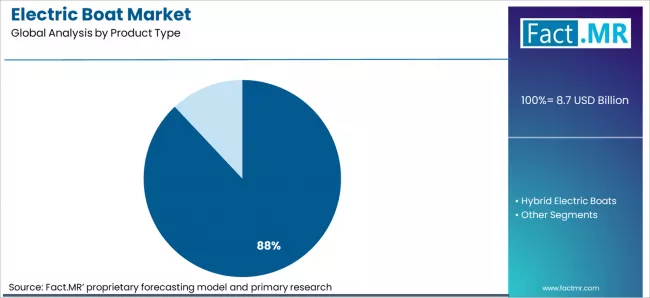
Leisure electric boats account for 42.1% of the market in 2025, reaffirming its position as the category's dominant vessel specification. Recreational boaters increasingly recognize the optimal balance of environmental responsibility and operational enjoyment offered by electric leisure boats for waterway recreation applications, particularly in environmentally sensitive lakes and coastal areas with emission restrictions.

This boat category addresses both silent operation requirements and zero-emission mandates while providing reliable performance outcomes across diverse recreational activities. This segment forms the foundation of most electric boat adoption protocols for recreational boating and waterway tourism, as it represents the most commercially viable and consumer-accessible vessel category in the electric marine industry.

Performance validation standards and extensive user experience continue to strengthen confidence in electric leisure boat systems among boat buyers and marina operators. With increasing recognition of environmental impact on waterway preservation and noise pollution reduction requirements, electric leisure boat technologies align with both current recreational boating practices and sustainable marine evolution goals, making them the central growth driver of comprehensive marine electrification strategies across multiple waterway platforms.

Pontoon & deck boats represent 22.3% of vessel applications, reflecting specialized requirements for family entertainment, social gatherings, and calm-water cruising requiring stable platforms and comfortable electric propulsion. Fishing boats, yachts & cruisers, and commercial & utility boats encompass specialized vessel categories including sport fishing applications, luxury cruising requirements, and commercial transport operations requiring distinct propulsion capabilities and operational profiles.

By Propulsion, Which Category of Electric Boats are Most Preferred?

Electric Boat Market Analysis By Propulsion Type

Outboard electric propulsion-based boats account for 46.0% of total demand in 2025, underscoring its role as the primary propulsion category driving market adoption and electrification technology deployment. Boat manufacturers recognize that outboard motor requirements, including installation simplicity, retrofit compatibility, and maintenance accessibility, provide the largest addressable market that inboard configurations cannot match in versatility and adoption ease.

Outboard electric propulsion utilized in marine applications offers enhanced flexibility characteristics and broad vessel compatibility essential for serving diverse boat designs and retrofit market opportunities. The segment is supported by the expanding nature of existing boat electrification retrofits, requiring propulsion solutions capable of delivering straightforward installation, proven reliability, and comprehensive power ranges, and the increasing recognition that outboard electric systems can provide equivalent performance to internal combustion alternatives.

Manufacturers are increasingly adopting modular outboard designs that enable scalable power configurations for optimal vessel requirements and performance optimization. As understanding of electric propulsion capabilities advances and charging infrastructure becomes more widespread, outboard electric propulsion systems will continue to play a crucial role in comprehensive marine electrification differentiation strategies.

Inboard electric propulsion represents 28.4% of propulsion applications, reflecting permanent installation requirements in larger vessels and luxury craft requiring integrated power systems. Hybrid propulsion and solar-integrated systems account for specialized configurations combining multiple power sources and renewable energy integration for extended range and operational flexibility.

Which Battery Type is Preferred in Electric Boat Configurations?

Electric Boat Market Analysis By Battery Type

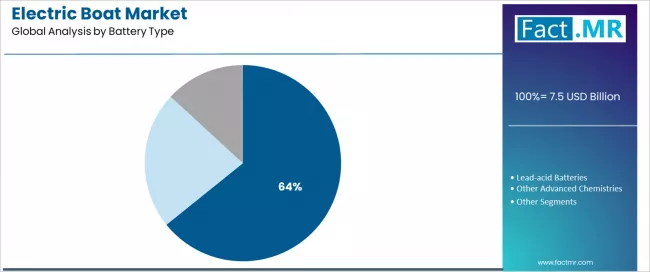
Lithium-ion battery equipped electric boats are projected to account for 64.2% of the market in 2025, establishing its position as the leading energy storage category. Marine engineers and boat manufacturers increasingly recognize that lithium-ion batteries, encompassing high energy density, superior cycle life, and lightweight characteristics, represent the most technically advanced and performance-optimized category for electric marine propulsion due to range requirements and weight sensitivity.

Lithium-ion batteries addresses both energy capacity demands and vessel weight limitations while delivering critical operational range across varied marine applications. The segment is supported by the continuing nature of battery technology advancement in electric vehicle sectors, driven by energy density improvements, cost reduction trajectories, and safety enhancement requiring proven energy storage technologies.

Marine manufacturers are increasingly focusing on advanced lithium battery management systems that enhance safety performance and optimize charging efficiency while maintaining operational reliability. As electric boat range expectations increase and charging infrastructure evolves, lithium-ion battery applications will continue to serve a crucial role in ensuring operational viability and performance excellence within global electric marine markets.

Lead-acid batteries represent 21.7% of the total demand, reflecting cost-effective energy storage for budget-conscious applications and established marine battery supply chains. Other advanced chemistries comprise the remaining segment, encompassing emerging solid-state technologies, sodium-ion alternatives, and specialized marine battery innovations requiring distinct performance characteristics.

By Power Source, Which Electric Boat Category exhibits Dominance?

Electric Boat Market Analysis By Power Source

10-50 kW power electric boats account for 41.0% of the market in 2025, establishing its position as the leading power range category. Marine application engineers increasingly recognize that mid-range power requirements, encompassing typical recreational boats, small commercial vessels, and leisure craft, represent the most commercially relevant and technically feasible category for electric propulsion adoption due to battery capacity and range considerations.

This power range addresses both performance adequacy needs and energy storage practicality while delivering reliable operational capabilities across diverse vessel types. The segment is supported by the continuing nature of recreational boating patterns in typical waterway usage, driven by day-trip activities, short-range cruising, and marina-based operations requiring manageable battery capacities.

Boat operators are increasingly recognizing that mid-range electric power provides sufficient performance for most recreational applications while maintaining reasonable charging times and battery costs. As battery technology advances and power density improves, 10-50 kW electric propulsion will continue to serve a crucial role in mainstream electric boat adoption within recreational marine markets.

50-150 kW power sources represent 28.0% of power ranges, reflecting higher-performance applications in larger vessels and commercial operations requiring extended range. <10 kW and >150 kW categories encompass specialized low-power applications including small tenders and high-power requirements for luxury yachts and commercial ferries requiring substantial propulsion capacity.

What are the Drivers, Restraints, and Key Trends of the Electric Boat Market?

The electric boat market is advancing rapidly due to increasing recognition of marine emission challenges and growing demand for zero-emission propulsion solutions across the maritime sector.

The market faces challenges, including higher initial purchase costs compared to conventional boats, limited charging infrastructure availability in many waterways, and range limitations for extended cruising applications. Innovation in battery technologies and advanced fast-charging methodologies continues to influence product development and market expansion patterns.

Proliferation of Marine Emission Regulations and Zero-Emission Zones

The accelerating implementation of harbor emission restrictions is enabling the development of more comprehensive electric boat adoption mandates and environmental compliance protocols that can meet stringent air quality and noise pollution requirements.

Marine authorities demand advanced electric propulsion integration for waterway protection, including harbor zero-emission zones and marine sanctuary access formulations that are particularly important for achieving superior environmental preservation objectives in sensitive coastal applications.

Advanced regulatory frameworks provide mandated demand for electric vessels that can optimize waterway sustainability strategies and eliminate fossil fuel dependence while maintaining acceptable operational capabilities for diverse marine environments.

Integration of Smart Charging Infrastructure and Battery Swap Systems

Modern marina organizations are incorporating advanced technologies such as high-power charging stations, battery exchange platforms, and intelligent energy management interfaces to enhance electric boat operational viability and range confidence.

These systems improve charging convenience, enable seamless marina-vessel energy transitions, and provide better coordination between shore power capabilities and battery charging requirements throughout the operational experience.

Advanced charging capabilities also enable rapid turnaround times and early identification of battery degradation or charging system faults, supporting proactive maintenance management and improved vessel availability outcomes.

Analysis of the Electric Boat Market by Key Countries

Electric Boat Market Cagr Analysis By Country

Country CAGR (2025-2035)
China 16.0%
India 15.3%
USA 14.5%
Canada 13.9%
Germany 13.2%
UK 12.6%
Japan 12.1%

The electric boat market is experiencing exceptional growth globally, with China leading at a 16.0% CAGR through 2035, driven by rapid inland waterway electrification, urban water transport expansion, and comprehensive marine environmental infrastructure development across major river systems and coastal regions.

India follows at 15.3%, supported by solar-electric boat deployment initiatives, urban waterway development, and growing environmental awareness in water transport. USA records 14.5% growth, benefiting from strong marine industry investment and retail market expansion.

Canada demonstrates 13.9% growth, emphasizing government green marine incentive programs. Germany shows 13.2% growth with hydrogen fuel cell integration and advanced propulsion research.

The UK records 12.6% growth, representing academic research leadership and marine electrification initiatives, while Japan shows 12.1% growth, representing compact marine battery innovation and precision engineering capabilities.

How does China Demonstrate Exceptional Market Leadership with Waterway Electrification?

The market for electric boats in China is projected to exhibit exceptional growth with a CAGR of 16.0% through 2035, driven by massive inland waterway network and increasing emphasis on water transport electrification as an essential component for urban mobility and environmental protection enhancement. The country's extensive river systems and growing urban water taxi infrastructure are creating significant opportunities for electric boat deployment across both tourist applications and emerging commuter transport segments.

Major international marine manufacturers and domestic producers are establishing comprehensive production facilities to serve the expanding demand from ferry operators and tourism companies requiring zero-emission vessels across river cruises, water taxis, and recreational boat systems throughout China's diverse waterway regions. The government's strategic emphasis on green transportation and urban water mobility is driving substantial investments in electric marine capabilities and charging infrastructure availability.

Policy support, combined with the country's enormous inland waterway network and growing environmental enforcement, creates a favorable environment for electric boat market development. Chinese boat manufacturers are increasingly focusing on domestic electric propulsion production scaling to improve cost competitiveness, with advanced electric vessel systems representing a key component in this sustainable marine capability building.

  • Government initiatives supporting green transportation and water mobility enhancement are driving demand for electric boat solutions across commercial and recreational segments
  • Infrastructure investment and waterway development are supporting appropriate deployment of electric vessels among operators and tourism facilities nationwide
  • Ferry operators and tourism companies are increasingly recognizing electric boat operational advantages in cost reduction, creating new adoption capabilities
  • Rising environmental investment and growing awareness of emission elimination benefits are accelerating electric boat adoption across vessel categories

What makes India Demonstrate Strong Market Potential with Solar-Electric Integration?

The market for electric boats in India is expanding at a CAGR of 15.3%, supported by solar-electric boat initiatives, expanding urban waterway development, and advancing sustainable tourism integration across the country's developing river and coastal corridors. The country's substantial solar energy potential and increasing water transport infrastructure are driving demand for solar-integrated electric boat solutions in both tourism and emerging urban mobility applications.

International marine technology suppliers and domestic manufacturers are establishing market capacity to serve the growing demand for affordable electric vessels while supporting the country's position as an emerging sustainable marine market. India's water transport sector continues to benefit from favorable government policies supporting clean energy adoption, expanding waterway connectivity programs, and growing tourism infrastructure investment.

The country's focus on improving urban water mobility is driving interest in electric propulsion technologies including battery-electric and solar-hybrid boats. This development is particularly important for river tourism applications, as operators seek sustainable vessel solutions to serve environmental regulations and tourist expectations.

  • Government waterway development programs and clean energy initiatives are creating opportunities for electric boat solutions
  • Growing river tourism and urban water transport modernization are supporting increased deployment of electric vessels across application categories
  • Expanding solar integration capabilities and emerging marine electrification awareness are driving innovative applications of electric boats in tourism and commuter applications
  • Infrastructure development is enabling market growth for zero-emission vessels, supporting environmental outcomes and tourism enhancement

How does USA maintain Marine Industry Leadership with Investment Strength?

Electric Boat Market Country Value Analysis

The USA's advanced recreational boating market demonstrates sophisticated electric boat adoption with documented effectiveness in leisure applications and marina operations through integration with cutting-edge battery technologies and charging infrastructure. The country leverages marine industry innovation leadership and comprehensive boating culture to maintain a 14.5% CAGR through 2035.

Marine operators and boat manufacturers, including major recreational marine brands and specialty electric boat companies, showcase advancing electric boat implementations where zero-emission vessels integrate with comprehensive marina charging programs and ongoing sustainability initiatives to optimize environmental performance and user experience.

American boat buyers prioritize performance quality and environmental responsibility in recreational vessel selection, creating demand for premium electric boat solutions with proven capabilities, including extended range and integration with established marina networks. The market benefits from sophisticated recreational boating infrastructure and willingness to invest in advanced marine technologies that provide superior operational characteristics and alignment with waterway conservation values and marina environmental standards.

Strategic Market Considerations:

  • Leisure and pontoon boat segments leading adoption with focus on marina integration and environmental positioning applications
  • Strong recreational marine industry and retail distribution supporting electric boat market development through established channels
  • Marine technology innovation and battery advancement supporting continued product development in North American markets
  • Marina charging infrastructure and environmental awareness ensuring appropriate vessel selection and operational optimization

What drives Canada’s Market Growth with Government Incentive Programs?

The market for electric boats in Canada is projected to exhibit strong growth with a CAGR of 13.9% through 2035, driven by federal and provincial green marine incentive programs and comprehensive sustainable boating initiatives. The country's environmental leadership commitment and extensive freshwater waterway systems are creating significant opportunities for electric boat integration across both recreational and commercial tourism applications. Canadian boat operators and marine manufacturers are leveraging government support to serve the demand for zero-emission vessels while supporting the country's position as a sustainable marine innovation leader.

The Canadian market benefits from targeted government financial incentives supporting electric marine adoption, enabling optimized electric boat purchasing and comprehensive charging infrastructure development. This policy environment is particularly important for electric boat applications, as operators access subsidies and grants that improve economic viability while ensuring environmental performance in pristine lake and coastal environments.

Strategic Market Considerations:

  • Recreational boating and eco-tourism segments leading adoption with focus on government incentive utilization and environmental compliance applications
  • Federal and provincial green marine programs driving electric boat purchases through financial subsidies and infrastructure support
  • Environmental stewardship values and waterway protection supporting market development in Canadian marine sector
  • Cold-weather battery performance and seasonal operation patterns influencing technology selection and vessel design optimization

How does Germany drive European Technology Leadership?

Germany's advanced marine engineering market demonstrates sophisticated electric boat development with documented effectiveness in propulsion innovation and hydrogen integration through cutting-edge research and manufacturing capabilities. The country leverages automotive electrification expertise and precision marine engineering to maintain a 13.2% CAGR through 2035.

Marine research institutions and boat manufacturers showcase advanced electric and hydrogen-electric propulsion implementations where fuel cell integration and battery optimization combine with comprehensive testing programs to advance zero-emission marine technology.

German marine engineers prioritize technical excellence and innovation leadership in electric propulsion development, creating demand for advanced electric boat solutions with sophisticated features, including hydrogen fuel cell range extension and integration with European marine environmental standards. The market benefits from established engineering infrastructure and commitment to technology advancement that drives continuous marine electrification progress.

Strategic Market Considerations:

  • Research and commercial vessel segments demonstrating innovation focus with emphasis on hydrogen integration and advanced propulsion applications
  • Strong engineering capabilities and automotive electrification expertise supporting electric marine technology transfer and development
  • Marine research excellence and manufacturing precision supporting competitive positioning in European electric boat markets
  • Environmental regulations and technology leadership emphasizing continuous innovation and performance optimization

What drives the UK’s Market Growth with Academic Research Leadership?

The market for electric boats in UK is projected to exhibit moderate growth with a CAGR of 12.6% through 2035, driven by university research programs and marine electrification pilot initiatives. The country's academic excellence and comprehensive marine heritage are creating opportunities for electric boat development across both research applications and emerging commercial implementations. UK research institutions and marine companies are advancing electric propulsion technologies through collaborative programs and demonstration projects.

The UK market benefits from strong academic-industry partnerships supporting marine innovation, enabling advanced electric boat research and technology validation. This development is particularly relevant for electric marine applications, as universities and companies collaborate on battery optimization and propulsion efficiency research that advances commercial viability.

Strategic Market Considerations:

  • Academic research and demonstration projects leading innovation with emphasis on technology validation and commercial pathway development
  • University partnerships and government research funding supporting electric marine technology advancement
  • Marine heritage and innovation culture supporting market development in UK maritime sector
  • Regulatory frameworks and environmental targets influencing electric boat adoption trajectories and technology priorities

How Does Japan Drive Compact Battery Innovation Excellence?

Electric Boat Market Japan Market Share Analysis By Boat Type

Japan's advanced marine technology market demonstrates sophisticated electric boat development with documented effectiveness in battery miniaturization and propulsion efficiency through precision engineering capabilities. The country leverages electronics industry expertise and compact design methodology to maintain a 12.1% CAGR through 2035. Marine electronics manufacturers showcase advanced battery management systems and compact electric propulsion where Japanese engineering precision integrates with comprehensive quality control to optimize power density and reliability.

Japanese marine companies prioritize compact design and operational efficiency in electric boat development, creating demand for advanced marine battery solutions with sophisticated features, including high power density and integration with Japanese manufacturing quality standards. The market benefits from established electronics infrastructure and commitment to precision engineering excellence.

Strategic Market Considerations:

  • Compact boat and specialty vessel segments demonstrating focused development with emphasis on battery innovation and space optimization
  • Electronics industry expertise and precision manufacturing supporting electric marine component development
  • Marine technology excellence supported by battery industry capabilities and compact design innovation
  • Quality standards and reliability requirements emphasizing proven performance and comprehensive testing validation

Europe Market Split by Country

Electric Boat Market Europe Country Market Share Analysis, 2025 & 2035

The electric boat market in Europe is projected to grow from USD 2.1 billion in 2025 to USD 6.8 billion by 2035, registering a CAGR of 12.5% over the forecast period. Germany is expected to maintain its leadership position with a 28.6% market share in 2025, rising to 30.4% by 2035, supported by its dominant marine engineering infrastructure, comprehensive electric propulsion research capabilities, and advanced sustainability excellence throughout major waterway systems and coastal regions.

The Netherlands follows with a 22.4% share in 2025, projected to reach 23.1% by 2035, driven by extensive canal networks, electric water taxi adoption, and established sustainable boating culture serving both domestic and European markets. France holds a 18.7% share in 2025, expected to increase to 18.9% by 2035, supported by comprehensive river tourism infrastructure and Mediterranean coastal operations. Italy commands a 14.3% share in 2025, projected to reach 13.8% by 2035, while the UK accounts for 11.8% in 2025, expected to reach 10.6% by 2035.

The rest of Europe region, including Nordic countries with advanced environmental standards, Eastern European emerging waterway markets, and smaller Western European lake regions, is anticipated to hold 4.2% in 2025, increasing to 3.2% by 2035, attributed to market consolidation toward larger core markets with established electric boat infrastructure and charging network expertise.

Competitive Landscape of the Electric Boat Market

Electric Boat Market Analysis By Company

The electric boat market is characterized by intense competition among established marine manufacturers, specialized electric propulsion startups, and comprehensive marine electrification organizations focused on delivering high-performance, reliable, and environmentally sustainable electric boat products.

Companies are investing in battery technology development programs, advanced motor engineering, strategic marina partnerships, and comprehensive charging infrastructure initiatives to deliver effective, durable, and commercially viable electric vessel solutions that meet stringent marine standards and operator expectations. Product innovation, range optimization, and infrastructure development strategies are central to strengthening product portfolios and market presence.

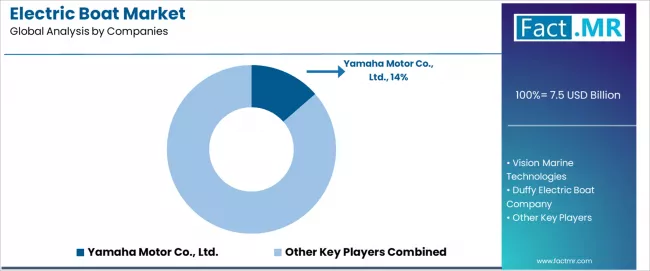
Yamaha Motor Co., Ltd. leads the market with a 13.6% market share, offering comprehensive electric marine propulsion solutions with a focus on outboard motor expertise and advanced battery integration capabilities for diverse recreational boating applications.

Vision Marine Technologies provides specialized electric powertrain platforms with emphasis on high-performance electric outboards and North American market leadership across marine sectors. Duffy Electric Boat Company focuses on leisure electric boat manufacturing and established recreational vessel expertise serving waterway tourism communities. RAND Boats ApS delivers Scandinavian electric boat design with strong sustainability positioning and premium market integration.

SVP Yachts d.o.o. (Greenline) operates with a focus on luxury electric yachts and hybrid propulsion systems for premium recreational applications. ElectraCraft, Inc. provides vintage-style electric boats emphasizing heritage design and modern electric propulsion integration. Frauscher Bootswerft GmbH specializes in Austrian craftsmanship and electric-hybrid luxury boats with emphasis on performance excellence.

X Shore AB delivers Swedish electric performance boats to enhance market positioning and provide high-performance recreational vessels. Pure Watercraft Inc. and Volvo Penta Corporation focus on electric outboard innovation and established marine industry integration, emphasizing propulsion reliability and comprehensive electric marine protocols through dedicated electrification strategies.

Key Players in the Electric Boat Market

  • Yamaha Motor Co., Ltd.
  • Vision Marine Technologies
  • Duffy Electric Boat Company
  • RAND Boats ApS
  • SVP Yachts d.o.o. (Greenline)
  • ElectraCraft, Inc.
  • Frauscher Bootswerft GmbH
  • X Shore AB
  • Pure Watercraft Inc.
  • Volvo Penta Corporation

Scope of the Report

Items Values
Quantitative Units (2025) USD 7.5 Billion
Boat Type Leisure Boats, Pontoon & Deck Boats, Fishing Boats, Yachts & Cruisers, Commercial & Utility Boats
Propulsion Type Outboard Electric Propulsion, Inboard Electric Propulsion, Hybrid Propulsion, Solar-Integrated Systems
Battery Type Lithium-ion Batteries, Lead-acid Batteries, Other Advanced Chemistries
Power Source <10 kW, 10-50 kW, 50-150 kW, >150 kW
Regions Covered North America, Europe, Asia Pacific, Latin America, Middle East & Africa
Countries Covered USA, Germany, UK, Japan, India, China, Canada and 40+ countries
Key Companies Profiled Yamaha Motor Co., Ltd., Vision Marine Technologies, Duffy Electric Boat Company, RAND Boats ApS, SVP Yachts d.o.o. (Greenline), ElectraCraft, Inc., Frauscher Bootswerft GmbH, X Shore AB, Pure Watercraft Inc., Volvo Penta Corporation
Additional Attributes Dollar sales by boat type, propulsion type, battery type, power source, regional demand trends, competitive landscape, boat buyer preferences for specific electric vessel configurations, integration with comprehensive marine charging systems, innovations in battery technology development, propulsion efficiency advancement, and operational range optimization capabilities

Electric Boat Market by Segments

  • Boat Type :

    • Leisure Boats
    • Pontoon & Deck Boats
    • Fishing Boats
    • Yachts & Cruisers
    • Commercial & Utility Boats
  • Propulsion Type :

    • Outboard Electric Propulsion
    • Inboard Electric Propulsion
    • Hybrid Propulsion
    • Solar-Integrated Systems
  • Battery Type :

    • Lithium-ion Batteries
    • Lead-acid Batteries
    • Other Advanced Chemistries
  • Power Source :

    • <10 kW
    • 10-50 kW
    • 50-150 kW
    • 150 kW
  • Region :

    • North America

      • United States
      • Canada
      • Mexico
    • Europe

      • Germany
      • France
      • United Kingdom
      • Italy
      • Spain
      • Nordic
      • BENELUX
      • Rest of Europe
    • Asia Pacific

      • China
      • India
      • Japan
      • South Korea
      • ASEAN
      • Australia & New Zealand
      • Rest of Asia Pacific
    • Latin America

      • Brazil
      • Argentina
      • Chile
      • Rest of Latin America
    • Middle East & Africa

      • Kingdom of Saudi Arabia
      • Other GCC Countries
      • Turkey
      • South Africa
      • Other African Countries
      • Rest of Middle East & Africa

Table of Content

  1. Executive Summary
    • USA Market Outlook
    • Demand to side Trends
    • Supply to side Trends
    • Technology Roadmap Analysis
    • Analysis and Recommendations
  2. Market Overview
    • Market Coverage / Taxonomy
    • Market Definition / Scope / Limitations
  3. Market Background
    • Market Dynamics
      • Drivers
      • Restraints
      • Opportunity
      • Trends
    • Scenario Forecast
      • Demand in Optimistic Scenario
      • Demand in Likely Scenario
      • Demand in Conservative Scenario
    • Opportunity Map Analysis
    • Product Life Cycle Analysis
    • Supply Chain Analysis
    • Investment Feasibility Matrix
    • Value Chain Analysis
    • PESTLE and Porter’s Analysis
    • Regulatory Landscape
    • Regional Parent Market Outlook
    • Production and Consumption Statistics
    • Import and Export Statistics
  4. USA Market Analysis 2020 to 2024 and Forecast, 2025 to 2035
    • Historical Market Size Value (USD Million) Analysis, 2020 to 2024
    • Current and Future Market Size Value (USD Million) Projections, 2025 to 2035
      • Y to o to Y Growth Trend Analysis
      • Absolute $ Opportunity Analysis
  5. USA Market Pricing Analysis 2020 to 2024 and Forecast 2025 to 2035
  6. USA Market Analysis 2020 to 2024 and Forecast 2025 to 2035, By Boat Type
    • Introduction / Key Findings
    • Historical Market Size Value (USD Million) Analysis By Boat Type, 2020 to 2024
    • Current and Future Market Size Value (USD Million) Analysis and Forecast By Boat Type, 2025 to 2035
      • Leisure Boats
      • Pontoon & Deck Boats
      • Fishing Boats
      • Yachts & Cruisers
      • Commercial & Utility Boats
    • Y to o to Y Growth Trend Analysis By Boat Type, 2020 to 2024
    • Absolute $ Opportunity Analysis By Boat Type, 2025 to 2035
  7. USA Market Analysis 2020 to 2024 and Forecast 2025 to 2035, By Propulsion Type
    • Introduction / Key Findings
    • Historical Market Size Value (USD Million) Analysis By Propulsion Type, 2020 to 2024
    • Current and Future Market Size Value (USD Million) Analysis and Forecast By Propulsion Type, 2025 to 2035
      • Outboard Electric Propulsion
      • Inboard Electric Propulsion
      • Hybrid Propulsion
      • Solar-Integrated Systems
    • Y to o to Y Growth Trend Analysis By Propulsion Type, 2020 to 2024
    • Absolute $ Opportunity Analysis By Propulsion Type, 2025 to 2035
  8. USA Market Analysis 2020 to 2024 and Forecast 2025 to 2035, By Battery Type
    • Introduction / Key Findings
    • Historical Market Size Value (USD Million) Analysis By Battery Type, 2020 to 2024
    • Current and Future Market Size Value (USD Million) Analysis and Forecast By Battery Type, 2025 to 2035
      • Lithium-ion Batteries
      • Lead-acid Batteries
      • Other Advanced Chemistries
    • Y to o to Y Growth Trend Analysis By Battery Type, 2020 to 2024
    • Absolute $ Opportunity Analysis By Battery Type, 2025 to 2035
  9. USA Market Analysis 2020 to 2024 and Forecast 2025 to 2035, By Power Source
    • Introduction / Key Findings
    • Historical Market Size Value (USD Million) Analysis By Power Source, 2020 to 2024
    • Current and Future Market Size Value (USD Million) Analysis and Forecast By Power Source, 2025 to 2035
      • 10-50 kW
      • <10 kW
      • 50-150 kW
      • 150 kW
    • Y to o to Y Growth Trend Analysis By Power Source, 2020 to 2024
    • Absolute $ Opportunity Analysis By Power Source, 2025 to 2035
  10. USA Market Analysis 2020 to 2024 and Forecast 2025 to 2035, By Region
    • Introduction
    • Historical Market Size Value (USD Million) Analysis By Region, 2020 to 2024
    • Current Market Size Value (USD Million) Analysis and Forecast By Region, 2025 to 2035
      • USA
    • Market Attractiveness Analysis By Region
  11. USA Market Analysis 2020 to 2024 and Forecast 2025 to 2035, By Country
    • Historical Market Size Value (USD Million) Trend Analysis By Market Taxonomy, 2020 to 2024
    • Market Size Value (USD Million) Forecast By Market Taxonomy, 2025 to 2035
      • By Country
      • By Boat Type
      • By Propulsion Type
      • By Battery Type
      • By Power Source
    • Market Attractiveness Analysis
      • By Country
      • By Boat Type
      • By Propulsion Type
      • By Battery Type
      • By Power Source
    • Key Takeaways
  12. Market Structure Analysis
    • Competition Dashboard
    • Competition Benchmarking
    • Market Share Analysis of Top Players
      • By Regional
      • By Boat Type
      • By Propulsion Type
      • By Battery Type
      • By Power Source
  13. Competition Analysis
    • Competition Deep Dive
      • Yamaha Motor Co., Ltd.
        • Overview
        • Product Portfolio
        • Profitability by Market Segments (Product/Age /Sales Channel/Region)
        • Sales Footprint
        • Strategy Overview
          • Marketing Strategy
          • Product Strategy
          • Channel Strategy
      • Vision Marine Technologies
      • Duffy Electric Boat Company
      • RAND Boats ApS
      • SVP Yachts d.o.o. (Greenline)
      • ElectraCraft, Inc.
      • Frauscher Bootswerft GmbH
      • X Shore AB
      • Pure Watercraft Inc.
      • Volvo Penta Corporation
  14. Assumptions & Acronyms Used
  15. Research Methodology

List Of Table

  • Table 1: USA Market Value (USD Million) Forecast by Region, 2020 to 2035
  • Table 2: USA Market Value (USD Million) Forecast by Boat Type, 2020 to 2035
  • Table 3: USA Market Value (USD Million) Forecast by Propulsion Type, 2020 to 2035
  • Table 4: USA Market Value (USD Million) Forecast by Battery Type, 2020 to 2035
  • Table 5: USA Market Value (USD Million) Forecast by Power Source, 2020 to 2035
  • Table 6: USA Market Value (USD Million) Forecast by Country, 2020 to 2035
  • Table 7: USA Market Value (USD Million) Forecast by Boat Type, 2020 to 2035
  • Table 8: USA Market Value (USD Million) Forecast by Propulsion Type, 2020 to 2035
  • Table 9: USA Market Value (USD Million) Forecast by Battery Type, 2020 to 2035
  • Table 10: USA Market Value (USD Million) Forecast by Power Source, 2020 to 2035

List Of Figures

  • Figure 1: USA Market Pricing Analysis
  • Figure 2: USA Market Value (USD Million) Forecast 2020 to 2035
  • Figure 3: USA Market Value Share and BPS Analysis by Boat Type, 2025 and 2035
  • Figure 4: USA Market Y to o to Y Growth Comparison by Boat Type, 2025 to 2035
  • Figure 5: USA Market Attractiveness Analysis by Boat Type
  • Figure 6: USA Market Value Share and BPS Analysis by Propulsion Type, 2025 and 2035
  • Figure 7: USA Market Y to o to Y Growth Comparison by Propulsion Type, 2025 to 2035
  • Figure 8: USA Market Attractiveness Analysis by Propulsion Type
  • Figure 9: USA Market Value Share and BPS Analysis by Battery Type, 2025 and 2035
  • Figure 10: USA Market Y to o to Y Growth Comparison by Battery Type, 2025 to 2035
  • Figure 11: USA Market Attractiveness Analysis by Battery Type
  • Figure 12: USA Market Value Share and BPS Analysis by Power Source, 2025 and 2035
  • Figure 13: USA Market Y to o to Y Growth Comparison by Power Source, 2025 to 2035
  • Figure 14: USA Market Attractiveness Analysis by Power Source
  • Figure 15: USA Market Value (USD Million) Share and BPS Analysis by Region, 2025 and 2035
  • Figure 16: USA Market Y to o to Y Growth Comparison by Region, 2025 to 2035
  • Figure 17: USA Market Attractiveness Analysis by Region
  • Figure 18: USA Market Incremental Dollar Opportunity, 2025 to 2035
  • Figure 19: USA Market Value Share and BPS Analysis by Country, 2025 and 2035
  • Figure 20: USA Market Value Share and BPS Analysis by Boat Type, 2025 and 2035
  • Figure 21: USA Market Y to o to Y Growth Comparison by Boat Type, 2025 to 2035
  • Figure 22: USA Market Attractiveness Analysis by Boat Type
  • Figure 23: USA Market Value Share and BPS Analysis by Propulsion Type, 2025 and 2035
  • Figure 24: USA Market Y to o to Y Growth Comparison by Propulsion Type, 2025 to 2035
  • Figure 25: USA Market Attractiveness Analysis by Propulsion Type
  • Figure 26: USA Market Value Share and BPS Analysis by Battery Type, 2025 and 2035
  • Figure 27: USA Market Y to o to Y Growth Comparison by Battery Type, 2025 to 2035
  • Figure 28: USA Market Attractiveness Analysis by Battery Type
  • Figure 29: USA Market Value Share and BPS Analysis by Power Source, 2025 and 2035
  • Figure 30: USA Market Y to o to Y Growth Comparison by Power Source, 2025 to 2035
  • Figure 31: USA Market Attractiveness Analysis by Power Source
  • Figure 32: USA Market - Tier Structure Analysis
  • Figure 33: USA Market - Company Share Analysis

- FAQs -

How big is the electric boat market in 2025?

The global electric boat market is estimated to be valued at USD 7.5 billion in 2025.

What will be the size of electric boat market in 2035?

The market size for the electric boat market is projected to reach USD 27.0 billion by 2035.

How much will be the electric boat market growth between 2025 and 2035?

The electric boat market is expected to grow at a 13.7% CAGR between 2025 and 2035.

What are the key product types in the electric boat market?

The key product types in electric boat market are leisure boats, pontoon & deck boats, fishing boats, yachts & cruisers and commercial & utility boats.

Which propulsion type segment to contribute significant share in the electric boat market in 2025?

In terms of propulsion type, outboard electric propulsion segment to command 46.0% share in the electric boat market in 2025.

Electric Boat Market