- Base Value(2025): 425.10 Bn
- Estimated Value(2026): 501.19 Bn
- Forecast Value (2036): 2601.02 Bn
- CAGR (2026 - 2036): 17.90%
Electric Commercial Vehicle Market Size, Market Forecast and Outlook By Fact.MR
The electric commercial vehicle market was valued at USD 425.10 billion in 2025, projected to reach USD 501.19 billion in 2026, and is forecast to expand to USD 2601.02 billion by 2036 at a 17.90% CAGR. Government zero-emission vehicle mandates targeting commercial fleets, including the California Advanced Clean Trucks regulation, EU heavy-duty CO2 standards, and India's PM E-Bus Sewa programme, are creating regulatory procurement floors that guarantee minimum electric commercial vehicle adoption regardless of market economics. City bus electrification leads adoption because fixed-route operations with predictable daily mileage and centralized depot charging align with current battery range and charging infrastructure capabilities.
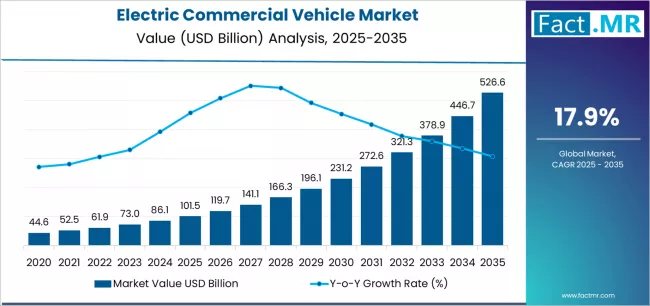
Electric Commercial Vehicle Market Market Value Analysis | Source: Fact.MR
Summary of Electric Commercial Vehicle Market
- Electric Commercial Vehicle Market Definition
- Electric commercial vehicles are zero-emission or low-emission trucks, vans, and buses powered by battery electric, plug-in hybrid, or fuel cell electric drivetrains for freight transport, passenger transit, and urban delivery operations.
- Demand Drivers in the Market
- Government zero-emission fleet mandates, including California Advanced Clean Trucks and EU heavy-duty CO2 standards, create regulatory procurement floors that guarantee minimum electric commercial vehicle adoption volumes regardless of market pricing dynamics.
- Total cost of ownership parity between electric and diesel commercial vehicles on high-utilization urban routes, driven by lower energy costs per kilometer and reduced maintenance requirements, shifts fleet procurement decisions from subsidy-dependent to economically self-sustaining.
- Municipal transit authority mandates requiring 100% zero-emission bus fleets by 2030 to 2035 in major cities across Europe, North America, and China generate concentrated procurement pipelines for electric buses.
- Key Segments Analyzed in the Fact.MR Report
- Buses & Coaches: 65.2% share in 2026, the dominant configuration within vehicle type.
- Battery Electric Vehicle: 70.0% share in 2026, leading within propulsion type.
- China: 21.5% compound growth, the fastest-expanding national market.
- Analyst Opinion at Fact.MR
- The electric commercial vehicle market is at an inflection point where regulatory mandates and total cost of ownership economics are converging to accelerate adoption beyond the early-adopter municipal bus segment into mainstream freight and delivery operations. Fleet operators that delay electric vehicle procurement face escalating regulatory penalties, restricted urban access zone entry, and competitive disadvantage against operators already capturing the per-kilometer cost savings from electric drivetrains. Buses and coaches lead because their fixed-route, depot-return operating profiles are ideally suited to current battery technology limitations, but light commercial delivery vans are the fastest-growing unit volume category as last-mile logistics electrification scales. Heavy-duty long-haul trucks represent the final frontier where battery energy density and charging infrastructure must advance further before electric alternatives can match diesel operational flexibility. BYD and the Chinese manufacturing ecosystem hold a structural cost advantage in electric buses and light trucks that European and North American competitors are working to close through domestic production scale-up.
- Strategic Implications / Executive Takeaways
- Fleet operators must develop phased electrification roadmaps that prioritize high-utilization urban routes where electric commercial vehicles already achieve TCO parity, before expanding to medium-haul and eventually long-haul applications as battery technology matures.
- Commercial vehicle OEMs must secure battery cell supply agreements scaled to their production forecasts, as cell allocation shortages have already delayed electric truck launch schedules at multiple manufacturers.
- Charging infrastructure developers should target commercial vehicle depot installations where fleet-scale overnight charging enables predictable load profiles that simplify grid connection planning and demand management.
Electric Commercial Vehicle Market Key Takeaways
| Metric | Details |
|---|---|
| Industry Size (2026) | USD 501.19 billion |
| Industry Value (2036) | USD 2601.02 billion |
| CAGR (2026 to 2036) | 17.90% |
Source: Fact.MR analysis. Updated Mar 26, 2026
The absolute dollar opportunity between 2026 and 2036 amounts to approximately USD 2,099.83 billion. This rapid expansion reflects the early-stage electrification of the commercial vehicle sector where penetration rates are transitioning from single digits to mainstream adoption. Buses and coaches lead the vehicle type segment because municipal transit authorities are the earliest adopters, with many cities mandating zero-emission bus fleets by 2030 to 2035. Based on Fact.MR's report, battery electric propulsion dominates because falling battery costs have brought total cost of ownership for electric buses and urban delivery vans below diesel equivalents on high-utilization routes, while fuel cell technology remains concentrated in long-haul heavy truck applications where battery weight and charging time constraints limit BEV viability.
China leads with a 21.5% CAGR as domestic manufacturing scale and government procurement mandates position it as the global electric bus and truck production leader. India follows at 20.0%, driven by the PM E-Bus Sewa programme deploying thousands of electric buses. USA advances at 16.0%, supported by CARB Advanced Clean Trucks rules. South Korea registers 15.5%. Germany tracks at 14.5%. UK maintains 13.5%, and Japan at 13.0%.
Why is the Electric Commercial Vehicle Market Growing?
The electric commercial vehicle market grows by enabling fleet operators and transportation companies to achieve zero-emission operations and regulatory compliance while addressing operational cost reduction and sustainability commitments without exclusive reliance on diesel-powered commercial vehicles.
Fleet operators face mounting pressure to reduce greenhouse gas emissions and meet increasingly stringent air quality standards while managing total cost of ownership considerations, driver comfort requirements, and operational range limitations, with modern electric commercial vehicles typically providing substantial fuel cost savings reaching 60-70% compared to diesel equivalents, reduced maintenance expenses through simplified drivetrains with fewer moving parts, and zero tailpipe emissions enabling unrestricted urban access compared to conventional commercial vehicles alone, making electric commercial vehicles essential for comprehensive fleet sustainability strategies.
The commercial transportation industry's need for economically viable and environmentally responsible vehicle solutions creates demand for specialized electric commercial vehicles that can provide operational efficiency, enhance corporate sustainability credentials, and support regulatory compliance without compromising payload capacity or operational flexibility.
Government policy support and total cost of ownership advantages supporting electric commercial vehicle benefits drive adoption in municipal transit operations, logistics fleet applications, and corporate transportation environments, where emission reduction has direct impact on regulatory compliance and operational economics. The accelerating global commitment to carbon neutrality targets, with numerous countries and cities announcing diesel vehicle phase-out timelines by 2030-2040, creates expanding market opportunities for zero-emission commercial transportation solutions.
Rising fuel price volatility and electricity cost stability enable predictable operating expense forecasting and adherence to long-term fleet electrification strategies. However, charging infrastructure availability constraints and battery cost premiums may limit adoption rates and optimal implementation across long-haul trucking operations serving diverse geographic regions with varying charging network maturity levels.
Segmental Analysis
The market is segmented by vehicle type, propulsion type, drive type, vehicle speed, and region. By vehicle type, the market is divided into light commercial vehicles, heavy trucks, and buses & coaches. Based on propulsion type, the market is categorized into battery electric vehicle, plug-in hybrid electric vehicle, and fuel cell electric vehicle.
By drive type, the market includes front-wheel drive, rear-wheel drive, and all-wheel drive. Based on vehicle speed, the market is divided into less than 100 MPH, 100 MPH to 125 MPH, and above 125 MPH. Regionally, the market is divided into Asia Pacific, Europe, North America, Latin America, and Middle East & Africa.
By Vehicle Type, Which Segment Accounts for the Dominant Market Share?
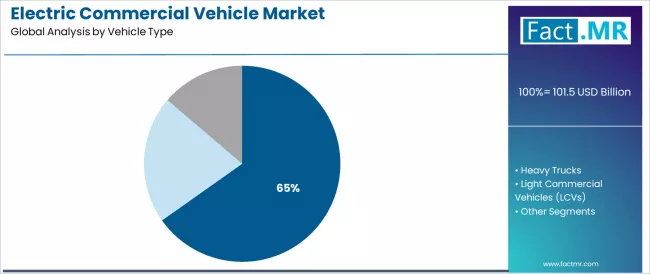
Electric Commercial Vehicle Market Analysis By Vehicle Type | Source: Fact.MR
Buses & coaches represent the dominant force in the electric commercial vehicle market, capturing 65.2% of the total market share in 2025. This established vehicle category encompasses solutions featuring high passenger capacity and scheduled route operations, including advanced electric transit buses and intercity coaches that enable zero-emission public transportation and reduced operational noise across municipal transit systems and regional passenger services worldwide.
The buses & coaches segment's market leadership stems from its compelling economic proposition for fleet electrification, with solutions capable of achieving operational cost parity or advantage compared to diesel alternatives within 3-5 years while delivering immediate air quality benefits in densely populated urban environments where transit vehicles operate on fixed routes with predictable energy requirements.
Light commercial vehicles maintain a substantial market share in the 19-21% range, serving last-mile delivery operations and urban logistics applications that require compact footprints and frequent stop-start driving patterns ideally suited for electric propulsion advantages including regenerative braking energy recovery and instant torque delivery.
LCVs offer essential functionality for e-commerce fulfillment and parcel delivery services enabling urban access compliance while providing sufficient payload capacity to support commercial delivery requirements. The light commercial vehicles segment demonstrates strong growth potential, driven by expanding e-commerce penetration and increasing urban delivery density requiring clean transportation solutions.
Within the vehicle type category, heavy trucks represent an emerging electrification opportunity at a 14.8% share, driven by increasing availability of long-range battery systems and megawatt charging infrastructure supporting regional distribution and specialized hauling applications.
Key operational advantages driving the buses & coaches segment include:
- Advanced route optimization capabilities with clinically demonstrated operational reliability across fixed-route transit services enabling predictable charging schedules and energy management protocols
- Established total cost of ownership benefits allowing operational savings through reduced fuel costs, lower maintenance requirements, and extended brake system life without extensive infrastructure complexity compared to depot charging solutions
- Enhanced passenger experience features enabling quieter cabin environments and smoother acceleration characteristics while maintaining schedule integrity and operational consistency
- Superior emission reduction profile providing optimal air quality improvements in urban corridors and compliance with stringent environmental regulations across various municipal transit applications
By Propulsion Type, Which Segment Accounts for the Largest Market Share?
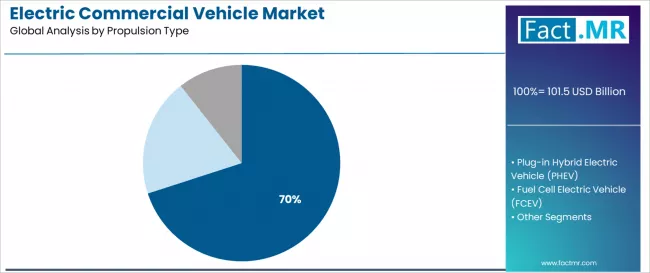
Electric Commercial Vehicle Market Analysis By Propulsion Type | Source: Fact.MR
Battery electric vehicles dominate the electric commercial vehicle propulsion landscape with approximately 70.0% market share in 2025, reflecting the critical role of pure electric powertrains in supporting zero-emission fleet operations, simplified maintenance protocols, and optimal energy efficiency across commercial transportation applications worldwide. The battery electric vehicle segment's market leadership is reinforced by rapid battery technology advancement reducing cost premiums, expanding charging infrastructure networks supporting depot and opportunity charging strategies, and proven operational reliability that characterizes successful municipal transit and urban delivery implementations.
Within this segment, lithium-ion battery systems represent the dominant technology platform, driven by established supply chains, proven energy density characteristics, and comprehensive charging infrastructure compatibility. This sub-segment benefits from ongoing battery cost reduction trends and manufacturing scale advantages.
The plug-in hybrid electric vehicle segment represents an important transitional technology at 15.0% share, demonstrating utility through extended range capabilities combining electric propulsion for urban operations with internal combustion backup for long-distance requirements and charging infrastructure gaps. This segment benefits from operational flexibility addressing range anxiety and infrastructure constraints in early fleet electrification phases.
The fuel cell electric vehicle segment maintains strategic presence at 15.0% share with fastest projected growth at 21.4% CAGR through specialized requirements for heavy-duty applications, long-haul operations, and rapid refueling needs where hydrogen fuel cell systems offer potential advantages over battery electric alternatives in specific duty cycles.
Key market dynamics supporting propulsion type growth include:
- Battery electric vehicle expansion driven by total cost of ownership advantages and charging infrastructure proliferation, requiring depot charging solutions and smart energy management systems
- Fuel cell technology advancement trends require hydrogen production and distribution infrastructure development alongside vehicle platform optimization
- Integration of renewable energy charging protocols enabling carbon-neutral fleet operations and utility demand response participation
- Growing emphasis on propulsion technology selection based on duty cycle analysis and total cost of ownership modeling
By Drive Type, Which Segment Accounts for the Dominant Market Share?
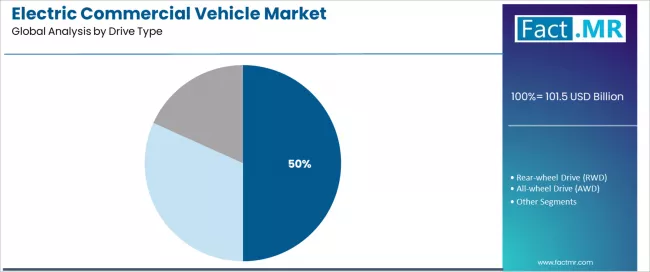
Electric Commercial Vehicle Market Analysis By Drive Type | Source: Fact.MR
Front-wheel drive dominates the electric commercial vehicle drive type landscape with approximately 50.0% market share in 2025, reflecting the critical role of cost-effective drivetrain configurations in supporting affordable fleet electrification, adequate traction performance, and simplified vehicle architecture across light and medium commercial vehicle applications worldwide. The front-wheel drive segment's market leadership is reinforced by established automotive engineering practices, component availability advantages, and proven reliability supporting high-volume commercial vehicle production strategies.
Within this segment, single front-mounted motor configurations represent the primary architecture, driven by packaging efficiency, manufacturing cost advantages, and sufficient performance characteristics for urban commercial vehicle duty cycles. This sub-segment benefits from automotive industry experience and established supply chain maturity.
The rear-wheel drive segment represents an important configuration category at 25.0% share demonstrating steady adoption through traditional commercial vehicle architecture preferences and load distribution advantages for cargo-carrying applications requiring optimal weight balance and traction characteristics.
The all-wheel drive segment maintains growing presence at 25.0% share with fastest projected CAGR through specialized requirements for enhanced traction control, improved vehicle stability, and superior performance in adverse weather conditions where dual-motor electric drivetrains offer operational advantages.
Key market dynamics supporting drive type growth include:
- Front-wheel drive optimization driven by cost reduction priorities and light commercial vehicle platform requirements, requiring efficient packaging solutions and component integration
- All-wheel drive modernization trends require advanced torque vectoring capabilities and traction management systems optimization
- Integration of regenerative braking systems enabling energy recovery optimization across different drive configurations
- Growing emphasis on drive type selection based on vehicle weight class and operational environment requirements
By Vehicle Speed, Which Segment Accounts for a Significant Market Share?
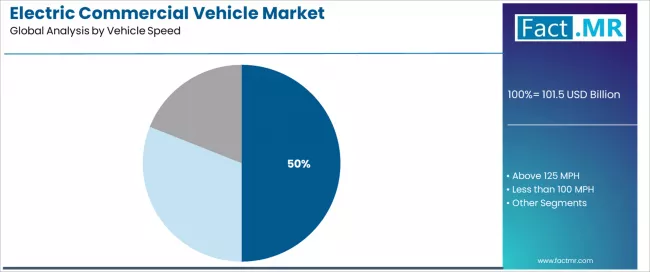
Electric Commercial Vehicle Market Analysis By Vehicle Speed | Source: Fact.MR
The 100 MPH to 125 MPH segment represents the dominant vehicle speed category in the electric commercial vehicle market with approximately 50.0% market share in 2025, reflecting optimal balance between operational capability and regulatory compliance requirements supporting highway-capable commercial vehicles, intercity bus services, and regional delivery operations across diverse commercial transportation applications.
The less than 100 MPH segment emerges as an important category with 35.0% share and fastest projected CAGR, driven by urban commercial vehicle applications including city buses, delivery vans, and municipal service vehicles operating primarily in speed-restricted environments where lower top speeds enable battery optimization and cost reduction.
Within vehicle speed applications, the above 125 MPH segment demonstrates specialized presence at 15.0% share serving premium coach services and express delivery applications requiring enhanced highway performance capabilities for competitive service delivery.
Key vehicle speed dynamics include:
- Mid-range speed optimization requirements accelerating across highway-capable commercial vehicles with emphasis on range efficiency and operational flexibility
- Urban speed applications driving specialized vehicle development for city-restricted operations and optimal battery utilization
- High-speed capabilities prioritizing premium service applications and competitive transit time requirements
- Speed-based vehicle design emphasizing aerodynamic optimization and energy efficiency across operational profiles
What are the Drivers, Restraints, and Key Trends of the Electric Commercial Vehicle Market?
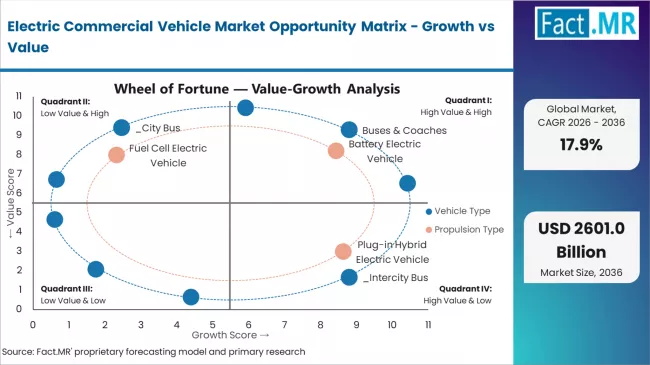
Electric Commercial Vehicle Market Opportunity Matrix Growth Vs Value | Source: Fact.MR
The market is driven by three concrete demand factors tied to commercial transportation evolution. First, stringent emission regulations and urban air quality mandates create expanding requirements for zero-emission commercial vehicles, with electric propulsion representing essential compliance technology for fleet operators in comprehensive urban access strategies, requiring widespread vehicle adoption. Second, improving total cost of ownership economics drives fleet electrification decisions and operational transformation, with electric commercial vehicles demonstrating substantial operational savings through reduced fuel costs, lower maintenance expenses, and extended component life compared to diesel vehicles by 2030. Third, corporate sustainability commitments and environmental social governance reporting requirements enable fleet electrification investments that improve brand reputation while meeting stakeholder expectations for emission reduction.
Market restraints include higher upfront vehicle purchase costs and capital investment requirements that can challenge fleet electrification business cases and financing availability across small and medium commercial operators, particularly when comparing electric vehicle premiums ranging from 30-80% above diesel equivalents depending on vehicle class and battery capacity. Charging infrastructure availability limitations pose another significant obstacle, as commercial vehicle electrification requires dedicated depot charging installations, electrical service upgrades, and strategic public charging network access, potentially affecting operational flexibility and route planning. Battery supply chain constraints and raw material availability concerns create additional market pressures, demanding secure supply relationships and potential vertical integration initiatives.
Key trends indicate accelerated megawatt charging technology deployment in developed markets, particularly Europe and North America, where logistics operators demonstrate commitment to long-haul electric trucking enabled by ultra-fast charging infrastructure supporting 15-30 minute charging sessions. Vehicle-to-grid integration trends toward bidirectional charging capabilities with fleet batteries providing grid services and renewable energy storage combine transportation electrification with energy system optimization that enhances economic viability and sustainability outcomes. However, the market thesis could face disruption if significant advances in hydrogen fuel cell cost reduction or sustainable synthetic fuel technologies provide competitive zero-emission alternatives reducing exclusive dependence on battery electric propulsion approaches.
Analysis of the Electric Commercial Vehicle Market by Key Countries
.webp "Top Country Growth Comparison Electric Commercial Vehicle Market Cagr (2026 2036)")
Top Country Growth Comparison Electric Commercial Vehicle Market Cagr (2026 2036) | Source: Fact.MR
| Country | CAGR (2026-2036) |
|---|---|
| India | 24.0% |
| China | 22.8% |
| USA | 19.5% |
| Germany | 18.0% |
| UK | 17.3% |
| Japan | 16.2% |
| Canada | 15.0% |
Source: Fact.MR analysis. Updated Mar 26, 2026
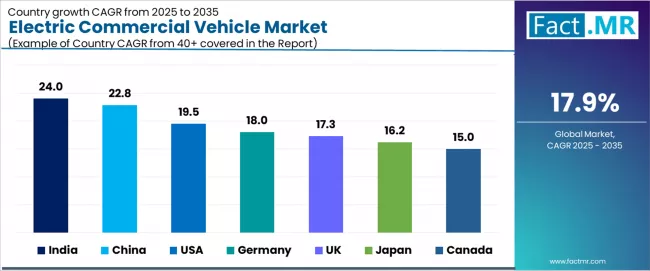
Electric Commercial Vehicle Market Cagr Analysis By Country | Source: Fact.MR
The global electric commercial vehicle market is expanding rapidly, with India leading at a 24.0% CAGR through 2036, driven by FAME II policy incentives, light commercial vehicle adoption acceleration, and urban air quality improvement mandates. China follows at 22.8%, supported by large electric vehicle manufacturing base, comprehensive government incentives, and municipal transit electrification programs. USA records 19.5%, reflecting federal and state incentive programs, fleet electrification commitments, and logistics industry sustainability initiatives.
Germany advances at 18.0%, leveraging industrial policy support, electric vehicle fleet adoption mandates, and automotive manufacturing excellence. UK posts 17.3%, focusing on urban clean air policies, electric vehicle roadmap implementation, and public transportation modernization, while Japan grows steadily at 16.2%, emphasizing electric vehicle innovation, fleet modernization programs, and technology leadership. Canada demonstrates 15.0% growth, anchored by moderate electric vehicle adoption rates, provincial incentive programs, and environmental policy support.
How is India Leading Global Market Expansion?
India demonstrates the strongest growth potential in the electric commercial vehicle market with a CAGR of 24.0% through 2036. The country's leadership position stems from aggressive FAME II subsidy scheme supporting electric bus and light commercial vehicle adoption, rapidly expanding urban delivery requirements driven by e-commerce growth, and government mandates for public transportation electrification addressing severe urban air pollution.
Growth is concentrated in major metropolitan areas and commercial centers, including Delhi, Mumbai, Bangalore, and Hyderabad, where municipal authorities are increasingly procuring electric buses for public transit while logistics companies deploy electric delivery vans for last-mile operations.
Distribution channels through government procurement programs, commercial fleet operators, and emerging electric vehicle leasing platforms expand vehicle accessibility across urban transportation and logistics sectors. The country's growing domestic electric vehicle manufacturing capabilities with companies including Tata Motors and Ashok Leyland provides strong momentum for affordable electric commercial vehicle development, including comprehensive adoption across vehicle segments from three-wheel cargo carriers to full-size transit buses.
Key market factors:
- Policy incentive strength concentrated in FAME II subsidies and state-level electric vehicle policies with proven adoption acceleration
- E-commerce logistics expansion through rapid urban delivery growth and last-mile electrification requirements enabling clean transportation solutions
- Comprehensive municipal transit modernization ecosystem, including electric bus procurement programs with substantial fleet replacement targets
- Local manufacturing development featuring domestic automakers establishing electric commercial vehicle production capabilities offering cost-competitive solutions
Why is China Emerging as a High-Growth Market?
In major urban centers including Beijing, Shanghai, Shenzhen, and Guangzhou, the adoption of electric commercial vehicle solutions is accelerating across municipal transit systems and logistics operations, driven by world-leading electric vehicle manufacturing scale and comprehensive government support for transportation electrification. The market demonstrates strong growth momentum with a CAGR of 22.8% through 2036, linked to massive public transportation fleet modernization programs and increasing focus on air quality improvement in major cities.
Chinese commercial vehicle manufacturers are implementing advanced electric vehicle platforms with competitive pricing and proven operational reliability to dominate domestic markets while expanding international exports. The country's extensive charging infrastructure deployment creates enabling conditions for commercial fleet electrification, while increasing regulatory pressure on diesel commercial vehicles drives accelerated replacement with electric alternatives.
Key development areas:
- Manufacturing scale leadership driving electric commercial vehicle production volumes with emphasis on buses and light commercial vehicles
- Government policy support through purchase subsidies, operational incentives, and diesel vehicle restrictions in urban areas
- Charging infrastructure proliferation enabling depot charging solutions and public fast charging network supporting commercial operations
- Export expansion initiatives alongside domestic market dominance offering competitive electric commercial vehicles to international markets
What drives USA’s Market Resilience?
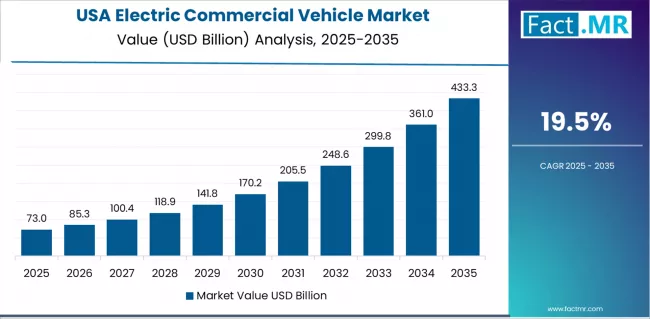
Electric Commercial Vehicle Market Country Value Analysis | Source: Fact.MR
USA’s market expansion is driven by diverse commercial transportation applications, including municipal transit electrification in major cities and corporate fleet sustainability commitments across logistics and delivery sectors. The country demonstrates steady growth potential with a CAGR of 19.5% through 2036, supported by federal tax incentives including commercial clean vehicle credits and state-level zero-emission vehicle mandates in California and other progressive jurisdictions.
American fleet operators face implementation challenges related to charging infrastructure deployment costs and vehicle range requirements for dispersed operations, requiring comprehensive total cost of ownership analysis and strategic electrification planning. However, established sustainability commitments from major logistics companies including Amazon, FedEx, and UPS create substantial baseline demand for electric commercial vehicles, particularly among last-mile delivery fleets and urban transit authorities where operational economics increasingly favor electrification.
Market characteristics:
- Corporate fleet electrification commitments and logistics industry sustainability targets showing robust demand with substantial vehicle procurement volumes
- Federal and state incentive programs varying between purchase tax credits and operational grants supporting diverse commercial vehicle applications
- Future projections indicate continued growth with emphasis on medium and heavy-duty truck electrification alongside established light commercial vehicle adoption
- Growing emphasis on charging infrastructure development and utility partnership programs supporting commercial fleet depot charging solutions
How does Germany Demonstrate Industrial Leadership?
The market in Germany leads in premium electric commercial vehicle development based on integration with automotive engineering excellence and comprehensive sustainability policy frameworks for enhanced environmental performance. The country shows strong potential with a CAGR of 18.0% through 2036, driven by stringent emission regulations and commercial vehicle manufacturer commitments to electric vehicle platforms in major industrial regions, including Bavaria, Baden-Württemberg, and North Rhine-Westphalia.
German commercial vehicle manufacturers are adopting electric propulsion technologies through substantial research and development investments and emphasis on total cost of ownership optimization for comprehensive fleet applications, particularly in quality-conscious municipal transit operations and corporate fleets demanding proven reliability credentials. Distribution channels through established dealer networks and municipal procurement processes expand coverage across public transportation authorities and commercial fleet operators.
Leading market segments:
- Premium electric bus adoption in major cities implementing comprehensive public transportation electrification programs
- Commercial vehicle manufacturer innovation with companies including Mercedes-Benz and MAN leading electric truck development
- Strategic partnerships between vehicle manufacturers and energy providers expanding charging infrastructure deployment
- Focus on hydrogen fuel cell development alongside battery electric vehicles addressing heavy-duty applications
What positions UK for Urban Electrification Leadership?
In London, Manchester, Birmingham, and other major cities, transportation authorities are implementing electric bus fleets through comprehensive clean air zone policies and government funding programs, with documented operational deployments showing substantial emission reduction achievements through zero-emission public transportation. The market shows steady growth potential with a CAGR of 17.3% through 2036, linked to ambitious government targets for diesel vehicle phase-out, urban air quality improvement mandates, and substantial grant funding supporting commercial vehicle electrification in major metropolitan regions.
Commercial operators are adopting electric vehicles with policy support to reduce operational emissions while maintaining service standards demanded by regulatory requirements and consumer expectations. The country's established clean air zone implementation creates ongoing requirements for zero-emission commercial vehicles that differentiate through proven urban operational capability and comprehensive charging infrastructure compatibility.
Market development factors:
- Urban clean air zone expansion leading adoption of zero-emission commercial vehicles across UK cities
- Government grant programs providing substantial funding for electric bus and truck procurement
- Strategic partnerships between local authorities and vehicle manufacturers expanding electric fleet deployment
- Emphasis on public transportation electrification and last-mile delivery solutions addressing urban pollution concerns
How does Japan Show Technology Innovation Leadership?
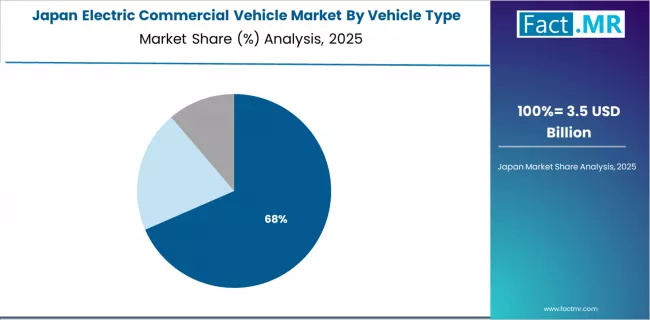
Electric Commercial Vehicle Market Japan Market Share Analysis By Vehicle Type | Source: Fact.MR
Japan's electric commercial vehicle market demonstrates advanced technological capabilities focused on electric powertrain efficiency and vehicle-to-grid integration, with documented deployment of innovative electric buses achieving substantial operational efficiency improvements through advanced energy management systems across municipal transit applications.
The country maintains steady growth momentum with a CAGR of 16.2% through 2036, driven by automotive manufacturer innovation emphasis and comprehensive fleet modernization programs emphasizing environmental performance and operational excellence that align with Japanese manufacturing quality standards applied to commercial transportation. Major metropolitan areas, including Tokyo, Osaka, Nagoya, and Fukuoka, showcase advanced adoption of electric commercial vehicle protocols where efficient electric drivetrains integrate seamlessly with smart charging infrastructure and comprehensive fleet management systems.
Key market characteristics:
- Technology innovation leadership driving development of advanced electric commercial vehicle platforms with emphasis on efficiency and reliability
- Fleet modernization programs enabling systematic replacement of aging diesel commercial vehicles with electric alternatives
- Vehicle-to-grid technology development pioneering bidirectional charging capabilities and energy system integration
- Emphasis on compact electric commercial vehicles addressing dense urban environments and specialized delivery applications
What characterizes Canada's Market Development?
In major metropolitan centers including Toronto, Vancouver, Montreal, and Calgary, the adoption of electric commercial vehicle solutions is expanding across municipal transit systems and commercial fleets, driven by federal zero-emission vehicle mandates and provincial incentive programs supporting clean transportation adoption. The market demonstrates moderate growth potential with a CAGR of 15.0% through 2036, linked to comprehensive climate action commitments and increasing focus on public transportation sustainability in major urban regions.
Canadian transit authorities and fleet operators are implementing electric vehicle procurement strategies aligned with federal targets requiring 100% zero-emission transit bus purchases by 2026 while commercial operators evaluate electric alternatives for delivery and service applications. The country's cold climate operational requirements create specific technology demands for battery thermal management and range optimization while growing charging infrastructure networks support commercial vehicle electrification feasibility.
Key development areas:
- Municipal transit electrification leading adoption with federal mandates requiring zero-emission bus procurement
- Provincial incentive programs providing financial support for commercial vehicle electrification across jurisdictions
- Cold climate technology development addressing battery performance and range optimization in winter conditions
- Charging infrastructure expansion through utility partnerships and government funding supporting commercial depot charging
Europe Market Split by Country
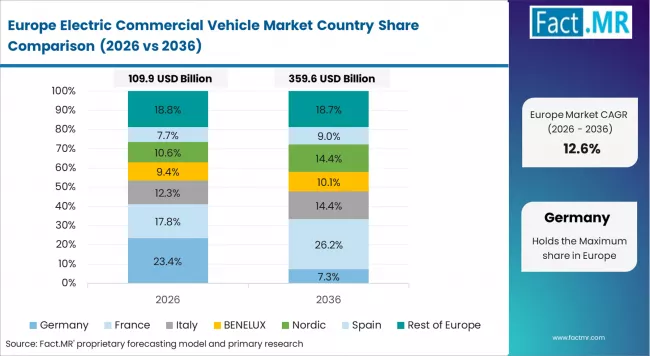
Electric Commercial Vehicle Market Europe Country Market Share Analysis, 2026 & 2036 | Source: Fact.MR
The electric commercial vehicle market in Europe is projected to grow from USD 28.5 billion in 2026 to USD 145.2 billion by 2036, registering a CAGR of 17.8% over the forecast period. Germany is expected to maintain its leadership position with a 31.0% market share in 2026, adjusting to 30.5% by 2036, supported by its dominant commercial vehicle manufacturing base, comprehensive emission regulations, and substantial government support programs serving major European markets.
UK follows with a 22.5% share in 2026, projected to reach 23.0% by 2036, driven by aggressive clean air zone implementation and municipal transit electrification programs in major cities implementing zero-emission transportation mandates. France holds a 18.0% share in 2026, expected to maintain 17.9% by 2036 through ongoing public transportation modernization and logistics fleet electrification initiatives.
Italy commands a 14.0% share, while Spain accounts for 10.5% in 2026. The rest of Europe region is anticipated to gain momentum, expanding its collective share from 4.0% to 5.0% by 2036, attributed to increasing electric commercial vehicle adoption in Nordic countries and emerging Eastern European markets implementing clean transportation policies.
Competitive Landscape of the Electric Commercial Vehicle Market
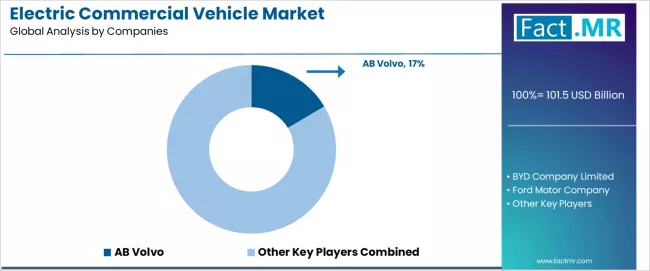
Electric Commercial Vehicle Market Analysis By Company | Source: Fact.MR
The electric commercial vehicle market features approximately 15-25 meaningful players with moderate concentration, where the top three companies control roughly 35-45% of global market share through established commercial vehicle expertise, comprehensive electric vehicle platforms, and multi-region manufacturing capabilities. Competition centers on total cost of ownership optimization, charging solution integration, and fleet service capabilities rather than vehicle price competition alone.
Market leaders include AB Volvo with a 16.5% market share, along with BYD and Daimler Truck AG, which maintain competitive advantages through comprehensive electric commercial vehicle portfolios spanning multiple weight classes, proven operational reliability in large-scale fleet deployments, and deep relationships with municipal transit authorities and major logistics operators, creating high credibility among fleet managers seeking dependable zero-emission solutions.
These companies leverage extensive commercial vehicle engineering experience and substantial electric vehicle investment programs to defend market positions while expanding into adjacent services including charging infrastructure, fleet management software, and battery leasing programs.
Challengers encompass diversified automotive manufacturers including Ford, General Motors, and Mercedes-Benz, which compete through leveraging existing commercial vehicle customer relationships and substantial electrification investments enabling rapid electric commercial vehicle platform development. Electric vehicle specialists, including Tesla with commercial Semi truck initiatives and startup companies focusing on specific commercial vehicle segments, offer differentiated capabilities in battery technology, software integration, and direct sales models.
Emerging electric commercial vehicle manufacturers and conversion specialists create competitive pressure through innovative business models and targeted applications, particularly in high-growth markets including China and India, where local manufacturing capabilities and government relationships provide advantages in municipal procurement processes and regional fleet deployments.
Market dynamics favor companies that combine proven commercial vehicle reliability with comprehensive electrification solutions addressing complete fleet transition from vehicle supply through charging infrastructure, maintenance services, and driver training programs. Strategic emphasis on total cost of ownership transparency, uptime guarantees, and energy management optimization enables differentiation in increasingly competitive commercial transportation electrification segments across developed and emerging markets.
Global Electric Commercial Vehicle Market — Stakeholder Contribution Framework
Electric commercial vehicles represent a critical technology category that enables fleet operators and transportation companies to achieve zero-emission operations and regulatory compliance while addressing operational cost reduction and sustainability commitments without exclusive diesel-powered vehicle dependency, typically providing substantial fuel cost savings reaching 60-70% compared to diesel equivalents, reduced maintenance expenses through simplified drivetrains, and zero tailpipe emissions enabling unrestricted urban access compared to conventional commercial vehicles alone while ensuring improved operational economics and comprehensive environmental performance outcomes.
With the market projected to grow from USD 101.5 billion in 2025 to USD 526.6 billion by 2035 at an 17.9% CAGR, these solutions offer compelling advantages for municipal transit applications, logistics fleet operations, and diverse commercial transportation segments seeking sustainable mobility solutions. Scaling market penetration and fleet adoption requires coordinated action across transportation policy, charging infrastructure development, vehicle manufacturers, fleet operators, and energy providers.
How Could Governments Spur Local Development and Adoption?
- Fleet Electrification Programs: Include commercial vehicle electrification in climate action initiatives, providing targeted purchase incentives for electric buses and trucks and supporting municipal transit authorities through comprehensive funding programs and technical assistance.
- Tax Policy & Investment Support: Implement enhanced tax credits for commercial electric vehicle purchases, provide accelerated depreciation schedules for fleet electrification investments, and establish favorable financing programs that reduce upfront cost barriers compared to diesel alternatives.
- Regulatory Framework Development: Create zero-emission zone policies in urban centers requiring commercial vehicle electrification, establish clear timelines for diesel commercial vehicle phase-out, and develop standardized charging infrastructure requirements that facilitate fleet depot development.
- Charging Infrastructure Support: Fund public charging corridor development supporting commercial vehicle operations, invest in utility grid upgrades enabling depot charging installations, and establish grant programs for fleet charging infrastructure deployment.
- Research & Innovation Support: Establish public-private partnerships for battery technology advancement, support academic-industry collaborations investigating charging optimization and fleet management protocols, and create demonstration programs validating electric commercial vehicle performance across diverse applications.
How Could Industry Bodies Support Market Development?
- Technical Standards & Specifications: Define standardized charging protocols for commercial vehicle applications across power levels and connector types, establish universal performance testing methodologies and range validation procedures, and create interoperability requirements that enable multi-manufacturer charging infrastructure compatibility.
- Market Education & Best Practices: Lead messaging that demonstrates total cost of ownership advantages, emphasizing operational savings, environmental benefits, and realistic range capabilities compared to diesel vehicle alternatives.
- Fleet Transition Guidelines: Develop comprehensive fleet electrification planning tools, route analysis methodologies, and charging infrastructure sizing protocols, ensuring successful transitions across commercial transportation operations.
- Professional Development: Run certification programs for fleet managers, maintenance technicians, and charging infrastructure installers on optimizing electric commercial vehicle operations, troubleshooting procedures, and safety protocols in diverse fleet environments.
How Could Manufacturers and Technology Players Strengthen the Ecosystem?
- Advanced Product Development: Develop next-generation electric commercial vehicle platforms with extended range capabilities, optimized payload capacities, and application-specific characteristics that enhance operational viability while reducing total cost of ownership premiums.
- Total Cost of Ownership Transparency: Provide comprehensive lifecycle cost modeling, operational savings documentation, and reliability data that support fleet electrification business cases and informed procurement decisions.
- Charging Solution Integration: Offer complete fleet electrification packages including vehicles, charging infrastructure, energy management systems, and maintenance services that simplify fleet transition complexity.
- Research & Development Networks: Build comprehensive testing capabilities, real-world validation programs, and continuous improvement systems that ensure electric commercial vehicles maintain high reliability standards and consistent performance across diverse duty cycles.
How Could Fleet Operators and Transportation Providers Navigate the Market?
- Strategic Electrification Planning: Develop comprehensive fleet transition roadmaps with route analysis, charging infrastructure requirements, and phased deployment strategies for successful commercial vehicle electrification.
- Operational Optimization Excellence: Establish energy management protocols, driver training programs, and performance monitoring frameworks through optimized fleet management practices and continuous improvement initiatives.
- Charging Infrastructure Development: Implement depot charging installations with appropriate power capacity, smart charging capabilities, and renewable energy integration supporting cost-effective fleet operations.
- Performance Monitoring Systems: Develop comprehensive vehicle utilization tracking, energy consumption analysis, and total cost of ownership validation that enable continuous electrification strategy refinement.
How Could Investors and Financial Enablers Unlock Value?
- Manufacturing Capacity Financing: Provide growth capital for established companies like AB Volvo, BYD, and Daimler to fund electric commercial vehicle production expansions and battery supply chain investments supporting increasing market demand.
- Innovation Investment: Back startups developing advanced battery technologies, charging solutions, and specialized electric commercial vehicle platforms that enhance market competitiveness and operational performance.
- Infrastructure Financing: Finance charging infrastructure deployment for fleet operators, utility grid upgrade projects, and energy storage systems supporting commercial vehicle electrification at scale.
- Fleet Electrification Funding: Support leasing programs, subscription models, and battery-as-a-service offerings that reduce fleet operator upfront costs through innovative financing structures enabling accelerated adoption.
Key Players in the Electric Commercial Vehicle Market
- AB Volvo
- BYD Company Limited
- Ford Motor Company
- General Motors Company (GM)
- Mercedes-Benz Group AG
- Mitsubishi Motors Corporation
- Nissan Motor Co., Ltd.
- Tesla, Inc.
- Daimler Truck AG
- Renault Group
Bibliography
- International Energy Agency. (2024, April). Global EV Outlook 2024: Electric truck and bus deployment trends and policy analysis. IEA.
- European Commission. (2024). CO2 emission standards for heavy-duty vehicles: Regulation (EU) 2024/xxx setting fleet-wide targets for 2030 and 2040. EC.
- California Air Resources Board. (2024). Advanced Clean Trucks regulation: Zero-emission vehicle sales requirements for manufacturers. CARB.
- International Council on Clean Transportation. (2024). ICCT briefing: Global electric bus and truck market update 2024. ICCT.
- Ministry of Heavy Industries, India. (2024). PM E-Bus Sewa scheme: Procurement targets and subsidy framework for electric bus deployment. MHI.
- China Association of Automobile Manufacturers. (2024). CAAM new energy commercial vehicle statistics: Production and sales data 2023 to 2024. CAAM.
This bibliography is provided for reader reference. The full Fact.MR report contains the complete reference list with primary research documentation.
This Report Addresses
- Market sizing and forecast metrics for electric commercial vehicle through 2036.
- Segmentation analysis across vehicle type, propulsion type, drive type, vehicle speed categories.
- Regional intelligence across North America, Europe, Asia Pacific, Latin America, and MEA.
- Regulatory compliance assessment shaping procurement specifications.
- Competitive landscape evaluation of leading participants.
- Strategic guidance for market positioning through the forecast period.
- Supply chain risk analysis identifying sourcing constraints.
- Custom data delivery formats including dashboards, Excel, and PDF reports.
Electric Commercial Vehicle Market Definition
Electric commercial vehicles are battery-powered, plug-in hybrid, or fuel cell electric trucks, vans, and buses designed for freight transport, passenger transit, and last-mile delivery operations. The market covers city and intercity buses, light commercial delivery vans and trucks, and medium to heavy-duty freight trucks across battery electric, plug-in hybrid electric, and fuel cell electric propulsion configurations.
Electric Commercial Vehicle Market Inclusions
The report covers buses and coaches, light commercial vehicles, and heavy trucks. Propulsion segmentation includes BEV, PHEV, and FCEV. Drive type and vehicle speed classifications are also covered across global regions for 2026 to 2036.
Electric Commercial Vehicle Market Exclusions
Electric passenger cars, electric two-wheelers, electric three-wheelers, and off-road electric construction equipment are excluded. Battery cell manufacturing, charging infrastructure construction, and fleet management software platforms fall outside the analytical scope.
Electric Commercial Vehicle Market Research Methodology
- Primary Research: Analysts engaged with procurement directors and operations leads across the electric commercial vehicle value chain to map adoption triggers.
- Desk Research: Regulatory filings, standards records, trade body publications, and corporate reports from allowed source categories were aggregated.
- Market-Sizing and Forecasting: A hybrid top-down and bottom-up approach with region-specific adoption curves projects demand through 2036.
- Data Validation and Update Cycle: Projections undergo cross-validation against public financial guidance and industry association benchmarks.
Segmentation
Scope of the Report
| Metric | Value |
|---|---|
| Quantitative Units | USD 501.19 billion to USD 2601.02 billion, at a CAGR of 17.90% |
| Market Definition | Electric commercial vehicles are zero-emission or low-emission trucks, vans, and buses powered by battery electric, plug-in hybrid, or fuel cell electric drivetrains for freight transport, passenger transit, and urban delivery operations. |
| Vehicle Type Segmentation | Buses & Coaches (Intercity, City), Light Commercial Vehicles (Delivery Vans, Light Trucks), Heavy Trucks (Medium Duty, Heavy Duty) |
| Propulsion Type Segmentation | Battery Electric Vehicle, Plug-in Hybrid Electric Vehicle, Fuel Cell Electric Vehicle |
| Drive Type Segmentation | Front-wheel Drive, Rear-wheel Drive, All-wheel Drive |
| Vehicle Speed Segmentation | 100 MPH to 125 MPH, Less than 100 MPH, Above 125 MPH |
| Regions Covered | North America, Latin America, Europe, East Asia, South Asia, Oceania, Middle East & Africa |
| Countries Covered | India, China, USA, Canada, UK, Germany, Japan, and 40 plus countries |
| Key Companies Profiled | AB Volvo, BYD Company Limited, Ford Motor Company, General Motors Company, Mercedes-Benz Group AG, Mitsubishi Motors Corporation, Nissan Motor Co., Ltd., Tesla, Inc., Daimler Truck AG, Renault Group |
| Forecast Period | 2026 to 2036 |
| Approach | Hybrid top-down and bottom-up methodology, cross-validated against primary research and public industry filings. |
Source: Fact.MR analysis. Updated Mar 26, 2026
Electric Commercial Vehicle Market by Segments
-
Vehicle Type :
- Light Commercial Vehicles (LCVs)
- Delivery Vans
- Light Trucks
- Heavy Trucks
- Medium Duty
- Heavy Duty
- Buses & Coaches
- Intercity Bus
- City Bus
- Light Commercial Vehicles (LCVs)
-
Propulsion Type :
- Battery Electric Vehicle (BEV)
- Plug-in Hybrid Electric Vehicle (PHEV)
- Fuel Cell Electric Vehicle (FCEV)
-
Drive Type :
- Front-wheel Drive (FWD)
- Rear-wheel Drive (RWD)
- All-wheel Drive (AWD)
-
Vehicle Speed :
- Less than 100 MPH
- 100 MPH to 125 MPH
- Above 125 MPH
-
Region :
- Asia Pacific
- China
- Japan
- South Korea
- India
- Australia
- Thailand
- Rest of Asia Pacific
- Europe
- Germany
- UK
- France
- Italy
- Spain
- Denmark
- Sweden
- Norway
- Rest of Europe
- North America
- USA
- Canada
- Mexico
- Latin America
- Brazil
- Argentina
- Rest of Latin America
- Middle East & Africa
- South Africa
- Saudi Arabia
- UAE
- Kuwait
- Rest of Middle East & Africa
- Asia Pacific
Frequently Asked Questions
How large is the electric commercial vehicle market in 2026?
What will the size be by 2036?
What is the expected CAGR between 2026 and 2036?
Which vehicle type segment leads in 2026?
Which country grows fastest?
What is the report scope?
What methodology is used?
Which companies are profiled?
Who worked on this report


Preview the report firsthand - request a free sample
Free SampleGet the brochure for pricing and purchase details
Download PDF