- Market Value (2025): USD 542.3 Mn
- Estimated Value (2026): USD 572.0 Mn
- Forecast Value (2036): USD 975.2 Mn
- CAGR (2026-2036): 5.5%
What is the Electronic Veterinary Thermometers Market forecast to be worth by 2036?
USD 572.0 million in 2026 to USD 975.2 million by 2036, at a 5.5% CAGR.
- The electronic veterinary thermometers market reached USD 542.3 million in 2025 as digital temperature checks remained part of routine animal examinations.
- As per Fact.MR analysis, revenue is projected to increase from USD 572.0 million in 2026 to USD 975.2 million in 2036 across veterinary and farm-care settings.
- A 5.5% CAGR from 2026 to 2036 reflects recurring equipment replacement and the need for dependable animal temperature measurements.
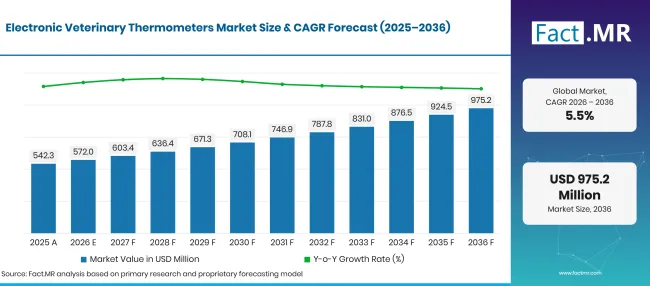
Electronic Veterinary Thermometers Market Forecast Global | Source: Fact.MR
| Year | Basis | Market Value (USD million) |
|---|---|---|
| 2025 | Actual | 542.3 |
| 2026 | Estimate | 572.0 |
| 2036 | Forecast | 975.2 |
| CAGR 2026 to 2036 | Forecast period | 5.5% |
Source: Fact.MR analysis. Updated Nov 4, 2026
What are the defining numbers behind Electronic Veterinary Thermometers Market growth?
USD 403.2 million in additional market value is forecast between 2026 and 2036, with contact instruments and companion-animal care accounting for established segments.
- Demand Drivers in the Market
- Companion-animal clinicians need a consistent temperature reading when assessing a patient with suspected fever or an unusual recovery.
- Livestock veterinarians often take temperature readings on farms, where instruments must withstand travel, handling and cleaning. A protected probe and suitable storage case make the device easier to use between visits, while the appropriate probe length depends on the animal.
- During an examination, staff may be holding an animal steady while taking its temperature. A readable display and an alert when measurement is complete make the process easier, while replaceable batteries and protective cases help clinics keep instruments ready for use.
- Farm teams look for thermometers that tolerate regular cleaning and repeated use. Longer probes suit some large-animal examinations, while flexible tips can be useful for smaller animals.
- Key Segments Analyzed
- By Product Type: Contact Thermometers represent 58.2% of 2026 market revenue, reflecting established rectal temperature measurement in clinical and livestock examinations.
- By Animal Type: Companion Animals contribute 64.7% in 2026, alongside routine appointments and follow-up examinations in small-animal practices.
- By End-User: Veterinary Clinics account for 42.8% in 2026 because thermometers are basic examination instruments used across consultation rooms.
- By Distribution Channel: Veterinary Pharmacies hold 45.3% in 2026 as professionals purchase clinical accessories alongside other animal-care supplies.
- Analyst Opinion at Fact.MR
- Shambhu Nath Jha, Principal Consultant at Fact.MR, states, “A low-cost veterinary thermometer becomes a repeat clinical purchase only when clinicians trust its stated animal use and cleaning process. Practice managers compare operating instructions and probe formats before replacing familiar instruments. For distributors, stocking the right veterinary models offers greater value than a long list of general fever thermometers.”
- Strategic Implications
- Veterinary equipment manufacturers can make measurement method, suitable animal type and probe design easy to identify so clinics can select the correct instrument without relying on consumer-device specifications.
- Veterinary distributors benefit from keeping both compact companion-animal models and longer-probe livestock options available, with replacement batteries and protective cases stocked alongside them.
- Clinics need clear cleaning and handling procedures that allow different staff members to use the same thermometer consistently between examinations.
- Online and pharmacy sellers can improve product listings by stating intended species, measurement site and operating instructions, reducing the risk of customers choosing an unsuitable thermometer.
Germany is forecast to grow at a 6.7% CAGR, followed by Brazil at 6.1%. The United States is forecast to record 5.5%, the United Kingdom 4.9%, and Japan 4.4% through 2036. Each country combines companion-animal consultations and livestock care in a different purchasing environment.
How does the Electronic Veterinary Thermometers Market break down by segment?
Contact Thermometers 58.2%; Companion Animals 64.7%; Veterinary Clinics 42.8%; Veterinary Pharmacies 45.3%.
Which Product Type dominates?
Contact Thermometers account for 58.2% of 2026 value.
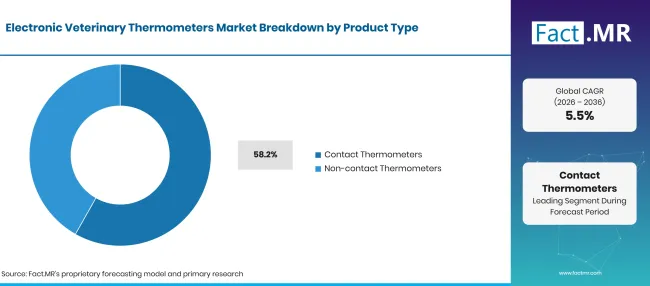
Electronic Veterinary Thermometers Market Breakdown Product Type | Source: Fact.MR
| Product Type | Share (2026) |
|---|---|
| Contact Thermometers (Leading segment) | 58.2% |
| Other segments combined | 41.8% |
| Total | 100.0% |
Source: Fact.MR analysis. Updated Nov 4, 2026
Contact thermometers measure temperature at a defined site, allowing clinicians to compare readings when staff use the same method. The segment accounts for 58.2% of estimated 2026 sales. Non-contact instruments may help in certain handling situations, but surface readings require different interpretation and cannot automatically replace a clinical contact measurement.
What leads the Animal Type segment?
Companion Animals lead with 64.7% of 2026 value.
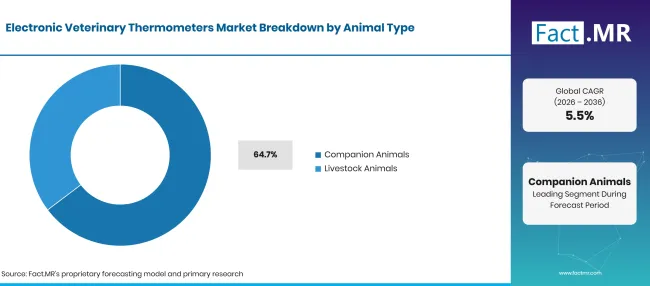
Electronic Veterinary Thermometers Market Breakdown Animal Type | Source: Fact.MR
| Animal Type | Share (2026) |
|---|---|
| Companion Animals (Leading segment) | 64.7% |
| Other segments combined | 35.3% |
| Total | 100.0% |
Source: Fact.MR analysis. Updated Nov 4, 2026
Dogs and cats visit clinics for illness assessment and care after treatment. Companion animals account for 64.7% of 2026 market value. Veterinary staff use temperature readings alongside other examination findings when checking patient condition. Compact models and flexible tips can help with handling during measurements. Livestock applications place greater weight on instrument durability and probe length because examinations often take place on farms.
How does End-User shape demand?
Veterinary Clinics represent 42.8% of 2026 value.
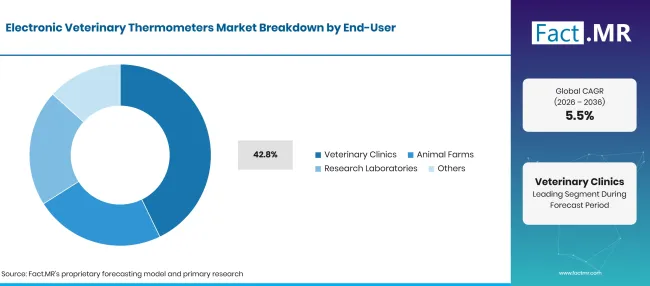
Electronic Veterinary Thermometers Market Breakdown End User | Source: Fact.MR
| End-User | Share (2026) |
|---|---|
| Veterinary Clinics (Leading segment) | 42.8% |
| Other segments combined | 57.2% |
| Total | 100.0% |
Source: Fact.MR analysis. Updated Nov 4, 2026
Veterinary clinics use thermometers during first examinations and ongoing patient checks. Clinics represent 42.8% of the market in 2026. Instruments need to be easy to clean between animals and simple for different staff members to operate. Farms often favor protected units for mobile examinations. Research laboratories choose devices according to the measurement methods used in their work.
Which Distribution Channel holds the largest share?
Veterinary Pharmacies capture 45.3% of 2026 value.
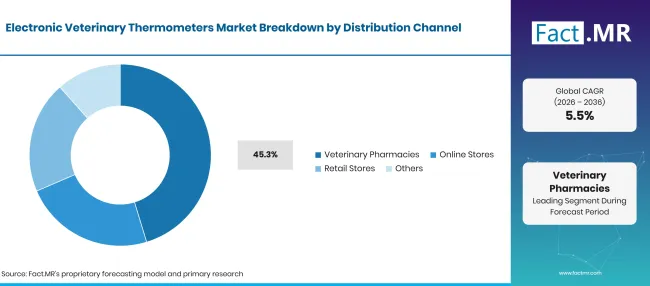
Electronic Veterinary Thermometers Market Breakdown Distribution Channel | Source: Fact.MR
| Distribution Channel | Share (2026) |
|---|---|
| Veterinary Pharmacies (Leading segment) | 45.3% |
| Other segments combined | 54.7% |
| Total | 100.0% |
Source: Fact.MR analysis. Updated Nov 4, 2026
Veterinary pharmacies combine thermometer sales with other clinical supplies and offer a familiar route for replacement purchases. This channel accounts for 45.3% of 2026 revenue. Online stores help customers compare product descriptions, while retailers can provide immediate access to basic models. Useful product listings identify the animal application and correct temperature-measurement method, reducing the chance of choosing an unsuitable instrument.
What is accelerating Electronic Veterinary Thermometers Market adoption, and what is holding it back?
Routine examinations and replacement of worn instruments support purchases. Clinicians also compare measurement suitability, cleaning procedures and animal-specific probe designs before selecting equipment.
Drivers Impact Analysis
| DRIVER | (~) % IMPACT ON CAGR | GEOGRAPHIC RELEVANCE | IMPACT TIMELINE |
|---|---|---|---|
| Routine companion-animal examinations | Qualitative effect | North America, Europe | Short term (<= 2 years) |
| Livestock field temperature checks | Qualitative effect | Brazil, USA, Europe | Medium term (2–4 years) |
| Replacement of worn clinical thermometers | Qualitative effect | Global | Short term (<= 2 years) |
| Veterinary pharmacy availability | Qualitative effect | Global | Medium term (2–4 years) |
| Species-specific probe formats | Qualitative effect | Global | Long term (>= 4 years) |
Source: Fact.MR analysis. Updated Nov 4, 2026
Opportunity Impact Analysis
| OPPORTUNITY | (~) % IMPACT ON CAGR | GEOGRAPHIC RELEVANCE | IMPACT TIMELINE |
|---|---|---|---|
| Clinic-specific replacement packs | Qualitative effect | USA, Europe | Medium term (2–4 years) |
| Durable large-animal thermometers | Qualitative effect | Brazil, Germany | Medium term (2–4 years) |
| Clear online technical listings | Qualitative effect | Global | Short term (<= 2 years) |
| Cleaning and instrument-care accessories | Qualitative effect | Global | Long term (>= 4 years) |
Source: Fact.MR analysis. Updated Nov 4, 2026
Restraints Impact Analysis
| RESTRAINT | (~) % IMPACT ON CAGR | GEOGRAPHIC RELEVANCE | IMPACT TIMELINE |
|---|---|---|---|
| Incorrect use of non-contact measurement methods | Qualitative effect | Global | Short term (<= 2 years) |
| Price sensitivity for basic digital thermometers | Qualitative effect | Global | Medium term (2–4 years) |
| Cleaning and handling burden | Qualitative effect | Global | Short term (<= 2 years) |
| Reduced animal holdings in selected markets | Qualitative effect | Europe, Japan | Long term (>= 4 years) |
Source: Fact.MR analysis. Updated Nov 4, 2026
Which countries are scaling the Electronic Veterinary Thermometers Market through 2036?
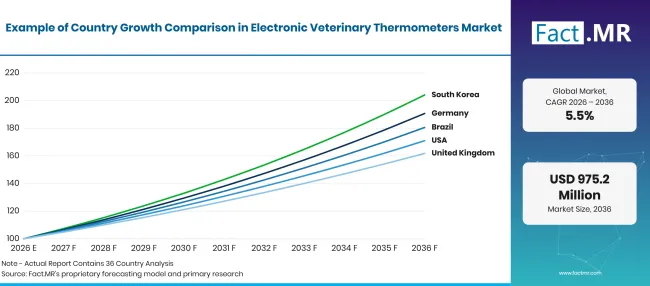
Electronic Veterinary Thermometers Market Growth Index | Source: Fact.MR
| Country | CAGR (2026 to 2036) |
|---|---|
| Germany | 6.7% |
| Brazil | 6.1% |
| USA | 5.5% |
| UK | 4.9% |
| Japan | 4.4% |
Source: Fact.MR analysis. Updated Nov 4, 2026
What supports Germany’s adoption?
6.7% CAGR, linked to professional veterinary supply and large-animal examinations.
Germany's veterinary thermometer trade serves clinics and farm teams that need dependable temperature checks during animal examinations. The Federal Statistical Office reported in July 2025 that Germany held 10.3 million cattle in May 2025 [3]. That livestock population gives large-animal practitioners an established setting for contact instruments with durable probes.
How is Brazil developing demand?
6.1% CAGR, connected to extensive livestock care and clinic purchasing.
Brazil's farm veterinary services cover extensive cattle operations and many separate points of animal care. The Brazilian Institute of Geography and Statistics reported in March 2026 that 42.94 million cattle were slaughtered under sanitary inspection in 2025 [4].
What shapes adoption in the USA?
5.5% CAGR, supported by companion-animal clinics and agricultural veterinary services.
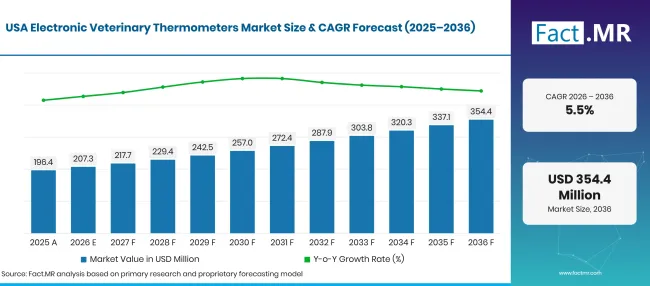
Electronic Veterinary Thermometers Market Forecast Usa | Source: Fact.MR
Veterinary clinics in the United States serve a substantial companion-animal population and are expected to keep electronic thermometers close to examination and treatment areas. The American Veterinary Medical Association's 2026 ownership figures count 58.9 million dog-owning households in the country [1]. The USDA National Agricultural Statistics Service reported in January 2026 that American farms held 86.2 million cattle and calves [2].
How is UK demand progressing?
4.9% CAGR, with clinic use complemented by farm-based veterinary examinations.
The United Kingdom combines companion-animal clinical work with established farm veterinary services. The Department for Environment, Food and Rural Affairs reported in its October 2026 update that the UK had 9.3 million cattle and calves in June 2025 [5]. Farm visits require sturdy probes and cleaning procedures that fit work between animals.
What influences Japanese purchasing?
4.4% CAGR, shaped by careful product selection and livestock-farm structure.
Japanese veterinary practices place careful attention on product instructions and the suitability of each measuring method for the animal being treated. Japan's Ministry of Agriculture, Forestry and Fisheries reported in its 2025 livestock figures that the country held 1.293 million dairy cattle [6].
Who leads the Electronic Veterinary Thermometers Market?
KRUUSE markets Digi-Vet and Digi-temp products for veterinary temperature checks, while Microlife identifies the VT 1831 as an animal thermometer. Jorgensen Laboratories supplies veterinary examination instruments, and TFA Dostmann lists purpose-designed VET thermometers. Neogen and Covetrus participate through veterinary product distribution and supply. These firms serve different points in the supply chain, so the comparison concerns documented animal-care product relevance rather than market share.
These companies differ in product construction and the channels they serve. Some sell under their own instrument brands, while specialist veterinary distributors bring several clinical supplies into one catalog. An established portfolio is more relevant to this market than a general consumer thermometer range.
Which companies are the key providers?
Key companies include KRUUSE, Microlife AG, Jorgensen Laboratories, Neogen Corporation, Covetrus, and TFA Dostmann GmbH & Co. KG.
- KRUUSE
- Microlife AG
- Jorgensen Laboratories
- Neogen Corporation
- Covetrus
- TFA Dostmann GmbH & Co. KG
Bibliography
- [2] U.S. Department of Agriculture, National Agricultural Statistics Service. (2026, January 30). United States cattle inventory down slightly
- [3] Statistisches Bundesamt (Destatis). (2025, July 1). Zahl der schweinehaltenden Betriebe geht weiter zurück.
- [4] Instituto Brasileiro de Geografia e Estatística. (2026, March 18). In 2025, Brazil registers the highest production of milk, leather and eggs in history; slaughter of cattle, chickens and pigs also hits record.
- [5] Department for Environment, Food & Rural Affairs. (2026, October 2). Livestock populations in the United Kingdom at 1 June 2025.
- [6] Ministry of Agriculture, Forestry and Fisheries. (2026). 第2節 我が国における食料の供給 [Section 2: Food supply in Japan].
This Report Answers
- The analysis explains why contact thermometers remain a routine choice for animal examinations and where non-contact products fit.
- The product review distinguishes companion-animal needs from long-probe field work with livestock.
- The country assessment compares equipment purchasing conditions in Germany, Brazil, the USA, the UK and Japan.
- The competitive review identifies documented veterinary thermometer product ranges and the distribution settings they serve.
What does the Electronic Veterinary Thermometers Market cover?
Electronic instruments sold for measuring animal body temperature form the center of this market. Covered products include veterinary contact thermometers and non-contact designs intended for animal care. The analysis follows use in clinics and on farms, with research settings included where a veterinary thermometer is part of an animal health protocol.
What is included in the scope?
Included devices are marketed for veterinary body-temperature measurement and sold through veterinary pharmacies, online sellers or retail stores.
Both companion-animal and livestock applications are within the scope. The product description must be specific enough to connect the instrument with an animal measurement technique.
What is excluded from the scope?
General-purpose room thermometers and environmental monitoring sensors are outside the market boundary.
Human-only clinical thermometers are also excluded unless the manufacturer explicitly supports veterinary use. Equipment that measures temperature only as one feature of a larger monitoring platform is not counted as a stand-alone thermometer.
How Was the Analysis Built?
The analysis draws on 120+ sources, 35+ company portfolios, 25+ countries, and more than 20 industry interviews.
- Primary Research: Primary research includes discussions with manufacturers, service providers, technology developers, distributors, end users, and subject-matter experts. These conversations examine purchasing priorities, product adoption, operational challenges, approval requirements, competitive positioning, and the factors that influence wider market acceptance.
- Desk Research: Desk research covers government statistics, regulatory publications, company filings, trade data, technical studies, industry associations, standards, public policy, and other authoritative sources. Every source used in the analysis is documented in the bibliography.
- Market Sizing and Forecasting: Market estimates combine historical performance, demand indicators, pricing and volume trends, segment shares, company participation, country-level growth, adoption patterns, investment activity, and barriers to market expansion.
- Data Validation and Update Cycle: Findings are validated by comparing primary interviews with public data, company activity, regulatory changes, trade patterns, and industry developments. Regular updates review new product launches, capacity changes, partnerships, approvals, and shifts in commercial adoption.
Segmentation
What is the report’s scope and coverage?
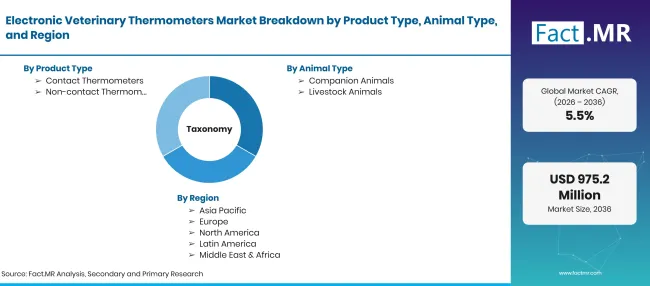
Electronic Veterinary Thermometers Market Taxonomy | Source: Fact.MR
| Attribute | Details |
|---|---|
| Quantitative Units | USD million |
| Market Definition | Electronic thermometers intended for measuring body temperature in veterinary animal care |
| Product Type | Contact Thermometers; Non-contact Thermometers |
| Animal Type | Companion Animals; Livestock Animals |
| End-User | Veterinary Clinics; Animal Farms; Research Laboratories; Others |
| Distribution Channel | Veterinary Pharmacies; Online Stores; Retail Stores; Others |
| Regions Covered | North America; Latin America; Western Europe; Eastern Europe; East Asia; South Asia & Pacific; Middle East & Africa |
| Countries Covered | Germany; Brazil; USA; UK; Japan |
| Companies Profiled | KRUUSE, Microlife AG, Jorgensen Laboratories, Neogen Corporation, Covetrus, and TFA Dostmann GmbH & Co. KG |
| Forecast Period | 2026 to 2036 |
| Approach | End-use setting and product portfolio review using official animal population statistics as contextual demand indicators |
Source: Fact.MR analysis. Updated Nov 4, 2026
How is the market segmented?
-
By Product Type
- Contact Thermometers
- Non-contact Thermometers
-
By Animal Type
- Companion Animals
- Livestock Animals
-
By End-User
- Veterinary Clinics
- Animal Farms
- Research Laboratories
- Others
-
By Distribution Channel
- Veterinary Pharmacies
- Online Stores
- Retail Stores
- Others
-
By Region
- North America
- Latin America
- Western Europe
- Eastern Europe
- East Asia
- South Asia & Pacific
- Middle East & Africa
Frequently Asked Questions
How big is the Electronic Veterinary Thermometers Market in 2026?
What is the CAGR of the Electronic Veterinary Thermometers Market from 2026 to 2036?
Which product type leads the Electronic Veterinary Thermometers Market?
Which animal type leads the Electronic Veterinary Thermometers Market?
Who are the leading companies in the Electronic Veterinary Thermometers Market?
Who worked on this report


Preview the report firsthand - request a free sample
Free SampleGet the brochure for pricing and purchase details
Download PDF