- Market Value (2025): USD 1.12 Bn
- Estimated Value (2026): USD 1.2 Bn
- Forecast Value (2036): USD 2.36 Bn
- CAGR (2026-2036): 7.0%
What is the Veterinary Radiography Market forecast to be worth by 2036?
USD 1.2 billion in 2026 to USD 2.4 billion by 2036, at a 7.0% CAGR.
- The veterinary radiography market reached USD 1.12 billion in 2025.
- According to Fact.MR analysis, sales are projected to rise from USD 1.2 billion in 2026 to USD 2.36 billion by 2036 as veterinary facilities renew equipment and move to digital imaging.
- The forecast indicates a 7.0% CAGR between 2026 and 2036, with companion-animal care and hospital imaging forming central purchasing areas.
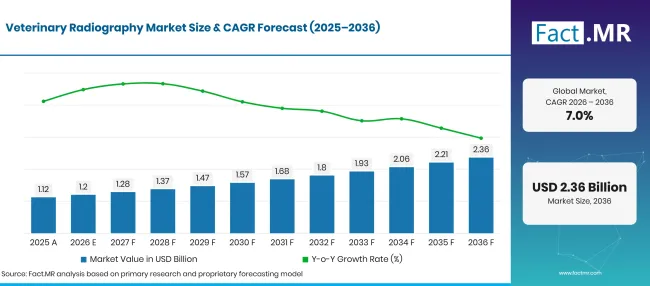
Veterinary Radiography Market Forecast Global | Source: Fact.MR
| Year | Basis | Market Value (USD billion) |
|---|---|---|
| 2025 | Actual | 1.12 |
| 2026 | Estimate | 1.2 |
| 2036 | Forecast | 2.4 |
| CAGR 2026 to 2036 | Forecast period | 7.0% |
Source: Fact.MR analysis. Updated Oct 27, 2026
What are the defining numbers behind Veterinary Radiography Market growth?
USD 1.2 billion in additional market value by 2036, led by digital systems and companion-animal care.
- Demand Drivers in the Market
- Veterinary surgeons use radiographs when a physical examination leaves a question about a fracture or joint condition. A digital image can be checked immediately, helping clinicians decide whether further views or treatment are needed.
- Referral hospitals value images that move between the examination room and remote readers.
- Equipment replacement creates room for detector upgrades where clinics already own an X-ray generator. Facilities assess whether a digital detector works with the installed machine before deciding on a full system replacement.
- Veterinary training increases the need for consistent image records. Teaching hospitals also need images that learners can review and compare during orthopedic and other clinical assessments.
- Key Segments Analyzed
- By Product Type: Digital X-ray Systems account for 52.4% of 2026 sales as clinics value immediate image review and electronic storage.
- By Animal Type: Companion Animals represent 72.1% in 2026 as dogs and cats remain common imaging patients.
- By Application: Orthopedic and Rheumatology cases are forecast to contribute 38.7% in 2026 since radiographs provide useful views of bones and joints.
- By End-User: Veterinary Hospitals are projected to account for 48.6% of 2026 revenue due to their varied case mix and imaging workflows.
- Analyst Opinion at Fact.MR
- Shambhu Nath Jha, Principal Consultant at Fact.MR, states, “Veterinary clinics now evaluate the full imaging workflow rather than the X-ray unit alone. Positioning time, repeat exposures and the ability to share studies with specialists all influence equipment selection. Suppliers can make purchasing easier with clear safety information and practical installation support.”
- Strategic Implications
- Imaging manufacturers should publish veterinary-specific specifications covering detector dimensions and compatibility with existing generators.
- Veterinary hospitals should plan room layouts around safe animal handling and staff access before ordering new equipment.
- Distributors need local installation capacity and dependable replacement parts so that clinics can keep appointments running after a fault.
Germany has the highest forecast rate among the five profiled countries at 8.4%, followed by Brazil at 7.7%. The United States is projected at 6.9%, while the United Kingdom stands at 6.2%. Japan completes the group at 5.5%. Different clinic structures and equipment replacement conditions shape how each market develops.
How does the Veterinary Radiography Market break down by segment?
Digital X-ray Systems account for 52.4%; Companion Animals 72.1%; Orthopedic and Rheumatology 38.7%; Veterinary Hospitals 48.6%.
Which Product Type dominates?
Digital X-ray Systems represents 52.4% of 2026 market value.
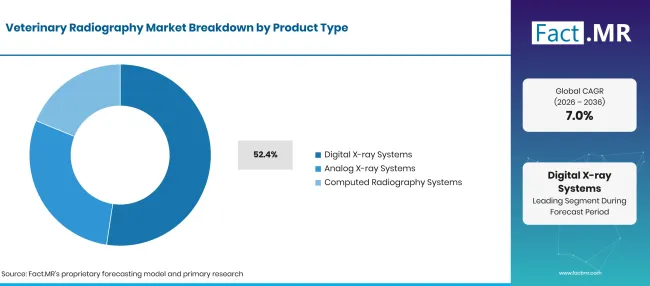
Veterinary Radiography Market Breakdown Product Type | Source: Fact.MR
| Which Product Type dominates | Share (2026) |
|---|---|
| Digital X-ray Systems (Leading segment) | 52.4% |
| Other segments combined | 47.6% |
| Total | 100.0% |
Source: Fact.MR analysis. Updated Oct 27, 2026
Digital systems allow the clinician to review an image without film processing. A flat-panel detector can shorten the time between positioning an animal and judging whether a view is usable. Analog X-ray Systems remain a choice in price-sensitive settings, while Computed Radiography Systems use reusable plates and separate readers. The digital option suits clinics that routinely send images to external specialists.
What leads the Animal Type segment?
Companion Animals represents 72.1% of 2026 market value.
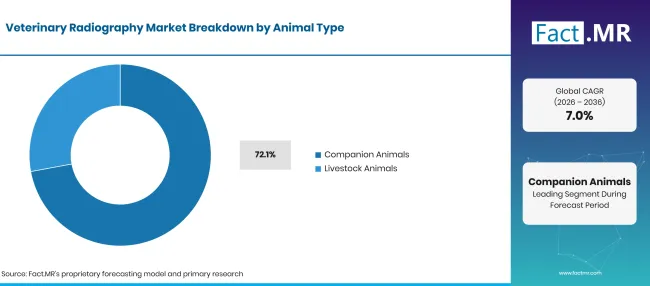
Veterinary Radiography Market Breakdown Animal Type | Source: Fact.MR
| What leads the Animal Type segment | Share (2026) |
|---|---|
| Companion Animals (Leading segment) | 72.1% |
| Other segments combined | 27.9% |
| Total | 100.0% |
Source: Fact.MR analysis. Updated Oct 27, 2026
Dogs and cats account for much of routine small-animal practice activity, making them regular subjects for skeletal and chest radiography. Clinics need positioning options for different body sizes and staff who can limit unnecessary movement. Livestock Animals require different handling and often rely on portable work where the animal cannot be moved easily.
How does Application shape demand?
Orthopedic and Rheumatology represents 38.7% of 2026 market value.
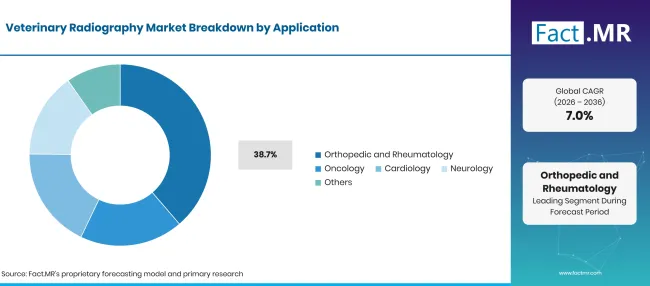
Veterinary Radiography Market Breakdown Application | Source: Fact.MR
| How does Application shape demand | Share (2026) |
|---|---|
| Orthopedic and Rheumatology (Leading segment) | 38.7% |
| Other segments combined | 61.3% |
| Total | 100.0% |
Source: Fact.MR analysis. Updated Oct 27, 2026
Radiographs help veterinary teams identify fractures and assess changes around bones and joints. Orthopedic imaging is used during an initial visit and can also guide follow-up checks during recovery. Oncology applications may involve chest images or skeletal evaluations, depending on the case. Cardiology uses X-ray images as one part of a broader heart assessment. Neurology investigations sometimes begin with radiographs before another imaging method is considered.
Which End-User accounts for the biggest share?
Veterinary Hospitals represents 48.6% of 2026 market value.
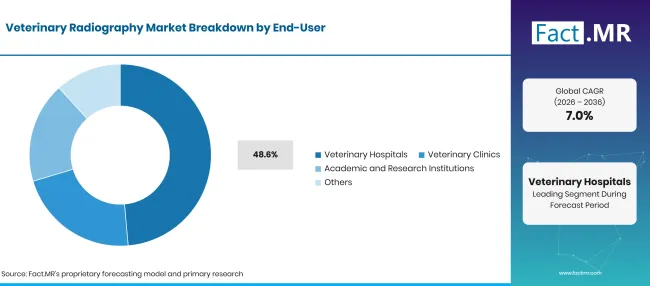
Veterinary Radiography Market Breakdown End User | Source: Fact.MR
| Which End-User accounts for the biggest share | Share (2026) |
|---|---|
| Veterinary Hospitals (Leading segment) | 48.6% |
| Other segments combined | 51.4% |
| Total | 100.0% |
Source: Fact.MR analysis. Updated Oct 27, 2026
Veterinary hospitals usually handle more varied imaging cases than a small consultation clinic, including urgent injuries and referred patients. A hospital may need multiple detector sizes and image review stations across departments. Veterinary Clinics tend to assess purchase price and installation simplicity closely, while Academic and Research Institutions emphasize teaching access and consistent records.
What is accelerating Veterinary Radiography Market adoption, and what is holding it back?
Digital image access and hospital replacement spending support sales; equipment cost and clinical workflow constraints limit purchases.
Drivers Impact Analysis
| DRIVER | (~) % IMPACT ON CAGR | GEOGRAPHIC RELEVANCE | IMPACT TIMELINE |
|---|---|---|---|
| Digital detector replacement | +1.0% | North America, Europe | Medium term (2–4 years) |
| Companion-animal case load | +0.8% | Global | Short term (<= 2 years) |
| Faster radiograph review | +0.7% | Global | Short term (<= 2 years) |
| Remote specialist review | +0.5% | North America, Europe, East Asia | Medium term (2–4 years) |
| Radiation-dose management | +0.4% | Global | Long term (>= 4 years) |
Source: Fact.MR analysis. Updated Oct 27, 2026
Opportunity Impact Analysis
| OPPORTUNITY | (~) % IMPACT ON CAGR | GEOGRAPHIC RELEVANCE | IMPACT TIMELINE |
|---|---|---|---|
| Retrofit digital panels | +0.8% | Global | Medium term (2–4 years) |
| Referral image networks | +0.6% | North America, Europe | Medium term (2–4 years) |
| Portable livestock systems | +0.5% | Latin America, rural regions | Long term (>= 4 years) |
| Veterinary teaching use | +0.4% | Global | Long term (>= 4 years) |
Source: Fact.MR analysis. Updated Oct 27, 2026
Restraints Impact Analysis
| RESTRAINT | (~) % IMPACT ON CAGR | GEOGRAPHIC RELEVANCE | IMPACT TIMELINE |
|---|---|---|---|
| Equipment and service costs | -0.8% | Global | Short term (<= 2 years) |
| Staffing and handling | -0.6% | Rural regions | Medium term (2–4 years) |
| Radiation safety requirements | -0.5% | Global | Long term (>= 4 years) |
| Space and workflow limits | -0.4% | Small clinics | Short term (<= 2 years) |
Source: Fact.MR analysis. Updated Oct 27, 2026
Which countries are scaling the Veterinary Radiography Market through 2036?
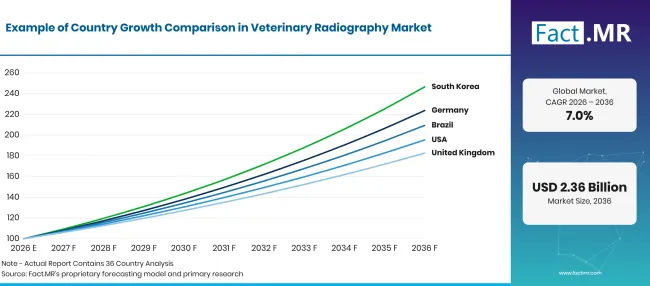
Veterinary Radiography Market Growth Index | Source: Fact.MR
| Country | CAGR (2026 to 2036) |
|---|---|
| Germany | 8.4% |
| Brazil | 7.7% |
| United States | 6.9% |
| United Kingdom | 6.2% |
| Japan | 5.5% |
Source: Fact.MR analysis. Updated Oct 27, 2026
What supports Germany’s veterinary radiography outlook?
8.4% CAGR, supported by digital imaging adoption across veterinary hospitals and independent clinics.
Germany’s veterinary hospitals and independent clinics may invest in digital radiography to make orthopedic examinations easier to review and share. The Bundestierärztekammer reported 46,089 registered veterinary professionals in June 2026, using figures for December 2025 [1]. The German Federal Employment Agency reported around 17,000 employed veterinarians for 2025 [2].
How is Brazil developing veterinary radiography capacity?
7.7% CAGR, linked to expanding veterinary service capacity and wider access to digital X-ray systems.
Brazil’s veterinary clinics and hospitals are expanding access to digital X-ray systems as providers seek dependable imaging at manageable costs. A broad veterinary service network supports equipment purchases across companion-animal hospitals and clinics, while buyers continue to weigh system price, maintenance needs, local technical support, and everyday imaging requirements.
What is shaping United States veterinary radiography purchases?
6.9% CAGR, shaped by integrated imaging workflows and specialist image sharing.
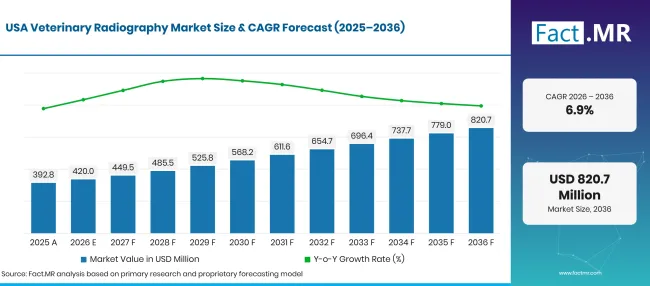
Veterinary Radiography Market Forecast Usa | Source: Fact.MR
In the United States, companion-animal hospitals may place greater value on radiography systems that connect images to clinical records and specialist review. IDEXX launched the ImageVue DR50 Plus in January 2026 with integrated imaging workflows [5]. The company reported a 12% increase in software, services and diagnostic imaging revenue in its second-quarter 2026 results [6].
How is the United Kingdom approaching veterinary imaging?
6.2% CAGR, supported by digital detector upgrades and faster referral imaging.
Veterinary hospitals in the United Kingdom are likely to adopt digital radiography where teams need prompt images for bone injuries and referrals. Clinics are likely to favor systems that allow clinicians to share cases with specialists and retrieve previous radiographs during follow-up visits. A practical choice for smaller clinics is a digital detector compatible with an existing X-ray generator.
How does Japan perform in veterinary radiography?
5.5% CAGR, influenced by compact digital systems and established companion-animal care infrastructure.
Japan’s companion-animal clinics may assess compact digital radiography systems that work in limited examination space. The Japan Pet Food Association estimated 8.847 million owned cats in its December 2025 survey [3]. Japan’s Ministry of Agriculture, Forestry and Fisheries published its veterinary facility registration results in March 2026, covering the use of X-ray equipment in registered facilities [4].
Who leads the Veterinary Radiography Market?
Competitive offerings differ by detector design and the level of software integration.
IDEXX has a clearly documented veterinary digital X-ray portfolio with linked image management [8]. Fujifilm publishes a veterinary digital radiography and computed radiography product line [7]. Other medical imaging manufacturers operate in neighboring radiography fields, but direct veterinary product availability varies by country and distributor. Purchasers therefore need to compare named veterinary models and local support arrangements rather than company size alone.
Which companies are the key providers?
Key companies include IDEXX Laboratories, Inc., Carestream Health, Inc., FUJIFILM Holdings Corporation, Konica Minolta, Inc. (20/20 Imaging), Agfa-Gevaert N.V. (Agfa Radiology Solutions), Canon Medical Systems Corporation, Siemens Healthineers AG and Shenzhen Mindray Animal Medical Technology Co., Ltd.
- IDEXX Laboratories, Inc.
- Carestream Health, Inc.
- FUJIFILM Holdings Corporation
- Konica Minolta, Inc. (20/20 Imaging)
- Agfa-Gevaert N.V. (Agfa Radiology Solutions)
- Canon Medical Systems Corporation
- Siemens Healthineers AG
- Shenzhen Mindray Animal Medical Technology Co., Ltd.
Bibliography
- [1] Bundestierärztekammer. (2026, June 1). Tierärztestatistik 2025: Mehr Tierärzt:innen – aber weniger Selbstständige. Official source
- [2] Bundesagentur für Arbeit. (2026, August). Akademikerinnen und Akademiker: Medizin und Pharmazie. Official source
- [3] Japan Pet Food Association. (2025, December). 2025 nationwide survey of dog and cat ownership.
- 一般社団法人ペットフード協会
- [4] Ministry of Agriculture, Forestry and Fisheries. (2026, March 6). 飼育動物診療施設の開設届出状況(診療施設数) [Status of notifications for establishment of animal medical facilities (number of facilities)]. MAFF source
- [5] IDEXX Laboratories, Inc. (2026, January 15). Lowest-dose radiography meets next-level imaging: IDEXX launches ImageVue DR50 Plus. IDEXX source
- [6] IDEXX Laboratories, Inc. (2026, August 4). IDEXX Laboratories announces second quarter results. IDEXX source
- [7] Fujifilm. (n.d.). Digital radiography. Fujifilm veterinary DR page
- [8] IDEXX Laboratories, Inc. (2026, February 20). Annual report for the year ended December 31, 2025 [Form 10-K]. IDEXX filing
This Report Answers
- How revenue develops from 2025 through 2036, with the projected value of veterinary radiography systems.
- Which product types and animal groups form the central purchasing categories.
- How veterinary hospitals compare imaging safety, system costs and software connections.
- Why purchasing conditions differ among Germany, Brazil, the United States, the United Kingdom and Japan.
- Which veterinary imaging equipment features matter during purchase and replacement decisions.
What does the Veterinary Radiography Market cover?
the market covers equipment used to generate veterinary radiographs in animal healthcare settings. Digital systems and older analog methods are included where purchased for clinical veterinary use. Sales relate to radiography systems and associated equipment used by veterinary end-users, not the whole cost of each clinical visit. Veterinary imaging systems include other medical imaging technologies beyond radiography.
What is included in the scope?
The coverage includes X-ray generators supplied for veterinary imaging and digital detectors used with compatible systems. Computed radiography readers and imaging configurations used by animal hospitals and veterinary clinics also fall inside the scope. Institutional use in teaching and veterinary research is included where the equipment serves animal imaging.
What is excluded from the scope?
Standalone ultrasound systems and MRI scanners fall outside veterinary radiography revenue. CT imaging and dental services without a general radiography equipment transaction are excluded. Human-only imaging systems are excluded unless specifically sold and configured for veterinary radiography use.
How Was the Analysis Built?
The analysis draws on 120+ sources, 35+ company portfolios, 25+ countries, and more than 20 industry interviews.
- Primary Research: Primary research includes discussions with manufacturers, service providers, technology developers, distributors, end users, and subject-matter experts. These conversations examine purchasing priorities, product adoption, operational challenges, approval requirements, competitive positioning, and the factors that influence wider market acceptance.
- Desk Research: Desk research covers government statistics, regulatory publications, company filings, trade data, technical studies, industry associations, standards, public policy, and other authoritative sources. Every source used in the analysis is documented in the bibliography.
- Market Sizing and Forecasting: Market estimates combine historical performance, demand indicators, pricing and volume trends, segment shares, company participation, country-level growth, adoption patterns, investment activity, and barriers to market expansion.
- Data Validation and Update Cycle: Findings are validated by comparing primary interviews with public data, company activity, regulatory changes, trade patterns, and industry developments. Regular updates review new product launches, capacity changes, partnerships, approvals, and shifts in commercial adoption.
Segmentation
What is the report’s scope and coverage?
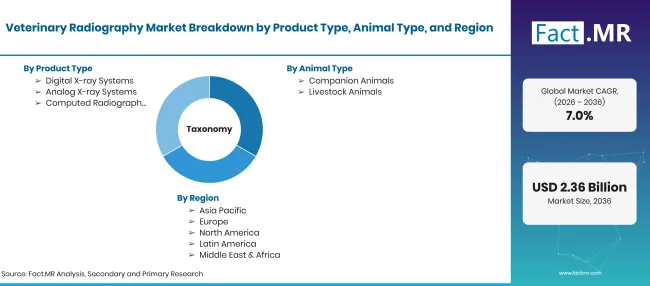
Veterinary Radiography Market Taxonomy | Source: Fact.MR
| Attribute | Details |
|---|---|
| Quantitative Units | USD billion in 2026 to USD billion by 2036, at CAGR |
| Market Definition | X-ray imaging equipment and associated radiography systems purchased for veterinary clinical and diagnostic use. |
| Product Type | Digital X-ray Systems; Analog X-ray Systems; Computed Radiography Systems |
| Animal Type | Companion Animals; Livestock Animals |
| Application | Orthopedic and Rheumatology; Oncology; Cardiology; Neurology; Others |
| End-User | Veterinary Hospitals; Veterinary Clinics; Academic and Research Institutions; Others |
| Regions Covered | North America; Latin America; Western Europe; Eastern Europe; East Asia; South Asia & Pacific; Middle East & Africa |
| Countries Covered | Germany; Brazil; United States; United Kingdom; Japan |
| Companies Profiled | IDEXX Laboratories, Inc., Carestream Health, Inc., FUJIFILM Holdings Corporation, Konica Minolta, Inc. (20/20 Imaging), Agfa-Gevaert N.V. (Agfa Radiology Solutions), Canon Medical Systems Corporation, Siemens Healthineers AG and Shenzhen Mindray Animal Medical Technology Co., Ltd. |
| Forecast Period | 2026 to 2036 |
| Approach | Facility purchasing analysis, veterinary equipment capability assessment, market segmentation and scenario-based forecasts |
Source: Fact.MR analysis. Updated Oct 27, 2026
How is the market segmented?
-
By Product Type
- Digital X-ray Systems
- Analog X-ray Systems
- Computed Radiography Systems
-
By Animal Type
- Companion Animals
- Livestock Animals
-
By Application
- Orthopedic and Rheumatology
- Oncology
- Cardiology
- Neurology
- Others
-
By End-User
- Veterinary Hospitals
- Veterinary Clinics
- Academic and Research Institutions
- Others
-
By Region
- North America
- Latin America
- Western Europe
- Eastern Europe
- East Asia
- South Asia & Pacific
- Middle East & Africa
Frequently Asked Questions
How big is the veterinary radiography market in 2026?
What is the CAGR of the veterinary radiography market?
Which product type leads veterinary radiography?
Which animal type represents the highest share?
Who are the main companies in the veterinary radiography market?
Who worked on this report


Preview the report firsthand - request a free sample
Free SampleGet the brochure for pricing and purchase details
Download PDF