- Market Value (2025): USD 26.8 Bn
- Estimated Value (2026): USD 28.5 Bn
- Forecast Value (2036): USD 53.3 Bn
- CAGR (2026-2036): 6.5%
What is the Electronic Endoscopic Instruments Market forecast to be worth by 2036?
USD 28.5 billion in 2026 to USD 53.3 billion by 2036, at a 6.5% CAGR.
- As per Fact.MR analysis, the electronic endoscopic instruments market reached USD 26.8 billion in 2025.
- Sales are forecast to increase from USD 28.5 billion in 2026 to USD 53.3 billion by 2036.
- The market is projected to record a 6.5% CAGR during 2026 to 2036 as clinical providers invest in video endoscopes and compatible viewing systems.
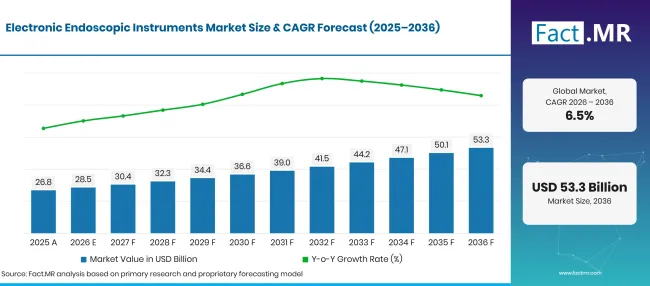
Electronic Endoscopic Instruments Market Forecast Global | Source: Fact.MR
| Year | Basis | Market Value (USD billion) |
|---|---|---|
| 2025 | Actual | 26.8 |
| 2026 | Estimate | 28.5 |
| 2036 | Forecast | 53.3 |
| CAGR 2026 to 2036 | Forecast period | 6.5% |
Source: Fact.MR analysis. Updated Oct 23, 2026
What are the defining numbers behind Electronic Endoscopic Instruments Market growth?
USD 24.8 billion absolute opportunity between 2026 and 2036, led by endoscopes and gastrointestinal applications.
- Demand Drivers in the Market
- Gastroenterology departments need clear mucosal images and predictable scope handling during screening and treatment. In May 2025, Olympus announced FDA clearance for its EZ1500 gastroscope and colonoscope with extended-depth-of-field imaging [2]. The equipment gives hospitals an additional option when replacing older visualization platforms.
- Hospital endoscopy units are assessing how digital image systems fit their installed processors and examination rooms. On April 11, 2025, the FDA issued a 510(k) substantial equivalence decision for Fujifilm’s EP-8000 processor and EG-860R endoscope (K243260) [1]. Compatibility and service planning influence when health systems move from individual replacements to full-system upgrades.
- Respiratory teams use video bronchoscopes to inspect the airways and guide sampling. Hospitals also consider how the images will be stored and whether staff can use a common viewing system across procedure rooms.
- Surgeons working in joints or pelvic spaces need cameras that provide a clear view where access is limited. Teams compare image controls and instrument-cleaning procedures before deciding whether a newer platform offers a practical improvement.
- Key Segments Analyzed
- By Product Type: Endoscopes represent 42.3% share in 2026 as flexible and rigid instruments matter in direct clinical visualization.
- By Application: Gastroenterology accounts for 36.6% share in 2026 due to diagnostic examinations and endoscopic treatment needs.
- By End User: Hospitals capture 60.1% share in 2026, reflecting investment in procedure suites and centralized instrument reprocessing.
- Analyst Opinion at Fact.MR
- Shambhu Nath Jha, Principal Consultant at Fact.MR, states, “Buyers compare image quality alongside servicing arrangements and the time required to clean reusable devices. The selection of a video endoscope depends on how the scope fits the examination and its imaging processor.”
- Strategic Implications
- Hospitals compare image quality with service arrangements and the time needed to clean reusable scopes. A video endoscope must also work with the available processor and examination setup.
- Hospitals are likely to examine lifetime service needs alongside purchase prices because reusable instruments require regular inspection and validated cleaning between patients.
- Visualization suppliers can distinguish their systems by providing image controls that fit ordinary examination routines and training that helps staff use them consistently.
- Specialty centers may favor compact equipment configurations where room space and daily case scheduling influence the type of electronic endoscopy system they choose.
Germany is projected to record 7.8% CAGR; Brazil follows at 7.1% as specialist treatment services develop. The USA is estimated to grow at 6.5%, while the UK records 5.8%. Japan is forecast to post 5.1% as established clinical facilities continue purchasing equipment for replacement and specialized care.
How does the Electronic Endoscopic Instruments Market break down by segment?
Endoscopes 42.3%; Gastroenterology 36.6%; Hospitals 60.1% in 2026.
Which Product Type dominates?
Endoscopes hold 42.3% share in 2026.
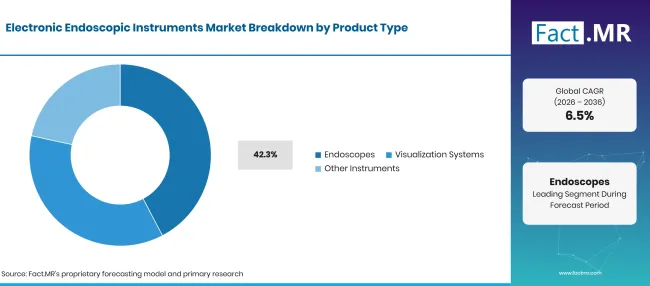
Electronic Endoscopic Instruments Market Breakdown Product Type | Source: Fact.MR
| Which Product Type dominates | Share (2026) |
|---|---|
| Endoscopes (Leading segment) | 42.3% |
| Other segments combined | 57.7% |
| Total | 100.0% |
Source: Fact.MR analysis. Updated Oct 23, 2026
Endoscopes form the instrument used to reach and view the body area under examination. A clinical department often chooses a scope according to its procedure mix and the processor already installed. Visualization systems supply the display, light and image-processing functions needed to interpret the pictures. Other instruments support specific interventions where a standard diagnostic endoscope alone is insufficient.
What leads the Application segment?
Gastroenterology accounts for 36.6% share in 2026.
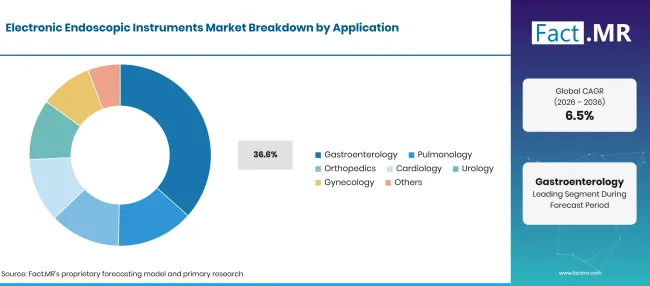
Electronic Endoscopic Instruments Market Breakdown Application | Source: Fact.MR
| What leads the Application segment | Share (2026) |
|---|---|
| Gastroenterology (Leading segment) | 36.6% |
| Other segments combined | 63.4% |
| Total | 100.0% |
Source: Fact.MR analysis. Updated Oct 23, 2026
Gastroenterology departments use electronic instruments for upper and lower digestive-tract examinations and selected treatments. The application calls for scopes that help physicians inspect tissue and access areas requiring a biopsy or intervention. Pulmonology uses bronchoscopes to observe the airway, while orthopedics relies on rigid camera systems for joint surgery. Urology and gynecology need instruments designed for different body spaces. Video-enabled examinations help clinics compare medical videoscopes according to imaging quality and processor compatibility.
How does End User purchasing shape sales?
Hospitals lead with 60.1% share in 2026.
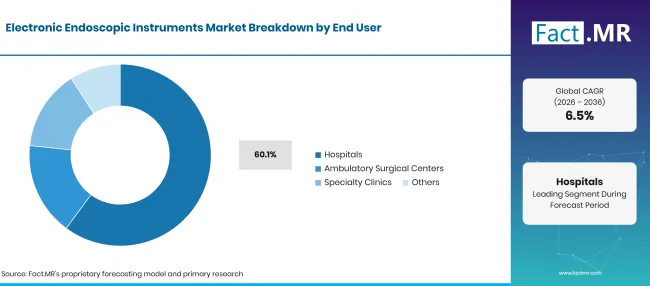
Electronic Endoscopic Instruments Market Breakdown End User | Source: Fact.MR
| How does End User purchasing shape sales | Share (2026) |
|---|---|
| Hospitals (Leading segment) | 60.1% |
| Other segments combined | 39.9% |
| Total | 100.0% |
Source: Fact.MR analysis. Updated Oct 23, 2026
Hospitals operate endoscopy rooms across diagnostic and surgical departments, so instrument selection involves clinical teams and engineering services. A hospital may have to replace scopes while keeping an existing video platform in operation. Ambulatory surgical centers concentrate on cases suitable for shorter visits and need practical equipment turnover. Specialty clinics usually purchase instruments matched to a narrower patient group. Operating-room teams review laparoscopic devices alongside camera systems when planning endoscopic surgery equipment.
What is accelerating Electronic Endoscopic Instruments Market adoption, and what is holding it back?
Video imaging upgrades support adoption; capital budgets and instrument reprocessing requirements can delay replacement.
Drivers Impact Analysis
| DRIVER | (~) % IMPACT ON CAGR | GEOGRAPHIC RELEVANCE | IMPACT TIMELINE |
|---|---|---|---|
| Scope and processor upgrades | +1.0% | Global | Medium term (2–4 years) |
| GI screening and treatment | +0.8% | North America, Europe | Medium term (2–4 years) |
| Digital image integration | +0.7% | Global | Long term (4+ years) |
| Outpatient procedure access | +0.5% | Americas, Europe | Medium term (2–4 years) |
| Specialist surgical needs | +0.4% | East Asia, Europe | Long term (4+ years) |
Source: Fact.MR analysis. Updated Oct 23, 2026
Opportunity Impact Analysis
| OPPORTUNITY | (~) % IMPACT ON CAGR | GEOGRAPHIC RELEVANCE | IMPACT TIMELINE |
|---|---|---|---|
| Broader optical imaging | +0.8% | Global | Medium term (2–4 years) |
| Endoscopic ultrasound | +0.6% | North America, Europe | Medium term (2–4 years) |
| Scope platform upgrades | +0.5% | Global | Short term (up to 2 years) |
| Specialty access expansion | +0.4% | Latin America, Asia | Long term (4+ years) |
Source: Fact.MR analysis. Updated Oct 23, 2026
Restraints Impact Analysis
| RESTRAINT | (~) % IMPACT ON CAGR | GEOGRAPHIC RELEVANCE | IMPACT TIMELINE |
|---|---|---|---|
| High equipment investment | -0.8% | Global | Short term (up to 2 years) |
| Cleaning validation needs | -0.6% | Global | Medium term (2–4 years) |
| Component compatibility | -0.5% | Global | Medium term (2–4 years) |
| Clinical training time | -0.4% | Global | Long term (4+ years) |
Source: Fact.MR analysis. Updated Oct 23, 2026
Which countries are scaling the Electronic Endoscopic Instruments Market through 2036?
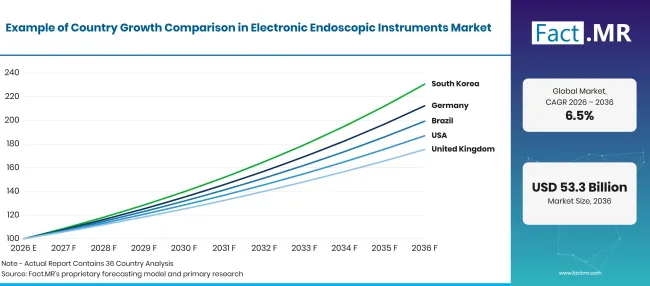
Electronic Endoscopic Instruments Market Growth Index | Source: Fact.MR
| Country | CAGR (2026–2036) |
|---|---|
| Germany | 7.8% |
| Brazil | 7.1% |
| USA | 6.5% |
| UK | 5.8% |
| Japan | 5.1% |
Source: Fact.MR analysis. Updated Oct 23, 2026
Why does Germany show a strong electronic endoscopy outlook?
7.8% CAGR, supported by established hospital endoscopy activity and equipment replacement needs.
German hospitals use electronic endoscopic instruments across digestive care and specialist surgery. The Federal Statistical Office reported 300,475 endoscopic operations on the bile ducts in 2025 [4]. Hospitals also assess processor compatibility, image quality, servicing, and repair support when replacing existing systems.
How is Brazil broadening electronic endoscopy access?
7.1% CAGR, shaped by specialist-care expansion and hospital equipment needs.
Brazilian hospitals use electronic endoscopy across gastrointestinal and other minimally invasive procedures. Ebserh highlights ongoing efforts to expand access to specialist care through its public hospital network [7]. Equipment purchases depend on local clinical capacity, while training, maintenance support, and access to spare instruments influence adoption outside major service centers.
What is driving electronic endoscopic instrument sales in the United States?
6.5% CAGR, linked to colorectal screening and visualization-system upgrades.
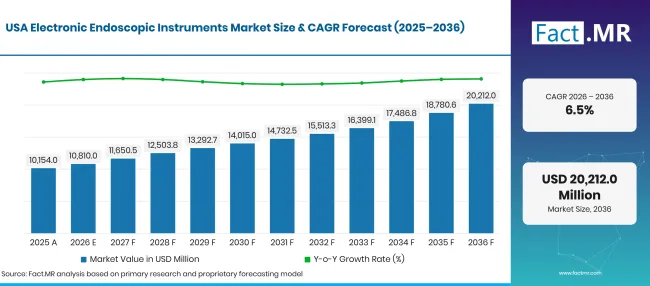
Electronic Endoscopic Instruments Market Forecast Usa | Source: Fact.MR
U.S. hospitals and ambulatory centers maintain endoscopy equipment for routine screening and diagnostic procedures. The CDC reported in June 2025 that about seven in ten adults aged 50 to 75 were current with colorectal cancer screening [3]. Providers also compare image quality, processor compatibility, servicing, and FDA requirements when selecting equipment.
How is the United Kingdom developing electronic endoscopy use?
5.8% CAGR, influenced by diagnostic capacity and equipment renewal.
UK hospitals plan endoscopy equipment around busy diagnostic schedules and the condition of existing scopes and processors. NHS England published December 2025 diagnostic waiting-time and activity statistics covering 15 key tests and procedures in February 2026 [5]. Hospitals also consider image consistency, familiar controls, cleaning requirements, and maintenance schedules when updating systems.
Why is Japan maintaining steady electronic endoscopy growth?
5.1% CAGR, supported by established video-endoscopy platforms and imaging upgrades.
Japanese hospitals have long experience with electronic endoscopy and established visualization systems. Olympus introduced 4K LCD monitors for endoscopic diagnosis and treatment in June 2026 [6]. Hospitals compare new cameras, displays, and processors with existing equipment, while system compatibility, image quality, reusable-scope care, and local technical support remain important purchasing factors.
Who leads the Electronic Endoscopic Instruments Market?
Olympus and Fujifilm are closely associated with electronic endoscopy platforms that combine scopes, processors, and viewing technologies for gastrointestinal and surgical procedures. Their competitive strength comes from complete visualization ecosystems, where hospitals consider image quality, system compatibility, ease of use, and access to service support before changing installed equipment.
Karl Storz and Richard Wolf have a strong presence in surgical endoscopy, particularly where hospitals need rigid scopes, camera systems, and procedure-specific instruments. Stryker, Smith & Nephew, and Medtronic participate through broader minimally invasive and surgical technology portfolios, giving them relevance in operating-room applications that use electronic visualization.
Boston Scientific serves endoscopy-related procedural areas through specialist instruments and accessories used alongside visualization systems. Competition therefore differs by clinical specialty, installed platform, service coverage, and instrument compatibility rather than following one uniform product model.
Which companies are the key providers?
Key companies include KARL STORZ SE & Co. KG; Stryker Corporation; Fujifilm Holdings Corporation; Boston Scientific Corporation; Medtronic plc; Richard Wolf GmbH; and Smith & Nephew plc.
- KARL STORZ SE & Co. KG
- Stryker Corporation
- Fujifilm Holdings Corporation
- Boston Scientific Corporation
- Medtronic plc
- Richard Wolf GmbH
- Smith & Nephew plc
Bibliography
- [1] U.S. Food and Drug Administration. (2025, April 11). 510(k) premarket notification: K243260—FUJIFILM Processor EP-8000; FUJIFILM Endoscope Model EG-860R.
- [2] Olympus Corporation. (2025, May 28). Olympus announces FDA clearance of its most advanced imaging endoscopes.
- [3] Centers for Disease Control and Prevention. (2025, June 11). Use of colorectal cancer screening tests.
- [4] Statistisches Bundesamt (Destatis). (2025, September 30). Die 20 häufigsten Operationen insgesamt.
- [5] NHS England. (2026, February 12). Diagnostic waiting times and activity for December 2025.
- [6] Olympus Corporation. (2026, June 24). Olympus launches 4K LCD monitors to enhance clarity in endoscopic diagnosis and therapy.
- [7] Empresa Brasileira de Serviços Hospitalares. (2025, November 11). Sobre: Ebserh em Ação.
This Report Answers
- The analysis examines purchasing factors for electronic endoscopes and supporting visualization systems.
- Product segmentation compares scopes with video processors and related endoscopic instruments.
- Gastroenterology coverage explains the need for direct tissue examination and video-guided procedures.
- End-user analysis distinguishes hospitals from ambulatory surgical centers and specialty clinics.
- Country outlook compares Germany, Brazil, the USA, the UK and Japan using the stated forecast rates.
- Competitive coverage describes the relevant endoscopy offerings of ten named companies.
- Official FDA records and manufacturer updates provide evidence on current device developments.
What does the Electronic Endoscopic Instruments Market cover?
The electronic endoscopic instruments market covers video-enabled scopes and associated viewing equipment used to inspect internal body areas during clinical procedures. Systems may be used in digestive examinations and in specialist surgery.
What is included in the scope?
The scope covers electronic endoscopes and compatible video systems used in hospitals and ambulatory care. It also includes specialist instruments requiring electronic viewing. Purchase analysis considers system replacement and equipment compatibility. Applications cover gastrointestinal examinations and airway procedures, alongside surgery guided by endoscopic views.
What is excluded from the scope?
The scope excludes general-purpose imaging equipment outside endoscopic examinations. Operating-room furniture and hospital services are separate from instrument sales. Disinfection-only products are operating supplies. Other diagnostic devices qualify only when they meet the electronic endoscopy definition.
How Was the Analysis Built?
The analysis draws on 120+ sources, 35+ company portfolios, 25+ countries, and more than 20 industry interviews.
- Primary Research: Primary research includes discussions with manufacturers, service providers, technology developers, distributors, end users, and subject-matter experts. These conversations examine purchasing priorities, product adoption, operational challenges, approval requirements, competitive positioning, and the factors that influence wider market acceptance.
- Desk Research: Desk research covers government statistics, regulatory publications, company filings, trade data, technical studies, industry associations, standards, public policy, and other authoritative sources. Every source used in the analysis is documented in the bibliography.
- Market Sizing and Forecasting: Market estimates combine historical performance, demand indicators, pricing and volume trends, segment shares, company participation, country-level growth, adoption patterns, investment activity, and barriers to market expansion.
- Data Validation and Update Cycle: Findings are validated by comparing primary interviews with public data, company activity, regulatory changes, trade patterns, and industry developments. Regular updates review new product launches, capacity changes, partnerships, approvals, and shifts in commercial adoption.
Segmentation
What is the report’s scope and coverage?
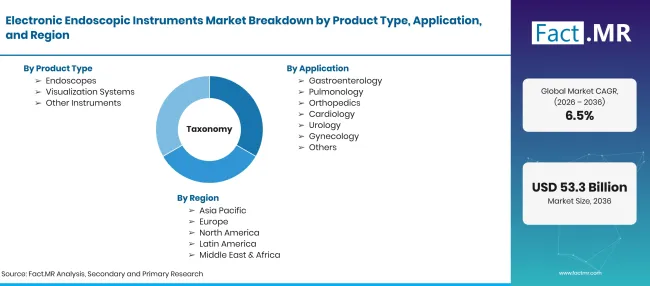
Electronic Endoscopic Instruments Market Taxonomy | Source: Fact.MR
| Attribute | Details |
|---|---|
| Quantitative Units | USD billion in 2026 to USD billion by 2036, at CAGR |
| Market Definition | Electronic endoscopes and compatible visualization instruments used for internal examination and treatment |
| Product Type | Endoscopes; Visualization Systems; Other Instruments |
| Application | Gastroenterology; Pulmonology; Orthopedics; Cardiology; Urology; Gynecology; Others |
| End User | Hospitals; Ambulatory Surgical Centers; Specialty Clinics; Others |
| Regions Covered | North America; Latin America; Western Europe; Eastern Europe; East Asia; South Asia & Pacific; Middle East & Africa |
| Countries Covered | Germany; Brazil; USA; UK; Japan |
| Companies Profiled | KARL STORZ SE & Co. KG; Stryker Corporation; Fujifilm Holdings Corporation; Boston Scientific Corporation; Medtronic plc; Richard Wolf GmbH; and Smith & Nephew plc. |
| Forecast Period | 2026 to 2036 |
| Approach | Market segmentation, official device records and named manufacturer product developments |
Source: Fact.MR analysis. Updated Oct 23, 2026
How is the market segmented?
-
By Product Type
- Endoscopes
- Visualization Systems
- Other Instruments
-
By Application
- Gastroenterology
- Pulmonology
- Orthopedics
- Cardiology
- Urology
- Gynecology
- Others
-
By End User
- Hospitals
- Ambulatory Surgical Centers
- Specialty Clinics
- Others
-
By Region
- North America
- Latin America
- Western Europe
- Eastern Europe
- East Asia
- South Asia & Pacific
- Middle East & Africa
Frequently Asked Questions
How big is the electronic endoscopic instruments market in 2026?
What is the CAGR from 2026 to 2036?
Which product type leads?
Which end user accounts for the leading share?
Who are the main companies in the electronic endoscopic instruments market?
Who worked on this report


Preview the report firsthand - request a free sample
Free SampleGet the brochure for pricing and purchase details
Download PDF