- Market Value (2025): v Bn
- Estimated Value (2026): USD 36.4 Bn
- Forecast Value (2036): USD 57.7 Bn
- CAGR (2026-2036): 4.7 %
What is the Endoscopy Equipment Market forecast to be worth by 2036?
USD 36.4 billion in 2026 to USD 57.7 billion by 2036 at a 4.7% CAGR.
- As per Fact.MR analysis, the Endoscopy Equipment Market was valued at USD 34.8 billion in 2025.
- Demand will grow from USD 36.4 billion in 2026 to USD 57.7 billion by 2036.
- The market records 4.7 % CAGR due to expansion of healthcare providers using endoscopic procedures for diagnosis and minimally invasive treatment.
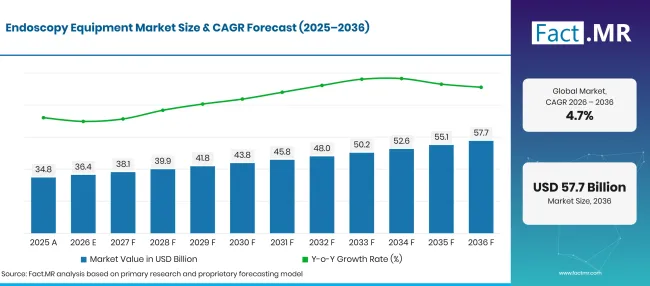
Endoscopy Equipment Market Forecast Global | Source: Fact.MR
| Year | Basis | Market Value (USD billion) |
|---|---|---|
| 2025 | Actual | 34.8 |
| 2026 | Estimate | 36.4 |
| 2036 | Forecast | 57.7 |
| CAGR 2026 to 2036 | Forecast period | 4.7% |
Source: Fact.MR analysis. Updated Nov 4, 2026
What are the defining numbers behind Endoscopy Equipment Market growth?
USD 21.3 billion absolute opportunity between 2026 and 2036
- Demand Drivers in the Market
- Increasing volume of minimally invasive procedures has driven the market growth. Healthcare providers increasingly use endoscopic procedures to diagnose gastrointestinal disorders and treat conditions affecting the respiratory, urinary and digestive systems. An aging population and rising cancer burden are supporting demand for diagnostic and therapeutic interventions. Olympus estimated approximately 200 million current global endoscopy procedures in 2025, indicating substantial scope for further procedure growth [10]
- Expansion of hospitals and ambulatory surgical centers supported the growth of the market. Hospitals and ambulatory surgical centers require endoscopy equipment to perform diagnostic examinations and minimally invasive interventions across multiple specialties. The expansion of outpatient treatment facilities is creating additional equipment requirements as providers seek efficient procedure workflows and shorter patient recovery periods.
- Growing adoption of single-use endoscopes: Healthcare facilities are increasingly evaluating disposable endoscopes to reduce reprocessing requirements and address infection-control concerns. Single-use technologies can support operational efficiency in respiratory, urology and gastrointestinal procedures. Ambu's 2024/25 annual report projects a 20% CAGR for the global single-use endoscopy market during 2025–2030, reflecting the company's own market estimate rather than observed industry-wide growth [11].[11]
- Key Segments Analyzed
- By Product Type: Endoscopes will account for 42.3% of the market in 2026, reflecting their central role in endoscopic procedures.
- By Application: Gastrointestinal Endoscopy leads with a 35.1% share in 2026, supported by the use of endoscopy in digestive tract diagnosis and treatment.
- By End User: Hospitals are projected to hold 60.1% of the market in 2026, driven by their broad procedural capabilities and investment in specialized equipment.
- Analyst Opinion at Fact.MR
- Shambhu Nath Jha, Principal Consultant at Fact.MR, states, “Endoscopy equipment demand will depend on healthcare providers’ need for dependable visualization and efficient procedural workflows. Manufacturers that combine image quality with practical system integration and reliable service support can strengthen their position with hospitals and outpatient facilities.”
- Strategic Implications
- Equipment manufacturers should focus on image quality and system reliability while ensuring compatibility with commonly used endoscopic accessories.
- Hospitals need to assess equipment purchases against procedure volumes and total ownership costs, including maintenance and reprocessing.
- Ambulatory surgical centers must prioritize systems that support efficient workflows and the procedures they perform most frequently.
- Suppliers can provide clinical training and technical support to help healthcare providers use equipment effectively.
Germany is forecast to record a 6.0% CAGR through 2036. Brazil is set to post 5.5%, followed by the USA at 4.9%. The UK is estimated to advance at 4.4%, while Japan is forecast to grow at 3.9%.
How does the Endoscopy Equipment Market break down by segment?
Fact.MR finds that Endoscopes leads Product Type with 42.3%; Gastrointestinal Endoscopy leads Application with 35.1%; and Hospitals leads End User with 60.1%.
Which Product Type dominates?
Endoscopes are set to hold 42.3% share in 2026.
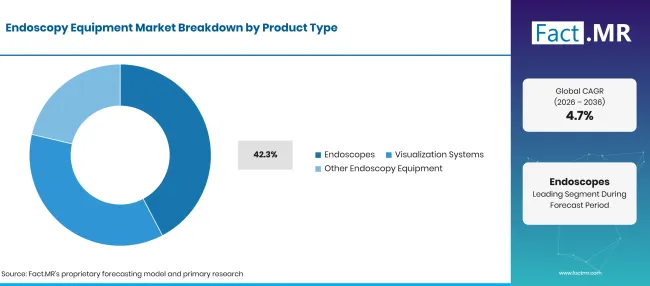
Endoscopy Equipment Market Breakdown Product Type | Source: Fact.MR
| Product Type | Share (2026) |
|---|---|
| Endoscopes (Leading segment) | 42.3% |
| Other segments combined | 57.7%* |
| Total | 100.0% |
Source: Fact.MR analysis. Updated Nov 4, 2026
Endoscopes form the core equipment category because they allow clinicians to examine internal organs and body cavities. Flexible endoscopes are widely used in gastrointestinal and respiratory procedures, while rigid endoscopes are important in laparoscopy, arthroscopy and other surgical applications. Visualization systems support image capture and display, while other equipment includes supporting components used during endoscopic procedures.
Which Application leads demand?
Gastrointestinal Endoscopy is set to represent 35.1% share in 2026.
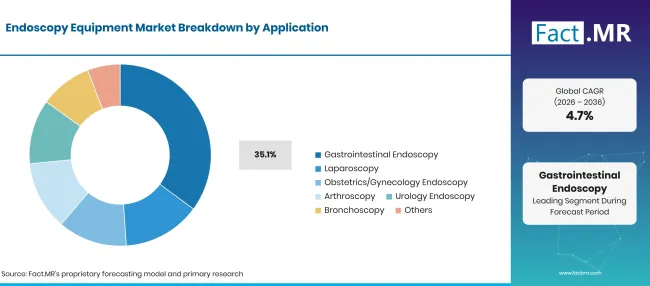
Endoscopy Equipment Market Breakdown Application | Source: Fact.MR
| Application | Share (2026) |
|---|---|
| Gastrointestinal Endoscopy (Leading segment) | 35.1% |
| Other segments combined | 64.9%* |
| Total | 100.0% |
Source: Fact.MR analysis. Updated Nov 4, 2026
Gastrointestinal endoscopy is used to examine the digestive tract and perform diagnostic or therapeutic procedures. Demand includes equipment used for upper gastrointestinal endoscopy and colonoscopy, as well as specialized procedures such as endoscopic ultrasound and endoscopic retrograde cholangiopancreatography. Laparoscopy and arthroscopy require equipment designed for minimally invasive surgical visualization, while urology and bronchoscopy applications require instruments suited to their respective anatomical areas.
Which End-User segment leads?
Hospitals are projected to account for 60.1% share in 2026.
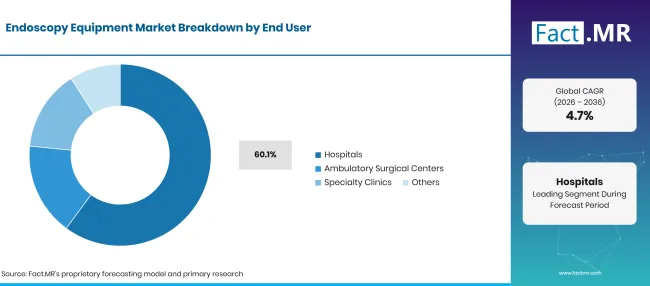
Endoscopy Equipment Market Breakdown End User | Source: Fact.MR
| End User | Share (2026) |
|---|---|
| Hospitals (Leading segment) | 60.1% |
| Other segments combined | 39.9%* |
| Total | 100.0% |
Source: Fact.MR analysis. Updated Nov 4, 2026
Hospitals lead because they perform a broad range of diagnostic and therapeutic endoscopic procedures across multiple specialties. They also require equipment for operating rooms and dedicated endoscopy units. Specialty clinics focus on specific procedures and patient groups, while ambulatory surgical centers use endoscopy equipment for selected procedures that do not require an inpatient stay.
What is accelerating Endoscopy Equipment Market adoption, and what is holding it back?
Demand for minimally invasive procedures and improved visualization supports equipment investment, while high acquisition costs and reprocessing requirements can constrain adoption.
Drivers Impact Analysis
| DRIVER | (~) % IMPACT ON CAGR | GEOGRAPHIC RELEVANCE | IMPACT TIMELINE |
|---|---|---|---|
| Increasing use of minimally invasive procedures | +1.0% | Global | Medium term (2–4 years) |
| Demand for advanced imaging and visualization | +0.8% | North America, Europe, Asia | Medium term (2–4 years) |
| Growth in gastrointestinal diagnostic procedures | +0.7% | Global | Short term (≤ 2 years) |
| Expansion of ambulatory surgical centers | +0.5% | North America, Europe | Long term (≥ 4 years) |
| Replacement of ageing endoscopy systems | +0.4% | Global | Medium term (2–4 years) |
Source: Fact.MR analysis. Updated Nov 4, 2026
Opportunity Impact Analysis
| OPPORTUNITY | (~) % IMPACT ON CAGR | GEOGRAPHIC RELEVANCE | IMPACT TIMELINE |
|---|---|---|---|
| Adoption of 4K and advanced imaging systems | +0.8% | Global | Medium term (2–4 years) |
| Expansion of single-use endoscopes | +0.7% | North America, Europe | Medium term (2–4 years) |
| Integration of AI-assisted visualization | +0.6% | Global | Long term (≥ 4 years) |
| Growth in outpatient endoscopy services | +0.5% | Americas, Europe, Asia | Medium term (2–4 years) |
| Wider access to endoscopic procedures in emerging markets | +0.4% | Asia, Latin America | Long term (≥ 4 years) |
Source: Fact.MR analysis. Updated Nov 4, 2026
Restraints Impact Analysis
| RESTRAINT | (~) % IMPACT ON CAGR | GEOGRAPHIC RELEVANCE | IMPACT TIMELINE |
|---|---|---|---|
| High equipment acquisition and installation costs | -0.8% | Global | Short term (≤ 2 years) |
| Complex cleaning and reprocessing requirements | -0.7% | Global | Medium term (2–4 years) |
| Risk of equipment damage and repair costs | -0.5% | Global | Medium term (2–4 years) |
| Shortage of trained endoscopy professionals | -0.5% | Emerging markets | Long term (≥ 4 years) |
| Budget constraints in public healthcare facilities | -0.4% | Asia, Latin America | Short term (≤ 2 years) |
Source: Fact.MR analysis. Updated Nov 4, 2026
Which countries are scaling the Endoscopy Equipment Market through 2036?
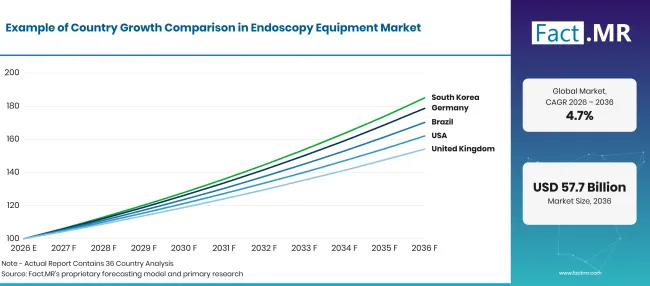
Endoscopy Equipment Market Growth Index | Source: Fact.MR
| Country | CAGR (2026–2036) |
|---|---|
| Germany | 6.0% |
| Brazil | 5.5% |
| USA | 4.9% |
| UK | 4.4% |
| Japan | 3.9% |
Source: Fact.MR analysis. Updated Nov 4, 2026
What supports Germany adoption?
6.0% CAGR, supported by established hospital infrastructure and demand for diagnostic endoscopic procedures.
Germany's healthcare system performs a substantial volume of endoscopic procedures across hospital settings. Destatis data on fully inpatient hospital procedures recorded approximately 3.2 million diagnostic endoscopy procedures in 2023. Hospitals and specialist providers also require reliable equipment for routine examinations and complex interventions. Manufacturers need to demonstrate image quality and system reliability while supporting equipment servicing and reprocessing requirements. [1]
How is Brazil developing endoscopy equipment adoption?
5.5% CAGR, driven by demand for diagnostic procedures and efforts to expand healthcare access.
Brazil's public and private healthcare systems provide a substantial base for diagnostic and therapeutic procedures. The Ministry of Health reported that more than 3.2 billion medium- and high-complexity procedures were performed in 2025 across the SUS system, although this total covers a wide range of services and is not specific to endoscopy. The National Supplementary Health Agency also reported approximately 2 billion procedures among private health plan beneficiaries in 2025, including medical consultations, diagnostic examinations, therapies, hospital admissions and dental services; this figure is not an endoscopy-specific procedure count [2] [3] [2][3]
What supports United States adoption?
4.9% CAGR, shaped by a large procedural healthcare system and continued investment in surgical visualization.
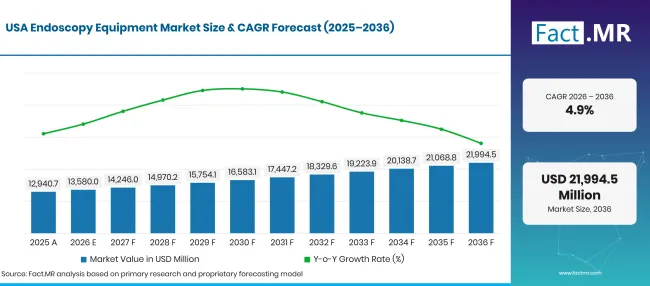
Endoscopy Equipment Market Forecast Usa | Source: Fact.MR
The United States has an established market for diagnostic and therapeutic endoscopy across hospitals and outpatient facilities. The Centers for Medicare & Medicaid Services released 2025 procedure-volume data for selected services, including colonoscopy and upper gastrointestinal endoscopy, through its clinician comparison initiative. The availability of procedure-level utilization information reflects the importance of these services within the Medicare system. Manufacturers can address demand through advanced visualization platforms and equipment designed for minimally invasive procedures. [4]
How is the United Kingdom building adoption?
4.4% CAGR, led by sustained endoscopy activity and efforts to improve diagnostic capacity.
The UK endoscopy equipment market is supported by sustained procedure volumes and efforts to expand diagnostic capacity. Hospitals continue to invest in imaging systems, scopes and related equipment, while manufacturers can strengthen adoption through equipment upgrades, maintenance support and clinical training for endoscopy teams.
What supports Japan adoption?
3.9% CAGR, backed by established endoscopy services and widespread use of diagnostic examinations.
Japan has an established base of hospitals providing upper gastrointestinal endoscopy and colonoscopy. The Ministry of Health, Labour and Welfare's Survey of Medical Institutions reported that 4,336 general hospitals performed upper endoscopy and 3,705 performed colonoscopy during September 2023. Suppliers can address demand through reliable imaging systems and equipment suited to gastrointestinal and other specialty procedures. [5]
Who leads the Endoscopy Equipment Market?
Fact.MR profiles Olympus Corporation, KARL STORZ SE & Co. KG, Stryker Corporation, Boston Scientific Corporation, Fujifilm Holdings Corporation, Medtronic plc, HOYA Corporation, Smith & Nephew plc, Richard Wolf GmbH and Cook Medical across the endoscopy equipment and associated technology landscape.
Olympus has a broad portfolio of gastrointestinal endoscopes and endoscopy systems, including its EVIS X1 platform [6]. The company also offers bronchoscopes and surgical visualization products. KARL STORZ is an established provider of rigid endoscopy systems and instruments across surgical specialties[7]. Stryker participates through surgical visualization platforms such as its 1688 AIM 4K system [8].
HOYA participates through its PENTAX Medical business, which supplies gastrointestinal endoscopy systems. Richard Wolf offers endoscopic systems and instruments for multiple surgical specialties. Smith & Nephew has a strong position in arthroscopy and sports medicine equipment. Boston Scientific and Cook Medical are relevant to the gastrointestinal endoscopy equipment ecosystem through endotherapy devices and procedural accessories [9]. Medtronic participates in endoscopy through technologies and products supporting gastrointestinal procedures.
Commercial competition depends on imaging performance and procedural suitability, alongside product reliability and service support. Hospitals assess equipment based on the procedures performed and the compatibility of scopes, processors and accessories. Manufacturers also compete through training and maintenance services that help healthcare providers sustain equipment availability.
Which companies are the key providers?
The company set for the Endoscopy Equipment Market includes:
- Olympus Corporation
- KARL STORZ SE & Co. KG
- Stryker Corporation
- Boston Scientific Corporation
- Fujifilm Holdings Corporation
- Medtronic plc
- HOYA Corporation
- Smith & Nephew plc
- Richard Wolf GmbH
- Cook Medical
Bibliography
- [1] Statistisches Bundesamt (Destatis). (n.d.). Operationen und Prozeduren an vollstationären Patienten: Deutschland, Jahre, Operationen und Prozeduren. GENESIS-Online.
- [2] Ministério da Saúde, Brazil. (2026, March 25). Relatório de Gestão Integrado 2025.
- [3] Agência Nacional de Saúde Suplementar. (2026, June 30). Planos de saúde registram 2 bilhões de procedimentos em 2025.
- [4] Centers for Medicare & Medicaid Services. (2025, December 11). Utilization (procedure volume) data published on the Medicare.gov Compare Tool: Doctors and Clinicians public reporting fact sheet.
- [5] Ministry of Health, Labour and Welfare, Japan. (2025). Outline of results: Survey of Medical Institutions 2023.
- [6] Olympus Corporation. (n.d.). Medical systems products.
- [7] KARL STORZ SE & Co. KG. (n.d.). Ear, nose and throat medicine.
- [8] Stryker Corporation. (n.d.). 1688 Advanced Imaging Modalities (AIM) 4K Platform.
- [9] Boston Scientific Corporation. (2026). Gastroenterology product catalog.
- [10] Olympus Corporation. (2025, November 7). Olympus unveils Corporate Strategy: Shaping the future of endoscopy-enabled care through innovation and operational excellence.
- [11] Ambu A/S. (2025). Annual report 2024/25.
This Report Answers
- The report describes how endoscopy equipment is used across diagnostic and minimally invasive procedures.
- Product analysis compares endoscopes and visualization systems alongside other supporting equipment.
- Application analysis examines gastrointestinal endoscopy and surgical uses such as laparoscopy and arthroscopy.
- End-user analysis compares demand across hospitals and specialty clinics.
- Country analysis discusses Germany, Brazil, the USA, the UK and Japan alongside available healthcare procedure statistics.
- The competitive overview profiles the ten companies included in the company set.
What does the Endoscopy Equipment Market cover?
The market covers medical instruments and supporting equipment used to examine internal organs and body cavities through minimally invasive procedures. It includes endoscopes and visualization systems, along with other equipment used in gastrointestinal examinations and surgical applications. The market also covers equipment used in laparoscopy and arthroscopy, as well as urology and respiratory procedures.
What is included in the scope?
The scope includes flexible and rigid endoscopes, endoscopic visualization systems and other supporting equipment used for diagnostic and therapeutic procedures.
Applications include gastrointestinal endoscopy and surgical endoscopy across the listed specialties. Revenue is attributed to the equipment category rather than the medical procedures performed using the equipment.
What is excluded from the scope?
The analysis excludes revenue from endoscopic procedures and clinical services.
Pharmaceutical products and unrelated diagnostic imaging equipment are outside the market boundary. General surgical instruments that are not designed for endoscopic use are also excluded. Revenue from hospital construction and unrelated operating room equipment is not included.
How Was the Analysis Built?
The analysis draws on 120+ sources, 35+ company portfolios, 25+ countries and more than 20 industry interviews.
- Primary Research: Primary research includes discussions with endoscopy equipment manufacturers, distributors, hospital team availability, clinicians, service providers and subject-matter experts. These discussions examine purchasing priorities and equipment preferences, alongside procedural requirements and maintenance considerations.
- Desk Research: Desk research covers government healthcare statistics and regulatory publications, company product portfolios, annual reports, technical documentation, clinical publications and industry association data. Sources used in the analysis are documented in the bibliography.
- Market Sizing and Forecasting: Market estimates combine historical performance and equipment demand indicators, alongside pricing and volume trends, segment shares, company participation, country-level growth and barriers to market expansion.
- Data Validation and Update Cycle: Findings are validated by comparing primary interviews with public data and company activity. Regular updates review product launches and equipment upgrades, regulatory developments, partnerships and changes in healthcare infrastructure.
Segmentation
What is the report’s scope and coverage?
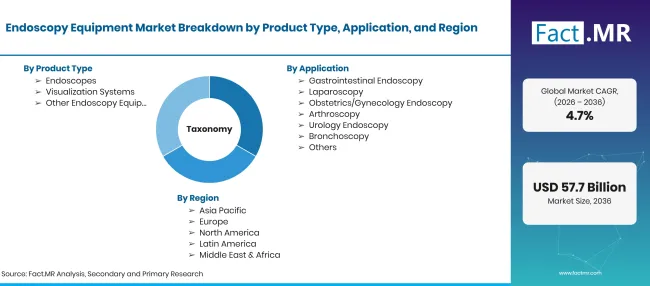
Endoscopy Equipment Market Taxonomy | Source: Fact.MR
| Attribute | Details |
|---|---|
| Quantitative Units | USD billion in 2026 to USD billion by 2036, at CAGR |
| Market Definition | The endoscopy equipment market comprises medical instruments and supporting systems used to visualize, examine and perform diagnostic or therapeutic procedures within internal organs and body cavities. It includes endoscopes, visualization systems and related equipment used across gastrointestinal, surgical, respiratory and urological applications. |
| Product Type | Endoscopes; Visualization Systems; Other Endoscopy Equipment |
| Application | Gastrointestinal Endoscopy; Laparoscopy; Obstetrics/Gynecology Endoscopy; Arthroscopy; Urology Endoscopy; Bronchoscopy; Others |
| End User | Hospitals; Specialty Clinics; Others |
| Regions Covered | North America; Latin America; Western Europe; Eastern Europe; East Asia; South Asia & Pacific; Middle East & Africa |
| Countries Covered | Germany; Brazil; USA; UK; Japan |
| Companies Profiled | Olympus Corporation; KARL STORZ SE & Co. KG; Stryker Corporation; Boston Scientific Corporation; Fujifilm Holdings Corporation; Medtronic plc; HOYA Corporation; Smith & Nephew plc; Richard Wolf GmbH; Cook Medical |
| Forecast Period | 2026 to 2036 |
| Approach | Market segmentation and scenario-based analysis supported by company portfolios, healthcare procedure data and industry research |
Source: Fact.MR analysis. Updated Nov 4, 2026
How is the market segmented?
-
By Product Type
- Endoscopes
- Visualization Systems
- Other Endoscopy Equipment
-
By Application
- Gastrointestinal Endoscopy
- Laparoscopy
- Obstetrics/Gynecology Endoscopy
- Arthroscopy
- Urology Endoscopy
- Bronchoscopy
- Others
-
By End User
- Hospitals
- Specialty Clinics
- Others
-
By Region
- North America
- Latin America
- Western Europe
- Eastern Europe
- East Asia
- South Asia & Pacific
- Middle East & Africa
Frequently Asked Questions
How big is the Endoscopy Equipment Market in 2026?
What is the CAGR from 2026 to 2036?
Which product type has the largest share?
Which application leads the market?
Which end-user segment has the largest share?
Which companies are covered?
Who worked on this report


Preview the report firsthand - request a free sample
Free SampleGet the brochure for pricing and purchase details
Download PDF