- Base Value(2025): 10.4 Bn
- Estimated Value(2026): 11.0 Bn
- Forecast Value (2036): 19.7 Bn
- CAGR (2026 - 2036): 6.0%
Endoscopy Operative Devices Market Analysis and Forecast by Fact.MR
- The Endoscopy Operative Devices Market is expected to grow from USD 11.0 billion in 2026 to USD 19.7 billion by 2036 at 6.0% CAGR, driven by expanding clinical demand, advancing treatment platforms, and healthcare infrastructure development.
- Endoscopic visualization devices account for 32.8% product share, while hospitals contribute 41.7% end-use share in 2026.
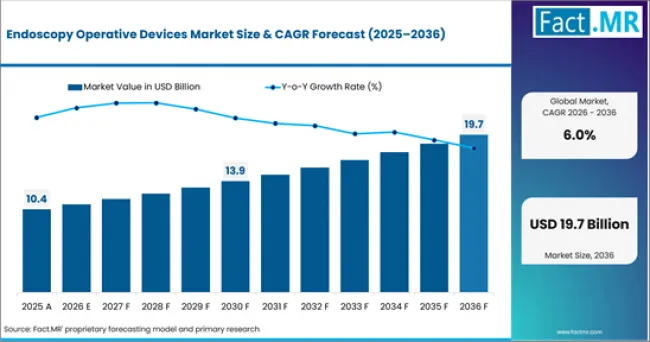
Endoscopy Operative Devices Market Value Analysis | Source: Fact.MR
Summary of Endoscopy Operative Devices Market
- Market Snapshot
- In 2025, the global Endoscopy Operative Devices Market was valued at approximately USD 10.4 billion.
- The market is estimated to reach USD 11.0 billion in 2026 and is projected to attain USD 19.7 billion by 2036.
- The market is likely to expand at a CAGR of 6.0% during the forecast period.
- The market is anticipated to create an absolute dollar opportunity of USD 8.7 billion between 2026 and 2036.
- Endoscopic Visualization Devices accounts for 32.8% of product segment share in 2026.
- China (8.1%) and India (7.5%) are the key growth markets.
- Demand and Growth Drivers
- Growing clinical demand driven by aging populations, rising disease prevalence, and expanding diagnostic and treatment awareness creates sustained procurement for endoscopic visualization devices and related product or service categories.
- Healthcare infrastructure investment including hospital construction, department expansion, and equipment modernization creates capital procurement pipelines across established and emerging market hospital systems.
- Technology advancement in endoscopic visualization devices and integrated operative systems improves clinical outcomes, procedural efficiency, and patient access, supporting adoption across primary treatment settings.
- Regulatory pathway development and reimbursement coverage expansion improve market access and financial viability for endoscopy operative devices procurement in both public and private healthcare systems.
- Product and Segment View
- Endoscopic Visualization Devices accounts for 32.8% of the product segment in 2026, reflecting established clinical utilization and broad institutional adoption.
- Hospitals represents 41.7% of end use demand in 2026, reflecting procurement concentration among primary healthcare institutional buyers.
- Integrated Operative Systems leads the formulation segment with 48.3% share in 2026, supported by clinical workflow integration and outcome improvement documentation.
- Key segmentation includes:
- Product Type: Endoscopic Visualization Devices, Rigid Endoscopy Systems
- End Use: Hospitals, Public Hospitals
- Formulation: Integrated Operative Systems, Multi Device Surgical Platforms
- These capabilities enable:
- Primary clinical capability addressing core diagnostic, therapeutic, or procedural requirements across end use settings.
- Workflow integration improving procedural efficiency, patient throughput, and resource utilization in institutional healthcare environments.
- Clinical outcome documentation supporting reimbursement justification and institutional procurement decision-making.
- Geography and Competitive Outlook
- North America maintains a significant share supported by established healthcare infrastructure, regulatory frameworks, and reimbursement coverage.
- Asia Pacific is the fastest-growing region, with China (8.1%) and India (7.5%) leading through hospital expansion and growing patient access.
- Europe maintains steady demand with Germany supported by EU regulatory compliance and GKV reimbursement structures.
- Key companies include Medtronic, Cook Medical Inc., Boston Scientific Corporation, Stryker, Ethicon Endo-Surgery, Inc. among others.
- Analyst Opinion
- Shambhu Nath Jha, Principal Consultant at Fact.MR, says "The endoscopy operative devices market reflects the convergence of clinical demand growth, technology advancement, and healthcare infrastructure expansion that creates sustained procurement across established and emerging markets. The critical dynamic is access expansion: as hospital construction, insurance coverage, and regulatory pathways mature in high-growth markets, the addressable patient population and institutional procurement base expand structurally. Companies that position portfolios across both premium and cost-effective tiers will capture the broadest share of this expansion."
Key Growth Drivers, Constraints, and Opportunities
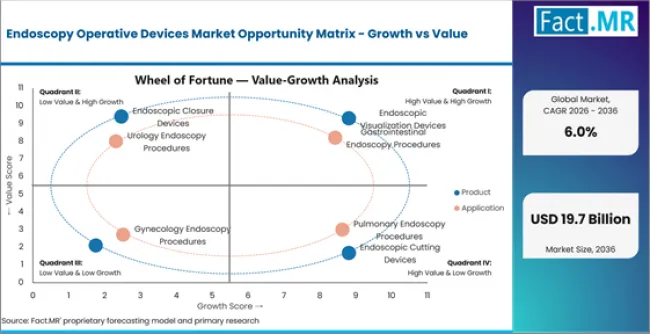
Endoscopy Operative Devices Market Opportunity Matrix Growth Vs Value | Source: Fact.MR
Key Factors Driving Growth
- Clinical demand growth driven by aging demographics, disease prevalence, and expanding treatment awareness creates sustained procurement across institutional healthcare settings.
- Healthcare infrastructure expansion including hospital construction and department modernization creates capital equipment and service procurement pipelines.
- Technology advancement improves clinical outcomes and procedural efficiency, supporting adoption and upgrade cycles.
Key Market Constraints
- High capital or service costs limit adoption in resource-constrained healthcare settings and emerging markets.
- Regulatory complexity across jurisdictions increases compliance costs and market access timelines.
- Trained workforce availability constrains adoption in markets where clinical expertise for specialized procedures is limited.
Key Opportunity Areas
- Emerging market healthcare infrastructure development creates incremental demand as hospital networks and clinical capacity expand.
- Technology innovation at lower cost points expands the addressable market to previously underserved facilities.
- Digital health integration and remote delivery models create new access pathways beyond traditional institutional settings.
Segment-wise Analysis of the Endoscopy Operative Devices Market
- Endoscopic Visualization Devices holds 32.8% of the product segment in 2026 through established clinical utilization.
- Hospitals accounts for 41.7% of end use demand in 2026, reflecting primary institutional procurement.
- Emerging categories grow faster as technology and access expansion create new clinical applications.
The market is segmented by product type, end use, formulation, and region. Lead segments maintain dominant positions through established clinical acceptance, while emerging categories grow faster driven by technology advancement and access expansion.
Which Product Segment Dominates the Endoscopy Operative Devices Market?
Endoscopic Visualization Devices accounts for 32.8% of the product segment in 2026. Its leadership reflects established clinical utilization, broad institutional adoption, and documented outcome evidence across primary healthcare settings.
Supporting segments hold growing positions as technology advancement and clinical guideline evolution create demand for specialized product and service categories.
Which End-Use Segment Dominates the Endoscopy Operative Devices Market?
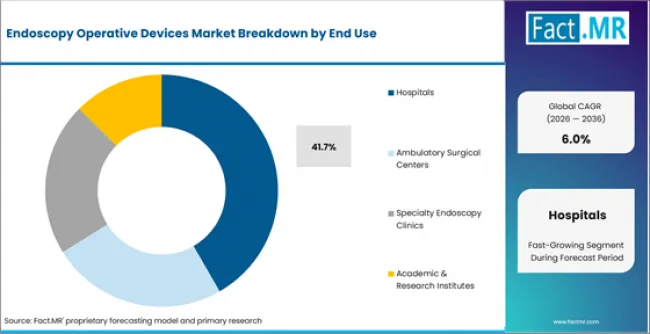
Endoscopy Operative Devices Market Analysis By End Use | Source: Fact.MR
Hospitals is expected to lead the end use segment with a 41.7% share in 2026, reflecting procurement concentration among primary healthcare institutional buyers managing the largest patient volumes.
Secondary channels hold growing positions as outpatient, ambulatory, and community-based settings expand clinical service delivery beyond traditional hospital environments.
Which Technology or Clinical Trend is Shaping the Next Phase of Growth in the Endoscopy Operative Devices Market?
Technology advancement in endoscopic visualization devices and integrated operative systems is the most significant trend, with next-generation platforms delivering improved clinical performance, workflow efficiency, and outcome documentation that supports adoption across both premium and cost-sensitive institutional settings.
The second dimension is access expansion through infrastructure development, insurance coverage growth, and regulatory pathway maturation in emerging markets, which structurally expands the addressable patient population and institutional procurement base for endoscopy operative devices products and services.
Regional Outlook Across Key Markets
- China leads growth at 8.1%, supported by hospital expansion, growing patient access, and domestic manufacturing capability.
- India follows at 7.5%, driven by Ayushman Bharat healthcare expansion and private hospital investment.
- North America and Europe maintain significant shares through established healthcare infrastructure and reimbursement coverage.
- Germany leads European growth at 6.9%, supported by EU MDR compliance, GKV reimbursement, and institutional procurement.
.webp "Top Country Growth Comparison Endoscopy Operative Devices Market Cagr (2026 2036)")
Top Country Growth Comparison Endoscopy Operative Devices Market Cagr (2026 2036) | Source: Fact.MR
CAGR Table
| Country | CAGR (%) |
|---|---|
| China | 8.1% |
| India | 7.5% |
| Germany | 6.9% |
| Brazil | 6.3% |
| USA | 5.7% |
Source: Fact.MR analysis. Updated Jun 11, 2026
Source: Fac.MR analysis, based on proprietary forecasting model and primary research.
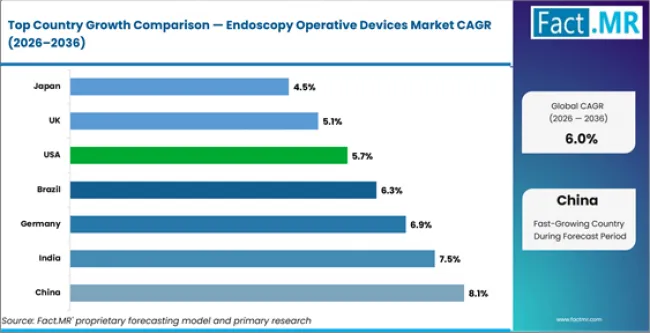
Endoscopy Operative Devices Market Cagr Analysis By Country | Source: Fact.MR
Endoscopy Operative Devices Demand Trends in the United States
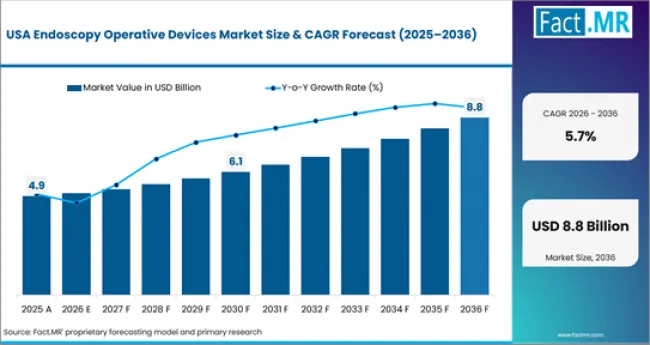
Endoscopy Operative Devices Market Country Value Analysis | Source: Fact.MR
Replacement cycles for installed endoscopic visualization devices and integrated operative systems across the established US hospital network shape procurement patterns, with ambulatory surgery center (ASC) expansion creating an additional growth channel for endoscopy capital equipment. FDA 510(k) and PMA regulatory pathways define market access timelines for new endoscopic visualization platforms, while hospital GPO contracts with Medtronic, Boston Scientific, and Stryker concentrate purchasing decisions. Medicare reimbursement for endoscopic procedures supports institutional investment in upgraded operative systems that improve throughput and clinical outcomes.
- ASC expansion creates a growing procurement channel for endoscopic visualization devices and integrated operative systems outside traditional hospital settings.
- Medicare procedural reimbursement supports institutional capital investment in next-generation endoscopy operative platforms with improved imaging and workflow integration.
China Endoscopy Operative Devices Growth Assessment
Domestic endoscopy device manufacturing capacity from Mindray, SonoScape, and Shanghai Aohua is expanding to serve the growing hospital network, with government medical device self-sufficiency policies creating procurement preference for locally manufactured endoscopic visualization devices in public hospital tenders. Hospital construction programs adding endoscopy suites in tier-2 and tier-3 city facilities create high-volume demand for cost-competitive integrated operative systems that provide core diagnostic and therapeutic endoscopy capability at price points below Olympus and Karl Storz platforms.
- Government self-sufficiency policies create procurement preference for domestically manufactured endoscopic visualization devices in public hospital capital equipment tenders.
- Tier-2 and tier-3 hospital expansion with new endoscopy suite construction creates high-volume demand for cost-competitive integrated operative systems.
India Endoscopy Operative Devices Market Opportunity Outlook
Ayushman Bharat hospital network expansion and private healthcare investment in GI endoscopy and surgical endoscopy departments at Apollo, Fortis, and Max Healthcare create dual procurement channels for endoscopic visualization devices and integrated operative systems. Cost-effectiveness is the dominant selection criterion, with refurbished endoscopy equipment and domestic device alternatives competing against premium Olympus, Stryker, and Medtronic platforms in price-sensitive institutional procurement. Growing medical tourism for endoscopic procedures creates additional demand at premium tertiary care facilities equipped with latest-generation operative systems.
- Ayushman Bharat network expansion creates endoscopy equipment procurement for hospital facilities serving newly covered patient populations across semi-urban locations.
- Medical tourism demand for endoscopic procedures drives premium tertiary care facilities to invest in latest-generation visualization and operative system platforms.
Germany Endoscopy Operative Devices Demand Analysis
EU MDR compliance requirements define technical documentation and clinical evidence standards for endoscopy operative device placement in Germany, creating regulatory barriers that favor established manufacturers with comprehensive conformity assessment portfolios. GKV reimbursement for endoscopic procedures through the DRG-based billing system shapes hospital economics and influences capital equipment selection based on procedural throughput and cost-per-case efficiency. University hospital procurement at Charite, LMU, and Heidelberg establishes specification standards that cascade into municipal and private hospital purchasing across the German market.
- EU MDR conformity assessment requirements create regulatory documentation barriers favoring Olympus, Karl Storz, and Stryker with established certification portfolios.
- University hospital procurement specifications at Charite and LMU establish equipment standards that influence broader German hospital endoscopy purchasing decisions.
Competitive Benchmarking and Company Positioning
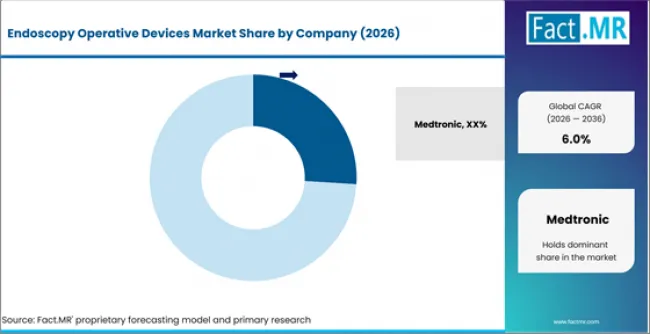
Endoscopy Operative Devices Market Analysis By Company | Source: Fact.MR
Endoscopy Operative Devices Market Analysis By Company
- Leading companies hold strong positions through comprehensive portfolios, established clinical relationships, and sustained R&D investment.
- Mid-tier competitors differentiate through focused specialties, regional strength, and cost-competitive positioning.
- Clinical evidence documentation, regulatory certification, and institutional relationship depth are key competitive differentiators.
The competitive landscape combines multinational medical technology and healthcare service companies with regional specialists. Leading companies compete through broad portfolios and established institutional relationships.
Strategic priorities include expanding product and service portfolios, strengthening emerging market presence, and building digital health capabilities.
Key Companies in the Endoscopy Operative Devices Market
- Medtronic, Cook Medical Inc., Boston Scientific Corporation are among the leading participants with established portfolios.
- Stryker, Ethicon Endo-Surgery, Inc., Karl Storz hold positions through focused categories and regional strength.
- CONMED Corporation, Richard Wolf GmbH, Fujifilm Holdings Corporation compete through specialized offerings.
Recent Industry Developments
- Medtronic, Next-Generation GI Genius Module and ColonPRO Software CE Mark (February 2026)
- Medtronic announced CE Mark approval for ColonPRO, the 4th-generation software for AI-assisted colonoscopy, and a redesigned GI Genius module for future real-time AI applications.
- Olympus, EZ1500 EDOF Endoscope FDA Clearance (May 2025)
- Olympus announced FDA 510(k) clearance for its EZ1500 series endoscopes with Extended Depth of Field technology as part of the EVIS X1 endoscopy system.
- Boston Scientific, Endura Weight Loss Solutions Launch (August 2025)
- Boston Scientific launched Endura Weight Loss Solutions, covering minimally invasive weight-loss procedures including endoscopic sleeve gastroplasty and Orbera intragastric balloon placement
Leading Companies Shaping the Endoscopy Operative Devices Market
- Medtronic
- Cook Medical Inc.
- Boston Scientific Corporation
- Stryker
- Ethicon Endo-Surgery, Inc.
- Karl Storz
- CONMED Corporation
- Richard Wolf GmbH
- Fujifilm Holdings Corporation
- Olympus
Sources and Research References
- Medtronic. (2026, February 23). Medtronic announces CE Mark for the next generation GI Genius™ module and ColonPRO™ software. Medtronic.
- Olympus Corporation of the Americas. (2025, May 28). Olympus announces FDA clearance of its most advanced imaging endoscopes: EDOF™ technology provides a continuously sharp image with minimal focal adjustment as part of the EVIS X1™ endoscopy system. Olympus.
- Boston Scientific. (2025, August 6). Boston Scientific introduces Endura Weight Loss Solutions. Boston Scientific.
- Organisation for Economic Co-operation and Development. (2025). OECD health statistics 2025.
- World Health Organization. (2025, May 15). World health statistics 2025: Monitoring health for the SDGs, sustainable development goals.
This bibliography is provided for reader reference and is not exhaustive.
Key Questions This Report Addresses
- What is the current and future size of the Endoscopy Operative Devices Market?
- How fast is the market expected to grow between 2026 and 2036?
- Which product type leads by 2026?
- Which end-use accounts for highest demand?
- What are the primary growth drivers?
- How is technology advancement influencing the market?
- Which countries show the fastest growth?
- Who are the key companies?
- How does Fact.MR validate the forecast?
Endoscopy Operative Devices Market Definition
The Endoscopy Operative Devices Market covers devices used during endoscopic diagnosis and treatment, including visualization systems, cutting tools, closure devices, access devices, and integrated operative platforms.
Endoscopy Operative Devices Market Inclusions
- The scope covers global and regional market size and forecasts for 2026 to 2036 across product type, end use, formulation, and region.
- It includes all major product categories and service formats for primary healthcare applications.
- The report covers technology, regulatory, and reimbursement trends alongside the competitive landscape.
Endoscopy Operative Devices Market Exclusions
- The scope excludes general-purpose medical supplies not specific to this market category.
- It excludes upstream component and raw material supply chains.
- The report excludes downstream patient outcomes data and health economics assessments.
Endoscopy Operative Devices Market Research Methodology
- The methodology combines secondary research, primary interviews, and forecast modelling.
- It draws on 90+ secondary sources and benchmarks 45+ company portfolios.
- Market sizing covers 30+ countries through a demand-side model supported by top-down validation.
- Key inputs include healthcare spending data, regulatory tracking, and clinical adoption rates.
- Primary validation includes 25+ interviews across manufacturers, clinicians, and hospital procurement.
Segmentation
Scope of Analysis
| Parameter | Details |
|---|---|
| Quantitative Units | USD 11.0 billion to USD 19.7 billion, at a CAGR of 6.0% |
| Market Definition | The Endoscopy Operative Devices Market covers endoscopic visualization, cutting, closure, access, and operative support devices used in diagnostic and therapeutic procedures. |
| Product | Endoscopic Visualization Devices, Endoscopic Cutting Devices, Endoscopic Closure Devices, Endoscopic Access Devices |
| Application | Gastrointestinal Endoscopy Procedures, Pulmonary Endoscopy Procedures,Urology Endoscopy Procedures,Gynecology Endoscopy Procedures |
| End use | Hospitals, Ambulatory Surgical Centers, Specialty Endoscopy Clinics, Academic & Research Institutes
|
| Formulation | Integrated Operative Systems, Disposable Operative Systems, Modular Operative Systems, Hybrid Operative Systems
|
| Distribution Channel | Direct OEM Distribution, Medical Device Distributors,Online Procurement Platforms, Third Party Service Providers |
| Technology | High Definition Imaging Technology, Energy Based Surgical Technology, Robotic Assisted Endoscopy Technology, Visualization & Navigation Technology |
| Regions Covered | North America, Latin America, Europe, East Asia, South Asia and Pacific, Middle East and Africa |
| Countries Covered | USA, Canada, UK, Germany, China, India, 30 plus countries |
| Key Companies | Medtronic, Cook Medical Inc., Boston Scientific Corporation, Stryker, Ethicon Endo-Surgery, Inc., Karl Storz, CONMED Corporation, Richard Wolf GmbH |
| Forecast Period | 2026 to 2036 |
| Approach | Hybrid demand-side methodology built on healthcare data, regulatory tracking, and primary interviews. |
Source: Fact.MR analysis. Updated Jun 11, 2026
Endoscopy Operative Devices Market Segmentation
-
Endoscopy Operative Devices Market Market Segmented by Product:
- Endoscopic Visualization Devices
- Rigid Endoscopy Systems
- 4K Rigid Visualization Systems
- High Definition Rigid Scopes
- Flexible Endoscopy Systems
- Video Flexible Endoscopes
- Therapeutic Flexible Scopes
- Rigid Endoscopy Systems
- Endoscopic Cutting Devices
- Electrosurgical Cutting Systems
- Monopolar Endoscopic Cutters
- Bipolar Endoscopic Cutters
- Mechanical Cutting Devices
- Endoscopic Scissors Systems
- Rotational Cutting Instruments
- Electrosurgical Cutting Systems
- Endoscopic Closure Devices
- Clip Application Systems
- Hemostatic Clip Devices
- Tissue Approximation Clip Systems
- Stapling Systems
- Linear Endoscopic Staplers
- Circular Endoscopic Staplers
- Clip Application Systems
- Endoscopic Access Devices
- Trocar Access Systems
- Bladed Trocar Devices
- Optical Trocar Systems
- Cannula Access Systems
- Single Port Cannulas
- Multi Channel Cannulas
- Trocar Access Systems
- Endoscopic Visualization Devices
-
Endoscopy Operative Devices Market Market Segmented by Application:
- Gastrointestinal Endoscopy Procedures
- Upper GI Procedures
- Esophagogastroduodenoscopy Procedures
- Upper GI Therapeutic Procedures
- Lower GI Procedures
- Colonoscopy Procedures
- Rectal Therapeutic Procedures
- Upper GI Procedures
- Pulmonary Endoscopy Procedures
- Diagnostic Bronchoscopy Procedures
- Airway Visualization Procedures
- Lung Tissue Sampling Procedures
- Therapeutic Pulmonary Procedures
- Bronchial Stent Placement Procedures
- Foreign Body Removal Procedures
- Diagnostic Bronchoscopy Procedures
- Urology Endoscopy Procedures
- Diagnostic Urology Procedures
- Cystoscopy Procedures
- Ureteroscopy Procedures
- Therapeutic Urology Procedures
- Stone Removal Procedures
- Prostate Tissue Resection Procedures
- Diagnostic Urology Procedures
- Gynecology Endoscopy Procedures
- Diagnostic Gynecology Procedures
- Pelvic Visualization Procedures
- Endometrial Assessment Procedures
- Operative Gynecology Procedures
- Laparoscopic Hysterectomy Procedures
- Ovarian Cyst Removal Procedures
- Diagnostic Gynecology Procedures
- Gastrointestinal Endoscopy Procedures
-
Endoscopy Operative Devices Market Market Segmented by End Use:
- Hospitals
- Public Hospitals
- Government Surgical Hospitals
- Regional Medical Centers
- Private Hospitals
- Corporate Specialty Hospitals
- Advanced Endoscopy Centers
- Public Hospitals
- Ambulatory Surgical Centers
- Day Care Surgical Facilities
- Outpatient GI Centers
- Minimally Invasive Surgery Centers
- Specialty Procedure Centers
- Pulmonary Procedure Clinics
- Urology Surgical Clinics
- Day Care Surgical Facilities
- Specialty Endoscopy Clinics
- Gastroenterology Clinics
- Digestive Disease Clinics
- Therapeutic GI Centers
- Pulmonology Clinics
- Respiratory Endoscopy Centers
- Interventional Pulmonary Clinics
- Gastroenterology Clinics
- Academic & Research Institutes
- Medical Universities
- Endoscopic Training Facilities
- Clinical Research Hospitals
- Simulation Centers
- Surgical Skills Laboratories
- Procedure Simulation Institutes
- Medical Universities
- Hospitals
-
Endoscopy Operative Devices Market Market Segmented by Technology:
- High Definition Imaging Technology
- Digital Imaging Systems
- 4K Endoscopic Imaging Platforms
- Ultra HD Camera Systems
- Optical Enhancement Systems
- Narrow Band Imaging Systems
- Fluorescence Imaging Platforms
- Digital Imaging Systems
- Energy Based Surgical Technology
- Electrosurgical Systems
- Radiofrequency Tissue Dissection Systems
- Advanced Coagulation Platforms
- Laser Surgical Systems
- Holmium Laser Endoscopy Systems
- CO2 Laser Surgical Platforms
- Electrosurgical Systems
- Robotic Assisted Endoscopy Technology
- Robot Guided Navigation Systems
- AI Assisted Scope Navigation
- Precision Motion Control Platforms
- Integrated Robotic Surgical Systems
- Robotic Endoluminal Platforms
- Remote Controlled Surgical Systems
- Robot Guided Navigation Systems
- Visualization & Navigation Technology
- 3D Visualization Systems
- Stereoscopic Imaging Platforms
- Depth Enhanced Endoscopy Systems
- Electromagnetic Navigation Systems
- Real Time Tracking Platforms
- Sensor Guided Navigation Systems
- 3D Visualization Systems
- High Definition Imaging Technology
-
Endoscopy Operative Devices Market Market Segmented by Formulation:
- Integrated Operative Systems
- Multi Device Surgical Platforms
- Combined Visualization & Cutting Systems
- Integrated Energy Delivery Platforms
- Procedure Workflow Systems
- Centralized Surgical Control Units
- Digital Procedure Coordination Systems
- Multi Device Surgical Platforms
- Disposable Operative Systems
- Single Use Endoscopic Instruments
- Disposable Biopsy Devices
- Single Use Cutting Instruments
- Sterile Access Systems
- Disposable Trocar Systems
- Pre Sterilized Cannula Kits
- Single Use Endoscopic Instruments
- Modular Operative Systems
- Expandable Procedure Platforms
- Custom Configurable Endoscopy Units
- Scalable Surgical Tower Systems
- Portable Operative Systems
- Compact Endoscopy Workstations
- Mobile Procedure Platforms
- Expandable Procedure Platforms
- Hybrid Operative Systems
- Imaging Integrated Systems
- Image Guided Surgical Platforms
- Real Time Diagnostic Integration Systems
- Robot Assisted Hybrid Platforms
- Robotic Visualization Integration Systems
- AI Enhanced Surgical Workflow Systems
- Imaging Integrated Systems
- Integrated Operative Systems
-
Endoscopy Operative Devices Market Market Segmented by Distribution Channel:
- Direct OEM Distribution
- Hospital Supply Contracts
- Large Healthcare Procurement Agreements
- Integrated Delivery Network Contracts
- Specialty Center Partnerships
- GI Center Supply Programs
- Surgical Network Distribution Agreements
- Hospital Supply Contracts
- Medical Device Distributors
- National Distribution Networks
- Endoscopy Equipment Suppliers
- Surgical Device Distribution Chains
- Regional Specialty Distributors
- Minimally Invasive Device Suppliers
- Clinical Equipment Dealers
- National Distribution Networks
- Online Procurement Platforms
- Digital B2B Portals
- Hospital Procurement Platforms
- Medical Equipment E Commerce Systems
- Manufacturer Direct Platforms
- Direct Device Configuration Portals
- Subscription Based Equipment Ordering
- Digital B2B Portals
- Third Party Service Providers
- Leasing & Rental Providers
- Endoscopy Tower Rental Services
- Procedure Equipment Leasing Programs
- Managed Service Providers
- Endoscopy Suite Management Services
- Integrated Equipment Maintenance Programs
- Leasing & Rental Providers
- Direct OEM Distribution
-
Endoscopy Operative Devices Market Market by Region:
- North America
- USA
- Canada
- Latin America
- Brazil
- Mexico
- Chile
- Rest of Latin America
- Western Europe
- Germany
- UK
- Italy
- Spain
- France
- Nordic
- BENELUX
- Rest of Western Europe
- Eastern Europe
- Russia
- Poland
- Hungary
- Balkan & Baltic
- Rest of Eastern Europe
- East Asia
- China
- Japan
- South Korea
- South Asia and Pacific
- India
- ASEAN
- Australia & New Zealand
- Rest of South Asia and Pacific
- Middle East & Africa
- Kingdom of Saudi Arabia
- Other GCC Countries
- Turkiye
- South Africa
- Other African Union
- Rest of Middle East & Africa
- North America
Frequently Asked Questions
What are the key products in the endoscopy operative devices market?
Which application segment is expected to contribute a significant share in the endoscopy operative devices market in 2026?
Which country is projected to grow the fastest in the Endoscopy Operative Devices Market?
What is the expected growth rate of the Endoscopy Operative Devices Market in Germany?
How fast is the Endoscopy Operative Devices Market expected to grow in Brazil?
Who worked on this report


Preview the report firsthand - request a free sample
Free SampleGet the brochure for pricing and purchase details
Download PDF