- Market Value (2025): USD 35.6 Bn
- Estimated Value (2026): USD 38.0 Bn
- Forecast Value (2036): USD 73.7 Bn
- CAGR (2026-2036): 6.8%
What is the Endoscopy Systems Market forecast to be worth by 2036?
USD 38.0 billion in 2026 to USD 73.7 billion by 2036, at a 6.8% CAGR.
- According to Fact.MR analysis, the endoscopy systems market reached USD 35.6 billion in 2025.
- Sales are forecast to rise from USD 38.0 billion in 2026 to USD 73.7 billion by 2036.
- The forecast indicates a 6.8% CAGR during 2026 to 2036 as hospitals and surgical centers renew visualization systems and broaden minimally invasive care.
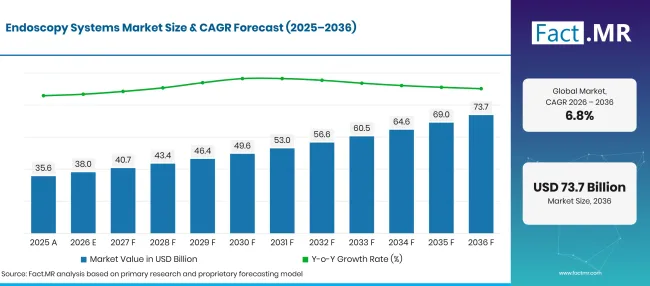
Endoscopy Systems Market Forecast Global | Source: Fact.MR
| Year | Basis | Market Value (USD billion) |
|---|---|---|
| 2025 | Actual | 35.6 |
| 2026 | Estimate | 38.0 |
| 2036 | Forecast | 73.7 |
| CAGR 2026 to 2036 | Forecast period | 6.8% |
Source: Fact.MR analysis. Updated Oct 26, 2026
What are the defining numbers behind Endoscopy Systems Market growth?
USD 35.6 billion absolute opportunity between 2026 and 2036, led by flexible endoscopes, gastrointestinal procedures and hospitals.
- Demand Drivers in the Market
- Hospital endoscopy units compare throughput alongside the time needed to clean reusable scopes. NHS England recorded 275,000 additional endoscopies from investment in diagnostic capacity during 2024/25 [2]. Departments expanding examination slots have a reason to compare processor compatibility and service coverage.
- Surgeons use rigid imaging systems to observe anatomy during laparoscopic and arthroscopic procedures. When equipment works across several specialties, a hospital has more flexibility to schedule cases without moving entire camera setups between rooms.
- Clinical engineering teams look closely at repair turnaround and consistent image performance. A camera head or light source that is unavailable can delay an operating list, making technical support an important buying consideration.
- Key Segments Analyzed
- By Product Type: Flexible Endoscopes account for 38.5% share in 2026, reflecting their role in gastrointestinal examination and other routes through natural openings.
- By Application: Gastrointestinal Endoscopy holds 35.7% share in 2026 as diagnostic examinations and therapeutic procedures require direct internal visualization.
- By End-User: Hospitals represent 52.3% share in 2026, supported by hospital-based diagnostic and surgical workflows.
- Analyst Opinion at Fact.MR
- Shambhu Nath Jha, Principal Consultant at Fact.MR, states, “Hospitals assess more than image sharpness when buying an endoscopy system. Clinical teams need systems that fit established treatment pathways and have repair support available when a procedure list is busy. Suppliers that link imaging improvements to practical cleaning processes and staff training are better placed to serve departments replacing older equipment.”
- Strategic Implications
- Hospital managers should review the total cost of a scope fleet, including processing equipment and maintenance schedules, before selecting a platform for several procedure rooms.
- Gastroenterology teams benefit from testing image modes against their regular case mix so new processor functions improve observation without adding unnecessary steps.
- Manufacturers need clear clinical instructions for cleaning and compatible accessories because device availability depends on how reliably each component is prepared for the next patient.
- Ambulatory surgical centers can consider compact visualization equipment when procedure volume and referral patterns justify repeat utilization across a limited number of specialties.
Brazil is projected to post an 8.6% CAGR, reflecting interest in specialist diagnostic capacity. The United States follows at 8.2% and Japan at 7.9%, while Germany records 6.5%. The United Kingdom is forecast at 4.9% as health services manage scheduled diagnostics alongside replacement budgets.
How does the Endoscopy Systems Market break down by segment?
Flexible Endoscopes 38.5%; Gastrointestinal Endoscopy 35.7%; Hospitals 52.3% in 2026.
Which Product Type dominates?
Flexible Endoscopes hold 38.5% share in 2026.
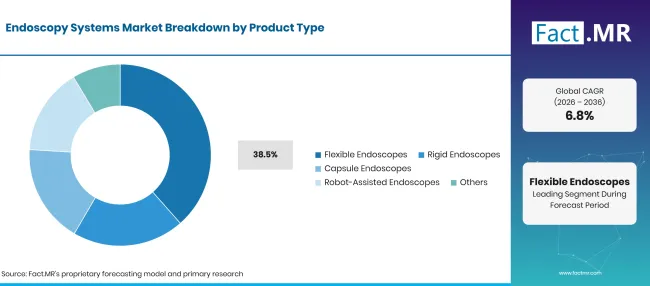
Endoscopy Systems Market Breakdown Product Type | Source: Fact.MR
| Product Type | Share (2026) |
|---|---|
| Flexible Endoscopes (Leading segment) | 38.5% |
| Other segments combined | 61.5% |
| Total | 100.0% |
Source: Fact.MR analysis. Updated Oct 26, 2026
Flexible scopes allow gastroenterologists to inspect the digestive tract while following its natural curves. Their value lies in combining navigation with an illuminated camera view and a working channel for selected tools. Rigid endoscopes remain useful in laparoscopic and joint procedures where a stable viewing shaft fits the surgical route. Capsule endoscopes offer a different examination method for selected gastrointestinal questions. Robot-assisted designs target specialist workflows in which precise instrument movement and a controlled image are central to the operation.
What leads the Application segment?
Gastrointestinal Endoscopy accounts for 35.7% share in 2026.
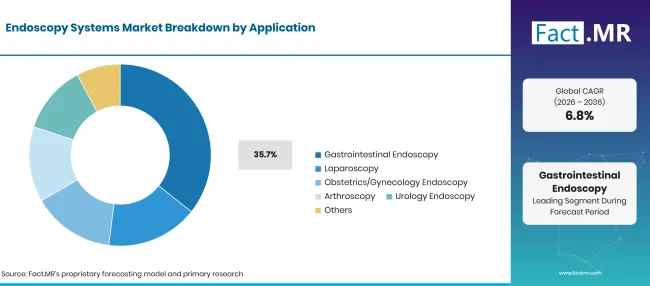
Endoscopy Systems Market Breakdown Application | Source: Fact.MR
| Application | Share (2026) |
|---|---|
| Gastrointestinal Endoscopy (Leading segment) | 35.7% |
| Other segments combined | 64.3% |
| Total | 100.0% |
Source: Fact.MR analysis. Updated Oct 26, 2026
Gastrointestinal endoscopy includes visual assessment of the esophagus and stomach as well as colon examinations. Screening programmes and follow-up testing affect when patients enter these pathways. Laparoscopy uses a different access route and depends on a camera view during surgery. Obstetrics and gynecology procedures and arthroscopy also rely on scopes adapted to the relevant anatomy. Urology endoscopy covers examination and selected treatments within the urinary tract, which brings its own instrument size and irrigation requirements.
How does End-User purchasing shape sales?
Hospitals represent 52.3% share in 2026.
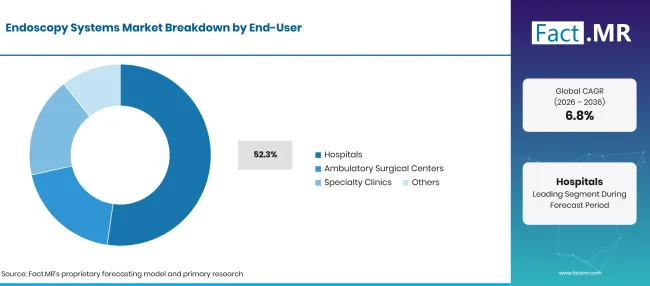
Endoscopy Systems Market Breakdown End User | Source: Fact.MR
| End-User | Share (2026) |
|---|---|
| Hospitals (Leading segment) | 52.3% |
| Other segments combined | 47.7% |
| Total | 100.0% |
Source: Fact.MR analysis. Updated Oct 26, 2026
Hospitals combine gastroenterology services with operating room activity and often need more than one scope type. Shared camera platforms can simplify training when several departments use related equipment. Ambulatory surgical centers focus on predictable appointment schedules and equipment that fits their case selection. Specialty clinics may concentrate on a narrower group of examinations and choose systems around that workload.
What is accelerating Endoscopy Systems Market adoption, and what is holding it back?
Screening activity and surgical visualization support purchases; reprocessing capacity and capital costs constrain replacement.
Drivers Impact Analysis
| DRIVER | (~) % IMPACT ON CAGR | GEOGRAPHIC RELEVANCE | IMPACT TIMELINE |
|---|---|---|---|
| Gastrointestinal screening | +1.0% | North America, Europe | Medium term (2–4 years) |
| Minimally invasive procedures | +0.8% | Global | Medium term (2–4 years) |
| Image enhancement | +0.7% | Japan, United States | Medium term (2–4 years) |
| System replacement | +0.5% | Global | Short term (<= 2 years) |
| Endoscopy access | +0.4% | Latin America | Long term (>= 4 years) |
Source: Fact.MR analysis. Updated Oct 26, 2026
Opportunity Impact Analysis
| OPPORTUNITY | (~) % IMPACT ON CAGR | GEOGRAPHIC RELEVANCE | IMPACT TIMELINE |
|---|---|---|---|
| Integrated imaging software | +0.8% | United States, Japan | Medium term (2–4 years) |
| Service and repair programmes | +0.6% | Global | Short term (<= 2 years) |
| Specialty surgical imaging | +0.5% | Europe, North America | Medium term (2–4 years) |
| Local supplier support | +0.4% | Latin America, Asia | Long term (>= 4 years) |
Source: Fact.MR analysis. Updated Oct 26, 2026
Restraints Impact Analysis
| RESTRAINT | (~) % IMPACT ON CAGR | GEOGRAPHIC RELEVANCE | IMPACT TIMELINE |
|---|---|---|---|
| Equipment acquisition cost | -0.8% | Global | Short term (<= 2 years) |
| Reprocessing workload | -0.6% | Global | Medium term (2–4 years) |
| Procedure staffing | -0.5% | Europe, North America | Medium term (2–4 years) |
| Regulatory and service needs | -0.4% | Global | Long term (>= 4 years) |
Source: Fact.MR analysis. Updated Oct 26, 2026
Which countries are scaling the Endoscopy Systems Market through 2036?
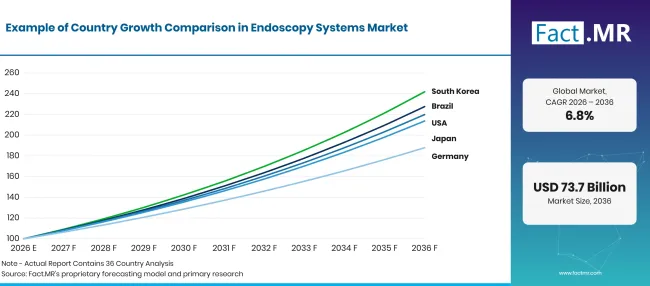
Endoscopy Systems Market Growth Index | Source: Fact.MR
| Country | CAGR (2026–2036) |
|---|---|
| Brazil | 8.6% |
| United States | 8.2% |
| Japan | 7.9% |
| Germany | 6.5% |
| United Kingdom | 4.9% |
Source: Fact.MR analysis. Updated Oct 26, 2026
How is Brazil expanding access to endoscopy systems?
8.6% CAGR, linked to colorectal diagnostic pathways and specialist capacity.
Brazilian public hospitals are expanding their focus on organized colorectal assessment, which creates a clear clinical need for reliable diagnostic endoscopy. Screening follow-up and specialist gastroenterology services are expected to support future scope purchases. Private facilities are another channel for gastrointestinal examinations, and equipment renewal offers an additional reason to compare imaging platforms.
What supports endoscopy purchasing in the United States?
8.2% CAGR, shaped by screening and hospital equipment replacement.
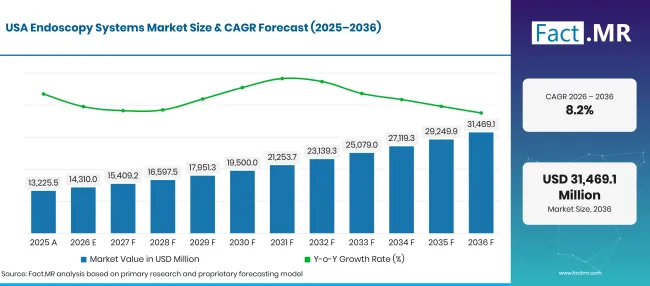
Endoscopy Systems Market Forecast Usa | Source: Fact.MR
In the United States, established colorectal screening pathways create a recurring need for colonoscopy when a direct examination is appropriate. The Centers for Disease Control and Prevention reported in June 2025 that about seven in ten adults aged 50 to 75 were up to date with colorectal screening [1]. Follow-up examinations and planned replacement of aging imaging systems both influence purchasing.
Why does Japan remain important for endoscopy technology?
7.9% CAGR, reflecting clinical imaging requirements and equipment renewal.
Japan’s established gastrointestinal endoscopy practice places attention on detailed surface imaging and consistent instrument handling. Olympus announced an NBI+TXI observation mode for its EVIS X1 system in October 2025 [3], offering hospitals another imaging function to evaluate.
How are German hospitals evaluating endoscopy systems?
6.5% CAGR, tied to routine diagnostic activity and surgical equipment standards.
German hospitals operate endoscopy services across diagnostic gastroenterology and surgical departments, creating distinct needs for flexible and rigid systems. Scope replacement and therapeutic procedures provide further reasons to review processor compatibility. Federal Statistical Office procedure tables offer a basis for examining local hospital activity [4].
What shapes the United Kingdom endoscopy outlook?
4.9% CAGR, linked to diagnostic backlogs and planned service capacity.
The United Kingdom has continuing interest in endoscopy capacity because screening follow-up requires timely access to colonoscopy and other examinations. NHS England reported in December 2025 that 26.3% of patients waiting for an endoscopy diagnostic test in England had waited at least six weeks in October 2025 [6]. Planned additional sessions and replacement of aging equipment are expected to influence equipment selection.
Who leads the Endoscopy Systems Market?
Olympus Corporation and Fujifilm Holdings Corporation offer gastrointestinal endoscopic imaging platforms. Stryker Corporation and KARL STORZ are associated with surgical imaging and rigid endoscopy systems. Hospitals compare product fit and service support across these categories because the same department may need both reusable scopes and image processors.
Boston Scientific Corporation supplies therapeutic endoscopy tools used with endoscopic procedures. Medtronic plc and Intuitive Surgical Inc. participate in related minimally invasive and robotic surgical systems, while Smith & Nephew plc serves arthroscopic surgical applications. Company offerings differ by procedure, so the competitive assessment centers on product compatibility and clinical workflow rather than an assumed uniform endoscopy system portfolio. Olympus expanded EVIS X1 production arrangements in China in November 2025 after regulatory registration of a locally manufactured processor [5].
Which companies are the key providers?
Key companies include Olympus Corporation; Stryker Corporation; KARL STORZ SE & Co. KG; Boston Scientific Corporation; Medtronic plc; Fujifilm Holdings Corporation; Smith & Nephew plc; PENTAX Medical (HOYA Group); Intuitive Surgical Inc.
- Olympus Corporation
- Stryker Corporation
- KARL STORZ SE & Co. KG
- Boston Scientific Corporation
- Medtronic plc
- Fujifilm Holdings Corporation
- Smith & Nephew plc
- PENTAX Medical (HOYA Group)
- Intuitive Surgical Inc.
Bibliography
- [1] Centers for Disease Control and Prevention. (2025, June 11). Use of colorectal cancer screening tests.
- [2] NHS England. (2025, October 31). Performance report.
- [3] Olympus Corporation. (2025, October 29). Olympus introduces NBI+TXI™ observation mode to the EVIS X1™ endoscopy system CV-1500 Video System Center.
- [4] Statistisches Bundesamt (Destatis). (n.d.). Operationen und Prozeduren an vollstationären Patienten: Deutschland, Jahre, Operationen und Prozeduren (1-4-Steller Hierarchie) [Operations and procedures on fully inpatient patients: Germany, years, operations and procedures].
- [5] Olympus Corporation. (2025, November 28). Olympus accelerates local production of the EVIS X1™ endoscopy system in China.
- [6] NHS England. (2025, December 11). Diagnostic waiting times and activity for October 2025.
This Report Answers
- The analysis explains how flexible scope purchases differ from rigid surgical visualization equipment.
- The product comparison reviews reusable and capsule systems in their appropriate clinical applications.
- The country outlook compares Germany, Brazil, the United States, the United Kingdom and Japan.
- The application assessment considers gastrointestinal examination alongside laparoscopic and specialty surgery.
- The competitive discussion separates full visualization systems from procedure-specific endoscopic instruments.
What does the Endoscopy Systems Market cover?
The market covers the imaging equipment and scopes used for visual examination or minimally invasive treatment inside the body. It includes flexible, rigid, capsule and robot-assisted configurations within the stated product classification. Device selection depends on clinical specialty and the route used to reach the area being examined.
What is included in the scope?
The scope includes endoscopic systems used by hospitals, ambulatory surgical centers and specialty clinics.
The market also considers equipment functions that are essential to visualization within the stated clinical procedure. Reusable instruments enter where an endoscopy unit maintains the appropriate reprocessing capability.
What is excluded from the scope?
General surgical equipment used without endoscopic visualization sits outside this market boundary.
Standalone imaging services and ordinary patient fees are separate from system sales. Therapeutic accessories are considered only where they form part of the defined endoscopy system package.
How Was the Analysis Built?
The analysis draws on 120+ sources, 35+ company portfolios, 25+ countries, and more than 20 industry interviews.
- Primary Research: Primary research includes discussions with manufacturers, service providers, technology developers, distributors, end users, and subject-matter experts. These conversations examine purchasing priorities, product adoption, operational challenges, approval requirements, competitive positioning, and the factors that influence wider market acceptance.
- Desk Research: Desk research covers government statistics, regulatory publications, company filings, trade data, technical studies, industry associations, standards, public policy, and other authoritative sources. Every source used in the analysis is documented in the bibliography.
- Market Sizing and Forecasting: Market estimates combine historical performance, demand indicators, pricing and volume trends, segment shares, company participation, country-level growth, adoption patterns, investment activity, and barriers to market expansion.
- Data Validation and Update Cycle: Findings are validated by comparing primary interviews with public data, company activity, regulatory changes, trade patterns, and industry developments. Regular updates review new product launches, capacity changes, partnerships, approvals, and shifts in commercial adoption.
Segmentation
What is the report’s scope and coverage?
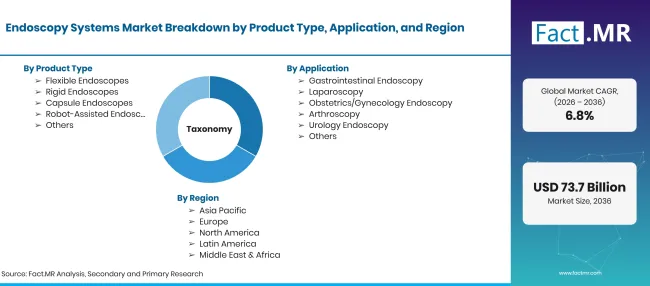
Endoscopy Systems Market Taxonomy | Source: Fact.MR
| Attribute | Details |
|---|---|
| Quantitative Units | USD billion |
| Market Definition | Equipment used to visualize internal anatomy during endoscopic diagnostic and therapeutic procedures |
| Product Type | Flexible Endoscopes; Rigid Endoscopes; Capsule Endoscopes; Robot-Assisted Endoscopes; Others |
| Application | Gastrointestinal Endoscopy; Laparoscopy; Obstetrics/Gynecology Endoscopy; Arthroscopy; Urology Endoscopy; Others |
| End-User | Hospitals; Ambulatory Surgical Centers; Specialty Clinics |
| Regions Covered | North America; Latin America; Western Europe; Eastern Europe; East Asia; South Asia & Pacific; Middle East & Africa |
| Countries Covered | Germany; Brazil; United States; United Kingdom; Japan |
| Companies Profiled | Olympus Corporation; Stryker Corporation; KARL STORZ SE & Co. KG; Boston Scientific Corporation; Medtronic plc; Fujifilm Holdings Corporation; Smith & Nephew plc; PENTAX Medical (HOYA Group); Intuitive Surgical Inc. |
| Forecast Period | 2026 to 2036 |
| Approach | Assessment of endoscopy applications, clinical equipment selection, service requirements and official procedure indicators |
Source: Fact.MR analysis. Updated Oct 26, 2026
How is the market segmented?
-
By Product Type
- Flexible Endoscopes
- Rigid Endoscopes
- Capsule Endoscopes
- Robot-Assisted Endoscopes
- Others
-
By Application
- Gastrointestinal Endoscopy
- Laparoscopy
- Obstetrics/Gynecology Endoscopy
- Arthroscopy
- Urology Endoscopy
- Others
-
By End-User
- Hospitals
- Ambulatory Surgical Centers
- Specialty Clinics
-
By Region
- North America
- Latin America
- Western Europe
- Eastern Europe
- East Asia
- South Asia & Pacific
- Middle East & Africa
Frequently Asked Questions
How big is the Endoscopy Systems Market in 2026?
What is the CAGR of the Endoscopy Systems Market from 2026 to 2036?
Which product type leads the Endoscopy Systems Market?
Which application leads the Endoscopy Systems Market?
Who are the leading companies in the Endoscopy Systems Market?
Who worked on this report


Preview the report firsthand - request a free sample
Free SampleGet the brochure for pricing and purchase details
Download PDF