Industrial Water Treatment Market
Industrial Water Treatment Market Size and Share Forecast Outlook 2025 to 2035
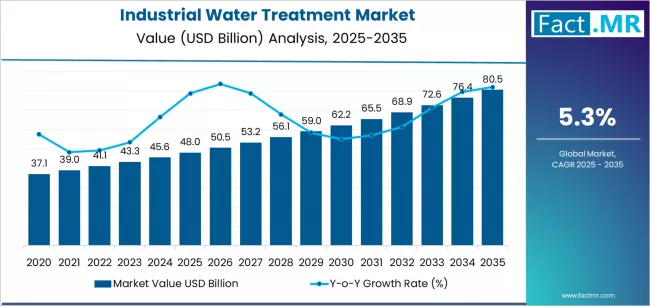
Industrial water treatment market is projected to grow from USD 48.0 billion in 2025 to USD 80.5 billion by 2035, at a CAGR of 5.3%. Chemical Treatment will dominate with a 27.5% market share, while chemical industry will lead the industry segment with a 28.0% share.
Industrial Water Treatment Market Forecast and Outlook 2025 to 2035
The global industrial water treatment market is projected to reach USD 80.5 billion by 2035, recording an absolute increase of USD 32.5 billion over the forecast period. The market is valued at USD 48.0 billion in 2025 and is set to rise at a CAGR of 5.3% during the assessment period.
Quick Stats for Industrial Water Treatment Market
- Industrial Water Treatment Market Value (2025): USD 48.0 billion
- Industrial Water Treatment Market Forecast Value (2035): USD 80.5 billion
- Industrial Water Treatment Market Forecast CAGR: 5.3%
- Leading Technology Type in Industrial Water Treatment Market: Chemical Treatment (27.5%)
- Key Growth Regions in Industrial Water Treatment Market: Asia Pacific, North America, and Europe
- Top Players in Industrial Water Treatment Market: Veolia, Ecolab Inc., Xylem, Pentair, Kurita Water Industries Ltd., Solenis, SWA Water Australia, WOG GROUP, Kemira, Feralco AB

The scope for industrial water treatment is expected to grow by approximately 1.7 times during the same period, supported by increasing regulatory pressure for wastewater compliance and sustainable water management worldwide, driving demand for advanced treatment technologies and increasing investments in water recycling systems with circular economy principles across manufacturing facilities and industrial processing operations globally.
Industrial operators and facility managers face mounting pressure to reduce water consumption and meet stringent discharge standards while addressing operational efficiency requirements and environmental sustainability commitments, with modern industrial water treatment solutions providing documented operational benefits including enhanced process water quality, reduced freshwater intake, and regulatory compliance assurance compared to conventional treatment approaches alone.
Rising water scarcity concerns and expanding zero liquid discharge mandates enabling resource conservation create substantial opportunities for technology providers and engineering firms. However, high capital investment requirements and complex system integration challenges may pose obstacles to widespread advanced treatment adoption across small and medium industrial enterprises.
The chemical treatment segment dominates market activity, driven by extensive application versatility supporting scale inhibition, corrosion control, and biological growth prevention across diverse industrial processes worldwide. Industrial facilities increasingly recognize the operational reliability of chemical treatment programs, with typical product offerings providing effective water conditioning and system protection at predictable operational costs through established chemical supply networks.
The physical treatment segment demonstrates robust presence, supported by proven filtration and separation technologies integrating mechanical purification in modern industrial water management approaches. Chemical industry applications emerge as the dominant end-use segment, reflecting critical water quality requirements and high treatment volumes in chemical manufacturing operations. Membrane technologies show strong growth potential, driven by advanced separation capabilities and zero liquid discharge system integration.
Regional dynamics show Asia Pacific maintaining market leadership, supported by rapid industrialization rates and stringent environmental regulations across manufacturing sectors. North America demonstrates steady growth trajectory driven by aging water infrastructure upgrades and increasing water reuse mandates adopting circular water management practices, while Europe emphasizes sustainability regulations and industrial decarbonization initiatives for comprehensive environmental stewardship. India leads country-level growth through rapid industrialization and major water stress conditions, followed by China supported by strong industrial expansion and strict effluent norms implementation.
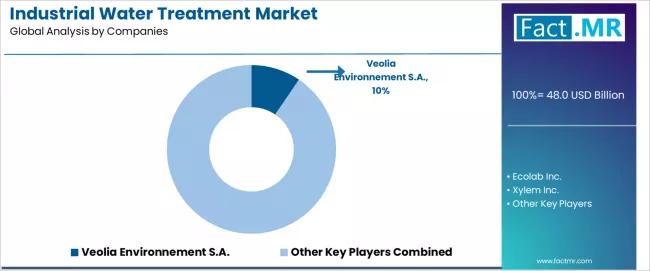
The competitive landscape features moderate concentration with Veolia maintaining market leadership position at 9.5% share, while specialized players including Ecolab, Xylem, Kurita Water Industries, and Suez compete through integrated water management solutions and comprehensive technical service capabilities across diverse industrial applications.
Industrial Water Treatment Market Year-over-Year Forecast 2025 to 2035
Between 2025 and 2029, the industrial water treatment market is projected to expand from USD 48.0 billion to USD 59.1 billion, resulting in a value increase of USD 11.1 billion, which represents 34.2% of the total forecast growth for the period.
This phase of development will be shaped by rising demand for water recycling systems addressing freshwater scarcity concerns, product innovation in smart monitoring technologies with real-time water quality analytics and predictive maintenance capabilities, as well as expanding integration with industrial digitalization platforms and Internet of Things sensor networks.
Companies are establishing competitive positions through investment in membrane technology advancement, chemical formulation optimization, and strategic market expansion across engineering procurement construction contracts, build-operate-transfer models, and long-term service agreements.
From 2029 to 2035, the market is forecast to grow from USD 59.1 billion to USD 80.5 billion, adding another USD 21.4 billion, which constitutes 65.8% of the overall expansion. This period is characterized by the expansion of specialized treatment applications, including zero liquid discharge systems for water-intensive industries and advanced oxidation processes tailored for complex industrial effluents, strategic collaborations between technology providers and industrial end-users, and an enhanced focus on decentralized treatment solutions and modular system designs.
The growing emphasis on circular economy principles and rising industrial preference for integrated water-energy nexus optimization addressing operational sustainability, carbon footprint reduction, and resource recovery will drive demand for comprehensive water treatment solutions across diverse manufacturing and processing sectors.
Industrial Water Treatment Market Key Takeaways
| Metric | Value |
|---|---|
| Market Value (2025) | USD 48.0 billion |
| Market Forecast Value (2035) | USD 80.5 billion |
| Forecast CAGR (2025-2035) | 5.3% |
Why is the Industrial Water Treatment Market Growing?
The industrial water treatment market grows by enabling manufacturing facilities and processing plants to achieve regulatory compliance and operational efficiency while addressing water scarcity and environmental sustainability requirements without exclusive reliance on freshwater sources and basic treatment methods. Industrial operators strive to minimize water consumption and meet increasingly stringent discharge limits while managing process reliability, equipment protection, and total cost of ownership considerations.
Contemporary industrial water treatment systems typically provide comprehensive solutions including advanced filtration achieving 99% contaminant removal, chemical conditioning programs preventing scale formation and corrosion damage. Industrial water treatment systems today enhance recycling capabilities, enabling 50-90% freshwater reduction compared to once-through water usage alone, making integrated water management essential for sustainable industrial operations.
The manufacturing industry's need for reliable water quality supporting production processes and environmental compliance creates demand for specialized treatment solutions that can provide consistent water specifications, enhance operational uptime, and support zero liquid discharge objectives without compromising product quality or facility performance.
Environmental regulatory enforcement and water scarcity pressures supporting treatment investment drive adoption in chemical manufacturing, power generation, and heavy industry applications, where water quality has direct impact on process efficiency and regulatory standing.
The accelerating global water stress affecting approximately 2 billion people in water-scarce regions creates expanding requirements for industrial water conservation and reuse technologies. Rising corporate sustainability commitments and environmental social governance reporting enable informed investment decisions and adherence to water stewardship protocols.
High initial capital expenditure and technical complexity may limit adoption rates and optimal implementation across resource-constrained facilities serving different industrial segments with varying water quality requirements and treatment sophistication levels.
Segmental Analysis
The market is segmented by technology, industry, and region. By technology, the market is divided into physical treatment, chemical treatment, biological treatment, membrane technologies, advanced oxidation processes, and sludge treatment.
Based on industry, the market is categorized into chemical industry, food & beverage, pharmaceuticals, automotive, electronics, and others. Regionally, the market is divided into Asia Pacific, Europe, North America, Latin America, and Middle East & Africa.
By Technology, Which Segment Accounts for the Dominant Market Share?

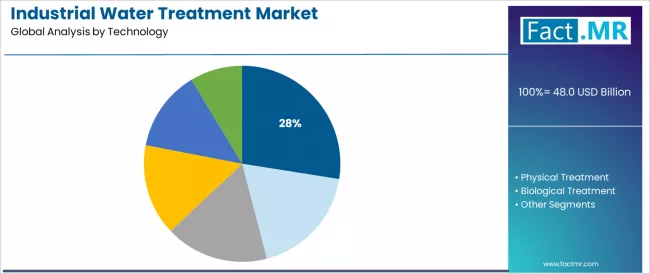
The chemical treatment segment represents the dominant force in the industrial water treatment market, capturing 27.5% of the total market share in 2025. This established technology category encompasses solutions featuring comprehensive water conditioning capabilities and operational flexibility, including corrosion inhibitors, scale preventers, biocides, and coagulants that enable effective water system protection and treatment performance across boiler systems, cooling towers, and wastewater treatment processes worldwide.
The chemical treatment segment's market leadership stems from its proven reliability and cost-effectiveness, with solutions capable of addressing diverse water quality challenges including hardness removal, pH adjustment, microbiological control, and suspended solids reduction while maintaining operational simplicity and compatibility with existing industrial infrastructure across various temperature conditions and water chemistry parameters.
Physical treatment maintains a substantial market share in the 21-23% range, serving industrial facilities that require mechanical separation and filtration technologies addressing particulate removal and clarification including sedimentation, filtration, flotation, and screening processes for primary treatment applications.
Physical treatment solutions offer fundamental treatment functionality for industrial operators enabling solid-liquid separation while providing sufficient reliability to support downstream treatment processes. The physical treatment segment demonstrates steady market presence, driven by established engineering principles and essential role in multi-stage treatment system configurations.
Within the technology category, membrane technologies demonstrate rapid growth driven by advanced separation capabilities for ultrafiltration, reverse osmosis, and nanofiltration applications supporting high-purity water production and zero liquid discharge systems, while biological treatment serves organic contaminant degradation through activated sludge and biofilm reactor processes.
Key operational advantages driving the chemical treatment segment include:
- Advanced multi-functionality mechanisms with demonstrated effectiveness across scale control, corrosion prevention, biological growth inhibition, and coagulation enhancement across industrial water systems
- Established dosing flexibility allowing precise chemical addition and real-time adjustment without extensive capital investment complexity for treatment optimization
- Enhanced operational simplicity features enabling rapid implementation and straightforward maintenance protocols while maintaining treatment effectiveness and system reliability
- Superior cost-effectiveness profile providing optimal treatment performance relative to capital expenditure and operational complexity across various industrial facility scales and water quality challenges
By Industry, Which Segment Accounts for the Largest Market Share?

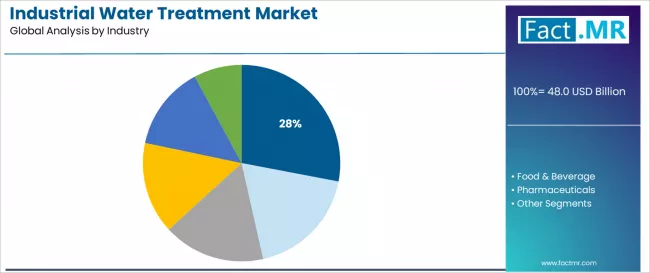
Chemical industry applications dominate the industrial water treatment landscape with a 28.0% market share in 2025, reflecting the critical role of water quality management in supporting chemical manufacturing processes, cooling operations, and wastewater treatment across petrochemical refineries, specialty chemical production, and basic chemical manufacturing facilities worldwide.
The chemical industry segment's market leadership is reinforced by high water consumption intensity averaging 50-200 cubic meters per ton of product output, stringent process water specifications requiring ultra-pure water for reactions and product formulation, and complex effluent characteristics that characterize chemical production requiring sophisticated treatment approaches.
Within this segment, petrochemical refineries represent substantial water treatment demand, driven by cooling water requirements, desalination needs, and complex wastewater streams containing hydrocarbons and dissolved organics. This sub-segment benefits from established capital investment capacity and regulatory compliance pressures.
Food & beverage represents an important industry category at 20.5% share, demonstrating steady expansion through food safety requirements, product quality assurance needs, and sustainability commitments where water treatment supports ingredient processing, equipment cleaning, and effluent management in dairy processing, beverage production, and food manufacturing facilities. This segment benefits from stringent hygiene standards and consumer brand protection priorities.
Key market dynamics supporting industry growth include:
- Chemical manufacturing expansion driven by global chemical production growth and increasing environmental compliance requirements, requiring comprehensive water treatment infrastructure
- Food & beverage quality assurance trends require validated water treatment systems and documentation supporting food safety certifications
- Integration of pharmaceutical-grade water systems enabling Good Manufacturing Practice compliance and product quality assurance
- Growing emphasis on electronics manufacturing supporting semiconductor industry growth and advanced display technology requiring ultrapure water specifications
What are the Drivers, Restraints, and Key Trends of the Industrial Water Treatment Market?
The market is driven by three concrete demand factors tied to industrial sustainability. First, strengthening environmental regulations and discharge standards create expanding compliance requirements for industrial facilities, with advanced treatment technologies representing essential investments for permit maintenance in comprehensive wastewater management strategies, requiring widespread system implementation.
Second, increasing water scarcity and rising water costs drive industrial water conservation initiatives and reuse adoption, with water recycling systems demonstrating substantial operational savings through reduced freshwater intake, lower discharge volumes, and minimized utility expenses by 2030. Third, growing corporate sustainability commitments and environmental social governance priorities enable water stewardship investments that improve stakeholder relations while meeting investor expectations for environmental performance transparency.
Market restraints include high capital investment requirements and long payback periods that can challenge project approval and budget allocation across industrial facilities, particularly when advanced treatment systems require USD 1-50 million investments depending on capacity and technology complexity with 3-7 year return on investment timelines.
Complex system integration and operational expertise requirements pose another significant obstacle, as industrial water treatment implementation demands specialized engineering, careful process integration, and skilled operations personnel, potentially affecting deployment feasibility and performance optimization. Energy consumption intensity and carbon footprint concerns create additional sustainability considerations, demanding energy-efficient technologies and renewable energy integration initiatives.
Key trends indicate accelerated digital transformation and smart water management in developed markets, particularly North America and Europe, where industrial facilities demonstrate commitment to Industry 4.0 technologies enabling artificial intelligence-driven optimization, predictive maintenance analytics, and remote monitoring systems.
Zero liquid discharge system adoption trends toward complete water recycling with brine crystallization and salt recovery combine water conservation with resource recovery that optimizes environmental performance and operational sustainability. However, the market thesis could face disruption if significant breakthroughs in low-energy desalination or innovative biological treatment approaches dramatically reduce treatment costs challenging conventional technology economics.
Analysis of the Industrial Water Treatment Market by Key Countries

| Country | CAGR (2025-2035) |
|---|---|
| India | 7.3% |
| China | 6.7% |
| Brazil | 5.6% |
| Germany | 4.6% |
| USA | 4.4% |
| UK | 4.2% |
| Japan | 3.9% |
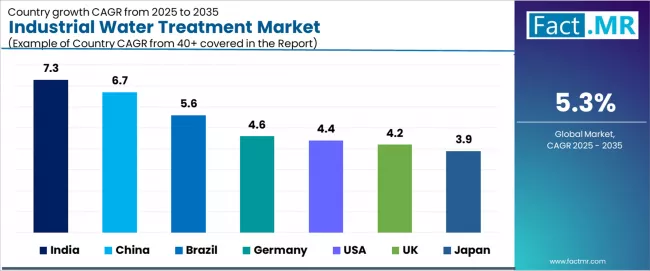
The global industrial water treatment market is expanding steadily, with India leading at a 7.3% CAGR through 2035, driven by rapid industrialization acceleration, major water stress conditions, and strengthening environmental enforcement. China follows at 6.7%, supported by strong industrial expansion, strict effluent norms implementation, and comprehensive environmental protection campaigns. Brazil records 5.6%, reflecting industrial growth momentum, increasing regulatory compliance requirements, and water resource management priorities.
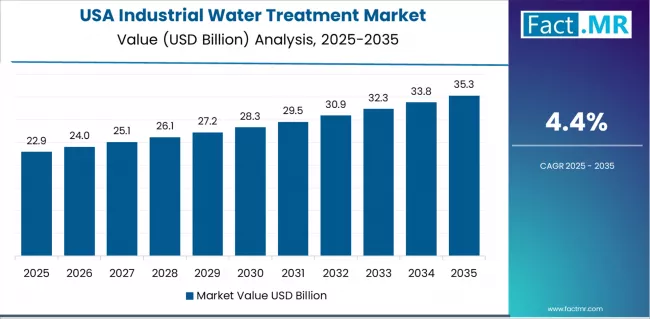
Germany advances at 4.6%, leveraging strong circular economy policies, industrial sustainability leadership, and advanced technology adoption. USA posts 4.4%, focusing on high regulatory standards, stable industrial infrastructure upgrading, and water reuse mandate expansion, while UK grows steadily at 4.2%, emphasizing tight pollution regulations, net-zero policy implementation, and industrial decarbonization initiatives. Japan demonstrates 3.9% growth, anchored by mature market characteristics, technology-focused system upgrades, and operational efficiency optimization.
How is India Leading Global Market Expansion?
India demonstrates the strongest growth potential in the industrial water treatment market with a CAGR of 7.3% through 2035. The country's leadership position stems from rapid industrialization across manufacturing sectors including chemicals, textiles, and pharmaceuticals, severe water scarcity affecting major industrial regions, and strengthening regulatory enforcement under pollution control board mandates driving treatment system adoption.
Growth is concentrated in major industrial clusters and manufacturing zones, including Mumbai, Delhi, Ahmedabad, and Bangalore, where factories are increasingly implementing effluent treatment plants and water recycling systems to comply with Zero Liquid Discharge norms and freshwater allocation restrictions. Distribution channels through engineering procurement construction contractors, technology providers, and turnkey solution suppliers expand treatment infrastructure across industrial facilities and manufacturing complexes.
The country's growing environmental awareness combined with regulatory pressure provides strong momentum for industrial water management investment, including comprehensive adoption across facility scales from small-medium enterprises to large integrated manufacturing plants.
Key market factors:
- Water scarcity pressure concentrated in industrial regions and metropolitan areas with declining groundwater levels and surface water availability
- Regulatory enforcement expansion through pollution control board inspections and closure threats for non-compliant facilities
- Comprehensive Zero Liquid Discharge mandates ecosystem, including textile industry requirements and chemical sector regulations
- Technology localization development featuring domestic engineering companies and international partnerships offering cost-competitive solutions
Why is China Emerging as a High-Growth Market?
In major industrial provinces including Jiangsu, Zhejiang, Guangdong, and Shandong, the adoption of industrial water treatment solutions is accelerating across manufacturing facilities and processing plants, driven by aggressive environmental protection policies and strict effluent discharge standards implementation. The market demonstrates strong growth momentum with a CAGR of 6.7% through 2035, linked to comprehensive industrial sector modernization and increasing focus on ecological civilization development principles.
Industrial facilities are implementing advanced treatment technologies and water recycling systems to meet increasingly stringent discharge permits while supporting production expansion requirements. The country's substantial manufacturing base creates ongoing demand for water treatment infrastructure, while government emphasis on green development drives investment in pollution control and resource conservation technologies.
Key development areas:
- Industrial expansion modernization leading water treatment adoption with emphasis on chemical industry, electronics manufacturing, and heavy industry sectors
- Environmental regulation strengthening through central government inspection campaigns and provincial enforcement mechanisms
- Technology advancement integration enabling domestic equipment manufacturing and international technology partnerships
- Water resource management emphasis supporting industrial water allocation controls and wastewater reuse requirements
What drives USA’s Market Resilience?

USA’s market expansion is driven by diverse industrial water management priorities, including aging infrastructure replacement in established manufacturing regions and water reuse mandate compliance in water-scarce western states. The country demonstrates steady growth potential with a CAGR of 4.4% through 2035, supported by continuous regulatory evolution from Environmental Protection Agency and state-level water quality boards implementing stricter discharge limits.
Industrial facilities in USA face implementation considerations related to permit compliance complexity and total cost of ownership optimization, requiring comprehensive treatment system design and operational efficiency. Established environmental compliance culture and substantial industrial water consumption averaging 18 billion gallons daily create stable baseline demand for treatment technologies, particularly among chemical manufacturers, power generators, and food processors where regulatory adherence drives primary investment decisions.
Market characteristics:
- Regulatory compliance driving and infrastructure modernization showing robust demand with substantial capital investment across industrial sectors
- Regional requirements varying between zero liquid discharge mandates in water-scarce regions and conventional treatment approaches in water-abundant areas
- Future projections indicate continued growth with emphasis on digital monitoring systems and energy-efficient treatment technologies
- Growing emphasis on public-private partnerships and build-operate-transfer models supporting municipal industrial park water infrastructure
How does Germany Demonstrate Circular Economy Leadership?
The industrial water treatment market in Germany leads in sustainable water management based on comprehensive circular economy policies and industrial resource efficiency programs for enhanced environmental performance. The country shows strong potential with a CAGR of 4.6% through 2035, driven by stringent Water Framework Directive implementation and industrial facility commitments to water stewardship in major manufacturing regions, including North Rhine-Westphalia, Bavaria, and Baden-Württemberg.
German industrial operators are adopting advanced treatment technologies through sustainability-driven investments and emphasis on closed-loop water systems for comprehensive resource conservation, particularly in chemical industry clusters and automotive manufacturing facilities demanding proven environmental credentials. Distribution channels through specialized engineering firms and technology providers expand coverage across industrial parks and manufacturing complexes.
Leading market segments:
- Circular economy implementation in major industrial sectors requiring water recycling and resource recovery systems
- Technology innovation leadership with German engineering companies developing advanced membrane systems and oxidation processes
- Strategic collaborations between industrial associations and technology providers advancing water efficiency benchmarks
- Focus on energy-water nexus optimization addressing carbon footprint reduction alongside water conservation
What positions UK for Regulatory Compliance Leadership?
In major industrial regions including North West England, Yorkshire, and Scotland, manufacturing facilities are implementing water treatment upgrades through Environment Agency permit requirements and net-zero strategy alignment, with documented compliance investments showing substantial environmental performance improvement through pollution prevention measures.
The market shows steady growth potential with a CAGR of 4.2% through 2035, linked to ongoing industrial decarbonization programs, aging infrastructure replacement needs, and water company discharge consent conditions in regulated industrial zones. Industrial operators are adopting proven treatment technologies with regulatory guidance to ensure discharge compliance while maintaining operational standards demanded by environmental permits and corporate sustainability commitments. The country's established regulatory framework creates ongoing requirements for treatment system optimization that differentiate through reliable performance and comprehensive compliance documentation.
Market development factors:
- Environmental permit compliance leading treatment investment with emphasis on chemical oxygen demand and nutrient removal
- Net-zero strategy integration providing growth opportunities in energy-efficient treatment systems and renewable energy coupling
- Strategic partnerships between water companies and industrial facilities expanding wastewater service contracts
- Emphasis on sustainable drainage systems and nature-based solutions complementing conventional treatment approaches
How does Japan Show Technology Excellence Leadership?

Japan's industrial water treatment market demonstrates sophisticated characteristics focused on operational efficiency and technology optimization, with documented deployment of advanced automation systems achieving substantial water recovery improvement through precision control across manufacturing facilities.
The country maintains steady growth momentum with a CAGR of 3.9% through 2035, driven by mature market dynamics emphasizing system upgrades and continuous improvement methodologies that align with Japanese manufacturing excellence standards applied to environmental management.
Major industrial regions, including Tokyo-Yokohama, Osaka-Kobe, and Nagoya, showcase advanced adoption of treatment technologies where membrane filtration integrates seamlessly with real-time monitoring systems and comprehensive predictive maintenance programs.
Key market characteristics:
- Technology sophistication driving demand for advanced control systems with emphasis on artificial intelligence optimization and sensor integration
- Operational efficiency focus enabling water consumption minimization and treatment cost reduction through process excellence
- Quality consciousness supporting reliable equipment preferences and long-term service relationships with proven technology providers
- Resource scarcity awareness emphasizing water recycling maximization and discharge minimization across industrial operations
What characterizes Brazil's Market Development?
In major industrial centers including São Paulo, Rio de Janeiro, Minas Gerais, and Rio Grande do Sul, the adoption of industrial water treatment solutions is expanding across manufacturing facilities and agro-processing plants, driven by industrial sector growth and increasing environmental compliance enforcement.
The market demonstrates moderate growth potential with a CAGR of 5.6% through 2035, linked to comprehensive regulatory framework development and increasing focus on sustainable industrial practices in major production regions. Brazilian industrial operators are implementing treatment systems and upgrading existing infrastructure to meet state environmental agency requirements while supporting production capacity expansion.
The country's growing industrial base creates ongoing demand for treatment technologies, while water resource management priorities in water-stressed regions drive adoption of recycling systems and efficiency measures.
Key development areas:
- Industrial growth expansion leading treatment adoption with emphasis on chemical industry, pulp and paper, and food processing sectors
- Regulatory compliance strengthening through state environmental agencies and federal water resource management policies
- Technology accessibility improvement through international suppliers and local engineering capabilities supporting market-appropriate solutions
- Water scarcity response supporting recycling system adoption in semi-arid regions and metropolitan industrial areas
Europe Market Split by Country

The industrial water treatment market in Europe is projected to grow from USD 14.2 billion in 2025 to USD 23.1 billion by 2035, registering a CAGR of 5.0% over the forecast period. Germany is expected to maintain its leadership position with a 30.0% market share in 2025, adjusting to 29.5% by 2035, supported by its dominant industrial manufacturing base, comprehensive environmental regulations, and circular economy policy leadership serving major European markets.
France follows with a 19.5% share in 2025, projected to reach 20.0% by 2035, driven by comprehensive Water Framework Directive implementation and industrial sustainability programs in major manufacturing regions requiring advanced treatment solutions. UK holds a 17.0% share in 2025, expected to maintain 17.5% by 2035 through ongoing regulatory compliance mandates and net-zero industrial strategy implementation.
Italy commands a 15.5% share, while Spain accounts for 12.0% in 2025. The rest of Europe is anticipated to gain momentum, expanding its collective share from 6.0% to 6.5% by 2035, attributed to increasing industrial water management adoption in Nordic countries and emerging Eastern European manufacturing sectors implementing modern environmental practices.
Competitive Landscape of the Industrial Water Treatment Market

The industrial water treatment market features approximately 20-30 meaningful players with moderate concentration, where the top three companies control roughly 25-30% of global market share through established technology portfolios, comprehensive service capabilities, and multi-region operational presence. Competition centers on integrated solutions delivery, digital technology integration, and long-term service contracts rather than equipment price competition alone.
Market leaders include Veolia Environnement S.A. with a 9.5% market share, along with Ecolab and Suez, which maintain competitive advantages through vertically integrated offerings spanning water treatment chemicals, equipment systems, and operational services, comprehensive industrial sector expertise, and deep relationships with major manufacturing corporations, creating high credibility among facility managers seeking reliable water management partners.
These companies leverage extensive research and development capabilities and global service networks to defend market positions while expanding into adjacent categories including water-energy nexus solutions and digital water management platforms.
Challengers encompass specialized technology providers including Xylem focusing on equipment and digital solutions, Kurita Water Industries emphasizing chemical treatment and engineering services, and Pentair plc competing through filtration systems and separation technologies. Equipment manufacturers and chemical suppliers, including Kemira, Solenis, and Feralco AB, focus on specific technology areas or chemical formulations, offering differentiated capabilities in membrane systems, specialty chemicals, and application-specific solutions.
Emerging digital water technology companies and modular system providers create competitive pressure through innovative business models and scalable solutions, particularly in high-growth markets including India and Southeast Asia, where decentralized treatment systems and pay-per-use models provide advantages in capital-constrained industrial facilities.
Market dynamics favor companies that combine technology expertise with operational service capabilities addressing complete water management lifecycles from system design through operations, maintenance, and performance optimization. Strategic emphasis on digital transformation, sustainability integration, and outcome-based contracting enables differentiation in increasingly competitive industrial water management segments across developed and emerging markets.
Global Industrial Water Treatment Market — Stakeholder Contribution Framework
Industrial water treatment represents a critical infrastructure category that enables manufacturing facilities and processing plants to achieve regulatory compliance and operational efficiency while addressing water scarcity and environmental sustainability requirements without exclusive freshwater dependency, typically providing comprehensive solutions including advanced filtration achieving high contaminant removal, chemical conditioning preventing equipment damage, and water recycling enabling substantial freshwater reduction compared to once-through water usage alone while ensuring improved environmental performance and comprehensive operational reliability outcomes.
With the market projected to grow from USD 48.0 billion in 2025 to USD 80.5 billion by 2035 at a 5.3% CAGR, these solutions offer compelling advantages for chemical manufacturing applications, water recycling systems, and diverse industrial sectors seeking sustainable water management. Scaling market adoption and technology implementation requires coordinated action across environmental policy, technology development, solution providers, industrial end-users, and financing mechanisms.
How Could Governments Spur Local Development and Adoption?
- Environmental Regulation Enforcement: Strengthen discharge standards and compliance monitoring, providing clear permit requirements and supporting enforcement agencies through inspection capacity and technical resources.
- Financial Incentive Programs: Implement tax credits for water treatment investments, provide accelerated depreciation for environmental equipment, and establish low-interest financing for small-medium enterprise treatment system adoption.
- Technology Development Support: Fund research programs for energy-efficient treatment technologies, support pilot demonstrations of innovative systems, and create technology transfer mechanisms facilitating commercialization.
- Water Pricing Reform: Establish volumetric water pricing reflecting scarcity value, implement wastewater discharge fees encouraging source reduction, and create differential tariffs incentivizing water recycling adoption.
- Public Infrastructure Investment: Develop industrial park shared treatment facilities, fund common effluent treatment plants, and support public-private partnerships for decentralized treatment systems.
How Could Industry Bodies Support Market Development?
- Technical Standards Development: Define standardized performance requirements for industrial water treatment across discharge quality and system reliability, establish universal testing protocols and quality assurance methodologies, and create technology assessment frameworks supporting informed selection.
- Best Practice Dissemination: Lead industry guidance on treatment technology selection, operational optimization approaches, and maintenance protocols, emphasizing proven solutions and realistic performance expectations.
- Benchmarking Programs: Develop water efficiency metrics for industrial sectors, establish performance benchmarking databases, and create recognition programs incentivizing water stewardship excellence.
- Professional Development: Run certification programs for operators, engineers, and facility managers on treatment system operation, troubleshooting procedures, and regulatory compliance across diverse industrial applications.
How Could Technology Providers and Manufacturers Strengthen the Ecosystem?
- Integrated Solution Development: Develop comprehensive water management systems combining chemical treatment, physical processes, and membrane technologies with digital monitoring and control optimization.
- Performance Guarantee Programs: Provide outcome-based contracting ensuring discharge compliance, water recovery targets, and operational cost commitments that support customer confidence and long-term partnerships.
- Digital Platform Integration: Offer advanced monitoring systems, predictive maintenance analytics, and remote operations support that enhance system reliability and optimize performance throughout lifecycles.
- Technical Service Excellence: Build comprehensive support capabilities including system design, commissioning assistance, operator training, and ongoing optimization consulting that ensure successful implementation and sustained performance.
How Could Industrial Facilities and Operators Navigate the Market?
- Strategic Water Management Planning: Develop comprehensive water audits identifying consumption patterns, waste generation, and treatment requirements for prioritized investment and phased implementation strategies.
- Technology Selection Excellence: Conduct thorough evaluations comparing treatment alternatives on total cost of ownership, performance reliability, and operational complexity through pilot testing and reference validation.
- Operations Optimization Systems: Implement continuous monitoring programs, establish key performance indicators, and deploy improvement methodologies that maximize treatment efficiency and minimize operational costs.
- Sustainability Integration: Align water management with corporate environmental targets, establish transparent reporting systems, and pursue water stewardship certifications supporting stakeholder communication.
How Could Investors and Financial Enablers Unlock Value?
- Infrastructure Project Financing: Provide growth capital for technology companies expanding manufacturing capacity and service networks, funding large-scale industrial treatment facility development.
- Innovation Investment: Back startups developing breakthrough technologies including low-energy desalination, novel biological processes, and artificial intelligence-driven optimization platforms enhancing market competitiveness.
- Project Finance Structures: Finance build-operate-transfer projects for industrial parks, support design-build-operate contracts, and enable long-term service agreements reducing industrial facility capital requirements.
- Asset Management: Support water infrastructure funds investing in industrial treatment facilities, enable operational efficiency improvements, and develop secondary markets for proven treatment systems.
Key Players in the Industrial Water Treatment Market
- Veolia Environnement S.A.
- Ecolab Inc.
- Xylem Inc.
- Pentair plc
- Kurita Water Industries Ltd.
- Solenis LLC
- SWA Water Australia Pty Ltd.
- WOG Group
- Kemira Oyj
- Feralco AB
Scope of the Report
| Items | Values |
|---|---|
| Quantitative Units | USD 48.0 Billion |
| Technology | Physical Treatment, Chemical Treatment, Biological Treatment, Membrane Technologies, Advanced Oxidation Processes, Sludge Treatment |
| Industry | Chemical Industry, Food & Beverage, Pharmaceuticals, Automotive, Electronics, Others |
| Regions Covered | Asia Pacific, Europe, North America, Latin America, Middle East & Africa |
| Country Covered | India, China, USA, Germany, UK, Japan, Brazil, and 40+ countries |
| Key Companies Profiled | Veolia, Ecolab Inc., Xylem, Pentair, Kurita Water Industries Ltd., Solenis, SWA Water Australia, WOG GROUP, Kemira, Feralco AB |
| Additional Attributes | Dollar sales by technology and industry categories, regional adoption trends across Asia Pacific, Europe, and North America, competitive landscape with water treatment providers and engineering contractors, system specifications and performance requirements, integration with industrial digitalization platforms and smart monitoring systems, innovations in membrane technology and advanced oxidation processes, and development of specialized applications with zero liquid discharge systems and circular water management capabilities. |
Industrial Water Treatment Market by Segments
-
Technology :
- Physical Treatment
- Chemical Treatment
- Biological Treatment
- Membrane Technologies
- Advanced Oxidation Processes (AOPs)
- Sludge Treatment
-
Industry :
- Chemical Industry
- Food & Beverage
- Pharmaceuticals
- Automotive
- Electronics
- Others
-
Region :
- Asia Pacific
- China
- Japan
- South Korea
- India
- Australia
- Thailand
- Rest of Asia Pacific
- Europe
- Germany
- UK
- France
- Italy
- Spain
- Denmark
- Sweden
- Norway
- Rest of Europe
- North America
- USA
- Canada
- Mexico
- Latin America
- Brazil
- Argentina
- Rest of Latin America
- Middle East & Africa
- South Africa
- Saudi Arabia
- UAE
- Kuwait
- Rest of Middle East & Africa
- Asia Pacific
Table of Content
- Executive Summary
- Global Market Outlook
- Demand to side Trends
- Supply to side Trends
- Technology Roadmap Analysis
- Analysis and Recommendations
- Market Overview
- Market Coverage / Taxonomy
- Market Definition / Scope / Limitations
- Market Background
- Market Dynamics
- Drivers
- Restraints
- Opportunity
- Trends
- Scenario Forecast
- Demand in Optimistic Scenario
- Demand in Likely Scenario
- Demand in Conservative Scenario
- Opportunity Map Analysis
- Product Life Cycle Analysis
- Supply Chain Analysis
- Investment Feasibility Matrix
- Value Chain Analysis
- PESTLE and Porter’s Analysis
- Regulatory Landscape
- Regional Parent Market Outlook
- Production and Consumption Statistics
- Import and Export Statistics
- Market Dynamics
- Global Market Analysis 2020 to 2024 and Forecast, 2025 to 2035
- Historical Market Size Value (USD Million) Analysis, 2020 to 2024
- Current and Future Market Size Value (USD Million) Projections, 2025 to 2035
- Y to o to Y Growth Trend Analysis
- Absolute $ Opportunity Analysis
- Global Market Pricing Analysis 2020 to 2024 and Forecast 2025 to 2035
- Global Market Analysis 2020 to 2024 and Forecast 2025 to 2035, By Technology
- Introduction / Key Findings
- Historical Market Size Value (USD Million) Analysis By Technology, 2020 to 2024
- Current and Future Market Size Value (USD Million) Analysis and Forecast By Technology, 2025 to 2035
- Chemical Treatment
- Physical Treatment
- Biological Treatment
- Membrane Technologies
- Advanced Oxidation Processes (AOPs)
- Sludge Treatment
- Y to o to Y Growth Trend Analysis By Technology, 2020 to 2024
- Absolute $ Opportunity Analysis By Technology, 2025 to 2035
- Global Market Analysis 2020 to 2024 and Forecast 2025 to 2035, By Industry
- Introduction / Key Findings
- Historical Market Size Value (USD Million) Analysis By Industry, 2020 to 2024
- Current and Future Market Size Value (USD Million) Analysis and Forecast By Industry, 2025 to 2035
- Chemical Industry
- Food & Beverage
- Pharmaceuticals
- Automotive
- Electronics
- Others
- Y to o to Y Growth Trend Analysis By Industry, 2020 to 2024
- Absolute $ Opportunity Analysis By Industry, 2025 to 2035
- Global Market Analysis 2020 to 2024 and Forecast 2025 to 2035, By Region
- Introduction
- Historical Market Size Value (USD Million) Analysis By Region, 2020 to 2024
- Current Market Size Value (USD Million) Analysis and Forecast By Region, 2025 to 2035
- North America
- Latin America
- Western Europe
- Eastern Europe
- East Asia
- South Asia and Pacific
- Middle East & Africa
- Market Attractiveness Analysis By Region
- North America Market Analysis 2020 to 2024 and Forecast 2025 to 2035, By Country
- Historical Market Size Value (USD Million) Trend Analysis By Market Taxonomy, 2020 to 2024
- Market Size Value (USD Million) Forecast By Market Taxonomy, 2025 to 2035
- By Country
- USA
- Canada
- Mexico
- By Technology
- By Industry
- By Country
- Market Attractiveness Analysis
- By Country
- By Technology
- By Industry
- Key Takeaways
- Latin America Market Analysis 2020 to 2024 and Forecast 2025 to 2035, By Country
- Historical Market Size Value (USD Million) Trend Analysis By Market Taxonomy, 2020 to 2024
- Market Size Value (USD Million) Forecast By Market Taxonomy, 2025 to 2035
- By Country
- Brazil
- Chile
- Rest of Latin America
- By Technology
- By Industry
- By Country
- Market Attractiveness Analysis
- By Country
- By Technology
- By Industry
- Key Takeaways
- Western Europe Market Analysis 2020 to 2024 and Forecast 2025 to 2035, By Country
- Historical Market Size Value (USD Million) Trend Analysis By Market Taxonomy, 2020 to 2024
- Market Size Value (USD Million) Forecast By Market Taxonomy, 2025 to 2035
- By Country
- Germany
- UK
- Italy
- Spain
- France
- Nordic
- BENELUX
- Rest of Western Europe
- By Technology
- By Industry
- By Country
- Market Attractiveness Analysis
- By Country
- By Technology
- By Industry
- Key Takeaways
- Eastern Europe Market Analysis 2020 to 2024 and Forecast 2025 to 2035, By Country
- Historical Market Size Value (USD Million) Trend Analysis By Market Taxonomy, 2020 to 2024
- Market Size Value (USD Million) Forecast By Market Taxonomy, 2025 to 2035
- By Country
- Russia
- Poland
- Hungary
- Balkan & Baltic
- Rest of Eastern Europe
- By Technology
- By Industry
- By Country
- Market Attractiveness Analysis
- By Country
- By Technology
- By Industry
- Key Takeaways
- East Asia Market Analysis 2020 to 2024 and Forecast 2025 to 2035, By Country
- Historical Market Size Value (USD Million) Trend Analysis By Market Taxonomy, 2020 to 2024
- Market Size Value (USD Million) Forecast By Market Taxonomy, 2025 to 2035
- By Country
- China
- Japan
- South Korea
- By Technology
- By Industry
- By Country
- Market Attractiveness Analysis
- By Country
- By Technology
- By Industry
- Key Takeaways
- South Asia and Pacific Market Analysis 2020 to 2024 and Forecast 2025 to 2035, By Country
- Historical Market Size Value (USD Million) Trend Analysis By Market Taxonomy, 2020 to 2024
- Market Size Value (USD Million) Forecast By Market Taxonomy, 2025 to 2035
- By Country
- India
- ASEAN
- Australia & New Zealand
- Rest of South Asia and Pacific
- By Technology
- By Industry
- By Country
- Market Attractiveness Analysis
- By Country
- By Technology
- By Industry
- Key Takeaways
- Middle East & Africa Market Analysis 2020 to 2024 and Forecast 2025 to 2035, By Country
- Historical Market Size Value (USD Million) Trend Analysis By Market Taxonomy, 2020 to 2024
- Market Size Value (USD Million) Forecast By Market Taxonomy, 2025 to 2035
- By Country
- Kingdom of Saudi Arabia
- Other GCC Countries
- Turkiye
- South Africa
- Other African Union
- Rest of Middle East & Africa
- By Technology
- By Industry
- By Country
- Market Attractiveness Analysis
- By Country
- By Technology
- By Industry
- Key Takeaways
- Key Countries Market Analysis
- USA
- Pricing Analysis
- Market Share Analysis, 2024
- By Technology
- By Industry
- Canada
- Pricing Analysis
- Market Share Analysis, 2024
- By Technology
- By Industry
- Mexico
- Pricing Analysis
- Market Share Analysis, 2024
- By Technology
- By Industry
- Brazil
- Pricing Analysis
- Market Share Analysis, 2024
- By Technology
- By Industry
- Chile
- Pricing Analysis
- Market Share Analysis, 2024
- By Technology
- By Industry
- Germany
- Pricing Analysis
- Market Share Analysis, 2024
- By Technology
- By Industry
- UK
- Pricing Analysis
- Market Share Analysis, 2024
- By Technology
- By Industry
- Italy
- Pricing Analysis
- Market Share Analysis, 2024
- By Technology
- By Industry
- Spain
- Pricing Analysis
- Market Share Analysis, 2024
- By Technology
- By Industry
- France
- Pricing Analysis
- Market Share Analysis, 2024
- By Technology
- By Industry
- India
- Pricing Analysis
- Market Share Analysis, 2024
- By Technology
- By Industry
- ASEAN
- Pricing Analysis
- Market Share Analysis, 2024
- By Technology
- By Industry
- Australia & New Zealand
- Pricing Analysis
- Market Share Analysis, 2024
- By Technology
- By Industry
- China
- Pricing Analysis
- Market Share Analysis, 2024
- By Technology
- By Industry
- Japan
- Pricing Analysis
- Market Share Analysis, 2024
- By Technology
- By Industry
- South Korea
- Pricing Analysis
- Market Share Analysis, 2024
- By Technology
- By Industry
- Russia
- Pricing Analysis
- Market Share Analysis, 2024
- By Technology
- By Industry
- Poland
- Pricing Analysis
- Market Share Analysis, 2024
- By Technology
- By Industry
- Hungary
- Pricing Analysis
- Market Share Analysis, 2024
- By Technology
- By Industry
- Kingdom of Saudi Arabia
- Pricing Analysis
- Market Share Analysis, 2024
- By Technology
- By Industry
- Turkiye
- Pricing Analysis
- Market Share Analysis, 2024
- By Technology
- By Industry
- South Africa
- Pricing Analysis
- Market Share Analysis, 2024
- By Technology
- By Industry
- USA
- Market Structure Analysis
- Competition Dashboard
- Competition Benchmarking
- Market Share Analysis of Top Players
- By Regional
- By Technology
- By Industry
- Competition Analysis
- Competition Deep Dive
- Veolia Environnement S.A.
- Overview
- Product Portfolio
- Profitability by Market Segments (Product/Age /Sales Channel/Region)
- Sales Footprint
- Strategy Overview
- Marketing Strategy
- Product Strategy
- Channel Strategy
- Ecolab Inc.
- Xylem Inc.
- Pentair plc
- Kurita Water Industries Ltd.
- Solenis LLC
- SWA Water Australia Pty Ltd.
- WOG Group
- Kemira Oyj
- Feralco AB
- Veolia Environnement S.A.
- Competition Deep Dive
- Assumptions & Acronyms Used
- Research Methodology
List Of Table
- Table 1: Global Market Value (USD Million) Forecast by Region, 2020 to 2035
- Table 2: Global Market Value (USD Million) Forecast by Technology, 2020 to 2035
- Table 3: Global Market Value (USD Million) Forecast by Industry, 2020 to 2035
- Table 4: North America Market Value (USD Million) Forecast by Country, 2020 to 2035
- Table 5: North America Market Value (USD Million) Forecast by Technology, 2020 to 2035
- Table 6: North America Market Value (USD Million) Forecast by Industry, 2020 to 2035
- Table 7: Latin America Market Value (USD Million) Forecast by Country, 2020 to 2035
- Table 8: Latin America Market Value (USD Million) Forecast by Technology, 2020 to 2035
- Table 9: Latin America Market Value (USD Million) Forecast by Industry, 2020 to 2035
- Table 10: Western Europe Market Value (USD Million) Forecast by Country, 2020 to 2035
- Table 11: Western Europe Market Value (USD Million) Forecast by Technology, 2020 to 2035
- Table 12: Western Europe Market Value (USD Million) Forecast by Industry, 2020 to 2035
- Table 13: Eastern Europe Market Value (USD Million) Forecast by Country, 2020 to 2035
- Table 14: Eastern Europe Market Value (USD Million) Forecast by Technology, 2020 to 2035
- Table 15: Eastern Europe Market Value (USD Million) Forecast by Industry, 2020 to 2035
- Table 16: East Asia Market Value (USD Million) Forecast by Country, 2020 to 2035
- Table 17: East Asia Market Value (USD Million) Forecast by Technology, 2020 to 2035
- Table 18: East Asia Market Value (USD Million) Forecast by Industry, 2020 to 2035
- Table 19: South Asia and Pacific Market Value (USD Million) Forecast by Country, 2020 to 2035
- Table 20: South Asia and Pacific Market Value (USD Million) Forecast by Technology, 2020 to 2035
- Table 21: South Asia and Pacific Market Value (USD Million) Forecast by Industry, 2020 to 2035
- Table 22: Middle East & Africa Market Value (USD Million) Forecast by Country, 2020 to 2035
- Table 23: Middle East & Africa Market Value (USD Million) Forecast by Technology, 2020 to 2035
- Table 24: Middle East & Africa Market Value (USD Million) Forecast by Industry, 2020 to 2035
List Of Figures
- Figure 1: Global Market Pricing Analysis
- Figure 2: Global Market Value (USD Million) Forecast 2020 to 2035
- Figure 3: Global Market Value Share and BPS Analysis by Technology, 2025 and 2035
- Figure 4: Global Market Y to o to Y Growth Comparison by Technology, 2025 to 2035
- Figure 5: Global Market Attractiveness Analysis by Technology
- Figure 6: Global Market Value Share and BPS Analysis by Industry, 2025 and 2035
- Figure 7: Global Market Y to o to Y Growth Comparison by Industry, 2025 to 2035
- Figure 8: Global Market Attractiveness Analysis by Industry
- Figure 9: Global Market Value (USD Million) Share and BPS Analysis by Region, 2025 and 2035
- Figure 10: Global Market Y to o to Y Growth Comparison by Region, 2025 to 2035
- Figure 11: Global Market Attractiveness Analysis by Region
- Figure 12: North America Market Incremental Dollar Opportunity, 2025 to 2035
- Figure 13: Latin America Market Incremental Dollar Opportunity, 2025 to 2035
- Figure 14: Western Europe Market Incremental Dollar Opportunity, 2025 to 2035
- Figure 15: Eastern Europe Market Incremental Dollar Opportunity, 2025 to 2035
- Figure 16: East Asia Market Incremental Dollar Opportunity, 2025 to 2035
- Figure 17: South Asia and Pacific Market Incremental Dollar Opportunity, 2025 to 2035
- Figure 18: Middle East & Africa Market Incremental Dollar Opportunity, 2025 to 2035
- Figure 19: North America Market Value Share and BPS Analysis by Country, 2025 and 2035
- Figure 20: North America Market Value Share and BPS Analysis by Technology, 2025 and 2035
- Figure 21: North America Market Y to o to Y Growth Comparison by Technology, 2025 to 2035
- Figure 22: North America Market Attractiveness Analysis by Technology
- Figure 23: North America Market Value Share and BPS Analysis by Industry, 2025 and 2035
- Figure 24: North America Market Y to o to Y Growth Comparison by Industry, 2025 to 2035
- Figure 25: North America Market Attractiveness Analysis by Industry
- Figure 26: Latin America Market Value Share and BPS Analysis by Country, 2025 and 2035
- Figure 27: Latin America Market Value Share and BPS Analysis by Technology, 2025 and 2035
- Figure 28: Latin America Market Y to o to Y Growth Comparison by Technology, 2025 to 2035
- Figure 29: Latin America Market Attractiveness Analysis by Technology
- Figure 30: Latin America Market Value Share and BPS Analysis by Industry, 2025 and 2035
- Figure 31: Latin America Market Y to o to Y Growth Comparison by Industry, 2025 to 2035
- Figure 32: Latin America Market Attractiveness Analysis by Industry
- Figure 33: Western Europe Market Value Share and BPS Analysis by Country, 2025 and 2035
- Figure 34: Western Europe Market Value Share and BPS Analysis by Technology, 2025 and 2035
- Figure 35: Western Europe Market Y to o to Y Growth Comparison by Technology, 2025 to 2035
- Figure 36: Western Europe Market Attractiveness Analysis by Technology
- Figure 37: Western Europe Market Value Share and BPS Analysis by Industry, 2025 and 2035
- Figure 38: Western Europe Market Y to o to Y Growth Comparison by Industry, 2025 to 2035
- Figure 39: Western Europe Market Attractiveness Analysis by Industry
- Figure 40: Eastern Europe Market Value Share and BPS Analysis by Country, 2025 and 2035
- Figure 41: Eastern Europe Market Value Share and BPS Analysis by Technology, 2025 and 2035
- Figure 42: Eastern Europe Market Y to o to Y Growth Comparison by Technology, 2025 to 2035
- Figure 43: Eastern Europe Market Attractiveness Analysis by Technology
- Figure 44: Eastern Europe Market Value Share and BPS Analysis by Industry, 2025 and 2035
- Figure 45: Eastern Europe Market Y to o to Y Growth Comparison by Industry, 2025 to 2035
- Figure 46: Eastern Europe Market Attractiveness Analysis by Industry
- Figure 47: East Asia Market Value Share and BPS Analysis by Country, 2025 and 2035
- Figure 48: East Asia Market Value Share and BPS Analysis by Technology, 2025 and 2035
- Figure 49: East Asia Market Y to o to Y Growth Comparison by Technology, 2025 to 2035
- Figure 50: East Asia Market Attractiveness Analysis by Technology
- Figure 51: East Asia Market Value Share and BPS Analysis by Industry, 2025 and 2035
- Figure 52: East Asia Market Y to o to Y Growth Comparison by Industry, 2025 to 2035
- Figure 53: East Asia Market Attractiveness Analysis by Industry
- Figure 54: South Asia and Pacific Market Value Share and BPS Analysis by Country, 2025 and 2035
- Figure 55: South Asia and Pacific Market Value Share and BPS Analysis by Technology, 2025 and 2035
- Figure 56: South Asia and Pacific Market Y to o to Y Growth Comparison by Technology, 2025 to 2035
- Figure 57: South Asia and Pacific Market Attractiveness Analysis by Technology
- Figure 58: South Asia and Pacific Market Value Share and BPS Analysis by Industry, 2025 and 2035
- Figure 59: South Asia and Pacific Market Y to o to Y Growth Comparison by Industry, 2025 to 2035
- Figure 60: South Asia and Pacific Market Attractiveness Analysis by Industry
- Figure 61: Middle East & Africa Market Value Share and BPS Analysis by Country, 2025 and 2035
- Figure 62: Middle East & Africa Market Value Share and BPS Analysis by Technology, 2025 and 2035
- Figure 63: Middle East & Africa Market Y to o to Y Growth Comparison by Technology, 2025 to 2035
- Figure 64: Middle East & Africa Market Attractiveness Analysis by Technology
- Figure 65: Middle East & Africa Market Value Share and BPS Analysis by Industry, 2025 and 2035
- Figure 66: Middle East & Africa Market Y to o to Y Growth Comparison by Industry, 2025 to 2035
- Figure 67: Middle East & Africa Market Attractiveness Analysis by Industry
- Figure 68: Global Market - Tier Structure Analysis
- Figure 69: Global Market - Company Share Analysis
- FAQs -
How big is the industrial water treatment market in 2025?
The global industrial water treatment market is estimated to be valued at USD 48.0 billion in 2025.
What will be the size of industrial water treatment market in 2035?
The market size for the industrial water treatment market is projected to reach USD 80.5 billion by 2035.
How much will be the industrial water treatment market growth between 2025 and 2035?
The industrial water treatment market is expected to grow at a 5.3% CAGR between 2025 and 2035.
What are the key product types in the industrial water treatment market?
The key product types in industrial water treatment market are chemical treatment, physical treatment, biological treatment, membrane technologies, advanced oxidation processes (aops) and sludge treatment.
Which industry segment to contribute significant share in the industrial water treatment market in 2025?
In terms of industry, chemical industry segment to command 28.0% share in the industrial water treatment market in 2025.