- Base Value(2025): 37.5 Bn
- Estimated Value(2026): 39.3 Bn
- Forecast Value (2036): 62.2 Bn
- CAGR (2026 - 2036): 4.7%
Industrial Filtration Market Analysis and Forecast by Fact.MR
- The global industrial filtration market is estimated at USD 39.26 billion in 2026 and is forecast to expand at a CAGR of 4.7% to reach USD 62.15 billion by 2036.
- Industrial filtration encompasses liquid filtration, air and gas filtration, and dust collection systems using mechanical, electrostatic, and membrane technologies across water treatment, manufacturing, oil and gas, food processing, pharmaceutical, and power generation applications.
- The market is driven by tightening environmental discharge standards, expanding water and wastewater treatment infrastructure, growing industrial air quality requirements, membrane technology advancement, and the increasing specification of automated, IoT-enabled filtration systems delivering real-time performance monitoring and predictive maintenance.
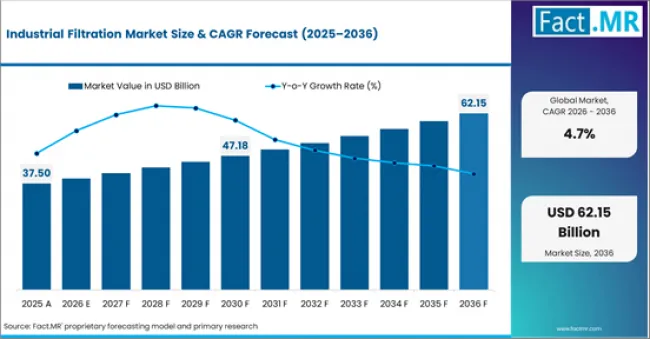
Industrial Filtration Market Value Analysis | Source: Fact.MR
Summary of Industrial Filtration Market
- Market Snapshot
- In 2025, the global Industrial Filtration Market was valued at approximately USD 37.50 billion.
- The market is estimated to reach USD 39.26 billion in 2026 and is projected to attain USD 62.15 billion by 2036.
- The industrial filtration market is likely to expand at a CAGR of 4.7% during the forecast period.
- The market is anticipated to create an absolute dollar opportunity of USD 22.89 billion between 2026 and 2036.
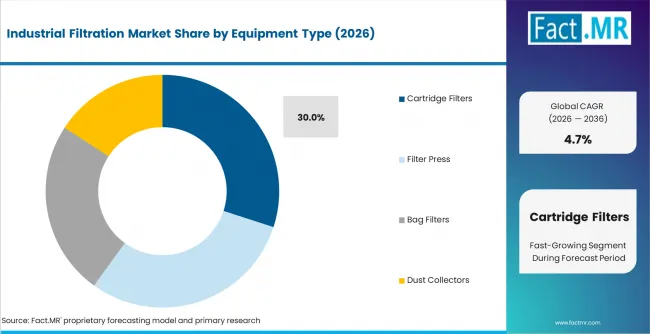
- Cartridge filters account for 30% of equipment type share in 2026.
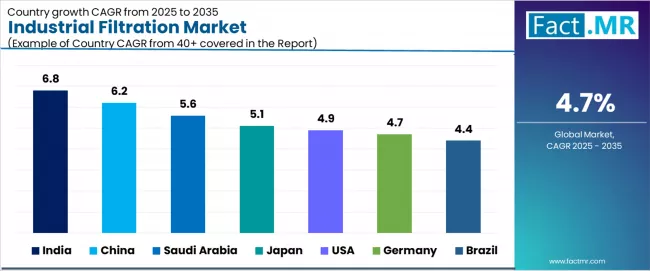
- India (6.8%) and China (6.2%) are the key growth markets during the forecast period.
- Demand and Growth Drivers
- Expanding municipal and industrial water treatment capacity is the primary driver, with tightening discharge standards requiring higher filtration performance across both new installations and treatment plant upgrades.
- Industrial air quality regulations and occupational exposure limits are driving investment in dust collection, fume extraction, and gas filtration systems across manufacturing and processing facilities.
- Membrane filtration technology advancement is expanding applications in water reuse, food processing, and pharmaceutical manufacturing where separation precision is critical.
- Oil and gas sector filtration requirements for produced water treatment, drilling fluid management, and refinery process filtration sustain steady demand across upstream and downstream operations.
- IoT-enabled smart filtration systems with real-time monitoring and predictive maintenance are creating premium equipment segments that optimize filter lifecycle and reduce operating costs.
- Product and Segment View
- Liquid filtration accounts for 55% of the filter type segment in 2026, driven by water treatment, chemical processing, oil filtration, and food and beverage applications.
- Mechanical filtration holds 40% of the technology segment in 2026, with depth and surface filtration methods serving the broadest range of industrial air and liquid applications.
- Cartridge filters hold 30% of the equipment type segment, driven by versatility across water treatment, chemical processing, and food and beverage filtration.
- Key segmentation includes:
- Filter Type: Liquid filtration (process, oil), Air and gas filtration (dust collection, gas filtration)
- Technology: Mechanical, Electrostatic, Membrane (micro, ultra, nano)
- Application: Water and wastewater, Manufacturing, Oil and gas, Food and beverage, Power generation
- End Use Industry: Water and wastewater, Manufacturing, Oil and gas, Food and beverage
- Filter Media: Synthetic, Fiber, Metal media
- Equipment Type: Cartridge filters, Filter press, Bag filters
- These systems enable:
- Water and wastewater treatment meeting discharge and reuse standards across municipal and industrial applications
- Particulate and contaminant removal maintaining product quality and equipment protection in manufacturing processes
- Air quality compliance through dust collection and fume extraction protecting worker health and meeting emission regulations
- Geography and Competitive Outlook
- Asia Pacific leads growth through India and China, driven by water treatment infrastructure expansion, industrial growth, and tightening environmental enforcement.
- The Middle East sustains growth through Saudi Arabia, driven by desalination, industrial diversification, and oil and gas sector filtration requirements.
- North America maintains demand through the USA, supported by environmental compliance, manufacturing filtration, and water infrastructure investment.
- India (6.8%) and China (6.2%) lead growth, while Saudi Arabia (5.6%), Japan (5.1%), the USA (4.9%), Germany (4.7%), and Brazil (4.4%) sustain demand.
- Major players include Donaldson Company, 3M, Alfa Laval, Filtration Group, Freudenberg, Mann + Hummel, Pall Corporation, and Parker Hannifin.
- Analyst Opinion
- Shambhu Nath Jha, Principal Consultant at Fact.MR, says 'The industrial filtration market is being reshaped by the convergence of water scarcity driving treatment and reuse investment, tightening air quality regulations raising filtration specification, and membrane technology expanding the addressable applications for precision separation. Companies offering integrated filtration platforms combining equipment, replacement media, monitoring, and service are capturing specification advantages over component-only suppliers. The replacement filter aftermarket represents approximately 60% of total revenue and provides recurring income that smooths capital equipment cyclicality. Manufacturers investing in IoT-enabled filtration monitoring and membrane technology development are positioned for the premium growth segments.'
Key Growth Drivers, Constraints, and Opportunities
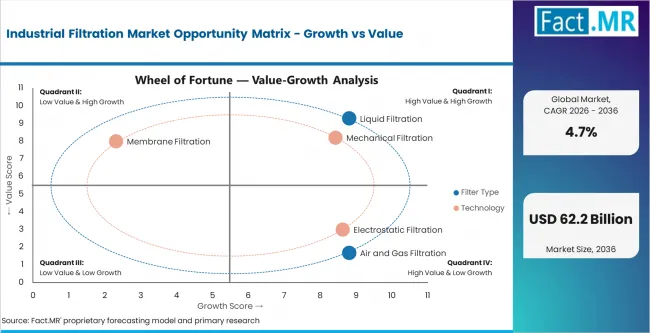
Industrial Filtration Market Opportunity Matrix Growth Vs Value | Source: Fact.MR
Key Factors Driving Growth
- Water and wastewater treatment infrastructure expansion in India, China, the Middle East, and Latin America drives sustained filtration equipment and media demand.
- Tightening environmental discharge standards raise minimum filtration performance requirements across industrial and municipal applications.
- Membrane filtration technology advancement expands precision separation applications in water reuse, food processing, and pharmaceutical manufacturing.
Key Market Constraints
- Price sensitivity in replacement filter procurement drives lowest-cost purchasing behavior that limits premium product adoption in cost-conscious segments.
- Energy consumption of high-performance filtration systems, particularly membrane systems, creates operating cost considerations for facility operators.
- Fragmented end-use requirements across diverse industries create product portfolio complexity for filter manufacturers.
Key Opportunity Areas
- Smart filtration systems with IoT monitoring and predictive maintenance create premium equipment segments with recurring service revenue.
- Water reuse and zero-liquid-discharge requirements are creating high-value filtration applications in water-stressed regions.
- Industrial air quality upgrades driven by occupational health regulations create replacement and upgrade demand across manufacturing facilities.
Segment-wise Analysis of the Industrial Filtration Market
- Liquid filtration holds 55% of the filter type segment in 2026, driven by water treatment, oil filtration, chemical processing, and food and beverage applications.
- Water and wastewater accounts for 30% of both application and end use industry segments in 2026, reflecting the dominant role of treatment infrastructure.
- Synthetic media accounts for 40% of the filter media segment, driven by polypropylene and polyester durability in liquid and air filtration applications.
The market is segmented by filter type, technology, application, end use industry, filter media, equipment type, and region. Liquid filtration leads by type. Mechanical filtration leads by technology. Water treatment leads by application, and cartridge filters lead by equipment type.
Which Filter Type Segment Dominates the Industrial Filtration Market?
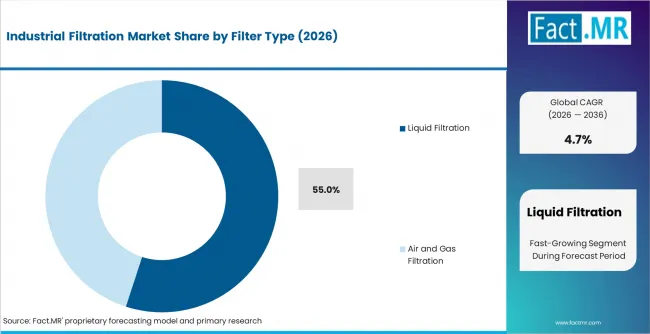
Industrial Filtration Market Analysis By Filter Type | Source: Fact.MR
Liquid filtration accounts for 55% of the filter type segment in 2026. Process liquid filtration, oil filtration, and water filtration serve the broadest range of industrial applications. Water and wastewater treatment drives the largest share of liquid filtration demand, followed by chemical processing and oil and gas sector requirements.
Air and gas filtration accounts for 45%, with dust collection through baghouse and cartridge systems serving manufacturing, mining, and power generation. Gas filtration using activated carbon and scrubber systems addresses volatile organic compound and hazardous gas removal requirements.
Which Application Segment Dominates the Industrial Filtration Market?
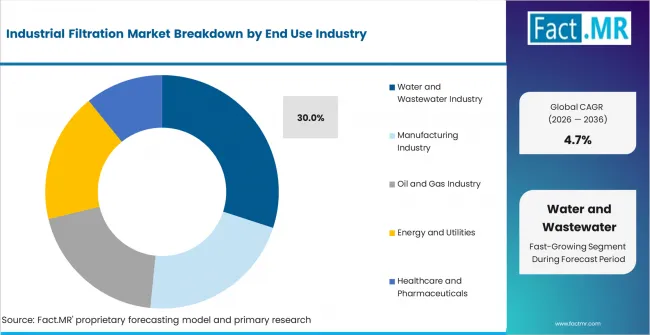
Industrial Filtration Market Analysis By End Use Industry | Source: Fact.MR
Water and wastewater treatment accounts for 30% of the application segment in 2026. Municipal sewage treatment, industrial effluent treatment, and drinking water production represent the core demand base. Tightening discharge standards and water reuse requirements are driving higher-performance filtration specification across both new and existing treatment facilities.
Manufacturing is the second-largest application, with metal processing coolant filtration, food processing, and pharmaceutical manufacturing driving diverse filtration requirements. Oil and gas sustains demand through produced water treatment, drilling fluid management, and refinery process filtration.
Which Equipment Type Segment Dominates the Industrial Filtration Market?
Industrial Filtration Market Analysis By Equipment Type | Source: Fact.MR
Cartridge filters account for 30% of the equipment type segment in 2026. Single and multi-cartridge systems serve the broadest range of water treatment, chemical processing, and food and beverage applications through their versatility, compact footprint, and ease of media replacement.
Filter press systems serve dewatering and solid-liquid separation in mining, chemical, and wastewater sludge applications. Bag filters serve higher-flow industrial applications where cost-effective large-volume filtration is the priority.
Which Product Trend is Shaping the Next Phase of Growth in the Industrial Filtration Market?
IoT-enabled smart filtration platforms with real-time performance monitoring and predictive maintenance are the defining trend. Digital sensors measuring pressure differential, flow rate, turbidity, and particle counts enable automated filter management that optimizes media replacement timing, reduces unplanned downtime, and provides compliance documentation. This digital layer transforms filtration from passive equipment into managed performance systems.
Membrane filtration technology advancement, particularly in ultrafiltration and nanofiltration, is expanding precision separation applications. Ceramic membranes with longer lifespans and higher temperature tolerance are gaining specification in pharmaceutical and chemical processing. The combination of membrane precision with digital monitoring creates high-value filtration systems that command premium pricing and generate recurring service revenue through media replacement and system optimization contracts.
Regional Outlook Across Key Markets
.webp "Top Country Growth Comparison Industrial Filtration Market Cagr (2026 2036)")
Top Country Growth Comparison Industrial Filtration Market Cagr (2026 2036) | Source: Fact.MR
- India leads growth at 6.8%, driven by massive water treatment expansion, industrial growth, and tightening environmental enforcement.
- China follows at 6.2%, supported by water treatment investment, manufacturing expansion, and environmental compliance enforcement.
- Saudi Arabia grows at 5.6%, driven by desalination, industrial diversification, and oil and gas sector filtration.
- The USA sustains growth at 4.9% through environmental compliance, water infrastructure investment, and manufacturing filtration requirements.
| Country | CAGR (%) |
|---|---|
| India | 6.8% |
| China | 6.2% |
| Saudi Arabia | 5.6% |
| Japan | 5.1% |
| USA | 4.9% |
| Germany | 4.7% |
| Brazil | 4.4% |
Source: Fact.MR analysis. Updated May 25, 2026
Source: Fact MR (FMR) analysis, based on proprietary forecasting model and primary research.
Industrial Filtration Market Cagr Analysis By Country | Source: Fact.MR
Market Outlook for Industrial Filtration in India
The India industrial filtration market is projected to grow at a CAGR of 6.8% through 2036. Demand is driven by massive water treatment infrastructure expansion, industrial growth, pharmaceutical manufacturing, and tightening environmental standards.
- Water treatment expansion creates multi-year filtration procurement.
- Industrial growth drives diverse air and liquid filtration demand.
- Environmental enforcement raises minimum filtration standards.
Industrial Filtration Demand Trends in China
The China market is projected to grow at a CAGR of 6.2% through 2036. Growth is supported by water treatment investment, manufacturing expansion, environmental compliance, and growing membrane technology adoption.
- Water treatment investment drives liquid filtration demand.
- Manufacturing expansion sustains industrial air filtration procurement.
- Membrane technology adoption creates precision filtration demand.
Saudi Arabia Industrial Filtration Market Growth Assessment
The Saudi Arabia market is projected to grow at a CAGR of 5.6% through 2036. Demand is driven by desalination, NEOM and Vision 2030 industrial programs, oil and gas sector requirements, and water reuse initiatives.
- Desalination drives membrane and pre-treatment filtration demand.
- Vision 2030 industrial programs create manufacturing filtration needs.
- Oil and gas sustains produced water and process filtration demand.
United States Industrial Filtration Market Demand Analysis
Industrial Filtration Market Country Value Analysis | Source: Fact.MR
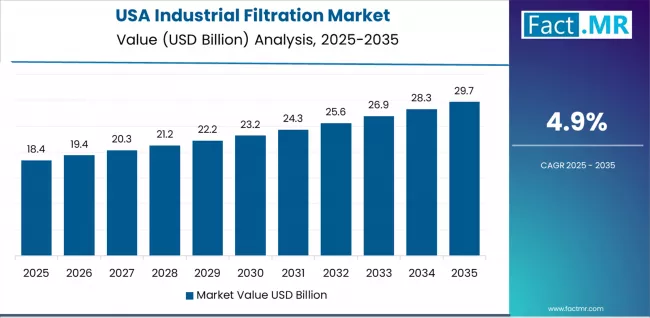
The U.S. market is projected to grow at a CAGR of 4.9% through 2036. Demand is shaped by environmental compliance, water infrastructure investment, manufacturing requirements, and the replacement filter aftermarket.
- Environmental compliance drives air and water filtration specification.
- Water infrastructure investment sustains treatment system demand.
- Replacement filter aftermarket provides recurring revenue.
Germany Industrial Filtration Market Opportunity Outlook
The Germany market is projected to grow at a CAGR of 4.7% through 2036. Demand is supported by environmental regulations, automotive manufacturing filtration, pharmaceutical cleanroom needs, and water treatment standards.
- Environmental regulations sustain high-specification filtration.
- Automotive manufacturing drives process filtration demand.
- Pharmaceutical cleanroom needs support HEPA and membrane filtration.
Competitive Benchmarking and Company Positioning
Industrial Filtration Market Analysis By Company | Source: Fact.MR
Industrial Filtration Market Analysis By Company
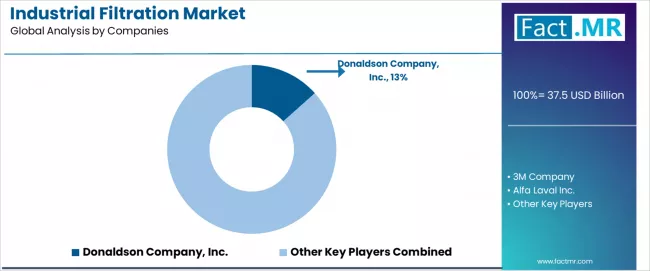
- Donaldson Company holds approximately 13% market share through broad industrial filtration portfolios, technology leadership, and global distribution.
- 3M, Pall Corporation, and Parker Hannifin compete through filter media technology, membrane capabilities, and diversified industrial portfolios.
- Product portfolio breadth, replacement media revenue, membrane technology, and distribution network are primary differentiators.
The competitive landscape is moderately concentrated among specialized filtration companies. Donaldson Company holds approximately 13% market share through comprehensive industrial air and liquid filtration portfolios, proprietary filter media technology, and a global distribution network serving diversified end markets.
3M Company competes through proprietary media technology and broad material science capabilities. Pall Corporation (Danaher) and Parker Hannifin serve process-critical filtration in pharmaceutical, food, and industrial applications. Alfa Laval provides integrated separation and filtration solutions.
Filtration Group, Freudenberg Filtration Technologies, and Mann + Hummel serve industrial and automotive filtration markets. Ahlstrom-Munksjo and Hollingsworth & Vose compete as filter media suppliers serving multiple OEMs and aftermarket channels.
Strategic priorities include expanding membrane filtration capabilities, developing IoT-enabled monitoring platforms, building water treatment and reuse portfolios, and strengthening replacement media distribution in emerging markets.
Key Companies in the Industrial Filtration Market
Donaldson Company, Inc., 3M Company, and Pall Corporation lead through technology leadership, broad portfolios, and global distribution.
Alfa Laval Inc., Filtration Group, and Parker Hannifin Corp. hold established positions through diversified industrial portfolios and process-critical applications.
Freudenberg Filtration Technologies, Mann + Hummel, Ahlstrom-Munksjo, and Hollingsworth & Vose compete through filter media technology and multi-channel supply.
Recent Industry Developments
- Donaldson Company - Technology Enhancement / IoT-Enabled Filtration Monitoring Platform (2025)
- Donaldson expanded its connected filtration platform with IoT sensors and cloud-based analytics, enabling real-time performance monitoring and predictive maintenance scheduling across industrial air and liquid filtration installations.
- Pall Corporation - Membrane Innovation / Advanced Ultrafiltration for Water Reuse (2025)
- Pall Corporation expanded its membrane filtration portfolio for industrial water reuse applications, addressing growing demand for precision separation technologies in water-stressed regions and zero-liquid-discharge industrial facilities.
- Mann + Hummel - Product Launch / Energy-Efficient Industrial Air Filtration (2025)
- Mann + Hummel launched energy-efficient industrial air filtration systems with reduced pressure drop and extended media life, addressing growing demand for filtration that balances air quality performance with operating energy costs.
Leading Companies Shaping the Industrial Filtration Market
- Donaldson Company, Inc.
- 3M Company
- Alfa Laval Inc.
- Filtration Group
- Freudenberg Filtration Technologies SE & Co. KG
- Mann + Hummel
- Pall Corporation
- Parker Hannifin Corp.
- Ahlstrom-Munksjo
- Hollingsworth & Vose Company
Sources and Research References
- Donaldson Company. IoT-enabled filtration monitoring and connected platform documentation.
- Pall Corporation. Advanced ultrafiltration membrane technology for water reuse.
- Environmental regulation databases, water treatment capacity statistics, and manufacturing output data.
- Oil and gas production databases, filter media pricing, and replacement cycle analysis.
- Primary interviews with filter manufacturers, distributors, water utilities, and industrial end users.
This bibliography is provided for reader reference and is not exhaustive. The full report contains the complete reference list and detailed citations.
Key Questions This Report Addresses
- What is the current and future size of the Industrial Filtration market?
- How fast is the market expected to grow between 2026 and 2036?
- Which filter type leads in 2026?
- Which application holds highest share?
- What drives demand?
- How is membrane technology influencing the market?
- Why is India the fastest-growing market?
- How are smart filtration systems shaping demand?
- Which countries show fastest growth?
- Who are the key companies?
- How does Fact.MR validate the forecast?
Industrial Filtration Market Definition
The industrial filtration market covers liquid, air, and gas filtration systems using mechanical, electrostatic, and membrane technologies for water treatment, manufacturing, oil and gas, food processing, and power generation applications.
Industrial Filtration Market Inclusions
- The scope covers global and regional market size and forecasts for 2026 to 2036 across filter type, technology, application, end use industry, filter media, equipment type, and region.
- It includes analysis of water treatment infrastructure investment, environmental regulation, manufacturing capacity expansion, and oil and gas production trends.
- The report covers pricing and cost analysis across filtration categories including equipment capital costs, replacement media, and total cost of ownership.
- It covers technology trends, market drivers, and competitive landscape including product portfolios and service capabilities of leading manufacturers.
Industrial Filtration Market Exclusions
- The scope excludes residential water and air purification systems.
- It excludes HVAC-specific filtration covered under building ventilation standards.
- The report excludes laboratory filtration equipment and analytical instruments.
- It also excludes desalination membrane systems classified under water infrastructure rather than industrial filtration.
Industrial Filtration Market Research Methodology
- The methodology combines secondary research, primary interviews, and forecast modelling.
- It draws on 80+ secondary sources and benchmarks 30+ manufacturer product portfolios.
- Market sizing covers 25+ countries through a demand-side model, supported by top-down validation.
- Key inputs include water treatment investment, manufacturing output, oil production, environmental regulation timelines, and replacement filter consumption.
- The model cross-checks demand with manufacturing capacity, media pricing, and distribution data.
- Primary validation includes 25+ interviews across filter manufacturers, distributors, water utilities, and industrial end users.
- Final estimates go through treatment-capacity checks, replacement-cycle analysis, and sensitivity testing.
Segmentation
Scope of Analysis
| Parameter | Details |
|---|---|
| Quantitative Units | USD 39.26 billion to USD 62.15 billion, at a CAGR of 4.7% |
| Market Definition | The market covers liquid, air, and gas filtration systems for water treatment, manufacturing, oil and gas, food processing, and power generation applications. |
| Regions Covered | North America, Latin America, Europe, East Asia, South Asia and Pacific, Middle East and Africa |
| Countries Covered | India, China, Saudi Arabia, Japan, USA, Germany, Brazil, 25 plus countries |
| Key Companies | Donaldson, 3M, Alfa Laval, Filtration Group, Freudenberg, Mann + Hummel, Pall Corporation, Parker Hannifin, Ahlstrom-Munksjo, Hollingsworth & Vose |
| Forecast Period | 2026 to 2036 |
| Approach | Hybrid demand-side and top-down methodology built on water treatment investment, manufacturing output, oil production, and primary interviews across manufacturers, distributors, and end users |
Source: Fact.MR analysis. Updated May 25, 2026
Industrial Filtration Market Segmentation
-
Industrial Filtration Market Segmented by Filter Type:
- Liquid Filtration
- Process Liquid Filtration
- Water Filtration
- Chemical Filtration
- Oil Filtration
- Hydraulic Oil
- Lubrication Systems
- Process Liquid Filtration
- Air and Gas Filtration
- Dust Collection
- Baghouse Filters
- Cartridge Filters
- Gas Filtration
- Activated Carbon Filters
- Scrubber Systems
- Dust Collection
- Liquid Filtration
-
Industrial Filtration Market Segmented by Technology:
- Mechanical Filtration
- Depth Filtration
- Layered Media
- High Dirt Holding
- Surface Filtration
- Membrane Filters
- Fine Particle Removal
- Depth Filtration
- Electrostatic Filtration
- Electrostatic Precipitators
- Industrial Emissions
- Power Plants
- Electrostatic Filters
- Reusable Systems
- Low Pressure Drop
- Electrostatic Precipitators
- Membrane Filtration
- Microfiltration
- Bacteria Removal
- Water Treatment
- Ultrafiltration
- Fine Particle Removal
- Industrial Use
- Nanofiltration and Reverse Osmosis
- Desalination
- High Purity Water
- Microfiltration
- Mechanical Filtration
-
Industrial Filtration Market Segmented by Application:
- Water and Wastewater Treatment
- Municipal Treatment
- Sewage Treatment
- Drinking Water
- Industrial Effluent Treatment
- Chemical Plants
- Manufacturing Units
- Municipal Treatment
- Manufacturing
- Metal Processing
- Coolant Filtration
- Debris Removal
- Food Processing
- Liquid Filtration
- Hygiene Control
- Metal Processing
- Oil and Gas
- Upstream
- Drilling Fluids
- Produced Water
- Downstream
- Refining
- Petrochemical Processing
- Upstream
- Power Generation
- Thermal Plants
- Air Filtration
- Cooling Water
- Renewable Energy
- Wind Turbines
- Solar Plants
- Thermal Plants
- Pharmaceuticals
- Drug Manufacturing
- Sterile Filtration
- Cleanrooms
- Biotech Applications
- Cell Culture
- Purification
- Drug Manufacturing
- Water and Wastewater Treatment
-
Industrial Filtration Market Segmented by End Use Industry:
- Water and Wastewater Industry
- Municipal Sector
- Public Utilities
- Urban Infrastructure
- Industrial Sector
- Effluent Treatment
- Recycling
- Municipal Sector
- Manufacturing Industry
- Automotive
- Assembly Lines
- Metal Processing
- Food and Beverage
- Processing
- Packaging
- Automotive
- Oil and Gas Industry
- Exploration and Production
- Upstream
- Offshore
- Refining and Petrochemicals
- Downstream
- Processing Plants
- Exploration and Production
- Energy and Utilities
- Power Plants
- Thermal
- Hydropower
- Renewable Energy
- Solar
- Wind
- Power Plants
- Healthcare and Pharmaceuticals
- Pharmaceuticals
- Drug Manufacturing
- Sterile Production
- Biotech
- Research
- Clinical Labs
- Pharmaceuticals
- Water and Wastewater Industry
-
Industrial Filtration Market Segmented by Filter Media:
- Synthetic Media
- Polypropylene
- Chemical Resistance
- Liquid Filtration
- Polyester
- Durability
- Air Filtration
- Polypropylene
- Fiber Media
- Glass Fiber
- High Temperature
- Fine Filtration
- Cellulose
- Cost-effective
- General Filtration
- Glass Fiber
- Metal Media
- Stainless Steel
- High Strength
- Harsh Environments
- Aluminum Mesh
- Reusable
- Grease Filtration
- Stainless Steel
- Activated Carbon
- Granular Carbon
- Gas Filtration
- Odor Removal
- Powdered Carbon
- Liquid Filtration
- Chemical Removal
- Granular Carbon
- Synthetic Media
-
Industrial Filtration Market Segmented by Equipment Type:
- Cartridge Filters
- Single Cartridge Systems
- Small Scale
- Laboratory Use
- Multi-cartridge Systems
- Industrial Use
- High Flow Rates
- Single Cartridge Systems
- Filter Press
- Plate and Frame Filter Press
- Batch Operation
- High Efficiency
- Membrane Filter Press
- Improved Dewatering
- Automation
- Plate and Frame Filter Press
- Bag Filters
- Single Bag Filters
- Low Flow
- Cost-effective
- Multi-bag Filters
- High Flow
- Industrial Use
- Single Bag Filters
- Dust Collectors
- Baghouse Systems
- Large Facilities
- Dust Removal
- Cyclone Separators
- Pre-filtration
- Bulk Particle Removal
- Baghouse Systems
- Cartridge Filters
-
Industrial Filtration Market by Region:
- North America
- USA
- Canada
- Mexico
- Latin America
- Brazil
- Chile
- Rest of Latin America
- Western Europe
- Germany
- UK
- Italy
- Spain
- France
- Nordic
- BENELUX
- Rest of Western Europe
- Eastern Europe
- Russia
- Poland
- Hungary
- Balkan & Baltic
- Rest of Eastern Europe
- East Asia
- China
- Japan
- South Korea
- South Asia and Pacific
- India
- ASEAN
- Australia & New Zealand
- Rest of South Asia and Pacific
- Middle East & Africa
- Kingdom of Saudi Arabia
- Other GCC Countries
- Turkiye
- South Africa
- Other African Union
- Rest of Middle East & Africa
- North America
Frequently Asked Questions
How big is the Industrial Filtration Market in 2025?
What will be the size of the Industrial Filtration Market by 2036?
How much will the Industrial Filtration Market grow between 2026 and 2036?
What are the key filter types in the Industrial Filtration Market?
Which filter type holds the highest share in the Industrial Filtration Market in 2026?
Which technology holds the highest share in the Industrial Filtration Market in 2026?
Which application holds the highest share in the Industrial Filtration Market in 2026?
Which equipment type holds the highest share in the Industrial Filtration Market in 2026?
Which are the fastest-growing countries in the Industrial Filtration Market?
Who worked on this report


Preview the report firsthand - request a free sample
Free SampleGet the brochure for pricing and purchase details
Download PDF