- Market Value (2025): USD 3.6 Bn
- Estimated Value (2026): USD 4.1 Bn
- Forecast Value (2036): USD 14.7 Bn
- CAGR (2026-2036): 13.6%
What is the EPC Digital Collaborations Market forecast to be worth by 2036?
USD 4.1 billion in 2026 to USD 14.7 billion by 2036 at a 13.6% CAGR.
- The EPC Digital Collaborations Market reached USD 3.6 billion in 2025.
- Demand is projected to increase from USD 4.1 billion in 2026 to USD 14.7 billion by 2036.
- The market is forecast to record 13.6% CAGR from 2026 to 2036 as asset owners, EPC contractors, engineering houses, construction managers, equipment suppliers and commissioning teams expand qualified purchasing and deployment.
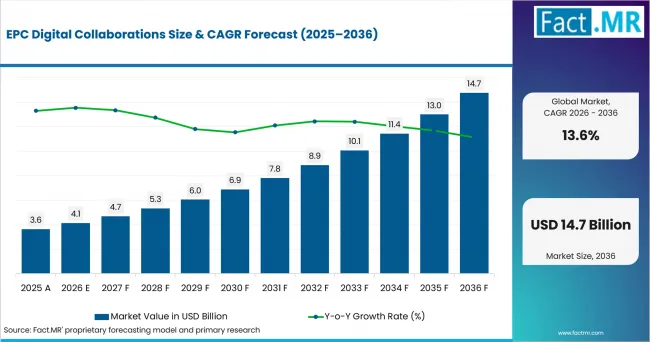
Epc Digital Collaborations Value Analysis | Source: Fact.MR
What are the defining numbers behind EPC Digital Collaborations Market growth?
Forecast expansion creates USD 10.6 billion in absolute opportunity through 2036.
- Demand Drivers in the Market
- Distributed EPC teams need one controlled environment for drawings, models, RFIs, submittals and supplier documents across long project timelines.
- ISO 19650 information-management practice supports defined responsibilities, status controls and common data environments for built assets.
- Owner demand for structured digital handover increases the value of collaboration data that survives beyond construction into commissioning and operations.
- Key Segments Analyzed
- By Collaboration Layer: Common data environment is expected to hold 27.0% share in 2026 because it provides controlled status, revision and approval pathways for project information across participating teams.
- By Project Phase: Engineering is projected to account for 28.0% share in 2026 as this phase generates the models, calculations and equipment specifications that guide downstream purchasing and field execution.
- By Industry: Energy / power is anticipated to capture 24.0% share in 2026 because projects in this sector combine complex equipment packages, regulated interfaces and demanding commissioning-documentation requirements.
- By Platform Model: Cloud CDE is estimated to represent 43.0% share in 2026 because cloud deployment supports controlled access for owners, EPC teams, suppliers and field users working across organizational boundaries.
- Analyst Opinion at Fact.MR
- Shambhu Nath Jha, Principal Consultant, Fact.MR, states, "EPC collaboration succeeds when the platform becomes the contractual path for decisions, not another file repository. The strongest implementations connect design status, supplier documents, field evidence and handover requirements."
- Strategic Implications
- CDE and document-control requirements should be anchored in ISO 19650 information-management processes rather than analogies to unrelated industrial technologies.
- Supplier-document workflows should preserve controlled status, revision, approval and auditable project records across organizational boundaries.
- Where model exchange is required, interoperability assessments should consider ISO 16739-1:2024 for IFC-based data exchange.
- Field-to-design issue closure should maintain traceable links among models, documents, issues and approvals in the project record.
- Digital handover plans should define information requirements, exchange points and retained records from engineering through commissioning and handover.
How does the EPC Digital Collaborations Market break down by segment?
The EPC Digital Collaborations Market is analyzed by Collaboration Layer, Project Phase, Industry, and Platform Model.
Why does Common data environment lead Collaboration Layer?
The Common data environment category holds 27.0% share of Collaboration Layer in 2026.
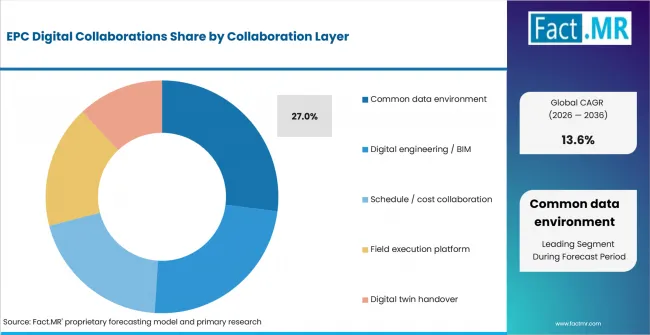
Epc Digital Collaborations Analysis By Collaboration Layer | Source: Fact.MR
A common data environment creates controlled status, revision and approval paths for project information. Procurement teams can use Digital engineering / BIM for specialized requirements, whereas the broader operating brief points to Common data environment.
The buying conversation moves from category preference to execution once the Common data environment category is shortlisted. At that point, model-linked work packages and contractual record disputes determine whether model-to-field control of project information produces measurable value.
Why does Engineering lead Project Phase?
The Engineering category accounts for 28.0% share of Project Phase in 2026.
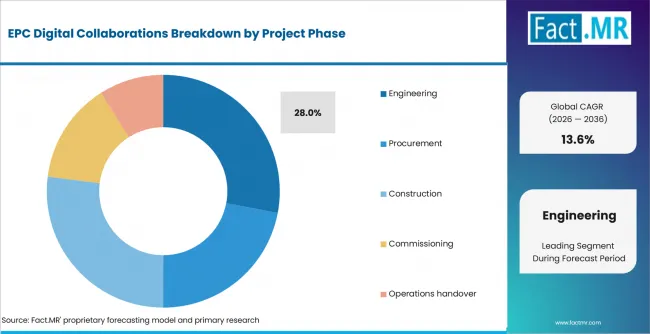
Epc Digital Collaborations Analysis By Project Phase | Source: Fact.MR
Engineering produces the models, calculations and equipment specifications that shape procurement and field execution downstream. This does not remove demand for Procurement. It shows why the leading position across a wider set of project phase use cases is held by Engineering.
Qualification depth matters here. The Engineering category supports wider purchasing when evidence for supplier document portals is auditable and the exposure to model and document interoperability is clear before commissioning.
Why does Energy / power lead Industry?
The Energy / power category leads with 24.0% share of Industry in 2026.
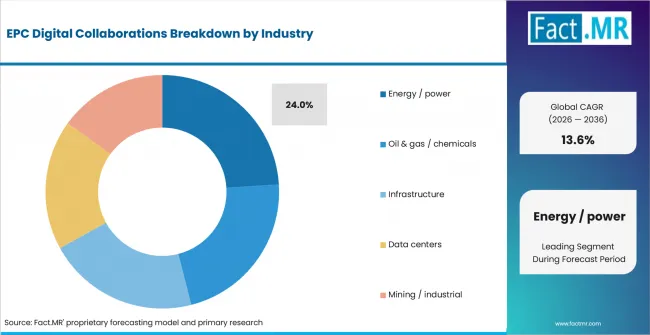
Epc Digital Collaborations Analysis By Industry | Source: Fact.MR
Energy and power projects combine complex equipment packages, regulated interfaces and demanding commissioning records. The more particular fit of Oil & gas / chemicals limits its repeatability; the Energy / power option is easier to carry across programs.
A supplier can defend the Energy / power position by making field-to-design issue closure easy to verify. The counterweight is site connectivity gaps, which remains a practical gate on wider adoption.
Why does Cloud CDE lead Platform Model?
The Cloud CDE category holds 43.0% share of Platform Model in 2026.
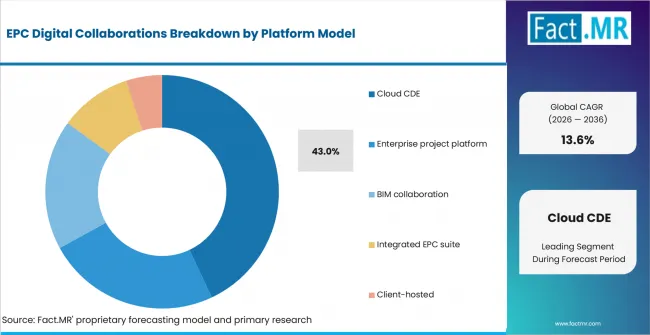
Epc Digital Collaborations Analysis By Platform Model | Source: Fact.MR
Cloud CDE deployment supports controlled access for owners, EPC teams, suppliers and field users across organizational boundaries. The lead over Enterprise project platform comes from application breadth, not from the segment name itself.
For asset owners, EPC contractors, engineering houses, construction managers, equipment suppliers and commissioning teams, the useful distinction is operational: Cloud CDE must enable asset-ready digital handover while keeping user adoption across subcontractors within an acceptable project envelope.
What is accelerating EPC Digital Collaborations Market adoption, and what is holding it back?
Expansion is constrained by contractual record disputes, model and document interoperability, site connectivity gaps, and user adoption across subcontractors.
Drivers Impact Analysis
| DRIVER | (~) % IMPACT ON CAGR | GEOGRAPHIC RELEVANCE | IMPACT TIMELINE |
|---|---|---|---|
| Controlled environment for distributed EPC information | +2.4% | Global | Short term (<= 2 years) |
| ISO 19650 information-management practice | +1.9% | USA and Germany | Medium term (2-4 years) |
| Structured digital handover demand | +1.5% | Germany and UAE | Long term (>= 4 years) |
Opportunity Impact Analysis
| DRIVER | (~) % IMPACT ON CAGR | GEOGRAPHIC RELEVANCE | IMPACT TIMELINE |
|---|---|---|---|
| Model-linked work packages | +1.6% | Global | Medium term (2-4 years) |
| Supplier document portals | +1.4% | USA and Germany | Short term (<= 2 years) |
| Field-to-design issue closure | +1.1% | Germany and UAE | Long term (>= 4 years) |
| Asset-ready digital handover | +0.8% | Global | Medium term (2-4 years) |
Restraints Impact Analysis
| RESTRAINT | (~) % IMPACT ON CAGR | GEOGRAPHIC RELEVANCE | IMPACT TIMELINE |
|---|---|---|---|
| Contractual record disputes | -1.2% | Global | Short term (<= 2 years) |
| Model and document interoperability | -1.0% | USA and Germany | Medium term (2-4 years) |
| Site connectivity gaps | -0.7% | Global | Long term (>= 4 years) |
| User adoption across subcontractors | -0.5% | UAE and UK | Medium term (2-4 years) |
Which countries are scaling the EPC Digital Collaborations Market through 2036?
- USA: The expected 13.9% pace is supported by model-linked work packages, although contractual record disputes can still delay scale.
- Germany: The demand case, measured at 13.3%, is strongest around Engineering and projects requiring supplier document portals.
- UAE: The 14.5% trajectory is application-led. Buyers are expected to use Energy / power as a reference while assessing field-to-design issue closure.
- UK: The 17.4% outlook is tied to asset-ready digital handover, with Cloud CDE gaining attention where user adoption across subcontractors can be contained.
- France: The 16.4% growth path points to selective expansion, led by model-linked work packages rather than undifferentiated replacement.
Country demand reflects the interaction of standards, asset age, project pipelines and local support for model-to-field control of project information. The broader scope encompasses North America, Latin America, Western Europe, Eastern Europe, East Asia, South Asia & Pacific, and Middle East & Africa. These pathways frame the EPC Digital Collaborations Market outlook.
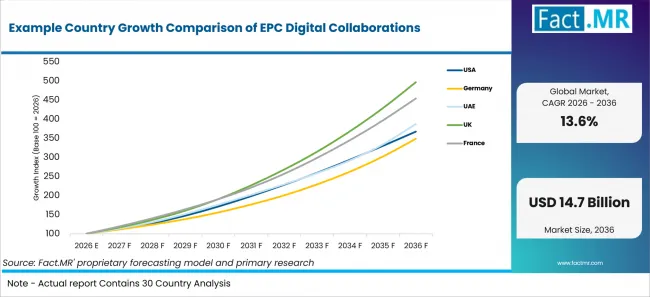
Example Country Growth Comparison Of Epc Digital Collaborations | Source: Fact.MR
| Country | CAGR (2026-2036) |
|---|---|
| USA | 13.9% |
| Germany | 13.3% |
| UAE | 14.5% |
| UK | 17.4% |
| France | 16.4% |
What supports USA adoption?
13.9% CAGR, supported by structured digital-delivery requirements and model-based project information workflows.
U.S. federal-building practice provides a strong digital-delivery reference. The U.S. General Services Administration requires model-based design, including native and IFC BIM deliverables at project milestones, alongside open-standard facility-management data. These requirements support structured project-information exchange, model coordination and lifecycle data workflows across design, construction and facility management.
Demand is strongest among asset owners, EPC contractors, engineering houses, construction managers, equipment suppliers and commissioning teams seeking tighter model-to-field control. Adoption also depends on contractual clarity, interoperability and sufficient service coverage across project participants.
What is supporting Germany’s adoption?
13.3% CAGR, driven by federal BIM implementation and digital infrastructure delivery.
Germany’s Masterplan BIM Bundesfernstraßen provides a federal framework for implementing BIM in federal trunk-road projects and supports BIM integration across the planning, construction, maintenance and operation lifecycle. Its framework promotes structured information management, standardized documentation and collaborative working through common data environments.
Supplier document portals represent a practical opportunity as engineering teams coordinate drawings, specifications and revisions across organizations. Model and document interoperability remains an important consideration because inconsistent data structures can slow broader deployment.
How is UAE developing demand?
14.5% CAGR, supported by Common Data Environment use and model-to-field information control.
Abu Dhabi City Municipality’s BIM Documentation Guidelines for Infrastructure define a Common Data Environment as the single source for collecting, managing and distributing project information. The framework includes work-in-progress, shared, published and archive states, supporting structured collaboration across infrastructure projects.
Growth opportunities are strongest where project teams connect field issues with design information through controlled workflows. Asset owners, EPC contractors, engineering houses, construction managers, equipment suppliers and commissioning teams benefit from consistent access to current project records across organizational boundaries.
What supports the United Kingdom’s growth?
17.4% CAGR, backed by information-management mandates and interoperable digital-delivery practices.
The UK’s Transforming Infrastructure Performance: Roadmap to 2030 includes an Information Management Mandate delivered through the UK BIM Framework. Its emphasis on interoperable information, structured information exchange and data sharing supports coordinated digital project delivery and the use of Common Data Environment workflows and solutions.
Commercial traction is strongest around asset-ready digital handover, coordinated project records and cross-team information access. Wider adoption depends on making these workflows usable for subcontractors and field teams as well as technically experienced engineering users.
How is France scaling demand?
16.4% CAGR, supported by continued BIM adoption and structured digital information management.
France’s Plan BIM supports wider adoption of BIM and digital methods across the building sector, including broader BIM commissioning and access to appropriate digital tools. Related French BIM guidance promotes structured project-information management through defined information requirements, Common Data Environments, collaborative workflows and digital information delivery across design, construction and handover.
Growth will depend on how effectively vendors connect model-linked work packages with tender, construction and commissioning documents. Clear record ownership, revision control and coordinated handover can reduce contractual friction and improve confidence in Common Data Environment deployment.
Who Leads the EPC Digital Collaborations Market?
Key players in the EPC Digital Collaborations Market include AVEVA, Bentley Systems, Autodesk, Oracle, Hexagon, and Trimble.
Portfolio breadth helps, but execution quality remains the deciding factor. Buyers compare evidence, integration responsibility and long-term support before standardizing around a provider. This is the competitive frame for the EPC Digital Collaborations Market.
The competitive opening comes from model-linked work packages; the defensive requirement is control of contractual record disputes. Both are tied to model-to-field control of project information.
Which companies are the key providers?
Key companies include AVEVA, Bentley Systems, Autodesk, Oracle, Hexagon, and Trimble.
- AVEVA
- Bentley Systems
- Autodesk
- Oracle
- Hexagon
- Trimble
Bibliography
- International Organization for Standardization. (2024). Industry Foundation Classes (IFC) for data sharing in the construction and facility management industries—Part 1: Data schema (ISO 16739-1:2024).
- U.S. General Services Administration. (2024, March 27). 3D-4D building information modeling.
- Ministère de la Transition écologique. (2025, February 14). Bâtiment et numérique.
This Report Answers
- The report explains how the EPC Digital Collaborations Market develops across Collaboration Layer and Project Phase.
- Segment analysis identifies Common data environment and Engineering as the principal 2026 reference points.
- Country analysis examines USA, Germany, UAE, UK, and France.
- Competitive analysis reviews AVEVA, Bentley Systems, Autodesk, Oracle, Hexagon, and Trimble.
- Opportunity analysis covers model-linked work packages, supplier document portals, field-to-design issue closure, and asset-ready digital handover.
- Risk analysis evaluates contractual record disputes, model and document interoperability, site connectivity gaps, and user adoption across subcontractors.
What does the EPC Digital Collaborations Market cover?
The EPC Digital Collaborations Market covers cloud or hybrid collaboration platforms, project licenses and implementation services that connect EPC information across engineering, procurement, construction and handover.
Commercial coverage follows purchases made by asset owners, EPC contractors, engineering houses, construction managers, equipment suppliers and commissioning teams. Revenue is counted when the qualifying product, platform or integrated system is supplied for an in-scope application.
What is included in the scope?
The scope includes cloud or hybrid collaboration platforms, project licenses and implementation services that connect EPC information across engineering, procurement, construction and handover across Collaboration Layer, Project Phase, Industry, and Platform Model.
Inclusions extend to configuration and integration elements that are inseparable from the in-scope commercial offer. The boundary is applied consistently across USA, Germany, UAE, UK, and France and the seven global regions.
What is excluded from the scope?
The scope excludes standalone CAD authoring, generic file storage, enterprise ERP without project collaboration and physical construction services.
Adjacent categories enter the EPC Digital Collaborations Market only when the sold product or service performs the defining function described above. This prevents unrelated software, physical construction services and broader project revenue from being counted twice.
How Was the Analysis Built?
The analysis draws on 120+ sources, 35+ company portfolios, 25+ countries, and more than 20 industry interviews.
- Primary Research: Primary research includes discussions with manufacturers, service providers, technology developers, distributors, end users, and subject-matter experts. These conversations examine purchasing priorities, product adoption, operational challenges, approval requirements, competitive positioning, and the factors that influence wider market acceptance.
- Desk Research: Desk research covers government statistics, regulatory publications, company filings, trade data, technical studies, industry associations, standards, public policy, and other authoritative sources. Every source used in the analysis is documented in the bibliography.
- Market Sizing and Forecasting: Market estimates combine historical performance, demand indicators, pricing and volume trends, segment shares, company participation, country-level growth, adoption patterns, investment activity, and barriers to market expansion.
- Data Validation and Update Cycle: Findings are validated by comparing primary interviews with public data, company activity, regulatory changes, trade patterns, and industry developments. Regular updates review new product launches, capacity changes, partnerships, approvals, and shifts in commercial adoption.
What is the report's scope and coverage?
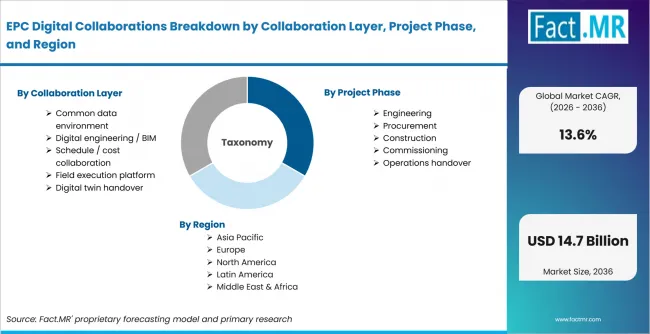
Epc Digital Collaborations Breakdown By Collaboration Layer, Project Phase, And Region | Source: Fact.MR
| Attribute | Details |
|---|---|
| Quantitative Units | USD Billion in 2026 and 2036; CAGR from 2026 to 2036 |
| Market Definition | Common data environments and connected workspaces used by engineering, procurement and construction teams to coordinate models, documents, packages, field issues and handover records. |
| Collaboration Layer | Common data environment; Digital engineering / BIM; Schedule / cost collaboration; Field execution platform; Digital twin handover |
| Project Phase | Engineering; Procurement; Construction; Commissioning; Operations handover |
| Industry | Energy / power; Oil & gas / chemicals; Infrastructure; Data centers; Mining / industrial |
| Platform Model | Cloud CDE; Enterprise project platform; BIM collaboration; Integrated EPC suite; Client-hosted |
| Regions Covered | North America; Latin America; Western Europe; Eastern Europe; East Asia; South Asia & Pacific; Middle East & Africa |
| Countries Covered | USA; Germany; UAE; UK; France |
| Key Companies | AVEVA; Bentley Systems; Autodesk; Oracle; Hexagon; Trimble |
| Forecast Period | 2026 to 2036 |
| Approach | Hybrid top-down and bottom-up assessment using Collaboration Layer, Project Phase, Industry, and Platform Model, country deployment, renewal, migration and expansion demand and company participation. |
How is the market segmented?
-
By Collaboration Layer
- Common data environment
- Digital engineering / BIM
- Schedule / cost collaboration
- Field execution platform
- Digital twin handover
-
By Project Phase
- Engineering
- Procurement
- Construction
- Commissioning
- Operations handover
-
By Industry
- Energy / power
- Oil & gas / chemicals
- Infrastructure
- Data centers
- Mining / industrial
-
By Platform Model
- Cloud CDE
- Enterprise project platform
- BIM collaboration
- Integrated EPC suite
- Client-hosted
-
By Region
- North America
- Latin America
- Western Europe
- Eastern Europe
- East Asia
- South Asia & Pacific
- Middle East & Africa