- Base Value(2026): 672.8 Mn
- Forecast Value (2036): 2984.6 Mn
- CAGR (2036): 16%
Digital Twins for CNC Machining Centers Market Forecast 2026 to 2036
The digital twins for CNC machining centers market reached USD 589.4 million in 2025. Fact MR estimates the market will expand to USD 672.8 million in 2026 and attain USD 2,984.6 million by 2036. The market is forecast to register a CAGR of 16% across the assessment period.
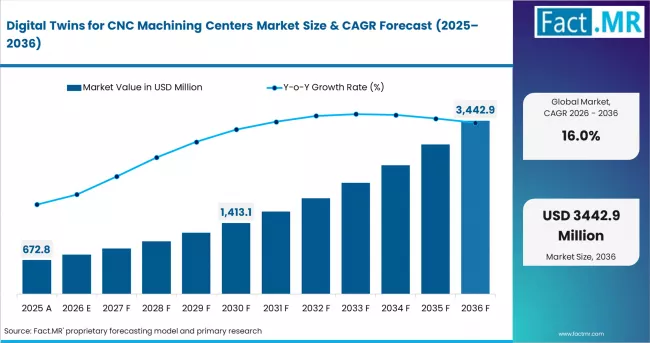
Digital Twins For Cnc Machining Centers Market Market Value Analysis | Source: Fact.MR
Summary of the Digital Twins for CNC Machining Centers Market
- Market Definition
- The market comprises software platforms and connected data environments that create virtual replicas of CNC machining centers to enable real time monitoring, predictive maintenance, machining simulation, and process optimization through integration with industrial IoT, CAD, CAM, and manufacturing execution systems.
- Demand Drivers
- Increasing adoption of predictive maintenance tools supporting reduction of unplanned CNC machine downtime.
- Rising integration of industrial IoT sensors enabling real time synchronization of machining parameters.
- Growing requirement for process simulation supporting optimization of cutting paths and machining accuracy.
- Expansion of smart factory initiatives supporting data driven production decision frameworks.
- Increasing focus on reducing scrap rates through simulation based machining parameter validation.
- Rising demand for centralized monitoring of distributed CNC machining assets across manufacturing facilities.
- Key Segments Analyzed
- Deployment: Cloud leads with 46% share supported by centralized data processing capability.
- Twin Type: Process twin holds 36% share driven by predictive machining performance modelling.
- Application Role: Predictive maintenance and performance monitoring support reduction of machine downtime risk.
- Technology Role: Production twins support simulation of machining workflow efficiency across manufacturing systems.
- Geography: Asia Pacific leads adoption supported by smart manufacturing investment across precision engineering industries.
- Analyst Opinion at Fact MR
- Shambhu Nath Jha, Principal Consultant, Fact MR, opines, 'In this updated edition of the Digital Twins for CNC Machining Centers Market report, adoption patterns indicate transition from standalone machining simulation tools toward connected digital replicas enabling continuous synchronization of machine performance parameters. Manufacturers increasingly deploy predictive analytics to improve machining accuracy, optimize tool utilization, and reduce operational downtime across high precision production environments through 2036.'
- Strategic Implications/Executive Takeaways
- Invest in interoperable digital twin platforms supporting integration with CNC controllers and industrial IoT sensors.
- Develop simulation models supporting optimization of machining parameters across varied production conditions.
- Strengthen cloud deployment capability supporting centralized monitoring of machining performance data.
- Expand predictive analytics functionality supporting early detection of tool wear and machine performance deviation.
- Improve compatibility with CAD and CAM environments supporting seamless digital manufacturing workflow integration.
- Focus on modular software architecture supporting scalability across multi machine production environments.
- Methodology
- Primary interviews conducted with CNC machine builders, industrial software providers, automation integrators, and manufacturing engineers.
- Benchmarked against Industry 4.0 adoption indicators influencing demand for digital machining simulation platforms.
- Evaluated utilization across predictive maintenance, process optimization, and real time performance monitoring workflows.
- Hybrid modeling applied combining top down smart manufacturing demand assessment with bottom up CNC digital twin deployment analysis.
- Validation conducted using industrial IoT adoption indicators, simulation software utilization trends, and machine connectivity data benchmarks.
- Peer review applied using Fact MR analytical frameworks linking digital manufacturing adoption patterns with CNC process optimization software deployment trends.
Digital Twins for CNC Machining Centers Market
| Metric | Details |
|---|---|
| Industry Size (2026E) | USD 672.8 million |
| Industry Value (2036F) | USD 2,984.6 million |
| CAGR (2026 to 2036) | 16% |
Source: Fact.MR analysis. Updated Apr 11, 2026
A CAGR of 16% indicates transformational expansion with variability linked to adoption pace of simulation-driven machining optimization and integration with industrial IoT platforms. Growth is supported by demand for predictive maintenance and process efficiency, while volatility persists due to implementation complexity, software interoperability challenges, and capital investment prioritization.
China leads with a projected CAGR of 17.2%, supported by rapid adoption of virtual process simulation across advanced manufacturing facilities. India follows with a CAGR of 16.8%, driven by increasing integration of digital machining optimization platforms across precision engineering environments. The United Kingdom records a CAGR of 16.5%, reflecting steady deployment of real-time production modeling tools across industrial machining operations. Germany shows a CAGR of 16.3%, supported by consistent adoption of predictive manufacturing simulation systems across high-precision machining centers. The United States records the slowest growth at 16.0%, reflecting a relatively mature digital manufacturing ecosystem tied to replacement cycles within existing industrial simulation infrastructure.
Segmental Analysis
Digital Twins for CNC Machining Centers Market Analysis by Deployment
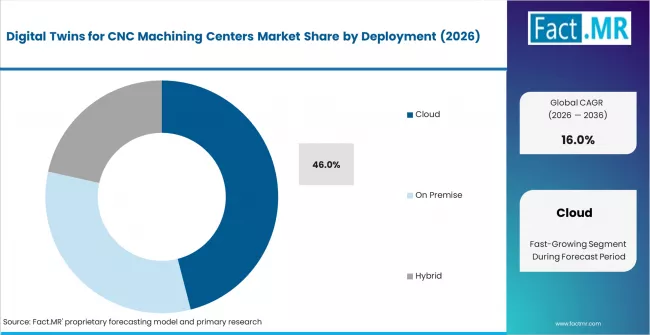
Digital Twins For Cnc Machining Centers Market Analysis By Deployment | Source: Fact.MR
- Market Overview: Based on Fact MR assessment, cloud deployment is projected to account for 46% share of the digital twins for CNC machining centers market in 2026. Cloud infrastructure enables continuous synchronization of machining parameters including spindle speed, feed rate, vibration signatures, and tool wear indicators across virtual simulation environments. Data transmission frameworks support centralized storage and computational processing required for real time monitoring of machining performance across distributed production facilities. Cloud based architecture enables scalable processing capacity supporting simulation of machining conditions and predictive assessment of operational parameters influencing machining accuracy and equipment utilization performance.
- Demand Drivers:
- Data Accessibility Requirements: Cloud deployment supports centralized availability of machining data enabling monitoring of operational parameters across multiple CNC machines.
- Computational Scalability Parameters: Cloud infrastructure enables simulation of machining processes requiring processing capacity for digital representation of machine behavior.
- System Integration Needs: Cloud platforms support connection between machine sensors and digital twin environments enabling continuous data synchronization workflows.
Digital Twins for CNC Machining Centers Market Analysis by Twin Type
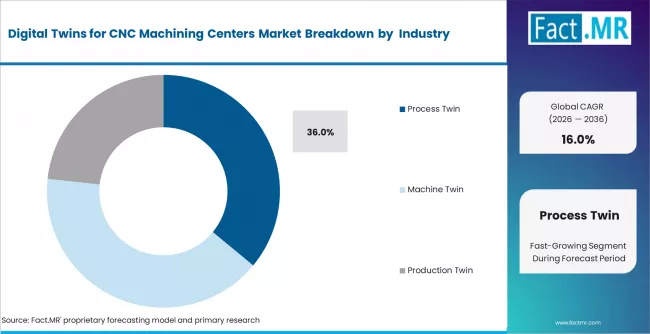
Digital Twins For Cnc Machining Centers Market Analysis By Twin Type | Source: Fact.MR
- Market Overview: Process twin models are estimated to hold 36% share of the digital twins for CNC machining centers market in 2026, supported by capability to replicate machining dynamics including cutting forces, thermal behavior, and tool path interaction across simulated machining environments. Digital process representation enables evaluation of machining parameter adjustments influencing surface finish quality, dimensional accuracy, and tool life characteristics. Process twin frameworks support optimization of machining strategies requiring virtual validation of feed rate profiles, cutting depth parameters, and machining sequence configuration across precision manufacturing operations.
- Demand Drivers:
- Machining Parameter Optimization Requirements: Process twins support simulation of cutting conditions enabling evaluation of machining performance across varied tool path configurations.
- Dimensional Accuracy Parameters: Digital simulation models support prediction of machining deviation enabling adjustment of process variables influencing component tolerance outcomes.
- Operational Efficiency Needs: Process twin implementation supports reduction of trial machining cycles through virtual validation of machining process configurations.
Key Dynamics
Digital Twins for CNC Machining Centers Market Drivers, Restraints, and Opportunities
FMR analysts observe that historical patterns position digital twins for CNC machining as an emerging Industry 4.0 software layer built upon earlier adoption of CAD/CAM simulation and machine monitoring platforms. The present market size reflects transition from static virtual machining models toward real-time synchronized digital replicas capable of predicting tool wear, process deviation, and machine performance degradation. Structural reality indicates a growth-phase market because CNC machining centers represent high-value capital assets where downtime risk and scrap cost justify investment in predictive analytics and virtual commissioning environments. Digital twin architectures commonly integrate MTConnect data standards and ISO 23247 reference frameworks to enable interoperability across machine tools and manufacturing software ecosystems.
Current structural tension reflects declining reliance on offline process simulation as real-time digital twins enable adaptive machining parameter optimization and predictive maintenance scheduling. High implementation cost linked to sensor integration, cloud computation, and model calibration increases per-machine software expenditure, yet reduced scrap rates and improved spindle utilization support favorable lifecycle economics despite moderate adoption scale. Demand expansion is strongest in precision manufacturing sectors where tolerance deviations directly impact part qualification and downstream assembly yield.
- Predictive Machining Models: Digital twins improve tool life prediction and process stability by continuously synchronizing machine data with virtual machining simulations.
- Interoperability Standards: ISO 23247 digital twin architecture and MTConnect communication protocols enable standardized data exchange between CNC equipment and analytics platforms.
- Asia Manufacturing Base: Japan, China, and South Korea drive adoption due to dense CNC machine installations supporting automotive, electronics, and precision component production ecosystems.
Regional Analysis
The Digital Twins for CNC Machining Centers Market is assessed across North America, Europe, and Asia Pacific, segmented by country-level demand in virtual machining simulation, predictive maintenance modelling, process optimization software, and real-time production monitoring platforms. Regional demand reflects adoption of smart manufacturing frameworks and integration of data-driven machining performance optimization tools. The full report offers market attractiveness analysis.
.webp "Top Country Growth Comparison Digital Twins For Cnc Machining Centers Market Cagr (2026 2036)")
Top Country Growth Comparison Digital Twins For Cnc Machining Centers Market Cagr (2026 2036) | Source: Fact.MR
| Country | CAGR (2026 to 2036) |
|---|---|
| China | 17.2% |
| India | 16.8% |
| United Kingdom | 16.5% |
| Germany | 16.3% |
| United States | 16.0% |
Source: Fact.MR analysis. Updated Apr 11, 2026
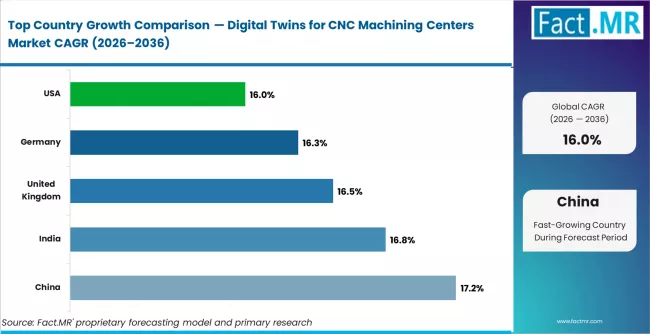
Digital Twins For Cnc Machining Centers Market Cagr Analysis By Country | Source: Fact.MR
Source: Fact MR analysis, based on proprietary forecasting model and primary research
Asia Pacific
Asia Pacific functions as the digital machining simulation adoption hub, supported by expansion of smart factory initiatives and demand for virtual commissioning tools in precision manufacturing environments. Siemens AG strengthens digital twin simulation software capabilities. Hexagon AB expands metrology-integrated modelling platforms. Dassault Systèmes SE supports virtual machining environment development.
- China: China is projected to record 17.2% CAGR in digital twins for CNC machining centers through 2036. Smart Manufacturing pilot factory programme expansion (MIIT, March 2024) supports virtual machining optimization adoption. Hexagon AB expanded digital metrology integration capability (July 2023).
- India: Deployment of digital twins for CNC machining centers in India is forecast to grow at 16.8% CAGR through 2036. SAMARTH Udyog Industry 4.0 initiative update (Ministry of Heavy Industries, January 2024) supports adoption of simulation-driven machining platforms. Siemens AG expanded digital manufacturing software partnerships (September 2023).
Europe
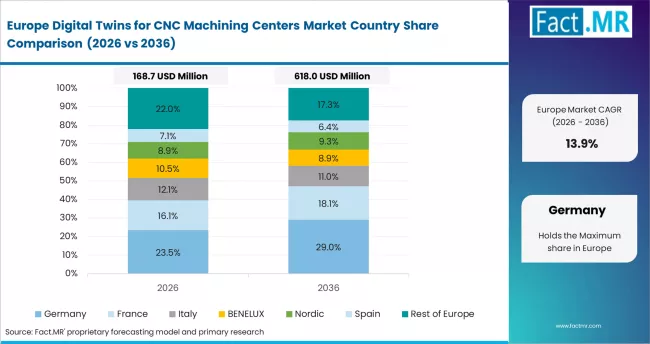
Digital Twins For Cnc Machining Centers Market Europe Country Market Share Analysis, 2026 & 2036 | Source: Fact.MR
Europe operates as the advanced digital engineering modeling center, supported by Industry 4.0 frameworks and strong presence of precision machine tool manufacturers. Dassault Systèmes SE strengthens virtual machining simulation software capability. Siemens AG expands CNC digital twin integration platforms. Hexagon AB supports measurement-driven digital modelling technologies.
- United Kingdom: Adoption of digital twins for CNC machining centers in United Kingdom is expected to expand at 16.5% CAGR through 2036. Made Smarter digital supply chain programme expansion (Department for Business and Trade, February 2024) supports virtual production modelling deployment. Dassault Systèmes SE expanded digital machining simulation tools (June 2023).
- Germany: Germany is anticipated to observe 16.3% CAGR in digital twins for CNC machining centers through 2036. Plattform Industrie 4.0 interoperability initiative update (BMWK, October 2023) supports connected machining data environments. Siemens AG expanded digital twin-enabled CNC optimization software capability (May 2023).
North America
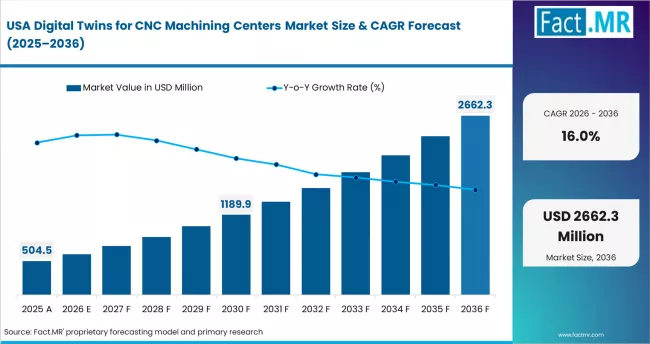
Digital Twins For Cnc Machining Centers Market Country Value Analysis | Source: Fact.MR
North America represents the predictive machining analytics development environment, supported by integration of industrial IoT data platforms and high adoption of simulation-based process optimization technologies. PTC Inc. strengthens industrial digital twin software capability. Autodesk Inc. expands manufacturing simulation software tools. Rockwell Automation Inc. supports connected machining performance analytics.
- United States: The United States is forecast to witness 16.0% CAGR in digital twins for CNC machining centers through 2036. Manufacturing USA digital engineering funding update (NIST, April 2024) supports simulation-based machining optimization adoption. PTC Inc. expanded industrial digital twin modelling platform capability (August 2023).
Fact MR's analysis of digital twins for CNC machining centers market in global regions consists of country-wise assessment that includes China, India, United Kingdom, Germany, and United States. Readers can find virtual machining simulation trends, predictive maintenance modelling developments, Industry 4.0 adoption signals, and competitive positioning across key markets.
Competitive Landscape
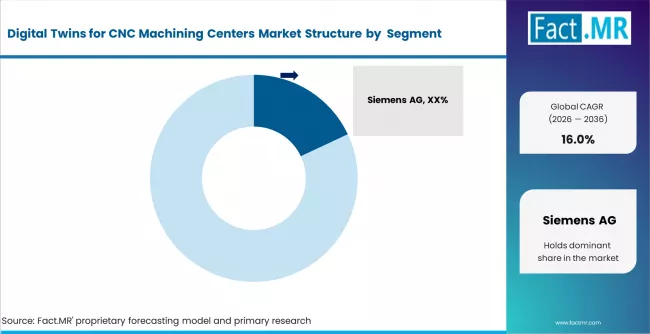
Digital Twins For Cnc Machining Centers Market Analysis By Company | Source: Fact.MR
Competitive Structure and Buyer Dynamics in the Digital Twins for CNC Machining Centers Market
The competitive structure of the Digital Twins for CNC Machining Centers Market is moderately concentrated, with industrial software developers and engineering simulation providers controlling a significant share of deployment solutions. Companies such as Siemens AG, Dassault Systemes SE, PTC Inc., ANSYS Inc., Hexagon AB, Autodesk Inc., Altair Engineering Inc., Bentley Systems Inc., IBM Corporation, and Microsoft Corporation maintain strong positions through digital engineering platforms and simulation software integrated with manufacturing systems. These firms provide virtual modeling, predictive maintenance analytics, and process optimization tools used in CNC machining environments. Competition is primarily influenced by simulation accuracy, interoperability with CAD and CAM systems, data processing capability, and integration with industrial automation platforms.
Several companies maintain structural advantages through established engineering software ecosystems and long term relationships with manufacturing enterprises. Firms such as Siemens AG and Dassault Systemes SE benefit from integrated product lifecycle management platforms supporting digital twin deployment across production processes. ANSYS Inc. and Altair Engineering Inc. maintain advantages through advanced physics based simulation capabilities used in machining performance optimization. Microsoft Corporation and IBM Corporation support cloud computing infrastructure enabling real time data integration. Manufacturers often adopt multi vendor software strategies to reduce dependence on a single platform and maintain interoperability across digital engineering environments. Procurement decisions evaluate suppliers based on simulation precision, system compatibility, and long term technical support, moderating supplier pricing leverage.
Key Players of the Digital Twins for CNC Machining Centers Market
- Siemens AG
- Dassault Systemes SE
- PTC Inc.
- ANSYS Inc.
- Hexagon AB
- Autodesk Inc.
- Altair Engineering Inc.
- Bentley Systems Inc.
- IBM Corporation
- Microsoft Corporation
Bibliographies
- [1] National Institute of Standards and Technology. (2024, August). Strategic plan for the Manufacturing USA program. U.S. Department of Commerce.
- [2] National Institute of Standards and Technology. (2024, March). NIST launches competition for AI-focused Manufacturing USA institute. U.S. Department of Commerce.
- [3] Ministry of Industry and Information Technology. (2024, March). Smart manufacturing pilot factory programme expansion. Government of China.
- [4] Ministry of Heavy Industries. (2024, January). SAMARTH Udyog Industry 4.0 initiative update. Government of India.
- [5] Department for Business and Trade. (2024, February). Made Smarter digital supply chain programme expansion. UK Government.
- [6] Federal Ministry for Economic Affairs and Climate Action. (2023, October). Plattform Industrie 4.0 interoperability initiative update. Government of Germany.
This Report Addresses
- Market size forecasts for 2026 to 2036 based on adoption of simulation-driven machining optimization and industrial IoT-connected CNC environments.
- Opportunity mapping across process twins, machine twins, production twins, and tooling twins supporting virtual machining performance modeling.
- Segment and regional forecasts covering predictive maintenance, process optimization, performance monitoring, and quality control applications.
- Competition assessment based on simulation accuracy capability, interoperability with CAD CAM systems, and integration with manufacturing execution architectures.
- Regulatory and standards review covering ISO 23247 digital twin framework and MTConnect data communication protocols supporting machining data exchange.
- Report delivery in PDF, Excel, PPT, and dashboard formats for CNC machine builders, industrial software providers, and manufacturing engineering teams.
- Technology risk assessment covering data integration complexity, model calibration accuracy constraints, cybersecurity exposure, and software interoperability limitations across connected machining environments.
Market Definition
Definition Paragraph
The digital twins for CNC machining centers market includes software platforms and integrated data models that create virtual replicas of CNC machines, enabling real time monitoring, simulation, predictive maintenance, and process optimization across machining operations using sensor data and industrial connectivity systems.
Market Inclusions
The report includes global and regional market size estimates, forecast analysis, and segmentation by twin type, deployment architecture, simulation capability, application area, end use industry, pricing structure, and integration with CAD, CAM, IoT, and manufacturing execution systems.
Market Exclusions
The scope excludes standalone CAD models without real time data integration, conventional CNC simulation software lacking bidirectional machine connectivity, hardware only machine tools, and digital manufacturing platforms not specifically configured for CNC machining process twins.
Research Methodology
- Primary Research: Interviews were conducted with CNC machine builders, industrial software providers, manufacturing engineers, automation integrators, and digital transformation specialists.
- Desk Research: Public sources included industrial automation publications, company software documentation, patent literature, standards frameworks, and research papers on digital twin implementation in machining.
- Market-Sizing and Forecasting: A hybrid model combining top-down smart manufacturing demand evaluation and bottom-up analysis of digital twin deployment across CNC machining installations was applied.
- Data Validation and Update Cycle: Outputs were validated through cross comparison of vendor data, expert consultation, and periodic monitoring of Industry 4.0 adoption trends in precision manufacturing.
Segmentation
Report Scope
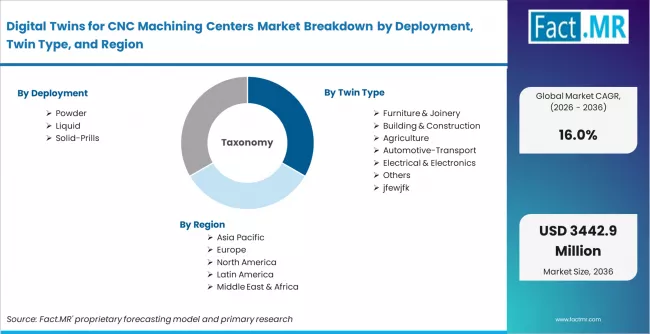
Digital Twins For Cnc Machining Centers Market Breakdown By Deployment, Twin Type, And Region | Source: Fact.MR
| Metric | Value |
|---|---|
| Quantitative Units | USD 672.8 million (2026) to USD 2,984.6 million (2036), at a CAGR of 16% |
| Market Definition | The digital twins for CNC machining centers market includes virtual simulation models replicating machine tools, processes, and production environments to enable real time monitoring, predictive diagnostics, process optimization, and quality control across precision manufacturing operations. |
| Twin Type Segmentation | Process twin, Machine twin, Production twin, Tooling twin |
| Application Segmentation | Predictive maintenance, Process optimization, Performance monitoring, Quality control |
| Deployment Segmentation | Cloud, On premise, Hybrid |
| Regions Covered | North America, Latin America, Europe, East Asia, South Asia, Oceania, Middle East and Africa |
| Countries Covered | United States, Canada, Germany, France, United Kingdom, Italy, Spain, Netherlands, Sweden, China, Japan, South Korea, India, Singapore, Australia, United Arab Emirates, Brazil, Mexico, and 40+ countries |
| Key Companies Profiled | Siemens AG, Dassault Systemes SE, PTC Inc., ANSYS Inc., Hexagon AB, Autodesk Inc., Altair Engineering Inc., Bentley Systems Inc., IBM Corporation, Microsoft Corporation |
| Forecast Period | 2026 to 2036 |
| Approach | Hybrid top-down and bottom-up market estimation based on industrial digital twin adoption rates, CNC machining automation demand benchmarking, simulation software deployment trends, predictive maintenance analytics adoption, and validation through primary interviews with industrial software developers, machine tool manufacturers, and manufacturing engineering firms. |
Source: Fact.MR analysis. Updated Apr 11, 2026
Digital Twins for CNC Machining Centers Market Key Segments
-
Twin Type :
- Process Twin
- Machine Twin
- Production Twin
- Tooling Twin
-
Application :
- Predictive Maintenance
- Process Optimization
- Performance Monitoring
- Quality Control
-
Deployment :
- Cloud
- On Premise
- Hybrid
-
Region :
- North America
- USA
- Canada
- Mexico
- Europe
- Germany
- UK
- France
- Italy
- Spain
- Nordic Countries
- BENELUX
- Rest of Europe
- Asia Pacific
- China
- Japan
- South Korea
- India
- Australia
- Rest of Asia Pacific
- Latin America
- Brazil
- Argentina
- Rest of Latin America
- Middle East and Africa
- Kingdom of Saudi Arabia
- United Arab Emirates
- South Africa
- Rest of Middle East and Africa
- Other Regions
- Oceania
- Central Asia
- Other Markets
- North America
Frequently Asked Questions
How large is the demand for Digital Twins for CNC Machining Centers in the global market in 2026?
What will be the market size of Digital Twins for CNC Machining Centers in the global market by 2036?
What is the expected demand growth for Digital Twins for CNC Machining Centers in the global market between 2026 and 2036?`
Which company is identified as a leading provider in the Digital Twins for CNC Machining Centers market?
Which deployment model is projected to dominate digital twin adoption by 2026?
Why are cloud based digital twin platforms widely used in CNC machining environments?
What is driving demand for digital twin platforms for CNC machining centers in China?
What is the growth outlook for the Digital Twins for CNC Machining Centers market in China?
Why is India an important market for CNC digital twin deployment?
What is the growth outlook for the Digital Twins for CNC Machining Centers market in India?
How is demand for digital twin platforms evolving in the United Kingdom machining sector?
What is the growth outlook for the Digital Twins for CNC Machining Centers market in the United Kingdom?
What is the growth outlook for the Digital Twins for CNC Machining Centers market in Germany?
How is the United States positioned in the Digital Twins for CNC Machining Centers market?
What is the growth outlook for the Digital Twins for CNC Machining Centers market in the United States?
What are digital twins for CNC machining centers and what are they mainly used for?
What does the Digital Twins for CNC Machining Centers market include in this report?
What applications are included in the scope of the Digital Twins for CNC Machining Centers market?
What is excluded from the scope of the Digital Twins for CNC Machining Centers market report?
What does market forecast mean in the Digital Twins for CNC Machining Centers market report?
How is the Digital Twins for CNC Machining Centers market forecast developed in this report?
What does primary validation indicate in the Digital Twins for CNC Machining Centers market analysis?
Who worked on this report


Preview the report firsthand - request a free sample
Free SampleGet the brochure for pricing and purchase details
Download PDF