Digital Torque Tools Market (2026 - 2036)
Digital Torque Tools Market Size and Share Forecast Outlook 2026 to 2036
Core Findings
Digital Torque Tools Market Forecast Outlook 2026 to 2036
The digital torque tools market is projected to reach USD 850 million in 2026 and grow to USD 2,012 million by 2036, reflecting a CAGR of 9%.
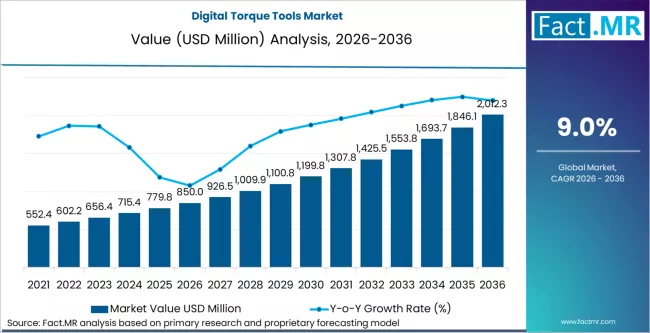
Key Takeaways from Digital Torque Tools Market
- Digital Torque Tools Market Value (2026): USD 850 million
- Digital Torque Tools Market Forecast Value (2036): USD 2,012 million
- Digital Torque Tools Market Forecast CAGR 2026 to 2036: 9%
- Leading Segment in Digital Torque Tools Market: OEMs (52%)
- Key Growth Region in Digital Torque Tools Market: Asia Pacific
- Key Players in Digital Torque Tools Market: Atlas Copco AB, Desoutter Industrial Tools, Ingersoll Rand, Inc., STANLEY Assembly Technologies, Snap-on Incorporated, Robert Bosch GmbH, Apex Tool Group, LLC, Mountz, Inc., Crane Electronics, Inc., HYTORC

This market occupies a vital role in the industrial tools sector, where precision and reliability are essential. Digital torque tools ensure accurate fastening in high-demand sectors such as automotive, aerospace, and manufacturing, making them integral to assembly line efficiency and product quality.
The influence of this space is growing as industries increasingly focus on automation and digital solutions to enhance operational efficiency and reduce error rates. Competitive weight is defined by the ability of suppliers to offer tools that meet stringent regulatory standards while remaining cost-competitive. As digitalization continues to shape industrial practices, the demand for advanced torque tools will rise, making this market an attractive space for both established and emerging players who can balance innovation with proven reliability.
Digital Torque Tools Market
| Metric | Value |
|---|---|
| Estimated Value in (2026E) | USD 850 million |
| Forecast Value in (2036F) | USD 2,012 million |
| Forecast CAGR 2026 to 2036 | 9% |
Category
| Category | Segments |
|---|---|
| Type | Electronic torque wrenches; Mechatronic torque drivers; Smart WiFi torque tools |
| Application | Automotive assembly; Aerospace; General manufacturing |
| Form Factor | Handheld; Pistol grip; Inline |
| End User | OEMs; Tier suppliers; MRO |
| Region | North America; Europe; Asia Pacific; Latin America; Middle East & Africa |
Segmental Analysis
What Is the Impact of Form Factor on the Digital Torque Tools Market?
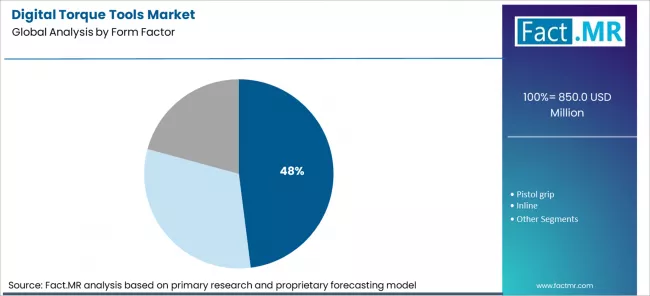
In the digital torque tools market, form factor plays a significant role in determining the usability and application of the tools. Handheld tools lead the market with a 48% share, as they offer versatility and ease of use for a wide range of applications across industries. Handheld digital torque tools are particularly favored for their portability and accuracy in tasks such as assembly and maintenance. As industries increasingly focus on precision and ease of use, the demand for handheld digital torque tools will continue to grow, especially in sectors like automotive, aerospace, and manufacturing.
What Is the Impact of End User on the Digital Torque Tools Market?
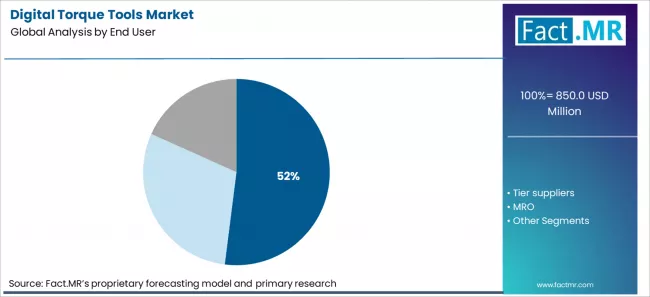
End user plays a crucial role in shaping the demand for digital torque tools, with OEMs (Original Equipment Manufacturers) holding a 52% share. OEMs require high-precision torque tools for assembly and production processes, where maintaining consistent torque application is critical for product quality and safety. As manufacturing processes become more automated and quality-focused, the need for reliable and accurate digital torque tools in OEM applications will remain strong. Additionally, the demand for digital torque tools from tier suppliers and MRO (Maintenance, Repair, and Overhaul) sectors will continue to support market growth, driving the adoption of these tools across various industries.
What are the Drivers, Restraints, and Key Trends in the Digital Torque Tools Market?
- Drivers: Demand for digital torque tools is shaped by requirements to improve precision and repeatability in tightening operations across automotive, aerospace, industrial assembly, and maintenance applications. Manufacturers and service providers specify digital torque solutions that deliver accurate measurement, data logging, and real time feedback to support quality control and reduce fastener failure risk. Procurement teams prioritize tools that integrate with digital quality systems, support traceability, and enable standardized calibration practices across facilities. Growing emphasis on assembly data capture and process validation influences adoption of digital torque tools in production and field service environments.
- Restraints: Higher acquisition cost relative to manual torque wrenches constrains uptake where budget pressures exist or where manual methods meet minimal requirements. Some operators face challenges in training technicians on digital interfaces and interpreting recorded data. Integration with existing enterprise systems can require custom software or hardware interfaces, adding complexity. Variability in tool performance across brands and models can affect confidence in consistency of measurements.
- Trend 1: Expansion of connectivity features that link digital torque tools with cloud based quality dashboards for centralized monitoring.
- Trend 2: Development of automated torque systems with guided workflows that reduce reliance on operator interpretation and support compliance with tightening standards.
Analysis of the Digital Torque Tools Market by Key Country
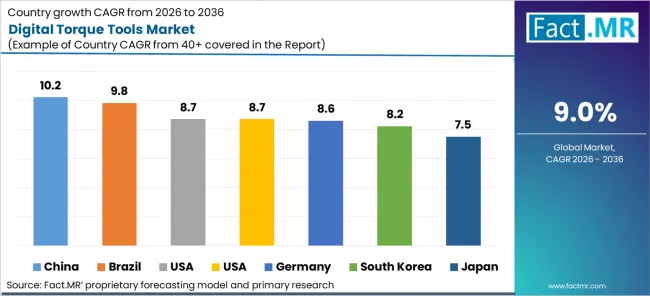
| Country | CAGR 2026 to 2036 |
|---|---|
| USA | 8.7% |
| Japan | 7.5% |
| South Korea | 8.2% |
| Germany | 8.6% |
| China | 10.2% |
| UK | 8.7% |
| Brazil | 9.8% |
The report covers an in-depth analysis of 40+ countries; top-performing countries are highlighted below.
What is the Outlook on the Digital Torque Tools Market in the USA?
USA market in digital torque tools is projected to grow at a CAGR of 8.7% from 2026 to 2036. The demand for digital torque tools in the USA is increasing as industries such as automotive, manufacturing, and construction continue to prioritize precision and efficiency in their operations. These tools are essential for ensuring accurate torque application, improving product quality, and enhancing worker safety. With increasing automation in manufacturing processes and growing regulatory requirements, the market for digital torque tools in the USA is expected to expand steadily, supported by both technological advancements and industrial adoption.
What is the Demand for Digital Torque Tools in Japan?
Japan sales of digital torque tools are expected to grow at a CAGR of 7.5% from 2026 to 2036. The demand for these tools is rising as Japan’s automotive and manufacturing industries focus on improving precision, efficiency, and safety in assembly and production processes. Digital torque tools offer significant advantages over traditional mechanical tools, including increased accuracy and data logging capabilities. As Japan continues to invest in automation and advanced manufacturing technologies, the market for digital torque tools is expected to grow, supported by the country’s focus on technological innovation and high-quality manufacturing standards.
What is the Sales Outlook on Digital Torque Tools in South Korea?
South Korea demand for digital torque tools is projected to grow at a CAGR of 8.2% from 2026 to 2036. South Korea’s manufacturing sectors, particularly in automotive and electronics, are increasingly adopting digital torque tools to enhance production efficiency and ensure the accuracy of torque applications. With growing industry automation and an emphasis on improving product quality and worker safety, the market for digital torque tools is expected to experience steady growth. South Korea’s strong industrial base and technological advancements in manufacturing will continue to support this market’s expansion.
What is the Demand for Digital Torque Tools in Germany?
Germany market in digital torque tools is forecast to grow at a CAGR of 8.6% from 2026 to 2036. As Germany continues to lead in industrial manufacturing, particularly in automotive and heavy machinery, the demand for digital torque tools is increasing. These tools are essential for ensuring the accuracy and reliability of torque applications, which are critical for product quality and operational efficiency. With Germany’s commitment to high manufacturing standards and its focus on automation, the market for digital torque tools is expected to grow steadily, supported by both local and international industrial demand.
What is the Sales Outlook on Digital Torque Tools in China?
China demand for digital torque tools is projected to grow at a CAGR of 10.2% from 2026 to 2036. China’s rapidly expanding manufacturing sector is driving the demand for digital torque tools, particularly in automotive, electronics, and construction. These tools enable manufacturers to improve production accuracy and efficiency while meeting increasing safety and regulatory standards. As China continues to focus on automation and upgrading its industrial processes, the market for digital torque tools is expected to experience significant growth, driven by the country’s industrial expansion and technological advancements.
What is the Market Expansion Outlook for Digital Torque Tools in the UK?
UK sales of digital torque tools are set to grow at a CAGR of 8.7% from 2026 to 2036. The demand for these tools in the UK is rising as industries such as automotive, aerospace, and manufacturing increasingly adopt advanced solutions to improve torque application precision and enhance productivity. Digital torque tools offer key advantages in terms of accuracy, data collection, and ease of use. As the UK focuses on improving manufacturing standards and integrating digital solutions, the market for digital torque tools is expected to grow steadily, supported by the country’s industrial and technological advancements.
What is the Market Expansion Outlook for Digital Torque Tools in Brazil?
Brazil demand for digital torque tools is projected to grow at a CAGR of 9.8% from 2026 to 2036. Brazil’s automotive and industrial manufacturing sectors are driving the demand for digital torque tools, as these tools help improve product quality, enhance operational efficiency, and meet regulatory requirements. With the country’s focus on improving industrial processes and adopting more precise and reliable equipment, the market for digital torque tools in Brazil is expected to experience robust growth. This growth will be supported by increasing automation and the country’s growing manufacturing capabilities.
How Are Key Players Competing in the Digital Torque Tools Market?
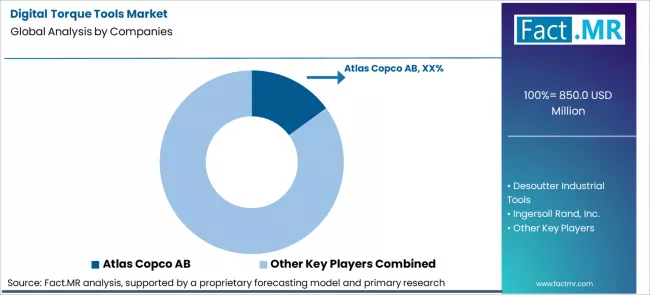
Competition in the digital torque tools market is driven by measurement accuracy, digital connectivity, and tool durability. Atlas Copco AB and Desoutter Industrial Tools provide calibrated torque wrenches and controllers with data logging for assembly verification. Ingersoll Rand, Inc. and STANLEY Assembly Technologies offer integrated digital torque systems that interface with manufacturing execution systems for traceable torque records. Snap on Incorporated and Robert Bosch GmbH focus on handheld electronic torque tools with user configurable settings and diagnostic feedback. Apex Tool Group, LLC and Mountz, Inc. emphasise precision calibration and tool ruggedness for industrial environments. Crane Electronics, Inc. and HYTORC supply specialised digital torque tools designed for heavy duty applications and automated tightening sequences. Competitive positioning is defined by torque accuracy, ease of integration with quality systems, and consistency of performance under repeated use.
Key Players of the Digital Torque Tools Market
- Atlas Copco AB
- Desoutter Industrial Tools
- Ingersoll Rand, Inc.
- STANLEY Assembly Technologies
- Snap-on Incorporated
- Robert Bosch GmbH
- Apex Tool Group, LLC
- Mountz, Inc.
- Crane Electronics, Inc.
- HYTORC
Scope of the Report
| Items | Values |
|---|---|
| Quantitative Units (2026) | USD Million |
| Type | Electronic torque wrenches, Mechatronic torque drivers, Smart WiFi torque tools |
| Application | Automotive assembly, Aerospace, General manufacturing |
| Form Factor | Handheld, Pistol grip, Inline |
| End User | OEMs, Tier suppliers, MRO |
| Regions Covered | North America, Europe, Asia Pacific, Latin America, Middle East & Africa |
| Countries Covered | United States, Canada, Mexico, Brazil, Germany, United Kingdom, France, Italy, Spain, China, Japan, South Korea, India, Australia & New Zealand |
| Key Companies Profiled | Atlas Copco AB, Desoutter Industrial Tools, Ingersoll Rand, Inc., STANLEY Assembly Technologies, Snap-on Incorporated, Robert Bosch GmbH, Apex Tool Group, LLC, Mountz, Inc., Crane Electronics, Inc., HYTORC |
| Additional Attributes | Dollar revenue by type, application, form factor, and end user; regional demand trends, competitive landscape, technological advancements in digital torque tools, and innovations in torque control and precision tools |
Digital Torque Tools Market Key Segments
-
Type :
- Electronic torque wrenches
- Mechatronic torque drivers
- Smart WiFi torque tools
-
Application :
- Automotive assembly
- Aerospace
- General manufacturing
-
Form Factor :
- Handheld
- Pistol grip
- Inline
-
End User :
- OEMs
- Tier suppliers
- MRO
-
Region :
- North America
- USA
- Canada
- Mexico
- Europe
- Germany
- UK
- France
- Italy
- Spain
- Nordic Countries
- BENELUX
- Rest of Europe
- Asia Pacific
- China
- Japan
- South Korea
- India
- Australia
- Rest of Asia Pacific
- Latin America
- Brazil
- Argentina
- Rest of Latin America
- Middle East and Africa
- Kingdom of Saudi Arabia
- United Arab Emirates
- South Africa
- Rest of Middle East and Africa
- Other Regions
- Oceania
- Central Asia
- Other Markets
- North America
Bibliographies
- International Organization for Standardization. (2023). ISO 6789-2: Calibration and recalibration of torque tools.
- VDI/VDE Society. (2024). VDI/VDE 2645: Torque measuring systems.
- National Institute of Standards and Technology. (2024). Traceability and calibration of torque measurement systems.
- Physikalisch-Technische Bundesanstalt. (2023). Torque measurement in industrial fastening.
- National Physical Laboratory. (2023). Best practice guide for torque tool calibration.
Table of Content
- Executive Summary
- Global Market Outlook
- Demand to side Trends
- Supply to side Trends
- Technology Roadmap Analysis
- Analysis and Recommendations
- Market Overview
- Market Coverage / Taxonomy
- Market Definition / Scope / Limitations
- Market Background
- Market Dynamics
- Drivers
- Restraints
- Opportunity
- Trends
- Scenario Forecast
- Demand in Optimistic Scenario
- Demand in Likely Scenario
- Demand in Conservative Scenario
- Opportunity Map Analysis
- Product Life Cycle Analysis
- Supply Chain Analysis
- Investment Feasibility Matrix
- Value Chain Analysis
- PESTLE and Porter’s Analysis
- Regulatory Landscape
- Regional Parent Market Outlook
- Production and Consumption Statistics
- Import and Export Statistics
- Market Dynamics
- Global Market Analysis 2021 to 2025 and Forecast, 2026 to 2036
- Historical Market Size Value (USD Million) Analysis, 2021 to 2025
- Current and Future Market Size Value (USD Million) Projections, 2026 to 2036
- Y to o to Y Growth Trend Analysis
- Absolute $ Opportunity Analysis
- Global Market Pricing Analysis 2021 to 2025 and Forecast 2026 to 2036
- Global Market Analysis 2021 to 2025 and Forecast 2026 to 2036, By Type
- Introduction / Key Findings
- Historical Market Size Value (USD Million) Analysis By Type, 2021 to 2025
- Current and Future Market Size Value (USD Million) Analysis and Forecast By Type, 2026 to 2036
- Electronic torque wrenches
- Mechatronic torque drivers
- Smart WiFi torque tools
- Electronic torque wrenches
- Y to o to Y Growth Trend Analysis By Type, 2021 to 2025
- Absolute $ Opportunity Analysis By Type, 2026 to 2036
- Global Market Analysis 2021 to 2025 and Forecast 2026 to 2036, By Application
- Introduction / Key Findings
- Historical Market Size Value (USD Million) Analysis By Application, 2021 to 2025
- Current and Future Market Size Value (USD Million) Analysis and Forecast By Application, 2026 to 2036
- Automotive assembly
- Aerospace
- General manufacturing
- Automotive assembly
- Y to o to Y Growth Trend Analysis By Application, 2021 to 2025
- Absolute $ Opportunity Analysis By Application, 2026 to 2036
- Global Market Analysis 2021 to 2025 and Forecast 2026 to 2036, By Form Factor
- Introduction / Key Findings
- Historical Market Size Value (USD Million) Analysis By Form Factor, 2021 to 2025
- Current and Future Market Size Value (USD Million) Analysis and Forecast By Form Factor, 2026 to 2036
- Handheld
- Pistol grip
- Inline
- Handheld
- Y to o to Y Growth Trend Analysis By Form Factor, 2021 to 2025
- Absolute $ Opportunity Analysis By Form Factor, 2026 to 2036
- Global Market Analysis 2021 to 2025 and Forecast 2026 to 2036, By End User
- Introduction / Key Findings
- Historical Market Size Value (USD Million) Analysis By End User, 2021 to 2025
- Current and Future Market Size Value (USD Million) Analysis and Forecast By End User, 2026 to 2036
- OEMs
- Tier suppliers
- MRO
- OEMs
- Y to o to Y Growth Trend Analysis By End User, 2021 to 2025
- Absolute $ Opportunity Analysis By End User, 2026 to 2036
- Global Market Analysis 2021 to 2025 and Forecast 2026 to 2036, By Region
- Introduction
- Historical Market Size Value (USD Million) Analysis By Region, 2021 to 2025
- Current Market Size Value (USD Million) Analysis and Forecast By Region, 2026 to 2036
- North America
- Latin America
- Western Europe
- Eastern Europe
- East Asia
- South Asia and Pacific
- Middle East & Africa
- Market Attractiveness Analysis By Region
- North America Market Analysis 2021 to 2025 and Forecast 2026 to 2036, By Country
- Historical Market Size Value (USD Million) Trend Analysis By Market Taxonomy, 2021 to 2025
- Market Size Value (USD Million) Forecast By Market Taxonomy, 2026 to 2036
- By Country
- USA
- Canada
- Mexico
- By Type
- By Application
- By Form Factor
- By End User
- By Country
- Market Attractiveness Analysis
- By Country
- By Type
- By Application
- By Form Factor
- By End User
- Key Takeaways
- Latin America Market Analysis 2021 to 2025 and Forecast 2026 to 2036, By Country
- Historical Market Size Value (USD Million) Trend Analysis By Market Taxonomy, 2021 to 2025
- Market Size Value (USD Million) Forecast By Market Taxonomy, 2026 to 2036
- By Country
- Brazil
- Chile
- Rest of Latin America
- By Type
- By Application
- By Form Factor
- By End User
- By Country
- Market Attractiveness Analysis
- By Country
- By Type
- By Application
- By Form Factor
- By End User
- Key Takeaways
- Western Europe Market Analysis 2021 to 2025 and Forecast 2026 to 2036, By Country
- Historical Market Size Value (USD Million) Trend Analysis By Market Taxonomy, 2021 to 2025
- Market Size Value (USD Million) Forecast By Market Taxonomy, 2026 to 2036
- By Country
- Germany
- UK
- Italy
- Spain
- France
- Nordic
- BENELUX
- Rest of Western Europe
- By Type
- By Application
- By Form Factor
- By End User
- By Country
- Market Attractiveness Analysis
- By Country
- By Type
- By Application
- By Form Factor
- By End User
- Key Takeaways
- Eastern Europe Market Analysis 2021 to 2025 and Forecast 2026 to 2036, By Country
- Historical Market Size Value (USD Million) Trend Analysis By Market Taxonomy, 2021 to 2025
- Market Size Value (USD Million) Forecast By Market Taxonomy, 2026 to 2036
- By Country
- Russia
- Poland
- Hungary
- Balkan & Baltic
- Rest of Eastern Europe
- By Type
- By Application
- By Form Factor
- By End User
- By Country
- Market Attractiveness Analysis
- By Country
- By Type
- By Application
- By Form Factor
- By End User
- Key Takeaways
- East Asia Market Analysis 2021 to 2025 and Forecast 2026 to 2036, By Country
- Historical Market Size Value (USD Million) Trend Analysis By Market Taxonomy, 2021 to 2025
- Market Size Value (USD Million) Forecast By Market Taxonomy, 2026 to 2036
- By Country
- China
- Japan
- South Korea
- By Type
- By Application
- By Form Factor
- By End User
- By Country
- Market Attractiveness Analysis
- By Country
- By Type
- By Application
- By Form Factor
- By End User
- Key Takeaways
- South Asia and Pacific Market Analysis 2021 to 2025 and Forecast 2026 to 2036, By Country
- Historical Market Size Value (USD Million) Trend Analysis By Market Taxonomy, 2021 to 2025
- Market Size Value (USD Million) Forecast By Market Taxonomy, 2026 to 2036
- By Country
- India
- ASEAN
- Australia & New Zealand
- Rest of South Asia and Pacific
- By Type
- By Application
- By Form Factor
- By End User
- By Country
- Market Attractiveness Analysis
- By Country
- By Type
- By Application
- By Form Factor
- By End User
- Key Takeaways
- Middle East & Africa Market Analysis 2021 to 2025 and Forecast 2026 to 2036, By Country
- Historical Market Size Value (USD Million) Trend Analysis By Market Taxonomy, 2021 to 2025
- Market Size Value (USD Million) Forecast By Market Taxonomy, 2026 to 2036
- By Country
- Kingdom of Saudi Arabia
- Other GCC Countries
- Turkiye
- South Africa
- Other African Union
- Rest of Middle East & Africa
- By Type
- By Application
- By Form Factor
- By End User
- By Country
- Market Attractiveness Analysis
- By Country
- By Type
- By Application
- By Form Factor
- By End User
- Key Takeaways
- Key Countries Market Analysis
- USA
- Pricing Analysis
- Market Share Analysis, 2025
- By Type
- By Application
- By Form Factor
- By End User
- Canada
- Pricing Analysis
- Market Share Analysis, 2025
- By Type
- By Application
- By Form Factor
- By End User
- Mexico
- Pricing Analysis
- Market Share Analysis, 2025
- By Type
- By Application
- By Form Factor
- By End User
- Brazil
- Pricing Analysis
- Market Share Analysis, 2025
- By Type
- By Application
- By Form Factor
- By End User
- Chile
- Pricing Analysis
- Market Share Analysis, 2025
- By Type
- By Application
- By Form Factor
- By End User
- Germany
- Pricing Analysis
- Market Share Analysis, 2025
- By Type
- By Application
- By Form Factor
- By End User
- UK
- Pricing Analysis
- Market Share Analysis, 2025
- By Type
- By Application
- By Form Factor
- By End User
- Italy
- Pricing Analysis
- Market Share Analysis, 2025
- By Type
- By Application
- By Form Factor
- By End User
- Spain
- Pricing Analysis
- Market Share Analysis, 2025
- By Type
- By Application
- By Form Factor
- By End User
- France
- Pricing Analysis
- Market Share Analysis, 2025
- By Type
- By Application
- By Form Factor
- By End User
- India
- Pricing Analysis
- Market Share Analysis, 2025
- By Type
- By Application
- By Form Factor
- By End User
- ASEAN
- Pricing Analysis
- Market Share Analysis, 2025
- By Type
- By Application
- By Form Factor
- By End User
- Australia & New Zealand
- Pricing Analysis
- Market Share Analysis, 2025
- By Type
- By Application
- By Form Factor
- By End User
- China
- Pricing Analysis
- Market Share Analysis, 2025
- By Type
- By Application
- By Form Factor
- By End User
- Japan
- Pricing Analysis
- Market Share Analysis, 2025
- By Type
- By Application
- By Form Factor
- By End User
- South Korea
- Pricing Analysis
- Market Share Analysis, 2025
- By Type
- By Application
- By Form Factor
- By End User
- Russia
- Pricing Analysis
- Market Share Analysis, 2025
- By Type
- By Application
- By Form Factor
- By End User
- Poland
- Pricing Analysis
- Market Share Analysis, 2025
- By Type
- By Application
- By Form Factor
- By End User
- Hungary
- Pricing Analysis
- Market Share Analysis, 2025
- By Type
- By Application
- By Form Factor
- By End User
- Kingdom of Saudi Arabia
- Pricing Analysis
- Market Share Analysis, 2025
- By Type
- By Application
- By Form Factor
- By End User
- Turkiye
- Pricing Analysis
- Market Share Analysis, 2025
- By Type
- By Application
- By Form Factor
- By End User
- South Africa
- Pricing Analysis
- Market Share Analysis, 2025
- By Type
- By Application
- By Form Factor
- By End User
- USA
- Market Structure Analysis
- Competition Dashboard
- Competition Benchmarking
- Market Share Analysis of Top Players
- By Regional
- By Type
- By Application
- By Form Factor
- By End User
- Competition Analysis
- Competition Deep Dive
- Atlas Copco AB
- Overview
- Product Portfolio
- Profitability by Market Segments (Product/Age /Sales Channel/Region)
- Sales Footprint
- Strategy Overview
- Marketing Strategy
- Product Strategy
- Channel Strategy
- Desoutter Industrial Tools
- Ingersoll Rand, Inc.
- STANLEY Assembly Technologies
- Snap-on Incorporated
- Robert Bosch GmbH
- Apex Tool Group, LLC
- Mountz, Inc.
- Crane Electronics, Inc.
- HYTORC
- Atlas Copco AB
- Competition Deep Dive
- Assumptions & Acronyms Used
- Research Methodology
List Of Table
- Table 1: Global Market Value (USD Million) Forecast by Region, 2021 to 2036
- Table 2: Global Market Value (USD Million) Forecast by Type, 2021 to 2036
- Table 3: Global Market Value (USD Million) Forecast by Application, 2021 to 2036
- Table 4: Global Market Value (USD Million) Forecast by Form Factor, 2021 to 2036
- Table 5: Global Market Value (USD Million) Forecast by End User, 2021 to 2036
- Table 6: North America Market Value (USD Million) Forecast by Country, 2021 to 2036
- Table 7: North America Market Value (USD Million) Forecast by Type, 2021 to 2036
- Table 8: North America Market Value (USD Million) Forecast by Application, 2021 to 2036
- Table 9: North America Market Value (USD Million) Forecast by Form Factor, 2021 to 2036
- Table 10: North America Market Value (USD Million) Forecast by End User, 2021 to 2036
- Table 11: Latin America Market Value (USD Million) Forecast by Country, 2021 to 2036
- Table 12: Latin America Market Value (USD Million) Forecast by Type, 2021 to 2036
- Table 13: Latin America Market Value (USD Million) Forecast by Application, 2021 to 2036
- Table 14: Latin America Market Value (USD Million) Forecast by Form Factor, 2021 to 2036
- Table 15: Latin America Market Value (USD Million) Forecast by End User, 2021 to 2036
- Table 16: Western Europe Market Value (USD Million) Forecast by Country, 2021 to 2036
- Table 17: Western Europe Market Value (USD Million) Forecast by Type, 2021 to 2036
- Table 18: Western Europe Market Value (USD Million) Forecast by Application, 2021 to 2036
- Table 19: Western Europe Market Value (USD Million) Forecast by Form Factor, 2021 to 2036
- Table 20: Western Europe Market Value (USD Million) Forecast by End User, 2021 to 2036
- Table 21: Eastern Europe Market Value (USD Million) Forecast by Country, 2021 to 2036
- Table 22: Eastern Europe Market Value (USD Million) Forecast by Type, 2021 to 2036
- Table 23: Eastern Europe Market Value (USD Million) Forecast by Application, 2021 to 2036
- Table 24: Eastern Europe Market Value (USD Million) Forecast by Form Factor, 2021 to 2036
- Table 25: Eastern Europe Market Value (USD Million) Forecast by End User, 2021 to 2036
- Table 26: East Asia Market Value (USD Million) Forecast by Country, 2021 to 2036
- Table 27: East Asia Market Value (USD Million) Forecast by Type, 2021 to 2036
- Table 28: East Asia Market Value (USD Million) Forecast by Application, 2021 to 2036
- Table 29: East Asia Market Value (USD Million) Forecast by Form Factor, 2021 to 2036
- Table 30: East Asia Market Value (USD Million) Forecast by End User, 2021 to 2036
- Table 31: South Asia and Pacific Market Value (USD Million) Forecast by Country, 2021 to 2036
- Table 32: South Asia and Pacific Market Value (USD Million) Forecast by Type, 2021 to 2036
- Table 33: South Asia and Pacific Market Value (USD Million) Forecast by Application, 2021 to 2036
- Table 34: South Asia and Pacific Market Value (USD Million) Forecast by Form Factor, 2021 to 2036
- Table 35: South Asia and Pacific Market Value (USD Million) Forecast by End User, 2021 to 2036
- Table 36: Middle East & Africa Market Value (USD Million) Forecast by Country, 2021 to 2036
- Table 37: Middle East & Africa Market Value (USD Million) Forecast by Type, 2021 to 2036
- Table 38: Middle East & Africa Market Value (USD Million) Forecast by Application, 2021 to 2036
- Table 39: Middle East & Africa Market Value (USD Million) Forecast by Form Factor, 2021 to 2036
- Table 40: Middle East & Africa Market Value (USD Million) Forecast by End User, 2021 to 2036
List Of Figures
- Figure 1: Global Market Pricing Analysis
- Figure 2: Global Market Value (USD Million) Forecast 2021 to 2036
- Figure 3: Global Market Value Share and BPS Analysis by Type, 2026 and 2036
- Figure 4: Global Market Y to o to Y Growth Comparison by Type, 2026 to 2036
- Figure 5: Global Market Attractiveness Analysis by Type
- Figure 6: Global Market Value Share and BPS Analysis by Application, 2026 and 2036
- Figure 7: Global Market Y to o to Y Growth Comparison by Application, 2026 to 2036
- Figure 8: Global Market Attractiveness Analysis by Application
- Figure 9: Global Market Value Share and BPS Analysis by Form Factor, 2026 and 2036
- Figure 10: Global Market Y to o to Y Growth Comparison by Form Factor, 2026 to 2036
- Figure 11: Global Market Attractiveness Analysis by Form Factor
- Figure 12: Global Market Value Share and BPS Analysis by End User, 2026 and 2036
- Figure 13: Global Market Y to o to Y Growth Comparison by End User, 2026 to 2036
- Figure 14: Global Market Attractiveness Analysis by End User
- Figure 15: Global Market Value (USD Million) Share and BPS Analysis by Region, 2026 and 2036
- Figure 16: Global Market Y to o to Y Growth Comparison by Region, 2026 to 2036
- Figure 17: Global Market Attractiveness Analysis by Region
- Figure 18: North America Market Incremental Dollar Opportunity, 2026 to 2036
- Figure 19: Latin America Market Incremental Dollar Opportunity, 2026 to 2036
- Figure 20: Western Europe Market Incremental Dollar Opportunity, 2026 to 2036
- Figure 21: Eastern Europe Market Incremental Dollar Opportunity, 2026 to 2036
- Figure 22: East Asia Market Incremental Dollar Opportunity, 2026 to 2036
- Figure 23: South Asia and Pacific Market Incremental Dollar Opportunity, 2026 to 2036
- Figure 24: Middle East & Africa Market Incremental Dollar Opportunity, 2026 to 2036
- Figure 25: North America Market Value Share and BPS Analysis by Country, 2026 and 2036
- Figure 26: North America Market Value Share and BPS Analysis by Type, 2026 and 2036
- Figure 27: North America Market Y to o to Y Growth Comparison by Type, 2026 to 2036
- Figure 28: North America Market Attractiveness Analysis by Type
- Figure 29: North America Market Value Share and BPS Analysis by Application, 2026 and 2036
- Figure 30: North America Market Y to o to Y Growth Comparison by Application, 2026 to 2036
- Figure 31: North America Market Attractiveness Analysis by Application
- Figure 32: North America Market Value Share and BPS Analysis by Form Factor, 2026 and 2036
- Figure 33: North America Market Y to o to Y Growth Comparison by Form Factor, 2026 to 2036
- Figure 34: North America Market Attractiveness Analysis by Form Factor
- Figure 35: North America Market Value Share and BPS Analysis by End User, 2026 and 2036
- Figure 36: North America Market Y to o to Y Growth Comparison by End User, 2026 to 2036
- Figure 37: North America Market Attractiveness Analysis by End User
- Figure 38: Latin America Market Value Share and BPS Analysis by Country, 2026 and 2036
- Figure 39: Latin America Market Value Share and BPS Analysis by Type, 2026 and 2036
- Figure 40: Latin America Market Y to o to Y Growth Comparison by Type, 2026 to 2036
- Figure 41: Latin America Market Attractiveness Analysis by Type
- Figure 42: Latin America Market Value Share and BPS Analysis by Application, 2026 and 2036
- Figure 43: Latin America Market Y to o to Y Growth Comparison by Application, 2026 to 2036
- Figure 44: Latin America Market Attractiveness Analysis by Application
- Figure 45: Latin America Market Value Share and BPS Analysis by Form Factor, 2026 and 2036
- Figure 46: Latin America Market Y to o to Y Growth Comparison by Form Factor, 2026 to 2036
- Figure 47: Latin America Market Attractiveness Analysis by Form Factor
- Figure 48: Latin America Market Value Share and BPS Analysis by End User, 2026 and 2036
- Figure 49: Latin America Market Y to o to Y Growth Comparison by End User, 2026 to 2036
- Figure 50: Latin America Market Attractiveness Analysis by End User
- Figure 51: Western Europe Market Value Share and BPS Analysis by Country, 2026 and 2036
- Figure 52: Western Europe Market Value Share and BPS Analysis by Type, 2026 and 2036
- Figure 53: Western Europe Market Y to o to Y Growth Comparison by Type, 2026 to 2036
- Figure 54: Western Europe Market Attractiveness Analysis by Type
- Figure 55: Western Europe Market Value Share and BPS Analysis by Application, 2026 and 2036
- Figure 56: Western Europe Market Y to o to Y Growth Comparison by Application, 2026 to 2036
- Figure 57: Western Europe Market Attractiveness Analysis by Application
- Figure 58: Western Europe Market Value Share and BPS Analysis by Form Factor, 2026 and 2036
- Figure 59: Western Europe Market Y to o to Y Growth Comparison by Form Factor, 2026 to 2036
- Figure 60: Western Europe Market Attractiveness Analysis by Form Factor
- Figure 61: Western Europe Market Value Share and BPS Analysis by End User, 2026 and 2036
- Figure 62: Western Europe Market Y to o to Y Growth Comparison by End User, 2026 to 2036
- Figure 63: Western Europe Market Attractiveness Analysis by End User
- Figure 64: Eastern Europe Market Value Share and BPS Analysis by Country, 2026 and 2036
- Figure 65: Eastern Europe Market Value Share and BPS Analysis by Type, 2026 and 2036
- Figure 66: Eastern Europe Market Y to o to Y Growth Comparison by Type, 2026 to 2036
- Figure 67: Eastern Europe Market Attractiveness Analysis by Type
- Figure 68: Eastern Europe Market Value Share and BPS Analysis by Application, 2026 and 2036
- Figure 69: Eastern Europe Market Y to o to Y Growth Comparison by Application, 2026 to 2036
- Figure 70: Eastern Europe Market Attractiveness Analysis by Application
- Figure 71: Eastern Europe Market Value Share and BPS Analysis by Form Factor, 2026 and 2036
- Figure 72: Eastern Europe Market Y to o to Y Growth Comparison by Form Factor, 2026 to 2036
- Figure 73: Eastern Europe Market Attractiveness Analysis by Form Factor
- Figure 74: Eastern Europe Market Value Share and BPS Analysis by End User, 2026 and 2036
- Figure 75: Eastern Europe Market Y to o to Y Growth Comparison by End User, 2026 to 2036
- Figure 76: Eastern Europe Market Attractiveness Analysis by End User
- Figure 77: East Asia Market Value Share and BPS Analysis by Country, 2026 and 2036
- Figure 78: East Asia Market Value Share and BPS Analysis by Type, 2026 and 2036
- Figure 79: East Asia Market Y to o to Y Growth Comparison by Type, 2026 to 2036
- Figure 80: East Asia Market Attractiveness Analysis by Type
- Figure 81: East Asia Market Value Share and BPS Analysis by Application, 2026 and 2036
- Figure 82: East Asia Market Y to o to Y Growth Comparison by Application, 2026 to 2036
- Figure 83: East Asia Market Attractiveness Analysis by Application
- Figure 84: East Asia Market Value Share and BPS Analysis by Form Factor, 2026 and 2036
- Figure 85: East Asia Market Y to o to Y Growth Comparison by Form Factor, 2026 to 2036
- Figure 86: East Asia Market Attractiveness Analysis by Form Factor
- Figure 87: East Asia Market Value Share and BPS Analysis by End User, 2026 and 2036
- Figure 88: East Asia Market Y to o to Y Growth Comparison by End User, 2026 to 2036
- Figure 89: East Asia Market Attractiveness Analysis by End User
- Figure 90: South Asia and Pacific Market Value Share and BPS Analysis by Country, 2026 and 2036
- Figure 91: South Asia and Pacific Market Value Share and BPS Analysis by Type, 2026 and 2036
- Figure 92: South Asia and Pacific Market Y to o to Y Growth Comparison by Type, 2026 to 2036
- Figure 93: South Asia and Pacific Market Attractiveness Analysis by Type
- Figure 94: South Asia and Pacific Market Value Share and BPS Analysis by Application, 2026 and 2036
- Figure 95: South Asia and Pacific Market Y to o to Y Growth Comparison by Application, 2026 to 2036
- Figure 96: South Asia and Pacific Market Attractiveness Analysis by Application
- Figure 97: South Asia and Pacific Market Value Share and BPS Analysis by Form Factor, 2026 and 2036
- Figure 98: South Asia and Pacific Market Y to o to Y Growth Comparison by Form Factor, 2026 to 2036
- Figure 99: South Asia and Pacific Market Attractiveness Analysis by Form Factor
- Figure 100: South Asia and Pacific Market Value Share and BPS Analysis by End User, 2026 and 2036
- Figure 101: South Asia and Pacific Market Y to o to Y Growth Comparison by End User, 2026 to 2036
- Figure 102: South Asia and Pacific Market Attractiveness Analysis by End User
- Figure 103: Middle East & Africa Market Value Share and BPS Analysis by Country, 2026 and 2036
- Figure 104: Middle East & Africa Market Value Share and BPS Analysis by Type, 2026 and 2036
- Figure 105: Middle East & Africa Market Y to o to Y Growth Comparison by Type, 2026 to 2036
- Figure 106: Middle East & Africa Market Attractiveness Analysis by Type
- Figure 107: Middle East & Africa Market Value Share and BPS Analysis by Application, 2026 and 2036
- Figure 108: Middle East & Africa Market Y to o to Y Growth Comparison by Application, 2026 to 2036
- Figure 109: Middle East & Africa Market Attractiveness Analysis by Application
- Figure 110: Middle East & Africa Market Value Share and BPS Analysis by Form Factor, 2026 and 2036
- Figure 111: Middle East & Africa Market Y to o to Y Growth Comparison by Form Factor, 2026 to 2036
- Figure 112: Middle East & Africa Market Attractiveness Analysis by Form Factor
- Figure 113: Middle East & Africa Market Value Share and BPS Analysis by End User, 2026 and 2036
- Figure 114: Middle East & Africa Market Y to o to Y Growth Comparison by End User, 2026 to 2036
- Figure 115: Middle East & Africa Market Attractiveness Analysis by End User
- Figure 116: Global Market - Tier Structure Analysis
- Figure 117: Global Market - Company Share Analysis
- FAQs -
How big is the digital torque tools market in 2026?
The global digital torque tools market is estimated to be valued at USD 850.0 million in 2026.
What will be the size of digital torque tools market in 2036?
The market size for the digital torque tools market is projected to reach USD 2,012.3 million by 2036.
How much will be the digital torque tools market growth between 2026 and 2036?
The digital torque tools market is expected to grow at a 9.0% CAGR between 2026 and 2036.
What are the key product types in the digital torque tools market?
The key product types in digital torque tools market are electronic torque wrenches, mechatronic torque drivers and smart wifi torque tools.
Which application segment to contribute significant share in the digital torque tools market in 2026?
In terms of application, automotive assembly segment to command 44.0% share in the digital torque tools market in 2026.