- Market Value (2025): USD 1.05 Bn
- Estimated Value (2026): USD 1.13 Bn
- Forecast Value (2036): USD 2.45 Bn
- CAGR (2026-2036): 8.0%
What is the Essential Oils in Animal Nutrition Market forecast to be worth by 2036?
USD 1.13 billion in 2026 to USD 2.45 billion by 2036 at an 8.0% CAGR.
- As per Fact.MR analysis, the essential oils in animal nutrition market reached USD 1.05 billion in 2025.
- Demand will increase from USD 1.13 billion in 2026 to USD 2.45 billion by 2036.
- The essential oils in animal nutrition market will record 8.0% CAGR from 2026 to 2036.
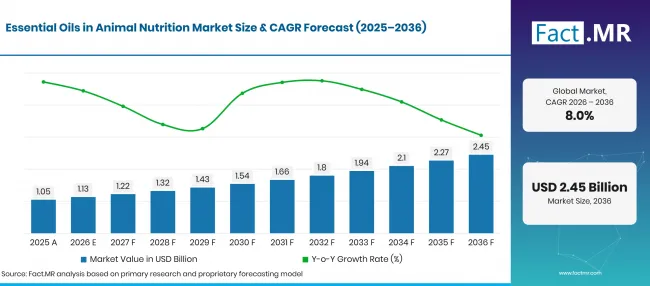
Factmr Essential Oils In Animal Nutrition Market Forecast Global | Source: Fact.MR
| Year | Basis | Market value (USD billion) |
|---|---|---|
| 2025 | Actual | 1.05 |
| 2026 | Estimate | 1.13 |
| 2036 | Forecast | 2.45 |
| CAGR, 2026 to 2036 | 8.0% | |
What are the defining numbers behind Essential Oils in Animal Nutrition Market growth?
An absolute opportunity of USD 1.4 billion will be created between 2026 and 2036.
- Demand Drivers in the Market
- Antibiotic growth promoters are being phased out on more farms. The World Organisation for Animal Health reported in May 2025 that 71% of countries in its survey had stopped using antimicrobials for growth promotion, while 22% still did so [1]. Producers that drop these drugs will turn to plant compounds for gut support.
- Animal protein output keeps expanding. The OECD-FAO Agricultural Outlook released in July 2025 projects that output of meat, dairy products and eggs will increase by 17% through 2034 [2].
- Export rules now reach farms outside Europe. EU rules that apply from 3 September 2026 require exporting countries to guarantee that animals were not given antimicrobials for growth promotion [3].
- Better delivery systems are widening use. Microencapsulation protects volatile compounds such as carvacrol and thymol through pelleting, so dosing stays consistent.
- Key Segments Analyzed
- By Product Type: Blended Oils will hold 62.8% share in 2026 since combined plant compounds act on several gut targets in one product.
- By Livestock: Poultry will account for 48.0% share in 2026, supported by large broiler flocks on short production cycles.
- By Application: Feed Additives will capture 58.3% share in 2026 owing to direct inclusion of phytogenics in compound feed and premixes.
- By Sales Channel: Specialty Stores will represent 39.2% share in 2026, given that buyers value advice on dosing and species fit.
- Analyst Opinion at Fact.MR
- Shambhu Nath Jha, Principal Consultant at Fact.MR, states, “Essential oils are now bought as a measurable gut-health input in antibiotic-free feed programs. Nutritionists will favor standardized blends with species-specific trial data and coatings that hold carvacrol and thymol through pelleting. Suppliers that pair registered products with on-farm technical service will gain the most from poultry integrators and exporters.”
- Strategic Implications
- Phytogenic suppliers should publish species-specific trials on feed conversion, since buyers compare essential oil programs with other antibiotic alternatives on results.
- Blend developers should standardize active compound content and invest in encapsulation, so potency holds through pelleting, storage and transport.
- Feed mills serving export-oriented poultry integrators should document non-antibiotic programs, given that EU buyers now require guarantees on growth promoter use.
Brazil will lead at 10.0% CAGR as poultry exporters adapt to EU growth promoter rules. Mexico will follow at 9.2% on a fast-growing poultry flock. The United States will record 8.9% on no-antibiotics-ever broiler programs. South Korea will post 7.7% with steady broiler and layer numbers. The Netherlands will reach 6.7% on a long record of antibiotic reduction, while the United Kingdom will close at 6.1% where antibiotic sales are already low.
How does the Essential Oils in Animal Nutrition Market break down by segment?
Blended Oils will lead Product Type at 62.8%; Poultry will lead Livestock at 48.0%; Feed Additives will lead Application at 58.3%; Specialty Stores will lead Sales Channel at 39.2%.
Which Product Type dominates?
Blended Oils will hold 62.8% share in 2026.
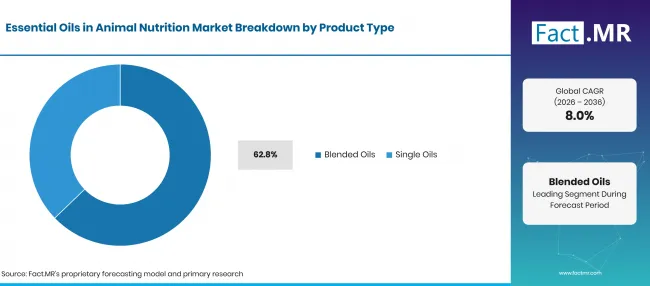
Essential Oils In Animal Nutrition Market Breakdown Product Type | Source: Fact.MR
Essential Oils in Animal Nutrition Market Breakdown by Product Type
| Product Type | Share (2026) |
|---|---|
| Blended Oils (Leading Segment) | 62.8% |
| Single Oils | 37.2% |
| Total | 100.0% |
Blended oils will lead because no single compound covers every gut-health target. Formulators combine carvacrol, thymol and cinnamaldehyde with capsicum oleoresin in one product. Blends also let suppliers tune dose by species and production stage.
Single oils serve buyers who want one defined active. Oregano oil remains a common choice for poultry and swine diets. The European Commission authorised Spanish type origanum essential oil for all animal species in July 2025, with a recommended maximum of 15 mg per kg of complete feed for chickens for fattening [4].
What supports Poultry within Livestock?
Poultry will account for 48.0% share in 2026.
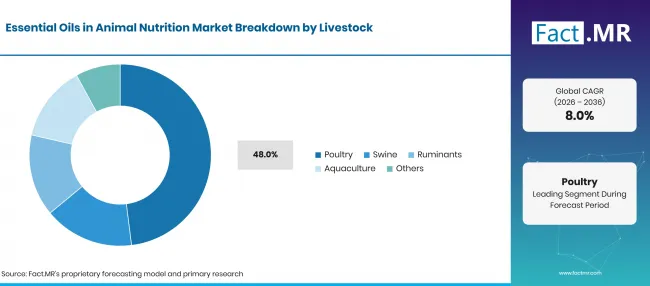
Essential Oils In Animal Nutrition Market Breakdown Livestock | Source: Fact.MR
Essential Oils in Animal Nutrition Market Breakdown by Livestock
| Livestock | Share (2026) |
|---|---|
| Poultry (Leading Segment) | 48.0% |
| Other Segments Combined | 52.0% |
| Total | 100.0% |
Poultry will lead since broiler integrators run large flocks on short cycles, where small gains in feed conversion pay back quickly. Necrotic enteritis control without in-feed antibiotics is a central reason for use. USDA reported that U.S. live weight broiler output reached 62.2 billion pounds in 2025, up 2% from 2024 [5].
Swine producers use essential oils around weaning, when piglets face feed changes and gut stress. Ruminant programs target rumen fermentation and feed intake. Aquaculture is a smaller outlet in shrimp and fish feeds.
What leads the Application segment?
Feed Additives will capture 58.3% share in 2026.
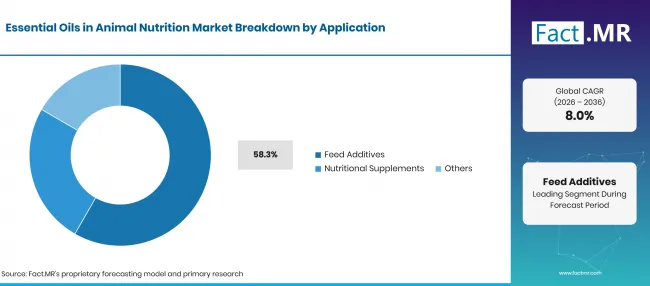
Essential Oils In Animal Nutrition Market Breakdown Application | Source: Fact.MR
Essential Oils in Animal Nutrition Market Breakdown by Application
| Application | Share (2026) |
|---|---|
| Feed Additives (Leading Segment) | 58.3% |
| Other Segments Combined | 41.7% |
| Total | 100.0% |
Feed additives will lead as mills add phytogenic products directly to compound feed through a feed premix at fixed inclusion rates. This route gives integrators uniform dosing across large batches.
Nutritional supplements cover water-soluble liquids used during stress periods such as vaccination or heat waves. These products are often paired with feed enzymes and organic acids in gut-health programs.
How does Sales Channel shape demand?
Specialty Stores will represent 39.2% share in 2026.
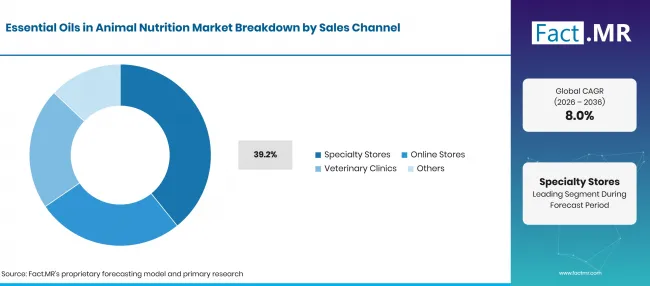
Essential Oils In Animal Nutrition Market Breakdown Sales Channel | Source: Fact.MR
Essential Oils in Animal Nutrition Market Breakdown by Sales Channel
| Sales Channel | Share (2026) |
|---|---|
| Specialty Stores (Leading Segment) | 39.2% |
| Other Segments Combined | 60.8% |
| Total | 100.0% |
Specialty stores will lead because feed dealers give advice on dose and species fit at the point of purchase. Many mid-sized farms prefer to discuss gut-health programs in person.
Online stores serve repeat buyers who compare prices across brands. Veterinary clinics sell supplements within herd health plans.
What is accelerating Essential Oils in Animal Nutrition Market adoption, and what is holding it back?
Demand will rise through antibiotic phase-outs, export rules and a focus on gut health. Growth is held back by uneven trial results and botanical raw material costs.
Drivers Impact Analysis
| DRIVER | (~) % IMPACT ON CAGR | GEOGRAPHIC RELEVANCE | IMPACT TIMELINE |
|---|---|---|---|
| Phase-out of antibiotic growth promoters in livestock feed | +2.0% | Global | Short term (<= 2 years) |
| Gut health and feed efficiency focus in poultry and swine | +1.6% | Global | Medium term (2-4 years) |
| Growth promoter guarantees required for exports to the EU | +1.2% | Latin America, North America | Short term (<= 2 years) |
| Rising livestock output in emerging economies | +0.8% | Latin America, South Asia & Pacific, East Asia | Long term (>= 4 years) |
Opportunity Impact Analysis
| OPPORTUNITY | (~) % IMPACT ON CAGR | GEOGRAPHIC RELEVANCE | IMPACT TIMELINE |
|---|---|---|---|
| Encapsulated and controlled-release essential oil formulations | +1.2% | Global | Medium term (2-4 years) |
| Species-specific blends for swine and aquaculture | +0.9% | East Asia, Latin America | Long term (>= 4 years) |
| New EU authorisations for plant-based feed additives | +0.6% | Western Europe, Eastern Europe | Medium term (2-4 years) |
| Online purchasing of farm inputs | +0.4% | North America, East Asia | Short term (<= 2 years) |
Restraints Impact Analysis
| RESTRAINT | (~) % IMPACT ON CAGR | GEOGRAPHIC RELEVANCE | IMPACT TIMELINE |
|---|---|---|---|
| Inconsistent efficacy across species and farm conditions | -0.8% | Global | Short term (<= 2 years) |
| Price and supply swings in botanical raw materials | -0.6% | Global | Medium term (2-4 years) |
| Loss of volatile compounds during pelleting and storage | -0.4% | Global | Long term (>= 4 years) |
Which countries are scaling the Essential Oils in Animal Nutrition Market through 2036?
- The country comparison spans 3.9 percentage points between Brazil at 10.0% and the United Kingdom at 6.1%.
- Brazil will keep a 0.8-point lead over Mexico, helped by exporters that must prove growth promoter-free production.
- Only 0.3 percentage point will separate Mexico from the United States, with Mexican demand drawn from a growing commercial flock.
- Antibiotic-free broiler programs will give the United States a 1.2-point edge over South Korea.
- In South Korea, stable broiler and layer numbers will leave the country 1.0 point clear of the Netherlands.
- The Netherlands will hold a 0.6-point lead over the United Kingdom, as mature antibiotic policy keeps phytogenic use routine.
- The United Kingdom will close the displayed range, where antibiotic sales are already low.
Comparable CAGRs create different entry conditions, since antibiotic rules, export exposure and livestock mix vary by country. Full report coverage includes North America, Latin America, Western Europe, Eastern Europe, East Asia, South Asia & Pacific, Middle East & Africa.
As per Fact.MR, global essential oils in animal nutrition consumption is estimated at USD 0.136 per capita in 2026, compared with USD 0.128 per capita in 2025. It will grow to USD 0.275 per capita by 2036 as livestock producers replace in-feed antibiotics with plant-based gut-health programs. Demand will rise across broiler integrators, pig farms, dairy herds and fish farms in mature and emerging economies. As per Fact.MR, the growth of essential oils in animal nutrition will come less from natural label claims and more from standardized blends, encapsulated actives and export rules on antibiotic use.
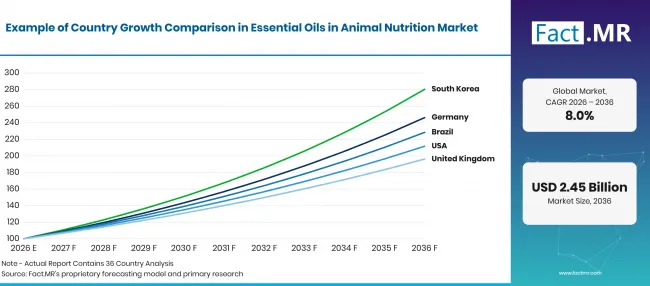
Essential Oils In Animal Nutrition Market Growth Index | Source: Fact.MR
| Country | CAGR (2026-2036) |
|---|---|
| Brazil | 10.0% |
| Mexico | 9.2% |
| United States | 8.9% |
| South Korea | 7.7% |
| Netherlands | 6.7% |
| United Kingdom | 6.1% |
What supports Brazil adoption?
10.0% CAGR, supported by record poultry output and EU growth promoter rules.
IBGE reported that 6.69 billion chickens were slaughtered in 2025, up 3.1% from 2024 [6]. In June 2026, the European Commission removed Brazil’s poultry listing for EU entry from 3 September 2026, since it had not received guarantees on growth promoter use [3].
How is Mexico scaling demand?
9.2% CAGR, driven by a fast-growing commercial poultry flock.
INEGI reported in March 2025 that the country held 531.5 million chickens in 2022, with poultry stocks up 46.4% since 2007 [7]. Integrated producers will add phytogenic blends as they modernize feed programs.
What supports United States adoption?
8.9% CAGR, supported by antibiotic-free broiler programs.
U.S. integrators run large no-antibiotics-ever programs that depend on non-drug gut-health tools. The FDA reported that sales of medically important antimicrobials for food-producing animals rose 16% between 2023 and 2024, though they stayed 27% below the 2015 peak [8].
How is South Korea developing demand?
7.7% CAGR, backed by steady broiler and layer numbers.
The Ministry of Data and Statistics reported 110.9 million broilers on farms in June 2026, up 1.0% from a year earlier, while pig numbers fell 2.2% to 10.66 million [9]. Feed mills will use plant compounds in heat-stressed summer flocks.
What is supporting the Netherlands’ adoption?
6.7% CAGR, supported by a long record of antibiotic reduction.
Dutch livestock farms have operated under tight antibiotic targets for years, so phytogenic use is already common. CBS reported 35.4 million broilers in the 2025 agricultural census, up 0.8%, while meat pig numbers fell 8.8% [10]. Shrinking pig herds limit volume growth.
How does the United Kingdom perform?
6.1% CAGR, shaped by already low antibiotic use.
The Veterinary Medicines Directorate reported that antibiotic sales for food-producing animals were 15.6 mg/kg in 2024, down 57% since 2014 [11]. Low starting use leaves less room for replacement demand.
Who leads the Essential Oils in Animal Nutrition Market?
Competition falls into two groups. Broad animal nutrition groups compete on global reach and bundled programs: Cargill sells Delacon’s Biostrong and Fresta phytogenics, Nutreco offers Selko’s Fytera Perform, and dsm-firmenich markets Digestarom blends.
In February 2026, dsm-firmenich agreed to sell its Animal Nutrition & Health business to CVC Capital Partners, with closing expected at the end of 2026 [12]. Specialist formulators compete on defined actives and registrations, including ADM with its Xtract range of feed additives. The European Commission renewed the authorisation of ADM’s carvacrol, cinnamaldehyde and capsicum oleoresin preparation for chickens for fattening in July 2026 [13]. IFF offers Enviva EO essential oils, while EW Nutrition sells Ventar D, an encapsulated gut-health product for poultry and swine. Trial evidence, EU registrations and stable actives after pelleting will decide competition through 2036
Which companies are the key providers?
Key companies include Cargill, Incorporated (including Delacon); dsm-firmenich (Animal Nutrition & Health; sale to CVC Capital Partners pending); Archer Daniels Midland Company; International Flavors & Fragrances Inc.; Nutreco (Selko); and EW Nutrition GmbH.
- Cargill, Incorporated (including Delacon)
- dsm-firmenich (Animal Nutrition & Health; sale to CVC Capital Partners pending)
- Archer Daniels Midland Company
- International Flavors & Fragrances Inc.
- Nutreco (Selko)
- EW Nutrition GmbH
Bibliography
- [1] World Organisation for Animal Health. (2025, May 24). Less antimicrobial use in animals: a win for everyone.
- [2] Food and Agriculture Organization of the United Nations. (2025, July 15). OECD-FAO Agricultural Outlook 2025-2034: Emerging economies will drive growth in animal source food consumption and production.
- [3] European Commission. (2026, June 4). Commission Implementing Regulation (EU) 2026/1189 amending Implementing Regulation (EU) 2021/405 as regards the application of the restrictions on the use of certain antimicrobial medicinal products and repealing Implementing Regulation (EU) 2024/2598.
- [4] European Commission. (2025, July 17). Commission Implementing Regulation (EU) 2025/1417 concerning the authorisation of Spanish type origanum essential oil from Thymbra capitata (L.) Cav. as a feed additive for all animal species.
- [5] United States Department of Agriculture, National Agricultural Statistics Service. (2026, April). Poultry - Production and Value 2025 Summary.
- [6] Instituto Brasileiro de Geografia e Estatística. (2026, March 18). Produção pecuária atinge recordes históricos em 2025 [Livestock production reaches historic records in 2025].
- [7] Instituto Nacional de Estadística y Geografía. (2025, March 4). Estadísticas a propósito del Día Nacional de la Ganadería [Statistics for National Livestock Day].
- [8] U.S. Food and Drug Administration. (2025, December 5). FDA Releases Annual Summary of Sales and Distribution of Antimicrobials in 2024 for Use in Food-Producing Animals.
- [9] Ministry of Data and Statistics of Korea. (2026, July 24). 2026년 2/4분기(6월 1일 기준) 가축동향조사 결과 [Livestock Trend Survey results for the second quarter of 2026, as of June 1].
- [10] Centraal Bureau voor de Statistiek. (2026, October 1). Dierlijke mest en mineralen 2025: 5. Landbouwtelling [Animal manure and minerals 2025: 5. Agricultural census].
- [11] Veterinary Medicines Directorate. (2025, November 18). Veterinary Antimicrobial Resistance and Sales Surveillance 2024.
- [12] dsm-firmenich. (2026, February 9). dsm-firmenich announces agreement to divest Animal Nutrition & Health to CVC Capital Partners.
- [13] European Commission. (2026, July 24). Commission Implementing Regulation (EU) 2026/1777 concerning the renewal of the authorisation of a preparation of carvacrol, cinnamaldehyde and capsicum oleoresin as a feed additive for chickens for fattening (holder of authorisation: ADM International Sarl, represented in the Union by ADM Specialty Ingredients (Europe) B.V.) and repealing Implementing Regulation (EU) 2015/1490
This Report Answers
- The report explains how essential oils are used in animal nutrition by product type, livestock, application and channel.
- Segment analysis identifies the subsegment that leads each segment and the farm needs behind its 2026 share.
- Country analysis compares the six listed countries through antibiotic rules, export exposure and livestock numbers.
- Competitive analysis reviews animal nutrition groups and specialist phytogenic formulators.
- Regulatory analysis tracks EU feed additive authorisations and growth promoter rules for imports
What does the Essential Oils in Animal Nutrition Market cover?
The Essential Oils in Animal Nutrition Market covers plant essential oils and phytogenic compounds added to feed or given as supplements. Typical actives include carvacrol from oregano and thymol from thyme. Cinnamaldehyde, eugenol and capsaicin come from cinnamon, clove and capsicum.
The assessment tracks single essential oils and blends of essential oils used for poultry, swine, ruminants and aquaculture. Feed-grade products draw on the wider essential oils supply chain for raw materials.
What is included in the scope?
The scope includes standardized essential oils, nature-identical actives and blends for animal feed, including encapsulated forms. It covers phytogenic products registered as sensory or zootechnical feed additives.
Combination products are included when essential oils make up the active base. Products that pair plant compounds with feed yeast or organic acids count only for their phytogenic value.
What is excluded from the scope?
The scope excludes feed fats and energy oils such as soybean oil, rice bran oil, tallow and rumen-protected fat supplements. Marine oils, including fish oil products, are also excluded.
Essential oils sold for human food, cosmetics or aromatherapy fall outside the revenue boundary. Probiotics, enzymes and organic acids sold without an essential oil base are excluded.
How Was the Analysis Built?
The analysis draws on 120+ sources, 35+ company portfolios, 25+ countries, and more than 20 industry interviews.
- Primary Research: Primary research includes discussions with manufacturers, service providers, technology developers, distributors, end users, and subject-matter experts. These conversations examine purchasing priorities, product adoption, operational challenges, approval requirements, competitive positioning, and the factors that influence wider market acceptance.
- Desk Research: Desk research covers government statistics, regulatory publications, company filings, trade data, technical studies, industry associations, standards, public policy, and other authoritative sources. Every source used in the analysis is documented in the bibliography.
- Market Sizing and Forecasting: Market estimates combine historical performance, demand indicators, pricing and volume trends, segment shares, company participation, country-level growth, adoption patterns, investment activity, and barriers to market expansion.
- Data Validation and Update Cycle: Findings are validated by comparing primary interviews with public data, company activity, regulatory changes, trade patterns, and industry developments. Regular updates review new product launches, capacity changes, partnerships, approvals, and shifts in commercial adoption.
What is the report’s scope and coverage?
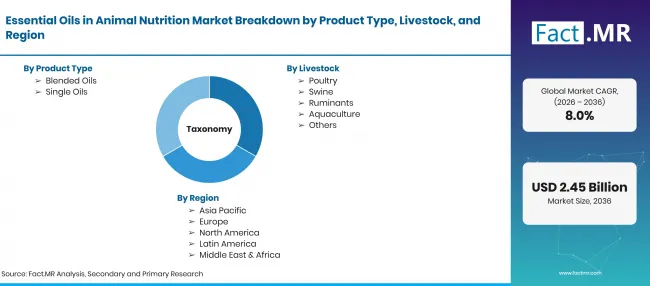
Essential Oils In Animal Nutrition Market Taxonomy | Source: Fact.MR
| Attribute | Details |
|---|---|
| Quantitative Units | USD billion |
| Market Definition | Plant essential oils and phytogenic compounds, such as carvacrol, thymol, cinnamaldehyde, eugenol and capsicum blends, used in animal feed and supplements to support gut health and performance. |
| Product Type | Blended Oils; Single Oils |
| Livestock | Poultry; Swine; Ruminants; Aquaculture |
| Application | Feed Additives; Nutritional Supplements |
| Sales Channel | Specialty Stores; Online Stores; Veterinary Clinics |
| Regions Covered | North America; Latin America; Western Europe; Eastern Europe; East Asia; South Asia & Pacific; Middle East & Africa |
| Countries Covered | Brazil; Mexico; United States; South Korea; Netherlands; United Kingdom |
| Key Companies Profiled | Cargill, Incorporated (including Delacon); dsm-firmenich (Animal Nutrition & Health); Archer Daniels Midland Company; International Flavors & Fragrances Inc.; Nutreco (Selko); EW Nutrition GmbH |
| Forecast Period | 2026 to 2036 |
| Approach | Hybrid top-down and bottom-up approach using compound feed volumes by species; phytogenic inclusion rates; antibiotic policy by country; sales channel mix; country growth; and supplier portfolio review. |
How is the market segmented?
-
By Product Type:
- Blended Oils
- Single Oils
-
By Livestock:
- Poultry
- Swine
- Ruminants
- Aquaculture
-
By Application:
- Feed Additives
- Nutritional Supplements
-
By Sales Channel:
- Specialty Stores
- Online Stores
- Veterinary Clinics
-
By Region:
- North America
- Latin America
- Western Europe
- Eastern Europe
- East Asia
- South Asia & Pacific
- Middle East & Africa