Feed Enzymes Market (2026 - 2036)
Feed Enzymes Market is segmented by Enzyme Type (Phytase, Carbohydrase, Protease, and Others), Livestock (Poultry, Swine, Ruminants, Aquaculture, and Others), Application (Feed Efficiency, Digestibility Enhancement, Nutrient Utilization, and Others), and Region. Forecast for 2026 to 2036.
Core Findings
Feed Enzymes Market Forecast 2026 to 2036
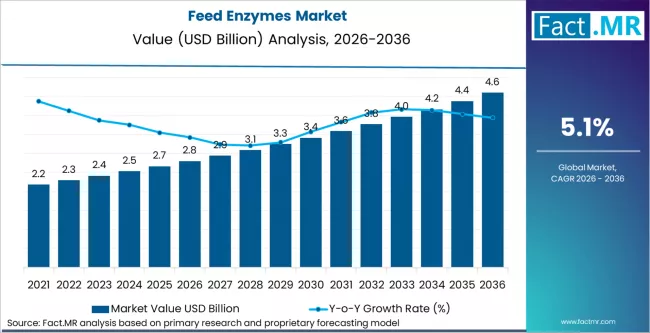
In 2025, the feed enzymes market was valued at USD 2.5 billion. Based on Fact MR's analysis, demand for feed enzymes is estimated to grow to USD 2.8 billion in 2026 and USD 4.6 billion by 2036. FMR projects a CAGR of 5.1% during the forecast period.
The absolute dollar growth from 2026 to 2036 is USD 1.8 billion. This growth is driven by increasing demand for animal feed additives that enhance nutrient absorption, improve animal health, and reduce feed costs. The rising global demand for high-quality animal products is also contributing to the growth of the feed enzymes market. However, challenges such as regulatory pressures and competition from alternative feed solutions may impact the market in some regions.
As Dr. Chris Nelson, President and CEO of Kemin Industries, noted regarding feed biosecurity and growing global feed demand, 'As the world population grows, more feed is needed to raise healthy livestock and poultry. PROSIDIUM™ is the culmination of our extensive research and innovative chemistry to create a powerful solution to safeguard feed biosecurity.'
Brazil leads with a CAGR of 6.2%, supported by strong growth in the animal farming sector and increasing demand for feed additives. China follows with a 5.8% CAGR, driven by the expansion of its livestock and poultry industries. India grows at 5.6%, fueled by rising demand for animal products and efficient feed solutions. The USA grows at 4.7%, reflecting steady demand for feed enzymes in a mature market. Germany shows growth at 4.1%, driven by increasing focus on animal nutrition and feed efficiency in the European market.
Feed Enzymes Market Definition
The feed enzymes market refers to the sale of specialized enzymes incorporated into animal feed to enhance nutrient digestion, improve feed conversion, and optimize livestock productivity.
Market Inclusions
This report covers global and regional market sizes for feed enzymes with a defined forecast period. It includes segment breakdowns by enzyme type (phytase, protease, carbohydrase, multi‑enzyme blends), application (poultry, swine, ruminants, aquaculture, pets), and form (liquid, dry). End‑use industries, pricing trends, raw material supply, and trade flow data are included to reflect overall market behavior.
Market Exclusions
The scope excludes unrelated feed additives such as antibiotics, vitamins, minerals, and premixes not primarily formulated as enzymes. Finished animal feeds and complete feed formulations are not covered. Niche enzyme products intended solely for non‑feed industrial applications (e.g., detergents, biofuels) are omitted.
Research Methodology
- Primary Research: Interviews were conducted with nutritionists, feed formulators, enzyme producers, and livestock producers.
- Desk Research: Data was sourced from industry reports, agricultural publications, and trade association statistics.
- Market‑Sizing and Forecasting: A hybrid model was used, combining top‑down livestock feed demand forecasts with bottom‑up shipment and revenue data.
- Data Validation and Update Cycle: Findings were validated through expert review and aligned with recent production and trade figures, with periodic updates.
Summary of the Feed Enzymes Market
-
Market Definition
- The Feed Enzymes Market refers to the sale of specialized enzymes incorporated into animal feed to enhance nutrient digestion, improve feed conversion, and optimize livestock productivity. These enzymes help in breaking down feed components, making nutrients more bioavailable to animals and improving overall feed efficiency.
-
Demand Drivers
- Growing demand for efficient animal feed additives that optimize nutrient absorption and enhance animal health, especially in livestock farming.
- Increasing global consumption of animal products, driving the need for efficient and cost-effective feed solutions.
- Rising focus on sustainability and regulatory requirements to reduce environmental impacts, particularly the need for reduced phosphorus waste in livestock farming.
- Expansion of the livestock sector, particularly in developing countries, which requires more advanced feed technologies.
-
Key Segments Analyzed
- Enzyme Type: Phytase is expected to dominate with 42.7% of the market share by 2026 due to its role in improving phosphorus absorption and reducing waste.
- Livestock: Poultry is anticipated to lead the market, accounting for 38.9% of the share by 2026, driven by high demand for poultry meat and eggs.
- Application: Feed efficiency is projected to be the leading application, driven by the need for optimized feed utilization and enhanced livestock growth.
- Region: Latin America, particularly Brazil, is expected to show the highest growth, with a projected CAGR of 6.2%, driven by the expansion of the agricultural and livestock sectors.
-
Analyst Opinion at FactMR
- "The Feed Enzymes Market is poised for steady growth, driven by the need for more efficient feed solutions in the expanding global livestock sector. Phytase, in particular, plays a crucial role in improving nutrient efficiency and sustainability, which is why it is expected to dominate the market moving forward." - Shambhu Nath Jha, Principal Consultant at FactMR.
-
Strategic Implications/Executive Takeaways
- Focus on developing enzyme blends that target specific livestock needs for greater feed efficiency and nutrient utilization.
- Invest in innovations that address sustainability concerns, such as enzymes that help reduce environmental pollution from livestock farming.
- Leverage opportunities in emerging markets, particularly in Latin America and Asia-Pacific, where growing livestock production is driving demand for feed enzymes.
- Collaborate with key stakeholders in the livestock industry to expand the use of advanced feed enzyme solutions in emerging economies.
-
Methodology
- Derived from primary research with nutritionists, feed formulators, enzyme producers, and livestock producers.
- Benchmarked against data from global livestock production, feed demand forecasts, and feed efficiency trends.
- Hybrid top-down and bottom-up market modeling, validated through expert reviews and recent production data.
Segmental Analysis
Feed Enzymes Market Analysis by Enzyme Type
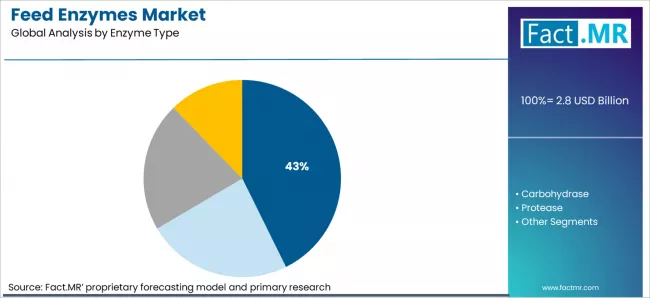
- Market Overview: Phytase is projected to hold 42.7% of the feed enzymes market by 2026. Phytase enzymes are crucial in animal feed, as they break down phytate-bound phosphorus in plant-based ingredients, making the phosphorus more bioavailable to livestock. This helps reduce phosphorus waste, improve feed efficiency, and enhance overall animal health.
- Demand Drivers:
- Enhanced Nutrient Utilization: Phytase improves the digestibility of plant-based feed, increasing the bioavailability of nutrients, particularly phosphorus, and reducing the need for supplemental phosphorus in animal diets.
- Environmental Benefits: The use of phytase in animal feed helps reduce phosphorus excretion, which can contribute to environmental pollution if not properly managed. This aligns with growing environmental concerns in the agricultural sector and the push for more sustainable farming practices.
- Regulatory and Sustainability Standards: Stricter environmental regulations regarding nutrient waste in livestock farming are driving the adoption of phytase, as it helps meet sustainability goals by optimizing feed efficiency and reducing the environmental footprint.
Feed Enzymes Market Analysis by Livestock
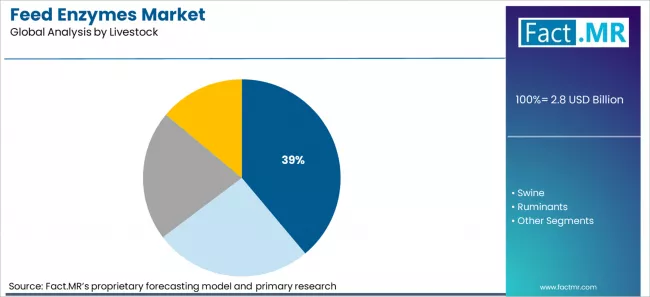
- Market Overview: Poultry is expected to account for 38.9% of the market share by 2026. Poultry farming represents a significant portion of global animal husbandry, and feed enzymes, including phytase, are widely used in poultry nutrition to improve feed conversion rates and support overall poultry health.
- Demand Drivers:
- High Demand for Poultry Products: The growing global demand for poultry meat and eggs is driving the need for improved feed efficiency. Feed enzymes like phytase are essential for optimizing nutrient utilization and ensuring the health of poultry, making them a critical part of poultry farming operations.
- Feed Efficiency and Growth Rate: Enzymes improve feed utilization and accelerate growth rates in poultry, which are important factors for poultry producers aiming to maximize production and profitability. This makes feed enzymes an integral part of poultry farming.
- Sustainability in Poultry Farming: As poultry farmers seek more sustainable practices to reduce costs and environmental impact, the use of feed enzymes to optimize nutrient absorption and reduce waste is becoming increasingly common.
Feed Enzymes Market Drivers, Restraints, and Opportunities
FMR analysts observe that the feed enzymes market is driven by the need to improve nutrient utilization and production efficiency in animal agriculture. Enzymes such as phytase, protease, and carbohydrases break down anti‑nutritional factors, enhancing feed conversion and supporting cost‑effective animal production. The 2026 valuation reflects demand from global livestock and poultry industries focused on improving feed efficiency and reducing waste.
While basic feed additives remain common, tailored enzyme blends are gaining traction due to their higher effectiveness for specific species. These advanced products drive net market value growth, with demand supported by regulatory pressures to reduce antibiotics in animal feeds and improve overall feed utilization.
- Efficiency & Nutrient Utilization: Enzyme blends improve digestion and feed conversion, replacing basic diets with more efficient alternatives.
- Regulatory Influence: Policies limiting antibiotics boost the adoption of enzymes that support animal health and performance.
- Regional Growth: Strong livestock growth in Asia‑Pacific and North America fuels enzyme demand.
Regional Analysis
The market analysis covers key global regions, including Latin America, East Asia, South Asia, North America, and Western Europe. It is segmented geographically, with specific market dynamics for each region. The full report provides a detailed market attractiveness analysis.
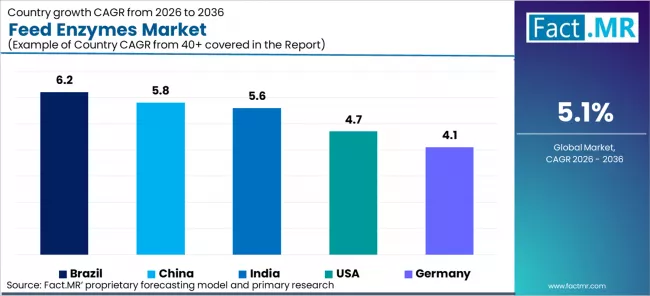
| Country | CAGR (%) |
|---|---|
| Brazil | 6.2% |
| China | 5.8% |
| India | 5.6% |
| USA | 4.7% |
| Germany | 4.1% |
Source: Fact MR (FMR) analysis, based on proprietary forecasting model and primary research.
Latin America:
In Latin America, Brazil is the leading market for feed enzymes, driven by the region's growing agricultural sector and increasing demand for efficient animal feed.
- Brazil: Demand for feed enzymes in Brazil is projected to rise at 6.2% CAGR through 2036. Brazil’s large agricultural sector and focus on enhancing animal feed efficiency continue to drive demand for feed enzymes.
East Asia:
In East Asia, China continues to dominate the feed enzymes market, supported by its vast animal farming industry and the growing demand for high-quality, cost-effective animal feed.
- China: Demand for feed enzymes in China is projected to rise at 5.8% CAGR through 2036. China’s large-scale livestock and poultry farming and increasing demand for sustainable feed solutions contribute to robust market growth.
South Asia:
In South Asia, India is witnessing increasing demand for feed enzymes, driven by the growing livestock population and the need for high-performance animal feed.
- India: Demand for feed enzymes in India is projected to rise at 5.6% CAGR through 2036. India’s expanding poultry and dairy industries and increasing awareness of feed optimization drive demand for feed enzymes.
North America:
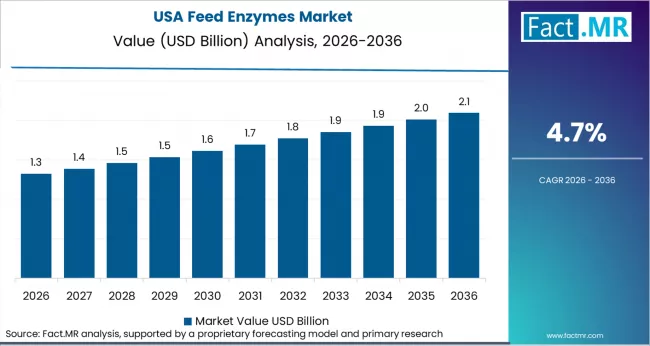
In North America, the USA remains a key market for feed enzymes, supported by the growth of the livestock and poultry industries and the increasing need for efficient, sustainable feed solutions.
- USA: Demand for feed enzymes in the U.S. is projected to rise at 4.7% CAGR through 2036. The USA’s advanced livestock farming sector and growing focus on feed optimization and animal health contribute to steady demand for feed enzymes.
Western Europe:
In Western Europe, Germany is a significant market for feed enzymes, driven by the region's advanced agricultural practices and increasing focus on animal health and feed efficiency.
- Germany: Demand for feed enzymes in Germany is projected to rise at 4.1% CAGR through 2036. Germany’s strong livestock sector and increasing demand for sustainable and efficient animal feed solutions continue to support market growth for feed enzymes.
Fact MR's analysis of the Feed Enzymes Market in Latin America, East Asia, South Asia, North America, and Western Europe consists of country-wise assessments that include Brazil, China, India, the USA, and Germany. Readers can find detailed trends, regulatory updates, and company-specific investments shaping the market’s growth in these countries.
How Are Key Players Competing in the Feed Enzymes Market?
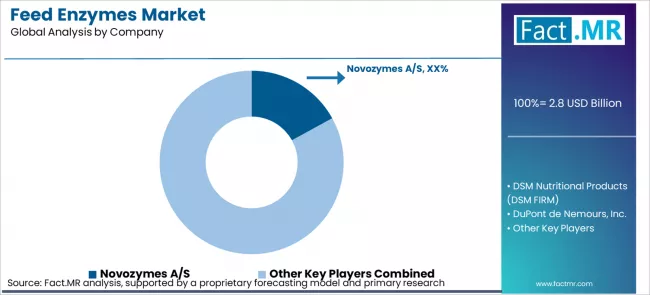
In the feed enzymes market, companies like Novozymes A/S, DSM Nutritional Products, and DuPont de Nemours, Inc. lead through continuous innovations and comprehensive enzyme solutions designed to improve feed efficiency, animal health, and sustainability. These players invest heavily in R&D to develop specialized enzymes that aid in digestibility and nutrient absorption, reducing feed costs for livestock producers. Companies such as Kemin Industries, Inc., Adisseo France S.A.S., and Alltech, Inc. focus on offering a broad range of enzyme products, including those that target specific animal species or production systems. Evonik Industries AG and Cargill, Incorporated expand their market presence through strategic partnerships, acquisitions, and expanding their enzyme portfolios for both conventional and organic feed markets. Smaller companies like Elanco Animal Health Incorporated are increasingly turning to bio-based solutions, aligning with sustainability trends and offering unique advantages for the poultry and aquaculture sectors.
Recent Industry Developments
- Novonesis Acquisition of DSM-Firmenich’s Enzyme Stake (Corporate): On February 11, 2025, Novonesis (the company formed by the merger of Novozymes and Chr. Hansen) reached a €1.5 billion agreement to acquire DSM-Firmenich’s share of their long-standing "Feed Enzyme Alliance," effectively vertically integrating the entire value chain from R&D to global sales.
- BASF Strategic Exit from Feed Enzymes (Corporate): In October 2025, BASF announced it is officially "evaluating strategic options" (seeking a buyer) for its feed enzyme business as part of its new "Differentiated Steering" model, which separates core chemical businesses from standalone units like nutrition that do not fit its integrated "Verbund" production strategy.
- EU Feed Additive Simplification Package (Regulatory): In December 2025, the European Commission proposed a major "Simplification Package" (including COM(2025) 1030 final) aimed at streamlining the renewal procedures for feed additive authorisations and introducing digital labelling options for feed enzymes to reduce administrative burdens for EU agri-food operators by late 2026.
Key Players of the Feed Enzymes Market
- Novozymes A/S
- DSM Nutritional Products (DSM FIRM)
- DuPont de Nemours, Inc.
- AB Enzymes GmbH
- Kemin Industries, Inc.
- Adisseo France S.A.S.
- Alltech, Inc.
- Elanco Animal Health Incorporated
- Cargill, Incorporated
- Evonik Industries AG
Report Scope
| Metric | Value |
|---|---|
| Quantitative Units | USD 2.8 billion (2026) to USD 4.6 billion (2036), at a CAGR of 5.1% |
| Market Definition | The Feed Enzymes Market includes enzymes used in animal feed to improve feed efficiency, digestibility, and nutrient utilization, enhancing livestock growth and health across various species. |
| By Enzyme Type | Phytase, Carbohydrase, Protease, Others |
| By Livestock | Poultry, Swine, Ruminants, Aquaculture, Others |
| By Application | Feed Efficiency, Digestibility Enhancement, Nutrient Utilization, Others |
| Regions Covered | North America, Latin America, Europe, East Asia, South Asia, Oceania, Middle East and Africa |
| Countries Covered | United States, Canada, Mexico, Brazil, Argentina, Germany, France, United Kingdom, Italy, Spain, China, India, Japan, South Korea, Indonesia, Australia, and 40+ countries |
| Key Companies Profiled | Novozymes A/S, DSM Nutritional Products (DSM FIRM), DuPont de Nemours, Inc., AB Enzymes GmbH, Kemin Industries, Inc., Adisseo France S.A.S., Alltech, Inc., Elanco Animal Health Incorporated, Cargill, Incorporated, Evonik Industries AG |
| Forecast Period | 2026 to 2036 |
| Approach | Hybrid top-down and bottom-up market modeling validated through primary interviews with manufacturers and supported by trade data benchmarking and market research. |
Feed Enzymes Market Key Segments
-
Enzyme Type :
- Phytase
- Carbohydrase
- Protease
- Others
-
Livestock :
- Poultry
- Swine
- Ruminants
- Aquaculture
- Others
-
Application :
- Feed Efficiency
- Digestibility Enhancement
- Nutrient Utilization
- Others
-
Region :
- North America
- USA
- Canada
- Mexico
- Europe
- Germany
- UK
- France
- Italy
- Spain
- Nordic Countries
- BENELUX
- Rest of Europe
- Asia Pacific
- China
- Japan
- South Korea
- India
- Australia
- Rest of Asia Pacific
- Latin America
- Brazil
- Argentina
- Rest of Latin America
- Middle East and Africa
- Kingdom of Saudi Arabia
- United Arab Emirates
- South Africa
- Rest of Middle East and Africa
- Other Regions
- Oceania
- Central Asia
- Other Markets
- North America

Bibliographies
- Kemin Industries, Inc. (2025, October 12). Kemin launches PROSIDIUM™ feed additive to address biosecurity and feed industry demands [Press release]. Kemin Industries, Inc.
- Novonesis A/S. (2025, February 11). Novonesis acquires dsm-firmenich’s share of the Feed Enzyme Alliance for €1.5 billion [Press release]. Novonesis A/S.
- BASF SE. (2025, October). BASF evaluates strategic options for its feed enzyme business under new differentiated steering model [Corporate statement]. BASF SE.
- European Commission. (2025, December). Proposal for a regulation on the simplification of authorisation and labelling procedures for feed additives [Legislative proposal]. European Commission.
This report addresses
- Market intelligence enabling comprehensive assessment of leading countries and product segments across the Feed Enzymes Market globally.
- Market volume (sales units) estimates and 10-year revenue forecasts from 2026 to 2036, validated through manufacturer shipment data, channel partner surveys, and country-level demand modeling.
- Growth opportunity mapping across enzyme types (Phytase, Carbohydrase, Protease, and Others), livestock (Poultry, Swine, Ruminants, Aquaculture, and Others), and applications (Feed Efficiency, Digestibility Enhancement, Nutrient Utilization, and Others).
- Segment and regional revenue forecasts by enzyme type, livestock, application, and geography across 40+ countries.
- Competition strategy analysis covering dealer network structure, recent developments, product portfolio, USPs, and market share analysis.
- Product and regulatory compliance tracking aligned with national animal feed standards, sustainability practices, and municipal procurement requirements.
- Regulatory impact analysis addressing environmental regulations, feed efficiency mandates, and livestock industry standards across key markets.
- Report delivery in PDF, Excel, PowerPoint, and interactive dashboard formats for executive, procurement, and operational planning use.
Table of Content
- Executive Summary
- Global Market Outlook
- Demand to side Trends
- Supply to side Trends
- Technology Roadmap Analysis
- Analysis and Recommendations
- Market Overview
- Market Coverage / Taxonomy
- Market Definition / Scope / Limitations
- Research Methodology
- Chapter Orientation
- Analytical Lens and Working Hypotheses
- Market Structure, Signals, and Trend Drivers
- Benchmarking and Cross-market Comparability
- Market Sizing, Forecasting, and Opportunity Mapping
- Research Design and Evidence Framework
- Desk Research Programme (Secondary Evidence)
- Company Annual and Sustainability Reports
- Peer-reviewed Journals and Academic Literature
- Corporate Websites, Product Literature, and Technical Notes
- Earnings Decks and Investor Briefings
- Statutory Filings and Regulatory Disclosures
- Technical White Papers and Standards Notes
- Trade Journals, Industry Magazines, and Analyst Briefs
- Conference Proceedings, Webinars, and Seminar Materials
- Government Statistics Portals and Public Data Releases
- Press Releases and Reputable Media Coverage
- Specialist Newsletters and Curated Briefings
- Sector Databases and Reference Repositories
- FMR Internal Proprietary Databases and Historical Market Datasets
- Subscription Datasets and Paid Sources
- Social Channels, Communities, and Digital Listening Inputs
- Additional Desk Sources
- Expert Input and Fieldwork (Primary Evidence)
- Primary Modes
- Qualitative Interviews and Expert Elicitation
- Quantitative Surveys and Structured Data Capture
- Blended Approach
- Why Primary Evidence is Used
- Field Techniques
- Interviews
- Surveys
- Focus Groups
- Observational and In-context Research
- Social and Community Interactions
- Stakeholder Universe Engaged
- C-suite Leaders
- Board Members
- Presidents and Vice Presidents
- R&D and Innovation Heads
- Technical Specialists
- Domain Subject-matter Experts
- Scientists
- Physicians and Other Healthcare Professionals
- Governance, Ethics, and Data Stewardship
- Research Ethics
- Data Integrity and Handling
- Primary Modes
- Tooling, Models, and Reference Databases
- Desk Research Programme (Secondary Evidence)
- Data Engineering and Model Build
- Data Acquisition and Ingestion
- Cleaning, Normalisation, and Verification
- Synthesis, Triangulation, and Analysis
- Quality Assurance and Audit Trail
- Market Background
- Market Dynamics
- Drivers
- Restraints
- Opportunity
- Trends
- Scenario Forecast
- Demand in Optimistic Scenario
- Demand in Likely Scenario
- Demand in Conservative Scenario
- Opportunity Map Analysis
- Product Life Cycle Analysis
- Supply Chain Analysis
- Investment Feasibility Matrix
- Value Chain Analysis
- PESTLE and Porter’s Analysis
- Regulatory Landscape
- Regional Parent Market Outlook
- Production and Consumption Statistics
- Import and Export Statistics
- Market Dynamics
- Global Market Analysis 2021 to 2025 and Forecast, 2026 to 2036
- Historical Market Size Value (USD Million) Analysis, 2021 to 2025
- Current and Future Market Size Value (USD Million) Projections, 2026 to 2036
- Y to o to Y Growth Trend Analysis
- Absolute $ Opportunity Analysis
- Global Market Pricing Analysis 2021 to 2025 and Forecast 2026 to 2036
- Global Market Analysis 2021 to 2025 and Forecast 2026 to 2036, By Enzyme Type
- Introduction / Key Findings
- Historical Market Size Value (USD Million) Analysis By Enzyme Type , 2021 to 2025
- Current and Future Market Size Value (USD Million) Analysis and Forecast By Enzyme Type , 2026 to 2036
- Phytase
- Carbohydrase
- Protease
- Others
- Phytase
- Y to o to Y Growth Trend Analysis By Enzyme Type , 2021 to 2025
- Absolute $ Opportunity Analysis By Enzyme Type , 2026 to 2036
- Global Market Analysis 2021 to 2025 and Forecast 2026 to 2036, By Livestock
- Introduction / Key Findings
- Historical Market Size Value (USD Million) Analysis By Livestock, 2021 to 2025
- Current and Future Market Size Value (USD Million) Analysis and Forecast By Livestock, 2026 to 2036
- Poultry
- Swine
- Ruminants
- Aquaculture
- Poultry
- Y to o to Y Growth Trend Analysis By Livestock, 2021 to 2025
- Absolute $ Opportunity Analysis By Livestock, 2026 to 2036
- Global Market Analysis 2021 to 2025 and Forecast 2026 to 2036, By Region
- Introduction
- Historical Market Size Value (USD Million) Analysis By Region, 2021 to 2025
- Current Market Size Value (USD Million) Analysis and Forecast By Region, 2026 to 2036
- North America
- Latin America
- Western Europe
- Eastern Europe
- East Asia
- South Asia and Pacific
- Middle East & Africa
- Market Attractiveness Analysis By Region
- North America Market Analysis 2021 to 2025 and Forecast 2026 to 2036, By Country
- Historical Market Size Value (USD Million) Trend Analysis By Market Taxonomy, 2021 to 2025
- Market Size Value (USD Million) Forecast By Market Taxonomy, 2026 to 2036
- By Country
- USA
- Canada
- Mexico
- By Enzyme Type
- By Livestock
- By Country
- Market Attractiveness Analysis
- By Country
- By Enzyme Type
- By Livestock
- Key Takeaways
- Latin America Market Analysis 2021 to 2025 and Forecast 2026 to 2036, By Country
- Historical Market Size Value (USD Million) Trend Analysis By Market Taxonomy, 2021 to 2025
- Market Size Value (USD Million) Forecast By Market Taxonomy, 2026 to 2036
- By Country
- Brazil
- Chile
- Rest of Latin America
- By Enzyme Type
- By Livestock
- By Country
- Market Attractiveness Analysis
- By Country
- By Enzyme Type
- By Livestock
- Key Takeaways
- Western Europe Market Analysis 2021 to 2025 and Forecast 2026 to 2036, By Country
- Historical Market Size Value (USD Million) Trend Analysis By Market Taxonomy, 2021 to 2025
- Market Size Value (USD Million) Forecast By Market Taxonomy, 2026 to 2036
- By Country
- Germany
- UK
- Italy
- Spain
- France
- Nordic
- BENELUX
- Rest of Western Europe
- By Enzyme Type
- By Livestock
- By Country
- Market Attractiveness Analysis
- By Country
- By Enzyme Type
- By Livestock
- Key Takeaways
- Eastern Europe Market Analysis 2021 to 2025 and Forecast 2026 to 2036, By Country
- Historical Market Size Value (USD Million) Trend Analysis By Market Taxonomy, 2021 to 2025
- Market Size Value (USD Million) Forecast By Market Taxonomy, 2026 to 2036
- By Country
- Russia
- Poland
- Hungary
- Balkan & Baltic
- Rest of Eastern Europe
- By Enzyme Type
- By Livestock
- By Country
- Market Attractiveness Analysis
- By Country
- By Enzyme Type
- By Livestock
- Key Takeaways
- East Asia Market Analysis 2021 to 2025 and Forecast 2026 to 2036, By Country
- Historical Market Size Value (USD Million) Trend Analysis By Market Taxonomy, 2021 to 2025
- Market Size Value (USD Million) Forecast By Market Taxonomy, 2026 to 2036
- By Country
- China
- Japan
- South Korea
- By Enzyme Type
- By Livestock
- By Country
- Market Attractiveness Analysis
- By Country
- By Enzyme Type
- By Livestock
- Key Takeaways
- South Asia and Pacific Market Analysis 2021 to 2025 and Forecast 2026 to 2036, By Country
- Historical Market Size Value (USD Million) Trend Analysis By Market Taxonomy, 2021 to 2025
- Market Size Value (USD Million) Forecast By Market Taxonomy, 2026 to 2036
- By Country
- India
- ASEAN
- Australia & New Zealand
- Rest of South Asia and Pacific
- By Enzyme Type
- By Livestock
- By Country
- Market Attractiveness Analysis
- By Country
- By Enzyme Type
- By Livestock
- Key Takeaways
- Middle East & Africa Market Analysis 2021 to 2025 and Forecast 2026 to 2036, By Country
- Historical Market Size Value (USD Million) Trend Analysis By Market Taxonomy, 2021 to 2025
- Market Size Value (USD Million) Forecast By Market Taxonomy, 2026 to 2036
- By Country
- Kingdom of Saudi Arabia
- Other GCC Countries
- Turkiye
- South Africa
- Other African Union
- Rest of Middle East & Africa
- By Enzyme Type
- By Livestock
- By Country
- Market Attractiveness Analysis
- By Country
- By Enzyme Type
- By Livestock
- Key Takeaways
- Key Countries Market Analysis
- USA
- Pricing Analysis
- Market Share Analysis, 2025
- By Enzyme Type
- By Livestock
- Canada
- Pricing Analysis
- Market Share Analysis, 2025
- By Enzyme Type
- By Livestock
- Mexico
- Pricing Analysis
- Market Share Analysis, 2025
- By Enzyme Type
- By Livestock
- Brazil
- Pricing Analysis
- Market Share Analysis, 2025
- By Enzyme Type
- By Livestock
- Chile
- Pricing Analysis
- Market Share Analysis, 2025
- By Enzyme Type
- By Livestock
- Germany
- Pricing Analysis
- Market Share Analysis, 2025
- By Enzyme Type
- By Livestock
- UK
- Pricing Analysis
- Market Share Analysis, 2025
- By Enzyme Type
- By Livestock
- Italy
- Pricing Analysis
- Market Share Analysis, 2025
- By Enzyme Type
- By Livestock
- Spain
- Pricing Analysis
- Market Share Analysis, 2025
- By Enzyme Type
- By Livestock
- France
- Pricing Analysis
- Market Share Analysis, 2025
- By Enzyme Type
- By Livestock
- India
- Pricing Analysis
- Market Share Analysis, 2025
- By Enzyme Type
- By Livestock
- ASEAN
- Pricing Analysis
- Market Share Analysis, 2025
- By Enzyme Type
- By Livestock
- Australia & New Zealand
- Pricing Analysis
- Market Share Analysis, 2025
- By Enzyme Type
- By Livestock
- China
- Pricing Analysis
- Market Share Analysis, 2025
- By Enzyme Type
- By Livestock
- Japan
- Pricing Analysis
- Market Share Analysis, 2025
- By Enzyme Type
- By Livestock
- South Korea
- Pricing Analysis
- Market Share Analysis, 2025
- By Enzyme Type
- By Livestock
- Russia
- Pricing Analysis
- Market Share Analysis, 2025
- By Enzyme Type
- By Livestock
- Poland
- Pricing Analysis
- Market Share Analysis, 2025
- By Enzyme Type
- By Livestock
- Hungary
- Pricing Analysis
- Market Share Analysis, 2025
- By Enzyme Type
- By Livestock
- Kingdom of Saudi Arabia
- Pricing Analysis
- Market Share Analysis, 2025
- By Enzyme Type
- By Livestock
- Turkiye
- Pricing Analysis
- Market Share Analysis, 2025
- By Enzyme Type
- By Livestock
- South Africa
- Pricing Analysis
- Market Share Analysis, 2025
- By Enzyme Type
- By Livestock
- USA
- Market Structure Analysis
- Competition Dashboard
- Competition Benchmarking
- Market Share Analysis of Top Players
- By Regional
- By Enzyme Type
- By Livestock
- Competition Analysis
- Competition Deep Dive
- Novozymes A/S
- Overview
- Product Portfolio
- Profitability by Market Segments (Product/Age /Sales Channel/Region)
- Sales Footprint
- Strategy Overview
- Marketing Strategy
- Product Strategy
- Channel Strategy
- DSM Nutritional Products (DSM FIRM)
- DuPont de Nemours, Inc.
- AB Enzymes GmbH
- Kemin Industries, Inc.
- Adisseo France S.A.S.
- Novozymes A/S
- Competition Deep Dive
- Assumptions & Acronyms Used
List Of Table
- Table 1: Global Market Value (USD Million) Forecast by Region, 2021 to 2036
- Table 2: Global Market Value (USD Million) Forecast by Enzyme Type , 2021 to 2036
- Table 3: Global Market Value (USD Million) Forecast by Livestock, 2021 to 2036
- Table 4: North America Market Value (USD Million) Forecast by Country, 2021 to 2036
- Table 5: North America Market Value (USD Million) Forecast by Enzyme Type , 2021 to 2036
- Table 6: North America Market Value (USD Million) Forecast by Livestock, 2021 to 2036
- Table 7: Latin America Market Value (USD Million) Forecast by Country, 2021 to 2036
- Table 8: Latin America Market Value (USD Million) Forecast by Enzyme Type , 2021 to 2036
- Table 9: Latin America Market Value (USD Million) Forecast by Livestock, 2021 to 2036
- Table 10: Western Europe Market Value (USD Million) Forecast by Country, 2021 to 2036
- Table 11: Western Europe Market Value (USD Million) Forecast by Enzyme Type , 2021 to 2036
- Table 12: Western Europe Market Value (USD Million) Forecast by Livestock, 2021 to 2036
- Table 13: Eastern Europe Market Value (USD Million) Forecast by Country, 2021 to 2036
- Table 14: Eastern Europe Market Value (USD Million) Forecast by Enzyme Type , 2021 to 2036
- Table 15: Eastern Europe Market Value (USD Million) Forecast by Livestock, 2021 to 2036
- Table 16: East Asia Market Value (USD Million) Forecast by Country, 2021 to 2036
- Table 17: East Asia Market Value (USD Million) Forecast by Enzyme Type , 2021 to 2036
- Table 18: East Asia Market Value (USD Million) Forecast by Livestock, 2021 to 2036
- Table 19: South Asia and Pacific Market Value (USD Million) Forecast by Country, 2021 to 2036
- Table 20: South Asia and Pacific Market Value (USD Million) Forecast by Enzyme Type , 2021 to 2036
- Table 21: South Asia and Pacific Market Value (USD Million) Forecast by Livestock, 2021 to 2036
- Table 22: Middle East & Africa Market Value (USD Million) Forecast by Country, 2021 to 2036
- Table 23: Middle East & Africa Market Value (USD Million) Forecast by Enzyme Type , 2021 to 2036
- Table 24: Middle East & Africa Market Value (USD Million) Forecast by Livestock, 2021 to 2036
List Of Figures
- Figure 1: Global Market Pricing Analysis
- Figure 2: Global Market Value (USD Million) Forecast 2021 to 2036
- Figure 3: Global Market Value Share and BPS Analysis by Enzyme Type , 2026 and 2036
- Figure 4: Global Market Y to o to Y Growth Comparison by Enzyme Type , 2026 to 2036
- Figure 5: Global Market Attractiveness Analysis by Enzyme Type
- Figure 6: Global Market Value Share and BPS Analysis by Livestock, 2026 and 2036
- Figure 7: Global Market Y to o to Y Growth Comparison by Livestock, 2026 to 2036
- Figure 8: Global Market Attractiveness Analysis by Livestock
- Figure 9: Global Market Value (USD Million) Share and BPS Analysis by Region, 2026 and 2036
- Figure 10: Global Market Y to o to Y Growth Comparison by Region, 2026 to 2036
- Figure 11: Global Market Attractiveness Analysis by Region
- Figure 12: North America Market Incremental Dollar Opportunity, 2026 to 2036
- Figure 13: Latin America Market Incremental Dollar Opportunity, 2026 to 2036
- Figure 14: Western Europe Market Incremental Dollar Opportunity, 2026 to 2036
- Figure 15: Eastern Europe Market Incremental Dollar Opportunity, 2026 to 2036
- Figure 16: East Asia Market Incremental Dollar Opportunity, 2026 to 2036
- Figure 17: South Asia and Pacific Market Incremental Dollar Opportunity, 2026 to 2036
- Figure 18: Middle East & Africa Market Incremental Dollar Opportunity, 2026 to 2036
- Figure 19: North America Market Value Share and BPS Analysis by Country, 2026 and 2036
- Figure 20: North America Market Value Share and BPS Analysis by Enzyme Type , 2026 and 2036
- Figure 21: North America Market Y to o to Y Growth Comparison by Enzyme Type , 2026 to 2036
- Figure 22: North America Market Attractiveness Analysis by Enzyme Type
- Figure 23: North America Market Value Share and BPS Analysis by Livestock, 2026 and 2036
- Figure 24: North America Market Y to o to Y Growth Comparison by Livestock, 2026 to 2036
- Figure 25: North America Market Attractiveness Analysis by Livestock
- Figure 26: Latin America Market Value Share and BPS Analysis by Country, 2026 and 2036
- Figure 27: Latin America Market Value Share and BPS Analysis by Enzyme Type , 2026 and 2036
- Figure 28: Latin America Market Y to o to Y Growth Comparison by Enzyme Type , 2026 to 2036
- Figure 29: Latin America Market Attractiveness Analysis by Enzyme Type
- Figure 30: Latin America Market Value Share and BPS Analysis by Livestock, 2026 and 2036
- Figure 31: Latin America Market Y to o to Y Growth Comparison by Livestock, 2026 to 2036
- Figure 32: Latin America Market Attractiveness Analysis by Livestock
- Figure 33: Western Europe Market Value Share and BPS Analysis by Country, 2026 and 2036
- Figure 34: Western Europe Market Value Share and BPS Analysis by Enzyme Type , 2026 and 2036
- Figure 35: Western Europe Market Y to o to Y Growth Comparison by Enzyme Type , 2026 to 2036
- Figure 36: Western Europe Market Attractiveness Analysis by Enzyme Type
- Figure 37: Western Europe Market Value Share and BPS Analysis by Livestock, 2026 and 2036
- Figure 38: Western Europe Market Y to o to Y Growth Comparison by Livestock, 2026 to 2036
- Figure 39: Western Europe Market Attractiveness Analysis by Livestock
- Figure 40: Eastern Europe Market Value Share and BPS Analysis by Country, 2026 and 2036
- Figure 41: Eastern Europe Market Value Share and BPS Analysis by Enzyme Type , 2026 and 2036
- Figure 42: Eastern Europe Market Y to o to Y Growth Comparison by Enzyme Type , 2026 to 2036
- Figure 43: Eastern Europe Market Attractiveness Analysis by Enzyme Type
- Figure 44: Eastern Europe Market Value Share and BPS Analysis by Livestock, 2026 and 2036
- Figure 45: Eastern Europe Market Y to o to Y Growth Comparison by Livestock, 2026 to 2036
- Figure 46: Eastern Europe Market Attractiveness Analysis by Livestock
- Figure 47: East Asia Market Value Share and BPS Analysis by Country, 2026 and 2036
- Figure 48: East Asia Market Value Share and BPS Analysis by Enzyme Type , 2026 and 2036
- Figure 49: East Asia Market Y to o to Y Growth Comparison by Enzyme Type , 2026 to 2036
- Figure 50: East Asia Market Attractiveness Analysis by Enzyme Type
- Figure 51: East Asia Market Value Share and BPS Analysis by Livestock, 2026 and 2036
- Figure 52: East Asia Market Y to o to Y Growth Comparison by Livestock, 2026 to 2036
- Figure 53: East Asia Market Attractiveness Analysis by Livestock
- Figure 54: South Asia and Pacific Market Value Share and BPS Analysis by Country, 2026 and 2036
- Figure 55: South Asia and Pacific Market Value Share and BPS Analysis by Enzyme Type , 2026 and 2036
- Figure 56: South Asia and Pacific Market Y to o to Y Growth Comparison by Enzyme Type , 2026 to 2036
- Figure 57: South Asia and Pacific Market Attractiveness Analysis by Enzyme Type
- Figure 58: South Asia and Pacific Market Value Share and BPS Analysis by Livestock, 2026 and 2036
- Figure 59: South Asia and Pacific Market Y to o to Y Growth Comparison by Livestock, 2026 to 2036
- Figure 60: South Asia and Pacific Market Attractiveness Analysis by Livestock
- Figure 61: Middle East & Africa Market Value Share and BPS Analysis by Country, 2026 and 2036
- Figure 62: Middle East & Africa Market Value Share and BPS Analysis by Enzyme Type , 2026 and 2036
- Figure 63: Middle East & Africa Market Y to o to Y Growth Comparison by Enzyme Type , 2026 to 2036
- Figure 64: Middle East & Africa Market Attractiveness Analysis by Enzyme Type
- Figure 65: Middle East & Africa Market Value Share and BPS Analysis by Livestock, 2026 and 2036
- Figure 66: Middle East & Africa Market Y to o to Y Growth Comparison by Livestock, 2026 to 2036
- Figure 67: Middle East & Africa Market Attractiveness Analysis by Livestock
- Figure 68: Global Market - Tier Structure Analysis
- Figure 69: Global Market - Company Share Analysis
- FAQs -
How large is the demand for Feed Enzymes in the global market in 2026?
Demand for Feed Enzymes in the global market is estimated to be valued at USD 2.8 billion in 2026.
What will be the market size of Feed Enzymes in the global market by 2036?
The market size for Feed Enzymes is projected to reach USD 4.6 billion by 2036.
What is the expected demand growth for Feed Enzymes in the global market between 2026 and 2036?
Demand for Feed Enzymes in the global market is expected to grow at a CAGR of 5.1% between 2026 and 2036.
Which enzyme type is expected to dominate the market?
Phytase is expected to dominate the market, accounting for 42.7% of the market share in 2026, due to its effectiveness in improving nutrient utilization and reducing phosphorus emissions in animal feed.
Which region is expected to show the highest growth rate for Feed Enzymes?
Brazil is projected to show the highest regional CAGR at 6.2% during the forecast period, driven by the country’s expanding livestock industry and the increasing demand for feed enzymes to enhance animal feed efficiency.
How significant is the growth outlook for China in this market?
China is expected to grow at a CAGR of 5.8%, reflecting strong demand for feed enzymes driven by the country’s rapidly growing livestock sector and the need for more efficient and sustainable feed formulations.
What is the growth outlook for India in this report?
India is anticipated to grow at a CAGR of 5.6% from 2026 to 2036, supported by a growing demand for high-quality animal feed additives and increasing adoption of feed enzymes to enhance animal health and productivity.
What is the growth forecast for the United States in the Feed Enzymes market?
The United States is expected to grow at a CAGR of 4.7%, supported by the country's large animal feed industry and increasing adoption of feed enzymes to improve feed efficiency and animal health.
What is the growth forecast for Germany in the Feed Enzymes market?
Germany is expected to grow at a CAGR of 4.1%, driven by the growing focus on animal feed sustainability and increasing demand for feed additives that improve the performance and efficiency of livestock feed.
Which company is identified as a leading player in the Feed Enzymes market?
Novozymes A/S is recognized as a leading player in this market, providing a wide range of feed enzymes, including phytase, to enhance the nutritional value and sustainability of animal feed.
What are Feed Enzymes used for?
Feed Enzymes are used in animal feed to improve the digestibility of nutrients, enhance feed efficiency, and promote better growth and health of livestock. They help break down complex feed ingredients, making nutrients more accessible for animals.
What does the Feed Enzymes market include in this report?
The market scope includes enzymes used in animal feed, particularly phytase, which is widely used to improve phosphorus utilization and reduce environmental impact, and other enzymes that enhance the digestibility and efficiency of animal feed.
How is the market forecast developed in this report?
The forecast is developed using historical data on feed enzyme adoption, trends in livestock production, and insights from key industry players involved in the production and distribution of feed enzymes.
What is meant by the Feed Enzymes market in this report?
The market refers to the global production, trade, and consumption of feed enzymes used in animal nutrition, focusing on enzymes that improve the quality, efficiency, and sustainability of animal feed formulations.