- Market Value (2025): USD 65.3 Mn
- Estimated Value (2026): USD 77.8 Mn
- Forecast Value (2036): USD 445.3 Mn
- CAGR (2026-2036): 19.1%
What is the Executive Cognitive-Fitness Retreats Market forecast to be worth by 2036?
USD 77.8 million in 2026 to USD 445.3 million by 2036 at a 19.1% CAGR.
- The executive cognitive-fitness retreats market reached a value of USD 65.3 million in 2025, a small base built mainly on premium destination stays and private executive bookings.
- Revenue will expand from USD 77.8 million in 2026 to USD 445.3 million by 2036 as operators add attention training, sleep recovery and cognitive performance coaching to their menus.
- A 19.1% CAGR for 2026 to 2036 reflects employer spending on workplace mental health, wider interest in preventive brain care and the shift toward recurring memberships.
| Year | Basis | Market Value (USD million) |
|---|---|---|
| 2025 | Actual | 65.3 |
| 2026 | Estimate | 77.8 |
| 2036 | Forecast | 445.3 |
| CAGR 2026 to 2036 | Forecast period | 19.1% |
Source: Fact.MR analysis. Updated Nov 12, 2026
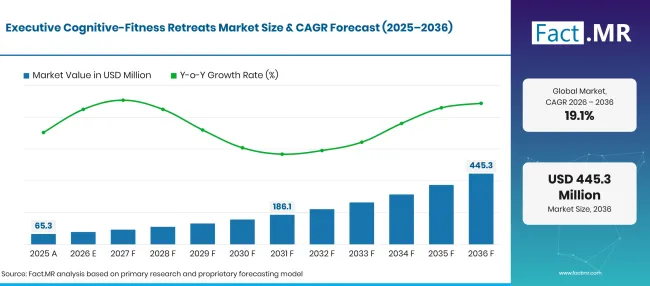
Executive Cognitive Fitness Retreats Forecast Global | Source: Fact.MR
What are the defining numbers behind Executive Cognitive-Fitness Retreats Market growth?
The 2026 to 2036 period adds USD 367.5 million in new value, with recurring memberships, hybrid delivery and older participants accounting for much of the gain.
- Demand Drivers in the Market
- Workplace strain is pushing professionals toward retreats that address mental fatigue and focus. Globally, an estimated 12 billion working days are lost every year to depression and anxiety, at a cost of USD 1 trillion in lost productivity.
- The scale of mental health need is widening the pool of potential participants. More than 1 billion people live with mental health conditions, according to WHO figures released in September 2025.
- Preventive brain care is gaining formal guidance. The second edition of WHO guidelines on risk reduction of cognitive decline and dementia, published in July 2026, adds advice on multidomain interventions that combine several healthy behaviours.
- Movement is becoming a standard part of cognitive programmes. WHO states that physical activity enhances brain health in adults, yet 31% of adults do not meet the recommended activity levels.
- Corporate wellness budgets are opening space for private group bookings. Employers want resilience sessions for leadership teams that can be measured and repeated each year.
- Key Segments Analyzed
- By Executive Cognitive Retreat Focus: Stress Resilience will hold 33.5% share in 2026 because pressure at work is a frequent trigger for an executive’s first cognitive programme.
- By Access / Commercial Model: Monthly Membership will account for 31.9% of 2026 value, since a regular schedule suits participants who want progress between residential stays.
- By Operating Setting: Hybrid Pop-up / Digital will capture 27.0% in 2026 as providers combine short on-site sessions with remote follow-up for busy participants.
- By Core Visitor Group: Active Older Adults will represent 30.4% of 2026 revenue, reflecting rising attention to memory, mental engagement and healthy ageing.
- Analyst Opinion at Fact.MR
- Shambhu Nath Jha, Principal Consultant at Fact.MR, states, “Executive cognitive-fitness retreats will grow from a niche premium service into a planned part of leadership and healthy ageing budgets. Providers that pair baseline assessments with stress resilience coaching and clear follow-up will win repeat bookings. Over the next ten years, memberships, corporate contracts and measurable outcomes will separate credible programmes from general spa stays.”
- Strategic Implications
- Retreat operators should publish the structure behind each programme, including assessment methods, practitioner qualifications and session frequency, so buyers can compare offers on substance.
- Hospitality groups should build membership tiers and digital follow-up into existing wellness properties, turning one-time stays into recurring revenue.
- Employers should assess providers on their ability to tailor sessions to leadership demands and to report participation and outcome data after each programme.
- Investors should favour operators with trained neurofeedback and sleep specialists, since staff depth limits how quickly a cognitive programme can be copied.
Country growth ranges from 21.9% in the UAE to 17.7% in Germany. The UAE gains from premium hotel capacity and new wellness openings, while Thailand at 20.9% draws on its resort network and international wellness events. The United States at 19.8% has the deepest corporate wellness spending, though high prices slow uptake outside senior roles. Japan at 18.4% leans on its ageing population, and Germany at 17.7% grows from a mature medical wellness base where new demand comes mainly from preventive brain checks.
How does the Executive Cognitive-Fitness Retreats Market break down by segment?
Stress Resilience will lead Executive Cognitive Retreat Focus at 33.5%; Monthly Membership will head Access / Commercial Model at 31.9%; Hybrid Pop-up / Digital will top Operating Setting at 27.0%; Active Older Adults will hold Core Visitor Group at 30.4% in 2026.
Which Executive Cognitive Retreat Focus leads?
Stress Resilience takes 33.5% of 2026 revenue.
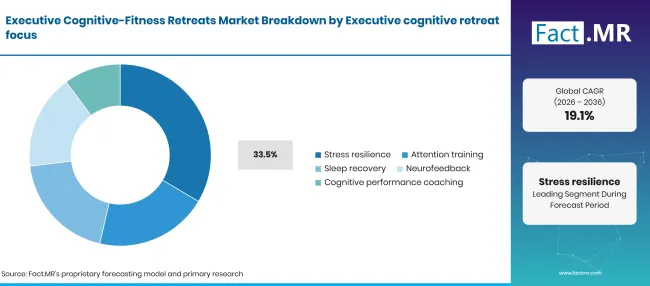
Executive Cognitive Fitness Retreats Breakdown Executive Cognitive Retreat Focus | Source: Fact.MR
| Executive Cognitive Retreat Focus | Share (2026) |
|---|---|
| Stress Resilience (Leading segment) | 33.5% |
| Other segments combined | 66.5%* |
| Total | 100.0% |
Source: Fact.MR analysis. Updated Nov 12, 2026
Executives facing long hours and constant decisions book stress resilience programmes first, often before they try attention or memory work. Sessions combine breathing practice, guided relaxation and coaching on recovery habits. Global losses of working days to depression and anxiety give employers a clear reason to fund this focus. Many retreats also link stress sessions to the wider corporate wellness programmes that companies already run. Attention Training builds concentration through structured exercises and digital tasks. Neurofeedback uses brain activity monitoring to guide training, a niche that relies on equipment similar to brain monitoring devices used in clinics. Sleep Recovery targets rest quality, and Cognitive Performance Coaching works toward individual productivity goals.
What supports Monthly Membership within Access / Commercial Model?
Monthly Membership accounts for 31.9% of 2026 value.
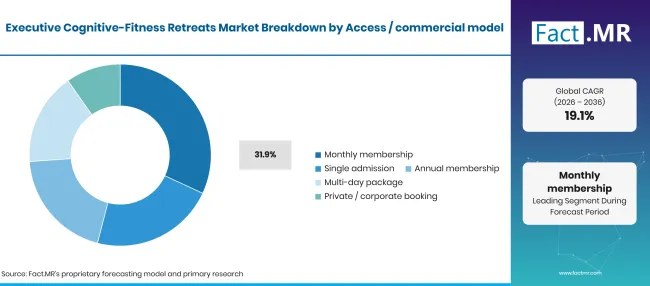
Executive Cognitive Fitness Retreats Breakdown Access Commercial Model | Source: Fact.MR
| Access / Commercial Model | Share (2026) |
|---|---|
| Monthly Membership (Leading segment) | 31.9% |
| Other segments combined | 68.1%* |
| Total | 100.0% |
Source: Fact.MR analysis. Updated Nov 12, 2026
Participants who want steady progress prefer a fixed monthly fee that covers scheduled sessions, specialist check-ins and access to on-site facilities. This model gives operators predictable income and gives members a reason to return between longer stays. Membership apps and remote check-ins borrow from mobile health apps to track sleep and attention scores. Single Admission suits people testing one session before they commit. Annual Membership serves loyal participants who want extended access, while Multi-day Packages offer concentrated stays of three to seven nights. Private / Corporate Booking covers leadership groups that need customised schedules and confidential sessions.
How does Operating Setting shape demand?
Hybrid Pop-up / Digital captures 27.0% of 2026 sales.
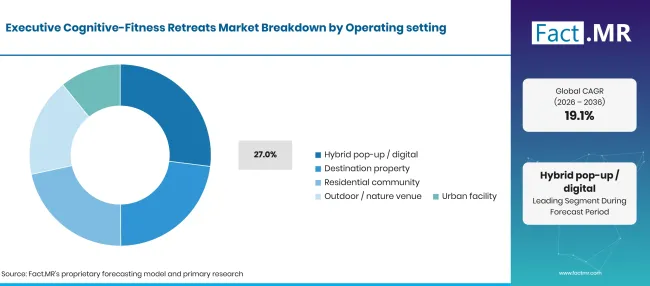
Executive Cognitive Fitness Retreats Breakdown Operating Setting | Source: Fact.MR
| Operating Setting | Share (2026) |
|---|---|
| Hybrid Pop-up / Digital (Leading segment) | 27.0% |
| Other segments combined | 73.0%* |
| Total | 100.0% |
Source: Fact.MR analysis. Updated Nov 12, 2026
Busy participants rarely have a free week, so providers run pop-up sessions in cities and keep members engaged through video coaching and digital exercises. One specialist team can then serve several cities. Destination Properties offer immersive stays in resort settings and link closely to wellness tourism flows. Residential Communities add cognitive activities to longer-term living settings. Outdoor / Nature Venues combine programmes with walking and nature exposure, and Urban Facilities serve professionals who want sessions near the office.
How does Core Visitor Group shape demand?
Active Older Adults represent 30.4% of 2026 spending.
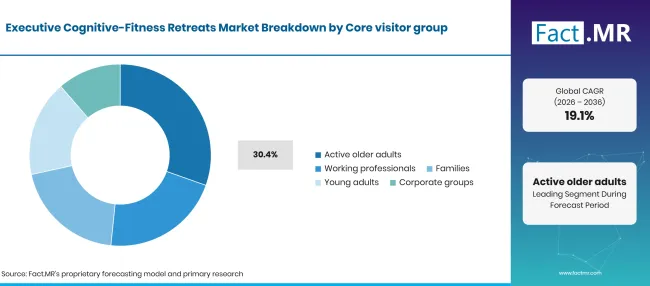
Executive Cognitive Fitness Retreats Breakdown Core Visitor Group | Source: Fact.MR
| Core Visitor Group | Share (2026) |
|---|---|
| Active Older Adults (Leading segment) | 30.4% |
| Other segments combined | 69.6%* |
| Total | 100.0% |
Source: Fact.MR analysis. Updated Nov 12, 2026
Retired and semi-retired guests want to protect memory and stay socially engaged, and they often have the time for longer programmes. About 15% of adults aged 70 and over live with a mental disorder, and social isolation affects about a quarter of older people. By 2030, 1 in 6 people worldwide will be aged 60 or over. Working Professionals seek help with mental fatigue and workplace stress. Corporate Groups book leadership programmes for teams, while Families and Young Adults join for mental wellness, study focus and preventive health activities.
What is accelerating Executive Cognitive-Fitness Retreats Market adoption, and what is holding it back?
Workplace mental health costs, new WHO guidance on preventive brain care and employer interest in leadership resilience are pulling more buyers into cognitive programmes. Against this, premium residential stays carry high prices, trained neurofeedback and sleep specialists are scarce outside major hubs, and many operators still struggle to show consistent, measurable results. Providers that publish outcome data and offer lower-cost hybrid tiers will widen the buyer base in the coming years.
Drivers Impact Analysis
| DRIVER | (~) % IMPACT ON CAGR | GEOGRAPHIC RELEVANCE | IMPACT TIMELINE |
|---|---|---|---|
| Demand for structured stress resilience and workplace mental wellness programmes | +3.0% | Global | Short term (<=2 years) |
| Awareness of preventive brain health and cognitive stimulation | +2.4% | North America, Europe, Asia Pacific | Medium term (2-4 years) |
| Adoption of neurofeedback and attention training programmes | +2.1% | North America, Europe, East Asia | Medium term (2-4 years) |
| Growth of corporate wellness and executive retreat bookings | +1.9% | North America, Middle East, Asia Pacific | Medium term (2-4 years) |
| Participation in sleep recovery and healthy ageing programmes | +1.4% | Europe, Asia Pacific, Middle East | Long term (>=4 years) |
Source: Fact.MR analysis. Updated Nov 12, 2026
Opportunity Impact Analysis
| OPPORTUNITY | (~) % IMPACT ON CAGR | GEOGRAPHIC RELEVANCE | IMPACT TIMELINE |
|---|---|---|---|
| Personalised cognitive performance and brain health programmes | +3.0% | Global | Medium term (2-4 years) |
| Hybrid pop-up and digital cognitive wellness delivery | +2.5% | North America, Europe, Asia Pacific | Short term (<=2 years) |
| Private and corporate bookings for leadership wellness retreats | +2.3% | North America, Middle East, Asia Pacific | Medium term (2-4 years) |
| Cognitive wellness programmes for active older adults | +2.0% | Europe, Japan, UAE | Long term (>=4 years) |
Source: Fact.MR analysis. Updated Nov 12, 2026
Restraints Impact Analysis
| RESTRAINT | (~) % IMPACT ON CAGR | GEOGRAPHIC RELEVANCE | IMPACT TIMELINE |
|---|---|---|---|
| High cost of premium residential retreats and specialist cognitive services | -0.6% | Global | Short term (<=2 years) |
| Limited supply of trained cognitive wellness and neurofeedback practitioners | -0.5% | Emerging markets | Medium term (2-4 years) |
| Difficulty showing consistent, measurable outcomes across programmes | -0.4% | Global | Long term (>=4 years) |
Source: Fact.MR analysis. Updated Nov 12, 2026
Which countries are scaling the Executive Cognitive-Fitness Retreats Market through 2036?
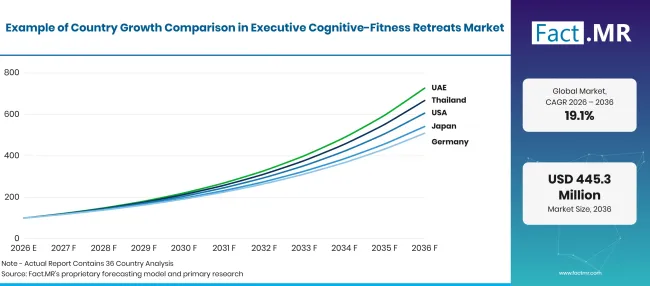
Executive Cognitive Fitness Retreats Growth Index | Source: Fact.MR
| Country | CAGR (2026 to 2036) |
|---|---|
| UAE | 21.9% |
| Thailand | 20.9% |
| United States | 19.8% |
| Japan | 18.4% |
| Germany | 17.7% |
Source: Fact.MR analysis. Updated Nov 12, 2026
What supports the UAE’s adoption?
21.9% CAGR, driven by premium hotel capacity and new longevity-focused wellness openings.
Dubai received 19.59 million international overnight visitors in 2025, and hotel occupancy reached 80.7% across 154,264 rooms. That flow of high-spending business travellers gives retreat operators a ready audience for short stress and sleep programmes. Six Senses opened reservations in February 2026 for Six Senses The Palm, Dubai, from 1 September 2026, with a 60,000 square foot spa and a Longevity Clinic offering diagnostics and personalised programmes.
How is Thailand developing demand?
20.9% CAGR, backed by an established resort network and a national push on healing-led tourism.
Thailand hosts the Global Wellness Summit 2026 in Phuket from 10 to 13 November, with about 600 Thai and international delegates, and the Tourism Authority of Thailand is presenting wellness routes across five regions. Destination resorts can pair meditation and stress resilience with sleep recovery in multi-day packages.
What is supporting the United States’ adoption?
19.8% CAGR, helped by deep corporate wellness spending and widespread sleep problems.
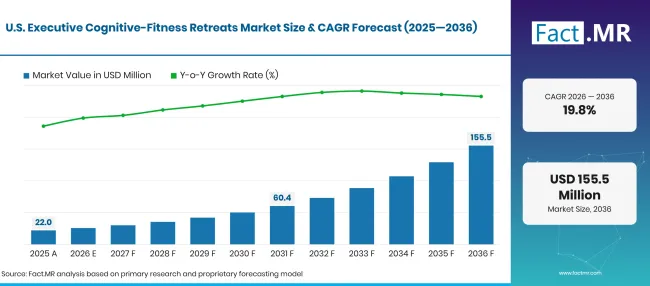
Executive Cognitive Fitness Retreats Forecast Usa | Source: Fact.MR
About 30.5% of US adults sleep less than 7 hours on average, and 18.1% have trouble staying asleep most days. Full-time workers averaged 8.1 hours on days they worked in 2025. These figures give employers a reason to fund sleep and attention programmes for senior staff, and Canyon Ranch scheduled a brain health retreat in Lenox for July 2026.
How does Japan perform?
18.4% CAGR, reflecting a very old population and strong interest in preventive care.
Japan had 36.24 million people aged 65 and over, or 29.3% of the population, and 20.78 million aged 75 and over. That base favours programmes on memory, sleep and mental engagement for active older adults. Six Senses Kyoto will host a women’s wellness retreat from 11 to 14 December 2026 that covers sleep health, stress management and meditation.
How is Germany scaling demand?
17.7% CAGR, as medical wellness resorts add preventive brain checks.
People aged 60 and over formed 31% of Germany’s 83.5 million residents at the end of 2025. A mature medical wellness sector already offers diagnostics, so growth comes from adding neurocognitive testing and sleep analysis to existing stays. Lanserhof Tegernsee runs a Brain Health package of 7 to 16 nights built around memory, attention and processing speed tests.
Who leads the Executive Cognitive-Fitness Retreats Market?
Competition splits into three groups. Medical wellness specialists such as SHA Wellness Clinic and Lanserhof compete on clinical depth: SHA runs a Cognitive Stimulation Unit and a Leaders Health & Performance programme, while Lanserhof offers neurocognitive testing within its Brain Health focus. Integrated resort brands such as Six Senses, Canyon Ranch and Chiva-Som compete on programme range and destination appeal.
Six Senses offers a one-day Mind Your Brain programme and opened reservations in February 2026 for its first UAE property with a Longevity Clinic, and Chiva-Som exhibited at the Global Wellness Summit 2026 in Phuket. Canyon Ranch adds themed stays such as its Lenox brain health retreat in July 2026, and Six Senses will bring a sleep and stress retreat to Kyoto in December 2026. Luxury hospitality groups such as Aman and COMO Shambhala reach executives through stress management immersions and corporate team packages. Over the next decade, credible outcome tracking and trained specialists will decide who wins corporate contracts.
Which companies are the key providers?
Key companies in the Executive Cognitive-Fitness Retreats Market include Six Senses, Canyon Ranch, SHA Wellness Clinic, Lanserhof, Chiva-Som, Aman and COMO Shambhala.
- Six Senses
- Canyon Ranch
- SHA Wellness Clinic
- Lanserhof
- Chiva-Som
- Aman
- COMO Shambhala
Bibliography
- Cabinet Office, Government of Japan. (2025, June). Annual Report on the Ageing Society [Summary] FY2025.
- Government of Dubai Media Office. (2026, February 9). Dubai’s tourism industry achieves third successive record-breaking year.
- National Center for Health Statistics. (2026, April 29). Short Sleep Duration and Sleep Difficulties Among Adults: United States, 2024.
- Six Senses. (2026, February 24). Six Senses The Palm, Dubai Opens Reservations.
- Six Senses. (2026, July 24). The Way of a Woman: the First Six Senses-led Retreat for Women.
- Statistisches Bundesamt. (2026, June 16). Bevölkerung Deutschlands sinkt im Jahr 2025 um 0,1 %.
- Tourism Authority of Thailand. (2026, October 30). TAT spotlights Thai wellness as Phuket hosts Global Wellness Summit 2026.
- U.S. Bureau of Labor Statistics. (2026, June 25). American Time Use Survey Summary: 2025 Results.
- World Health Organization. (2025, September 2). Over a billion people living with mental health conditions: services require urgent scale-up.
- World Health Organization. (2025, October 1). Ageing and health.
- World Health Organization. (2026, July 15). Risk reduction of cognitive decline and dementia: WHO guidelines, second edition.
- World Health Organization. (2026, July 20). Mental health of older adults.
- World Health Organization. (2026, September 15). Mental health at work.
- World Health Organization. (2026, November 4). Physical activity.
This Report Answers
- How much value executive cognitive-fitness retreats will add between 2026 and 2036, and at what pace.
- Which retreat focus, access model, setting and visitor group lead in 2026, and why buyers choose them.
- Where workplace stress and preventive brain care translate into paid programme demand.
- How the UAE, Thailand, the United States, Japan and Germany compare on growth and buyer profile.
- Which operators offer credible cognitive programmes and how their strategies differ.
- What cost, staffing and outcome barriers will slow adoption, and how providers can lower them.
What does the Executive Cognitive-Fitness Retreats Market cover?
This market tracks paid retreats and programmes built around mental performance and preventive brain health. Each qualifying offer combines structured cognitive activities with stress management, sleep recovery or personalised coaching, delivered by trained staff.
Value is counted as programme fees, membership dues and package prices paid by individuals and organisations. Accommodation is counted only when it is sold as part of a cognitive programme package.
What is included in the scope?
Stress resilience, attention training, sleep recovery, neurofeedback and cognitive performance coaching programmes are covered.
Monthly and annual memberships, single admissions, multi-day packages and private corporate bookings count when they give access to an organised cognitive programme.
Destination properties, residential communities, urban facilities and outdoor venues are counted, along with hybrid digital sessions that extend a retreat.
Programmes sold alongside medical tourism stays are included where a defined cognitive module is part of the package.
What is excluded from the scope?
General spa visits and leisure holidays without structured cognitive or mental wellness activities fall outside this market.
Standalone meditation apps and general fitness subscriptions are left out unless bundled into a retreat offer.
Clinical neurology care and diagnostic equipment such as functional brain imaging systems belong to separate healthcare categories.
Employee assistance programmes and routine counselling services are not counted when no retreat experience is involved.
How Was the Analysis Built?
The analysis draws on 120+ sources, 35+ company portfolios, 25+ countries, and more than 20 industry interviews.
- Primary Research: Primary research includes discussions with manufacturers, service providers, technology developers, distributors, end users, and subject-matter experts. These conversations examine purchasing priorities, product adoption, operational challenges, approval requirements, competitive positioning, and the factors that influence wider market acceptance.
- Desk Research: Desk research covers government statistics, regulatory publications, company filings, trade data, technical studies, industry associations, standards, public policy, and other authoritative sources. Every source used in the analysis is documented in the bibliography.
- Market Sizing and Forecasting: Market estimates combine historical performance, demand indicators, pricing and volume trends, segment shares, company participation, country-level growth, adoption patterns, investment activity, and barriers to market expansion.
- Data Validation and Update Cycle: Findings are validated by comparing primary interviews with public data, company activity, regulatory changes, trade patterns, and industry developments. Regular updates review new product launches, capacity changes, partnerships, approvals, and shifts in commercial adoption.
Segmentation
What is the report’s scope and coverage?
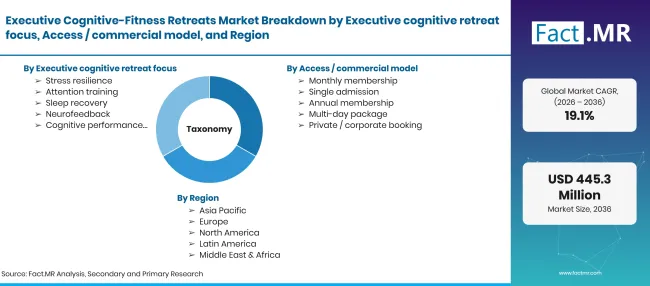
Executive Cognitive Fitness Retreats Taxonomy | Source: Fact.MR
| Attribute | Details |
|---|---|
| Quantitative Units | USD million |
| Market Definition | Structured retreats and cognitive-fitness programmes that support mental performance, attention, memory, stress resilience and preventive brain health. |
| Executive Cognitive Retreat Focus | Stress Resilience; Attention Training; Sleep Recovery; Neurofeedback; Cognitive Performance Coaching |
| Access / Commercial Model | Monthly Membership; Single Admission; Annual Membership; Multi-day Package; Private / Corporate Booking |
| Operating Setting | Hybrid Pop-up / Digital; Destination Property; Residential Community; Outdoor / Nature Venue; Urban Facility |
| Core Visitor Group | Active Older Adults; Working Professionals; Families; Young Adults; Corporate Groups |
| Regions Covered | North America; Latin America; Western Europe; Eastern Europe; East Asia; South Asia & Pacific; Middle East & Africa |
| Countries Covered | UAE; Thailand; United States; Japan; Germany |
| Companies Profiled | Six Senses; Canyon Ranch; SHA Wellness Clinic; Lanserhof; Chiva-Som; Aman; COMO Shambhala |
| Forecast Period | 2026 to 2036 |
| Approach | Programme fees and membership revenue are tracked by retreat focus, access model, setting and visitor group, then checked against operator portfolios in each country. |
Source: Fact.MR analysis. Updated Nov 12, 2026
How is the market segmented?
-
By Executive Cognitive Retreat Focus
- Stress Resilience
- Attention Training
- Sleep Recovery
- Neurofeedback
- Cognitive Performance Coaching
-
By Access / Commercial Model
- Monthly Membership
- Single Admission
- Annual Membership
- Multi-day Package
- Private / Corporate Booking
-
By Operating Setting
- Hybrid Pop-up / Digital
- Destination Property
- Residential Community
- Outdoor / Nature Venue
- Urban Facility
-
By Core Visitor Group
- Active Older Adults
- Working Professionals
- Families
- Young Adults
- Corporate Groups
-
By Region
- North America
- Latin America
- Western Europe
- Eastern Europe
- East Asia
- South Asia & Pacific
- Middle East & Africa
Frequently Asked Questions
How large is the executive cognitive-fitness retreats market in 2026?
What growth rate will the executive cognitive-fitness retreats market record?
Which executive cognitive retreat focus leads?
Which access / commercial model leads?
Which operating setting leads?
Which core visitor group leads?
Which country will grow quickest?
Who are the main companies?
What holds the market back?
Who worked on this report


Preview the report firsthand - request a free sample
Free SampleGet the brochure for pricing and purchase details
Download PDF