Exterior Insulation and Finish System (EIFS) Market (2026 - 2036)
Exterior Insulation and Finish System (EIFS) Market is segmented by Type (Polymer-Based and Polymer-Modified), Insulation Material (EPS, MW, and Others), End Use (Residential and Commercial), and Region. Forecast for 2026 to 2036.
Core Findings
Exterior Insulation and Finish System (EIFS) Market Size, Market Forecast and Outlook By Fact.MR
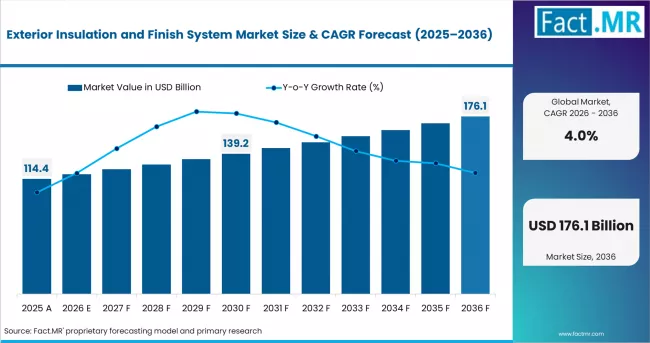
The exterior insulation and finish system market was valued at USD 110.00 billion in 2025, projected to reach USD 114.40 billion in 2026, and is forecast to expand to USD 169.34 billion by 2036 at a 4.0% CAGR. Building energy efficiency mandates requiring continuous exterior insulation in new construction and deep energy retrofit programmes are driving EIFS adoption across residential and commercial building envelopes globally. The system's ability to deliver continuous insulation without thermal bridging, combined with design flexibility for architectural finish aesthetics, positions EIFS as a specification-grade wall assembly solution in energy code compliance pathways.
An absolute dollar opportunity of USD 54.94 billion between 2026 and 2036 characterizes this as a large building materials market where energy code stringency, construction labor availability, and system warranty performance define specification decisions. Raw material costs for expanded polystyrene insulation boards, polymer-based base coats, and acrylic finish coats are tied to petrochemical feedstock pricing, creating margin structures sensitive to crude oil and styrene monomer price movements. Installation quality assurance programmes and manufacturer-certified applicator requirements add system-level compliance costs that differentiate EIFS from commodity cladding alternatives.
-market-market-value-analysis.webp)
Exterior Insulation and Finish System (EIFS) Market Key Takeaways
| Metric | Details |
|---|---|
| Industry Size (2026) | USD 114.40 billion |
| Industry Value (2036) | USD 169.34 billion |
| CAGR (2026 to 2036) | 4.0% |
Source: Fact.MR, 2026
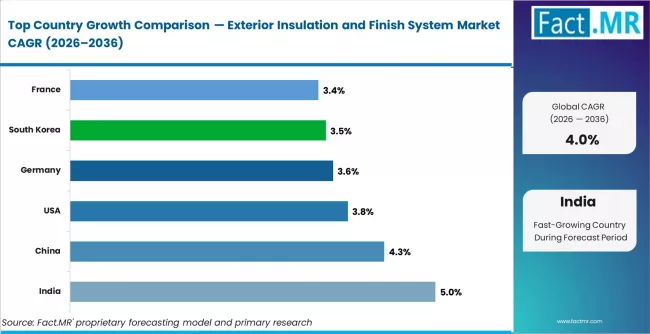
All major EIFS markets reflect expanding adoption trajectories. India sets the pace with a 5.0% CAGR, followed by China at 4.3% as building energy efficiency codes tighten in both new urban construction and renovation programmes. USA advances at a 3.8% rate supported by ASHRAE 90.1 continuous insulation requirements and IBC code adoption. Germany tracks at 3.6% and South Korea at 3.5%. France registers a 3.4% pace as EU Energy Performance of Buildings Directive requirements mandate deep energy renovations. Japan expands at 3.0% with steady procurement for residential thermal envelope upgrades.
Summary of Exterior Insulation and Finish System (EIFS) Market
- Market Overview
- The market is valued at USD 110.00 billion in 2025 and is projected to reach USD 169.34 billion by 2036.
- The industry is expected to grow at a 4.0% CAGR from 2026 to 2036, creating an incremental opportunity of USD 54.94 billion.
- The market operates as a building envelope materials category where energy code compliance requirements, continuous insulation specifications, and certified applicator availability define adoption rates.
- Demand and Growth Drivers
- Demand is rising as building energy codes in major economies mandate continuous exterior insulation to eliminate thermal bridging, making EIFS a code-compliant wall assembly solution for new construction.
- Deep energy retrofit programmes funded by government incentive schemes are expanding EIFS installation on existing building stock to meet national carbon reduction targets.
- Architectural design preferences for seamless exterior finishes with color and texture flexibility are positioning EIFS as an aesthetic wall cladding choice alongside its thermal performance benefits.
- Among key countries, India leads at 5.0% CAGR, followed by China at 4.3%, the USA at 3.8%, Germany at 3.6%, South Korea at 3.5%, France at 3.4%, and Japan at 3.0%.
- Product and Segment View
- EIFS is a multi-layered exterior wall cladding system consisting of an insulation board mechanically or adhesively attached to the substrate, a reinforced base coat layer, and a textured acrylic or silicone finish coat providing weather protection and architectural aesthetics.
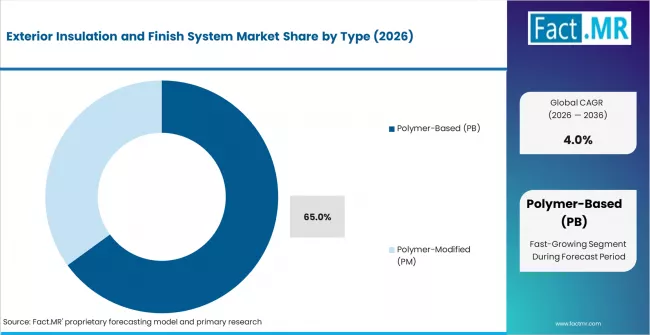
- Polymer-Based systems dominate the Type segment with 65.0% share in 2026, as acrylic-based systems deliver superior crack resistance, breathability, and color retention for both residential and commercial building envelopes.
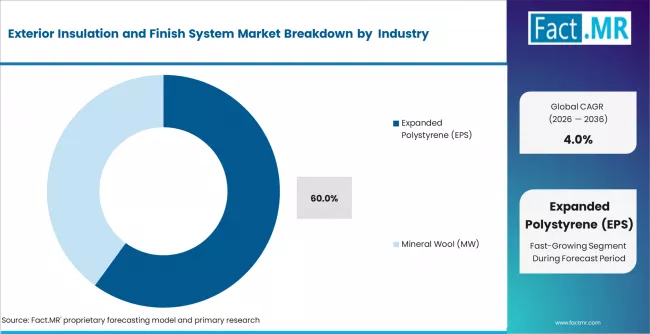
- EPS (expanded polystyrene) holds 60.0% of the Insulation Material segment, as its low cost, lightweight handling, and proven thermal performance make it the default insulation board specification for standard EIFS assemblies.
- Residential commands 50.0% of the End Use segment, reflecting the large volume of single-family and multi-family housing construction requiring exterior insulation for energy code compliance.
- Scope includes complete EIFS assemblies and system components sold for building exterior wall applications. It excludes interior insulation, standalone stucco without insulation board, and curtain wall glazing systems.
- Geography and Competitive Outlook
- India and China are the fastest-growing markets, with building energy efficiency code implementation and rapid urbanization driving EIFS specification in new construction projects.
- Germany and France represent regulation-driven European markets where EU Energy Performance of Buildings Directive mandates sustain deep renovation demand for exterior insulation systems.
- Competition is shaped by system warranty performance, certified applicator network breadth, and insulation material sourcing, with key players including BASF, Sika, Saint-Gobain Weber, Dryvit, Sto SE, Master Builders Solutions, Parex, Wacker Chemie, Dow, and Henkel.
Why is the Exterior Insulation and Finish System (EIFS) Market Growing?
Market expansion is being supported by the increasing demand for energy-efficient building solutions and the corresponding need for high-performance insulation systems in EIFS applications across global construction and building operations. Modern construction companies are increasingly focused on advanced insulation technologies that can improve building performance, reduce energy costs, and enhance thermal efficiency while meeting stringent building code requirements. The proven efficacy of EIFS solutions in various construction applications makes them an essential component of comprehensive building performance strategies and energy-efficient construction programs.
The growing focus on construction industry transformation and advanced building performance optimization is driving demand for ultra-efficient insulation systems that meet stringent thermal specifications and construction requirements for specialized applications. Construction companies' preference for reliable, high-performance insulation systems that can ensure consistent building performance is creating opportunities for innovative EIFS technologies and customized construction solutions. The rising influence of building codes and energy efficiency protocols is also contributing to increased adoption of premium-grade insulation systems across different construction applications and building systems requiring advanced thermal technology.
Opportunity Pathways - Exterior Insulation and Finish System (EIFS) Market
The EIFS market represents a specialized growth opportunity, expanding from USD 110.0 billion in 2025 to USD 162.0 billion by 2035 at a 4.0% CAGR. As construction companies prioritize energy efficiency, building code compliance, and thermal performance in complex insulation processes, EIFS systems have evolved from a niche construction technology to an essential component enabling building performance, energy optimization, and multi-stage construction production across building operations and specialized construction applications.
The convergence of construction expansion, increasing insulation adoption, specialized building material organization growth, and thermal performance requirements creates momentum in demand. High-efficiency formulations offering superior insulation performance, cost-effective polymer-based systems balancing performance with economics, and specialized insulation material variants for premium applications will capture market premiums, while geographic expansion into high-growth Asian construction markets and emerging market penetration will drive volume leadership. Construction focus on thermal quality and installation reliability provides structural support.
- Pathway A - Polymer-based Dominance: Leading with 65.0% market share, polymer-based applications drive primary demand through complex construction workflows requiring comprehensive insulation systems for thermal performance. Advanced formulations enabling improved building efficiency, reduced energy costs, and enhanced thermal performance command premium pricing from construction companies requiring stringent performance specifications and building compliance. Expected revenue pool: USD 71.5-105.3 billion.
- Pathway B - Residential Leadership: Dominating with 50.0% market share through an optimal balance of performance and cost-effectiveness, residential applications serve most construction projects while meeting building performance requirements. This segment addresses both thermal standards and economic considerations, making it the preferred choice for construction and building operations seeking reliable performance. Opportunity: USD 55.0-81.0 billion.
- Pathway C - Asian Market Acceleration: India (5.0% CAGR) and China (4.3% CAGR) lead global growth through construction infrastructure expansion, building performance development, and domestic EIFS demand. Strategic partnerships with local construction companies, building compliance expertise, and supply chain localization enable the expansion of insulation technology in major construction hubs. Geographic expansion upside: USD 25.0-40.0 billion.
- Pathway D - EPS Insulation Material Premium Segment: EPS insulation materials serve specialized applications requiring exceptional thermal specifications for critical building performance processes. EPS formulations supporting consistent insulation requirements, complex thermal applications, and performance-sensitive processes command significant premiums from advanced construction organizations and specialized building facilities. Revenue potential: USD 66.0-97.2 billion.
- Pathway E - Advanced Insulation & Technology Systems: Companies investing in sophisticated insulation technologies, thermal performance systems, and automated construction processes gain competitive advantages through consistent system performance and building efficiency reliability. Advanced capabilities enabling customized specifications and rapid installation capture premium construction partnerships. Technology premium: USD 15.0-25.0 billion.
- Pathway F - Supply Chain Optimization & Reliability: Specialized distribution networks, strategic inventory management, and reliable supply chain systems create competitive differentiation in construction markets requiring consistent EIFS availability. Companies offering guaranteed supply security, technical support, and building documentation gain preferred supplier status with compliance-focused construction companies. Supply chain value: USD 10.0-18.0 billion.
- Pathway G - Emerging Applications & Market Development: Beyond traditional polymer-based EIFS, insulation systems in specialty materials, premium thermal solutions, and novel installation systems represent growth opportunities. Companies developing new applications, supporting R&D initiatives, and expanding into adjacent construction markets capture incremental demand while diversifying revenue streams. Emerging opportunity: USD 8.0-15.0 billion.
Segmental Analysis
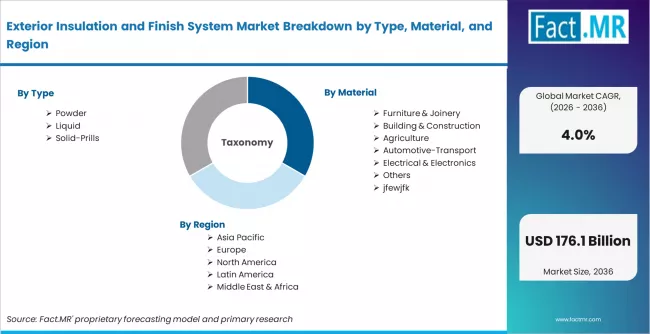
The market is segmented by type, insulation material, end use, and region. By type, the market is divided into polymer-based and polymer-modified. Based on insulation material, the market is categorized into EPS, MW, and others. By end use, the market is divided into residential and commercial. Regionally, the market is divided into Asia Pacific, North America, Europe, Latin America, Middle East & Africa.
By Type, Polymer-based Segment Accounts for 65.0% Market Share
-market-analysis-by-type.webp)
The polymer-based segment is projected to account for 65.0% of the market in 2026, reaffirming its position as the category's dominant type. Construction companies increasingly recognize the optimal balance of performance and cost-effectiveness offered by polymer-based systems for most building applications, particularly in thermal insulation and construction processes. This type addresses both thermal performance requirements and economic considerations while providing reliable quality across diverse construction applications.
This type forms the foundation of most construction protocols for insulation applications, as it represents the most widely accepted and commercially viable level of EIFS technology in the industry. Quality control standards and extensive thermal testing continue to strengthen confidence in polymer-based formulations among construction and building providers. With increasing recognition of the cost-performance optimization requirements in building performance, polymer-based systems align with both operational efficiency and thermal performance goals, making them the central growth driver of comprehensive construction strategies.
By Insulation Material, EPS Segment Accounts for 60.0% Market Share
-market-analysis-by-insulation-material.webp)
EPS is projected to represent 60.0% of EIFS demand in 2026, highlighting its role as the primary insulation material segment driving market adoption and growth. Construction companies recognize that EPS requirements, including complex thermal processes, specialized insulation needs, and multi-stage construction systems, often require advanced insulation materials that standard construction technologies cannot adequately provide. EPS materials offer enhanced thermal performance and building compliance in construction applications.
The segment is supported by the growing nature of thermal insulation adoption, requiring sophisticated insulation systems, and the increasing recognition that advanced EPS technologies can improve construction performance and building outcomes. Additionally, construction companies are increasingly adopting evidence-based building guidelines that recommend specific EPS materials for optimal thermal performance. As understanding of thermal complexity advances and construction requirements become more stringent, EPS materials will continue to play a crucial role in comprehensive building strategies within the EIFS market.
By End Use, Residential and Commercial Segments Each Account for 50.0% Market Share
-market-analysis-by-end-use.webp)
The residential and commercial segments are each projected to represent 50.0% of EIFS demand in 2026, demonstrating balanced market distribution across construction applications. Both segments show strong demand patterns, with residential applications focusing on energy efficiency and cost-effectiveness, while commercial applications emphasize advanced thermal performance and building code compliance. This balanced split reflects the versatile nature of EIFS solutions across different construction project types and building requirements.
The residential segment benefits from growing homeowner awareness of energy efficiency benefits and increasing adoption of insulation technologies in new construction and retrofit projects. The commercial segment is driven by stringent building codes, energy efficiency mandates, and the need for reliable thermal performance in larger construction projects. Both segments continue to drive innovation in EIFS technologies and installation methods.
What are the Drivers, Restraints, and Key Trends of the Exterior Insulation and Finish System (EIFS) Market?
-market-opportunity-matrix-growth-vs-value.webp)
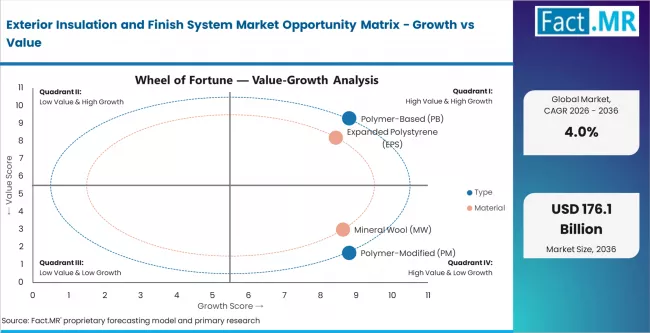
The EIFS market is advancing steadily due to increasing recognition of insulation technologies' importance and growing demand for high-efficiency thermal systems across the construction and building sectors. However, the market faces challenges, including complex installation processes, potential for performance variations during implementation and maintenance, and concerns about supply chain consistency for specialized construction equipment. Innovation in insulation technologies and customized construction protocols continues to influence product development and market expansion patterns.
Expansion of Advanced Construction Facilities and Insulation Technologies
The growing adoption of advanced construction facilities is enabling the development of more sophisticated insulation production and performance control systems that can meet stringent building requirements. Specialized construction facilities offer comprehensive insulation services, including advanced thermal design and performance optimization processes that are particularly important for achieving high-efficiency requirements in building applications. Advanced construction channels provide access to premium services that can optimize building performance and reduce energy costs while maintaining cost-effectiveness for large-scale construction operations.
Integration of Building Information Systems and Performance Management Systems
Modern construction organizations are incorporating digital technologies such as real-time performance monitoring, automated insulation systems, and supply chain integration to enhance EIFS installation and distribution processes. These technologies improve thermal performance, enable continuous building monitoring, and provide better coordination between contractors and building owners throughout the construction cycle. Advanced digital platforms also enable customized performance specifications and early identification of potential installation deviations or supply disruptions, supporting reliable construction production.
Analysis of the Exterior Insulation and Finish System (EIFS) Market by Key Country
-market-cagr-(2026-2036).webp)
| Country | CAGR (2026-2036) |
|---|---|
| India | 5.0% |
| China | 4.3% |
| USA | 3.8% |
| Germany | 3.6% |
| South Korea | 3.5% |
| France | 3.4% |
| Japan | 3.0% |
-market-cagr-analysis-by-country.webp)
The market is experiencing varied growth globally, with India leading at a 5.0% CAGR through 2036, driven by the expansion of construction infrastructure development, increasing building performance capabilities, and growing domestic demand for high-efficiency insulation systems. China follows at 4.3%, supported by construction expansion, growing recognition of advanced insulation technology importance, and expanding building capacity. USA records 3.8% growth, with a focus on developing the construction technology and building performance industries. Germany shows 3.6% growth, representing a mature market with established construction patterns and building frameworks. South Korea demonstrates 3.5% growth with focus on advanced construction adoption. France demonstrates 3.4% growth, emphasizing construction infrastructure expansion and systematic building approaches. Japan demonstrates 3.0% growth, emphasizing construction infrastructure expansion and systematic building approaches.
India Demonstrates Growing Market Potential with Construction Infrastructure Development
India is projected to exhibit robust growth with a CAGR of 5.0% through 2036, driven by ongoing construction expansion and increasing recognition of high-efficiency insulation systems as essential building components for complex thermal processes. The country's expanding construction infrastructure and growing availability of specialized thermal capabilities are creating significant opportunities for EIFS adoption across both domestic and export-oriented building facilities. Major international and domestic construction companies are establishing comprehensive insulation and distribution networks to serve the growing population of builders and construction facilities requiring high-performance insulation systems across residential and commercial applications throughout India's major construction hubs.
The Indian government's strategic focus on infrastructure modernization and construction advancement is driving substantial investments in specialized thermal capabilities. This policy support, combined with the country's large domestic construction market and expanding building requirements, creates a favorable environment for the EIFS market development. Indian construction companies are increasingly focusing on high-value building technologies to improve thermal capabilities, with insulation systems representing a key component in this construction transformation.
- Government initiatives supporting construction development and infrastructure modernization are driving demand for high-efficiency insulation systems throughout major construction and building centers, including Mumbai, Delhi, and Bangalore regions.
- Building capacity expansion and thermal system development are supporting appropriate utilization of insulation services among construction companies and building facilities nationwide, with particular growth in residential operations and commercial building services.
China Demonstrates Exceptional Market Potential with Construction Growth
China is expanding at a CAGR of 4.3%, supported by increasing construction accessibility, growing building awareness, and developing technology market presence across the country's major construction clusters. The country's large construction sector and increasing recognition of advanced insulation systems are driving demand for effective high-efficiency thermal solutions in both building performance and construction applications. International construction companies and domestic providers are establishing comprehensive distribution channels to serve the growing demand for quality insulation systems while supporting the country's position as an emerging construction technology market.
China's construction sector continues to benefit from favorable building policies, expanding construction capabilities, and cost-competitive infrastructure development. The country's focus on becoming a global construction technology hub is driving investments in specialized insulation technology and building performance infrastructure. This development is particularly important for EIFS applications, as construction companies seek reliable domestic sources for critical thermal technologies to reduce import dependency and improve supply chain security.
- Rising awareness about advanced thermal options and improving construction capabilities are creating opportunities for specialized insulation systems across residential and commercial settings in major hubs like Beijing, Shanghai, and Guangzhou.
- Growing construction infrastructure development and technology adoption are supporting increased access to high-efficiency insulation services among organizations requiring comprehensive thermal capabilities, particularly in building performance and construction organizations.
USA Maintains Technology Leadership
-market-country-value-analysis.webp)
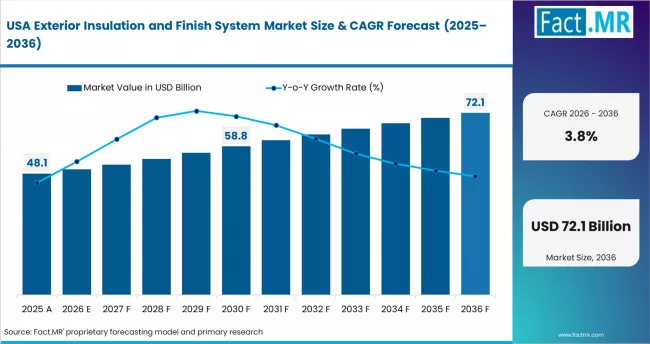
The USA's advanced construction technology market demonstrates sophisticated building performance deployment with documented insulation effectiveness in construction departments and building centers through integration with existing construction systems and thermal infrastructure. The country leverages building expertise in construction technology and thermal systems integration to maintain a 3.8% CAGR through 2036. Building centers, including major metropolitan areas, showcase premium installations where insulation systems integrate with comprehensive construction information systems and building platforms to optimize thermal accuracy and operational workflow effectiveness.
American construction companies prioritize system reliability and building compliance in thermal development, creating demand for premium systems with advanced features, including quality validation and integration with US construction standards. The market benefits from established construction industry infrastructure and a willingness to invest in advanced insulation technologies that provide long-term operational benefits and compliance with building regulations.
Germany Shows Strong Regional Leadership
Germany's market expansion benefits from diverse construction demand, including building performance modernization in major cities, thermal development programs, and government construction programs that increasingly incorporate insulation solutions for building enhancement applications. The country maintains a 3.6% CAGR through 2036, driven by rising building awareness and increasing adoption of thermal benefits, including superior building capabilities and reduced complexity.
Market dynamics focus on cost-effective insulation solutions that balance advanced thermal features with affordability considerations important to German construction operators. Growing construction infrastructure creates demand for modern thermal systems in new building facilities and construction equipment modernization projects.
Strategic Market Considerations:
- Construction and building performance segments leading growth with focus on thermal enhancement and operational efficiency applications
- Regional building requirements are driving a diverse product portfolio from basic insulation systems to advanced thermal platforms
- Import dependency challenges offset by potential local development partnerships with international thermal manufacturers
- Government construction initiatives beginning to influence procurement standards and building performance requirements
South Korea Emphasizes Advanced Construction Innovation
-market-south-korea-market-share-analysis-by-insulation-material.webp)
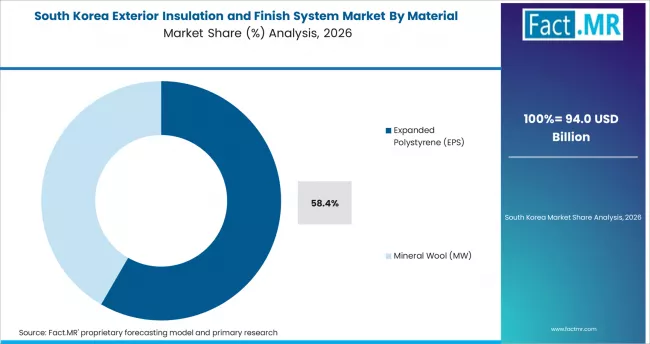
South Korea demonstrates strong market development with a 3.5% CAGR through 2036, driven by advanced construction infrastructure and building preference for technology-integrated insulation services. The country's sophisticated construction ecosystem and high technology penetration rates are creating significant opportunities for EIFS adoption across both domestic and technology-driven building facilities. Major international and domestic construction companies are establishing comprehensive thermal insulation and distribution networks to serve the growing population of tech-savvy builders and construction facilities requiring high-performance insulation systems across residential and commercial applications throughout South Korea's major construction hubs.
In South Korea, the market demonstrates unique characteristics with end-use distribution showing residential applications accounting for 55.0% and commercial applications representing 45.0% of the market, reflecting the country's focus on residential construction development and the growing commercial building sector.
- Government initiatives supporting construction development and technology modernization are driving demand for high-efficiency insulation systems throughout major construction and building centers, including Seoul, Busan, and Incheon regions.
- Technology capacity expansion and thermal insulation system development are supporting appropriate utilization of EIFS services among construction companies and building facilities nationwide, with particular growth in residential-focused operations and commercial building services.
Japan Emphasizes Precision and Integration Excellence
-market-japan-market-share-analysis-by-type.webp)
Japan demonstrates steady market development with a 3.0% CAGR through 2036, distinguished by construction operators' preference for high-quality insulation systems that integrate seamlessly with existing building equipment and provide reliable long-term operation in specialized thermal applications. The market prioritizes advanced features, including precision thermal algorithms, quality validation, and integration with comprehensive construction platforms that reflect Japanese building expectations for technological advancement and operational excellence.
In Japan, the market shows distinctive type preferences with polymer-based systems commanding 70.0% market share compared to polymer-modified systems at 30.0%, indicating a stronger preference for polymer-based solutions than the global average of 65.0%.
Japanese construction companies focus on system reliability and precision in insulation development, creating demand for premium systems with advanced features including automated quality monitoring and comprehensive technical support. The market benefits from established construction research infrastructure and investment in thermal technology that provides long-term building benefits.
Strategic Market Indicators:
- Premium focus on precision systems with advanced thermal algorithms and high-reliability capabilities
- Integration requirements with existing construction information systems and building performance management platforms
- Focus on insulation reliability and long-term performance in construction applications
France Shows Steady Market Growth
France demonstrates steady market development with a 3.4% CAGR through 2036, driven by construction modernization initiatives and increasing adoption of energy-efficient building solutions. The country's focus on building performance standards and environmental building codes is creating opportunities for advanced EIFS technologies across residential and commercial construction projects.
French construction companies are increasingly investing in high-performance insulation systems that meet strict building regulations and energy efficiency requirements. The market benefits from government support for building modernization and the growing focus on thermal performance in new construction and renovation projects.
Europe Market Split by Country
-market-europe-country-market-share-analysis,-2026-&-2036.webp)
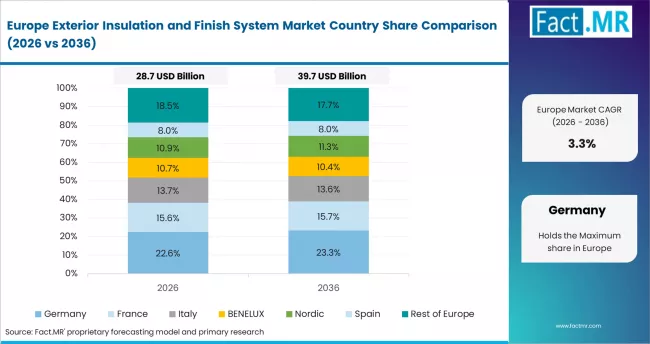
The EIFS market in Europe is projected to show strong regional performance, with individual country contributions varying across the region. Germany is expected to maintain its leadership position with a market value of USD 25.0 billion in 2026, supported by its advanced construction infrastructure, precision thermal capabilities, and strong building presence throughout major construction regions.
UK follows with USD 18.0 billion in 2026, driven by construction modernization programs, building performance integration, and expanding specialty construction networks serving both domestic and international markets. France holds USD 14.0 billion in 2026, supported by construction infrastructure expansion and growing adoption of high-efficiency insulation systems. Italy commands USD 11.0 billion in 2026, while Spain accounts for USD 9.0 billion in 2026. The Rest of Europe region, including Nordic countries, Eastern Europe, and smaller Western European markets, holds USD 23.0 billion in 2026, representing diverse market opportunities with established construction and building performance capabilities.
Competitive Landscape of the Exterior Insulation and Finish System (EIFS) Market
-market-analysis-by-company.webp)
The market is characterized by competition among established construction companies, specialty insulation companies, and building technology suppliers focused on delivering high-efficiency, consistent, and reliable insulation systems. Companies are investing in thermal technology advancement, performance control enhancement, strategic partnerships, and customer technical support to deliver effective, efficient, and reliable insulation solutions that meet stringent construction and building performance requirements. Building optimization, performance validation protocols, and supply chain strategies are central to strengthening product portfolios and market presence.
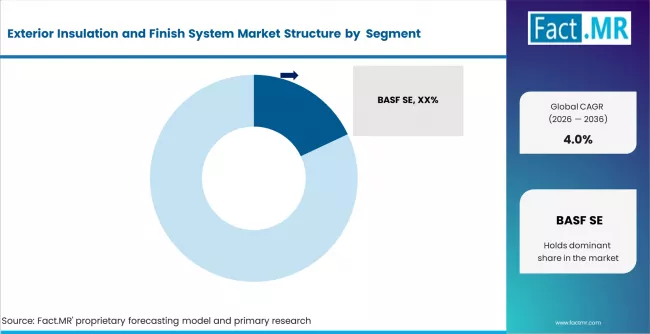
BASF leads the market with comprehensive high-efficiency insulation system offerings with a focus on thermal consistency and performance reliability for construction applications, holding a 14.0% market share. Sika provides specialized thermal systems with focus on building performance applications and comprehensive technical support services. Saint-Gobain Weber focuses on advanced insulation technologies and customized construction solutions for thermal systems serving global markets. Dryvit delivers established building systems with strong performance control systems and customer service capabilities.
Sto SE operates with a focus on bringing innovative insulation technologies to specialized construction applications and emerging markets. Master Builders Solutions provides comprehensive thermal system portfolios, including advanced insulation services, across multiple construction applications and building performance processes. Parex specializes in customized thermal solutions and performance management systems for construction systems with focus on building compliance. Wacker Chemie provides reliable supply chain solutions and technical expertise to enhance market accessibility and customer access to essential insulation systems.
Key Players in the Exterior Insulation and Finish System (EIFS) Market
- BASF
- Sika
- Saint-Gobain Weber
- Dryvit
- Sto SE
- Master Builders Solutions
- Parex
- Wacker Chemie
- Dow
- Henkel
- Knauf
- Caparol
- Mapetherm
- Tremco
- Laticrete
Bibliography
- European Commission. (2024). Directive 2010/31/EU on the Energy Performance of Buildings: Consolidated Text with 2024 Amendments. Official Journal of the European Union.
- ASHRAE. (2024). ANSI/ASHRAE/IES Standard 90.1-2024: Energy Standard for Sites and Buildings Except Low-Rise Residential Buildings. ASHRAE, Atlanta.
- BASF SE. (2024). BASF Annual Report 2024: Construction Chemicals Division Performance. BASF SE, Ludwigshafen.
- Sto SE & Co. KGaA. (2024). Sto Group Annual Report 2024: Facade Systems Business Unit. Sto SE, Stuhlingen.
- International Code Council. (2024). 2024 International Energy Conservation Code (IECC): Commercial and Residential Provisions. ICC, Washington D.C.
- Sika AG. (2024). Sika Annual Report 2024: Building Finishing Division. Sika AG, Baar.
This bibliography is provided for reader reference. The full Fact.MR report contains the complete reference list with primary research documentation.
This Report Addresses
- Market sizing and quantitative forecast metrics detailing building envelope material expenditure dedicated to EIFS across residential and commercial construction sectors through 2036.
- Segmentation analysis mapping system type preferences and evaluating insulation material specifications driving procurement decisions between EPS and mineral wool variants.
- Regional deployment intelligence comparing the energy code-driven EIFS adoption in North America against the deep renovation mandate programmes prevalent in European building markets.
- Regulatory compliance assessment analyzing how ASHRAE 90.1 continuous insulation requirements, IECC provisions, and EU EPBD mandates create specification-level demand for exterior insulation systems.
- Competitive posture evaluation tracking system warranty performance, certified applicator network reach, and component material sourcing that define market positioning among leading EIFS manufacturers.
- Capital project strategic guidance defining the manufacturing and distribution infrastructure required to service expanding EIFS installation demand from new construction and energy renovation programmes.
- Supply chain vulnerability analysis identifying EPS insulation board supply constraints, acrylic polymer pricing, and certified installer labor availability factors affecting project delivery timelines.
- Custom data delivery formats encompassing interactive dashboards, raw Excel datasets, and comprehensive PDF narrative reports.
Exterior Insulation and Finish System (EIFS) Market Definition
Exterior insulation and finish system (EIFS) is a non-load-bearing exterior wall cladding assembly that combines insulation board, reinforced base coat, and decorative finish coat into an integrated building envelope solution. The system provides continuous thermal insulation across the wall surface, eliminating thermal bridges at structural framing members. EIFS assemblies are classified as polymer-based (PB) or polymer-modified (PM) depending on the base coat binder chemistry. End users procure EIFS as complete manufacturer-specified systems installed by certified applicators to maintain warranty coverage and building code compliance.
Exterior Insulation and Finish System (EIFS) Market Inclusions
Market scope includes complete EIFS assemblies and component materials sold for new construction and renovation exterior wall applications. Coverage spans global and regional market sizes, the forecast period from 2026 to 2036, segment breakdowns by system type, insulation material, and end-use building type. Energy code compliance mapping and warranty performance assessments are incorporated.
Exterior Insulation and Finish System (EIFS) Market Exclusions
The scope excludes interior wall insulation systems, standalone cementitious stucco applied without insulation board, and curtain wall glazing assemblies. Spray-applied polyurethane foam insulation and rigid foam board sold separately without EIFS base coat and finish components fall outside the market boundary.
Exterior Insulation and Finish System (EIFS) Market Research Methodology
- Primary Research: Analysts engaged with building envelope consultants, EIFS manufacturer technical representatives, and commercial construction general contractors to map specification requirements and installation project volumes.
- Desk Research: Data collection aggregated building energy code publications, ASHRAE standard updates, EU Energy Performance of Buildings Directive implementation reports, and construction permit databases from major markets.
- Market-Sizing and Forecasting: Baseline values derive from a bottom-up aggregation of EIFS component shipment volumes from major manufacturers, applying building permit growth rates and energy renovation programme funding allocations to project installation demand.
- Data Validation and Update Cycle: Projections are cross-validated against publicly reported building materials revenue from leading EIFS manufacturers and quarterly construction output statistics from national agencies.
Scope of the Report
-market-breakdown-by-type,-insulation-material,-and-region.webp)
| Metric | Value |
|---|---|
| Quantitative Units | USD 114.40 billion to USD 169.34 billion, at a CAGR of 4.0% |
| Market Definition | EIFS is a non-load-bearing exterior wall cladding system combining insulation board, reinforced base coat, and decorative finish coat to deliver continuous thermal insulation and architectural aesthetics for building envelopes. |
| Type Segmentation | Polymer-Based, Polymer-Modified |
| Insulation Material Segmentation | EPS, MW, Others |
| End Use Segmentation | Residential, Commercial |
| Regions Covered | North America, Latin America, Europe, East Asia, South Asia, Oceania, Middle East & Africa |
| Countries Covered | India, China, USA, Germany, South Korea, France, Japan, and 40 plus countries |
| Key Companies Profiled | BASF, Sika, Saint-Gobain Weber, Dryvit, Sto SE, Master Builders Solutions, Parex, Wacker Chemie, Dow, Henkel |
| Forecast Period | 2026 to 2036 |
| Approach | Forecasting models apply a bottom-up methodology starting with EIFS component shipment volumes, projecting installation demand based on building permit growth rates, energy code compliance requirements, and renovation programme funding allocations. |
Exterior Insulation and Finish System (EIFS) Market by Segments
-
Type :
- Polymer-based
- Polymer-modified
-
Insulation Material :
- EPS
- MW
- Others
-
End Use :
- Residential
- Commercial
-
Region :
-
Asia Pacific
- China
- India
- Japan
- South Korea
- ASEAN
- Australia & New Zealand
- Rest of Asia Pacific
-
North America
- United States
- Canada
- Mexico
-
Europe
- Germany
- United Kingdom
- France
- Italy
- Spain
- Nordic
- BENELUX
- Rest of Europe
-
Latin America
- Brazil
- Argentina
- Chile
- Rest of Latin America
-
Middle East & Africa
- Kingdom of Saudi Arabia
- Other GCC Countries
- Turkey
- South Africa
- Other African Countries
- Rest of Middle East & Africa
-
Table of Content
- Executive Summary
- Global Market Outlook
- Demand to side Trends
- Supply to side Trends
- Technology Roadmap Analysis
- Analysis and Recommendations
- Market Overview
- Market Coverage / Taxonomy
- Market Definition / Scope / Limitations
- Research Methodology
- Chapter Orientation
- Analytical Lens and Working Hypotheses
- Market Structure, Signals, and Trend Drivers
- Benchmarking and Cross-market Comparability
- Market Sizing, Forecasting, and Opportunity Mapping
- Research Design and Evidence Framework
- Desk Research Programme (Secondary Evidence)
- Company Annual and Sustainability Reports
- Peer-reviewed Journals and Academic Literature
- Corporate Websites, Product Literature, and Technical Notes
- Earnings Decks and Investor Briefings
- Statutory Filings and Regulatory Disclosures
- Technical White Papers and Standards Notes
- Trade Journals, Industry Magazines, and Analyst Briefs
- Conference Proceedings, Webinars, and Seminar Materials
- Government Statistics Portals and Public Data Releases
- Press Releases and Reputable Media Coverage
- Specialist Newsletters and Curated Briefings
- Sector Databases and Reference Repositories
- Fact.MR Internal Proprietary Databases and Historical Market Datasets
- Subscription Datasets and Paid Sources
- Social Channels, Communities, and Digital Listening Inputs
- Additional Desk Sources
- Expert Input and Fieldwork (Primary Evidence)
- Primary Modes
- Qualitative Interviews and Expert Elicitation
- Quantitative Surveys and Structured Data Capture
- Blended Approach
- Why Primary Evidence is Used
- Field Techniques
- Interviews
- Surveys
- Focus Groups
- Observational and In-context Research
- Social and Community Interactions
- Stakeholder Universe Engaged
- C-suite Leaders
- Board Members
- Presidents and Vice Presidents
- R&D and Innovation Heads
- Technical Specialists
- Domain Subject-matter Experts
- Scientists
- Physicians and Other Healthcare Professionals
- Governance, Ethics, and Data Stewardship
- Research Ethics
- Data Integrity and Handling
- Primary Modes
- Tooling, Models, and Reference Databases
- Desk Research Programme (Secondary Evidence)
- Data Engineering and Model Build
- Data Acquisition and Ingestion
- Cleaning, Normalisation, and Verification
- Synthesis, Triangulation, and Analysis
- Quality Assurance and Audit Trail
- Market Background
- Market Dynamics
- Drivers
- Restraints
- Opportunity
- Trends
- Scenario Forecast
- Demand in Optimistic Scenario
- Demand in Likely Scenario
- Demand in Conservative Scenario
- Opportunity Map Analysis
- Product Life Cycle Analysis
- Supply Chain Analysis
- Investment Feasibility Matrix
- Value Chain Analysis
- PESTLE and Porter’s Analysis
- Regulatory Landscape
- Regional Parent Market Outlook
- Production and Consumption Statistics
- Import and Export Statistics
- Market Dynamics
- Global Market Analysis 2021 to 2025 and Forecast, 2026 to 2036
- Historical Market Size Value (USD Million) Analysis, 2021 to 2025
- Current and Future Market Size Value (USD Million) Projections, 2026 to 2036
- Y to o to Y Growth Trend Analysis
- Absolute $ Opportunity Analysis
- Global Market Pricing Analysis 2021 to 2025 and Forecast 2026 to 2036
- Global Market Analysis 2021 to 2025 and Forecast 2026 to 2036, By Type
- Introduction / Key Findings
- Historical Market Size Value (USD Million) Analysis By Type, 2021 to 2025
- Current and Future Market Size Value (USD Million) Analysis and Forecast By Type, 2026 to 2036
- Polymer-Based
- Polymer-Modified
- Polymer-Based
- Y to o to Y Growth Trend Analysis By Type, 2021 to 2025
- Absolute $ Opportunity Analysis By Type, 2026 to 2036
- Global Market Analysis 2021 to 2025 and Forecast 2026 to 2036, By Insulation Material
- Introduction / Key Findings
- Historical Market Size Value (USD Million) Analysis By Insulation Material, 2021 to 2025
- Current and Future Market Size Value (USD Million) Analysis and Forecast By Insulation Material, 2026 to 2036
- EPS
- MW
- Others
- EPS
- Y to o to Y Growth Trend Analysis By Insulation Material, 2021 to 2025
- Absolute $ Opportunity Analysis By Insulation Material, 2026 to 2036
- Global Market Analysis 2021 to 2025 and Forecast 2026 to 2036, By End Use
- Introduction / Key Findings
- Historical Market Size Value (USD Million) Analysis By End Use, 2021 to 2025
- Current and Future Market Size Value (USD Million) Analysis and Forecast By End Use, 2026 to 2036
- Residential
- Commercial
- Residential
- Y to o to Y Growth Trend Analysis By End Use, 2021 to 2025
- Absolute $ Opportunity Analysis By End Use, 2026 to 2036
- Global Market Analysis 2021 to 2025 and Forecast 2026 to 2036, By Region
- Introduction
- Historical Market Size Value (USD Million) Analysis By Region, 2021 to 2025
- Current Market Size Value (USD Million) Analysis and Forecast By Region, 2026 to 2036
- North America
- Latin America
- Western Europe
- Eastern Europe
- East Asia
- South Asia and Pacific
- Middle East & Africa
- Market Attractiveness Analysis By Region
- North America Market Analysis 2021 to 2025 and Forecast 2026 to 2036, By Country
- Historical Market Size Value (USD Million) Trend Analysis By Market Taxonomy, 2021 to 2025
- Market Size Value (USD Million) Forecast By Market Taxonomy, 2026 to 2036
- By Country
- USA
- Canada
- Mexico
- By Type
- By Insulation Material
- By End Use
- By Country
- Market Attractiveness Analysis
- By Country
- By Type
- By Insulation Material
- By End Use
- Key Takeaways
- Latin America Market Analysis 2021 to 2025 and Forecast 2026 to 2036, By Country
- Historical Market Size Value (USD Million) Trend Analysis By Market Taxonomy, 2021 to 2025
- Market Size Value (USD Million) Forecast By Market Taxonomy, 2026 to 2036
- By Country
- Brazil
- Chile
- Rest of Latin America
- By Type
- By Insulation Material
- By End Use
- By Country
- Market Attractiveness Analysis
- By Country
- By Type
- By Insulation Material
- By End Use
- Key Takeaways
- Western Europe Market Analysis 2021 to 2025 and Forecast 2026 to 2036, By Country
- Historical Market Size Value (USD Million) Trend Analysis By Market Taxonomy, 2021 to 2025
- Market Size Value (USD Million) Forecast By Market Taxonomy, 2026 to 2036
- By Country
- Germany
- UK
- Italy
- Spain
- France
- Nordic
- BENELUX
- Rest of Western Europe
- By Type
- By Insulation Material
- By End Use
- By Country
- Market Attractiveness Analysis
- By Country
- By Type
- By Insulation Material
- By End Use
- Key Takeaways
- Eastern Europe Market Analysis 2021 to 2025 and Forecast 2026 to 2036, By Country
- Historical Market Size Value (USD Million) Trend Analysis By Market Taxonomy, 2021 to 2025
- Market Size Value (USD Million) Forecast By Market Taxonomy, 2026 to 2036
- By Country
- Russia
- Poland
- Hungary
- Balkan & Baltic
- Rest of Eastern Europe
- By Type
- By Insulation Material
- By End Use
- By Country
- Market Attractiveness Analysis
- By Country
- By Type
- By Insulation Material
- By End Use
- Key Takeaways
- East Asia Market Analysis 2021 to 2025 and Forecast 2026 to 2036, By Country
- Historical Market Size Value (USD Million) Trend Analysis By Market Taxonomy, 2021 to 2025
- Market Size Value (USD Million) Forecast By Market Taxonomy, 2026 to 2036
- By Country
- China
- Japan
- South Korea
- By Type
- By Insulation Material
- By End Use
- By Country
- Market Attractiveness Analysis
- By Country
- By Type
- By Insulation Material
- By End Use
- Key Takeaways
- South Asia and Pacific Market Analysis 2021 to 2025 and Forecast 2026 to 2036, By Country
- Historical Market Size Value (USD Million) Trend Analysis By Market Taxonomy, 2021 to 2025
- Market Size Value (USD Million) Forecast By Market Taxonomy, 2026 to 2036
- By Country
- India
- ASEAN
- Australia & New Zealand
- Rest of South Asia and Pacific
- By Type
- By Insulation Material
- By End Use
- By Country
- Market Attractiveness Analysis
- By Country
- By Type
- By Insulation Material
- By End Use
- Key Takeaways
- Middle East & Africa Market Analysis 2021 to 2025 and Forecast 2026 to 2036, By Country
- Historical Market Size Value (USD Million) Trend Analysis By Market Taxonomy, 2021 to 2025
- Market Size Value (USD Million) Forecast By Market Taxonomy, 2026 to 2036
- By Country
- Kingdom of Saudi Arabia
- Other GCC Countries
- Turkiye
- South Africa
- Other African Union
- Rest of Middle East & Africa
- By Type
- By Insulation Material
- By End Use
- By Country
- Market Attractiveness Analysis
- By Country
- By Type
- By Insulation Material
- By End Use
- Key Takeaways
- Key Countries Market Analysis
- USA
- Pricing Analysis
- Market Share Analysis, 2025
- By Type
- By Insulation Material
- By End Use
- Canada
- Pricing Analysis
- Market Share Analysis, 2025
- By Type
- By Insulation Material
- By End Use
- Mexico
- Pricing Analysis
- Market Share Analysis, 2025
- By Type
- By Insulation Material
- By End Use
- Brazil
- Pricing Analysis
- Market Share Analysis, 2025
- By Type
- By Insulation Material
- By End Use
- Chile
- Pricing Analysis
- Market Share Analysis, 2025
- By Type
- By Insulation Material
- By End Use
- Germany
- Pricing Analysis
- Market Share Analysis, 2025
- By Type
- By Insulation Material
- By End Use
- UK
- Pricing Analysis
- Market Share Analysis, 2025
- By Type
- By Insulation Material
- By End Use
- Italy
- Pricing Analysis
- Market Share Analysis, 2025
- By Type
- By Insulation Material
- By End Use
- Spain
- Pricing Analysis
- Market Share Analysis, 2025
- By Type
- By Insulation Material
- By End Use
- France
- Pricing Analysis
- Market Share Analysis, 2025
- By Type
- By Insulation Material
- By End Use
- India
- Pricing Analysis
- Market Share Analysis, 2025
- By Type
- By Insulation Material
- By End Use
- ASEAN
- Pricing Analysis
- Market Share Analysis, 2025
- By Type
- By Insulation Material
- By End Use
- Australia & New Zealand
- Pricing Analysis
- Market Share Analysis, 2025
- By Type
- By Insulation Material
- By End Use
- China
- Pricing Analysis
- Market Share Analysis, 2025
- By Type
- By Insulation Material
- By End Use
- Japan
- Pricing Analysis
- Market Share Analysis, 2025
- By Type
- By Insulation Material
- By End Use
- South Korea
- Pricing Analysis
- Market Share Analysis, 2025
- By Type
- By Insulation Material
- By End Use
- Russia
- Pricing Analysis
- Market Share Analysis, 2025
- By Type
- By Insulation Material
- By End Use
- Poland
- Pricing Analysis
- Market Share Analysis, 2025
- By Type
- By Insulation Material
- By End Use
- Hungary
- Pricing Analysis
- Market Share Analysis, 2025
- By Type
- By Insulation Material
- By End Use
- Kingdom of Saudi Arabia
- Pricing Analysis
- Market Share Analysis, 2025
- By Type
- By Insulation Material
- By End Use
- Turkiye
- Pricing Analysis
- Market Share Analysis, 2025
- By Type
- By Insulation Material
- By End Use
- South Africa
- Pricing Analysis
- Market Share Analysis, 2025
- By Type
- By Insulation Material
- By End Use
- USA
- Market Structure Analysis
- Competition Dashboard
- Competition Benchmarking
- Market Share Analysis of Top Players
- By Regional
- By Type
- By Insulation Material
- By End Use
- Competition Analysis
- Competition Deep Dive
- BASF
- Overview
- Product Portfolio
- Profitability by Market Segments (Product/Age /Sales Channel/Region)
- Sales Footprint
- Strategy Overview
- Marketing Strategy
- Product Strategy
- Channel Strategy
- Sika
- Saint-Gobain Weber
- Dryvit
- Sto SE
- Master Builders Solutions
- Parex
- Wacker Chemie
- Dow
- Henkel
- Knauf
- Caparol
- Mapetherm
- Tremco
- Laticrete
- BASF
- Competition Deep Dive
- Assumptions & Acronyms Used
List Of Table
- Table 1: Global Market Value (USD Million) Forecast by Region, 2021 to 2036
- Table 2: Global Market Value (USD Million) Forecast by Type, 2021 to 2036
- Table 3: Global Market Value (USD Million) Forecast by Insulation Material, 2021 to 2036
- Table 4: Global Market Value (USD Million) Forecast by End Use, 2021 to 2036
- Table 5: North America Market Value (USD Million) Forecast by Country, 2021 to 2036
- Table 6: North America Market Value (USD Million) Forecast by Type, 2021 to 2036
- Table 7: North America Market Value (USD Million) Forecast by Insulation Material, 2021 to 2036
- Table 8: North America Market Value (USD Million) Forecast by End Use, 2021 to 2036
- Table 9: Latin America Market Value (USD Million) Forecast by Country, 2021 to 2036
- Table 10: Latin America Market Value (USD Million) Forecast by Type, 2021 to 2036
- Table 11: Latin America Market Value (USD Million) Forecast by Insulation Material, 2021 to 2036
- Table 12: Latin America Market Value (USD Million) Forecast by End Use, 2021 to 2036
- Table 13: Western Europe Market Value (USD Million) Forecast by Country, 2021 to 2036
- Table 14: Western Europe Market Value (USD Million) Forecast by Type, 2021 to 2036
- Table 15: Western Europe Market Value (USD Million) Forecast by Insulation Material, 2021 to 2036
- Table 16: Western Europe Market Value (USD Million) Forecast by End Use, 2021 to 2036
- Table 17: Eastern Europe Market Value (USD Million) Forecast by Country, 2021 to 2036
- Table 18: Eastern Europe Market Value (USD Million) Forecast by Type, 2021 to 2036
- Table 19: Eastern Europe Market Value (USD Million) Forecast by Insulation Material, 2021 to 2036
- Table 20: Eastern Europe Market Value (USD Million) Forecast by End Use, 2021 to 2036
- Table 21: East Asia Market Value (USD Million) Forecast by Country, 2021 to 2036
- Table 22: East Asia Market Value (USD Million) Forecast by Type, 2021 to 2036
- Table 23: East Asia Market Value (USD Million) Forecast by Insulation Material, 2021 to 2036
- Table 24: East Asia Market Value (USD Million) Forecast by End Use, 2021 to 2036
- Table 25: South Asia and Pacific Market Value (USD Million) Forecast by Country, 2021 to 2036
- Table 26: South Asia and Pacific Market Value (USD Million) Forecast by Type, 2021 to 2036
- Table 27: South Asia and Pacific Market Value (USD Million) Forecast by Insulation Material, 2021 to 2036
- Table 28: South Asia and Pacific Market Value (USD Million) Forecast by End Use, 2021 to 2036
- Table 29: Middle East & Africa Market Value (USD Million) Forecast by Country, 2021 to 2036
- Table 30: Middle East & Africa Market Value (USD Million) Forecast by Type, 2021 to 2036
- Table 31: Middle East & Africa Market Value (USD Million) Forecast by Insulation Material, 2021 to 2036
- Table 32: Middle East & Africa Market Value (USD Million) Forecast by End Use, 2021 to 2036
List Of Figures
- Figure 1: Global Market Pricing Analysis
- Figure 2: Global Market Value (USD Million) Forecast 2021 to 2036
- Figure 3: Global Market Value Share and BPS Analysis by Type, 2026 and 2036
- Figure 4: Global Market Y-o-Y Growth Comparison by Type, 2026 to 2036
- Figure 5: Global Market Attractiveness Analysis by Type
- Figure 6: Global Market Value Share and BPS Analysis by Insulation Material, 2026 and 2036
- Figure 7: Global Market Y-o-Y Growth Comparison by Insulation Material, 2026 to 2036
- Figure 8: Global Market Attractiveness Analysis by Insulation Material
- Figure 9: Global Market Value Share and BPS Analysis by End Use, 2026 and 2036
- Figure 10: Global Market Y-o-Y Growth Comparison by End Use, 2026 to 2036
- Figure 11: Global Market Attractiveness Analysis by End Use
- Figure 12: Global Market Value (USD Million) Share and BPS Analysis by Region, 2026 and 2036
- Figure 13: Global Market Y-o-Y Growth Comparison by Region, 2026 to 2036
- Figure 14: Global Market Attractiveness Analysis by Region
- Figure 15: North America Market Incremental Dollar Opportunity, 2026 to 2036
- Figure 16: Latin America Market Incremental Dollar Opportunity, 2026 to 2036
- Figure 17: Western Europe Market Incremental Dollar Opportunity, 2026 to 2036
- Figure 18: Eastern Europe Market Incremental Dollar Opportunity, 2026 to 2036
- Figure 19: East Asia Market Incremental Dollar Opportunity, 2026 to 2036
- Figure 20: South Asia and Pacific Market Incremental Dollar Opportunity, 2026 to 2036
- Figure 21: Middle East & Africa Market Incremental Dollar Opportunity, 2026 to 2036
- Figure 22: North America Market Value Share and BPS Analysis by Country, 2026 and 2036
- Figure 23: North America Market Value Share and BPS Analysis by Type, 2026 and 2036
- Figure 24: North America Market Y-o-Y Growth Comparison by Type, 2026 to 2036
- Figure 25: North America Market Attractiveness Analysis by Type
- Figure 26: North America Market Value Share and BPS Analysis by Insulation Material, 2026 and 2036
- Figure 27: North America Market Y-o-Y Growth Comparison by Insulation Material, 2026 to 2036
- Figure 28: North America Market Attractiveness Analysis by Insulation Material
- Figure 29: North America Market Value Share and BPS Analysis by End Use, 2026 and 2036
- Figure 30: North America Market Y-o-Y Growth Comparison by End Use, 2026 to 2036
- Figure 31: North America Market Attractiveness Analysis by End Use
- Figure 32: Latin America Market Value Share and BPS Analysis by Country, 2026 and 2036
- Figure 33: Latin America Market Value Share and BPS Analysis by Type, 2026 and 2036
- Figure 34: Latin America Market Y-o-Y Growth Comparison by Type, 2026 to 2036
- Figure 35: Latin America Market Attractiveness Analysis by Type
- Figure 36: Latin America Market Value Share and BPS Analysis by Insulation Material, 2026 and 2036
- Figure 37: Latin America Market Y-o-Y Growth Comparison by Insulation Material, 2026 to 2036
- Figure 38: Latin America Market Attractiveness Analysis by Insulation Material
- Figure 39: Latin America Market Value Share and BPS Analysis by End Use, 2026 and 2036
- Figure 40: Latin America Market Y-o-Y Growth Comparison by End Use, 2026 to 2036
- Figure 41: Latin America Market Attractiveness Analysis by End Use
- Figure 42: Western Europe Market Value Share and BPS Analysis by Country, 2026 and 2036
- Figure 43: Western Europe Market Value Share and BPS Analysis by Type, 2026 and 2036
- Figure 44: Western Europe Market Y-o-Y Growth Comparison by Type, 2026 to 2036
- Figure 45: Western Europe Market Attractiveness Analysis by Type
- Figure 46: Western Europe Market Value Share and BPS Analysis by Insulation Material, 2026 and 2036
- Figure 47: Western Europe Market Y-o-Y Growth Comparison by Insulation Material, 2026 to 2036
- Figure 48: Western Europe Market Attractiveness Analysis by Insulation Material
- Figure 49: Western Europe Market Value Share and BPS Analysis by End Use, 2026 and 2036
- Figure 50: Western Europe Market Y-o-Y Growth Comparison by End Use, 2026 to 2036
- Figure 51: Western Europe Market Attractiveness Analysis by End Use
- Figure 52: Eastern Europe Market Value Share and BPS Analysis by Country, 2026 and 2036
- Figure 53: Eastern Europe Market Value Share and BPS Analysis by Type, 2026 and 2036
- Figure 54: Eastern Europe Market Y-o-Y Growth Comparison by Type, 2026 to 2036
- Figure 55: Eastern Europe Market Attractiveness Analysis by Type
- Figure 56: Eastern Europe Market Value Share and BPS Analysis by Insulation Material, 2026 and 2036
- Figure 57: Eastern Europe Market Y-o-Y Growth Comparison by Insulation Material, 2026 to 2036
- Figure 58: Eastern Europe Market Attractiveness Analysis by Insulation Material
- Figure 59: Eastern Europe Market Value Share and BPS Analysis by End Use, 2026 and 2036
- Figure 60: Eastern Europe Market Y-o-Y Growth Comparison by End Use, 2026 to 2036
- Figure 61: Eastern Europe Market Attractiveness Analysis by End Use
- Figure 62: East Asia Market Value Share and BPS Analysis by Country, 2026 and 2036
- Figure 63: East Asia Market Value Share and BPS Analysis by Type, 2026 and 2036
- Figure 64: East Asia Market Y-o-Y Growth Comparison by Type, 2026 to 2036
- Figure 65: East Asia Market Attractiveness Analysis by Type
- Figure 66: East Asia Market Value Share and BPS Analysis by Insulation Material, 2026 and 2036
- Figure 67: East Asia Market Y-o-Y Growth Comparison by Insulation Material, 2026 to 2036
- Figure 68: East Asia Market Attractiveness Analysis by Insulation Material
- Figure 69: East Asia Market Value Share and BPS Analysis by End Use, 2026 and 2036
- Figure 70: East Asia Market Y-o-Y Growth Comparison by End Use, 2026 to 2036
- Figure 71: East Asia Market Attractiveness Analysis by End Use
- Figure 72: South Asia and Pacific Market Value Share and BPS Analysis by Country, 2026 and 2036
- Figure 73: South Asia and Pacific Market Value Share and BPS Analysis by Type, 2026 and 2036
- Figure 74: South Asia and Pacific Market Y-o-Y Growth Comparison by Type, 2026 to 2036
- Figure 75: South Asia and Pacific Market Attractiveness Analysis by Type
- Figure 76: South Asia and Pacific Market Value Share and BPS Analysis by Insulation Material, 2026 and 2036
- Figure 77: South Asia and Pacific Market Y-o-Y Growth Comparison by Insulation Material, 2026 to 2036
- Figure 78: South Asia and Pacific Market Attractiveness Analysis by Insulation Material
- Figure 79: South Asia and Pacific Market Value Share and BPS Analysis by End Use, 2026 and 2036
- Figure 80: South Asia and Pacific Market Y-o-Y Growth Comparison by End Use, 2026 to 2036
- Figure 81: South Asia and Pacific Market Attractiveness Analysis by End Use
- Figure 82: Middle East & Africa Market Value Share and BPS Analysis by Country, 2026 and 2036
- Figure 83: Middle East & Africa Market Value Share and BPS Analysis by Type, 2026 and 2036
- Figure 84: Middle East & Africa Market Y-o-Y Growth Comparison by Type, 2026 to 2036
- Figure 85: Middle East & Africa Market Attractiveness Analysis by Type
- Figure 86: Middle East & Africa Market Value Share and BPS Analysis by Insulation Material, 2026 and 2036
- Figure 87: Middle East & Africa Market Y-o-Y Growth Comparison by Insulation Material, 2026 to 2036
- Figure 88: Middle East & Africa Market Attractiveness Analysis by Insulation Material
- Figure 89: Middle East & Africa Market Value Share and BPS Analysis by End Use, 2026 and 2036
- Figure 90: Middle East & Africa Market Y-o-Y Growth Comparison by End Use, 2026 to 2036
- Figure 91: Middle East & Africa Market Attractiveness Analysis by End Use
- Figure 92: Global Market - Tier Structure Analysis
- Figure 93: Global Market - Company Share Analysis
- Frequently Asked Questions -
How large is the demand for EIFS in the global market in 2026?
Demand for exterior insulation and finish systems in the global market is estimated to be valued at USD 114.40 billion in 2026.
What will be the market size of EIFS in the global market by 2036?
Market size for exterior insulation and finish systems is projected to reach USD 169.34 billion by 2036.
What is the expected demand growth for EIFS between 2026 and 2036?
Demand for EIFS is expected to grow at a CAGR of 4.0% between 2026 and 2036.
Which Type segment is poised to lead global sales by 2026?
Polymer-Based accounts for 65.0% in 2026 as acrylic-based EIFS systems deliver superior crack resistance, breathability, and color retention for residential and commercial building envelopes.
How significant is EPS as an insulation material in the EIFS market in 2026?
EPS holds 60.0% of insulation material share as expanded polystyrene boards provide the low cost, lightweight handling, and proven thermal performance that make them the default specification for standard EIFS assemblies.
What is driving demand in India?
India leads at 5.0% CAGR as building energy efficiency codes tighten for new urban construction and government housing programmes specify continuous exterior insulation for thermal comfort compliance.
What is the growth outlook for Japan in this report?
Japan is projected to grow at a CAGR of 3.0% during 2026 to 2036, supported by residential thermal envelope upgrade programmes and commercial building energy retrofit requirements.
What does Fact.MR use as the basis for its EIFS forecast?
Forecasting models apply a bottom-up methodology starting with EIFS component shipment data, cross-validated against building permit statistics and energy renovation programme funding allocations from major construction markets.