- Base Value(2025): 1.0 Bn
- Estimated Value(2026): 1.1 Bn
- Forecast Value (2036): 2.6 Bn
- CAGR (2026 - 2036): 9.4%
Fermented Fava Protein Texturates Market Forecast and Outlook By FACT.MR
In 2025, the fermented fava protein texturates market was valued at USD 1.0 billion. Based on Fact.MR analysis, demand for fermented fava protein texturates is estimated to grow to USD 1.1 billion in 2026 and USD 2.6 billion by 2036. FACT.MR projects a CAGR of 9.4% during the forecast period.
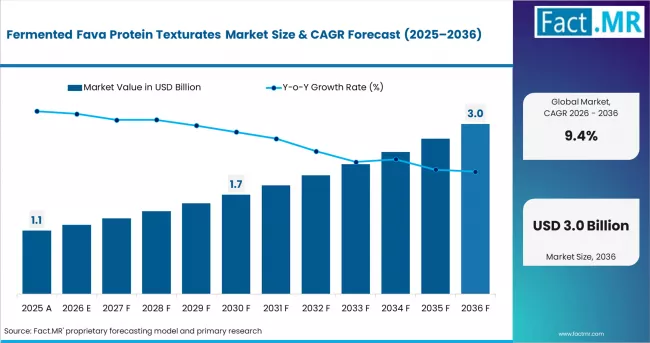
Fermented Fava Protein Texturates Market Value Analysis | Source: Fact.MR
Summary of Fermented Fava Protein Texturates Market
- Market Definition
- The market covers fermented fava protein texturates in chunk, flake, and powder formats. Used in meat alternatives, processed foods, and nutritional ingredient applications globally.
- Demand Drivers
- EU novel food approvals are accelerating fava texturate adoption. Driven by clean-label reformulation mandates across European food manufacturers.
- China plant protein capacity expansion is scaling fermented texturate output. Supported by state food security and domestic protein self-sufficiency goals.
- U.S. alternative meat sector investment is increasing demand for functionally superior texturates. Driven by textural performance requirements of leading burger and patty brands.
- Key Segments Analyzed
- By Product Type: Textured chunks/granules lead at 63% in 2026. Dominant in meat substitute burger and mince formats.
- By Fermentation Type: Solid-state fermentation leads at 45% in 2026. Preferred for flavour improvement and functional performance.
- By Application: Meat alternatives lead at 60% in 2026. Driven by plant-based burger, sausage, and mince product demand.
- Analyst Opinion at FACT.MR
- Shambhu Nath Jha, Principal Consultant at Fact.MR, opines, 'Fermentation type and application combinations define premium positioning. CXOs will find actionable segment-level opportunity maps in this report.'
- Strategic Implications
- Invest in solid-state fermentation capacity for chunk and granule formats targeting meat alternative manufacturers.
- Develop precision fermentation-based fava texturate lines for nutritional ingredient buyers requiring documented amino acid profiles.
- Secure fava bean supply chain partnerships in Europe and India to reduce feedstock dependency and improve cost positions.
- Methodology
- Market sizing based on producer revenues and ingredient volumes. Validated with 2024–2025 procurement data.
- Supported by novel food approval data, EU and U.S. plant protein trade statistics, and fermentation capacity records.
- Forecasts include alternative meat sector growth, fermentation type adoption curves, and expert ingredient industry inputs.
| Metric | Value |
|---|---|
| Estimated Value in 2026 | USD 1.1 billion |
| Forecast Value in 2036 | USD 2.6 billion |
| Forecast CAGR (2026 to 2036) | 9.4% |
Source: Fact.MR analysis. Updated Apr 22, 2026
The market is expected to generate USD 1.5 billion in incremental revenue during the forecast period. Growth is transformational and structurally driven. Demand is supported by plant-based food reformulation and clean-label protein mandates. Scale-up of fava cultivation and fermentation capacity remains an enabling constraint on faster growth.
Demand is shifting toward functionally characterised texturate formats. Meat alternative developers and ready-meal producers require fermentation-enhanced digestibility and taste neutrality. Manufacturers demand documented amino acid profiles and low anti-nutritional factor content. Certified organic and allergen-free grades are increasingly standard. Ingredient suppliers without validated fermentation platforms are being excluded from premium food innovation contracts.
China leads at 13.4% CAGR through 2036, driven by plant protein demand and fermentation scale-up. India follows at 12.7%, supported by pulse availability and growing protein consumption. The Netherlands records 11.2%, anchored by fermentation and food-tech startup density. The United Kingdom grows at 10.9%, reflecting rapid vegan population expansion and retail channel penetration. The United States records 10.8%, driven by alternative meat innovation and food technology investment. Germany grows at 10.5%, led by plant-based R&D strength and clean-label product development.
Segmental Analysis
Fermented Fava Protein Texturates Market Analysis by Product Type
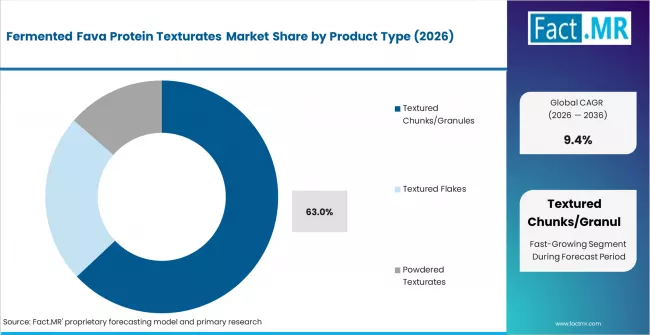
Fermented Fava Protein Texturates Market Analysis By Product Type | Source: Fact.MR
Based on FACT.MR's fermented fava protein texturates market report, consumption of textured chunks and granules is estimated to hold 63% share in 2026. They dominate because they directly replicate the bite and chew of meat in burgers and mince formats. Their structural versatility across hydration levels gives them application breadth unavailable to flake or powder formats.
- Roquette Investment: Roquette Frères expanded its pea and fava protein texturate manufacturing capacity in France in Q3 2024, targeting increased chunk and granule output for European meat alternative customers. The expansion supports multi-year supply agreements. [4]
- Ingredion Technology Development: Ingredion Incorporated launched new fermented fava protein texturate grades in early 2025, specifically validated for solid-state fermentation profiles. Products meet clean-label and low anti-nutritional factor standards required by food manufacturers. [5]
- Texturate Demand Trend: Chunk and granule texturate procurement grew 11% in 2024 per Good Food Institute plant protein ingredient tracking data. Meat alternative product launches requiring defined texturate formats accelerated across North America and Europe.
Fermented Fava Protein Texturates Market Analysis by Fermentation Type
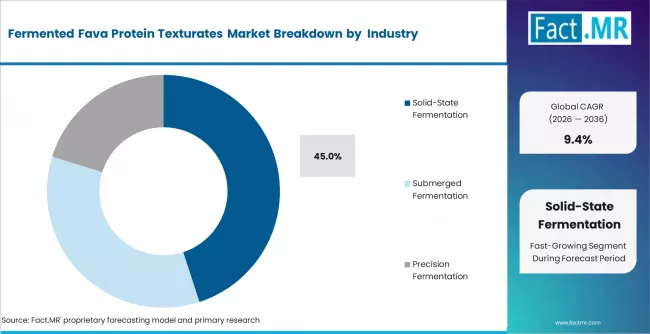
Fermented Fava Protein Texturates Market Analysis By Fermentation Type | Source: Fact.MR
Based on FACT.MR's fermented fava protein texturates market report, solid-state fermentation is estimated to hold 45% share in 2026. This method leads due to its superior flavour profile improvement and lower water usage relative to submerged fermentation. Food manufacturers prefer it for the taste neutrality it delivers in finished meat substitute products.
- DSM-Firmenich Platform Launch: DSM-Firmenich launched a new solid-state fermentation platform for legume protein in Q4 2024, targeting flavour improvement and digestibility enhancement in fava and pea texturates for European food customers. [7]
- PURIS Submerged Fermentation Expansion: PURIS expanded submerged fermentation capacity for plant protein texturates in the United States in 2024, supported by USDA alternative protein grant funding and supply agreements with major food brands. [2]
- Precision Fermentation Adoption Trend: Precision fermentation-based fava protein texturate pilots increased 18% in 2024 per Good Food Institute R&D tracking. New entrants in the Netherlands and Germany are positioning precision fermentation as the next-generation upgrade path for nutritional ingredient buyers. [6]
Drivers, Restraints, and Opportunities
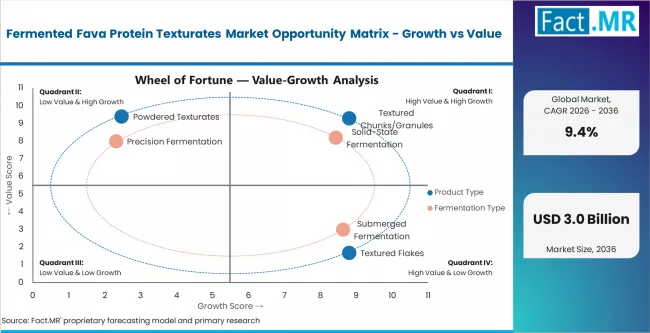
Fermented Fava Protein Texturates Market Opportunity Matrix Growth Vs Value | Source: Fact.MR
Fact.MR analysis indicates the market is a high-growth, innovation-led ingredient segment. Growth is concentrated in meat alternative and clean-label processed food formulations. These segments hold the majority of current demand. Ready-to-eat and nutritional ingredient applications are growing from a smaller base.
Commodity fava protein is not a key differentiator. Buyers require fermentation-documented, functionally characterised texturate grades. These command premium pricing over standard plant protein formats. High-capacity fermentation infrastructure is limited. This supports premium supplier positioning. A mid-value segment is developing in ready-meal and food service channels.
- EU Novel Food Regulation: European Commission Novel Food approvals for fermented fava protein formats expanded in 2024. Clean-label mandates are tightening ingredient specifications. Roquette reported increased EU customer interest in fermented variants. [1]
- U.S. Alternative Meat Investment: USDA-backed alternative protein research grants disbursed in 2024 increased fava texturate development activity. Ingredient buyers are requiring superior textural and binding performance. PURIS expanded fermented protein output in 2024 targeting burger and patty applications.
- China Plant Protein Capacity Scale-Up: China's Ministry of Agriculture approved 12 plant protein processing capacity projects in 2024. Fermented fava texturate demand is rising with export-oriented food manufacturing. Domestic suppliers are scaling fermentation infrastructure for international ingredient buyers. [3]
Regional Analysis
The fermented fava protein texturates market is assessed across Asia Pacific, North America, Europe, Latin America, and Middle East and Africa, covering 40+ countries with distinct demand profiles shaped by plant protein adoption rates, fermentation infrastructure scale, alternative meat regulatory frameworks, and food innovation investment intensity. The full report offers market attractiveness analysis by region and country.
.webp "Top Country Growth Comparison Fermented Fava Protein Texturates Market Cagr (2026 2036)")
Top Country Growth Comparison Fermented Fava Protein Texturates Market Cagr (2026 2036) | Source: Fact.MR
| Country | CAGR (2026 to 2036) |
|---|---|
| China | 13.4% |
| India | 12.7% |
| Netherlands | 11.2% |
| United Kingdom | 10.9% |
| United States | 10.8% |
| Germany | 10.5% |
Source: Fact.MR analysis. Updated Apr 22, 2026
Source: Fact.MR (FACT.MR) analysis, based on proprietary forecasting model and primary research
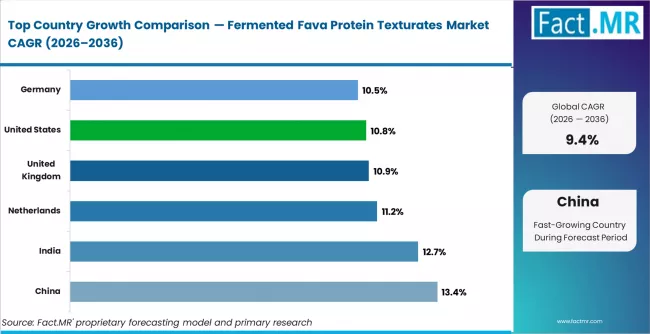
Fermented Fava Protein Texturates Market Cagr Analysis By Country | Source: Fact.MR
Asia Pacific Fermented Fava Protein Texturates Market Analysis
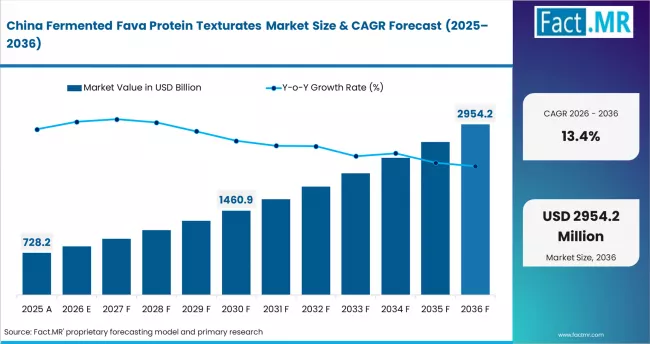
Fermented Fava Protein Texturates Market Country Value Analysis | Source: Fact.MR
Asia Pacific dominates global scale and capacity expansion. China and India anchor supply and demand dynamics. Processing ecosystems are expanding rapidly. Procurement is becoming functionality-driven.
- China: In China, market expansion is accelerating rapidly, with growth expected to register a CAGR of 13.4% through 2036. Industrial approvals in 2024 boosted fermentation capacity across key provinces. National food security priorities are strengthening domestic protein production. Manufacturers are integrating fermented texturates into ready meals and export-driven supply chains.
- India: India is witnessing strong upward momentum, with the market forecast to expand at 12.7% CAGR over the forecast period. The presence of local fava cultivation supports cost-efficient production. Government-backed incentives in 2024 encouraged capacity additions. Rising demand for affordable protein foods is supporting wider adoption across urban markets.
- Japan: Japan reflects a steady growth trajectory, with moderate expansion anticipated through 2036. Market progression is supported by advanced fermentation research initiatives. Strict procurement standards extend qualification timelines. However, once approved, products secure long-term demand in premium food segments.
FACT.MR covers China, India, Japan, South Korea, ASEAN, and Australia and New Zealand. It includes fermentation capacity data, plant protein adoption trends, and ingredient procurement benchmarks.
Europe Fermented Fava Protein Texturates Market Analysis
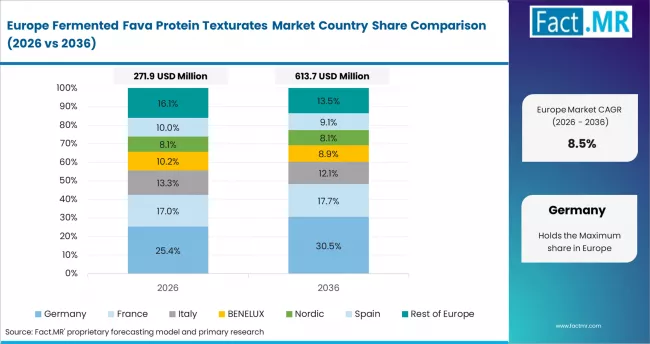
Fermented Fava Protein Texturates Market Europe Country Market Share Analysis, 2026 & 2036 | Source: Fact.MR
Europe acts as a regulatory and innovation hub. Clean-label demand is accelerating product uptake. Food-tech investments are strengthening supply capabilities. Companies are focusing on compliant and high-performance formulations.
- Germany: Germany’s market is set to expand at a CAGR of 10.5% through 2036, supported by strong R&D integration. National protein strategies are driving domestic processing investments. Ingredient suppliers are expanding fermented portfolios. Retail channels are increasing plant-based product visibility.
- United Kingdom: The UK market is expected to record growth at around 10.9% CAGR through 2036, driven by rising consumer adoption. A growing vegan population is expanding demand. Regulatory clarity has improved supplier entry conditions. Food manufacturers are increasing usage in ready meals and convenience products.
- Netherlands: In the Netherlands, growth is projected at an estimated CAGR of 11.2% through 2036, reflecting strong innovation intensity. Research institutions are commercialising fermentation technologies. Government funding is accelerating industrial scale-up. The country continues to function as a key export hub across Europe.
FACT.MR covers Germany, the UK, France, Italy, Spain, Netherlands, Nordic Countries, and BENELUX. It includes regulatory approval trends, plant-based retail data, and fermented ingredient procurement analysis.
North America Fermented Fava Protein Texturates Market Analysis
North America reflects a performance-driven and premium market structure. Demand is shaped by alternative protein innovation. Procurement depends on validated functionality and certification standards.
- United States: The United States is anticipated to grow at a CAGR of 10.8% through 2036, supported by strong innovation pipelines. Federal funding initiatives in 2024 accelerated fermentation R&D. Production capacity is expanding across major regions. Food brands are increasingly adopting fermented proteins for enhanced texture and formulation performance.
FACT.MR covers the United States, Canada, and Mexico. It includes USDA programme data, alternative protein ingredient trends, and fermented protein procurement benchmarks.
Competitive Aligners for Market Players
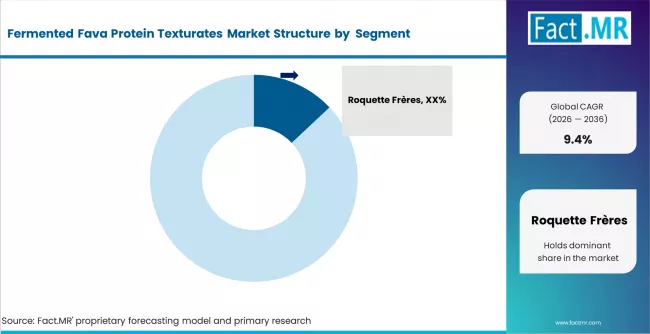
Fermented Fava Protein Texturates Market Analysis By Company | Source: Fact.MR
The fermented fava protein texturates market is evolving into a capability-driven competitive environment, where differentiation is defined by fermentation expertise, functional performance, and application alignment rather than raw protein supply. Traditional plant protein suppliers are facing pressure as buyers shift toward texturates that deliver improved texture, digestibility, and flavour masking, particularly in meat alternatives and performance nutrition.
Leading players are investing in fermentation platforms to enhance protein functionality at a molecular level. Companies such as Roquette, DSM-Firmenich, and Ingredion are expanding their portfolios with application-specific formulations tailored for ready meals, meat analogues, and high-protein snacks. Their competitive strength lies in combining ingredient innovation with regulatory compliance and large-scale production capabilities.
Emerging food-tech companies are also gaining traction by focusing on precision fermentation and novel processing techniques. These firms are targeting niche, high-margin segments where performance requirements are stringent and willingness to pay is higher. Their agility in product development allows faster response to changing formulation needs from food manufacturers.
Partnerships across the value chain are becoming critical. Ingredient suppliers are collaborating with food brands, contract manufacturers, and retail chains to co-develop products and secure long-term supply agreements. This integrated approach improves market access and strengthens customer retention. Regional dynamics further shape competition. Europe leads in innovation and regulatory alignment, while Asia Pacific offers cost advantages and scale. North America remains a premium market driven by performance validation and brand partnerships. The competitive landscape is shifting toward players that can deliver consistent functionality, scalable production, and strong application support, positioning fermentation capability as the core differentiator.
Key Players
- Roquette Frères
- Ingredion Incorporated
- Cargill Inc.
- ADM (Archer Daniels Midland)
- PURIS
- Vestkorn Milling
- BENEO GmbH
- DSM-Firmenich
- DuPont Nutrition (IFF)
- Chr. Hansen
Bibliography
- [1] European Commission. (2024). Novel Food Regulation Update 2024: Approved Fermented Legume Protein Formats and Clean-Label Ingredient Processing Standards for Plant-Based Food Applications in EU Member States. ec.europa.eu/food/safety/novel_food
- [2] USDA Agricultural Research Service. (2024). Alternative Protein Research Initiative 2024: Grant Awards for Fermented Plant Protein Texturate Development Including Fava Bean Fermentation Capacity Expansion Projects. usda.gov/ars/alternative-protein
- [3] Ministry of Agriculture and Rural Affairs, China. (2024). 14th Five-Year Plan Plant Protein Processing Investment Programme: Approved Capacity Projects Including Legume Fermentation and Protein Texturate Manufacturing Facilities. moa.gov.cn/english
- [4] Roquette Frères. (Q3 2024). Capacity Expansion Announcement: Fava and Pea Protein Texturate Manufacturing Facility Expansion in France Targeting European Meat Alternative Ingredient Supply Agreements. roquette.com/media
- [5] Ingredion Incorporated. (Early 2025). Product Launch: Fermented Fava Protein Texturate Grades Validated for Clean-Label and Low Anti-Nutritional Factor Standards for Food Manufacturer Ingredient Applications. ingredion.com/news
- [6] Good Food Institute. (2024). Plant Protein Ingredient Market Report 2024: Fermented Texturate Procurement Growth, Precision Fermentation Pilot Tracking, and Alternative Meat Ingredient Format Adoption Data. gfi.org/resources
- [7] DSM-Firmenich. (Q4 2024). Platform Launch: Solid-State Fermentation System for Legume Protein Texturate Flavour Improvement and Digestibility Enhancement Targeting European and Asian Food Manufacturer Customers. dsm-firmenich.com/news
This Report Addresses
- Strategic intelligence on demand across meat alternative, ready-to-eat processed food, and nutritional ingredient applications of fermented fava protein texturates globally.
- Market forecast from USD 1.1 billion in 2026 to USD 2.6 billion by 2036, at a CAGR of 9.4%.
- Growth opportunity mapping across China plant protein scale-up, India feedstock advantage, Netherlands food-tech fermentation density, U.S. alternative meat innovation, UK vegan retail expansion, and Germany clean-label R&D.
- Segment analysis by product type (chunks, flakes, powders), fermentation type (solid-state, submerged, precision), and application (meat alternatives, processed foods, nutritional ingredients).
- Regional outlook covering Asia Pacific capacity-led growth, Europe regulation-driven premium demand, and North America food innovation-led texturate adoption.
- Competitive analysis of Roquette, Ingredion, Cargill, PURIS, DSM-Firmenich, and others. Focus on fermentation platform depth, qualification breadth, and food brand alignment.
- Regulatory analysis covering EU Novel Food Regulation, U.S. USDA Alternative Protein Initiative, India PLI food processing programme, and China 14th Five-Year Plan protein mandates.
- Report delivered in PDF, Excel, and presentation formats. Supported by primary interviews, food industry procurement data, and fermentation capacity benchmarks.
Fermented Fava Protein Texturates Market Definition
The market includes fermented fava bean protein texturates, chunks, granules, flakes, and powders processed through solid-state, submerged, or precision fermentation. These texturates improve digestibility, reduce off-flavours, and enhance functional performance in meat alternative and processed food applications.
Fermented Fava Protein Texturates Market Inclusions
Covers global and regional forecasts from 2026 to 2036. Includes product type and fermentation type segments. Covers meat alternatives, ready-to-eat foods, and nutritional ingredients. Includes retail, food service, and B2B ingredient supply channels.
Fermented Fava Protein Texturates Market Exclusions
Excludes unfermented fava protein concentrates and isolates. Omits finished consumer packaged meat substitute products. Also excludes fava-based beverages and non-textured fava flour. Focus remains on fermented texturate formats as ingredient intermediates.
Fermented Fava Protein Texturates Market Research Methodology
- Primary Research
- Interviews with protein texturate producers and food manufacturers. Covers meat alternative developers, ready-meal producers, and nutritional ingredient buyers.
- Desk Research
- Uses Roquette, Ingredion, and PURIS disclosure data. Includes plant protein trade statistics and fermentation capacity data from 2024–2025.
- Market-Sizing and Forecasting
- Uses a hybrid top-down and bottom-up model. Based on producer revenues and application-level volumes. Segmented by product type, fermentation type, and application.
- Data Validation and Update Cycle
- Validated using revenue data and food industry procurement statistics. Cross-checked with ingredient launch records and expert interviews. Updated regularly.
Segmentation
Scope of Report
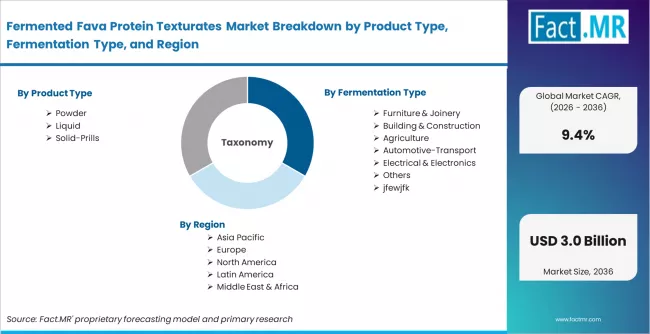
Fermented Fava Protein Texturates Market Breakdown By Product Type, Fermentation Type, And Region | Source: Fact.MR
| Attribute | Details |
|---|---|
| Quantitative Units | USD 1.1 billion (2026) to USD 2.6 billion (2036), at a CAGR of 9.4% |
| Market Definition | Fermented fava bean protein texturates in chunk, granule, flake, and powder formats produced via solid-state, submerged, or precision fermentation and supplied as functional ingredients for meat alternatives, processed foods, and nutritional ingredient applications. |
| Product Type Segmentation | Textured Chunks/Granules, Textured Flakes, Powdered Texturates |
| Fermentation Type Segmentation | Solid-State Fermentation, Submerged Fermentation, Precision Fermentation |
| Application Segmentation | Meat Alternatives, Ready-to-Eat/Processed Foods, Nutritional Ingredients |
| Application Coverage | Plant-based burger, sausage, and mince forming; chilled and frozen ready-meal protein inclusion; sports nutrition and clinical nutrition ingredient supply; and food service plant protein procurement. |
| Regions Covered | North America, Europe, Asia Pacific, Latin America, Middle East and Africa |
| Countries Covered | USA, Canada, Mexico, Germany, UK, France, Italy, Spain, Netherlands, Nordic, BENELUX, China, Japan, South Korea, India, ASEAN, Australia and New Zealand, Brazil, Argentina, Chile, Saudi Arabia, GCC, Turkey, South Africa, Rest of MEA |
| Key Companies Profiled | Roquette Frères, Ingredion Incorporated, Cargill Inc., ADM, PURIS, Vestkorn Milling, BENEO GmbH, DSM-Firmenich, DuPont Nutrition (IFF), Chr. Hansen |
| Forecast Period | 2026 to 2036 |
| Approach | Hybrid top-down and bottom-up model using protein texturate producer revenues, application-level volume estimates by fermentation type, average selling prices by grade and format, food manufacturer procurement benchmarks, and primary interviews with alternative meat developers and nutritional ingredient buyers. |
Source: Fact.MR analysis. Updated Apr 22, 2026
Fermented Fava Protein Texturates Market by Segments
-
By Product Type:
- Textured Chunks/Granules
- Textured Flakes
- Powdered Texturates
-
By Fermentation Type:
- Solid-State Fermentation
- Submerged Fermentation
- Precision Fermentation
-
By Application:
- Meat Alternatives
- Ready-to-Eat/Processed Foods
- Nutritional Ingredients
-
By Region:
- North America
- United States
- Canada
- Mexico
- Latin America
- Brazil
- Mexico
- Argentina
- Chile
- Rest of Latin America
- Western Europe
- Germany
- United Kingdom
- France
- Italy
- Spain
- Netherlands
- Nordic Countries
- BENELUX
- Rest of Western Europe
- Eastern Europe
- Russia
- Poland
- Hungary
- Balkan and Baltic
- Rest of Eastern Europe
- East Asia
- China
- Japan
- South Korea
- South Asia and Pacific
- India
- ASEAN
- Australia and New Zealand
- Rest of South Asia and Pacific
- Middle East and Africa
- Kingdom of Saudi Arabia
- Other GCC Countries
- Turkey
- South Africa
- Rest of Middle East and Africa
- North America
Frequently Asked Questions
How large is the fermented fava protein texturates market in 2025?
What will the market size be in 2026?
What is the projected market size by 2036?
What is the expected CAGR of the fermented fava protein texturates market?
What is the absolute dollar opportunity in this market?
Which product type segment leads the market?
Which fermentation type segment is poised to lead?
Which application segment holds the largest share?
Which country shows the fastest growth?
Who worked on this report


Preview the report firsthand - request a free sample
Free SampleGet the brochure for pricing and purchase details
Download PDF