- Base Value(2025): 1.4 Bn
- Forecast Value (2035): 4.5 Bn
- CAGR (2035): 12.2%
Fermented Plant Yogurts Market Outlook 2025 to 2035
The global fermented plant yogurts market is expected to reach USD 4.5 Billion by 2035, up from USD 1.4 Billion in 2025. During the forecast period (2025 – 2035), the industry is projected to expand at a CAGR of 12.7%.
The market for fermented plant-based foods is undergoing significant transformation as consumers increasingly seek dairy-free products that promote gut health. The rising adoption of vegan diets, growing lactose intolerance, and heightened health awareness are key factors fueling this shift.
Advancements in plant-based fermentation technologies, along with clean-label formulations and improved taste and texture, are enhancing consumer acceptance. Moreover, environmental concerns and the proactive innovation of leading global food companies are further driving the expansion of the fermented plant-based dairy alternatives market.
Quick Stats for Fermented Plant Yogurts Market
- Industry Value (2025): USD 1.4 Billion
- Projected Value (2035): USD 4.5 Billion
- Forecast CAGR (2025 to 2035): 12.7%
- Leading Segment (2025): Soy (34.7% Market Share)
- Fastest Growing Country (2025-2035): China (14.3% CAGR)
- Top Key Players: Danone, General Mills, Inc., Nestlé S.A., Hain Celestial Group, Inc., Califia Farms, Oatly AB, Kite Hill, Daiya Foods and Stonyfield Farm
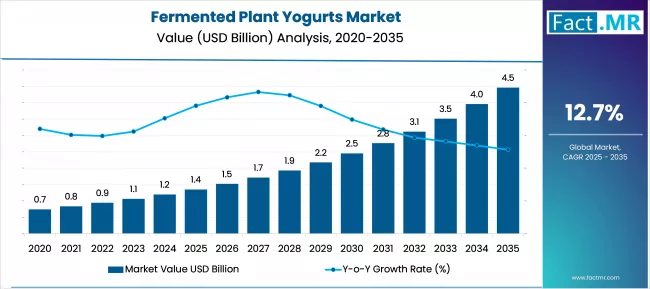
Fermented Plant Yogurts Market Market Value Analysis | Source: Fact.MR
What are the drivers of the Fermented Plant Yogurts Market?
The market for cultured plant yogurts is increasing as buyers focus more on foods that are both healthful and earth friendly. Large scale patterns like plant-based diets, no-animal foods, and lactose free eating have been behind this popularity. Plant-based yogurts are creamier, tastier, healthier, and have lower environmental impact due to innovations in fermentation technology, which are more environmentally friendly.
The liaison of food manufacturers and biotech innovators and brands pushes the development of products faster, introducing new flavors and products with probiotics into the market sooner. Demand will be driven by the increasing awareness of the consumer regarding gut health, clean labels and socially responsible foods, which will position fermented plant yogurts as a convenient, ethical and health-conscience alternative to traditional dairy products.
What are the regional trends of the Fermented Plant Yogurts Market?
Fermented plant yogurts market displays the unique regional trends determined by the consumer preferences, health concerns, and sustainability objectives. North America is a leader with great demand of dairy-free, probiotic-rich foods and intense investment in plant-based innovation.
Europe is devoted to the production of organic, clean-label, and environmental friendly yogurts that correspond to the strict food regulation and green lifestyles.
Asia-Pacific, particularly the areas of China, India and Southeast Asia are growing at a high rate, particularly in terms of protein demand, urbanization and growing health-conscious consumption.
Latin America is growing moderately, shifting towards the use of plant-based yogurts in wellness and digestive health. Middle East & Africa consider fermented plant yogurts to be the more sustainable and healthy alternatives when there is a lack of dairy resources.
What are the challenges and restraining factors of the Fermented Plant Yogurts Market?
Fermented plant yogurts market has a number of challenges that restrict their mass adoption. Prices are high due to high production costs such as sourcing quality plant bases and special fermentation equipment. High quality of taste and texture, as well as nutritional values, needs high-level technology and competent personnel. In certain areas, the level of consumer awareness is low, and people are still inclined to use traditional dairy yogurt.
Countries have different regulatory approvals of new plant-based formulations, which delay the launch of products. There are constraints in the complexities of the supply chains such as sourcing of sustainable ingredients and cold chains. Moreover, market development is threatened by the dairy yogurts and other plant-based snacks, and constant innovation is needed in sensory acceptance and clean-labels expectations.
Country-Wise Insights
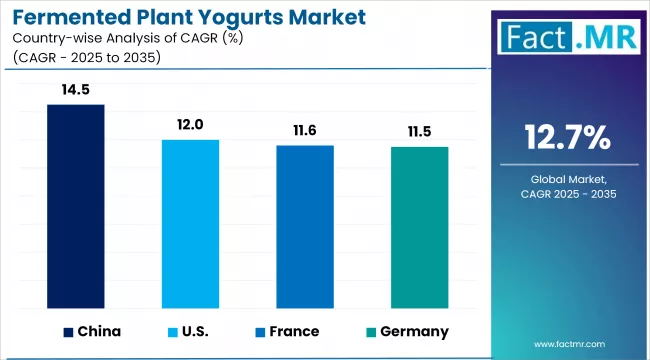
Fermented Plant Yogurts Market Cagr Analysis By Country | Source: Fact.MR
U.S. leads fermented plant yogurts with health-conscious, sustainable demand
The U.S. is the leading market in fermented plant yogurts because consumer interest in health, gut health and sustainable foods is increasing. The big names such as Danone (Silk), Oatley, and Califia Farms are working hard to provide creamy and full of flavor and probiotic-enriched plant yogurts. The trend of veganism, lactose intolerance, and flexitarianism compels acceptance, and the growth is expedited by investment in clean-label and functional products.
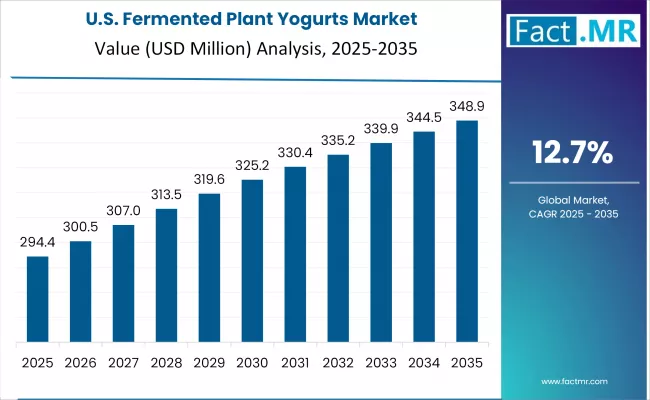
Fermented Plant Yogurts Market Country Value Analysis | Source: Fact.MR
Food tech startups in participation with established brands and retailers used to launch new products in short time. The U.S. is the largest market in the world with the further reinforcement of consumer consciousness of the environment and willingness to consume healthy, ethical, and convenient food.
Germany drives plant yogurt adoption through eco-friendly, organic, probiotic trends
There is a high consumer behavior in Germany with regard to health and environmental friendliness which has led to the fact that the country is a major market in Europe in fermented plant yogurts. Alpro, Provamel and Andechser are making their organic, probiotic and functional vegan yogurts more popular. They are all based on plants. Germans want labels that are easy to read, local supply and sustainability all help them to invent new yogurts made of oats, soybeans and almonds. Retail chains and online shops are the suppliers of plant yogurts.
If rules are put in place that favor labels and full transparency, consumer confidence will grow, especially curiosity about vegan and lactose free diets which will strengthen the trend. This awareness of the environment coupled with the health focus and disposable income makes Germany remain at the top when compared to the rest of Europe.
France embraces plant yogurts for gut health and sustainability focus
The trend of fermented plant yogurts is also being adopted quickly in France as consumers are transitioning to plant-based, gut-friendly, and sustainable diets. Such companies as Danone (Alpro), Sojasun, Bjorg are pioneering organic, flavored, and probiotic-enriched, and tastier, plant yogurts, that are gaining popularity among the taste-sensitive customers.
Purchase decisions are made by awareness programs on health, environmental advantages and ethical food production. Consumers in France are increasingly moving toward clean-label products made of natural ingredients, and retailers are increasing shelf space of plant-based dairy products. Regulations and guidelines by the government over plant-based labeling enhance confidence and culture which approves alternative foods leads to growth. France is currently among the European markets leading in the consumption of fermented plant yogurts.
Category-Wise Analysis
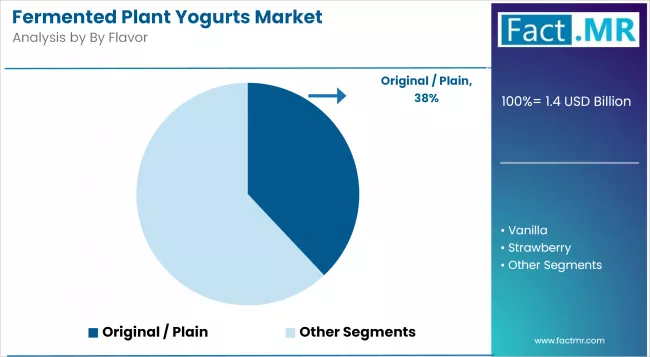
Fermented Plant Yogurts Market Analysis By By Flavor | Source: Fact.MR
High-protein, lactose-free soy yogurts attract health-conscious, plant-based consumers
The competitiveness of the soy-based fermented yogurts is high because of the high protein levels, lactose-free nature, and the high level of consumer trends of plant-based products. High in isoflavones, they appeal to health-conscious and vegan consumers who are interested in improvement of the gut health. The use of technological progress in fermentation contributes to a better taste and texture, thereby making soy yogurt more acceptable.
There are fortified versions and mixed flavours being invented by brands so as to meet various taste preferences. Other critical markets are Asia-Pacific and North American markets, as more people become aware of plant-based diets. To increase the range of access, retailers are selling a wide range of pack sizes, organic, and flavored variants in order to gain more repeat buyers.
Versatile plain yogurts preferred for minimal ingredients and digestive benefits
Simple or original fermented plant yogurts are still popularized by their versatility and low levels of ingredient perception. They are targeted to conservative consumers that prioritize the existence of neutral flavor to cook, smoothies, or consume straight. This is a segment that is seen to be healthier, having fewer additives and less sugar. Usability such as probiotics and digestive wellness are highlighted.
It is a foundation of it being customized with fruits, nuts or cereals. Health stores and supermarkets are oriented on clean-label marketing to appeal to healthy consumers. Plain forms are characterized by high repurchase and high brand loyalty in different regions.
Convenient retail channels drive wide availability and mass adoption
The most popular retail outlet in fermented plant yogurts distribution is supermarket and hypermarket. These stores have extensive product range, reasonable prices and promotional presence and mass adoption. Consumers would like to have the convenience of shopping in a single place, and exposure to a variety of brands and flavors. Using shelf placement, in-store sampling, and loyalty cards, retailers drive their customers to make more frequent purchases.
The channel supports international and local brands, and it will enable penetration of the market. The cost-effectiveness of the yogurts is also spreading to the use of the private-labeled yogurts. In cities, sales are dominated by supermarkets and hypermarkets, and ready-to-eat products and plant-based yogurt with a healthy focus are increasingly gaining popularity.
Competitive Analysis
Key players in the Fermented Plant Yogurts Market include Danone, General Mills, Inc., Nestlé S.A., Hain Celestial Group, Inc., Califia Farms, Oatly AB, Kite Hill, Daiya Foods and Stonyfield Farm.
The market of fermented plant yogurt is rather competitive; the major players in the market are Danone, Alpro, Siggi, Chobani, and Silk. The most popular companies in this sector are first movers with a great variety of plant-based yogurts and different flavors, viscosities, and nutritional value. Their distinction strategy is using premium quality ingredients, taste profiles, and operational advantages such as probiotics and support to digestibility. Innovations with products form strong ties with retail outlets and see more shoppers choosing to eat only plants. If you want to be top dog, then find ways to raise the taste, last longer, and eco-friendliness of the packaging. It will be a winner if you can talk about clear labels, push protein and be kind to nature.
Recent Development
- In November 2024, IFF introduced TEXSTAR™, a state-of-the-art enzymatic product that will improve the texture of fresh fermented dairy and plant-based products without stabilizers. TEXSTAR is designed to allow manufacturers to develop unique textures in their products which involve familiar ingredients, which are accepted by the consumer.
- In January 2024, Nature’s Fynd introduced a yeasts-powered probiotic, Fy Yogurt, the world’s first ever fermented products made out of fungi that can make protein. The innovation provides a creamy texture and high nutritional value and is an alternative to the traditional and plant-based yogurts.
Fact.MR has provided detailed information about the price points of key manufacturers of Fermented Plant Yogurts Market positioned across regions, sales growth, production capacity, and speculative technological expansion, in the recently published report.
Methodology and Industry Tracking Approach
In Fact.MR (2025) report on the fermented plant yogurts market, 6,200 individuals in 20 countries participated in the survey (at least 120 surveyed per market). Approximately 55 percent were real users of plant-based yogurts, such as vegans, lactose intolerant and health conscious consumers. The rest 45 percent was made up of industry players including, manufacturers, nutritionists and regulatory bodies. The analysis examined the consumption behavior, the favorite flavours and formats, the prices, the distribution, and the drivers of market development. Subsidiary data for September 2024 through October 2025 was obtained using more than 150 secondary sources, such as industry reports, patents, scientific articles and regulatory frameworks and algorithmically processed by trend analysis, forecasting, scenario modeling.
With Fact.MR monitoring consumer behavior, product efficacy, industry trends, and market opportunities since 2018, this report is becoming an authoritative source of information that stakeholders can rely on.
Segmentation
Segmentation of Fermented Plant Yogurts Market
-
By Raw Material / Source :
- Soy
- Almond
- Coconut
- Oat
- Others
-
By Flavor :
- Original / Plain
- Vanilla
- Strawberry
- Blueberry
- Others
-
By Distribution Channel :
- Supermarket / Hypermarket
- Convenience stores
- Specialty stores
- Online retail
-
By Region :
- North America
- Latin America
- Western Europe
- Eastern Europe
- East Asia
- South Asia & Pacific
- Middle East & Africa
Frequently Asked Questions
What was the global Fermented Plant Yogurts Market size reported by Fact.MR for 2025?
Who are the major players Operating in the Fermented Plant Yogurts Market?
What is the estimated valuation of the Fermented Plant Yogurts Market in 2035?
What Value CAGR did the Fermented Plant Yogurts Market exhibit over the last five years?
Who worked on this report


Preview the report firsthand - request a free sample
Free SampleGet the brochure for pricing and purchase details
Download PDF