- Base Value(2025): 2.0 Bn
- Estimated Value(2025): 2.0 Bn
- Forecast Value (2035): 4.5 Bn
- CAGR (2025 - 2035): 8.4%
Fermenters Market Forecast and Outlook 2025 to 2035
The global fermenters market is projected to reach USD 4.5 billion by 2035, recording an absolute increase of USD 2.5 billion over the forecast period. The market is valued at USD 2.0 billion in 2025 and is set to rise at a CAGR of 8.4% during the assessment period.
Quick Stats for Fermenters Market
- Fermenters Market Value (2025): USD 2.0 billion
- Fermenters Market Forecast Value (2035): USD 4.5 billion
- Fermenters Market Forecast CAGR: 8.4%
- Leading Application in Fermenters Market: Food & Beverage (41.0%)
- Key Growth Regions in Fermenters Market: Asia Pacific, North America, and Europe
- Top Players in Fermenters Market: Eppendorf AG, Sartorius AG, Thermo Fisher Scientific, GEA Group, Pierre Guerin SAS, Applikon Biotechnology BV, New Brunswick Scientific, Zeta Holding GmbH, Cercell APS, Electrolab Biotech Ltd.
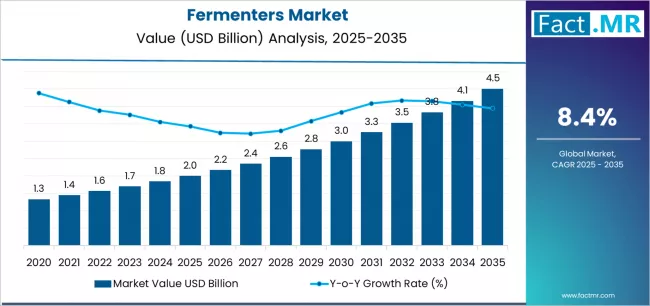
Fermenters Market Market Value Analysis | Source: Fact.MR
The market is expected to grow by 2.3 times during the same period, supported by expanding biopharmaceutical production capacity and growing fermentation-based manufacturing across both developed and emerging industrial markets. Growing application diversity in probiotics production, biofuel development, and enzyme manufacturing creates expanding opportunities for fermenter innovation and specialized bioprocessing equipment development across pharmaceutical facilities and food production operations.
Rising industrial biotechnology investment in Asia Pacific nations, coupled with expanding bioprocessing infrastructure through advanced fermentation facilities and modern manufacturing plants, further accelerate market penetration across diverse production segments. The growing global demand for biopharmaceuticals, particularly in monoclonal antibodies, vaccines, and recombinant proteins, generates sustained requirements for high-capacity fermentation systems and automated bioprocessing platforms.
Technical advancements in fermenter control technologies demonstrating measurable improvements in process monitoring, contamination prevention, and yield optimization reinforce manufacturer confidence in fermentation economics, while sustainable manufacturing trends toward bio-based products expand addressable market opportunities beyond traditional pharmaceutical applications into industrial enzyme production and specialty chemical manufacturing.
Biotechnology companies and food manufacturers increasingly incorporate advanced fermentation systems into production facilities, research laboratories, and pilot-scale operations, creating mainstream adoption channels that extend beyond specialty applications into conventional manufacturing environments.
High capital costs for large-scale fermentation systems and stringent regulatory requirements for biopharmaceutical manufacturing may pose challenges to market expansion. Technical complexity during process optimization and scale-up in certain applications also influences production efficiency, requiring manufacturers to develop sophisticated control systems catering to specific bioprocessing requirements across different product categories.
Contamination risks during fermentation operations and the specialized expertise requirements for bioprocess engineering and microbial cultivation may limit accessibility among smaller producers in developing regions with limited infrastructure for advanced fermentation technology and comprehensive quality assurance systems.
Fermenters Market Year-over-Year Forecast 2025 to 2035
Between 2025 and 2030, the fermenters market is projected to expand from USD 2.0 billion to USD 3.0 billion, resulting in a value increase of USD 1.0 billion, which represents 40.0% of the total forecast growth for the decade. This phase of development will be shaped by accelerating biopharmaceutical manufacturing expansion and probiotic production growth, product innovation in automated fermentation control systems and single-use bioreactor technologies, as well as expanding integration with continuous manufacturing platforms and real-time bioprocess monitoring solutions. Companies are establishing competitive positions through investment in advanced fermentation technology development, scalable bioprocessing capabilities, and strategic market expansion across pharmaceutical manufacturing facilities, food production plants, and biotechnology research operations.
From 2030 to 2035, the market is forecast to grow from USD 3.0 billion to USD 4.5 billion, adding another USD 1.5 billion, which constitutes 60.0% of the overall ten-year expansion. This period is expected to be characterized by the expansion of specialized fermentation applications, including cell-free protein synthesis systems and precision fermentation platforms tailored for alternative protein production, strategic collaborations between fermenter manufacturers and biopharmaceutical companies, and an enhanced focus on sustainable bioprocessing practices and energy-efficient fermentation technologies. The growing emphasis on bio-based manufacturing and circular economy principles will drive demand for advanced fermenter solutions across diverse industrial applications.
Fermenters Market Key Takeaways
| Metric | Value |
|---|---|
| Market Value (2025) | USD 2.0 billion |
| Market Forecast Value (2035) | USD 4.5 billion |
| Forecast CAGR (2025-2035) | 8.4% |
Why is the Fermenters Market Experiencing Steady Growth?
The fermenters market grows by enabling biopharmaceutical manufacturers, food producers, and biotechnology companies to access reliable bioprocessing equipment that supports production scalability while meeting industrial demand for consistent fermentation performance specifications.
Pharmaceutical manufacturers and food processing operators face mounting pressure to develop high-quality biological products with proven batch consistency and regulatory compliance, with fermentation systems typically providing precise environmental control and sterile operating conditions essential for successful microbial cultivation and product biosynthesis, making these systems essential for competitive production positioning in biopharmaceuticals, fermented foods, and industrial biotechnology categories.
The bioprocessing industry's need for reliable fermentation infrastructure and consistent production outcomes creates demand for diverse fermenter configurations that can provide optimal growth conditions, maintain predictable performance across different microbial strains, and ensure quality compliance without compromising production economics or operational efficiency.
Government initiatives promoting biopharmaceutical manufacturing and biotechnology sector development drive adoption in pharmaceutical production facilities, food processing plants, and research institutions, where fermenter technology has a direct impact on product quality outcomes and manufacturing capacity.
The pharmaceutical industry's growing focus on biologics production and biosimilar development further expands market opportunities, with industry research demonstrating measurable productivity advantages from advanced fermentation systems, including improved cell densities and enhanced product titers.
Technical complexity during process development and the specialized requirements for bioprocess optimization and contamination control may limit accessibility among smaller biotechnology startups and developing regions with limited infrastructure for advanced fermentation operations and comprehensive validation systems.
Segmental Analysis
The market is segmented by application, mode of operation, microorganism, process, and region. By application, the market is divided into food & beverage, pharmaceuticals, personal care & cosmetics, and other applications. By mode of operation, the market encompasses automatic and semi-automatic.
By microorganism, the market includes bacteria, fungi, and others. By process, the market comprises fed-batch, batch, and continuous. Regionally, the market is divided into Asia Pacific, North America, Europe, Latin America, and Middle East & Africa.
Which is the Dominant Application Area for Fermenters?
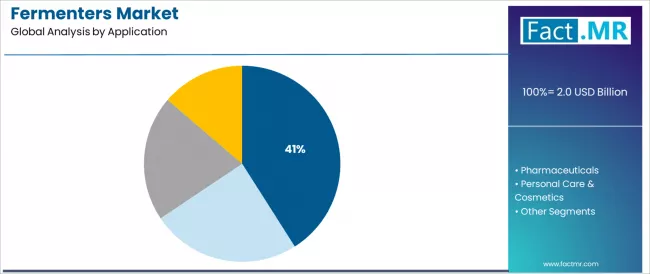
Fermenters Market Analysis By Application | Source: Fact.MR
The food & beverage segment represents the dominant force in the fermenters market, capturing 41.0% of the total market share in 2025. This established application category encompasses solutions featuring diverse fermentation processes for dairy products, alcoholic beverages, probiotics, and fermented ingredients, including yogurt production, beer brewing, and enzyme manufacturing that enable consistent product quality, scalable production capacity, and reliable fermentation performance across all food manufacturing applications.
The food & beverage segment's market leadership stems from its widespread adoption across global food production operations, with fermentation technology capable of meeting diverse product requirements while maintaining cost-effective manufacturing and operational flexibility across all food processing environments.
Within the food & beverage segment, dairy fermentation and probiotic production account for the largest capacity share, driven by growing consumer demand for functional foods and continuous product innovation across global food manufacturing operations.
The pharmaceuticals segment maintains a substantial 29.0% market share, serving biopharmaceutical manufacturers who require sterile fermentation systems for producing antibiotics, vaccines, therapeutic proteins, and biosimilar drugs. These systems offer precise environmental control for pharmaceutical production applications while providing sufficient scalability to meet commercial manufacturing demands and regulatory requirements.
The personal care & cosmetics segment accounts for approximately 18.0% of the market, serving ingredient manufacturers requiring fermentation-derived compounds for skincare formulations and cosmetic applications demanding natural ingredient production and sustainable manufacturing specifications.
Key advantages driving the food & beverage segment include:
- Established manufacturing infrastructure with integrated fermentation facilities that reduce implementation complexity and ensure consistent production availability
- Diverse product applications allowing broad market reach across different food categories without significant process adaptation requirements
- Proven commercial viability, delivering reliable production outcomes while maintaining competitiveness against alternative manufacturing processes
- Broad industry acceptance enabling straightforward equipment specification and quality standards across multiple food production sectors
Why are Automatic Fermenters Preferred?
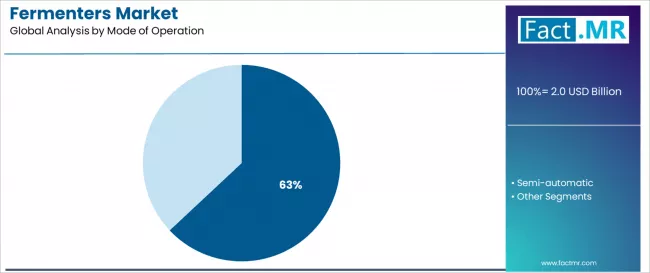
Fermenters Market Analysis By Mode Of Operation | Source: Fact.MR
Automatic fermenters constitute 63.0% of the market share in 2025, representing the largest operational category. This dominance stems from growing demand for process automation, reduced manual intervention requirements, and enhanced batch consistency through computerized control systems.
Automatic fermenters leverage advanced sensor technologies and programmable logic controllers to maintain optimal fermentation conditions, with automation systems enabling real-time parameter adjustment, data logging capabilities, and remote monitoring functions that define operational excellence in modern bioprocessing facilities.
The segment benefits from labor cost reduction advantages, with automated systems reducing operator requirements by 40-60% compared to manual fermentation operations while improving batch reproducibility.
The semi-automatic segment follows with 37.0% market share, reflecting operational approaches that combine automated control for critical parameters with manual oversight for process adjustments and intervention capabilities. Semi-automatic fermenters provide cost-effective solutions for smaller production scales and research applications, with manual control options enabling process flexibility during development phases and specialized fermentation protocols requiring operator expertise.
By Microorganism, Which Category is the Go-To Choice for Fermenter Users?
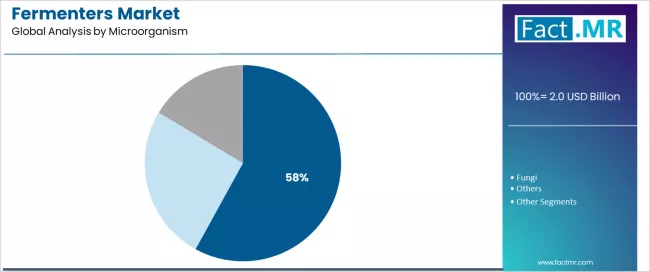
Fermenters Market Analysis By Microorganism | Source: Fact.MR
Bacterial fermentation accounts for 58.0% of the fermenters market microorganism distribution in 2025, reflecting widespread utilization of bacterial fermentation for antibiotic production, probiotic manufacturing, enzyme synthesis, and industrial chemical production.
Bacteria's leadership position stems from rapid growth rates, well-characterized metabolic pathways, and genetic engineering accessibility that enable efficient production of diverse biological products from therapeutic proteins to specialty chemicals.
Fungi maintain a 32.0% share through yeast fermentation for alcoholic beverage production, bread making, and recombinant protein expression, plus filamentous fungi cultivation for enzyme production and secondary metabolite synthesis.
Fungi-based fermentation offers unique product capabilities for brewing industries and pharmaceutical manufacturing. Other microorganisms account for 10.0% through algae cultivation, mammalian cell culture, and specialized microbial fermentation applications serving niche biotechnology markets.
Which Process is the Most Relied Upon by Industry Users of Fermenters?
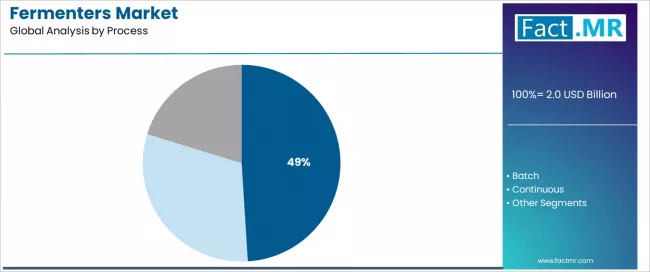
Fermenters Market Analysis By Process | Source: Fact.MR
The fed-batch process segment represents 49.0% of the fermenters market process distribution in 2025, reflecting optimal balance between productivity and operational control. Fed-batch fermentation's leadership position stems from ability to achieve high cell densities through controlled nutrient feeding, extended production phases, and substrate inhibition management that maximize product yields while maintaining metabolic efficiency.
The batch process segment maintains approximately 34.0% share through traditional fermentation approaches providing operational simplicity, equipment flexibility, and reduced contamination risks for pharmaceutical production requiring validated processes and regulatory compliance. The continuous process segment accounts for 17.0% through specialized applications enabling steady-state production, reduced downtime, and consistent product quality for high-volume industrial fermentation operations.
What are the Drivers, Restraints, and Key Trends of the Fermenters Market?
The market is driven by three concrete demand factors tied to biotechnology advancement and industrial production growth. First, expanding biopharmaceutical manufacturing capacity and increasing biologics production create growing demand for fermentation systems, with global biopharmaceutical market expanding by 8-10% annually requiring comprehensive bioprocessing infrastructure. Second, rising consumer demand for fermented foods and probiotic products drives increased adoption of food-grade fermentation equipment, with many food manufacturers implementing capacity expansion programs for functional food production by 2030. Third, technological advancements in bioprocess control and single-use technology enable more effective and efficient fermentation that reduces contamination risks while improving process monitoring and production flexibility capabilities.
Market restraints include high capital investment requirements for industrial-scale fermentation systems that can deter smaller biotechnology companies from equipment acquisition, particularly in regions where fermentation infrastructure represents substantial upfront costs or where production volumes cannot justify expensive bioprocessing investments. Technical complexity and process optimization challenges pose another significant challenge, as successful fermentation requires specialized expertise in microbial cultivation, media optimization, and contamination prevention, potentially causing extended development timelines and validation expenditures. Regulatory compliance requirements and quality assurance demands for pharmaceutical fermentation create additional market challenges for market entry, demanding ongoing investment in validation studies and comprehensive documentation systems.
Key trends indicate accelerated single-use bioreactor adoption in biopharmaceutical manufacturing, particularly in clinical trial production and specialized therapeutic development where disposable systems reduce cleaning validation requirements and cross-contamination risks. Technology integration trends toward continuous manufacturing with perfusion fermentation systems, real-time process analytics with advanced sensor technologies, and artificial intelligence-enabled process optimization enable improved production approaches that increase productivity and reduce manufacturing costs. However, the market thesis could face disruption if significant advances in cell-free biosynthesis technologies or major shifts in biomanufacturing strategies reduce reliance on traditional fermentation-based production systems.
Analysis of the Fermenters Market by Key Countries
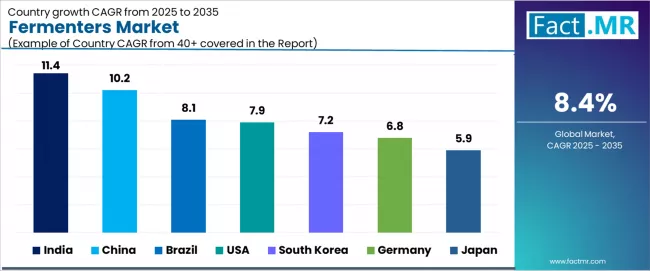
Fermenters Market Cagr Analysis By Country | Source: Fact.MR
| Country | CAGR (2025-2035) |
|---|---|
| India | 11.4% |
| China | 10.2% |
| Brazil | 8.1% |
| USA | 7.9% |
| South Korea | 7.2% |
| Germany | 6.8% |
| Japan | 5.9% |
The fermenters market is expanding steadily, with India leading at an 11.4% CAGR through 2035, driven by expanding pharmaceutical manufacturing capacity, growing biotechnology sector, and increasing food processing industrialization. China follows at 10.2%, supported by massive biopharmaceutical infrastructure development, integrated biotechnology industry growth, and government initiatives for biosimilar production.
Brazil records 8.1%, reflecting growing pharmaceutical manufacturing and expanding food fermentation capacity. USA posts 7.9%, anchored by established biopharmaceutical industry presence and continuous bioprocessing innovation. South Korea grows at 7.2%, with advanced biotechnology sector and fermentation technology development.
Germany advances at 6.8%, emphasizing pharmaceutical manufacturing excellence and bioprocessing equipment leadership, while Japan grows steadily at 5.9%, focusing on precision fermentation applications and advanced bioprocess control technologies.
India Leads Global Market Expansion
India demonstrates the strongest growth potential in the fermenters market with a CAGR of 11.4% through 2035. The country's leadership position stems from rapidly expanding pharmaceutical manufacturing sector, growing biotechnology industry, and increasing contract manufacturing operations enabling mainstream fermenter adoption.
Growth is concentrated in major pharmaceutical clusters, including Hyderabad, Ahmedabad, Bangalore, and Mumbai, where biopharmaceutical facilities and expanding fermentation capacity are implementing advanced fermenter systems for enhanced production capabilities and quality compliance.
Distribution channels through equipment manufacturers, specialized bioprocessing suppliers, and technology partnerships expand deployment across pharmaceutical manufacturers and biotechnology companies. The country's growing position as global pharmaceutical supplier provides policy support for manufacturing infrastructure, including production-linked incentive schemes for biotechnology equipment.
Key market factors:
- Pharmaceutical production demand concentrated in established manufacturing hubs with comprehensive fermentation infrastructure
- Manufacturing capacity development through government initiatives and private sector investments
- Comprehensive biotechnology ecosystem, including emerging biosimilar production capabilities
- Technology partnerships featuring collaborations with international equipment manufacturers and process technology providers
China Emerges as Biomanufacturing Powerhouse
In major industrial provinces including Jiangsu, Zhejiang, Shanghai, and Beijing, the deployment of fermentation systems is accelerating across biopharmaceutical facilities and industrial biotechnology operations, driven by government biotechnology initiatives and substantial manufacturing investments.
The market demonstrates strong growth momentum with a CAGR of 10.2% through 2035, linked to biopharmaceutical sector expansion, integrated manufacturing infrastructure, and sustained domestic production demand.
Chinese manufacturers are implementing advanced fermentation technologies and large-scale bioprocessing systems to enhance production economics while meeting growing demand in expanding pharmaceutical sectors and industrial enzyme industries. The country's biotechnology development plans create persistent demand for fermentation equipment, while increasing emphasis on biosimilar production drives adoption of modern bioprocessing platforms.
Key development areas:
- Biopharmaceutical companies and contract manufacturers leading fermenter adoption with comprehensive capacity expansion programs
- Government biotechnology initiatives providing systematic support with extensive funding mechanisms
- Technology partnerships between domestic manufacturers and international equipment suppliers are expanding capabilities
- Integration of continuous manufacturing systems and comprehensive process automation technologies
Brazil Shows Regional Manufacturing Leadership
Brazil's market expansion is driven by pharmaceutical manufacturing growth, including biopharmaceutical production facilities in São Paulo and Rio de Janeiro, and expanding industrial biotechnology operations across multiple states. The country demonstrates promising growth potential with a CAGR of 8.1% through 2035, supported by growing pharmaceutical industry, increasing biotechnology investments, and expanding fermented beverage production capacity.
Brazilian manufacturers demonstrate increasing fermentation technology adoption with modern equipment installations, requiring partnerships with international technology providers and technical support from equipment suppliers. However, economic volatility and capital availability constraints create implementation challenges, particularly in large-scale fermentation systems where investment requirements have direct impact on capacity expansion capabilities across pharmaceutical manufacturing operations.
Key market characteristics:
- Pharmaceutical manufacturing and food processing segments showing fastest growth with substantial equipment procurement
- Industrial development trends focused on biopharmaceutical production and specialty fermentation applications
- Future projections indicate the need for expanded bioprocessing infrastructure and technical workforce development programs
- Growing emphasis on technology transfer and local manufacturing capability building
USA Demonstrates Innovation Leadership
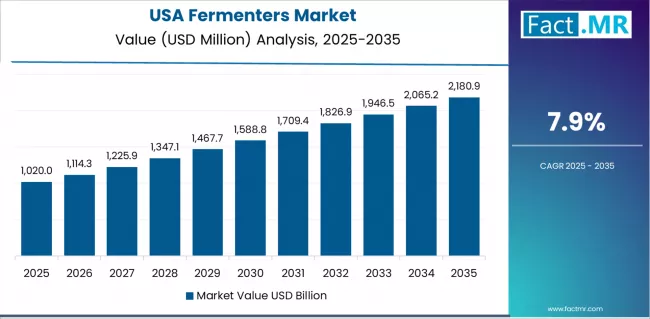
Fermenters Market Country Value Analysis | Source: Fact.MR
The USA’s market leads in bioprocessing innovation based on integration with advanced biopharmaceutical manufacturing and sophisticated fermentation technology for enhanced production capability. The country shows steady potential with a CAGR of 7.9% through 2035, driven by established pharmaceutical industry infrastructure, continuous biologics production expansion, and the adoption of next-generation fermentation technologies in major manufacturing regions, including Massachusetts, California, North Carolina, and New Jersey.
American manufacturers are implementing sophisticated fermentation systems for monoclonal antibody production and advanced therapeutics manufacturing, particularly in biopharmaceutical facilities with comprehensive bioprocessing capabilities demanding validated production systems. Technology deployment channels through direct equipment sales and specialized bioprocessing service providers expand coverage across pharmaceutical manufacturers and contract development organizations.
Leading market segments:
- Biopharmaceutical manufacturers and CDMOs implementing state-of-the-art fermentation facilities with comprehensive automation
- Strategic partnerships between equipment suppliers and pharmaceutical companies, achieving customized bioprocessing solutions and process optimization
- Continuous manufacturing initiatives and single-use technology adoption are expanding operational flexibility
- Focus on process intensification and sustainable manufacturing methodologies
South Korea Shows Technology Advancement
In major biotechnology centers including Seoul, Incheon, and Daejeon, pharmaceutical manufacturers and biotechnology companies are implementing advanced fermentation systems to optimize production capacity and improve bioprocessing efficiency, with documented implementations showing significant productivity improvements through automated control systems and process optimization approaches.
The market shows steady growth potential with a CAGR of 7.2% through 2035, linked to advanced biotechnology sector, growing biopharmaceutical manufacturing, and ongoing biosimilar production development in major regions.
South Korean manufacturers are adopting sophisticated fermentation technologies and quality assurance protocols to enhance manufacturing competitiveness while maintaining standards demanded by international pharmaceutical markets and export requirements. The country's strategic biotechnology initiatives create persistent demand for advanced bioprocessing equipment and modern fermentation systems that support pharmaceutical manufacturing excellence.
Market development factors:
- Biopharmaceutical companies and biosimilar manufacturers leading fermenter procurement across South Korea
- Government biotechnology programs and industrial development policies providing support for manufacturing infrastructure
- Strategic relationships between Korean pharmaceutical companies and international equipment manufacturers are expanding technology access
- Emphasis on manufacturing quality excellence and international regulatory compliance
Germany Demonstrates Manufacturing Excellence
Germany's fermenters market demonstrates sophisticated and technology-focused landscape, characterized by deep integration of precision engineering with existing pharmaceutical manufacturing operations across biopharmaceutical facilities, equipment manufacturing centers, and research institutions.
The country shows steady growth momentum with a CAGR of 6.8% through 2035, driven by world-class pharmaceutical manufacturing infrastructure, leading bioprocessing equipment industry, and advanced fermentation technology development in major industrial regions. Germany's emphasis on engineering excellence and quality manufacturing creates requirements for high-precision fermentation systems that support comprehensive pharmaceutical production standards and rigorous quality protocols in manufacturing operations.
The market benefits from strong equipment manufacturing capabilities and pharmaceutical industry presence, creating bioprocessing ecosystems that prioritize reliability and performance excellence. Pharmaceutical production facilities across major manufacturing regions showcase advanced fermentation implementations where system integration achieves stringent quality standards through comprehensive validation programs.
Key market characteristics:
- Pharmaceutical manufacturers and equipment producers driving market development with emphasis on technological innovation and quality excellence
- Engineering excellence frameworks enabling precision manufacturing with comprehensive quality assurance
- Collaborative development between equipment manufacturers and pharmaceutical companies are advancing fermentation technology
- Emphasis on sustainable bioprocessing and energy-efficient manufacturing methodologies
Japan Shows Precision Technology Focus
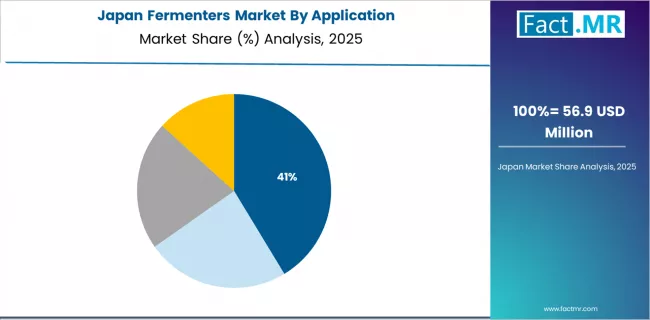
Fermenters Market Japan Market Share Analysis By Application | Source: Fact.MR
Japan's fermenters market demonstrates advanced and quality-focused landscape, characterized by sophisticated integration of precision fermentation control with existing pharmaceutical production operations across biopharmaceutical facilities and specialty fermentation applications.
The country shows steady growth momentum with a CAGR of 5.9% through 2035, driven by established pharmaceutical industry presence, advanced bioprocess control technology, and specialized fermentation applications in research facilities. Japan's emphasis on precision manufacturing and quality control creates requirements for sophisticated fermentation systems that support comprehensive pharmaceutical quality standards and advanced process monitoring in production operations.
The market benefits from strong instrumentation technology capabilities and pharmaceutical manufacturing excellence, creating bioprocessing environments that prioritize process control and product consistency. Pharmaceutical facilities in major production regions showcase precision fermentation implementations where advanced control systems achieve optimal production outcomes through systematic process management programs.
Key market characteristics:
- Pharmaceutical manufacturers and research institutions driving precision fermentation technology with emphasis on process control excellence
- Quality assurance partnerships enabling rigorous manufacturing standards with comprehensive validation programs
- Technology collaboration between Japanese equipment manufacturers and pharmaceutical companies are expanding innovation capabilities
- Emphasis on miniaturization technology and laboratory-scale fermentation system development
Europe Market Split by Country
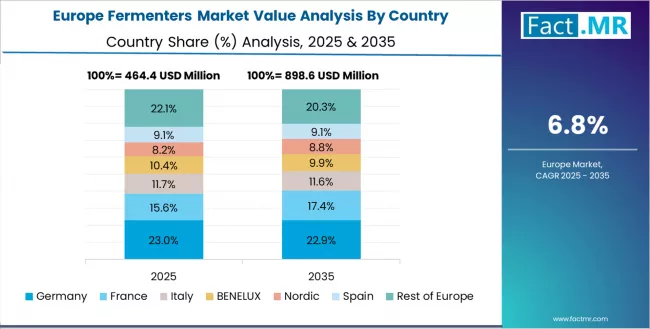
Fermenters Market Europe Country Market Share Analysis, 2025 & 2035 | Source: Fact.MR
The fermenters market in Europe is projected to grow from USD 0.5 billion in 2025 to USD 1.1 billion by 2035, registering a CAGR of 8.2% over the forecast period. Germany is expected to maintain its leadership position with a 32.4% market share in 2025, supported by its advanced pharmaceutical manufacturing infrastructure, world-class bioprocessing equipment industry, and strong biotechnology sector across major industrial centers.
Switzerland follows with a 21.8% share in 2025, driven by established biopharmaceutical production operations and concentrated pharmaceutical manufacturing facilities. France holds a 18.4% share in 2025 through its comprehensive pharmaceutical industry and growing biotechnology sector.
The UK commands a 14.3% share, while Rest of Europe accounts for 12.9% in 2025. By 2035, Germany is projected to hold 31.9% share, Switzerland 22.1%, France 18.9%, UK 14.6%, and Rest of Europe 12.5%, reflecting sustained growth momentum across all major European markets and increasing fermenter adoption in diversified pharmaceutical and biotechnology applications implementing advanced bioprocessing programs.
Competitive Landscape of the Fermenters Market
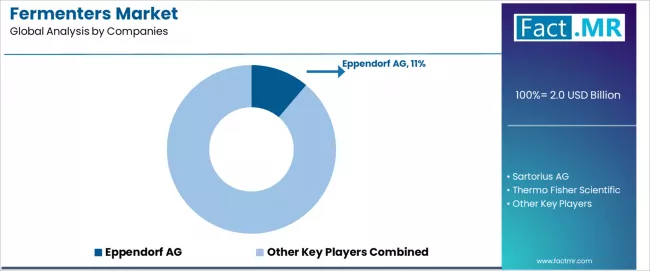
Fermenters Market Analysis By Company | Source: Fact.MR
The fermenters market features approximately 25-35 meaningful players with moderate concentration, where the top three companies control roughly 31-35% of global market share through established equipment portfolios and extensive customer relationships across pharmaceutical and biotechnology sectors.
Market leaders include Eppendorf AG, Sartorius AG, and Thermo Fisher Scientific, which maintain competitive advantages through comprehensive fermenter product portfolios, global service networks, and deep expertise in bioprocessing equipment design and manufacturing sectors, creating strong customer relationships among pharmaceutical manufacturers and biotechnology companies.
These companies leverage established manufacturing facilities and ongoing technology innovation initiatives to defend market positions while expanding into single-use bioreactor applications and advanced process control systems. Eppendorf AG commands an 11.2% market share through diversified bioprocessing equipment offerings and strategic positioning in laboratory and production-scale fermentation markets.
Challengers encompass GEA Group, Pierre Guerin SAS, and Applikon Biotechnology BV, which compete through specialized fermentation technologies and strong presence in industrial-scale bioprocessing and pharmaceutical manufacturing markets.
Specialized equipment manufacturers, including New Brunswick Scientific, Zeta Holding GmbH, and Cercell APS, focus on specific fermenter configurations or market segments, offering differentiated capabilities in laboratory-scale systems, pilot production equipment, and specialized fermentation applications.
Regional players and emerging bioprocessing companies create competitive pressure through innovative fermenter designs and cost-competitive solutions, particularly in high-growth markets including China and India, where local manufacturing presence provides advantages in pricing optimization and customer proximity.
Market dynamics favor companies that combine engineering excellence with comprehensive technical support services that address the complete bioprocessing value chain from equipment design through installation, validation, and ongoing maintenance. Strategic investments in automation technology and single-use system development enable differentiation and market share gains across diverse bioprocessing applications.
Global Fermenters Market - Stakeholder Contribution Framework
Fermenter products represent a critical bioprocessing technology that enables pharmaceutical manufacturers, food producers, and biotechnology companies to achieve reliable microbial cultivation and product biosynthesis without compromising production quality, typically providing essential environmental control and sterile operating conditions while supporting diverse fermentation applications.
With the market projected to grow from USD 2.0 billion in 2025 to USD 4.5 billion by 2035 at an 8.4% CAGR, these systems offer compelling advantages - precise process control, scalable production capacity, and consistent batch quality - making them essential for biopharmaceutical manufacturing (fastest growing application), food production operations (largest segment), and diverse industrial biotechnology applications seeking reliable fermentation solutions. Scaling production capacity and technology adoption requires coordinated action across government policy, industry standards, equipment manufacturers, end-user companies, and research institutions.
How Governments Could Spur Manufacturing Infrastructure Development?
- Biotechnology Industry Support Programs: Include fermentation infrastructure in national biotechnology strategies, providing targeted funding for bioprocessing facility development in regions with emerging pharmaceutical industries and supporting manufacturers through capital equipment grants and tax incentives.
- Manufacturing Infrastructure & Utilities: Implement reliable power supply systems for bioprocessing operations, provide access to high-quality water sources for fermentation applications, and establish industrial park infrastructure that supports biotechnology manufacturing facility development.
- Technology Transfer & Innovation Support: Create favorable frameworks for bioprocessing technology adoption, provide funding for equipment modernization programs, and develop public-private partnerships that facilitate advanced fermentation technology implementation in domestic manufacturing operations.
- Workforce Development & Training: Fund specialized education programs for bioprocess engineers, fermentation technologists, and quality assurance specialists. Invest in technical training initiatives that bridge bioprocessing theory with practical fermentation operation and troubleshooting skills.
How Industry Bodies Could Support Market Development?
- Technical Standards & Best Practices: Define standardized specifications for fermenter design and performance across pharmaceutical, food, and industrial applications, establish universal validation protocols and qualification criteria, and create good manufacturing practice guidelines for fermentation operations that manufacturers can implement.
- Industry Education & Knowledge Sharing: Lead educational initiatives that demonstrate fermentation technology applications, emphasizing process optimization strategies, contamination prevention protocols, and scale-up methodologies compared to inadequate bioprocessing approaches.
- Quality Standards & Compliance: Develop comprehensive quality frameworks for fermentation equipment, validation documentation requirements, and operational qualification programs, ensuring reliable bioprocessing performance across different manufacturing environments and regulatory jurisdictions.
How Manufacturers and Technology Providers Could Strengthen the Ecosystem?
- Equipment Innovation Development: Develop next-generation fermentation systems with enhanced automation capabilities, improved contamination prevention features, and application-specific configurations that enhance bioprocessing efficiency while addressing sustainability requirements and operational cost reduction.
- Technical Support & Services: Provide comprehensive customer support that integrates equipment installation, process development assistance, validation support, and preventive maintenance programs, enabling customers to maximize fermentation performance and production reliability.
- Process Integration Solutions: Offer complete bioprocessing platforms that combine fermentation with downstream processing equipment, including integrated control systems, data management software, and process analytical technology that keep bioprocessing workflows consistent with manufacturing requirements and quality standards.
Key Players in the Fermenters Market
- Eppendorf AG
- Sartorius AG
- Thermo Fisher Scientific
- GEA Group
- Pierre Guerin SAS
- Applikon Biotechnology BV
- New Brunswick Scientific
- Zeta Holding GmbH
- Cercell APS
- Electrolab Biotech Ltd.
Segmentation
Scope of the Report
| Items | Values |
|---|---|
| Quantitative Units | USD 2.0 Billion |
| Application | Food & Beverage, Pharmaceuticals, Personal Care & Cosmetics, Other Applications |
| Mode of Operation | Automatic, Semi-automatic |
| Microorganism | Bacteria, Fungi, Others |
| Process | Fed-batch, Batch, Continuous |
| Regions Covered | Asia Pacific, North America, Europe, Latin America, Middle East & Africa |
| Country Covered | India, China, Brazil, USA, South Korea, Germany, Japan, and 40+ countries |
| Key Companies Profiled | Eppendorf AG, Sartorius AG, Thermo Fisher Scientific, GEA Group, Pierre Guerin SAS, Applikon Biotechnology BV, New Brunswick Scientific, Zeta Holding GmbH, Cercell APS, Electrolab Biotech Ltd. |
| Additional Attributes | Dollar sales by application and process categories, regional fermentation technology adoption trends across Asia Pacific, North America, and Europe, competitive landscape with bioprocessing equipment manufacturers and biotechnology companies, technical specifications and validation requirements, integration with pharmaceutical manufacturing facilities and food production operations. |
Fermenters Market by Segments
-
Application :
- Food & Beverage
- Pharmaceuticals
- Personal Care & Cosmetics
- Other Applications
-
Mode of Operation :
- Automatic
- Semi-automatic
-
Microorganism :
- Bacteria
- Fungi
- Others
-
Process :
- Fed-batch
- Batch
- Continuous
-
Region :
- Asia Pacific
- China
- Japan
- South Korea
- India
- Australia & New Zealand
- ASEAN
- Rest of Asia Pacific
- North America
- USA
- Canada
- Mexico
- Europe
- Germany
- Switzerland
- France
- UK
- Rest of Europe
- Latin America
- Brazil
- Rest of Latin America
- Middle East & Africa
- Kingdom of Saudi Arabia
- Other GCC Countries
- Turkey
- South Africa
- Rest of Middle East & Africa
- Asia Pacific
Frequently Asked Questions
How big is the fermenters market in 2025?
What will be the size of fermenters market in 2035?
How much will be the fermenters market growth between 2025 and 2035?
What are the key product types in the fermenters market?
Which mode of operation segment to contribute significant share in the fermenters market in 2025?
Who worked on this report


Preview the report firsthand - request a free sample
Free SampleGet the brochure for pricing and purchase details
Download PDF