High Moisture Extrusion Dies Market Size, Share, Growth and Forecast (2026 - 2036)
The Global High Moisture Extrusion Dies Market is segmented by Die Type, End User, Extruder Compatibility, Die Configuration, Material Type, and Region, with forecasts covering the period from 2026 to 2036.
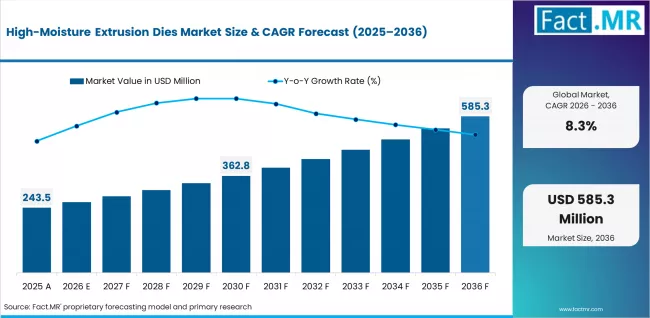
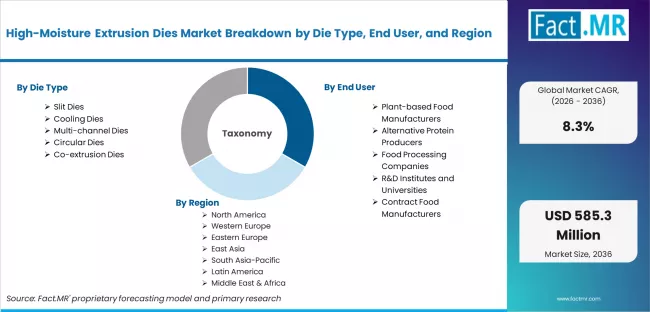
According to market estimates, the global high moisture extrusion dies market stood at approximately USD 243.5 million in 2025. The market is projected to reach around USD 263.7 million in 2026 and is expected to grow significantly to approximately USD 585.3 million by 2036, progressing at a CAGR of 8.3% during the forecast period. Slit Dies are anticipated to account for nearly 29.80% share by 2026, driven by their widespread use in producing fibrous, Twin‑screw Extrusion Dies are expected to remain the dominant compatibility segment with around 86.7% share by 2026.
High Moisture Extrusion Dies Market Overview, Growth Outlook, and Forecast by Fact.MR
- In 2025, the global high moisture extrusion dies market was valued at approximately USD 243.5 million.
- Based on Fact.MR analysis, demand for high moisture extrusion dies is estimated to grow to around USD 263.7 million in 2026 and USD 585.3 million by 2036.
- The market is projected to expand at a CAGR of around 8.3% during the forecast period.
Summary of the High Moisture Extrusion Dies Market
- Market Snapshot
- In 2025, the global high moisture extrusion dies market was valued at approximately USD 243.5 million.
- The market is estimated to reach around USD 263.7 million in 2026 and is projected to attain nearly USD 585.3 million by 2036.
- The market is expected to expand at a CAGR of approximately 8.3% during the forecast period.
- The market is anticipated to create an absolute dollar opportunity of approximately USD 321.6 million between 2026 and 2036.
- In terms of die type, Slit Dies dominate with a share of approximately 29.80% in 2026, driven by their ability to produce fibrous, meat-like textures essential for high-moisture plant-based protein extrusion.
- Based on extruder compatibility, Twin-screw Extrusion Dies account for approximately 86.7% share in 2026, driven by their superior mixing, shearing, and thermal control capabilities required for high moisture extrusion processes.
- Demand and Growth Drivers
- The efficiency, consistency and quality of products produced by advancements in technology related to extrusion dies and die design continue to improve.
- There is an increase in partnerships/collaborations between the food industry and manufacturers of processing equipment which helps to create new opportunities for growth within the market.
- Emergence of contract manufacturers producing plant-based products is further increasing demand for higher-capacity extrusion systems and/or dies.
- Product and Segment View
- Slit Dies hold a 29.80% share, driven by their ability to produce fibrous, meat-like textures essential for high‑moisture plant‑based protein extrusion and whole‑cut meat analogs.
- Plant‑based Food Manufacturers account for a 36.90% share, supported by the rapid global shift toward alternative proteins and the need for specialized dies that replicate animal meat structure and mouthfeel.
- Twin‑screw Extrusion Dies command an 86.70% share, owing to their superior mixing, shearing, and precise thermal control, which are critical for achieving consistent texturization in high moisture extrusion processes.
- Multi‑channel Systems represent a 43.80% share, as they enable uniform cooling and pressure distribution across multiple product streams, significantly improving throughput and product quality.
- Stainless Steel Dies are the leading material type with a 41.80% share, driven by their excellent corrosion resistance, compliance with food safety standards, and durability under high pressure and moisture conditions.
- Geography and Competitive Outlook
- China and India are seeing this growth as a result of increasing investments into production of plant proteins and the rising demand for meat substitutes.
- North America and Europe represent the largest markets at this time due to the established presence of developed plant protein companies, the use of advanced food processing technology and rapid introduction of high moisture extrusion systems.
- The developing regions Asia Pacific are experiencing growth from the expansion of disposable incomes, increasing awareness about sustainable diets, and increasing plant protein consumption due to heightened development of local production plants.
- The global High Moisture Extrusion Dies market includes key players such as Buhler AG, Nordson, FUTURE FOODSBV, Coperion, Thermo Fisher Scientific, and others.
- Analyst Opinion
- Shambhu Nath Jha, Principal Consultant at Fact.MR, says, “With the growing trend of the food industry towards developing plant-based protein sources, high moisture extrusion technology is gaining prominence. This is because the unique characteristics of high moisture extrusion dies allow them to form products that mimic meat textures. With increasing improvements in technology, and emphasis on continuous process and energy efficiency, innovation in high moisture extrusion die cooling techniques can be expected to advance rapidly.
High Moisture Extrusion Dies Market — At a Glance
| Metric | Value |
|---|---|
| Market Value 2025 | USD 243.5 Million |
| Market Value 2026 | USD 263.7 Million |
| Market Value 2036 | USD 585.3 Million |
| Absolute Dollar Opportunity | USD 321.6 Million (2026–2036) |
| CAGR | 8.30% |
| Growth Multiple | ~2.4x |
| Key Demand Theme | Rising global demand for plant‑based meat and alternative proteins, need for high‑moisture extrusion that mimics animal meat texture, and increasing automation in die design for consistent product quality and operational efficiency |
| Leading Die Type | Slit Dies |
| Die Type Share | 29.80% |
| Leading Extruder Compatibility | Twin‑screw Extrusion Dies |
| Extruder Compatibility Share | 86.70% |
| Leading End User | Plant‑based Food Manufacturers |
| End User Share | 36.90% |
| Leading Die Configuration | Multi‑channel Systems |
| Die Configuration Share | 43.80% |
| Leading Material Type | Stainless Steel Dies |
| Material Type Share | 41.80% |
| Key Growth Regions | North America, Europe, East Asia |
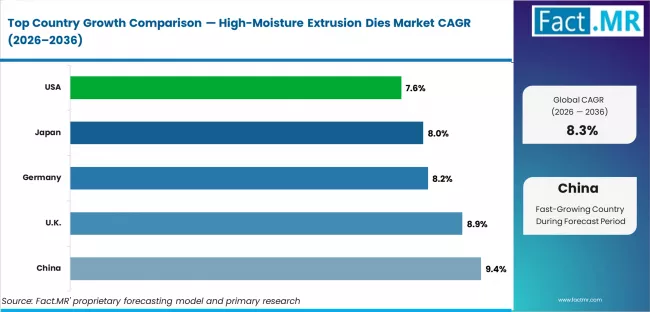
| Fastest Growing Countries | China (9.4% CAGR), U.K. (8.9% CAGR), Germany (8.2% CAGR), Japan (8.0% CAGR), USA (7.6% CAGR) |
| Key Companies | Clextral SAS, Bühler Group, Coperion GmbH, Baker Perkins, , Thermo Fisher Scientific Inc., Nordson, FUTURE FOODSBV |
| Die Type Segmentation | Slit Dies, Cooling Dies, Multi‑channel Dies, Circular Dies, Co‑extrusion Dies |
| End User Segmentation | Plant‑based Food Manufacturers, Alternative Protein Producers, Food Processing Companies, R&D Institutes and Universities, Contract Food Manufacturers, Extrusion Equipment OEMs |
| Extruder Compatibility Segmentation | Twin‑screw Extrusion Dies, Single‑screw Extrusion Dies |
| Die Configuration Segmentation | Multi‑channel Systems, Single‑channel Systems, Dynamic Flow Systems |
| Material Type Segmentation | Stainless Steel Dies, Hardened Alloy Dies, Ceramic‑coated Dies, Food‑grade Precision Metal Dies, Corrosion‑resistant Composite Dies |
| Region | North America, Latin America, Western Europe, Eastern Europe, East Asia, South Asia-Pacific, and Middle East & Africa |
Key Growth Drivers, Constraints, and Opportunities
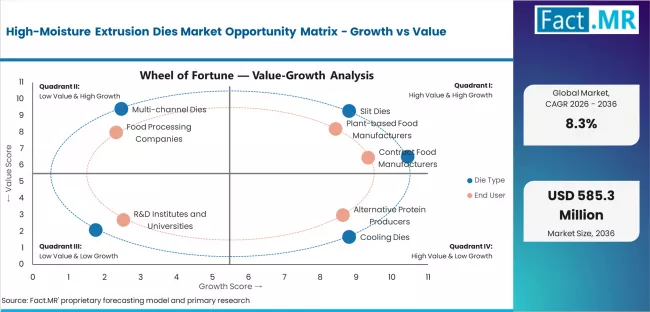
Key Factors Driving Growth
- Consumer demand Is growing rapidly for plant-based and alternative protein products, increasing the Need for improved moisture levels to produce meat-like quality and texture using Extrusion Technologies.
- Food Manufacturers are using modern technology to produce consistent quality food while using lower amounts of raw Materials in Extrusion processes.
- Due to growth in worldwide demand for plant-based protein products, there are more continuous automated systems required for the mass production of a consistent product of high Quality on both Industrial as well as Pilot scales.
| Growth Driver | Demand Impact | Time Horizon | Key Impact Area | Fact.MR Insight |
|---|---|---|---|---|
| Surge in plant-based meat demand | High | Short–Mid Term | Adoption acceleration | Rapid global shift toward plant-based diets is significantly increasing the deployment of high moisture extrusion systems, where dies are critical for achieving meat-like texture and structure |
| Expansion of alternative protein manufacturing capacity | High | Short–Mid Term | System deployment & scaling | Increasing investments in large-scale production facilities, especially in Asia-Pacific and North America, are driving installation of new extrusion lines and associated die systems |
| Rising demand for meat-like texture and product realism | High | Mid Term | Product quality enhancement | Food companies are focusing on replicating whole-cut meat textures, requiring advanced cooling die designs for precise fiber alignment and structural integrity |
| Technological advancements in extrusion and die engineering | High | Mid–Long Term | Technology advancement | Innovations in flow channel design, temperature control, and modular die systems are improving efficiency, scalability, and product consistency |
| Shift toward continuous and automated processing systems | High | Mid–Long Term | Operational efficiency | Adoption of continuous extrusion technologies is increasing demand for durable, high-performance dies capable of consistent large-scale production |
Key Market Constraints
- The costs of high moisture extruded die systems and integrated equipment are high, making it very difficult for small and medium-sized manufacturers to adopt the technology.
- Due to the need for advanced technological expertise in order to operate and integrate high moisture extrusion processes, companies that do not have this level of expertise face challenges in adopting these technologies.
- For new entrants, the high initial investment required to purchase full extrusion setups, including extruders, cooling systems for cooling the material after extrusion, and the dies for creating the final product will cause delays in making a purchasing decision.
Key Opportunity Areas
- The increase in the number of people who expect to consume an increasing number of plant and alternative proteins globally is creating new demand for advanced high moisture extrusion die technology.
- Food manufacturers, as well as many new businesses and startups, are expanding production capabilities in order to produce plant-based proteins including the meat and fish industries. This growth in the manufacturing sector is subsequently creating a need for scalable and highly efficient commercial extrusion die systems.
- The increased demand for custom product innovation, such as whole cut meats and fish, is anticipated to drive up the demand for high-performance die designs.
Segment-wise Analysis of the High Moisture Extrusion Dies Market
- Slit Dies hold 29.80% share in the die type segment, driven by their ability to produce fibrous, meat-like textures essential for high‑moisture plant‑based protein extrusion and whole‑cut meat analogs.
- Plant‑based Food Manufacturers account for 36.90% share in the end user segment, supported by the rapid global shift toward alternative proteins and the need for specialized dies that replicate animal meat structure and mouthfeel.
- Twin‑screw Extrusion Dies command 86.70% share in the extruder compatibility segment, driven by their superior mixing, shearing, and precise thermal control, which are critical for achieving consistent texturization in high moisture extrusion processes.
The High Moisture Extrusion Dies Market is segmented by die type, end user, extruder compatibility, die configuration, material type, and region.
Which Die Type Segment Dominates the Market?
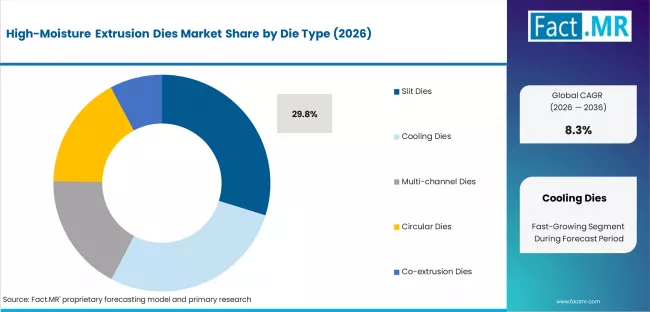
The Slit Dies section is expected to maintain its market dominance with a share of more than 29.80%. The capacity of the companies to manufacture fibrous and meat-like texture, which is needed in the extrusion process of plant-based protein with high moisture content and whole-cut meat analogs, has resulted in their market dominance.
Which End User Segment Dominates the Market?
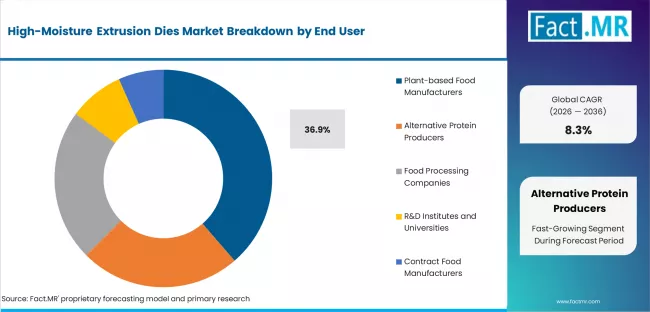
It is expected that the Plant-based Food Manufacturers segment will maintain its dominance with more than 36.90% market share because of the fast transition towards alternative proteins by countries worldwide, the necessity to employ unique dies that mimic animal meat structure and texture, and the rising demand for moist plant-based meat products.
Which Extruder Compatibility Segment Dominates the Market?
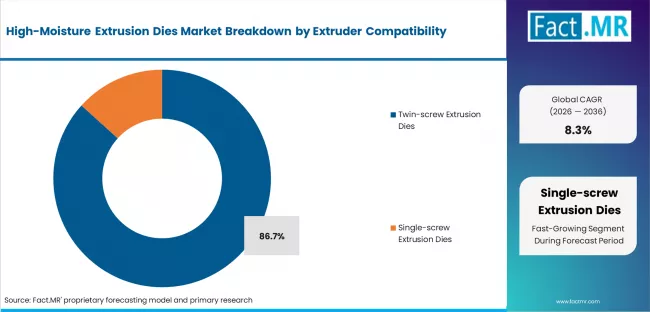
The market share of Twin-screw Extrusion Dies is expected to maintain its dominance with more than 86.70%. Due to the unique mixing properties and temperature control provided by twin screws for texturizing in high moisture environments, their wide usage in producing plant-based foods and food products has helped them retain their dominance in the market.
Which Die Configuration Segment Dominates the Market?
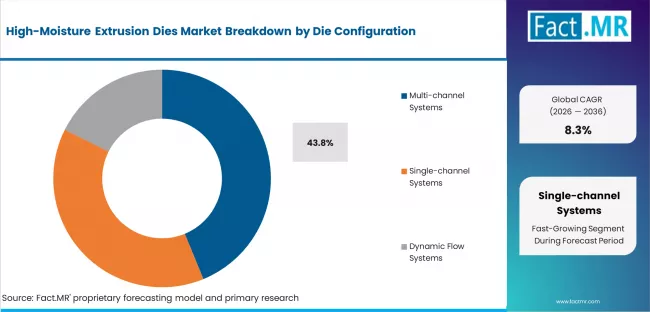
Multi-channel systems are expected to maintain their dominant market share with an estimated value of above 43.80%. Their capability of offering even cooling and pressure distribution for different product flows makes them widely accepted in the production of plant-based foods as well as in the process of food processing.
Which Material Type Segment Dominates the Market?
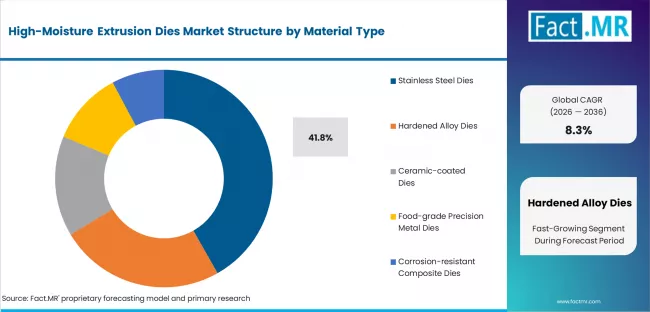
The Stainless Steel Dies segment is expected to retain its dominant market share with more than 41.80%. With their superior anti-corrosion properties, adherence to food safety norms, and capability to withstand high pressures and moisture, they have found extensive application in the production of plant-based foods and other alternatives, giving them their dominant share.
Regional Outlook Across Key Markets
The market analysis covers key global regions, including South Asia and Pacific, Middle East & Africa, North America, Latin America, Western Europe, and Eastern Europe. It is segmented geographically, with specific market dynamics for each region. The full report provides a detailed market attractiveness analysis.
CAGR Table
| Country | CAGR (%) |
|---|---|
| U.S. | 7.6% |
| Germany | 8.2% |
| China | 9.4% |
| Japan | 8.0% |
| U.K. | 8.9% |
| India | 9.7% |
| South Korea | 9.1% |
Source: Fact.MR (FMR) analysis, based on proprietary forecasting model and primary research.
North America – The High Moisture Extrusion & Plant‑based Protein Technology Hub
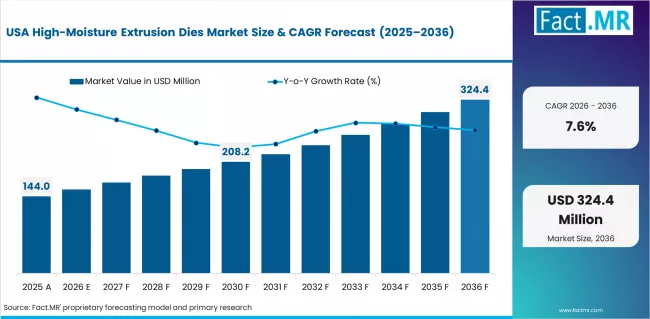
Considering the extensive research and development of plant-based meat texturizing and emphasis on consistency in the quality of products, the growth of the North America High Moisture Extrusion Dies Market will be steady in both the short-term, mid-term, and long-term periods. There is also growing preference for multi-channel slit dies and twin-screw extruders.
- U.S.: Demand for advanced high moisture extrusion dies in the U.S. is projected to grow at around 7.6% CAGR, supported by stringent food safety regulations, alternative protein production, and increasing investments in automated and Industry 4.0 ready extrusion processing technologies.
Western Europe – The High Moisture Extrusion & Plant‑based Protein Technology Hub
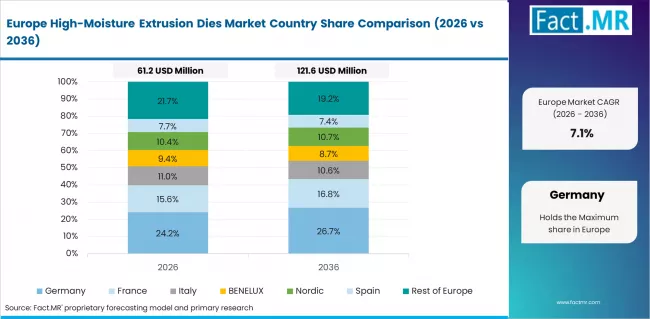
Western Europe market Growth is driven by rising numbers of whole cut plant-based meat alternatives and other protein applications, better food safety regulations, and rising use of more sophisticated multi-channel and slit dies in the region.
- Germany: Demand for advanced high moisture extrusion dies in Germany is projected to grow at an 8.2% CAGR through 2036, supported by its well‑established food processing machinery industry, and focus on high‑quality meat analog texturization and twin‑screw extrusion technologies.
East Asia – The High-Growth High Moisture Extrusion & Plant‑based Protein Technology Hub
The East Asia market is experiencing rapid expansion, driven by rising production of plant-based meat, growing demand for whole-cut meat analogs, and the increasing adoption of advanced multi-channel and slit die technologies across the region.
- China: Demand for advanced high moisture extrusion dies in China is projected to grow at around a 9.4% CAGR through 2036, supported by rapid expansion of domestic plant‑based meat and alternative protein production, increasing investments in automated twin‑screw extrusion systems, and growing focus on high‑quality and stainless steel die solutions.
South Asia & Pacific – The Rapidly Growing High Moisture Extrusion & Plant‑based Protein Expansion Region
The South Asian & Pacific market is witnessing initial growth, driven by rising production of plant-based meat and alternative protein products, higher investment in automated extrusion systems, and growing demand for both stainless steel and multi-channel die technologies across the region.
- India: Demand for advanced high moisture extrusion dies in India is projected to grow at around a 9.7% CAGR through 2036, driven by rapid expansion of the plant‑based meat and alternative protein industry, increasing adoption of twin‑screw extrusion systems and multi‑channel dies, and growing focus on high‑quality texturization and food safety standards.
Latin America – The Emerging High Moisture Extrusion & Plant‑based Protein Market
The Latin American market is expected to grow steadily, supported by increasing demand for plant-based meat and alternative protein products, rising investment in food processing automation infrastructure, and broader adoption of stainless steel and multi-channel die technologies in plant-based and food processing applications.
- Brazil: Demand for advanced high moisture extrusion dies in Brazil is projected to grow at around a 9.3% CAGR through 2036, supported by expanding plant‑based meat and alternative protein production, and growing demand for high‑quality and twin‑screw extrusion die solutions.
Middle East & Africa – The Emerging High Moisture Extrusion & Plant‑based Protein Expansion Zone
The market in Middle East and Africa is expected to grow at a steady pace over the forecast period due to growing capital investment in food processing facilities, alternative protein products, and demand for more efficient and high-level multi‑channel and slit die solutions in this part of the world.
- KSA: Demand for advanced high moisture extrusion dies in Saudi Arabia is projected to grow at around a 9.2% CAGR through 2036, improving food manufacturing infrastructure, and increasing adoption of twin‑screw extrusion systems and stainless-steel die technologies.
Fact.MR’s analysis of the High Moisture Extrusion Dies Market provides a comprehensive regional outlook covering North America, Western Europe, East Asia, South Asia & Pacific, Latin America, and Middle East & Africa. Readers can access country-wise insights, growth trends, plant‑based meat and alternative protein production expansion patterns, and adoption dynamics shaping both mature and emerging markets, driven by increasing demand for premium plant‑based meat products, energy‑efficient extrusion die solutions, and advanced automation technologies across plant‑based food manufacturing, alternative protein production, and food processing applications globally.
Competitive Benchmarking and Company Positioning
Leading Companies Shaping the High Moisture Extrusion Dies Market
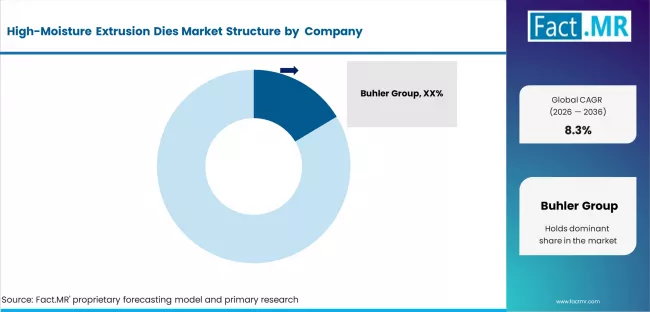
The global market for high-humidity extruder dies is not particularly concentrated, however, there are several large companies that supply these dies globally. The leading players in this market, just like every other industry, are all striving to continue advancing the technology related to the use of extrusion dies and developing plant-based protein texturing technology. Clextral SAS, Bühler Group, Coperion GmbH, Wenger Manufacturing, Inc., and GEA Group AG collectively represent approximately 40-45% of total global market share. All companies are leveraging their extensive experience within both slit dies and twin-screw extrusions and have extensive experience in multi-channel and stainless steel dies as innovative and consistently being on the forefront of the development of high-humidity plant-based meat alternatives, therefore providing these companies the potential to compete in this evolving environment and to continue to grow within this rapidly evolving marketplace.
Key Players of the High Moisture Extrusion Dies Market
- HES-SO Valais-Wallis
- Buhler AG
- Nordson
- FUTURE FOODSBV
- Coperion
- Thermo Fisher Scientific
- Baker Perkins Ltd.
- Clextral
Recent Industry Developments
- New Coperion MEGAtex R90 Cooling Die Allows Flexible Adjustments to Meat Substitute Texture (2026), Coperion introduces the latest model in its MEGAtex cooling die series for manufacturing plant-based HMMA (High Moisture Meat Analogues). (Coperion) [1]
- Andritz unveils extrusion innovation, expands digital solutions (2026): Andritz unveils extrusion innovation, expands digital solutions. (Andritz) [2]
- Clextral’s groundbreaking patented technology for Vegetable Protein Texturization (2025): Clextral’s new technology combines the principle of a shear-cell fibration process and the continuous extrusion process. (Clextral) [3]
- Buhler launches innovations and releases major upgrades to its Grains & Food portfolio (2026): Buhler’s extrusion engineers developed the Nutrex 7 Series in close collaboration with customers. Building on 40 years of experience in extrusion for cereals, snacks, pet food, meat alternatives, ingredients. (Buhler) [4]
- With its new PRIOtwin™ extruder, Bühler offers a solution tailored to the production (2025): Bühler Pasta & Extruded Products produces cost-efficient and optimized extrusion solutions for the Food, Beverage and Nutrition industry. (Buhler) [5]
Sources and Research References
- [1] “New Coperion MEGAtex R90 Cooling Die Allows Flexible Adjustments”, 2026
- [2] “Andritz unveils extrusion innovation, expands digital solutions”, 2025
- [3] “Clextral’s new technology combines the principle of a shear-cell fibration process and the continuous extrusion process.”, 2025
- [4] “Buhler launches innovations and releases major upgrades to its Grains & Food portfolio”, 2026
- [5] “PRIOtwin extruder, Buhler offers a solution tailored to the production of breakfast cereals, food ingredients and petfood.”, 2025
High Moisture Extrusion Dies Market Definition
The market includes die cooling and texturing systems employed during the process of extrusion of food for manufacturing meat analogs and other structured proteins. These dies are an essential component in shaping protein blends into fiber-like structures using plant-based protein formulations.
High Moisture Extrusion Dies Market Inclusions
The market encompasses all kinds of cooling and texturing dies employed in high moisture extrusion to manufacture structured proteins. Examples of such dies include slit dies, annular dies, multi-channels cooling dies, as well as customized modular dies compatible with twin-screw extruders. Such dies play an important role in producing desirable product attributes including fiber formation, texture orientation, juiciness, and consistency in high-moisture foods.
High Moisture Extrusion Dies Market Exclusions
Dies conventionally in extrusion operations of low moisture content such as snack foods, cereals, and pasta are not included within the market. This category also excludes any other food processing machinery which does not perform high moisture extrusion or protein texturizing operations.
High Moisture Extrusion Dies Market Research Methodology
- Primary Research
- The current trends in the market have been derived using contributions from various participants in the value chain of the market including the extruder equipment suppliers, the producers of plant-based proteins, the food processing companies, the high moisture extrusion facilities as well as the system integrators.
- Desk Research
- The analysis of the market has been conducted through the means of secondary research involving the use of the annual reports of the participating companies and publications in the field of food processing and confectioneries. The publications concerning the manufacture of chocolate, chocolate processing techniques, refining techniques, conching, as well as food processing equipment were considered.
- Market-Sizing and Forecasting
- The slit dies, annular dies, multi-channel cooling dies, modular and customized dies, industrial-grade extrusion dies, and pilot/extrusion dies were utilized to calculate the revenues generated by the market, all the above categories have been considered while analyzing the complete market sizing and forecast.
- Data Validation and Update Cycle
- There are several validations involved while determining the market, the information obtained through industry resources and leading players has been validated. The process is repeated at regular intervals considering the changes in demand for plant proteins, advancement in extrusion technology, and demand for effective cooling die systems.
Scope of Analysis
| Parameter | Details |
|---|---|
| Quantitative Units | USD 243.5 million in 2025 to USD 585.3 million in 2036, at a CAGR of 8.3% |
| Market Definition | The High Moisture Extrusion Dies Market comprises specialized dies designed for high‑moisture extrusion processes to texturize plant‑based proteins and create meat analogs. These include slit dies, circular dies, high‑quality plant‑based meat production across plant‑based food manufacturing, alternative protein production, and food processing applications. |
| Regions Covered | North America, Latin America, Europe, East Asia, South Asia & Pacific, Middle East & Africa |
| Countries Covered | USA, Canada, UK, Germany, China, India, 30 plus countries |
| Key Companies | Buhler AG, Nordson, FUTURE FOODSBV, Coperion, Thermo Fisher Scientific, and others |
| Forecast Period | 2026 to 2036 |
| Approach | Hybrid demand‑side and top‑down methodology based on plant‑based meat production trends, increasing adoption of whole‑cut meat analogs and alternative protein formulations, advancements in multi‑channel and twin‑screw extrusion die technologies. |
Analysis by Die Type, by Die Configuration, by Extruder Compatibility, by Material Type, by End User, and by Region
-
High Moisture Extrusion Dies Market By Die Type:
- Slit Dies
- Straight Slit Dies
- Adjustable Slit Dies
- Precision Fiber-forming Slit Dies
- Circular Dies
- Single-orifice Circular Dies
- Multi-orifice Circular Dies
- High-pressure Circular Dies
- Multi-channel Dies
- Parallel Channel Dies
- Layered Channel Dies
- Cooling Dies
- Water-cooled Dies
- Thermoregulated Cooling Dies
- Co-extrusion Dies
- Dual-layer Co-extrusion Dies
- Multi-layer Co-extrusion Dies
- Hybrid Protein Co-extrusion Dies
- Slit Dies
-
High Moisture Extrusion Dies Market By Die Configuration:
- Single-channel Systems
- Fixed Geometry Systems
- Adjustable Geometry Systems
- Compact Flow Systems
- Multi-channel Systems
- Parallel Flow Systems
- Cross-flow Systems
- Fiber Alignment Systems
- Dynamic Flow Systems
- Pressure-controlled Systems
- Smart Flow Regulation Systems
- AI-assisted Flow Control Systems
- Single-channel Systems
-
High Moisture Extrusion Dies Market By Extruder Compatibility:
- Twin-screw Extrusion Dies
- Co-rotating Twin-screw Compatible Dies
- Counter-rotating Twin-screw Compatible Dies
- High-torque Twin-screw Dies
- Single-screw Extrusion Dies
- Standard Single-screw Dies
- Compact Single-screw Dies
- Low-pressure Single-screw Dies
- Twin-screw Extrusion Dies
-
High Moisture Extrusion Dies Market By Material Type:
- Stainless Steel Dies
- Hardened Alloy Dies
- Ceramic-coated Dies
- Corrosion-resistant Composite Dies
- Food-grade Precision Metal Dies
-
High Moisture Extrusion Dies Market By End User:
- Plant-based Food Manufacturers
- Alternative Protein Producers
- Food Processing Companies
- R&D Institutes and Universities
- Contract Food Manufacturers
- Extrusion Equipment OEMs
-
High Moisture Extrusion Dies Market By Region:
- North America
- USA
- Canada
- Mexico
- Latin America
- Brazil
- Chile
- Rest of LATAM
- East Asia
- China
- Japan
- South Korea
- Western Europe
- Germany
- Italy
- France
- U.K.
- Spain
- BENELUX
- Nordic
- Rest of W. Europe
- Eastern Europe
- Russia
- Hungary
- Poland
- Balkan & Baltics
- Rest of E. Europe
- Middle East and Africa
- Kingdom of Saudi Arabia
- United Arab Emirates
- South Africa
- Rest of Middle East and Africa
- North America

- Frequently Asked Questions -
How large is the demand for High Moisture Extrusion Dies in the global market in 2025?
Demand for High Moisture Extrusion Dies in the global market is estimated to be valued at USD 243.5 million in 2025.
What will be the market size of High Moisture Extrusion Dies in the global market by 2036?
The market size for High Moisture Extrusion Dies is projected to reach USD 585.3 million by 2036.
What is the expected demand growth for High Moisture Extrusion Dies in the global market between 2026 and 2036?
Demand for High Moisture Extrusion Dies in the global market is expected to grow at a CAGR of 8.3% between 2026 and 2036.
Which die type segment is expected to dominate the High Moisture Extrusion Dies Market?
Slit Dies are expected to dominate the market, accounting for 29.80% share in 2026, driven by their ability to produce fibrous, meat-like textures essential for high‑moisture plant‑based protein extrusion and whole‑cut meat analogs.
How significant is the growth outlook for India in this market?
India is expected to grow at a CAGR of 9.7% through 2036, supported by expanding plant‑based meat and alternative protein manufacturing, increasing demand for whole‑cut meat analog formulations, and rising adoption of twin‑screw extrusion systems and multi‑channel dies.
Which company is identified as a leading player in the High Moisture Extrusion Dies Market?
Clextral is identified as a leading player in the market, supported by its strong portfolio of advanced high‑moisture extrusion dies and complete extrusion lines, continuous innovation in slit die and multi‑channel die technologies, and global presence across plant‑based food, alternative protein, and food processing segments.
Table of Content
- High Moisture Extrusion Dies Market – Executive Summary
- Market Overview
- Market Definition & Introduction
- Market Taxonomy & Research Scope
- Global High Moisture Extrusion Dies Market Demand Analysis 2021-2025 and Forecast, 2026–2036
- Historical Market Volume (Units) Analysis, 2021-2025
- Current and Future Market Volume (Units) Projections, 2026–2036
- Y-o-Y Growth Trend Analysis
- Global High Moisture Extrusion Dies Market - Pricing Analysis
- Product Category and Country-Level Pricing Analysis
- Region Average Pricing Analysis Benchmark
- Price Trends and Forecasts
- Historical price trends
- Future price forecasts
- Factors Influencing Pricing
- Competitive Pricing Strategies
- Cost Structure Analysis
- Global High Moisture Extrusion Dies Market Demand (in Value or Size in US$ Mn) Analysis 2021-2025 and Forecast, 2026–2036
- Historical Market Value (US$ Mn) Analysis, 2021-2025
- Current and Future Market Value (US$ Mn) Projections, 2026–2036
- Y-o-Y Growth Trend Analysis
- Absolute $ Opportunity Analysis
- Market Background and Foundational Data Points
- Penetration Rate of High Moisture Extrusion Systems in Plant-Based Meat Production (%)
- Annual Growth Rate of Advanced Cooling Die Adoption in Alternative Protein Manufacturing (%)
- Share of Customized Extrusion Dies in Total Equipment Installations (%)
- Growth Rate of Automated and Continuous Extrusion Line Adoption (%)
- Penetration of Twin-Screw Extrusion Technology in Plant-Based Protein Processing (%)
- Share of Industrial-Scale Extrusion Die Installations in Total Market (%)
- Adoption Rate of Energy-Efficient Extrusion Technologies in Food Processing (%)
- Annual Growth Rate of R&D Investment in Extrusion Die Design and Innovation (%)
- Penetration of Continuous Processing Systems in High Moisture Extrusion Lines (%)
- Share of Extrusion Equipment Upgrades and Retrofits in Total Demand (%)
- High Moisture Extrusion Dies Market Opportunity Assessment
- Total Available Market (US$ Mn)
- Serviceable Addressable Market (US$ Mn)
- Serviceable Obtainable Market (US$ Mn)
- Porter’s Five Forces and PESTEL Analysis
- Investment Feasibility Analysis
- Macro-Economic Factors & Forecast Factors - Relevance & Impact
- Industry Value and Supply Chain Analysis
- List of Key Channel Partners
- Profit Margin & Operating Margin at Each Node of Supply Chain.
- Notes on Value Added at Each Node in the Value Chain
- Factors Influencing Value Chain
- Market Dynamics
- Drivers
- Restraints
- Opportunity Analysis
- Key Regulations & Certifications
- High Moisture Extrusion Dies Market Analysis 2021-2025 and Forecast 2026–2036, By Die Type
- Introduction / Key Findings
- Historical Market Size (US$ Mn) & Volume (Units) Trend Analysis By Die Type, 2021-2025
- Current and Future Market Size (US$ Mn) & Volume (Units) Analysis and Forecast By Die Type, 2026-2036
- Slit Dies
- Straight Slit Dies
- Adjustable Slit Dies
- Precision Fiber-forming Slit Dies
- Circular Dies
- Single-orifice Circular Dies
- Multi-orifice Circular Dies
- High-pressure Circular Dies
- Multi-channel Dies
- Parallel Channel Dies
- Layered Channel Dies
- Cooling Dies
- Water-cooled Dies
- Thermoregulated Cooling Dies
- Co-extrusion Dies
- Dual-layer Co-extrusion Dies
- Multi-layer Co-extrusion Dies
- Hybrid Protein Co-extrusion Dies
- Slit Dies
- Market Attractiveness Analysis By Die Type
- High Moisture Extrusion Dies Market Analysis 2021-2025 and Forecast 2026–2036, By Die Configuration
- Introduction / Key Findings
- Historical Market Size (US$ Mn) & Volume (Units) Trend Analysis By Die Configuration, 2021-2025
- Current and Future Market Size (US$ Mn) & Volume (Units) Analysis and Forecast By Die Configuration, 2026-2036
- Single-channel Systems
- Fixed Geometry Systems
- Adjustable Geometry Systems
- Compact Flow Systems
- Multi-channel Systems
- Parallel Flow Systems
- Cross-flow Systems
- Fiber Alignment Systems
- Dynamic Flow Systems
- Pressure-controlled Systems
- Smart Flow Regulation Systems
- AI-assisted Flow Control Systems
- Single-channel Systems
- Market Attractiveness Analysis By Die Configuration
- High Moisture Extrusion Dies Market Analysis 2021-2025 and Forecast 2026–2036, By Extruder Compatibility
- Introduction / Key Findings
- Historical Market Size (US$ Mn) & Volume (Units) Trend Analysis By Extruder Compatibility, 2021-2025
- Current and Future Market Size (US$ Mn) & Volume (Units) Analysis and Forecast By Extruder Compatibility, 2026-2036
- Twin-screw Extrusion Dies
- Co-rotating Twin-screw Compatible Dies
- Counter-rotating Twin-screw Compatible Dies
- High-torque Twin-screw Dies
- Single-screw Extrusion Dies
- Standard Single-screw Dies
- Compact Single-screw Dies
- Low-pressure Single-screw Dies
- Twin-screw Extrusion Dies
- Market Attractiveness Analysis By Extruder Compatibility
- High Moisture Extrusion Dies Market Analysis 2021-2025 and Forecast 2026–2036, By Material Type
- Introduction / Key Findings
- Historical Market Size (US$ Mn) & Volume (Units) Trend Analysis By Material Type, 2021-2025
- Current and Future Market Size (US$ Mn) & Volume (Units) Analysis and Forecast By Material Type, 2026-2036
- Stainless Steel Dies
- Hardened Alloy Dies
- Ceramic-coated Dies
- Corrosion-resistant Composite Dies
- Food-grade Precision Metal Dies
- Market Attractiveness Analysis By Material Type
- High Moisture Extrusion Dies Market Analysis 2021-2025 and Forecast 2026–2036, By End User
- Introduction / Key Findings
- Historical Market Size (US$ Mn) & Volume (Units) Trend Analysis By End User, 2021-2025
- Current and Future Market Size (US$ Mn) & Volume (Units) Analysis and Forecast By End User, 2026-2036
- Plant-based Food Manufacturers
- Alternative Protein Producers
- Food Processing Companies
- R&D Institutes and Universities
- Contract Food Manufacturers
- Extrusion Equipment OEMs
- Market Attractiveness Analysis By End User
- Global High Moisture Extrusion Dies Market Analysis and Forecast, by Region
- Introduction / Key Findings
- Historical Market Size (US$ Mn) & Volume (Units) Trend Analysis by Region, 2021-2025
- Current and Future Market Size (US$ Mn) & Volume (Units) Analysis and Forecast by Region, 2026-2036
- North America
- Latin America
- Western Europe
- Eastern Europe
- East Asia
- South Asia & Pacific
- Middle East & Africa
- Market Attractiveness Analysis by Region
- North America High Moisture Extrusion Dies Market Analysis and Forecast
- Introduction / Key Findings
- Pricing Analysis
- Historical Market Size (US$ Mn) & Volume (Units) Trend Analysis by Market Taxonomy, 2021-2025
- Current and Future Market Size (US$ Mn) and Volume (Units) Analysis & Forecast by Market Taxonomy, 2026-2036
- By Country
- United States
- Canada
- Mexico
- By Taxonomy
- Market Attractiveness Analysis By Country & Taxonomy
- Market Trends
- Key Market Participants – Intensity Mapping
- Drivers and Restraints - Impact Analysis
- Latin America High Moisture Extrusion Dies Market Analysis and Forecast
- Introduction / Key Findings
- Pricing Analysis
- Historical Market Size (US$ Mn) & Volume (Units) Trend Analysis by Market Taxonomy, 2021-2025
- Current and Future Market Size (US$ Mn) and Volume (Units) Analysis & Forecast by Market Taxonomy, 2026-2036
- By Country
- Brazil
- Chile
- Rest of LATAM
- By Taxonomy
- Market Attractiveness Analysis By Country & Taxonomy
- Market Trends
- Key Market Participants – Intensity Mapping
- Drivers and Restraints - Impact Analysis
- Western Europe High Moisture Extrusion Dies Market Analysis and Forecast
- Introduction / Key Findings
- Pricing Analysis
- Historical Market Size (US$ Mn) & Volume (Units) Trend Analysis by Market Taxonomy, 2021-2025
- Current and Future Market Size (US$ Mn) and Volume (Units) Analysis & Forecast by Market Taxonomy, 2026-2036
- By Country
- Germany
- Italy
- France
- United Kingdom
- Spain
- BENELUX
- Nordics
- Rest of Western Europe
- By Taxonomy
- Market Attractiveness Analysis By Country & Taxonomy
- Market Trends
- Key Market Participants – Intensity Mapping
- Drivers and Restraints - Impact Analysis
- Eastern Europe High Moisture Extrusion Dies Market Analysis and Forecast
- Introduction / Key Findings
- Pricing Analysis
- Historical Market Size (US$ Mn) & Volume (Units) Trend Analysis by Market Taxonomy, 2021-2025
- Current and Future Market Size (US$ Mn) and Volume (Units) Analysis & Forecast by Market Taxonomy, 2026-2036
- By Country
- Russia
- Hungary
- Poland
- Balkan & Baltics
- Rest of Eastern Europe
- By Taxonomy
- Market Attractiveness Analysis By Country & Taxonomy
- Market Trends
- Key Market Participants – Intensity Mapping
- Drivers and Restraints - Impact Analysis
- East Asia High Moisture Extrusion Dies Market Analysis and Forecast
- Introduction / Key Findings
- Pricing Analysis
- Historical Market Size (US$ Mn) & Volume (Units) Trend Analysis by Market Taxonomy, 2021-2025
- Current and Future Market Size (US$ Mn) and Volume (Units) Analysis & Forecast by Market Taxonomy, 2026-2036
- By Country
- China
- Japan
- South Korea
- By Taxonomy
- Market Attractiveness Analysis By Country & Taxonomy
- Market Trends
- Key Market Participants – Intensity Mapping
- Drivers and Restraints - Impact Analysis
- South Asia & Pacific High Moisture Extrusion Dies Market Analysis and Forecast
- Introduction / Key Findings
- Pricing Analysis
- Historical Market Size (US$ Mn) & Volume (Units) Trend Analysis by Market Taxonomy, 2021-2025
- Current and Future Market Size (US$ Mn) and Volume (Units) Analysis & Forecast by Market Taxonomy, 2026-2036
- By Country
- India
- ASEAN
- Australia & New Zealand
- Rest of South Asia & Pacific
- By Taxonomy
- Market Attractiveness Analysis By Country & Taxonomy
- Market Trends
- Key Market Participants – Intensity Mapping
- Drivers and Restraints - Impact Analysis
- Middle East & Africa High Moisture Extrusion Dies Market Analysis and Forecast
- Introduction / Key Findings
- Pricing Analysis
- Historical Market Size (US$ Mn) & Volume (Units) Trend Analysis by Market Taxonomy, 2021-2025
- Current and Future Market Size (US$ Mn) and Volume (Units) Analysis & Forecast by Market Taxonomy, 2026-2036
- By Country
- Kingdom of Saudi Arabia
- Other GCC Countries
- Turkiye
- South Africa
- Other African Union
- By Taxonomy
- Market Attractiveness Analysis By Country & Taxonomy
- Market Trends
- Key Market Participants – Intensity Mapping
- Drivers and Restraints - Impact Analysis
- Country-level High Moisture Extrusion Dies Market Analysis and Forecast
- Introduction
- Market Value Proportion Analysis, By Key Countries
- Global Vs. Country Growth Comparison
- United States High Moisture Extrusion Dies Market Analysis
- Market Size (US$ Mn) & Volume (Units) Analysis by Market Taxonomy, 2021–2036
- By Die Type
- By Die Configuration
- By Extruder Compatibility
- By Material Type
- By End User
- United States High Moisture Extrusion Dies Market Analysis
-
-
- Canada High Moisture Extrusion Dies Market Analysis
- Mexico High Moisture Extrusion Dies Market Analysis
- Brazil High Moisture Extrusion Dies Market Analysis
- Chile High Moisture Extrusion Dies Market Analysis
- Germany High Moisture Extrusion Dies Market Analysis
- France High Moisture Extrusion Dies Market Analysis
- Italy High Moisture Extrusion Dies Market Analysis
- Spain High Moisture Extrusion Dies Market Analysis
- United Kingdom High Moisture Extrusion Dies Market Analysis
- BENELUX High Moisture Extrusion Dies Market Analysis
- Nordics High Moisture Extrusion Dies Market Analysis
- Poland High Moisture Extrusion Dies Market Analysis
- Russia High Moisture Extrusion Dies Market Analysis
- Hungary High Moisture Extrusion Dies Market Analysis
- Balkan & Baltics High Moisture Extrusion Dies Market Analysis
- China High Moisture Extrusion Dies Market Analysis
- Japan High Moisture Extrusion Dies Market Analysis
- South Korea High Moisture Extrusion Dies Market Analysis
- India High Moisture Extrusion Dies Market Analysis
- ASEAN High Moisture Extrusion Dies Market Analysis
- ANZ High Moisture Extrusion Dies Market Analysis
- KSA High Moisture Extrusion Dies Market Analysis
- Other GCC Countries High Moisture Extrusion Dies Market Analysis
- South Africa High Moisture Extrusion Dies Market Analysis
- Turkiye High Moisture Extrusion Dies Market Analysis
-
- High Moisture Extrusion Dies Market Structure Analysis
- Market Analysis by Tier of Companies
- Market Concentration
- Market Share Analysis of Top Players
- Market Space for New Brands and Dollar Opportunity
- Market Presence Analysis
- Regional Footprint of Players
- Product Footprint by Players
- High Moisture Extrusion Dies Competition Analysis
- Competition Dashboard
- Pricing Analysis by Competition
- Competition Benchmarking
- Competition Deep Dive
- Buhler Group
- Overview
- Product Portfolio
- Sales Footprint
- Key Developments
- SWOT Analysis
- Strategy Overview
- Key Financials
- HES-SO Valais-Wallis
- Nordson
- FUTURE FOODSBV
- Coperion
- Thermo Fisher Scientific
- Baker Perkins Ltd.
- Clextral
- Other Prominent Players
- Buhler Group
- Primary insights
- Assumptions & Acronyms Used
- Research Methodology & Data Sources
List Of Table
- Table 1: Global Market Value (USD Mn) Forecast by Region, 2021 to 2036
- Table 2: Global Market Volume (Units) Forecast by Region, 2021 to 2036
- Table 3: Global Market Value (USD Mn) Forecast by Die Type, 2021 to 2036
- Table 4: Global Market Volume (Units) Forecast by Die Type, 2021 to 2036
- Table 5: Global Market Value (USD Mn) Forecast by Die Configuration, 2021 to 2036
- Table 6: Global Market Volume (Units) Forecast by Die Configuration, 2021 to 2036
- Table 7: Global Market Value (USD Mn) Forecast by Extruder Compatibility, 2021 to 2036
- Table 8: Global Market Volume (Units) Forecast by Extruder Compatibility, 2021 to 2036
- Table 9: Global Market Value (USD Mn) Forecast by Material Type, 2021 to 2036
- Table 10: Global Market Volume (Units) Forecast by Material Type, 2021 to 2036
- Table 11: Global Market Value (USD Mn) Forecast by End User, 2021 to 2036
- Table 12: Global Market Volume (Units) Forecast by End User, 2021 to 2036
- Table 13: North America Market Value (USD Mn) Forecast by Country, 2021 to 2036
- Table 14: North America Market Volume (Units) Forecast by Country, 2021 to 2036
- Table 15: North America Market Value (USD Mn) Forecast by Die Type, 2021 to 2036
- Table 16: North America Market Volume (Units) Forecast by Die Type, 2021 to 2036
- Table 17: North America Market Value (USD Mn) Forecast by Die Configuration, 2021 to 2036
- Table 18: North America Market Volume (Units) Forecast by Die Configuration, 2021 to 2036
- Table 19: North America Market Value (USD Mn) Forecast by Extruder Compatibility, 2021 to 2036
- Table 20: North America Market Volume (Units) Forecast by Extruder Compatibility, 2021 to 2036
- Table 21: North America Market Value (USD Mn) Forecast by Material Type, 2021 to 2036
- Table 22: North America Market Volume (Units) Forecast by Material Type, 2021 to 2036
- Table 23: North America Market Value (USD Mn) Forecast by End User, 2021 to 2036
- Table 24: North America Market Volume (Units) Forecast by End User, 2021 to 2036
- Table 25: Latin America Market Value (USD Mn) Forecast by Country, 2021 to 2036
- Table 26: Latin America Market Volume (Units) Forecast by Country, 2021 to 2036
- Table 27: Latin America Market Value (USD Mn) Forecast by Die Type, 2021 to 2036
- Table 28: Latin America Market Volume (Units) Forecast by Die Type, 2021 to 2036
- Table 29: Latin America Market Value (USD Mn) Forecast by Die Configuration, 2021 to 2036
- Table 30: Latin America Market Volume (Units) Forecast by Die Configuration, 2021 to 2036
- Table 31: Latin America Market Value (USD Mn) Forecast by Extruder Compatibility, 2021 to 2036
- Table 32: Latin America Market Volume (Units) Forecast by Extruder Compatibility, 2021 to 2036
- Table 33: Latin America Market Value (USD Mn) Forecast by Material Type, 2021 to 2036
- Table 34: Latin America Market Volume (Units) Forecast by Material Type, 2021 to 2036
- Table 35: Latin America Market Value (USD Mn) Forecast by End User, 2021 to 2036
- Table 36: Latin America Market Volume (Units) Forecast by End User, 2021 to 2036
- Table 37: Western Europe Market Value (USD Mn) Forecast by Country, 2021 to 2036
- Table 38: Western Europe Market Volume (Units) Forecast by Country, 2021 to 2036
- Table 39: Western Europe Market Value (USD Mn) Forecast by Die Type, 2021 to 2036
- Table 40: Western Europe Market Volume (Units) Forecast by Die Type, 2021 to 2036
- Table 41: Western Europe Market Value (USD Mn) Forecast by Die Configuration, 2021 to 2036
- Table 42: Western Europe Market Volume (Units) Forecast by Die Configuration, 2021 to 2036
- Table 43: Western Europe Market Value (USD Mn) Forecast by Extruder Compatibility, 2021 to 2036
- Table 44: Western Europe Market Volume (Units) Forecast by Extruder Compatibility, 2021 to 2036
- Table 45: Western Europe Market Value (USD Mn) Forecast by Material Type, 2021 to 2036
- Table 46: Western Europe Market Volume (Units) Forecast by Material Type, 2021 to 2036
- Table 47: Western Europe Market Value (USD Mn) Forecast by End User, 2021 to 2036
- Table 48: Western Europe Market Volume (Units) Forecast by End User, 2021 to 2036
- Table 49: Eastern Europe Market Value (USD Mn) Forecast by Country, 2021 to 2036
- Table 50: Eastern Europe Market Volume (Units) Forecast by Country, 2021 to 2036
- Table 51: Eastern Europe Market Value (USD Mn) Forecast by Die Type, 2021 to 2036
- Table 52: Eastern Europe Market Volume (Units) Forecast by Die Type, 2021 to 2036
- Table 53: Eastern Europe Market Value (USD Mn) Forecast by Die Configuration, 2021 to 2036
- Table 54: Eastern Europe Market Volume (Units) Forecast by Die Configuration, 2021 to 2036
- Table 55: Eastern Europe Market Value (USD Mn) Forecast by Extruder Compatibility, 2021 to 2036
- Table 56: Eastern Europe Market Volume (Units) Forecast by Extruder Compatibility, 2021 to 2036
- Table 57: Eastern Europe Market Value (USD Mn) Forecast by Material Type, 2021 to 2036
- Table 58: Eastern Europe Market Volume (Units) Forecast by Material Type, 2021 to 2036
- Table 59: Eastern Europe Market Value (USD Mn) Forecast by End User, 2021 to 2036
- Table 60: Eastern Europe Market Volume (Units) Forecast by End User, 2021 to 2036
- Table 61: East Asia Market Value (USD Mn) Forecast by Country, 2021 to 2036
- Table 62: East Asia Market Volume (Units) Forecast by Country, 2021 to 2036
- Table 63: East Asia Market Value (USD Mn) Forecast by Die Type, 2021 to 2036
- Table 64: East Asia Market Volume (Units) Forecast by Die Type, 2021 to 2036
- Table 65: East Asia Market Value (USD Mn) Forecast by Die Configuration, 2021 to 2036
- Table 66: East Asia Market Volume (Units) Forecast by Die Configuration, 2021 to 2036
- Table 67: East Asia Market Value (USD Mn) Forecast by Extruder Compatibility, 2021 to 2036
- Table 68: East Asia Market Volume (Units) Forecast by Extruder Compatibility, 2021 to 2036
- Table 69: East Asia Market Value (USD Mn) Forecast by Material Type, 2021 to 2036
- Table 70: East Asia Market Volume (Units) Forecast by Material Type, 2021 to 2036
- Table 71: East Asia Market Value (USD Mn) Forecast by End User, 2021 to 2036
- Table 72: East Asia Market Volume (Units) Forecast by End User, 2021 to 2036
- Table 73: South Asia and Pacific Market Value (USD Mn) Forecast by Country, 2021 to 2036
- Table 74: South Asia and Pacific Market Volume (Units) Forecast by Country, 2021 to 2036
- Table 75: South Asia and Pacific Market Value (USD Mn) Forecast by Die Type, 2021 to 2036
- Table 76: South Asia and Pacific Market Volume (Units) Forecast by Die Type, 2021 to 2036
- Table 77: South Asia and Pacific Market Value (USD Mn) Forecast by Die Configuration, 2021 to 2036
- Table 78: South Asia and Pacific Market Volume (Units) Forecast by Die Configuration, 2021 to 2036
- Table 79: South Asia and Pacific Market Value (USD Mn) Forecast by Extruder Compatibility, 2021 to 2036
- Table 80: South Asia and Pacific Market Volume (Units) Forecast by Extruder Compatibility, 2021 to 2036
- Table 81: South Asia and Pacific Market Value (USD Mn) Forecast by Material Type, 2021 to 2036
- Table 82: South Asia and Pacific Market Volume (Units) Forecast by Material Type, 2021 to 2036
- Table 83: South Asia and Pacific Market Value (USD Mn) Forecast by End User, 2021 to 2036
- Table 84: South Asia and Pacific Market Volume (Units) Forecast by End User, 2021 to 2036
- Table 85: Middle East & Africa Market Value (USD Mn) Forecast by Country, 2021 to 2036
- Table 86: Middle East & Africa Market Volume (Units) Forecast by Country, 2021 to 2036
- Table 87: Middle East & Africa Market Value (USD Mn) Forecast by Die Type, 2021 to 2036
- Table 88: Middle East & Africa Market Volume (Units) Forecast by Die Type, 2021 to 2036
- Table 89: Middle East & Africa Market Value (USD Mn) Forecast by Die Configuration, 2021 to 2036
- Table 90: Middle East & Africa Market Volume (Units) Forecast by Die Configuration, 2021 to 2036
- Table 91: Middle East & Africa Market Value (USD Mn) Forecast by Extruder Compatibility, 2021 to 2036
- Table 92: Middle East & Africa Market Volume (Units) Forecast by Extruder Compatibility, 2021 to 2036
- Table 93: Middle East & Africa Market Value (USD Mn) Forecast by Material Type, 2021 to 2036
- Table 94: Middle East & Africa Market Volume (Units) Forecast by Material Type, 2021 to 2036
- Table 95: Middle East & Africa Market Value (USD Mn) Forecast by End User, 2021 to 2036
- Table 96: Middle East & Africa Market Volume (Units) Forecast by End User, 2021 to 2036
List Of Figures
- Figure 1: Global Market Volume (Units) Forecast 2021–2036
- Figure 2: Global Market Pricing Analysis
- Figure 3: Global Market Value (USD Mn) Forecast 2021–2036
- Figure 4: Global Market Value Share and BPS Analysis by Die Type, 2026 and 2036
- Figure 5: Global Market Y-o-Y Growth Comparison by Die Type, 2026 to 2036
- Figure 6: Global Market Attractiveness Analysis by Die Type
- Figure 7: Global Market Value Share and BPS Analysis by Die Configuration, 2026 and 2036
- Figure 8: Global Market Y-o-Y Growth Comparison by Die Configuration, 2026 to 2036
- Figure 9: Global Market Attractiveness Analysis by Die Configuration
- Figure 10: Global Market Value Share and BPS Analysis by Extruder Compatibility, 2026 and 2036
- Figure 11: Global Market Y-o-Y Growth Comparison by Extruder Compatibility, 2026 to 2036
- Figure 12: Global Market Attractiveness Analysis by Extruder Compatibility
- Figure 13: Global Market Value Share and BPS Analysis by Material Type, 2026 and 2036
- Figure 14: Global Market Y-o-Y Growth Comparison by Material Type, 2026 to 2036
- Figure 15: Global Market Attractiveness Analysis by Material Type
- Figure 16: Global Market Value Share and BPS Analysis by End User, 2026 and 2036
- Figure 17: Global Market Y-o-Y Growth Comparison by End User, 2026 to 2036
- Figure 18: Global Market Attractiveness Analysis by End User
- Figure 19: Global Market Value (USD Mn) Share and BPS Analysis by Region, 2026 and 2036
- Figure 20: Global Market Y-o-Y Growth Comparison by Region, 2026 to 2036
- Figure 21: Global Market Attractiveness Analysis by Region
- Figure 22: North America Market Incremental $ Opportunity, 2026 to 2036
- Figure 23: Latin America Market Incremental $ Opportunity, 2026 to 2036
- Figure 24: Western Europe Market Incremental $ Opportunity, 2026 to 2036
- Figure 25: Eastern Europe Market Incremental $ Opportunity, 2026 to 2036
- Figure 26: East Asia Market Incremental $ Opportunity, 2026 to 2036
- Figure 27: South Asia and Pacific Market Incremental $ Opportunity, 2026 to 2036
- Figure 28: Middle East & Africa Market Incremental $ Opportunity, 2026 to 2036
- Figure 29: North America Market Value Share and BPS Analysis by Country, 2026 and 2036
- Figure 30: North America Market Value Share and BPS Analysis by Die Type, 2026 and 2036
- Figure 31: North America Market Y-o-Y Growth Comparison by Die Type, 2026 to 2036
- Figure 32: North America Market Attractiveness Analysis by Die Type
- Figure 33: North America Market Value Share and BPS Analysis by Die Configuration, 2026 and 2036
- Figure 34: North America Market Y-o-Y Growth Comparison by Die Configuration, 2026 to 2036
- Figure 35: North America Market Attractiveness Analysis by Die Configuration
- Figure 36: North America Market Value Share and BPS Analysis by Extruder Compatibility, 2026 and 2036
- Figure 37: North America Market Y-o-Y Growth Comparison by Extruder Compatibility, 2026 to 2036
- Figure 38: North America Market Attractiveness Analysis by Extruder Compatibility
- Figure 39: North America Market Value Share and BPS Analysis by Material Type, 2026 and 2036
- Figure 40: North America Market Y-o-Y Growth Comparison by Material Type, 2026 to 2036
- Figure 41: North America Market Attractiveness Analysis by Material Type
- Figure 42: North America Market Value Share and BPS Analysis by End User, 2026 and 2036
- Figure 43: North America Market Y-o-Y Growth Comparison by End User, 2026 to 2036
- Figure 44: North America Market Attractiveness Analysis by End User
- Figure 45: Latin America Market Value Share and BPS Analysis by Country, 2026 and 2036
- Figure 46: Latin America Market Value Share and BPS Analysis by Die Type, 2026 and 2036
- Figure 47: Latin America Market Y-o-Y Growth Comparison by Die Type, 2026 to 2036
- Figure 48: Latin America Market Attractiveness Analysis by Die Type
- Figure 49: Latin America Market Value Share and BPS Analysis by Die Configuration, 2026 and 2036
- Figure 50: Latin America Market Y-o-Y Growth Comparison by Die Configuration, 2026 to 2036
- Figure 51: Latin America Market Attractiveness Analysis by Die Configuration
- Figure 52: Latin America Market Value Share and BPS Analysis by Extruder Compatibility, 2026 and 2036
- Figure 53: Latin America Market Y-o-Y Growth Comparison by Extruder Compatibility, 2026 to 2036
- Figure 54: Latin America Market Attractiveness Analysis by Extruder Compatibility
- Figure 55: Latin America Market Value Share and BPS Analysis by Material Type, 2026 and 2036
- Figure 56: Latin America Market Y-o-Y Growth Comparison by Material Type, 2026 to 2036
- Figure 57: Latin America Market Attractiveness Analysis by Material Type
- Figure 58: Latin America Market Value Share and BPS Analysis by End User, 2026 and 2036
- Figure 59: Latin America Market Y-o-Y Growth Comparison by End User, 2026 to 2036
- Figure 60: Latin America Market Attractiveness Analysis by End User
- Figure 61: Western Europe Market Value Share and BPS Analysis by Country, 2026 and 2036
- Figure 62: Western Europe Market Value Share and BPS Analysis by Die Type, 2026 and 2036
- Figure 63: Western Europe Market Y-o-Y Growth Comparison by Die Type, 2026 to 2036
- Figure 64: Western Europe Market Attractiveness Analysis by Die Type
- Figure 65: Western Europe Market Value Share and BPS Analysis by Die Configuration, 2026 and 2036
- Figure 66: Western Europe Market Y-o-Y Growth Comparison by Die Configuration, 2026 to 2036
- Figure 67: Western Europe Market Attractiveness Analysis by Die Configuration
- Figure 68: Western Europe Market Value Share and BPS Analysis by Extruder Compatibility, 2026 and 2036
- Figure 69: Western Europe Market Y-o-Y Growth Comparison by Extruder Compatibility, 2026 to 2036
- Figure 70: Western Europe Market Attractiveness Analysis by Extruder Compatibility
- Figure 71: Western Europe Market Value Share and BPS Analysis by Material Type, 2026 and 2036
- Figure 72: Western Europe Market Y-o-Y Growth Comparison by Material Type, 2026 to 2036
- Figure 73: Western Europe Market Attractiveness Analysis by Material Type
- Figure 74: Western Europe Market Value Share and BPS Analysis by End User, 2026 and 2036
- Figure 75: Western Europe Market Y-o-Y Growth Comparison by End User, 2026 to 2036
- Figure 76: Western Europe Market Attractiveness Analysis by End User
- Figure 77: Eastern Europe Market Value Share and BPS Analysis by Country, 2026 and 2036
- Figure 78: Eastern Europe Market Value Share and BPS Analysis by Die Type, 2026 and 2036
- Figure 79: Eastern Europe Market Y-o-Y Growth Comparison by Die Type, 2026 to 2036
- Figure 80: Eastern Europe Market Attractiveness Analysis by Die Type
- Figure 81: Eastern Europe Market Value Share and BPS Analysis by Die Configuration, 2026 and 2036
- Figure 82: Eastern Europe Market Y-o-Y Growth Comparison by Die Configuration, 2026 to 2036
- Figure 83: Eastern Europe Market Attractiveness Analysis by Die Configuration
- Figure 84: Eastern Europe Market Value Share and BPS Analysis by Extruder Compatibility, 2026 and 2036
- Figure 85: Eastern Europe Market Y-o-Y Growth Comparison by Extruder Compatibility, 2026 to 2036
- Figure 86: Eastern Europe Market Attractiveness Analysis by Extruder Compatibility
- Figure 87: Eastern Europe Market Value Share and BPS Analysis by Material Type, 2026 and 2036
- Figure 88: Eastern Europe Market Y-o-Y Growth Comparison by Material Type, 2026 to 2036
- Figure 89: Eastern Europe Market Attractiveness Analysis by Material Type
- Figure 90: Eastern Europe Market Value Share and BPS Analysis by End User, 2026 and 2036
- Figure 91: Eastern Europe Market Y-o-Y Growth Comparison by End User, 2026 to 2036
- Figure 92: Eastern Europe Market Attractiveness Analysis by End User
- Figure 93: East Asia Market Value Share and BPS Analysis by Country, 2026 and 2036
- Figure 94: East Asia Market Value Share and BPS Analysis by Die Type, 2026 and 2036
- Figure 95: East Asia Market Y-o-Y Growth Comparison by Die Type, 2026 to 2036
- Figure 96: East Asia Market Attractiveness Analysis by Die Type
- Figure 97: East Asia Market Value Share and BPS Analysis by Die Configuration, 2026 and 2036
- Figure 98: East Asia Market Y-o-Y Growth Comparison by Die Configuration, 2026 to 2036
- Figure 99: East Asia Market Attractiveness Analysis by Die Configuration
- Figure 100: East Asia Market Value Share and BPS Analysis by Extruder Compatibility, 2026 and 2036
- Figure 101: East Asia Market Y-o-Y Growth Comparison by Extruder Compatibility, 2026 to 2036
- Figure 102: East Asia Market Attractiveness Analysis by Extruder Compatibility
- Figure 103: East Asia Market Value Share and BPS Analysis by Material Type, 2026 and 2036
- Figure 104: East Asia Market Y-o-Y Growth Comparison by Material Type, 2026 to 2036
- Figure 105: East Asia Market Attractiveness Analysis by Material Type
- Figure 106: East Asia Market Value Share and BPS Analysis by End User, 2026 and 2036
- Figure 107: East Asia Market Y-o-Y Growth Comparison by End User, 2026 to 2036
- Figure 108: East Asia Market Attractiveness Analysis by End User
- Figure 109: South Asia and Pacific Market Value Share and BPS Analysis by Country, 2026 and 2036
- Figure 110: South Asia and Pacific Market Value Share and BPS Analysis by Die Type, 2026 and 2036
- Figure 111: South Asia and Pacific Market Y-o-Y Growth Comparison by Die Type, 2026 to 2036
- Figure 112: South Asia and Pacific Market Attractiveness Analysis by Die Type
- Figure 113: South Asia and Pacific Market Value Share and BPS Analysis by Die Configuration, 2026 and 2036
- Figure 114: South Asia and Pacific Market Y-o-Y Growth Comparison by Die Configuration, 2026 to 2036
- Figure 115: South Asia and Pacific Market Attractiveness Analysis by Die Configuration
- Figure 116: South Asia and Pacific Market Value Share and BPS Analysis by Extruder Compatibility, 2026 and 2036
- Figure 117: South Asia and Pacific Market Y-o-Y Growth Comparison by Extruder Compatibility, 2026 to 2036
- Figure 118: South Asia and Pacific Market Attractiveness Analysis by Extruder Compatibility
- Figure 119: South Asia and Pacific Market Value Share and BPS Analysis by Material Type, 2026 and 2036
- Figure 120: South Asia and Pacific Market Y-o-Y Growth Comparison by Material Type, 2026 to 2036
- Figure 121: South Asia and Pacific Market Attractiveness Analysis by Material Type
- Figure 122: South Asia and Pacific Market Value Share and BPS Analysis by End User, 2026 and 2036
- Figure 123: South Asia and Pacific Market Y-o-Y Growth Comparison by End User, 2026 to 2036
- Figure 124: South Asia and Pacific Market Attractiveness Analysis by End User
- Figure 125: Middle East & Africa Market Value Share and BPS Analysis by Country, 2026 and 2036
- Figure 126: Middle East & Africa Market Value Share and BPS Analysis by Die Type, 2026 and 2036
- Figure 127: Middle East & Africa Market Y-o-Y Growth Comparison by Die Type, 2026 to 2036
- Figure 128: Middle East & Africa Market Attractiveness Analysis by Die Type
- Figure 129: Middle East & Africa Market Value Share and BPS Analysis by Die Configuration, 2026 and 2036
- Figure 130: Middle East & Africa Market Y-o-Y Growth Comparison by Die Configuration, 2026 to 2036
- Figure 131: Middle East & Africa Market Attractiveness Analysis by Die Configuration
- Figure 132: Middle East & Africa Market Value Share and BPS Analysis by Extruder Compatibility, 2026 and 2036
- Figure 133: Middle East & Africa Market Y-o-Y Growth Comparison by Extruder Compatibility, 2026 to 2036
- Figure 134: Middle East & Africa Market Attractiveness Analysis by Extruder Compatibility
- Figure 135: Middle East & Africa Market Value Share and BPS Analysis by Material Type, 2026 and 2036
- Figure 136: Middle East & Africa Market Y-o-Y Growth Comparison by Material Type, 2026 to 2036
- Figure 137: Middle East & Africa Market Attractiveness Analysis by Material Type
- Figure 138: Middle East & Africa Market Value Share and BPS Analysis by End User, 2026 and 2036
- Figure 139: Middle East & Africa Market Y-o-Y Growth Comparison by End User, 2026 to 2036
- Figure 140: Middle East & Africa Market Attractiveness Analysis by End User
- Figure 141: Global Market – Tier Structure Analysis
- Figure 142: Global Market – Company Share Analysis