- Base Value(2025): 2.1 Bn
- Estimated Value(2026): 2.2 Bn
- Forecast Value (2036): 3.8 Bn
- CAGR (2026 - 2036): 5.5%
Cryostat Market Analysis and Forecast by Fact.MR
- The global cryostat market is estimated at USD 2.22 billion in 2026 and is forecast to expand at a CAGR of 5.5% to reach USD 3.78 billion by 2036.
- The market covers cryogenic temperature management systems used for scientific research, medical imaging, semiconductor fabrication, quantum computing, and superconducting material applications.
- The product portfolio includes closed-cycle cryostats, bath cryostats, continuous-flow cryostats, optical cryostats, and dilution refrigerators operating across temperature ranges from millikelvin to 77 Kelvin for research, medical, industrial, and quantum technology applications.
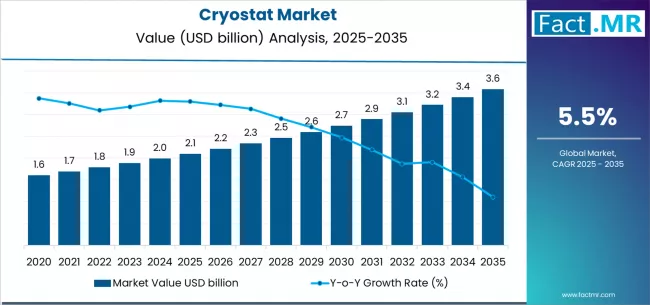
Cryostat Market Value Analysis | Source: Fact.MR
Summary of the Cryostat Market
- Market Snapshot
- In 2025, the global Cryostat Market was valued at approximately USD 2.1 billion.
- The market is estimated to reach USD 2.22 billion in 2026 and is projected to attain USD 3.78 billion by 2036.
- The cryostat market is likely to expand at a CAGR of 5.5% during the forecast period.
- The market is anticipated to create an absolute dollar opportunity of USD 1.57 billion between 2026 and 2036.
- Closed Cycle Cryostat accounts for 29.7% of product segment share in 2026.
- USA (6.2%) and Mexico (5.8%) are the key growth markets during the forecast period.
- Demand and Growth Drivers
- Expanding industrial and commercial demand for cryostat products is sustained by infrastructure investment, manufacturing modernization, and regulatory compliance requirements across major economies.
- Technology advancement in closed cycle cryostat is increasing product capability, reducing lifecycle costs, and broadening the addressable application range for end users across multiple industry verticals.
- Government investment programs in the U.S., EU, and Asia Pacific are generating facility construction and equipment procurement cycles that include cryostat specification.
- Growing adoption across emerging markets driven by industrialization, urbanization, and expanding manufacturing capacity is widening the geographic buyer base beyond mature North American and European markets.
- Sustainability and energy efficiency requirements are creating specification preference for advanced product variants that reduce operating costs and meet environmental compliance criteria.
- Product and Segment View
- Closed Cycle Cryostat accounts for 29.7% of the product segment in 2026.
- Scientific Research represents 34.5% of the application segment in 2026.
- Research Institutes accounts for 37.2% of the end use segment in 2026.
- Key segmentation includes:
- By Product: Closed Cycle Cryostat and related categories
- Geography and Competitive Outlook
- USA leads growth at 6.2%, reflecting strong demand from industrial and manufacturing sectors.
- Mexico at 5.8% sustains demand through facility construction and production capacity expansion.
- Germany at 5.5% maintains institutional demand through manufacturing automation and infrastructure investment.
- Key players include Leica Biosystems, Thermo Fisher Scientific, Cryomech, Oxford Instruments, JanisULT, Microm, Sakura Finetek, Lake Shore.
- Analyst Opinion
- Shambhu Nath Jha, Principal Consultant at Fact.MR, says 'The cryostat market is shaped by the intersection of technology advancement, industrial demand cycles, and regulatory specification requirements. Leica Biosystems holds an estimated 14.0% market share through product portfolio breadth and established distribution. Competition is defined by technical specification capability, application engineering support, and geographic service coverage across end-user industries.'
Key Growth Drivers, Constraints, and Opportunities
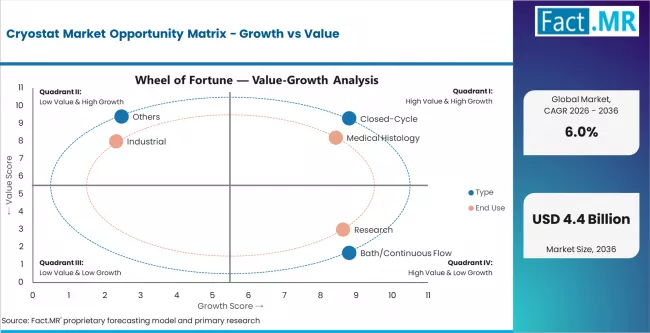
Cryostat Market Opportunity Matrix Growth Vs Value | Source: Fact.MR
Key Factors Driving Growth
- Industrial and manufacturing investment expansion across developed and emerging economies sustains procurement growth for cryostat products.
- Technology advancement and product performance improvement are broadening the addressable application range and supporting premium pricing tiers.
- Government infrastructure and manufacturing support programs create structured procurement pipelines aligned with multi-year budget allocations.
Key Market Constraints
- High capital cost of advanced product variants limits adoption among smaller enterprises without access to favorable financing terms.
- Supply chain concentration for critical components creates procurement vulnerability during demand surges or geopolitical disruption.
- Technical skill requirements for installation and operation create adoption barriers in markets with limited trained workforce availability.
Key Opportunity Areas
- Digital integration with IoT connectivity, predictive maintenance, and condition monitoring is creating premium product tiers with higher margins.
- Nearshoring and reshoring manufacturing investment is generating new facility procurement cycles that include cryostat specification.
- Sustainability and energy efficiency mandates are creating specification preference for advanced variants that reduce total cost of ownership.
Segment-wise Analysis of the Cryostat Market
- Closed Cycle Cryostat holds 29.7% of the product segment in 2026.
- Scientific Research represents 34.5% of the application segment in 2026.
The cryostat market is segmented by product, application, end use, technology, temperature range, and region.
Which Product Segment Dominates the Cryostat Market?
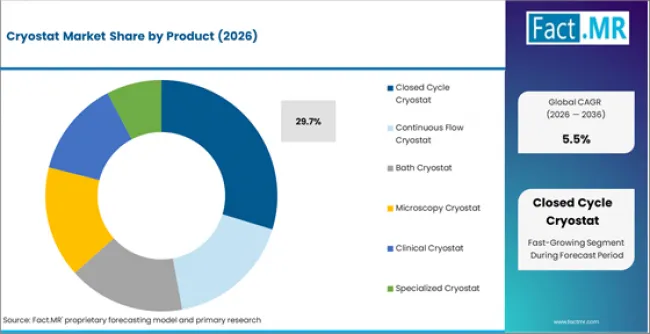
Cryostat Market Analysis By Product | Source: Fact.MR
Closed Cycle Cryostat is estimated to account for 29.7% of the product segment value in 2026. This leadership reflects broad applicability, established buyer preference, and competitive positioning across the primary end-use applications. Demand is concentrated in the highest-volume deployment scenarios where this product category delivers the most favorable cost-performance balance.
Which Application Segment Dominates the Cryostat Market?
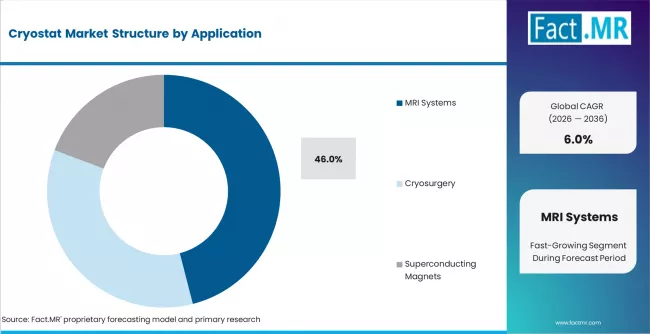
Cryostat Market Analysis By Application | Source: Fact.MR
Scientific Research is expected to lead the application segment with 34.5% share in 2026. This application generates the most concentrated procurement demand across the primary buyer base, supported by institutional requirements, regulatory mandates, and structural demand patterns tied to industry-specific activity cycles.
Which Product Trend is Shaping the Next Phase of Growth in the Cryostat Market?
Dilution refrigerators for quantum computing are the fastest-growing cryostat category, driven by massive investment in quantum processor development by technology companies and government research programs. Bluefors, based in Finland, has established a dominant position in quantum computing cryogenics with systems reaching millikelvin temperatures. Oxford Instruments and Cryomech continue expanding their closed-cycle and pulse tube cryocooler product lines to serve the growing installed base of MRI systems, NMR spectrometers, and superconducting magnet applications.
Regional Outlook Across Key Markets
- USA leads growth at 6.2%.
- Mexico at 5.8% sustains demand through expanding industrial capacity.
- Germany at 5.5% maintains demand through manufacturing investment and facility modernization.
.webp "Top Country Growth Comparison Cryostat Market Cagr (2026 2036)")
Top Country Growth Comparison Cryostat Market Cagr (2026 2036) | Source: Fact.MR
| Country | CAGR (%) |
|---|---|
| USA | 6.2% |
| Mexico | 5.8% |
| Germany | 5.5% |
| France | 5.2% |
| UK | 4.9% |
| South Korea | 4.7% |
| Japan | 4.5% |
Source: Fact.MR analysis. Updated Jun 3, 2026
Source: Fact MR (FMR) analysis, based on proprietary forecasting model and primary research.
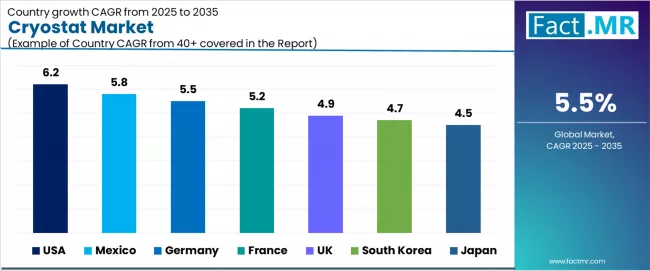
Cryostat Market Cagr Analysis By Country | Source: Fact.MR
Cryostat Demand Trends in USA
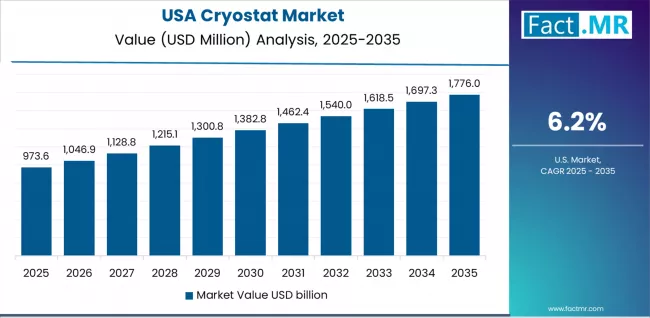
Cryostat Market Country Value Analysis | Source: Fact.MR
Government research funding for quantum computing, superconducting materials, and particle physics sustains the largest cryostat procurement base. CHIPS Act semiconductor facility construction generates demand for cryogenic process cooling. National laboratories and university research departments maintain large installed bases of MRI, NMR, and experimental physics cryostats.
- Government research funding for quantum computing, superconducting materials, and particle physics sustains the largest cryostat procurement base.
- CHIPS Act semiconductor facility construction generates demand for cryogenic process cooling.
Market Outlook for Cryostat in Germany
Max Planck Institutes, Fraunhofer centers, and university research programs sustain institutional procurement. Quantum computing research investment and superconducting magnet development drive dilution refrigerator and closed-cycle cryostat demand. DIN laboratory equipment standards shape procurement specification.
- Max Planck Institutes, Fraunhofer centers, and university research programs sustain institutional procurement.
- Quantum computing research investment and superconducting magnet development drive dilution refrigerator and closed-cycle cryostat demand.
France Cryostat Growth Assessment
CEA, CNRS, and university research laboratory programs sustain cryostat procurement for particle physics, materials science, and superconducting technology research. EU Horizon Europe research funding allocations support institutional capital equipment budgets.
- CEA, CNRS, and university research laboratory programs sustain cryostat procurement for particle physics, materials science, and superconducting technology research.
- EU Horizon Europe research funding allocations support institutional capital equipment budgets.
South Korea Cryostat Market Positioning
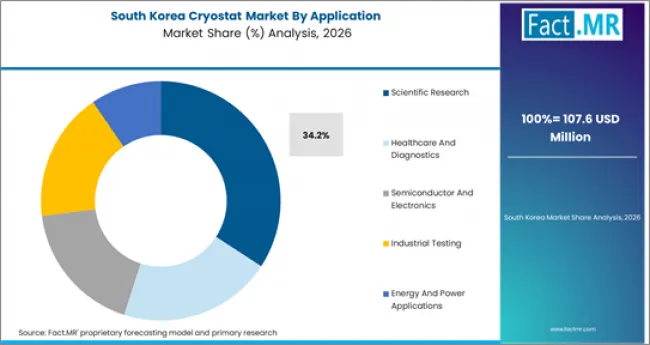
Cryostat Market South Korea Market Share Analysis By Application | Source: Fact.MR
Semiconductor industry process cooling and government quantum computing research programs sustain institutional demand. Advanced research institutions and university laboratories maintain growing cryostat installed bases for materials science and condensed matter physics research.
- Semiconductor industry process cooling and government quantum computing research programs sustain institutional demand.
- Advanced research institutions and university laboratories maintain growing cryostat installed bases for materials science and condensed matter physics research.
Competitive Benchmarking and Company Positioning
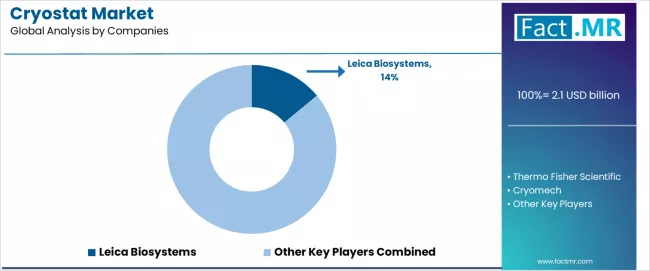
Cryostat Market Analysis By Company | Source: Fact.MR
Cryostat Market Analysis By Company
- Leica Biosystems holds an estimated 14.0% market share through product portfolio breadth, technical capability, and established distribution networks.
- Thermo Fisher Scientific and Cryomech compete through specialized product lines and regional market strength.
- Competition is shaped by product performance, application engineering, pricing, and service network coverage across end-user industries.
The competitive landscape is moderately concentrated, with the top players holding significant market share through product differentiation, technical application support, and geographic distribution coverage. Strategic priorities include expanding digital and connected product portfolios, extending into high-growth application segments, and deepening service network presence in emerging markets.
Key Companies in the Cryostat Market
- Leica Biosystems, Thermo Fisher Scientific, Cryomech, Oxford Instruments lead through broad product portfolios and established market positions.
- JanisULT, Microm, Sakura Finetek, Lake Shore maintain positions in specialized and regional segments.
Recent Industry Developments
- Bluefors, Quantum Computing Cryostat Expansion (2025): Bluefors continued expanding its dilution refrigerator product portfolio and manufacturing capacity to serve the rapidly growing quantum computing industry, where its systems provide the millikelvin cooling environment required for superconducting qubit operation.
- Oxford Instruments, Cryogenic Systems Product Updates (2025): Oxford Instruments advanced its cryostat and cryocooler product portfolio for scientific research, quantum technology, and semiconductor applications, strengthening its position in the research institution and advanced technology procurement channels.
- Thermo Fisher Scientific, Laboratory Equipment Integration (2025): Thermo Fisher Scientific continued integrating cryostat platforms into its broader laboratory and histology equipment portfolio, supporting pathology laboratory procurement for tissue sectioning and specimen preparation cryostats.
Leading Companies Shaping the Cryostat Market
- Leica Biosystems
- Thermo Fisher Scientific
- Cryomech
- Oxford Instruments
- JanisULT
- Microm
- Sakura Finetek
- Lake Shore
- Advanced Research Systems
- Bluefors
Sources and Research References
- Leica Biosystems. Product specifications and corporate announcements.
- Thermo Fisher Scientific. Product portfolio and market development data.
- Industry trade associations. Market statistics and industry benchmarks.
- Government databases and regulatory agencies. Industry investment and compliance data.
- Primary interviews with manufacturers, distributors, end users, and industry consultants.
This bibliography is provided for reader reference and is not exhaustive. The full report contains the complete reference list and detailed citations.
Key Questions This Report Addresses
- What is the current and projected size of the Cryostat Market through 2036?
- Which product type leads the market by value in 2026?
- What industry factors are driving cryostat demand?
- How is technology advancement influencing market growth?
- Which countries are projected to show the fastest growth through 2036?
- Who are the leading companies in the Cryostat Market?
- How does Fact.MR estimate and validate the cryostat market forecast?
Cryostat Market Definition
The cryostat market covers cryogenic temperature management systems used for scientific research, medical imaging, semiconductor fabrication, quantum computing, and superconducting material applications.
Cryostat Market Inclusions
- The scope covers global and regional market size and forecasts for 2026 to 2036 across product type, application, end use, technology, and region.
- It includes demand analysis based on industrial output, manufacturing investment, infrastructure spending, and technology adoption rates.
- The report includes pricing and competitive benchmarking across product categories and regional markets.
Cryostat Market Exclusions
- The scope excludes adjacent equipment categories, standalone software, and aftermarket consumables sold independently.
- It excludes used and refurbished equipment transactions and internal fleet transfers.
Cryostat Market Research Methodology
- The methodology combines secondary research, primary interviews, and forecast modelling tied to industrial activity.
- It draws on 100+ secondary sources including industry databases, manufacturer filings, and trade association data.
- Market sizing covers 30+ countries through a demand-side model validated against industry benchmarks.
- Primary validation includes 25+ interviews across manufacturers, distributors, and end users.
Segmentation
Scope of Analysis
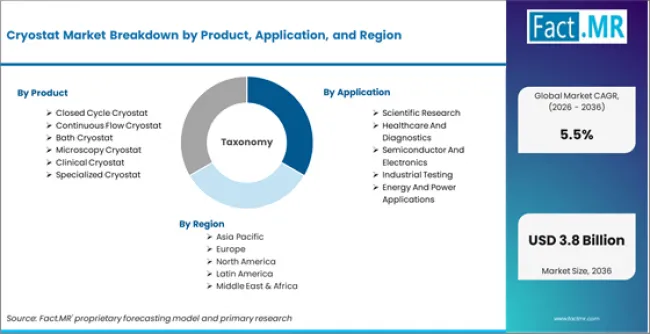
Cryostat Market Breakdown By Product, Application, And Region | Source: Fact.MR
| Parameter | Details |
|---|---|
| Quantitative Units | USD 2.22 billion to USD 3.78 billion, at a CAGR of 5.5% |
| Market Definition | The Cryostat Market covers cryogenic temperature management systems used for scientific research, medical imaging, semiconductor fabrication, quantum computing, and superconducting material applications. |
| Regions Covered | North America, Latin America, Europe, East Asia, South Asia and Pacific, Middle East and Africa |
| Countries Covered | USA, Mexico, Germany, France, UK, 30 plus countries |
| Key Companies | Leica Biosystems, Thermo Fisher Scientific, Cryomech, Oxford Instruments, JanisULT, Microm, Sakura Finetek, Lake Shore, Advanced Research Systems, Bluefors |
| Forecast Period | 2026 to 2036 |
| Approach | Hybrid demand-side and top-down methodology built on industry output data, manufacturing investment, infrastructure spending, and primary interviews across manufacturers, distributors, and end users. |
Source: Fact.MR analysis. Updated Jun 3, 2026
Cryostat Market Segmentation
-
Cryostat Market Segmented by Product:
- Closed Cycle Cryostat
- Optical Closed Cycle Cryostat
- Spectroscopy Research Applications
- Photonics Material Testing
- Low Vibration Closed Cycle Cryostat
- Quantum Computing Applications
- Semiconductor Device Characterization
- Optical Closed Cycle Cryostat
- Continuous Flow Cryostat
- Liquid Helium Continuous Flow Cryostat
- Superconductivity Research Applications
- Low Temperature Physics Studies
- Liquid Nitrogen Continuous Flow Cryostat
- Material Cooling Applications
- Industrial Testing Operations
- Liquid Helium Continuous Flow Cryostat
- Bath Cryostat
- Liquid Helium Bath Cryostat
- Ultra Low Temperature Experiments
- Particle Physics Research
- Liquid Nitrogen Bath Cryostat
- Biological Sample Preservation
- Laboratory Cooling Applications
- Liquid Helium Bath Cryostat
- Microscopy Cryostat
- Cryo Electron Microscopy Cryostat
- Structural Biology Research
- Nanotechnology Imaging Applications
- Cryo Fluorescence Microscopy Cryostat
- Cell Imaging Applications
- Biomedical Research Operations
- Cryo Electron Microscopy Cryostat
- Clinical Cryostat
- Rotary Clinical Cryostat
- Histopathology Sample Sectioning
- Cancer Diagnostic Applications
- Portable Clinical Cryostat
- Point Of Care Diagnostics
- Mobile Laboratory Operations
- Rotary Clinical Cryostat
- Specialized Cryostat
- Dilution Refrigerator Cryostat
- Quantum Computing Research
- Ultra Low Temperature Measurements
- High Magnetic Field Cryostat
- Magnetic Resonance Experiments
- Advanced Material Science Research
- Dilution Refrigerator Cryostat
- Closed Cycle Cryostat
-
Cryostat Market Segmented by Application:
- Scientific Research
- Low Temperature Physics Research
- Quantum Material Studies
- Superconductivity Experiments
- Material Science Research
- Nanomaterial Characterization
- Semiconductor Testing Applications
- Low Temperature Physics Research
- Healthcare And Diagnostics
- Histopathology Diagnostics
- Frozen Tissue Sectioning
- Cancer Detection Procedures
- Biomedical Research
- Cell Preservation Applications
- Cryogenic Biological Analysis
- Histopathology Diagnostics
- Semiconductor And Electronics
- Semiconductor Testing
- Wafer Characterization Applications
- Chip Reliability Testing
- Electronics Research
- Sensor Performance Evaluation
- Quantum Device Development
- Semiconductor Testing
- Industrial Testing
- Material Performance Testing
- Mechanical Property Evaluation
- Thermal Conductivity Analysis
- Aerospace Component Testing
- Low Temperature Stress Testing
- Cryogenic System Validation
- Material Performance Testing
- Energy And Power Applications
- Superconducting Systems
- Magnetic Energy Storage Research
- Superconducting Cable Testing
- Cryogenic Energy Systems
- Liquefied Gas Research
- Hydrogen Storage Applications
- Superconducting Systems
- Scientific Research
-
Cryostat Market Segmented by End Use:
- Research Institutes
- Physics Research Laboratories
- Quantum Research Centers
- Low Temperature Science Facilities
- Material Science Laboratories
- Nanotechnology Research Facilities
- Advanced Semiconductor Laboratories
- Physics Research Laboratories
- Healthcare Facilities
- Hospitals And Diagnostic Centers
- Pathology Laboratory Operations
- Cancer Research Facilities
- Biotechnology Laboratories
- Cell Preservation Facilities
- Biomedical Research Centers
- Hospitals And Diagnostic Centers
- Semiconductor Industry
- Semiconductor Manufacturers
- Wafer Testing Facilities
- Chip Development Centers
- Electronics Research Companies
- Quantum Electronics Facilities
- Sensor Development Laboratories
- Semiconductor Manufacturers
- Industrial Manufacturing Companies
- Aerospace Manufacturers
- Cryogenic Component Testing Facilities
- Advanced Material Testing Centers
- Energy Equipment Manufacturers
- Superconducting Equipment Production
- Hydrogen Technology Development Centers
- Aerospace Manufacturers
- Government And Academic Institutions
- University Research Departments
- Physics Research Programs
- Biomedical Science Programs
- Government Research Agencies
- National Laboratory Facilities
- Defense Research Centers
- University Research Departments
- Research Institutes
-
Cryostat Market Segmented by Technology:
- Cooling Technology
- Closed Cycle Refrigeration Systems
- Low Maintenance Cryogenic Cooling
- Continuous Operation Cooling Systems
- Liquid Based Cooling Systems
- Helium Cooling Applications
- Nitrogen Cooling Applications
- Closed Cycle Refrigeration Systems
- Temperature Range Technology
- High Temperature Cryogenic Systems
- Industrial Cooling Applications
- Biological Sample Processing
- Ultra Low Temperature Systems
- Quantum Research Applications
- Superconductivity Experiments
- High Temperature Cryogenic Systems
- Vacuum Technology
- High Vacuum Cryostat Systems
- Semiconductor Testing Applications
- Advanced Material Characterization
- Ultra High Vacuum Systems
- Particle Physics Research
- Surface Science Applications
- High Vacuum Cryostat Systems
- Magnetic Field Integration Technology
- Standard Magnetic Cryostat Systems
- Magnetic Material Testing
- Low Temperature Spectroscopy
- High Field Magnetic Systems
- Quantum Computing Research
- Superconducting Magnet Applications
- Standard Magnetic Cryostat Systems
- Cooling Technology
-
Cryostat Market Segmented by Temperature Range:
- 4 Kelvin To 77 Kelvin Cryostats
- Low Temperature Research Systems
- Semiconductor Testing Applications
- Material Science Research
- Superconductivity Research Systems
- Quantum Material Studies
- Magnetic Field Experiments
- Low Temperature Research Systems
- Above 77 Kelvin Cryostats
- Industrial Cryogenic Systems
- Material Testing Operations
- Biological Preservation Applications
- Laboratory Cooling Systems
- General Research Applications
- Educational Laboratory Operations
- Industrial Cryogenic Systems
- Below 4 Kelvin Cryostats
- Ultra Low Temperature Systems
- Quantum Computing Research
- Particle Physics Experiments
- Dilution Refrigeration Systems
- Superconducting Device Testing
- Advanced Cryogenic Measurements
- Ultra Low Temperature Systems
- 4 Kelvin To 77 Kelvin Cryostats
-
Cryostat Market by Region:
- North America
- USA
- Canada
- Mexico
- Latin America
- Brazil
- Chile
- Rest of Latin America
- Western Europe
- Germany
- UK
- Italy
- Spain
- France
- Nordic
- BENELUX
- Rest of Western Europe
- Eastern Europe
- Russia
- Poland
- Hungary
- Balkan & Baltic
- Rest of Eastern Europe
- East Asia
- China
- Japan
- South Korea
- South Asia and Pacific
- India
- ASEAN
- Australia & New Zealand
- Rest of South Asia and Pacific
- Middle East & Africa
- Kingdom of Saudi Arabia
- Other GCC Countries
- Turkiye
- South Africa
- Other African Union
- Rest of Middle East & Africa
- North America
Frequently Asked Questions
How big is the cryostat market in 2026?
What will be the size of cryostat market in 2036?
How much will be the cryostat market growth between 2026 and 2036?
What are the key product types in the cryostat market?
Which application segment is expected to contribute significant share in the cryostat market in 2026?
Who worked on this report


Preview the report firsthand - request a free sample
Free SampleGet the brochure for pricing and purchase details
Download PDF