- Market Value (2025): USD 1.7 Bn
- Estimated Value (2026): USD 1.9 Bn
- Forecast Value (2036): USD 9.1 Bn
- CAGR (2026-2036): 16.6%
What is the Flexible EV Chargers Market forecast to be worth by 2036?
USD 1.9 billion in 2026 to USD 9.1 billion by 2036 at a 16.6% CAGR.
- The Flexible EV Chargers Market reached USD 1.7 billion in 2025.
- Demand is projected to increase from USD 1.9 billion in 2026 to USD 9.1 billion by 2036.
- The market is forecast to record 16.6% CAGR from 2026 to 2036 as households, fleets, roadside-service operators, rental providers, event operators and temporary worksites expand qualified purchasing and deployment.
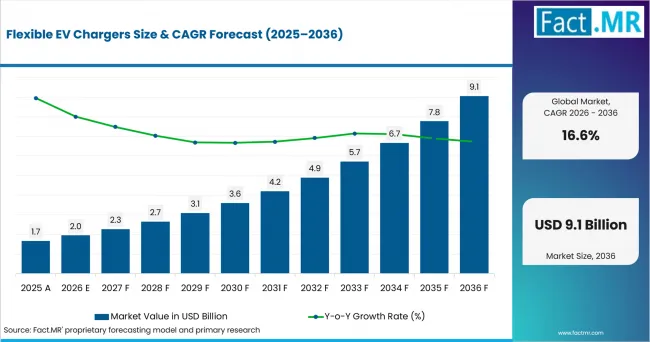
Flexible Ev Chargers Value Analysis | Source: Fact.MR
What are the defining numbers behind Flexible EV Chargers Market growth?
USD 7.1 billion in absolute opportunity through 2036.
- Demand Drivers in the Market
- Drivers and small fleets need charging options where a permanent installation is unavailable, delayed or uneconomic.
- Construction, events and roadside service create temporary charging demand that favors mobile DC and trailer-mounted equipment.
- Connected portable and modular chargers allow operators to control access, schedule load and move equipment without losing fleet visibility.
- Key Segments Analyzed
- By Form Factor: Portable EVSE is expected to hold 31.0% share in 2026 because portable Mode 2 charging equipment can integrate in-cable control and protection functions while allowing users to charge from compatible power supplies away from a fixed charger.
- By Power: 7.4-22 kW is projected to account for 34.0% share in 2026 as this range supports common lower-power charging applications while remaining within the slow-charging category of 22 kW and below.
- By Use Case: Residential backup / travel is anticipated to capture 29.0% share in 2026 because portable charging equipment gives users flexibility to move the charger with the vehicle and adapt to compatible power supplies during travel or backup situations.
- By Connectivity: App / Wi-Fi is estimated to represent 34.0% share in 2026 because connected charging platforms can support scheduling, status visibility and access management across portable EV charging applications.
- Analyst Opinion at Fact.MR
- Shambhu Nath Jha, Principal Consultant, Fact.MR, states, "Flexibility cannot come at the expense of electrical protection. Products that make input limits, connector temperature and site suitability obvious will be easier to deploy across temporary and mobile use cases."
- Strategic Implications
- IEC 62752:2024 applies to portable in-cable control and protection devices (IC-CPDs) used for Mode 2 charging of electric road vehicles and specifies requirements covering their control and safety functions.
- General EV supply equipment requirements should be checked against IEC 61851-1:2017, whose current copy incorporates Corrigendum 1:2023 and covers operating conditions, connections and electrical safety.
- Temporary and mobile DC charging propositions should document relocation, input-supply and connection requirements; product availability should also be checked before commercial positioning.
- Connected-charger claims should distinguish local app or Wi-Fi functionality from requirements that apply specifically to networked public charging infrastructure.
How does the Flexible EV Chargers Market break down by segment?
The Flexible EV Chargers Market is analyzed by Form Factor, Power, Use Case, and Connectivity.
Why does Portable EVSE lead Form Factor?
The Portable EVSE category leads with 31.0% share of Form Factor in 2026.
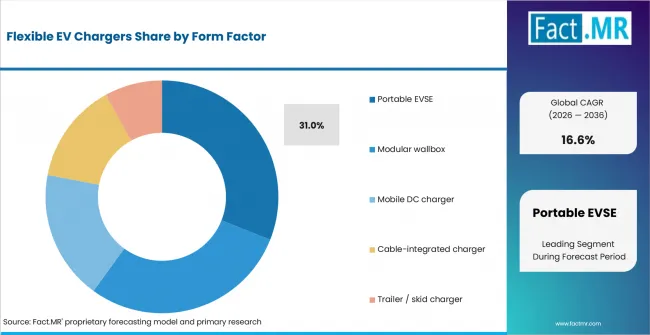
Flexible Ev Chargers Analysis By Form Factor | Source: Fact.MR
Portable Mode 2 EV charging equipment can incorporate an in-cable control and protection device (IC-CPD) conforming to IEC 62752:2024, which specifies control and safety requirements for portable Mode 2 charging devices.
Recurring Portable EVSE demand depends on a workable handoff between product and service. That means delivering charger rental fleets without leaving households, fleets, roadside-service operators, rental providers, event operators and temporary worksites to absorb electrical safety and misuse.
Why does 7.4-22 kW lead Power?
The 7.4-22 kW category holds 34.0% share of Power in 2026.
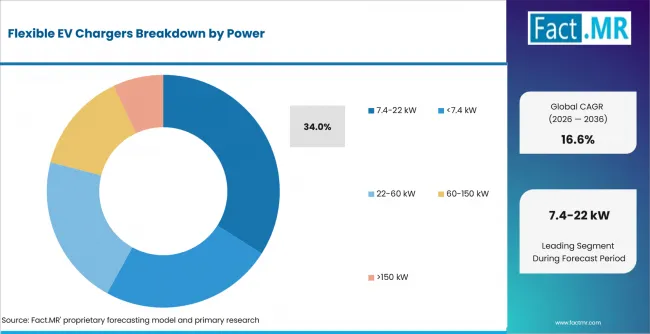
Flexible Ev Chargers Analysis By Power | Source: Fact.MR
The 7.4-22 kW band remains within the IEA classification of public slow charging at 22 kW and below.
The route from specification to volume is shaped by bidirectional portable units, not by headline share alone. Buyers will still test 7.4-22 kW against weather and cable durability and the economics of portable charging without compromising electrical protection.
Why does Residential backup / travel lead Use Case?
The Residential backup / travel category accounts for 29.0% share of Use Case in 2026.
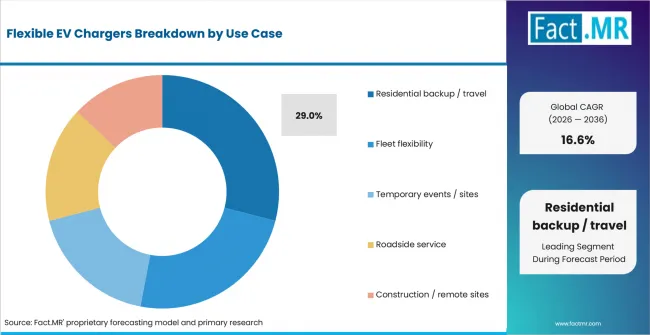
Flexible Ev Chargers Analysis By Use Case | Source: Fact.MR
Travel and backup use creates direct value from equipment that can move with the vehicle and adapt to available supplies. It shows why the leading position across the assessed use cases is held by Residential backup / travel.
The commercial test for Residential backup / travel is whether modular wallbox upgrades can be documented without allowing limited input power to erode the buyer case. That is especially relevant to households, fleets, roadside-service operators, rental providers, event operators and temporary worksites.
Why does App / Wi-Fi lead Connectivity?
The App / Wi-Fi category holds 34.0% share of Connectivity in 2026.
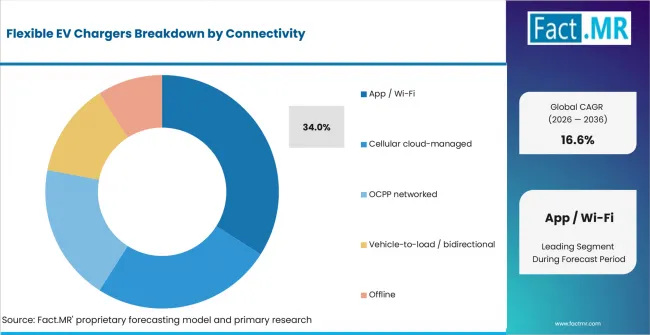
Flexible Ev Chargers Analysis By Connectivity | Source: Fact.MR
Connected charging platforms can support scheduling, status visibility and access management.
The lead held by App / Wi-Fi can persist when vendors connect the category with roadside mobile DC service. Commercial momentum weakens where certification across markets transfers excessive risk to the customer.
What is accelerating Flexible EV Chargers Market adoption, and what is holding it back?
Three principal adoption drivers: charging needs where permanent installation is unavailable, delayed or uneconomic; temporary demand at construction, event and roadside settings; and connected control of portable or modular chargers. Expansion is constrained by electrical safety and misuse, weather and cable durability, limited input power, and certification across markets.
Drivers Impact Analysis
| DRIVER | (~) % IMPACT ON CAGR | GEOGRAPHIC RELEVANCE | IMPACT TIMELINE |
|---|---|---|---|
| Charging needs where permanent installation is unavailable, delayed or uneconomic | +3.0% | Global | Short term (<= 2 years) |
| Temporary construction, event and roadside charging demand | +2.3% | USA and Germany | Medium term (2-4 years) |
| Connected control for portable and modular chargers | +1.8% | Germany and UK | Long term (>= 4 years) |
Opportunity Impact Analysis
| OPPORTUNITY | (~) % IMPACT ON CAGR | GEOGRAPHIC RELEVANCE | IMPACT TIMELINE |
|---|---|---|---|
| Charger rental fleets | +2.0% | Global | Medium term (2-4 years) |
| Bidirectional portable units | +1.7% | USA and Germany | Short term (<= 2 years) |
| Modular wallbox upgrades | +1.3% | Germany and UK | Long term (>= 4 years) |
| Roadside mobile DC service | +1.0% | Global | Medium term (2-4 years) |
Restraints Impact Analysis
| RESTRAINT | (~) % IMPACT ON CAGR | GEOGRAPHIC RELEVANCE | IMPACT TIMELINE |
|---|---|---|---|
| Electrical safety and misuse | -1.5% | Global | Short term (<= 2 years) |
| Weather and cable durability | -1.2% | USA and Germany | Medium term (2-4 years) |
| Limited input power | -0.9% | Global | Long term (>= 4 years) |
| Certification across markets | -0.7% | UK and France | Medium term (2-4 years) |
Which countries are scaling the Flexible EV Chargers Market through 2036?
- USA: A projected 16.4% CAGR brings charger rental fleets into sharper procurement focus, particularly for Portable EVSE.
- Germany: At 15.6% through 2036, the commercial focus falls on 7.4-22 kW and the rollout of bidirectional portable units.
- UK: Through 2036, the 16.1% forecast depends on how quickly buyers qualify Residential backup / travel and operationalize modular wallbox upgrades.
- France: The market advances at 16.7% where roadside mobile DC service can overcome the practical drag from certification across markets.
- Italy: Growth of 17.1% reflects a route to market built around charger rental fleets; electrical safety and misuse remains the near-term watchpoint.
Differences in qualification capacity, infrastructure and service access explain the country spread. The full geographic scope is North America, Latin America, Western Europe, Eastern Europe, East Asia, South Asia & Pacific, and Middle East & Africa. These pathways frame the Flexible EV Chargers Market outlook.
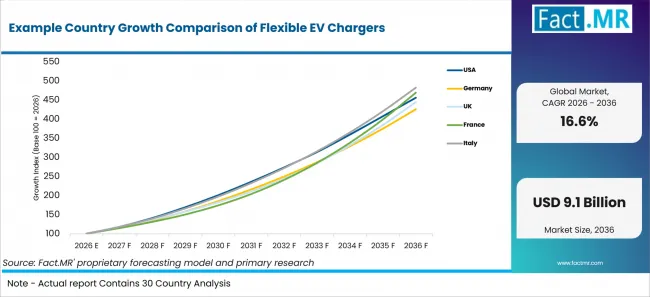
Example Country Growth Comparison Of Flexible Ev Chargers | Source: Fact.MR
| Country | CAGR (2026-2036) |
|---|---|
| USA | 16.4% |
| Germany | 15.6% |
| UK | 16.1% |
| France | 16.7% |
| Italy | 17.1% |
What is driving USA's growth through 2036?
A projected CAGR of 16.4% places USA on a distinct ten-year adoption path.
U.S. federally funded EV charging projects covered by 23 CFR Part 680 are subject to requirements on interoperability, network connectivity, data, pricing, real-time availability and accessibility. These requirements apply to NEVI and certain other federally funded publicly accessible charging projects and do not by themselves establish demand for portable EVSE.
The conversion from interest to revenue depends on charger rental fleets. In parallel, households, fleets, roadside-service operators, rental providers, event operators and temporary worksites will scrutinize electrical safety and misuse before widening deployment.
What is driving Germany's growth through 2036?
Through 2036, growth is projected at 15.6% CAGR as buyers act on portable charging without compromising electrical protection.
Germany's Deutschlandnetz is expanding high-power public charging through about 9,000 HPC charging points at more than 1,000 locations. This supports the broader charging-infrastructure backdrop.
Adoption will still be uneven. Orders should favor applications where portable charging without compromising electrical protection is measurable and weather and cable durability can be assigned before contract award.
What is driving UK's growth through 2036?
The 2026 to 2036 outlook points to 16.1% CAGR.
The Public Charge Point Regulations 2023 apply to publicly accessible UK charge points and cover pricing transparency, contactless payment, roaming, open data and a 99% annual-average reliability requirement for rapid public charging networks.
Suppliers still face a local proof burden. They must show households, fleets, roadside-service operators, rental providers, event operators and temporary worksites how the offer manages limited input power across installation, operation and service.
What is driving France's growth through 2036?
France is forecast to record 16.7% CAGR over the assessment period.
The UK’s Public Charge Point Regulations 2023 apply to publicly accessible charge points and establish requirements covering pricing transparency, contactless payment for applicable charge points, payment roaming, open data and a 99% annual-average reliability requirement across operators’ rapid public charging networks of 50 kW and above.
Commercial expansion depends on roadside mobile DC service. It also depends on how convincingly suppliers address certification across markets for buyers working under local technical and budget rules.
What is driving Italy's growth through 2036?
Italy's market trajectory is 17.1% CAGR between 2026 and 2036.
Italy’s PNRR M2C2 Investment 4.3 supports the expansion of public fast-charging infrastructure in urban areas and along extra-urban roads.
The second clue comes from procurement. Buyers will reward charger rental fleets only if the commercial package documents control of electrical safety and misuse.
Who Leads the Flexible EV Chargers Market?
Relevant EV-charging suppliers in the broader competitive landscape include Wallbox, ChargePoint, Delta Electronics, ABB E-mobility, Kempower and Blink Charging. Product-level participation in the report's narrower flexible, portable or relocatable scope varies by supplier.
The competitive landscape is defined by operating credibility. Product claims carry more weight when vendors can support qualification, field integration and lifecycle decisions for households, fleets, roadside-service operators, rental providers, event operators and temporary worksites. This is the competitive frame for the Flexible EV Chargers Market.
Providers will compete to make charger rental fleets repeatable. Their ability to contain electrical safety and misuse will influence customer retention and geographic reach.
Which companies are the key providers?
Key comapnies include Wallbox, ChargePoint, Delta Electronics, ABB E-mobility, Kempower and Blink Charging.
- Wallbox
- ChargePoint
- Delta Electronics
- ABB E-mobility
- Kempower
- Blink Charging
Bibliography
- International Electrotechnical Commission. (2024). In-cable control and protection device (IC-CPD) for mode 2 charging of electric road vehicles (IEC 62752:2024).
- International Energy Agency. (2026, May 20). Global EV Outlook 2026.
- National Fire Protection Association. (2026). NFPA 70®: National Electrical Code® (NEC®), 2026 edition.
- Bundesministerium für Verkehr. (2026, April 22). Deutschlandnetz: Schnellladen für E (Elektro)-Autos bundesweit.
- Office for Zero Emission Vehicles, & Department for Transport. (2024, October 21). Public Charge Point Regulations 2023 guidance.
- Ministère de la Transition écologique. (2025, August 20). Développer les bornes de recharge pour véhicules électriques.
- Presidenza del Consiglio dei ministri, Struttura di missione PNRR. (2024, July 22). Quinta Relazione al Parlamento sullo stato di attuazione del Piano Nazionale di Ripresa e Resilienza: Sezione II.
This Report Answers
- The report explains how the Flexible EV Chargers Market develops across Form Factor and Power.
- Segment analysis identifies Portable EVSE and 7.4-22 kW as the principal 2026 reference points.
- Country analysis examines USA, Germany, UK, France, and Italy.
- Competitive analysis reviews Wallbox, ChargePoint, Delta Electronics, ABB E-mobility, Kempower, and Blink Charging.
- Opportunity analysis covers charger rental fleets, bidirectional portable units, modular wallbox upgrades, and roadside mobile DC service.
- Risk analysis evaluates electrical safety and misuse, weather and cable durability, limited input power, and certification across markets.
What does the Flexible EV Chargers Market cover?
The Flexible EV Chargers Market covers portable EVSE, modular wallboxes, mobile DC chargers, cable-integrated units and skid or trailer charging systems.
Commercial coverage follows purchases made by households, fleets, roadside-service operators, rental providers, event operators and temporary worksites. Revenue is counted when the qualifying product, platform or integrated system is supplied for an in-scope application.
What is included in the scope?
The scope includes portable EVSE, modular wallboxes, mobile DC chargers, cable-integrated units and skid or trailer charging systems across Form Factor, Power, Use Case, and Connectivity.
Inclusions extend to configuration and integration elements that are inseparable from the in-scope commercial offer. The boundary is applied consistently across USA, Germany, UK, France, and Italy and the seven global regions.
What is excluded from the scope?
The scope excludes fixed high-power public hubs, vehicle onboard chargers, electricity sales, unprotected extension devices and temporary generators without EV charging controls.
Adjacent categories enter the Flexible EV Chargers Market only when the sold product or service performs the defining function described above. This prevents adjacent charging equipment, electricity-sales, software and project revenue from being counted twice.
How Was the Analysis Built?
The analysis draws on 120+ sources, 35+ company portfolios, 25+ countries, and more than 20 industry interviews.
- Primary Research: Primary research includes discussions with manufacturers, service providers, technology developers, distributors, end users, and subject-matter experts. These conversations examine purchasing priorities, product adoption, operational challenges, approval requirements, competitive positioning, and the factors that influence wider market acceptance.
- Desk Research: Desk research covers government statistics, regulatory publications, company filings, trade data, technical studies, industry associations, standards, public policy, and other authoritative sources. Every source used in the analysis is documented in the bibliography.
- Market Sizing and Forecasting: Market estimates combine historical performance, demand indicators, pricing and volume trends, segment shares, company participation, country-level growth, adoption patterns, investment activity, and barriers to market expansion.
- Data Validation and Update Cycle: Findings are validated by comparing primary interviews with public data, company activity, regulatory changes, trade patterns, and industry developments. Regular updates review new product launches, capacity changes, partnerships, approvals, and shifts in commercial adoption.
What is the report's scope and coverage?
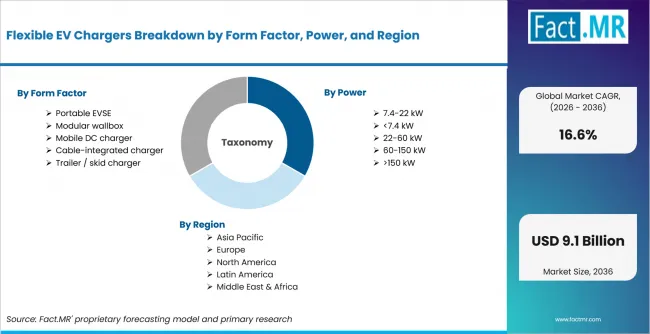
Flexible Ev Chargers Breakdown By Form Factor, Power, And Region | Source: Fact.MR
| Attribute | Details |
|---|---|
| Quantitative Units | USD Billion in 2026 and 2036; CAGR from 2026 to 2036 |
| Market Definition | Portable, mobile, modular and cable-integrated charging systems that can be relocated or reconfigured as vehicle and site requirements change. |
| Form Factor | Portable EVSE; Modular wallbox; Mobile DC charger; Cable-integrated charger; Trailer / skid charger |
| Power | 7.4-22 kW; <7.4 kW; 22-60 kW; 60-150 kW; >150 kW |
| Use Case | Residential backup / travel; Fleet flexibility; Temporary events / sites; Roadside service; Construction / remote sites |
| Connectivity | App / Wi-Fi; Cellular cloud-managed; OCPP networked; Vehicle-to-load / bidirectional; Offline |
| Regions Covered | North America; Latin America; Western Europe; Eastern Europe; East Asia; South Asia & Pacific; Middle East & Africa |
| Countries Covered | USA; Germany; UK; France; Italy |
| Key Companies | Wallbox; ChargePoint; Delta Electronics; ABB E-mobility; Kempower; Blink Charging |
| Forecast Period | 2026 to 2036 |
| Approach | Hybrid top-down and bottom-up assessment using Form Factor, Power, Use Case, and Connectivity, country deployment, replacement demand and company participation. |
How is the market segmented?
-
By Form Factor
- Portable EVSE
- Modular wallbox
- Mobile DC charger
- Cable-integrated charger
- Trailer / skid charger
-
By Power
- 7.4-22 kW
- <7.4 kW
- 22-60 kW
- 60-150 kW
- >150 kW
-
By Use Case
- Residential backup / travel
- Fleet flexibility
- Temporary events / sites
- Roadside service
- Construction / remote sites
-
By Connectivity
- App / Wi-Fi
- Cellular cloud-managed
- OCPP networked
- Vehicle-to-load / bidirectional
- Offline
-
By Region
- North America
- Latin America
- Western Europe
- Eastern Europe
- East Asia
- South Asia & Pacific
- Middle East & Africa