Exhaust Flexible Couplings Market (2026 - 2036)

Exhaust Flexible Couplings Market Size and Share Forecast Outlook 2026 to 2036

Core Findings

    Exhaust Flexible Couplings Market Forecast Outlook 2026 to 2036

    The exhaust flexible couplings market is projected to reach USD 1.7 billion in 2026, growing to USD 2.1 billion by 2036, with a CAGR of 2.4%.

    Key Takeaways from Exhaust Flexible Couplings Market

    • Exhaust Flexible Couplings Market Value (2026): USD 1.7 billion
    • Exhaust Flexible Couplings Market Forecast Value (2036): USD 2.1 billion
    • Exhaust Flexible Couplings Market Forecast CAGR (2026 to 2036): 2.4%
    • Leading Segment in Exhaust Flexible Couplings Market: First Fit (OEM) Sales Channel (74%)
    • Key Growth Region in Exhaust Flexible Couplings Market: Asia Pacific
    • Key Players in Exhaust Flexible Couplings Market: BOSAL International NV, Tenneco Inc., FORVIA S.A., Eberspächer Gruppe GmbH & Co. KG, Benteler International AG, Sango Co., Ltd., Sejong Industrial Co., Ltd., Dinex A/S, Katcon International, Inc., MagnaFlow
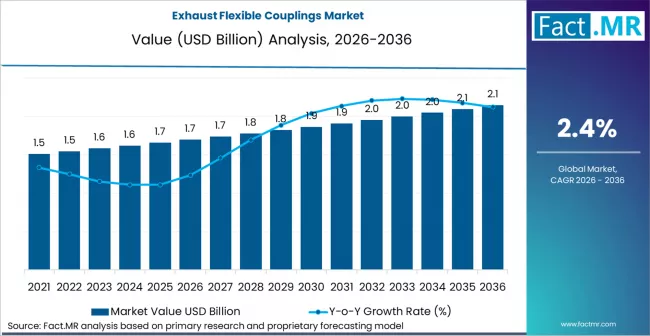
    Exhaust Flexible Couplings Market Market Value Analysis

    Positioned within the broader automotive and industrial equipment sectors, exhaust flexible couplings are essential components for managing system flexibility and reducing stress on exhaust systems. While their role is critical in ensuring smooth operation and longevity, the market remains influenced by ongoing technological trends, such as the shift toward electric vehicles and evolving emissions standards.

    Competitive weight is distributed between a handful of well-established suppliers and smaller players who target niche applications with specialized products. The market is somewhat fragmented, but growth will likely be driven by suppliers offering consistent product quality and reliable after-sales service. As demand remains steady, companies must focus on maintaining strong supplier relationships and adapting to regulatory changes that impact production standards, ensuring they remain competitive in this moderately growing market.

    Exhaust Flexible Couplings Market

    Metric Value
    Estimated Value in (2026E) USD 1.7 billion
    Forecast Value in (2036F) USD 2.1 billion
    Forecast CAGR (2026 to 2036) 2.4%

    Category

    Category Segments
    Sales Channel First Fit (OEM); Aftermarket
    Vehicle Type Passenger Cars; LCV; HCV
    Coupling Type Braided Flex Pipe; Bellows; Ball Joint/Other
    Material Stainless Steel; Other Alloys
    Region North America; Europe; Asia Pacific; Latin America; Middle East & Africa

    Segmental Analysis: Exhaust Flexible Couplings Market

    What is the Analysis of the Leading Sales Channel Segment in the Exhaust Flexible Couplings Market?
    Exhaust Flexible Couplings Market Analysis By Sales Channel

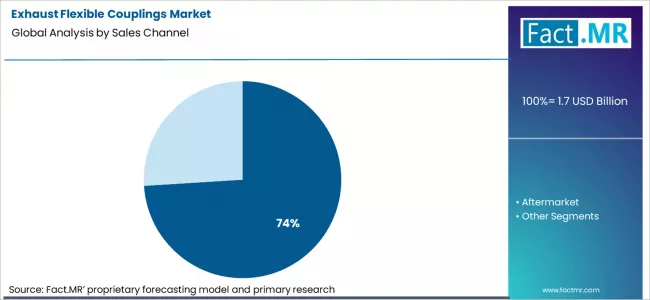
    The First Fit (OEM) segment dominates the exhaust flexible couplings market, holding 74% of the market share in 2026. This leadership is driven by the integration of flexible couplings directly into the original exhaust assembly to protect critical components like catalytic converters and turbochargers from engine-induced stress. OEM demand focuses on high-durability, multi-layered stainless steel bellows, which meet extended warranty requirements set by vehicle manufacturers. Tenneco Inc. maintains its position as the global leader in OEM sales, securing major contracts for high-performance flexible connectors, including for a 2026 pickup truck platform launch. The trend of localized production is evident, as Faurecia (FORVIA) and Eberspächer expand their R&D and manufacturing capabilities across more than 30 countries to support OEM production lines. These companies are prioritizing lightweight, high-strength alloy couplings for 2026 model vehicles to meet evolving customer needs.

    What is the Analysis of the Leading Vehicle Type Segment in the Exhaust Flexible Couplings Market?
    Exhaust Flexible Couplings Market Analysis By Vehicle Type

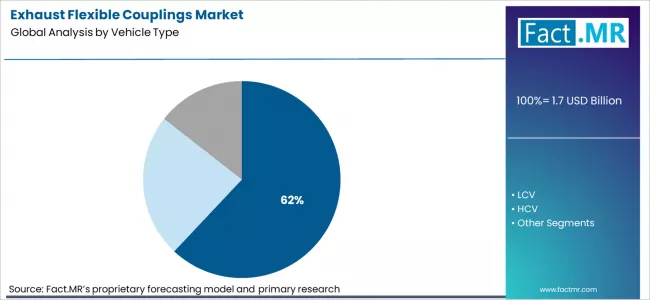
    Passenger cars are the leading vehicle type for exhaust flexible couplings, accounting for 62% of the market share in 2026. This segment's dominance is attributed to the widespread use of downsized, turbocharged engines, which result in more frequent thermal expansion cycles and high-frequency vibrations, making flexible couplings essential for maintaining system integrity. The global passenger car market significantly contributes to the automotive exhaust system's overall valuation, which is expected to reach $91.67 billion in 2026, with flexible couplings being a standard feature in over 90% of gasoline and hybrid models. There is a growing shift towards 4-layer sealed flexible pipes (Interlock/Braid) for enhanced acoustic damping in luxury and hybrid passenger vehicles, where cabin noise reduction is a key selling point. The Asia-Pacific region is the leading driver of this demand, with Zhejiang Yue Ding and Comflex Industrial leading the production of stainless steel bellows for the 2026 model year.

    Country

    Country Drivers Restraints Trends
    USA Large automotive production and stringent emissions regulations increase demand for flexible couplings to reduce vibration and exhaust stress in passenger and commercial vehicles. High compliance and manufacturing costs can temper adoption of premium exhaust solutions. Shift toward lightweight, high durability coupling materials to improve fuel economy and NVH performance.
    China World’s largest vehicle output supports strong demand for exhaust flex couplings across passenger cars and commercial vehicles. Tightening local emission norms further drive demand. Rapid growth in electric vehicles may reduce long term demand for traditional exhaust components. Growing focus on integration of flexible couplings in advanced emission control assemblies to meet China 7 standards.
    India Expanding vehicle production and stricter emission norms (BS VI and beyond) elevate requirement for quality exhaust components including flexible couplings. Cost sensitivity in mass market segments may limit uptake of high end flexible coupling solutions. Increasing retrofits in commercial fleet exhaust systems to comply with evolving NOx and particulate limits.
    Germany Premium automotive manufacturing and tight EU emission standards drive demand for high performance flexible exhaust components. Electrification and decline in internal combustion engine (ICE) volumes can reduce future market size. Adoption of precision engineered flexible couplings to optimize exhaust durability and reduce NVH.
    Japan Strong OEM base and continuous focus on emission and fuel economy improvements sustain flexible coupling usage. Slow growth in traditional diesel and ICE segments limits volume expansion. Trend toward integration of advanced materials for enhanced temperature and fatigue resistance.
    South Korea Robust automotive industry and emission standards support steady demand for exhaust flex couplings in passenger and commercial vehicles. Competition from domestic and imported component suppliers can pressure margins. Increased use of high performance alloys and composites in couplings to extend service life.
    Brazil Growing automotive assembly and tighter local emission regulations increase demand for flexible exhaust solutions in regional vehicles. Economic volatility and cost constrained automotive segments may delay upgrades. Expansion of aftermarket flexible coupling installations to meet evolving emission requirements.

    Analysis of the Exhaust Flexible Couplings Market by Key Country
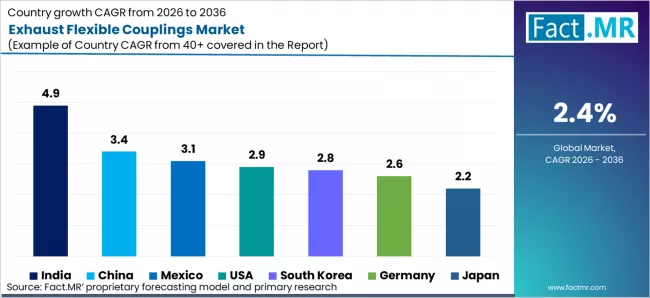
    Exhaust Flexible Couplings Market Cagr Analysis By Country

    Country CAGR (Forecast Period)
    USA 2.9%
    China 3.4%
    India 4.9%
    Germany 2.6%
    Japan 2.2%
    South Korea 2.8%
    Mexico 3.1%

    The report covers an in-depth analysis of 40+ countries; top-performing countries are highlighted below.

    What Drives Growth in the USA Exhaust Flexible Couplings Market?

    The 2.9% growth rate in the USA is driven by the EPA's Multi-Pollutant Emissions Standards for 2027-2032, which require automakers to overhaul exhaust architectures to comply with tighter regulations. These standards necessitate close-coupled catalytic converters, increasing the heat and vibration stress on flexible couplings. As the industry shifts to Tier 3 durability requirements, manufacturers are moving toward more durable interlock flex pipes that can withstand high temperatures and vibrations. This shift ensures long-term compliance with federal air quality mandates, particularly in regions like California, where CARB regulations are more stringent.

    What Influences Growth in the China Exhaust Flexible Couplings Market?

    China's 3.4% growth in the exhaust flexible couplings market is driven by the nationwide enforcement of the China VI-b emission standard. These regulations require high-performance SCR systems and diesel particulate filters (DPF) to meet real-driving emissions (RDE) standards, pushing manufacturers to optimize exhaust flow dynamics. To meet these demands, Chinese manufacturers are turning to advanced flexible couplings with multi-ply bellows and high-nickel alloys that can handle the intense thermal loads of modern turbocharged engines. The expansion of the domestic hybrid vehicle market also drives the need for specialized couplings to withstand thermal expansion and contraction during frequent engine start-stop cycles.

    How Does India Achieve Growth in the Exhaust Flexible Couplings Market?

    India’s exhaust flexible couplings market is growing at 4.9%, driven by the Bharat Stage VI (BS VI) Phase 2 (RDE) norms. The transition to these regulations requires more complex aftertreatment systems, including gasoline particulate filters (GPF), which add weight to the exhaust system. This increase in weight leads to greater demand for high-strength flexible couplings to prevent fractures and weld failures. Additionally, the Production Linked Incentive (PLI) Scheme encourages the localization of high-performance couplings in India, transforming the market toward more high-precision engineering solutions that can meet both domestic and export needs.

    What Drives Growth in the Germany Exhaust Flexible Couplings Market?

    Germany's 2.6% growth in the exhaust flexible couplings market is largely driven by the automotive industry's preparations for the Euro 7 regulations, set to tighten NOx and particulate matter limits by 2026/2027. German OEMs are integrating advanced systems like dual-SCR and electrically heated catalysts, which increase exhaust complexity and temperature. To protect these systems, high-torsional-stiffness flexible couplings are being adopted. Additionally, the Plattform Industrie 4.0 initiative is driving the use of advanced simulation tools like Finite Element Analysis to optimize coupling designs, reducing weight while maintaining durability and performance for premium automotive engineering.

    How Does Japan Achieve Growth in the Exhaust Flexible Couplings Market?

    Japan’s 2.2% growth rate is influenced by the Ministry of Economy, Trade and Industry (METI) and its Green Transformation (GX) roadmap. The policy’s focus on energy efficiency has led to the development of ultra-thin-walled exhaust components, which require specialized stainless steel alloys. Furthermore, Japan’s transition to hydrogen-combustion and carbon-neutral fuel engines increases demand for flexible couplings that can handle higher moisture levels and varying exhaust chemistries. AI-driven design is also improving the vibration-damping effectiveness of bellows, contributing to more durable and efficient couplings, which are critical for Japan’s high-precision automotive sector.

    Why Does South Korea Exhibit Growth in the Exhaust Flexible Couplings Market?

    South Korea’s 2.8% growth is supported by the Ministry of Trade, Industry and Energy (MOTIE) and a record R&D budget for 2026 that prioritizes Green Mobility and next-generation automotive parts. The budget supports the development of high-durability multi-ply bellows for hybrid and high-efficiency internal combustion engines. Additionally, the government’s energy grading scheme and NOx reduction targets incentivize the use of flexible couplings that minimize exhaust backpressure, improving fuel economy. South Korean suppliers are leveraging AI-based manufacturing to produce higher-quality couplings, ensuring that they remain competitive in both domestic and global markets.

    What Drives Growth in the Mexico Exhaust Flexible Couplings Market?

    Mexico’s 3.1% growth in the exhaust flexible couplings market is influenced by the USMCA and its Regional Value Content (RVC) requirements, which require 75% of vehicle parts to be sourced from North America to qualify for tariff-free trade. This has spurred the development of local stamping and assembly facilities for exhaust components. Additionally, Mexico has implemented protective tariffs on steel and auto parts from non-trade treaty countries, strengthening the domestic supply chain. The Plan Mexico infrastructure initiative further supports the automotive export corridor, ensuring efficient transportation of exhaust systems to U.S. and Canadian assembly plants, securing Mexico’s position as a key manufacturing hub for flexible couplings in the North American automotive market.

    How Are Participants Competing in the Exhaust Flexible Couplings Market?
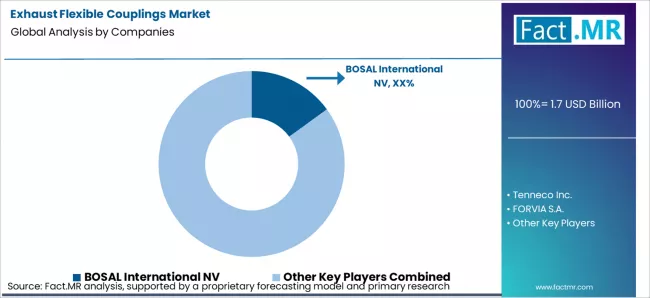
    Exhaust Flexible Couplings Market Analysis By Company

    The exhaust flexible couplings market is evolving with a focus on specialized dampening technologies and high-temperature alloys. FORVIA and Tenneco prioritize integrating flexible couplings into close-coupled aftertreatment modules to meet Euro 7 thermal requirements. Meanwhile, companies like BOSAL and Dinex emphasize vibration isolation for heavy-duty and off-highway engines. Regional expansions are evident, as shown by Dinex's new 50,000 sq. m production site in Pune, India. The industry is moving from component supply to thermal and acoustic architecture, with multi-fuel agility emerging as a key trend, as Cummins’ HELM™ platform exemplifies by standardizing exhaust systems across diesel, natural gas, and hydrogen engines. Eberspächer and Tenneco are exploring hydrogen and energy-neutral solutions, signaling a shift toward modular flex-logic and integrated thermal management. The market's future is increasingly tied to structural intelligence, where flexible couplings will serve as critical components in vibration diagnostics and thermal management for next-generation powertrains.

    Key Players of the Exhaust Flexible Couplings Market

    • BOSAL International NV
    • Tenneco Inc.
    • FORVIA S.A.
    • Eberspächer Gruppe GmbH & Co. KG
    • Benteler International AG
    • Sango Co., Ltd.
    • Sejong Industrial Co., Ltd.
    • Dinex A/S
    • Katcon International, Inc.
    • MagnaFlow

    Scope of the Report

    Items Values
    Quantitative Units (2026) USD Billion
    Sales Channel First Fit (OEM), Aftermarket
    Vehicle Type Passenger Cars, LCV, HCV
    Coupling Type Braided Flex Pipe, Bellows, Ball Joint/Other
    Material Stainless Steel, Other Alloys
    Regions Covered North America, Europe, Asia Pacific, Latin America, Middle East & Africa
    Countries Covered United States, Canada, Mexico, Germany, United Kingdom, France, Japan, South Korea, China, India, Brazil, and other countries
    Key Companies Profiled BOSAL International NV, Tenneco Inc., FORVIA S.A., Eberspächer Gruppe GmbH & Co. KG, Benteler International AG, Sango Co., Ltd., Sejong Industrial Co., Ltd., Dinex A/S, Katcon International, Inc., MagnaFlow
    Additional Attributes Dollar revenue by sales channel, vehicle type, coupling type, material, and region; regional demand trends, competitive landscape, technological advancements in exhaust flexible couplings, operational performance optimization initiatives, and product development strategies

    Exhaust Flexible Couplings Market Key Segments

    • Sales Channel :

      • First Fit (OEM)
      • Aftermarket
    • Vehicle Type :

      • Passenger Cars
      • LCV (Light Commercial Vehicle)
      • HCV (Heavy Commercial Vehicle)
    • Coupling Type :

      • Braided Flex Pipe
      • Bellows
      • Ball Joint/Other
    • Material :

      • Stainless Steel
      • Other Alloys
    • Region :

      • North America
        • USA
        • Canada
        • Mexico
      • Europe
        • Germany
        • UK
        • France
        • Italy
        • Spain
        • Nordic Countries
        • BENELUX
        • Rest of Europe
      • Asia Pacific
        • China
        • Japan
        • South Korea
        • India
        • Australia
        • Rest of Asia Pacific
      • Latin America
        • Brazil
        • Argentina
        • Rest of Latin America
      • Middle East and Africa
        • Kingdom of Saudi Arabia
        • United Arab Emirates
        • South Africa
        • Rest of Middle East and Africa
      • Other Regions
        • Oceania
        • Central Asia
        • Other Markets

    Bibliographies

    • International Organization of Motor Vehicle Manufacturers. (2024). Global vehicle production trends and implications for exhaust component demand. OICA.
    • European Automobile Manufacturers’ Association. (2023). Powertrain transition pathways and continued relevance of exhaust system components in hybrid vehicles. ACEA.
    • International Organization for Standardization. (2023). Road vehicles-Exhaust system components: Mechanical flexibility, vibration isolation, and thermal durability requirements. ISO.
    • SAE International. (2024). Design considerations for exhaust flexible couplings under thermal expansion and engine vibration. SAE International.
    • U.S. Environmental Protection Agency. (2024). Multi-pollutant emission standards for light- and medium-duty vehicles: Exhaust system design implications. U.S. EPA.

    Table of Content

    1. Executive Summary
      • Global Market Outlook
      • Demand to side Trends
      • Supply to side Trends
      • Technology Roadmap Analysis
      • Analysis and Recommendations
    2. Market Overview
      • Market Coverage / Taxonomy
      • Market Definition / Scope / Limitations
    3. Research Methodology
      • Chapter Orientation
      • Analytical Lens and Working Hypotheses
        • Market Sizing, Forecasting, and Opportunity Mapping
      • Research Design and Evidence Framework
        • Desk Research Programme (Secondary Evidence)
          • Company Annual and Sustainability Reports
          • Peer-reviewed Journals and Academic Literature
          • Corporate Websites, Product Literature, and Technical Notes
          • Earnings Decks and Investor Briefings
          • Statutory Filings and Regulatory Disclosures
          • Technical White Papers and Standards Notes
          • Trade Journals, Industry Magazines, and Analyst Briefs
          • Conference Proceedings, Webinars, and Seminar Materials
          • Government Statistics Portals and Public Data Releases
          • Press Releases and Reputable Media Coverage
          • Specialist Newsletters and Curated Briefings
          • Sector Databases and Reference Repositories
          • FMR Internal Proprietary Databases and Historical Market Datasets
          • Subscription Datasets and Paid Sources
          • Social Channels, Communities, and Digital Listening Inputs
          • Additional Desk Sources
        • Expert Input and Fieldwork (Primary Evidence)
          • Primary Modes
            • Qualitative Interviews and Expert Elicitation
            • Quantitative Surveys and Structured Data Capture
            • Blended Approach
          • Why Primary Evidence is Used
          • Focus Groups
          • Observational and In-context Research
          • Social and Community Interactions
        • Stakeholder Universe Engaged
          • C-suite Leaders
          • Board Members
          • Presidents and Vice Presidents
          • R&D and Innovation Heads
          • Technical Specialists
          • Domain Subject-matter Experts
          • Scientists
          • Physicians and Other Healthcare Professionals
        • Governance, Ethics, and Data Stewardship
          • Research Ethics
          • Data Integrity and Handling
      • Tooling, Models, and Reference Databases
    4. Data Engineering and Model Build
      • Data Acquisition and Ingestion
      • Cleaning, Normalisation, and Verification
      • Synthesis, Triangulation, and Analysis
    5. Quality Assurance and Audit Trail
    6. Market Background
      • Market Dynamics
        • Drivers
        • Restraints
        • Opportunity
        • Trends
      • Scenario Forecast
        • Demand in Optimistic Scenario
        • Demand in Likely Scenario
        • Demand in Conservative Scenario
      • Opportunity Map Analysis
      • Product Life Cycle Analysis
      • Supply Chain Analysis
      • Investment Feasibility Matrix
      • Value Chain Analysis
      • PESTLE and Porter’s Analysis
      • Regulatory Landscape
      • Regional Parent Market Outlook
      • Production and Consumption Statistics
      • Import and Export Statistics
    7. Global Market Analysis 2021 to 2025 and Forecast, 2026 to 2036
      • Historical Market Size Value (USD Million) Analysis, 2021 to 2025
      • Current and Future Market Size Value (USD Million) Projections, 2026 to 2036
        • Y to o to Y Growth Trend Analysis
        • Absolute $ Opportunity Analysis
    8. Global Market Pricing Analysis 2021 to 2025 and Forecast 2026 to 2036
    9. Global Market Analysis 2021 to 2025 and Forecast 2026 to 2036, By Sales Channel
      • Introduction / Key Findings
      • Historical Market Size Value (USD Million) Analysis By Sales Channel, 2021 to 2025
      • Current and Future Market Size Value (USD Million) Analysis and Forecast By Sales Channel, 2026 to 2036
        • First Fit (OEM)
        • Aftermarket
      • Y to o to Y Growth Trend Analysis By Sales Channel, 2021 to 2025
      • Absolute $ Opportunity Analysis By Sales Channel, 2026 to 2036
    10. Global Market Analysis 2021 to 2025 and Forecast 2026 to 2036, By Vehicle Type
      • Introduction / Key Findings
      • Historical Market Size Value (USD Million) Analysis By Vehicle Type, 2021 to 2025
      • Current and Future Market Size Value (USD Million) Analysis and Forecast By Vehicle Type, 2026 to 2036
        • Passenger Cars
        • LCV
        • HCV
      • Y to o to Y Growth Trend Analysis By Vehicle Type, 2021 to 2025
      • Absolute $ Opportunity Analysis By Vehicle Type, 2026 to 2036
    11. Global Market Analysis 2021 to 2025 and Forecast 2026 to 2036, By Coupling Type
      • Introduction / Key Findings
      • Historical Market Size Value (USD Million) Analysis By Coupling Type, 2021 to 2025
      • Current and Future Market Size Value (USD Million) Analysis and Forecast By Coupling Type, 2026 to 2036
        • Braided Flex Pipe
        • Bellows
        • Ball Joint/Other
      • Y to o to Y Growth Trend Analysis By Coupling Type, 2021 to 2025
      • Absolute $ Opportunity Analysis By Coupling Type, 2026 to 2036
    12. Global Market Analysis 2021 to 2025 and Forecast 2026 to 2036, By Material
      • Introduction / Key Findings
      • Historical Market Size Value (USD Million) Analysis By Material, 2021 to 2025
      • Current and Future Market Size Value (USD Million) Analysis and Forecast By Material, 2026 to 2036
        • Stainless Steel
        • Other Alloys
      • Y to o to Y Growth Trend Analysis By Material, 2021 to 2025
      • Absolute $ Opportunity Analysis By Material, 2026 to 2036
    13. Global Market Analysis 2021 to 2025 and Forecast 2026 to 2036, By Region
      • Introduction
      • Historical Market Size Value (USD Million) Analysis By Region, 2021 to 2025
      • Current Market Size Value (USD Million) Analysis and Forecast By Region, 2026 to 2036
        • North America
        • Latin America
        • Western Europe
        • Eastern Europe
        • East Asia
        • South Asia and Pacific
        • Middle East & Africa
      • Market Attractiveness Analysis By Region
    14. North America Market Analysis 2021 to 2025 and Forecast 2026 to 2036, By Country
      • Historical Market Size Value (USD Million) Trend Analysis By Market Taxonomy, 2021 to 2025
      • Market Size Value (USD Million) Forecast By Market Taxonomy, 2026 to 2036
        • By Country
          • USA
          • Canada
          • Mexico
        • By Sales Channel
        • By Vehicle Type
        • By Coupling Type
        • By Material
      • Market Attractiveness Analysis
        • By Country
        • By Sales Channel
        • By Vehicle Type
        • By Coupling Type
        • By Material
      • Key Takeaways
    15. Latin America Market Analysis 2021 to 2025 and Forecast 2026 to 2036, By Country
      • Historical Market Size Value (USD Million) Trend Analysis By Market Taxonomy, 2021 to 2025
      • Market Size Value (USD Million) Forecast By Market Taxonomy, 2026 to 2036
        • By Country
          • Brazil
          • Chile
          • Rest of Latin America
        • By Sales Channel
        • By Vehicle Type
        • By Coupling Type
        • By Material
      • Market Attractiveness Analysis
        • By Country
        • By Sales Channel
        • By Vehicle Type
        • By Coupling Type
        • By Material
      • Key Takeaways
    16. Western Europe Market Analysis 2021 to 2025 and Forecast 2026 to 2036, By Country
      • Historical Market Size Value (USD Million) Trend Analysis By Market Taxonomy, 2021 to 2025
      • Market Size Value (USD Million) Forecast By Market Taxonomy, 2026 to 2036
        • By Country
          • Germany
          • UK
          • Italy
          • Spain
          • France
          • Nordic
          • BENELUX
          • Rest of Western Europe
        • By Sales Channel
        • By Vehicle Type
        • By Coupling Type
        • By Material
      • Market Attractiveness Analysis
        • By Country
        • By Sales Channel
        • By Vehicle Type
        • By Coupling Type
        • By Material
      • Key Takeaways
    17. Eastern Europe Market Analysis 2021 to 2025 and Forecast 2026 to 2036, By Country
      • Historical Market Size Value (USD Million) Trend Analysis By Market Taxonomy, 2021 to 2025
      • Market Size Value (USD Million) Forecast By Market Taxonomy, 2026 to 2036
        • By Country
          • Russia
          • Poland
          • Hungary
          • Balkan & Baltic
          • Rest of Eastern Europe
        • By Sales Channel
        • By Vehicle Type
        • By Coupling Type
        • By Material
      • Market Attractiveness Analysis
        • By Country
        • By Sales Channel
        • By Vehicle Type
        • By Coupling Type
        • By Material
      • Key Takeaways
    18. East Asia Market Analysis 2021 to 2025 and Forecast 2026 to 2036, By Country
      • Historical Market Size Value (USD Million) Trend Analysis By Market Taxonomy, 2021 to 2025
      • Market Size Value (USD Million) Forecast By Market Taxonomy, 2026 to 2036
        • By Country
          • China
          • Japan
          • South Korea
        • By Sales Channel
        • By Vehicle Type
        • By Coupling Type
        • By Material
      • Market Attractiveness Analysis
        • By Country
        • By Sales Channel
        • By Vehicle Type
        • By Coupling Type
        • By Material
      • Key Takeaways
    19. South Asia and Pacific Market Analysis 2021 to 2025 and Forecast 2026 to 2036, By Country
      • Historical Market Size Value (USD Million) Trend Analysis By Market Taxonomy, 2021 to 2025
      • Market Size Value (USD Million) Forecast By Market Taxonomy, 2026 to 2036
        • By Country
          • India
          • ASEAN
          • Australia & New Zealand
          • Rest of South Asia and Pacific
        • By Sales Channel
        • By Vehicle Type
        • By Coupling Type
        • By Material
      • Market Attractiveness Analysis
        • By Country
        • By Sales Channel
        • By Vehicle Type
        • By Coupling Type
        • By Material
      • Key Takeaways
    20. Middle East & Africa Market Analysis 2021 to 2025 and Forecast 2026 to 2036, By Country
      • Historical Market Size Value (USD Million) Trend Analysis By Market Taxonomy, 2021 to 2025
      • Market Size Value (USD Million) Forecast By Market Taxonomy, 2026 to 2036
        • By Country
          • Kingdom of Saudi Arabia
          • Other GCC Countries
          • Turkiye
          • South Africa
          • Other African Union
          • Rest of Middle East & Africa
        • By Sales Channel
        • By Vehicle Type
        • By Coupling Type
        • By Material
      • Market Attractiveness Analysis
        • By Country
        • By Sales Channel
        • By Vehicle Type
        • By Coupling Type
        • By Material
      • Key Takeaways
    21. Key Countries Market Analysis
      • USA
        • Pricing Analysis
        • Market Share Analysis, 2025
          • By Sales Channel
          • By Vehicle Type
          • By Coupling Type
          • By Material
      • Canada
        • Pricing Analysis
        • Market Share Analysis, 2025
          • By Sales Channel
          • By Vehicle Type
          • By Coupling Type
          • By Material
      • Mexico
        • Pricing Analysis
        • Market Share Analysis, 2025
          • By Sales Channel
          • By Vehicle Type
          • By Coupling Type
          • By Material
      • Brazil
        • Pricing Analysis
        • Market Share Analysis, 2025
          • By Sales Channel
          • By Vehicle Type
          • By Coupling Type
          • By Material
      • Chile
        • Pricing Analysis
        • Market Share Analysis, 2025
          • By Sales Channel
          • By Vehicle Type
          • By Coupling Type
          • By Material
      • Germany
        • Pricing Analysis
        • Market Share Analysis, 2025
          • By Sales Channel
          • By Vehicle Type
          • By Coupling Type
          • By Material
      • UK
        • Pricing Analysis
        • Market Share Analysis, 2025
          • By Sales Channel
          • By Vehicle Type
          • By Coupling Type
          • By Material
      • Italy
        • Pricing Analysis
        • Market Share Analysis, 2025
          • By Sales Channel
          • By Vehicle Type
          • By Coupling Type
          • By Material
      • Spain
        • Pricing Analysis
        • Market Share Analysis, 2025
          • By Sales Channel
          • By Vehicle Type
          • By Coupling Type
          • By Material
      • France
        • Pricing Analysis
        • Market Share Analysis, 2025
          • By Sales Channel
          • By Vehicle Type
          • By Coupling Type
          • By Material
      • India
        • Pricing Analysis
        • Market Share Analysis, 2025
          • By Sales Channel
          • By Vehicle Type
          • By Coupling Type
          • By Material
      • ASEAN
        • Pricing Analysis
        • Market Share Analysis, 2025
          • By Sales Channel
          • By Vehicle Type
          • By Coupling Type
          • By Material
      • Australia & New Zealand
        • Pricing Analysis
        • Market Share Analysis, 2025
          • By Sales Channel
          • By Vehicle Type
          • By Coupling Type
          • By Material
      • China
        • Pricing Analysis
        • Market Share Analysis, 2025
          • By Sales Channel
          • By Vehicle Type
          • By Coupling Type
          • By Material
      • Japan
        • Pricing Analysis
        • Market Share Analysis, 2025
          • By Sales Channel
          • By Vehicle Type
          • By Coupling Type
          • By Material
      • South Korea
        • Pricing Analysis
        • Market Share Analysis, 2025
          • By Sales Channel
          • By Vehicle Type
          • By Coupling Type
          • By Material
      • Russia
        • Pricing Analysis
        • Market Share Analysis, 2025
          • By Sales Channel
          • By Vehicle Type
          • By Coupling Type
          • By Material
      • Poland
        • Pricing Analysis
        • Market Share Analysis, 2025
          • By Sales Channel
          • By Vehicle Type
          • By Coupling Type
          • By Material
      • Hungary
        • Pricing Analysis
        • Market Share Analysis, 2025
          • By Sales Channel
          • By Vehicle Type
          • By Coupling Type
          • By Material
      • Kingdom of Saudi Arabia
        • Pricing Analysis
        • Market Share Analysis, 2025
          • By Sales Channel
          • By Vehicle Type
          • By Coupling Type
          • By Material
      • Turkiye
        • Pricing Analysis
        • Market Share Analysis, 2025
          • By Sales Channel
          • By Vehicle Type
          • By Coupling Type
          • By Material
      • South Africa
        • Pricing Analysis
        • Market Share Analysis, 2025
          • By Sales Channel
          • By Vehicle Type
          • By Coupling Type
          • By Material
    22. Market Structure Analysis
      • Competition Dashboard
      • Competition Benchmarking
      • Market Share Analysis of Top Players
        • By Regional
        • By Sales Channel
        • By Vehicle Type
        • By Coupling Type
        • By Material
    23. Competition Analysis
      • Competition Deep Dive
        • BOSAL International NV
          • Overview
          • Product Portfolio
          • Profitability by Market Segments (Product/Age /Sales Channel/Region)
          • Sales Footprint
          • Strategy Overview
            • Marketing Strategy
            • Product Strategy
            • Channel Strategy
        • Tenneco Inc.
        • FORVIA S.A.
        • Eberspächer Gruppe GmbH & Co. KG
        • Benteler International AG
        • Sango Co., Ltd.
        • Sejong Industrial Co., Ltd.
        • Dinex A/S
        • Katcon International, Inc.
        • MagnaFlow
    24. Assumptions & Acronyms Used

    List Of Table

    • Table 1: Global Market Value (USD Million) Forecast by Region, 2021 to 2036
    • Table 2: Global Market Value (USD Million) Forecast by Sales Channel, 2021 to 2036
    • Table 3: Global Market Value (USD Million) Forecast by Vehicle Type, 2021 to 2036
    • Table 4: Global Market Value (USD Million) Forecast by Coupling Type, 2021 to 2036
    • Table 5: Global Market Value (USD Million) Forecast by Material, 2021 to 2036
    • Table 6: North America Market Value (USD Million) Forecast by Country, 2021 to 2036
    • Table 7: North America Market Value (USD Million) Forecast by Sales Channel, 2021 to 2036
    • Table 8: North America Market Value (USD Million) Forecast by Vehicle Type, 2021 to 2036
    • Table 9: North America Market Value (USD Million) Forecast by Coupling Type, 2021 to 2036
    • Table 10: North America Market Value (USD Million) Forecast by Material, 2021 to 2036
    • Table 11: Latin America Market Value (USD Million) Forecast by Country, 2021 to 2036
    • Table 12: Latin America Market Value (USD Million) Forecast by Sales Channel, 2021 to 2036
    • Table 13: Latin America Market Value (USD Million) Forecast by Vehicle Type, 2021 to 2036
    • Table 14: Latin America Market Value (USD Million) Forecast by Coupling Type, 2021 to 2036
    • Table 15: Latin America Market Value (USD Million) Forecast by Material, 2021 to 2036
    • Table 16: Western Europe Market Value (USD Million) Forecast by Country, 2021 to 2036
    • Table 17: Western Europe Market Value (USD Million) Forecast by Sales Channel, 2021 to 2036
    • Table 18: Western Europe Market Value (USD Million) Forecast by Vehicle Type, 2021 to 2036
    • Table 19: Western Europe Market Value (USD Million) Forecast by Coupling Type, 2021 to 2036
    • Table 20: Western Europe Market Value (USD Million) Forecast by Material, 2021 to 2036
    • Table 21: Eastern Europe Market Value (USD Million) Forecast by Country, 2021 to 2036
    • Table 22: Eastern Europe Market Value (USD Million) Forecast by Sales Channel, 2021 to 2036
    • Table 23: Eastern Europe Market Value (USD Million) Forecast by Vehicle Type, 2021 to 2036
    • Table 24: Eastern Europe Market Value (USD Million) Forecast by Coupling Type, 2021 to 2036
    • Table 25: Eastern Europe Market Value (USD Million) Forecast by Material, 2021 to 2036
    • Table 26: East Asia Market Value (USD Million) Forecast by Country, 2021 to 2036
    • Table 27: East Asia Market Value (USD Million) Forecast by Sales Channel, 2021 to 2036
    • Table 28: East Asia Market Value (USD Million) Forecast by Vehicle Type, 2021 to 2036
    • Table 29: East Asia Market Value (USD Million) Forecast by Coupling Type, 2021 to 2036
    • Table 30: East Asia Market Value (USD Million) Forecast by Material, 2021 to 2036
    • Table 31: South Asia and Pacific Market Value (USD Million) Forecast by Country, 2021 to 2036
    • Table 32: South Asia and Pacific Market Value (USD Million) Forecast by Sales Channel, 2021 to 2036
    • Table 33: South Asia and Pacific Market Value (USD Million) Forecast by Vehicle Type, 2021 to 2036
    • Table 34: South Asia and Pacific Market Value (USD Million) Forecast by Coupling Type, 2021 to 2036
    • Table 35: South Asia and Pacific Market Value (USD Million) Forecast by Material, 2021 to 2036
    • Table 36: Middle East & Africa Market Value (USD Million) Forecast by Country, 2021 to 2036
    • Table 37: Middle East & Africa Market Value (USD Million) Forecast by Sales Channel, 2021 to 2036
    • Table 38: Middle East & Africa Market Value (USD Million) Forecast by Vehicle Type, 2021 to 2036
    • Table 39: Middle East & Africa Market Value (USD Million) Forecast by Coupling Type, 2021 to 2036
    • Table 40: Middle East & Africa Market Value (USD Million) Forecast by Material, 2021 to 2036

    List Of Figures

    • Figure 1: Global Market Pricing Analysis
    • Figure 2: Global Market Value (USD Million) Forecast 2021 to 2036
    • Figure 3: Global Market Value Share and BPS Analysis by Sales Channel, 2026 and 2036
    • Figure 4: Global Market Y to o to Y Growth Comparison by Sales Channel, 2026 to 2036
    • Figure 5: Global Market Attractiveness Analysis by Sales Channel
    • Figure 6: Global Market Value Share and BPS Analysis by Vehicle Type, 2026 and 2036
    • Figure 7: Global Market Y to o to Y Growth Comparison by Vehicle Type, 2026 to 2036
    • Figure 8: Global Market Attractiveness Analysis by Vehicle Type
    • Figure 9: Global Market Value Share and BPS Analysis by Coupling Type, 2026 and 2036
    • Figure 10: Global Market Y to o to Y Growth Comparison by Coupling Type, 2026 to 2036
    • Figure 11: Global Market Attractiveness Analysis by Coupling Type
    • Figure 12: Global Market Value Share and BPS Analysis by Material, 2026 and 2036
    • Figure 13: Global Market Y to o to Y Growth Comparison by Material, 2026 to 2036
    • Figure 14: Global Market Attractiveness Analysis by Material
    • Figure 15: Global Market Value (USD Million) Share and BPS Analysis by Region, 2026 and 2036
    • Figure 16: Global Market Y to o to Y Growth Comparison by Region, 2026 to 2036
    • Figure 17: Global Market Attractiveness Analysis by Region
    • Figure 18: North America Market Incremental Dollar Opportunity, 2026 to 2036
    • Figure 19: Latin America Market Incremental Dollar Opportunity, 2026 to 2036
    • Figure 20: Western Europe Market Incremental Dollar Opportunity, 2026 to 2036
    • Figure 21: Eastern Europe Market Incremental Dollar Opportunity, 2026 to 2036
    • Figure 22: East Asia Market Incremental Dollar Opportunity, 2026 to 2036
    • Figure 23: South Asia and Pacific Market Incremental Dollar Opportunity, 2026 to 2036
    • Figure 24: Middle East & Africa Market Incremental Dollar Opportunity, 2026 to 2036
    • Figure 25: North America Market Value Share and BPS Analysis by Country, 2026 and 2036
    • Figure 26: North America Market Value Share and BPS Analysis by Sales Channel, 2026 and 2036
    • Figure 27: North America Market Y to o to Y Growth Comparison by Sales Channel, 2026 to 2036
    • Figure 28: North America Market Attractiveness Analysis by Sales Channel
    • Figure 29: North America Market Value Share and BPS Analysis by Vehicle Type, 2026 and 2036
    • Figure 30: North America Market Y to o to Y Growth Comparison by Vehicle Type, 2026 to 2036
    • Figure 31: North America Market Attractiveness Analysis by Vehicle Type
    • Figure 32: North America Market Value Share and BPS Analysis by Coupling Type, 2026 and 2036
    • Figure 33: North America Market Y to o to Y Growth Comparison by Coupling Type, 2026 to 2036
    • Figure 34: North America Market Attractiveness Analysis by Coupling Type
    • Figure 35: North America Market Value Share and BPS Analysis by Material, 2026 and 2036
    • Figure 36: North America Market Y to o to Y Growth Comparison by Material, 2026 to 2036
    • Figure 37: North America Market Attractiveness Analysis by Material
    • Figure 38: Latin America Market Value Share and BPS Analysis by Country, 2026 and 2036
    • Figure 39: Latin America Market Value Share and BPS Analysis by Sales Channel, 2026 and 2036
    • Figure 40: Latin America Market Y to o to Y Growth Comparison by Sales Channel, 2026 to 2036
    • Figure 41: Latin America Market Attractiveness Analysis by Sales Channel
    • Figure 42: Latin America Market Value Share and BPS Analysis by Vehicle Type, 2026 and 2036
    • Figure 43: Latin America Market Y to o to Y Growth Comparison by Vehicle Type, 2026 to 2036
    • Figure 44: Latin America Market Attractiveness Analysis by Vehicle Type
    • Figure 45: Latin America Market Value Share and BPS Analysis by Coupling Type, 2026 and 2036
    • Figure 46: Latin America Market Y to o to Y Growth Comparison by Coupling Type, 2026 to 2036
    • Figure 47: Latin America Market Attractiveness Analysis by Coupling Type
    • Figure 48: Latin America Market Value Share and BPS Analysis by Material, 2026 and 2036
    • Figure 49: Latin America Market Y to o to Y Growth Comparison by Material, 2026 to 2036
    • Figure 50: Latin America Market Attractiveness Analysis by Material
    • Figure 51: Western Europe Market Value Share and BPS Analysis by Country, 2026 and 2036
    • Figure 52: Western Europe Market Value Share and BPS Analysis by Sales Channel, 2026 and 2036
    • Figure 53: Western Europe Market Y to o to Y Growth Comparison by Sales Channel, 2026 to 2036
    • Figure 54: Western Europe Market Attractiveness Analysis by Sales Channel
    • Figure 55: Western Europe Market Value Share and BPS Analysis by Vehicle Type, 2026 and 2036
    • Figure 56: Western Europe Market Y to o to Y Growth Comparison by Vehicle Type, 2026 to 2036
    • Figure 57: Western Europe Market Attractiveness Analysis by Vehicle Type
    • Figure 58: Western Europe Market Value Share and BPS Analysis by Coupling Type, 2026 and 2036
    • Figure 59: Western Europe Market Y to o to Y Growth Comparison by Coupling Type, 2026 to 2036
    • Figure 60: Western Europe Market Attractiveness Analysis by Coupling Type
    • Figure 61: Western Europe Market Value Share and BPS Analysis by Material, 2026 and 2036
    • Figure 62: Western Europe Market Y to o to Y Growth Comparison by Material, 2026 to 2036
    • Figure 63: Western Europe Market Attractiveness Analysis by Material
    • Figure 64: Eastern Europe Market Value Share and BPS Analysis by Country, 2026 and 2036
    • Figure 65: Eastern Europe Market Value Share and BPS Analysis by Sales Channel, 2026 and 2036
    • Figure 66: Eastern Europe Market Y to o to Y Growth Comparison by Sales Channel, 2026 to 2036
    • Figure 67: Eastern Europe Market Attractiveness Analysis by Sales Channel
    • Figure 68: Eastern Europe Market Value Share and BPS Analysis by Vehicle Type, 2026 and 2036
    • Figure 69: Eastern Europe Market Y to o to Y Growth Comparison by Vehicle Type, 2026 to 2036
    • Figure 70: Eastern Europe Market Attractiveness Analysis by Vehicle Type
    • Figure 71: Eastern Europe Market Value Share and BPS Analysis by Coupling Type, 2026 and 2036
    • Figure 72: Eastern Europe Market Y to o to Y Growth Comparison by Coupling Type, 2026 to 2036
    • Figure 73: Eastern Europe Market Attractiveness Analysis by Coupling Type
    • Figure 74: Eastern Europe Market Value Share and BPS Analysis by Material, 2026 and 2036
    • Figure 75: Eastern Europe Market Y to o to Y Growth Comparison by Material, 2026 to 2036
    • Figure 76: Eastern Europe Market Attractiveness Analysis by Material
    • Figure 77: East Asia Market Value Share and BPS Analysis by Country, 2026 and 2036
    • Figure 78: East Asia Market Value Share and BPS Analysis by Sales Channel, 2026 and 2036
    • Figure 79: East Asia Market Y to o to Y Growth Comparison by Sales Channel, 2026 to 2036
    • Figure 80: East Asia Market Attractiveness Analysis by Sales Channel
    • Figure 81: East Asia Market Value Share and BPS Analysis by Vehicle Type, 2026 and 2036
    • Figure 82: East Asia Market Y to o to Y Growth Comparison by Vehicle Type, 2026 to 2036
    • Figure 83: East Asia Market Attractiveness Analysis by Vehicle Type
    • Figure 84: East Asia Market Value Share and BPS Analysis by Coupling Type, 2026 and 2036
    • Figure 85: East Asia Market Y to o to Y Growth Comparison by Coupling Type, 2026 to 2036
    • Figure 86: East Asia Market Attractiveness Analysis by Coupling Type
    • Figure 87: East Asia Market Value Share and BPS Analysis by Material, 2026 and 2036
    • Figure 88: East Asia Market Y to o to Y Growth Comparison by Material, 2026 to 2036
    • Figure 89: East Asia Market Attractiveness Analysis by Material
    • Figure 90: South Asia and Pacific Market Value Share and BPS Analysis by Country, 2026 and 2036
    • Figure 91: South Asia and Pacific Market Value Share and BPS Analysis by Sales Channel, 2026 and 2036
    • Figure 92: South Asia and Pacific Market Y to o to Y Growth Comparison by Sales Channel, 2026 to 2036
    • Figure 93: South Asia and Pacific Market Attractiveness Analysis by Sales Channel
    • Figure 94: South Asia and Pacific Market Value Share and BPS Analysis by Vehicle Type, 2026 and 2036
    • Figure 95: South Asia and Pacific Market Y to o to Y Growth Comparison by Vehicle Type, 2026 to 2036
    • Figure 96: South Asia and Pacific Market Attractiveness Analysis by Vehicle Type
    • Figure 97: South Asia and Pacific Market Value Share and BPS Analysis by Coupling Type, 2026 and 2036
    • Figure 98: South Asia and Pacific Market Y to o to Y Growth Comparison by Coupling Type, 2026 to 2036
    • Figure 99: South Asia and Pacific Market Attractiveness Analysis by Coupling Type
    • Figure 100: South Asia and Pacific Market Value Share and BPS Analysis by Material, 2026 and 2036
    • Figure 101: South Asia and Pacific Market Y to o to Y Growth Comparison by Material, 2026 to 2036
    • Figure 102: South Asia and Pacific Market Attractiveness Analysis by Material
    • Figure 103: Middle East & Africa Market Value Share and BPS Analysis by Country, 2026 and 2036
    • Figure 104: Middle East & Africa Market Value Share and BPS Analysis by Sales Channel, 2026 and 2036
    • Figure 105: Middle East & Africa Market Y to o to Y Growth Comparison by Sales Channel, 2026 to 2036
    • Figure 106: Middle East & Africa Market Attractiveness Analysis by Sales Channel
    • Figure 107: Middle East & Africa Market Value Share and BPS Analysis by Vehicle Type, 2026 and 2036
    • Figure 108: Middle East & Africa Market Y to o to Y Growth Comparison by Vehicle Type, 2026 to 2036
    • Figure 109: Middle East & Africa Market Attractiveness Analysis by Vehicle Type
    • Figure 110: Middle East & Africa Market Value Share and BPS Analysis by Coupling Type, 2026 and 2036
    • Figure 111: Middle East & Africa Market Y to o to Y Growth Comparison by Coupling Type, 2026 to 2036
    • Figure 112: Middle East & Africa Market Attractiveness Analysis by Coupling Type
    • Figure 113: Middle East & Africa Market Value Share and BPS Analysis by Material, 2026 and 2036
    • Figure 114: Middle East & Africa Market Y to o to Y Growth Comparison by Material, 2026 to 2036
    • Figure 115: Middle East & Africa Market Attractiveness Analysis by Material
    • Figure 116: Global Market - Tier Structure Analysis
    • Figure 117: Global Market - Company Share Analysis

    - FAQs -

    How big is the exhaust flexible couplings market in 2026?

    The global exhaust flexible couplings market is estimated to be valued at USD 1.7 billion in 2026.

    What will be the size of exhaust flexible couplings market in 2036?

    The market size for the exhaust flexible couplings market is projected to reach USD 2.1 billion by 2036.

    How much will be the exhaust flexible couplings market growth between 2026 and 2036?

    The exhaust flexible couplings market is expected to grow at a 2.4% CAGR between 2026 and 2036.

    What are the key product types in the exhaust flexible couplings market?

    The key product types in exhaust flexible couplings market are first fit (oem) and aftermarket.

    Which vehicle type segment to contribute significant share in the exhaust flexible couplings market in 2026?

    In terms of vehicle type, passenger cars segment to command 62.0% share in the exhaust flexible couplings market in 2026.

    Exhaust Flexible Couplings Market