- Market Value (2025): USD 0.5 Bn
- Estimated Value (2026): USD 0.7 Bn
- Forecast Value (2036): USD 20.0 Bn
- CAGR (2026-2036): 39.8%
What is the EV battery health certification and second-life services market forecast to be worth by 2036?
USD 0.7 billion in 2026 to USD 20.0 billion by 2036, at 39.8% CAGR.
- The EV battery health certification and second-life services market crossed a valuation of USD 0.5 billion in 2025.
- Demand is expected to increase from USD 0.7 billion in 2026 to USD 20.0 billion by 2036.
- The market is forecast to record 39.8% CAGR during 2026 to 2036 as the first mass EV wave enters resale age and battery-health data becomes central to used-EV pricing.
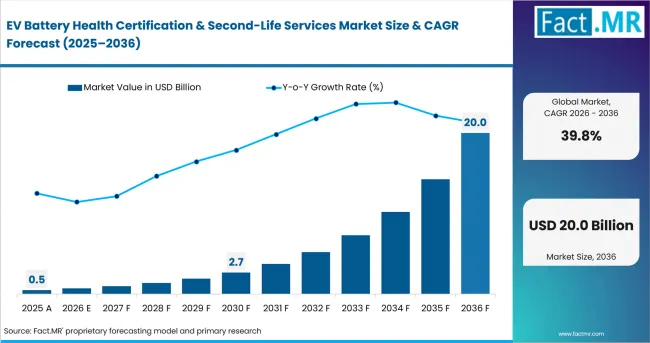
Ev Battery Health Certification & Second Life Services Market Value Analysis | Source: Fact.MR
What are the defining numbers behind EV battery health certification and second-life services growth?
USD 19.3 billion absolute opportunity by 2036, led by Germany and the United States.
- Demand Drivers in the Market
- Used-EV buyers need trusted battery health reports before paying resale prices.
- Dealers need certification tools that reduce pricing uncertainty and buyer hesitation.
- Fleet owners need battery triage before resale or storage reuse.
- Second-life developers need safety and capacity evidence before batteries enter stationary systems.
- Key Segments Analyzed
- By Service Type: Battery State-of-Health Testing is expected to hold 35.0% share in 2026 because every resale decision starts with battery condition.
- By Battery Source: Passenger EV Batteries lead because used car transactions create the first mass certification need. The share is projected at 48.0% in 2026.
- By Customer Type: Used-EV Dealers are likely to account for 39.0% share in 2026 because battery reports directly support retail confidence.
- By Delivery Model: Independent Certification Platforms lead as buyers need neutral proof. The model is projected to hold 41.0% share in 2026.
- By End Use: Used-EV Resale is expected to hold 44.0% share in 2026 because battery confidence affects vehicle valuation.
- By Geography: Germany is projected to record 42.6% CAGR through 2036 as EU battery passport rules and used-EV confidence needs expand.
- Analyst Opinion at Fact.MR
- Shambhu Nath Jha, Senior Analyst at Fact.MR, states, “Used EV resale will increasingly depend on trusted battery evidence. We see dealers and fleet owners asking how to prove state of health before pricing a vehicle or routing a pack into second life. Providers that combine independent testing with resale and repurposing workflows will gain stronger access to the EV value chain.”
- Strategic Implications
- Dealers should attach battery certificates to used EV listings before buyer negotiation.
- Fleet owners need battery triage before deciding resale or second-life routing.
- Diagnostic providers should align reports with battery passport data requirements.
- Second-life developers need standardized testing before scaling storage projects.
Independent battery state-of-health testing and second-life repurposing services as the first mass EV wave hits resale age. The European Alternative Fuels Observatory states that Regulation (EU) 2023/1542 mandates digital battery passports for all electric vehicle batteries by 18 February 2027. This creates demand for battery data readiness and independent verification.
Germany is projected to record 42.6% CAGR from 2026 to 2036 as EU battery passport rules and used-EV confidence needs expand. The United States is likely to post 41.2% CAGR as used-EV sales and battery-reporting tools scale. China is expected to register 39.8% CAGR because large EV parc growth creates battery assessment demand. The United Kingdom is forecast to advance at 38.4% CAGR by 2036 as used-EV retail and second-life storage programs expand. Japan is set to record 36.9% CAGR as fleet battery reuse and safety-focused resale certification gain importance.
How does the EV battery health certification and second-life services market break down by segment?
Battery State-of-Health Testing leads at 35.0%; Passenger EV Batteries lead at 48.0%.
Which service type dominates?
Battery State-of-Health Testing holds 35.0% share in 2026.
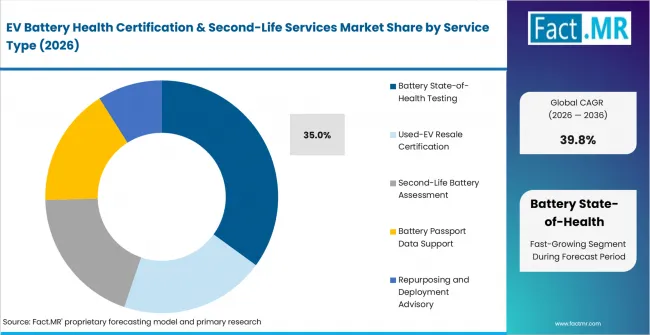
Ev Battery Health Certification & Second Life Services Market Analysis By Service Type | Source: Fact.MR
Battery State-of-Health Testing is expected to hold 35.0% share in 2026 because every resale and second-life decision starts with battery condition. UNECE’s 2024 electric vehicle battery durability work includes requirements for reading or displaying battery health information, supporting demand for verified battery condition checks before resale or second-life use. Testing services estimate remaining usable capacity and degradation risk. Demand is strongest where sellers need proof that battery performance supports vehicle price.
Which battery source dominates?
Passenger EV Batteries lead because used car transactions create the first mass certification need.
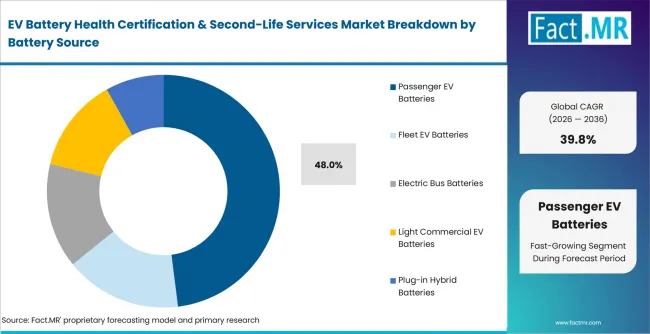
Ev Battery Health Certification & Second Life Services Market Analysis By Battery Source | Source: Fact.MR
Passenger EV Batteries lead because the major resale pool comes from passenger cars reaching second or third ownership. Lease returns and early EV adopters create a growing supply of vehicles that need health reports. The battery source is projected to capture 48.0% share in 2026 as used-EV listings expand. Certification providers can scale fastest through dealer networks and resale marketplaces.
Which customer type dominates?
Used-EV Dealers hold 39.0% share in 2026.
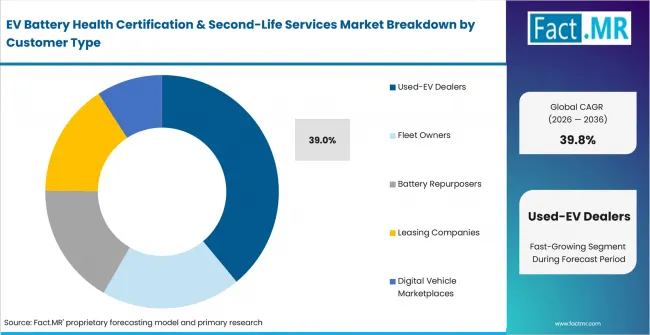
Ev Battery Health Certification & Second Life Services Market Analysis By Customer Type | Source: Fact.MR
Used-EV Dealers are likely to account for 39.0% share in 2026 because battery reports directly support retail confidence. Recurrent reported that used EV sales increased 35% in 2025 from 2024 in the United States. Dealers need tools that explain remaining range and battery condition in simple terms. Certification helps reduce negotiation friction and supports price transparency for buyers.
Which delivery model dominates?
Independent Certification Platforms lead because buyers need neutral proof.
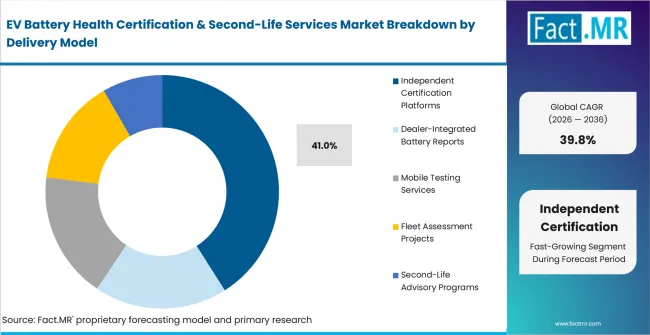
Ev Battery Health Certification & Second Life Services Market Analysis By Delivery Model | Source: Fact.MR
Independent Certification Platforms lead because used-EV buyers may not fully trust seller-provided battery claims. The model is projected to hold 41.0% share in 2026 as dealers and marketplaces seek third-party reports. Independent testing also supports second-life routing because pack owners need evidence before reuse. This model leads because battery value is too important to rely only on informal inspection.
Which end use dominates?
Used-EV Resale holds 44.0% share in 2026.
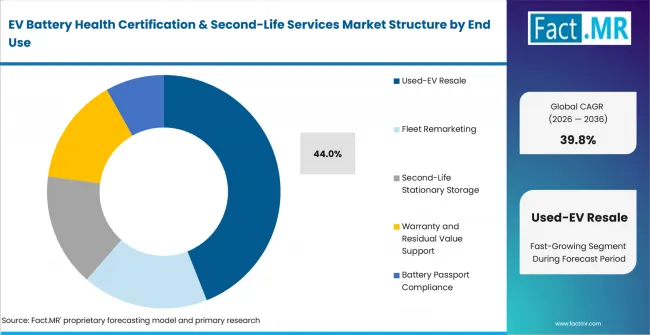
Ev Battery Health Certification & Second Life Services Market Analysis By End Use | Source: Fact.MR
Used-EV Resale leads because battery confidence affects the vehicle’s price and buyer trust. The end use is expected to hold 44.0% share in 2026 as more EVs enter the pre-owned market. The European Commission states that consumers are worried about battery health and repairability in zero-emission second-hand vehicles. Certification services answer that concern through verified battery condition and usable range data.
What is accelerating EV battery health certification and second-life services demand, and what is holding it back?
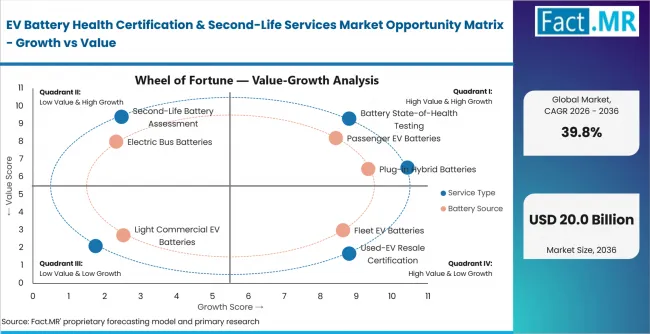
Ev Battery Health Certification & Second Life Services Market Opportunity Matrix Growth Vs Value | Source: Fact.MR
Battery passport rules, used-EV growth and second-life storage demand drive adoption; standardization gaps restrain it.
Battery passport regulation is the main driver. The European Commission’s 2026 Digital Product Passport guidance for batteries states that the DPP introduces new transparency and data requirements across the batteries value chain, supporting a structured data layer for health reporting and lifecycle decisions.
The main restraint is lack of consistent battery health standards across brands. Vehicles expose and battery management systems may not provide comparable state-of-health outputs. Service providers must develop brand-agnostic testing methods and clear reporting language before certification can become routine across resale channels.
Where do the biggest EV battery health certification and second-life services opportunities sit?
Used-EV resale certification and second-life storage routing.
- Used-EV Resale Certification: Dealers can attach battery reports to listings to reduce buyer uncertainty.
- Fleet Battery Triage: Fleet owners can decide which vehicles should be resold, retained or repurposed.
- Second-Life Storage Routing: Battery owners can screen packs before sending them into stationary storage projects.
Which countries are scaling EV battery health certification and second-life services fastest?
Germany 42.6%, United States 41.2%, China 39.8%, United Kingdom 38.4%, Japan 36.9%.
Based on regional analysis, the EV battery health certification and second-life services market is segmented into Western Europe, North America, East Asia, South Asia and Pacific, Latin America, and Middle East and Africa.
.webp "Top Country Growth Comparison Ev Battery Health Certification & Second Life Services Market Cagr (2026 2036)")
Top Country Growth Comparison Ev Battery Health Certification & Second Life Services Market Cagr (2026 2036) | Source: Fact.MR
| Country | CAGR |
|---|---|
| Germany | 42.6% |
| United States | 41.2% |
| China | 39.8% |
| United Kingdom | 38.4% |
| Japan | 36.9% |
Source: Fact.MR analysis. Updated Jun 19, 2026
Source: Fact.MR analysis, based on proprietary forecasting model and primary research.
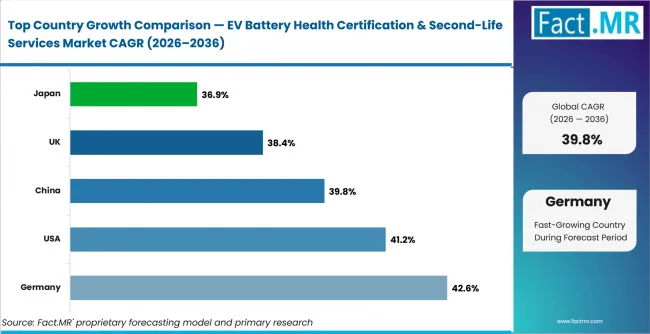
Ev Battery Health Certification & Second Life Services Market Cagr Analysis By Country | Source: Fact.MR
What is powering Germany’s lead?
Germany is projected to record 42.6% CAGR through 2036 as EU battery passport rules and used-EV confidence needs expand. Battery passports from 18 February 2027 create a strong compliance trigger for EV battery data. German dealers and fleet operators will need battery health proof before resale. The country also has a strong automotive inspection culture, which supports certification adoption. The Mobility House gives Germany second-life and battery integration experience.
How is the United States scaling EV battery health certification demand?
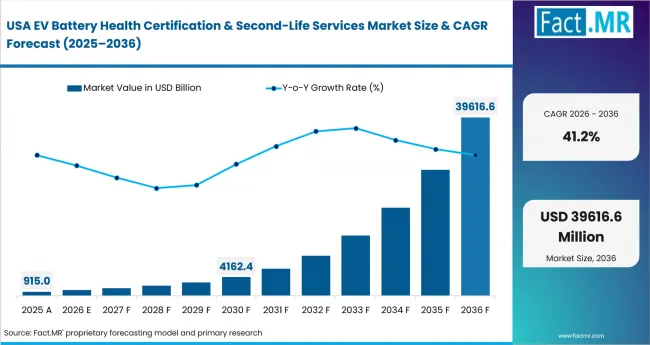
Ev Battery Health Certification & Second Life Services Market Country Value Analysis | Source: Fact.MR
The United States is likely to post 41.2% CAGR through 2036 as used-EV sales and battery-reporting tools scale. Buyers need trusted data because battery condition affects range and resale value. Dealers can use battery reports to reduce uncertainty in listings. B2U Storage also supports second-life value capture through EV Pack Storage technology. Service demand will favor providers that combine dealer tools with fleet and storage repurposing channels.
What underpins China’s growth?
China is expected to register 39.8% CAGR through 2036 because large EV parc growth creates battery assessment demand. China has the world’s major EV fleet and will generate a major flow of used EVs and retired battery packs. Certification demand will grow as second-hand EV transactions expand and pack reuse becomes more organized. Battery condition will be central to residual value and second-life routing.
What supports the United Kingdom outlook?
The United Kingdom is forecast to advance at 38.4% CAGR through 2036 as used-EV retail and second-life storage programs expand. Used-EV buyers need battery condition evidence before purchasing. Fleet operators need testing before packs move into storage projects. UK adoption will favor independent reports and dealer-friendly certification tools. Demand will also rise as EV lease returns increase and batteries need routing into resale or recycling channels.
Why is Japan an important market?
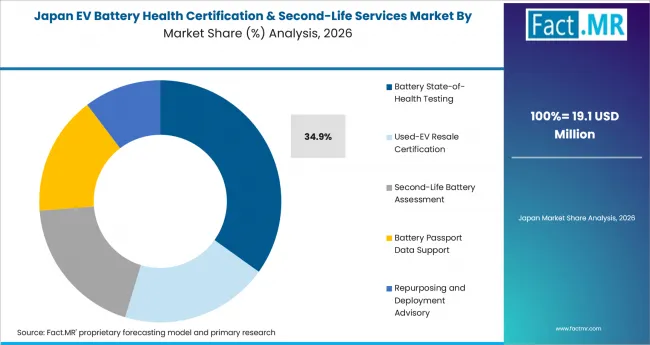
Ev Battery Health Certification & Second Life Services Market Japan Market Share Analysis By Service Type | Source: Fact.MR
Japan is set to record 36.9% CAGR through 2036 as fleet battery reuse and safety-focused resale certification gain importance. Japanese consumers place high value on vehicle reliability and documentation. Used-EV resale will need battery health reports that explain remaining range and safety condition clearly. Automakers and trading houses can support second-life programs through storage and energy projects. Japan’s cautious certification culture will favor reliable testing methods and warranty-ready documentation.
Who leads the EV battery health certification and second-life services landscape?
Recurrent and Connected Energy lead through resale reports and second-life battery expertise.
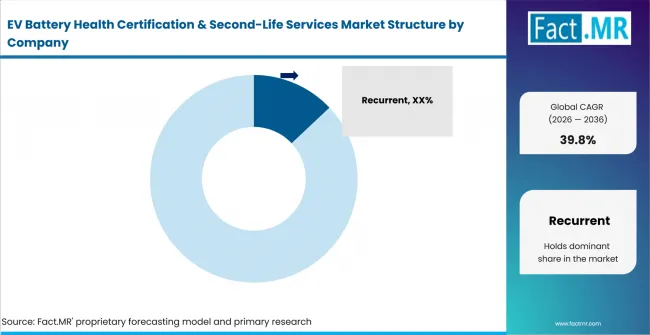
Ev Battery Health Certification & Second Life Services Market Analysis By Company | Source: Fact.MR
EV battery health certification and second-life services are used by dealers and battery repurposing companies. Recurrent provides real-world EV data and battery insights for used-EV buying and selling. AVILOO offers independent battery certificates that support trust in EV buying and leasing.
Connected Energy develops second-life battery energy storage systems and is investing in EV battery testing capability. The mobility house supports second-life storage and battery integration projects. B2U Storage develops and operates battery energy storage systems using repurposed EV packs.
Competition will depend on test accuracy and dealer integration over the forecast period. Providers that combine state-of-health testing with resale certification will be better placed. Second-life developers can gain value by adding screening and pack routing services. Platforms that support battery passport data and warranty evidence will gain stronger access to regulated resale channels.
Which companies are the key players?
Recurrent, AVILOO, Connected Energy, The Mobility House and B2U Storage.
- Recurrent
- AVILOO
- Connected Energy
- The Mobility House
- B2U Storage
Bibliography
- European Alternative Fuels Observatory. (2024, December 19). Solaris delivers the world’s first electric bus with a battery passport. European Commission.
- United Nations Economic Commission for Europe. (2024, January 9). ECE/TRANS/WP.29/GRPE/2024/6: Proposal for a new UN Global Technical Regulation on in-vehicle battery durability for electrified vehicles of categories 2 and 3.
- Recurrent. (2026, February 11). Used electric car prices & market report — Q1 2026.
- European Commission. (2025, March 5). Industrial action plan for the European automotive sector (COM(2025) 95 final).
- European Commission, Directorate-General for Internal Market, Industry, Entrepreneurship and SMEs. (2026, May 27). The EU Digital Product Passport: Implications and Practical Guidance for the Battery Industry.
This Report Addresses
- Strategic intelligence on EV battery health certification and second-life services across service type and customer type.
- Segment analysis covering Battery State-of-Health Testing, Passenger EV Batteries, Used-EV Dealers, Independent Certification Platforms and Used-EV Resale.
- Regional outlook covering Germany, United States, China, United Kingdom and Japan.
- Competitive analysis of Recurrent, AVILOO, Connected Energy, The Mobility House and B2U Storage.
- Service assessment covering health testing, resale certification, second-life assessment and battery passport support.
- End-use assessment covering used-EV resale, fleet remarketing, stationary storage and residual value support.
- Primary interviews, provider checks, official source review and EV resale validation support the forecast.
What does the EV battery health certification and second-life services market cover?
Battery state-of-health testing, used-EV resale certification and second-life repurposing support.
The EV battery health certification and second-life services market covers independent testing and second-life readiness services for used EV batteries. It includes state-of-health diagnostics and repurposing advisory. The market differs from battery recycling because it focuses on value preservation before final end-of-life processing.
What is included in the scope?
Battery diagnostics and repurposing assessment.
The scope includes independent battery state-of-health testing and resale certification for used EVs. It covers battery data extraction and warranty evidence. It includes second-life battery assessment and storage-system repurposing advisory. It also covers dealer-facing battery reports and fleet battery triage before resale or reuse.
What is excluded from the scope?
Battery recycling and EV repair without certification or second-life assessment.
The scope excludes battery recycling services unless health assessment or second-life routing is included. It excludes standard EV maintenance with no battery certification component. It excludes new battery manufacturing and cell production. It also excludes generic vehicle inspection unless battery state-of-health testing is delivered.
How was the analysis built?
100+ sources, 45+ company portfolios, 25+ countries, 20+ interviews.
- Primary Research:
- Primary research includes interviews with used-EV dealers and fleet remarketing teams. It includes input from battery diagnostic providers and second-life storage developers.
- Desk Research:
- Desk research reviews battery passport rules and EV resale market sources. It covers official provider pages and second-life battery deployment activity.
- Market-Sizing and Forecasting:
- Forecasting uses used-EV transaction volume and second-life routing demand. Battery passport timing and dealer certification adoption support the market assessment.
- Data Validation and Update Cycle:
- Forecasts are validated through provider checks and used-EV retail feedback. Battery regulation updates and second-life project announcements help confirm market direction.
Segmentation
What is the report’s scope and coverage?
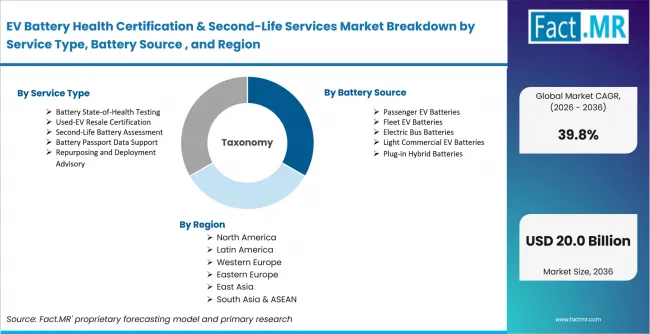
Ev Battery Health Certification & Second Life Services Market Breakdown By Service Type, Battery Source , And Region | Source: Fact.MR
| Attribute | Details |
|---|---|
| Quantitative Units | USD Billion in 2026 to USD Billion by 2036 at CAGR |
| Market Definition | Independent battery state-of-health testing, used-EV resale certification and second-life repurposing services |
| Service Type | Battery State-of-Health Testing, Used-EV Resale Certification, Second-Life Battery Assessment, Battery Passport Data Support, Repurposing and Deployment Advisory |
| Battery Source | Passenger EV Batteries, Fleet EV Batteries, Electric Bus Batteries, Light Commercial EV Batteries, Plug-in Hybrid Batteries |
| Customer Type | Used-EV Dealers, Fleet Owners, Battery Repurposers, Leasing Companies, Digital Vehicle Marketplaces |
| Delivery Model | Independent Certification Platforms, Dealer-Integrated Battery Reports, Mobile Testing Services, Fleet Assessment Projects, Second-Life Advisory Programs |
| End Use | Used-EV Resale, Fleet Remarketing, Second-Life Stationary Storage, Warranty and Residual Value Support, Battery Passport Compliance |
| Regions Covered | Western Europe, North America, East Asia, South Asia and Pacific, Latin America, Middle East and Africa |
| Countries Covered | Germany, United States, China, United Kingdom, Japan |
| Key Companies Profiled | Recurrent, AVILOO, Connected Energy, The Mobility House and B2U Storage |
| Forecast Period | 2026 to 2036 |
| Approach | Hybrid top-down and bottom-up approach using used-EV transaction volume, battery certification attachment rates, second-life routing demand, regulation timing and provider validation |
Source: Fact.MR analysis. Updated Jun 19, 2026
How is the market segmented?
-
By Service Type:
- Battery State-of-Health Testing
- Used-EV Resale Certification
- Second-Life Battery Assessment
- Battery Passport Data Support
- Repurposing and Deployment Advisory
-
By Battery Source:
- Passenger EV Batteries
- Fleet EV Batteries
- Electric Bus Batteries
- Light Commercial EV Batteries
- Plug-in Hybrid Batteries
-
By Customer Type:
- Used-EV Dealers
- Fleet Owners
- Battery Repurposers
- Leasing Companies
- Digital Vehicle Marketplaces
-
By Delivery Model:
- Independent Certification Platforms
- Dealer-Integrated Battery Reports
- Mobile Testing Services
- Fleet Assessment Projects
- Second-Life Advisory Programs
-
By End Use:
- Used-EV Resale
- Fleet Remarketing
- Second-Life Stationary Storage
- Warranty and Residual Value Support
- Battery Passport Compliance
-
Region:
- North America
- United States
- Canada
- Europe
- Germany
- United Kingdom
- France
- Netherlands
- Norway
- Asia Pacific
- China
- Japan
- South Korea
- Australia
- India
- Latin America
- Brazil
- Mexico
- Chile
- Middle East & Africa
- GCC Countries
- South Africa
- Israel
- North America
Frequently Asked Questions
Which service type leads the EV Battery Health Certification & Second-Life Services Market?
Which country expands faster in the EV Battery Health Certification & Second-Life Services Market?
How does the United States perform in the EV Battery Health Certification & Second-Life Services Market?
How does China perform in the EV Battery Health Certification & Second-Life Services Market?
How does the United Kingdom perform in the EV Battery Health Certification & Second-Life Services Market?
How does Japan perform in the EV Battery Health Certification & Second-Life Services Market?
What is the primary driver in the EV Battery Health Certification & Second-Life Services Market?
What is the main restraint in the EV Battery Health Certification & Second-Life Services Market?
Why are passenger EV batteries important in this market?
Who worked on this report


Preview the report firsthand - request a free sample
Free SampleGet the brochure for pricing and purchase details
Download PDF