Flight Simulator Market

Flight Simulator Market Size and Share Forecast Outlook 2026 to 2036

Flight simulator market is projected to grow from USD 5.6 billion in 2026 to USD 12.4 billion by 2036, at a CAGR of 8.3%. Full Flight Simulators will dominate with a 42.8% market share, while commercial aviation will lead the application segment with a 61.7% share.

Flight Simulator Market Forecast and Outlook 2026 to 2036

The global flight simulator market is valued at USD 5.6 billion in 2026 and is projected to reach USD 12.4 billion by 2036. This reflects an absolute increase of USD 6.8 billion and total growth of 121.4% over the forecast period. Demand is expected to expand at a CAGR of 8.3% between 2026 and 2036, with overall market size growing by about 2.2X.

Rising pilot training requirements, continued expansion of commercial aviation fleets, and increased reliance on simulation technologies across civil, military, and commercial aviation sectors drives growth.

Key Takeaways from Flight Simulator Market

  • Flight Simulator Market Value (2026): USD 5.6 billion
  • Flight Simulator Market Forecast Value (2036): USD 12.4 billion
  • Flight Simulator Market Forecast CAGR: 8.3%
  • Leading Simulator Type in Flight Simulator Market: Full Flight Simulators (42.8%)
  • Key Growth Regions in Flight Simulator Market: North America, Asia Pacific, Europe
  • Key Players in Flight Simulator Market: CAE Inc., L3Harris Technologies, Boeing Company, Thales Group, FlightSafety International
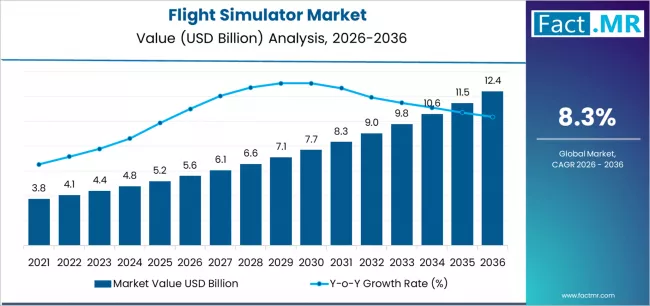
Flight Simulator Market Market Value Analysis

Full flight simulators account for the largest product share at 42.8% in 2026. Their ability to replicate complete aircraft systems, cockpit layouts, and flight dynamics makes them essential for advanced pilot training, certification, and emergency procedure practice. On the application side, commercial aviation dominates with a 61.7% share, reflecting strict regulatory training standards, recurrent pilot training needs, and airline focus on operational safety and efficiency.

At a broader level, the market is shaped by rapid improvements in simulation realism, computing power, and visual and motion technologies. Adoption of data-driven training tools, artificial intelligence–enabled scenario generation, and multi-platform simulation environments is enhancing training effectiveness and standardization. Airlines and training providers continue to favor simulators as cost-effective, scalable solutions that reduce operational risk while supporting long-term workforce readiness and regulatory compliance.

Flight Simulator Market

Metric Value
Estimated Value in (2026E) USD 5.6 billion
Forecast Value in (2036F) USD 12.4 billion
Forecast CAGR (2026 to 2036) 8.3%

Category

Category Segments
Simulator Type Full Flight Simulators; Fixed-Base Simulators; Flight Training Devices; Other Simulator Configurations
Application Commercial Aviation; Military Aviation; General Aviation
End-User Airlines; Training Centers; Defense Organizations; Others
Technology Visual Systems; Motion Systems; Control Systems; Other Technology Platforms
Region North America; Europe; Asia Pacific; Latin America; Middle East & Africa

Segmental Analysis

Why does the Full Flight Simulator Segment Account for a High Share?
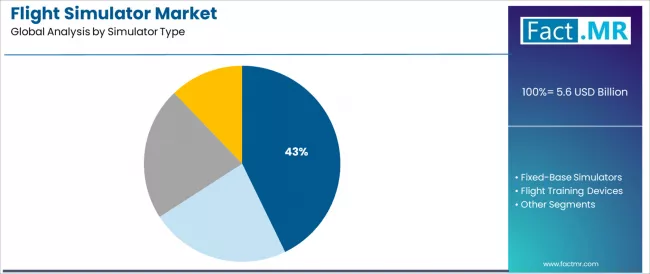
Flight Simulator Market Analysis By Simulator Type

The full flight simulator segment is projected to account for 42.8% of the flight simulator market in 2026, maintaining its position as the leading simulator type. This leadership is supported by high training realism, regulatory certification acceptance, and alignment with standardized pilot training requirements.

Full flight simulators enable comprehensive operational preparation across commercial and military programs by accurately replicating aircraft performance and flight environments. Proven reliability and compatibility with multiple aircraft platforms continue to reinforce their role within structured aviation training systems.

Why do Commercial Aviation Applications Demonstrate a High Share?
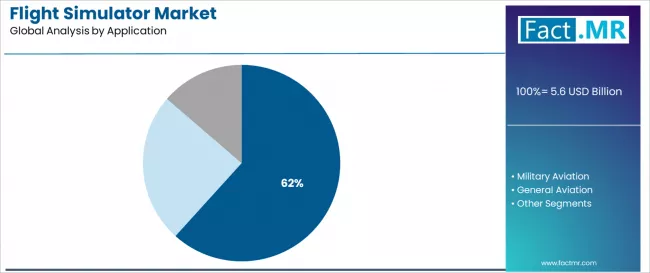
Flight Simulator Market Analysis By Application

Commercial aviation is projected to represent 61.7% of the flight simulator market in 2026, reflecting sustained demand from airline operators. Regular pilot certification cycles, safety compliance requirements, and fleet expansion drive continued simulator utilization. Airlines depend on simulator-based training to ensure consistent skill development, operational efficiency, and adherence to international aviation standards, supporting the segment’s dominant application position.

What are the Drivers, Restraints, and Key Trends of the Flight Simulator Market?

The flight simulator market is expanding due to rising demand for pilot training across commercial aviation, defense, and unmanned aerial vehicle programs. Growth is supported by increasing air traffic, stricter regulatory training requirements, and the need for cost-effective, risk-free training environments.

Airlines and military organizations are adopting simulators to improve training efficiency, safety, and standardization. However, the market faces restraints from high upfront costs, technical complexity, and continued reliance on traditional in-aircraft training methods in some regions.

A key trend is the integration of virtual reality and immersive technologies, which enhance realism, situational awareness, and skill retention during training. VR-enabled simulators allow more flexible and scalable training approaches.

Another important trend is the adoption of cloud-based training platforms and remote learning systems. These solutions support distributed training, real-time performance assessment, and data-driven evaluation, enabling aviation stakeholders to expand training capacity beyond conventional simulator-based infrastructure.

Analysis of the Flight Simulator Market by Key Countries
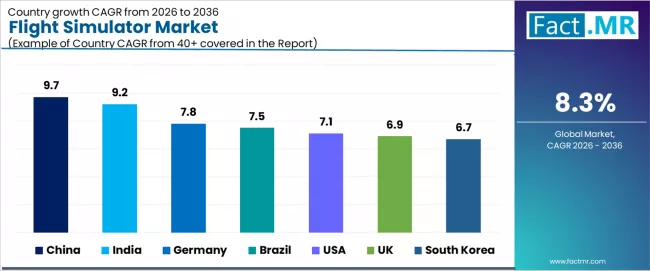
Flight Simulator Market Cagr Analysis By Country

Country CAGR (2026-2036)
China 9.7%
India 9.2%
Germany 7.8%
Brazil 7.5%
USA 7.1%
UK 6.9%
South Korea 6.7%

Why does China lead Global Market Growth?

China’s flight simulator market is projected to grow at a CAGR of 9.7% through 2036, supported by rapid expansion in commercial aviation, state-backed pilot training programs, and increasing fleet additions by domestic airlines. Government initiatives focused on aviation self-reliance and training standardization are accelerating simulator adoption across civil aviation academies and airline training centers. China’s role as a high-volume aviation market is also encouraging localized simulator manufacturing and advanced training infrastructure investment.

  • Expanding airline fleets and structured pilot training pipelines are driving simulator demand across major aviation hubs.
  • Strong infrastructure investment supports adoption of advanced simulators aligned with evolving certification and safety standards.

Why does India Demonstrate Strong Market Potential?

India’s flight simulator market is expanding at a CAGR of 9.2%, driven by sustained growth in commercial aviation, rising pilot shortages, and increased investment in domestic training capacity. Expansion of regional connectivity programs and private flight schools is strengthening demand for cost-efficient and scalable simulation platforms. International suppliers and domestic training providers are broadening distribution and service networks to support long-term training needs.

  • Growth in aviation training institutes is increasing simulator deployment across civil and commercial segments.
  • Rising emphasis on pilot readiness supports adoption of modern, high-fidelity simulation systems.

Why does Germany Demonstrate Considerable Expansion?

Germany’s flight simulator market is projected to grow at a CAGR of 7.8% through 2036, supported by stringent pilot training regulations, established aviation standards, and strong demand for precision-based training tools. Airlines and training centers prioritize simulator accuracy and regulatory compliance, sustaining demand for advanced systems across commercial and defense applications.

  • High training standards drive demand for technologically advanced simulation platforms.
  • Regulatory consistency supports continued investment in premium training infrastructure.

Why does Brazil Show Significant Growth?

Brazil’s flight simulator market is expected to grow at a CAGR of 7.5%, supported by expanding domestic air travel, pilot training modernization, and growing regional aviation activity. Training providers increasingly adopt simulators to reduce operational costs while improving pilot preparedness. Brazil’s role as a regional aviation hub supports steady demand across civil aviation academies.

  • Expansion of pilot training programs is increasing simulator installations nationwide.
  • Modernization of training infrastructure supports adoption of efficient simulation solutions.

What factors Underpin USA’s Flight Simulator Market Growth?
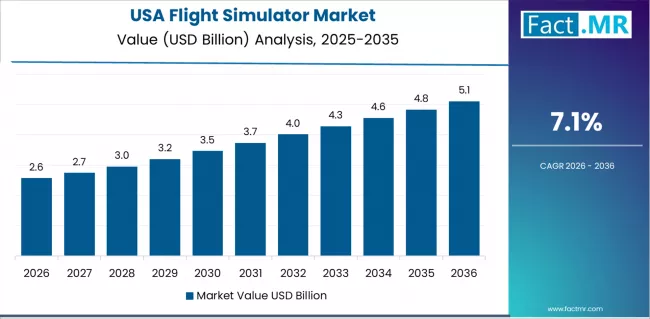
Flight Simulator Market Country Value Analysis

The USA flight simulator market is projected to grow at a CAGR of 7.1% through 2036, supported by advanced aviation training ecosystems, continuous fleet upgrades, and integration of simulation into certification and recurrent training programs. Airlines, defense organizations, and training institutions prioritize reliability, realism, and interoperability, sustaining demand for high-end simulation platforms.

  • Integration of simulators into recurrent training programs is driving consistent demand.
  • Strong emphasis on safety and precision supports adoption of advanced training systems.

Why does UK Maintain Steady Growth?

The UK flight simulator market is forecast to grow at a CAGR of 6.9%, supported by mature aviation training markets, established regulatory frameworks, and steady demand from commercial and military sectors. Training organizations continue to invest in simulators to improve efficiency and meet regulatory requirements.

  • Mature training infrastructure sustains consistent simulator demand.
  • Focus on compliance and quality supports long-term adoption.

Why does South Korea Show Strong Growth?
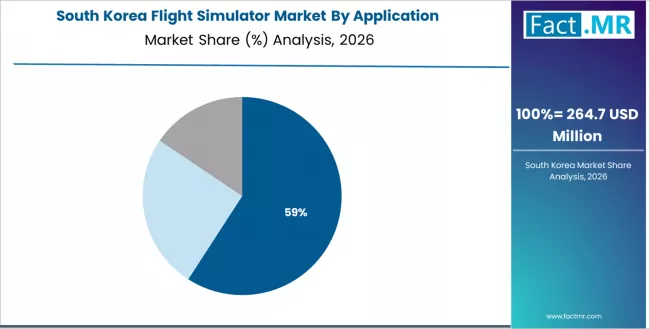
Flight Simulator Market South Korea Market Share Analysis By Application

South Korea’s flight simulator market is projected to grow at a CAGR of 6.7%, driven by precision-focused aviation training, strong technology integration, and expanding pilot development programs. Airlines and training institutions emphasize accuracy and operational efficiency, reinforcing demand for advanced simulation solutions.

  • Precision-oriented training models increase demand for high-fidelity simulators.
  • Technology-driven training systems support adoption across advanced aviation programs.

Competitive Landscape of the Flight Simulator Market
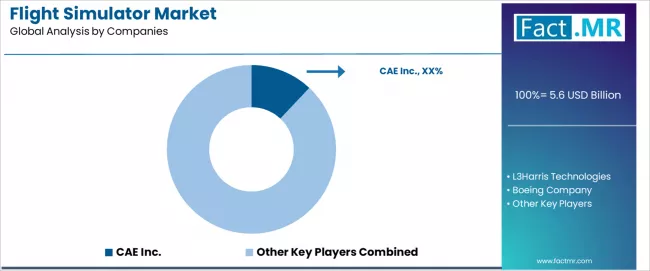
Flight Simulator Market Analysis By Company

The flight simulator market is defined by competition among established simulation technology firms, aviation manufacturers, and integrated training solution providers. Market participants are investing in high-fidelity simulation platforms, advanced motion and visual systems, and software-driven training environments to deliver reliable, regulation-compliant pilot training solutions. Emphasis on realism, system interoperability, and alignment with civil and defense aviation standards continues to shape competitive positioning.

Innovation is concentrated on improving simulator accuracy, adaptive training modules, and data-driven performance assessment while reducing lifecycle costs for airlines, training academies, and defense operators. Companies are also expanding global service networks and long-term training partnerships to support sustained demand across commercial, military, and business aviation segments.

CAE Inc. is widely recognized for its comprehensive pilot training ecosystems and simulator development expertise. L3Harris Technologies focuses on precision simulation systems tailored to defense and military training requirements. Boeing Company integrates simulation within broader commercial aviation and operational efficiency frameworks. Thales Group emphasizes defense-oriented simulation and mission training systems, while FlightSafety International specializes in advanced pilot training equipment designed for high-reliability aviation training environments.

Key Players in the Flight Simulator Market

  • CAE Inc.
  • L3Harris Technologies
  • Boeing Company
  • Thales Group
  • FlightSafety International
  • Rockwell Collins
  • Indra Sistemas
  • HAVELSAN
  • Frasca International
  • TRU Simulation + Training
  • Elite Simulation Solutions
  • Alsim
  • Diamond Aircraft Industries
  • Redbird Flight Simulations

Scope of the Report

Items Values
Quantitative Units (2026) USD 5.6 Billion
Simulator Type Full Flight Simulators, Fixed-Base Simulators, Flight Training Devices, Other Simulator Configurations
Application Commercial Aviation, Military Aviation, General Aviation
End-User Airlines, Training Centers, Defense Organizations, Others
Technology Visual Systems, Motion Systems, Control Systems, Other Technology Platforms
Regions Covered North America, Europe, Asia Pacific, Latin America, MEA, Other Regions
Countries Covered China, India, Germany, Brazil, USA, UK, South Korea, and 40+ countries
Key Companies Profiled CAE Inc., L3Harris Technologies, Boeing Company, Thales Group, FlightSafety International, and other leading flight simulator companies
Additional Attributes Dollar sales by simulator type, application, end-user, technology, and region; regional demand trends, competitive landscape, technological advancements in simulation engineering, training optimization initiatives, simulator enhancement programs, and premium product development strategies

Flight Simulator Market by Segments

  • Simulator Type :

    • Full Flight Simulators
    • Fixed-Base Simulators
    • Flight Training Devices
    • Other Simulator Configurations
  • Application :

    • Commercial Aviation
    • Military Aviation
    • General Aviation
  • End-User :

    • Airlines
    • Training Centers
    • Defense Organizations
    • Others
  • Technology :

    • Visual Systems
    • Motion Systems
    • Control Systems
    • Other Technology Platforms
  • Region :

    • North America

      • USA
      • Canada
      • Mexico
    • Europe

      • Germany
      • UK
      • France
      • Italy
      • Spain
      • Nordic Countries
      • BENELUX
      • Rest of Europe
    • Asia Pacific

      • China
      • India
      • Japan
      • South Korea
      • Australia
      • Rest of Asia Pacific
    • Latin America

      • Brazil
      • Argentina
      • Rest of Latin America
    • MEA

      • Saudi Arabia
      • UAE
      • South Africa
      • Rest of MEA

Table of Content

  1. Executive Summary
    • Global Market Outlook
    • Demand to side Trends
    • Supply to side Trends
    • Technology Roadmap Analysis
    • Analysis and Recommendations
  2. Market Overview
    • Market Coverage / Taxonomy
    • Market Definition / Scope / Limitations
  3. Market Background
    • Market Dynamics
      • Drivers
      • Restraints
      • Opportunity
      • Trends
    • Scenario Forecast
      • Demand in Optimistic Scenario
      • Demand in Likely Scenario
      • Demand in Conservative Scenario
    • Opportunity Map Analysis
    • Product Life Cycle Analysis
    • Supply Chain Analysis
    • Investment Feasibility Matrix
    • Value Chain Analysis
    • PESTLE and Porter’s Analysis
    • Regulatory Landscape
    • Regional Parent Market Outlook
    • Production and Consumption Statistics
    • Import and Export Statistics
  4. Global Market Analysis 2021 to 2025 and Forecast, 2026 to 2036
    • Historical Market Size Value (USD Million) Analysis, 2021 to 2025
    • Current and Future Market Size Value (USD Million) Projections, 2026 to 2036
      • Y to o to Y Growth Trend Analysis
      • Absolute $ Opportunity Analysis
  5. Global Market Pricing Analysis 2021 to 2025 and Forecast 2026 to 2036
  6. Global Market Analysis 2021 to 2025 and Forecast 2026 to 2036, By Simulator Type
    • Introduction / Key Findings
    • Historical Market Size Value (USD Million) Analysis By Simulator Type, 2021 to 2025
    • Current and Future Market Size Value (USD Million) Analysis and Forecast By Simulator Type, 2026 to 2036
      • Full Flight Simulators
      • Fixed-Base Simulators
      • Flight Training Devices
      • Other Simulator Configurations
    • Y to o to Y Growth Trend Analysis By Simulator Type, 2021 to 2025
    • Absolute $ Opportunity Analysis By Simulator Type, 2026 to 2036
  7. Global Market Analysis 2021 to 2025 and Forecast 2026 to 2036, By Application
    • Introduction / Key Findings
    • Historical Market Size Value (USD Million) Analysis By Application, 2021 to 2025
    • Current and Future Market Size Value (USD Million) Analysis and Forecast By Application, 2026 to 2036
      • Commercial Aviation
      • Military Aviation
      • General Aviation
    • Y to o to Y Growth Trend Analysis By Application, 2021 to 2025
    • Absolute $ Opportunity Analysis By Application, 2026 to 2036
  8. Global Market Analysis 2021 to 2025 and Forecast 2026 to 2036, By Region
    • Introduction
    • Historical Market Size Value (USD Million) Analysis By Region, 2021 to 2025
    • Current Market Size Value (USD Million) Analysis and Forecast By Region, 2026 to 2036
      • North America
      • Latin America
      • Western Europe
      • Eastern Europe
      • East Asia
      • South Asia and Pacific
      • Middle East & Africa
    • Market Attractiveness Analysis By Region
  9. North America Market Analysis 2021 to 2025 and Forecast 2026 to 2036, By Country
    • Historical Market Size Value (USD Million) Trend Analysis By Market Taxonomy, 2021 to 2025
    • Market Size Value (USD Million) Forecast By Market Taxonomy, 2026 to 2036
      • By Country
        • USA
        • Canada
        • Mexico
      • By Simulator Type
      • By Application
    • Market Attractiveness Analysis
      • By Country
      • By Simulator Type
      • By Application
    • Key Takeaways
  10. Latin America Market Analysis 2021 to 2025 and Forecast 2026 to 2036, By Country
    • Historical Market Size Value (USD Million) Trend Analysis By Market Taxonomy, 2021 to 2025
    • Market Size Value (USD Million) Forecast By Market Taxonomy, 2026 to 2036
      • By Country
        • Brazil
        • Chile
        • Rest of Latin America
      • By Simulator Type
      • By Application
    • Market Attractiveness Analysis
      • By Country
      • By Simulator Type
      • By Application
    • Key Takeaways
  11. Western Europe Market Analysis 2021 to 2025 and Forecast 2026 to 2036, By Country
    • Historical Market Size Value (USD Million) Trend Analysis By Market Taxonomy, 2021 to 2025
    • Market Size Value (USD Million) Forecast By Market Taxonomy, 2026 to 2036
      • By Country
        • Germany
        • UK
        • Italy
        • Spain
        • France
        • Nordic
        • BENELUX
        • Rest of Western Europe
      • By Simulator Type
      • By Application
    • Market Attractiveness Analysis
      • By Country
      • By Simulator Type
      • By Application
    • Key Takeaways
  12. Eastern Europe Market Analysis 2021 to 2025 and Forecast 2026 to 2036, By Country
    • Historical Market Size Value (USD Million) Trend Analysis By Market Taxonomy, 2021 to 2025
    • Market Size Value (USD Million) Forecast By Market Taxonomy, 2026 to 2036
      • By Country
        • Russia
        • Poland
        • Hungary
        • Balkan & Baltic
        • Rest of Eastern Europe
      • By Simulator Type
      • By Application
    • Market Attractiveness Analysis
      • By Country
      • By Simulator Type
      • By Application
    • Key Takeaways
  13. East Asia Market Analysis 2021 to 2025 and Forecast 2026 to 2036, By Country
    • Historical Market Size Value (USD Million) Trend Analysis By Market Taxonomy, 2021 to 2025
    • Market Size Value (USD Million) Forecast By Market Taxonomy, 2026 to 2036
      • By Country
        • China
        • Japan
        • South Korea
      • By Simulator Type
      • By Application
    • Market Attractiveness Analysis
      • By Country
      • By Simulator Type
      • By Application
    • Key Takeaways
  14. South Asia and Pacific Market Analysis 2021 to 2025 and Forecast 2026 to 2036, By Country
    • Historical Market Size Value (USD Million) Trend Analysis By Market Taxonomy, 2021 to 2025
    • Market Size Value (USD Million) Forecast By Market Taxonomy, 2026 to 2036
      • By Country
        • India
        • ASEAN
        • Australia & New Zealand
        • Rest of South Asia and Pacific
      • By Simulator Type
      • By Application
    • Market Attractiveness Analysis
      • By Country
      • By Simulator Type
      • By Application
    • Key Takeaways
  15. Middle East & Africa Market Analysis 2021 to 2025 and Forecast 2026 to 2036, By Country
    • Historical Market Size Value (USD Million) Trend Analysis By Market Taxonomy, 2021 to 2025
    • Market Size Value (USD Million) Forecast By Market Taxonomy, 2026 to 2036
      • By Country
        • Kingdom of Saudi Arabia
        • Other GCC Countries
        • Turkiye
        • South Africa
        • Other African Union
        • Rest of Middle East & Africa
      • By Simulator Type
      • By Application
    • Market Attractiveness Analysis
      • By Country
      • By Simulator Type
      • By Application
    • Key Takeaways
  16. Key Countries Market Analysis
    • USA
      • Pricing Analysis
      • Market Share Analysis, 2025
        • By Simulator Type
        • By Application
    • Canada
      • Pricing Analysis
      • Market Share Analysis, 2025
        • By Simulator Type
        • By Application
    • Mexico
      • Pricing Analysis
      • Market Share Analysis, 2025
        • By Simulator Type
        • By Application
    • Brazil
      • Pricing Analysis
      • Market Share Analysis, 2025
        • By Simulator Type
        • By Application
    • Chile
      • Pricing Analysis
      • Market Share Analysis, 2025
        • By Simulator Type
        • By Application
    • Germany
      • Pricing Analysis
      • Market Share Analysis, 2025
        • By Simulator Type
        • By Application
    • UK
      • Pricing Analysis
      • Market Share Analysis, 2025
        • By Simulator Type
        • By Application
    • Italy
      • Pricing Analysis
      • Market Share Analysis, 2025
        • By Simulator Type
        • By Application
    • Spain
      • Pricing Analysis
      • Market Share Analysis, 2025
        • By Simulator Type
        • By Application
    • France
      • Pricing Analysis
      • Market Share Analysis, 2025
        • By Simulator Type
        • By Application
    • India
      • Pricing Analysis
      • Market Share Analysis, 2025
        • By Simulator Type
        • By Application
    • ASEAN
      • Pricing Analysis
      • Market Share Analysis, 2025
        • By Simulator Type
        • By Application
    • Australia & New Zealand
      • Pricing Analysis
      • Market Share Analysis, 2025
        • By Simulator Type
        • By Application
    • China
      • Pricing Analysis
      • Market Share Analysis, 2025
        • By Simulator Type
        • By Application
    • Japan
      • Pricing Analysis
      • Market Share Analysis, 2025
        • By Simulator Type
        • By Application
    • South Korea
      • Pricing Analysis
      • Market Share Analysis, 2025
        • By Simulator Type
        • By Application
    • Russia
      • Pricing Analysis
      • Market Share Analysis, 2025
        • By Simulator Type
        • By Application
    • Poland
      • Pricing Analysis
      • Market Share Analysis, 2025
        • By Simulator Type
        • By Application
    • Hungary
      • Pricing Analysis
      • Market Share Analysis, 2025
        • By Simulator Type
        • By Application
    • Kingdom of Saudi Arabia
      • Pricing Analysis
      • Market Share Analysis, 2025
        • By Simulator Type
        • By Application
    • Turkiye
      • Pricing Analysis
      • Market Share Analysis, 2025
        • By Simulator Type
        • By Application
    • South Africa
      • Pricing Analysis
      • Market Share Analysis, 2025
        • By Simulator Type
        • By Application
  17. Market Structure Analysis
    • Competition Dashboard
    • Competition Benchmarking
    • Market Share Analysis of Top Players
      • By Regional
      • By Simulator Type
      • By Application
  18. Competition Analysis
    • Competition Deep Dive
      • CAE Inc.
        • Overview
        • Product Portfolio
        • Profitability by Market Segments (Product/Age /Sales Channel/Region)
        • Sales Footprint
        • Strategy Overview
          • Marketing Strategy
          • Product Strategy
          • Channel Strategy
      • L3Harris Technologies
      • Boeing Company
      • Thales Group
      • FlightSafety International
      • Rockwell Collins
      • Indra Sistemas
      • HAVELSAN
      • Frasca International
      • TRU Simulation + Training
      • Elite Simulation Solutions
      • Alsim
      • Diamond Aircraft Industries
      • Redbird Flight Simulations
  19. Assumptions & Acronyms Used
  20. Research Methodology

List Of Table

  • Table 1: Global Market Value (USD Million) Forecast by Region, 2021 to 2036
  • Table 2: Global Market Value (USD Million) Forecast by Simulator Type, 2021 to 2036
  • Table 3: Global Market Value (USD Million) Forecast by Application, 2021 to 2036
  • Table 4: North America Market Value (USD Million) Forecast by Country, 2021 to 2036
  • Table 5: North America Market Value (USD Million) Forecast by Simulator Type, 2021 to 2036
  • Table 6: North America Market Value (USD Million) Forecast by Application, 2021 to 2036
  • Table 7: Latin America Market Value (USD Million) Forecast by Country, 2021 to 2036
  • Table 8: Latin America Market Value (USD Million) Forecast by Simulator Type, 2021 to 2036
  • Table 9: Latin America Market Value (USD Million) Forecast by Application, 2021 to 2036
  • Table 10: Western Europe Market Value (USD Million) Forecast by Country, 2021 to 2036
  • Table 11: Western Europe Market Value (USD Million) Forecast by Simulator Type, 2021 to 2036
  • Table 12: Western Europe Market Value (USD Million) Forecast by Application, 2021 to 2036
  • Table 13: Eastern Europe Market Value (USD Million) Forecast by Country, 2021 to 2036
  • Table 14: Eastern Europe Market Value (USD Million) Forecast by Simulator Type, 2021 to 2036
  • Table 15: Eastern Europe Market Value (USD Million) Forecast by Application, 2021 to 2036
  • Table 16: East Asia Market Value (USD Million) Forecast by Country, 2021 to 2036
  • Table 17: East Asia Market Value (USD Million) Forecast by Simulator Type, 2021 to 2036
  • Table 18: East Asia Market Value (USD Million) Forecast by Application, 2021 to 2036
  • Table 19: South Asia and Pacific Market Value (USD Million) Forecast by Country, 2021 to 2036
  • Table 20: South Asia and Pacific Market Value (USD Million) Forecast by Simulator Type, 2021 to 2036
  • Table 21: South Asia and Pacific Market Value (USD Million) Forecast by Application, 2021 to 2036
  • Table 22: Middle East & Africa Market Value (USD Million) Forecast by Country, 2021 to 2036
  • Table 23: Middle East & Africa Market Value (USD Million) Forecast by Simulator Type, 2021 to 2036
  • Table 24: Middle East & Africa Market Value (USD Million) Forecast by Application, 2021 to 2036

List Of Figures

  • Figure 1: Global Market Pricing Analysis
  • Figure 2: Global Market Value (USD Million) Forecast 2021 to 2036
  • Figure 3: Global Market Value Share and BPS Analysis by Simulator Type, 2026 and 2036
  • Figure 4: Global Market Y to o to Y Growth Comparison by Simulator Type, 2026 to 2036
  • Figure 5: Global Market Attractiveness Analysis by Simulator Type
  • Figure 6: Global Market Value Share and BPS Analysis by Application, 2026 and 2036
  • Figure 7: Global Market Y to o to Y Growth Comparison by Application, 2026 to 2036
  • Figure 8: Global Market Attractiveness Analysis by Application
  • Figure 9: Global Market Value (USD Million) Share and BPS Analysis by Region, 2026 and 2036
  • Figure 10: Global Market Y to o to Y Growth Comparison by Region, 2026 to 2036
  • Figure 11: Global Market Attractiveness Analysis by Region
  • Figure 12: North America Market Incremental Dollar Opportunity, 2026 to 2036
  • Figure 13: Latin America Market Incremental Dollar Opportunity, 2026 to 2036
  • Figure 14: Western Europe Market Incremental Dollar Opportunity, 2026 to 2036
  • Figure 15: Eastern Europe Market Incremental Dollar Opportunity, 2026 to 2036
  • Figure 16: East Asia Market Incremental Dollar Opportunity, 2026 to 2036
  • Figure 17: South Asia and Pacific Market Incremental Dollar Opportunity, 2026 to 2036
  • Figure 18: Middle East & Africa Market Incremental Dollar Opportunity, 2026 to 2036
  • Figure 19: North America Market Value Share and BPS Analysis by Country, 2026 and 2036
  • Figure 20: North America Market Value Share and BPS Analysis by Simulator Type, 2026 and 2036
  • Figure 21: North America Market Y to o to Y Growth Comparison by Simulator Type, 2026 to 2036
  • Figure 22: North America Market Attractiveness Analysis by Simulator Type
  • Figure 23: North America Market Value Share and BPS Analysis by Application, 2026 and 2036
  • Figure 24: North America Market Y to o to Y Growth Comparison by Application, 2026 to 2036
  • Figure 25: North America Market Attractiveness Analysis by Application
  • Figure 26: Latin America Market Value Share and BPS Analysis by Country, 2026 and 2036
  • Figure 27: Latin America Market Value Share and BPS Analysis by Simulator Type, 2026 and 2036
  • Figure 28: Latin America Market Y to o to Y Growth Comparison by Simulator Type, 2026 to 2036
  • Figure 29: Latin America Market Attractiveness Analysis by Simulator Type
  • Figure 30: Latin America Market Value Share and BPS Analysis by Application, 2026 and 2036
  • Figure 31: Latin America Market Y to o to Y Growth Comparison by Application, 2026 to 2036
  • Figure 32: Latin America Market Attractiveness Analysis by Application
  • Figure 33: Western Europe Market Value Share and BPS Analysis by Country, 2026 and 2036
  • Figure 34: Western Europe Market Value Share and BPS Analysis by Simulator Type, 2026 and 2036
  • Figure 35: Western Europe Market Y to o to Y Growth Comparison by Simulator Type, 2026 to 2036
  • Figure 36: Western Europe Market Attractiveness Analysis by Simulator Type
  • Figure 37: Western Europe Market Value Share and BPS Analysis by Application, 2026 and 2036
  • Figure 38: Western Europe Market Y to o to Y Growth Comparison by Application, 2026 to 2036
  • Figure 39: Western Europe Market Attractiveness Analysis by Application
  • Figure 40: Eastern Europe Market Value Share and BPS Analysis by Country, 2026 and 2036
  • Figure 41: Eastern Europe Market Value Share and BPS Analysis by Simulator Type, 2026 and 2036
  • Figure 42: Eastern Europe Market Y to o to Y Growth Comparison by Simulator Type, 2026 to 2036
  • Figure 43: Eastern Europe Market Attractiveness Analysis by Simulator Type
  • Figure 44: Eastern Europe Market Value Share and BPS Analysis by Application, 2026 and 2036
  • Figure 45: Eastern Europe Market Y to o to Y Growth Comparison by Application, 2026 to 2036
  • Figure 46: Eastern Europe Market Attractiveness Analysis by Application
  • Figure 47: East Asia Market Value Share and BPS Analysis by Country, 2026 and 2036
  • Figure 48: East Asia Market Value Share and BPS Analysis by Simulator Type, 2026 and 2036
  • Figure 49: East Asia Market Y to o to Y Growth Comparison by Simulator Type, 2026 to 2036
  • Figure 50: East Asia Market Attractiveness Analysis by Simulator Type
  • Figure 51: East Asia Market Value Share and BPS Analysis by Application, 2026 and 2036
  • Figure 52: East Asia Market Y to o to Y Growth Comparison by Application, 2026 to 2036
  • Figure 53: East Asia Market Attractiveness Analysis by Application
  • Figure 54: South Asia and Pacific Market Value Share and BPS Analysis by Country, 2026 and 2036
  • Figure 55: South Asia and Pacific Market Value Share and BPS Analysis by Simulator Type, 2026 and 2036
  • Figure 56: South Asia and Pacific Market Y to o to Y Growth Comparison by Simulator Type, 2026 to 2036
  • Figure 57: South Asia and Pacific Market Attractiveness Analysis by Simulator Type
  • Figure 58: South Asia and Pacific Market Value Share and BPS Analysis by Application, 2026 and 2036
  • Figure 59: South Asia and Pacific Market Y to o to Y Growth Comparison by Application, 2026 to 2036
  • Figure 60: South Asia and Pacific Market Attractiveness Analysis by Application
  • Figure 61: Middle East & Africa Market Value Share and BPS Analysis by Country, 2026 and 2036
  • Figure 62: Middle East & Africa Market Value Share and BPS Analysis by Simulator Type, 2026 and 2036
  • Figure 63: Middle East & Africa Market Y to o to Y Growth Comparison by Simulator Type, 2026 to 2036
  • Figure 64: Middle East & Africa Market Attractiveness Analysis by Simulator Type
  • Figure 65: Middle East & Africa Market Value Share and BPS Analysis by Application, 2026 and 2036
  • Figure 66: Middle East & Africa Market Y to o to Y Growth Comparison by Application, 2026 to 2036
  • Figure 67: Middle East & Africa Market Attractiveness Analysis by Application
  • Figure 68: Global Market - Tier Structure Analysis
  • Figure 69: Global Market - Company Share Analysis

- FAQs -

How big is the flight simulator market in 2026?

The global flight simulator market is estimated to be valued at USD 5.6 billion in 2026.

What will be the size of flight simulator market in 2036?

The market size for the flight simulator market is projected to reach USD 12.4 billion by 2036.

How much will be the flight simulator market growth between 2026 and 2036?

The flight simulator market is expected to grow at a 8.3% CAGR between 2026 and 2036.

What are the key product types in the flight simulator market?

The key product types in flight simulator market are full flight simulators, fixed-base simulators, flight training devices and other simulator configurations.

Which application segment to contribute significant share in the flight simulator market in 2026?

In terms of application, commercial aviation segment to command 61.7% share in the flight simulator market in 2026.

Flight Simulator Market