- Market Value (2025): USD 127.3 Mn
- Estimated Value (2026): USD 170 Mn
- Forecast Value (2036):USD 3056.8 Mn
- CAGR (2026-2036): 33.5%
What is the world model simulators market forecast to be worth by 2036?
USD 170 million in 2026 to USD 3,056.8 million by 2036, at 33.5% CAGR.
- The world model simulators market crossed a valuation of USD 127.3 million in 2025.
- Demand is expected to increase from USD 170 million in 2026 to USD 3,056.8 million by 2036.
- The market is forecast to record 33.5% CAGR from 2026 to 2036 as physical AI and autonomous system testing move toward generative world platforms.
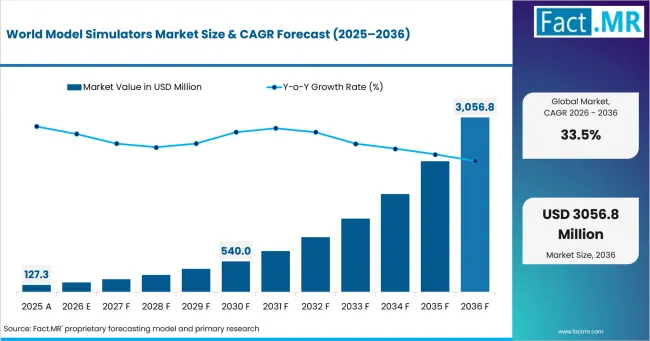
World Model Simulators Market Market Value Analysis | Source: Fact.MR
What are the defining numbers behind world model simulators market growth?
USD 2,886.8 million absolute opportunity by 2036, led by the United States and China.
- Demand Drivers in the Market
- Robotics labs need controllable task worlds to train policies before hardware deployment.
- AV teams need synthetic driving worlds that expose rare events safely.
- Industrial AI vendors need factory and warehouse environments for robot planning.
- Simulation providers need generative world models that reduce manual scenario creation.
- Key Segments Analyzed
- By World Type: Driving worlds are expected to hold 34.0% share in 2026 because AV validation has the strongest simulation base.
- By Use Case: Safety testing leads because simulated worlds help teams expose edge cases. The segment is projected to capture 33.0% share in 2026.
- By Technology: Physics simulation is likely to account for 36.0% share in 2026 because engineering teams still need trusted physical behavior.
- By Deployment: Cloud platforms lead because world generation and synthetic data workloads need scalable compute. The segment is expected to hold 41.0% share in 2026.
- By Buyer Type: AV teams are projected to record 37.0% share in 2026 because autonomous driving validation is an early commercial use case.
- Analyst Opinion at Fact.MR
- Shambhu Nath Jha, Senior Analyst at Fact.MR, states, “World model simulators are becoming infrastructure for physical AI. The market will grow where teams can move from static scenarios to interactive worlds that support training, testing and policy improvement. Vendors that combine physics, synthetic data and developer access will be better placed than providers offering isolated visualization tools.”
- Strategic Implications
- Simulation vendors should combine physics fidelity with generative world creation.
- Robotics labs should use simulator outputs to reduce hardware-only trial cycles.
- AV teams should map synthetic scenarios to safety and perception validation needs.
- Cloud platforms should support developer APIs for training and evaluation pipelines.
World model simulators sit below the wider AI simulation software category because the title focuses on interactive and physics-aware world environments. The category differs from ordinary simulation tools because it supports action-controllable environments and policy-testing workflows. Industrial teams also compare these platforms with digital twin commissioning environments when simulation is tied to robot cell validation before deployment.
NVIDIA launched its Cosmos world foundation model platform in 2025 to accelerate physical AI development for robots and autonomous vehicles. This supports the market boundary because world model simulators are moving from classic scene simulation into foundation-model-led physical AI workflows. These workflows also support autonomous vehicle validation when synthetic environments are used to test edge cases before road deployment.
The United States is projected to record 36.5% CAGR through 2036 as NVIDIA and Applied Intuition expand physical AI and autonomous robots ecosystems. China is expected to post a 34.8% CAGR through 2036 as autonomous driving simulated training. Germany is likely to record 33.2% CAGR as industrial automation and automotive validation teams adopt high-fidelity simulation. Japan is forecast to advance at 31.8% CAGR as robotics labs and manufacturing AI vendors adopt robot task worlds. South Korea is set to record 30.5% CAGR as industrial robotics and synthetic video workflows expand.
How does the world model simulators market break down by segment?
Driving worlds lead at 34.0%; cloud platforms lead at 41.0%.
Which world type dominates?
Driving worlds hold 34.0% share in 2026.
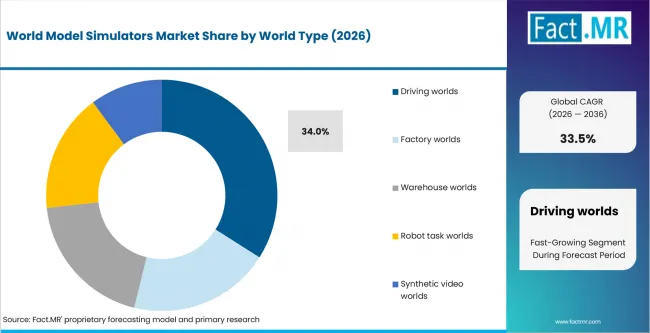
World Model Simulators Market Analysis By World Type | Source: Fact.MR
Driving worlds are expected to hold 34.0% share in 2026 because autonomous vehicle teams already use simulation for perception validation, safety testing and scenario coverage. Factory worlds are expanding as industrial AI teams simulate production flows. Warehouse worlds support mobile robot planning and logistics automation. Robot task worlds are important for manipulation and embodied AI training. Synthetic video worlds support generative data creation and model evaluation. Google DeepMind introduced Genie 2 in 2024 as a foundation world model capable of generating action-controllable playable 3D environments.
Which use case dominates?
Safety testing accounts for 33.0% share, by world model simulator use.
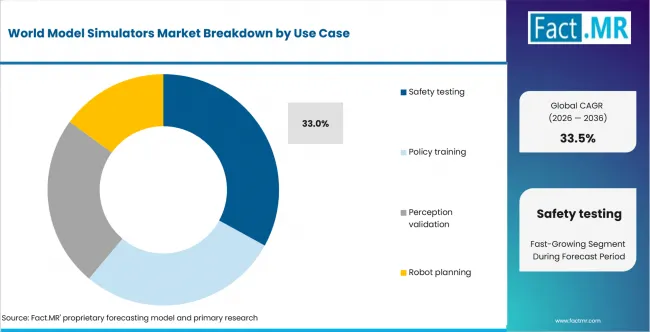
World Model Simulators Market Analysis By Use Case | Source: Fact.MR
Safety testing leads because physical AI systems must be evaluated against rare and risky conditions before deployment. The segment is projected to capture 33.0% share in 2026 as AV, robotics and industrial AI teams use simulated worlds to test corner cases. Policy training follows as teams train agents in synthetic environments. Perception validation supports camera, lidar and multimodal systems. Robot planning gains traction where task worlds replicate factory or warehouse constraints. Meta’s V-JEPA 2 research describes a video-trained world model that supports understanding and planning in the physical world.
Which technology dominates?
Physics simulation holds 36.0% share in 2026.
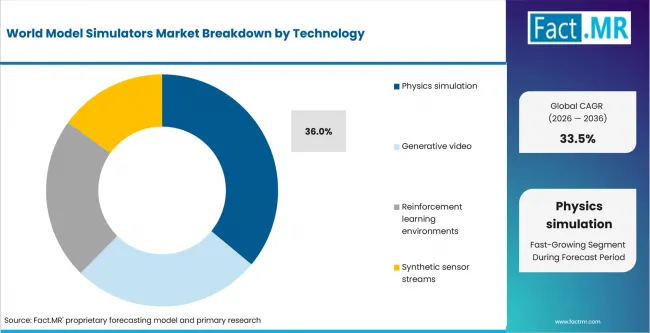
World Model Simulators Market Analysis By Technology | Source: Fact.MR
Physics simulation leads because industrial and AV teams need simulated behavior that can be trusted for engineering decisions. The technology segment is likely to account for 36.0% share in 2026 as physics engines, sensor models and real-time environments support validation. Generative video is gaining fast attention because it can create diverse synthetic worlds. Reinforcement learning environments support agent training. Synthetic sensor streams help perception teams test camera, radar and lidar stacks. Ansys stated in 2024 that AVxcelerate Sensors supports perception software testing in hardware-in-the-loop environments.
Which deployment dominates?
Cloud platforms lead with 41.0% share, world model simulator deployment.
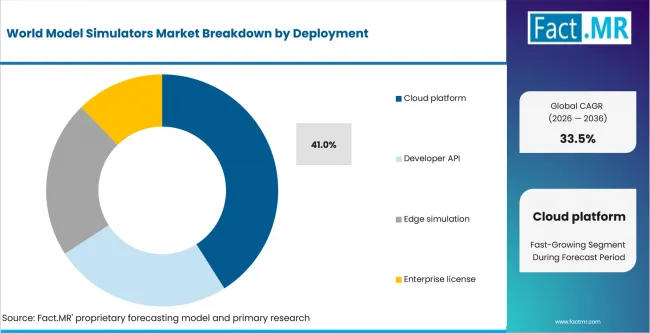
World Model Simulators Market Analysis By Deployment | Source: Fact.MR
Cloud platforms lead because world generation, synthetic sensor rendering and large-scale policy training require scalable compute. The deployment segment is expected to hold 41.0% share in 2026 as vendors offer hosted environments, model access and training pipelines. Developer APIs help teams integrate simulators into AI workflows. Edge simulation supports lower-latency testing near deployed systems. Enterprise licenses are important where automotive, manufacturing and robotics customers require controlled environments. Microsoft Research introduced Muse in 2025 as a World and Human Action Model that can generate video-game visuals and controller actions.
Which buyer type dominates?
AV teams hold 37.0% share in 2026.
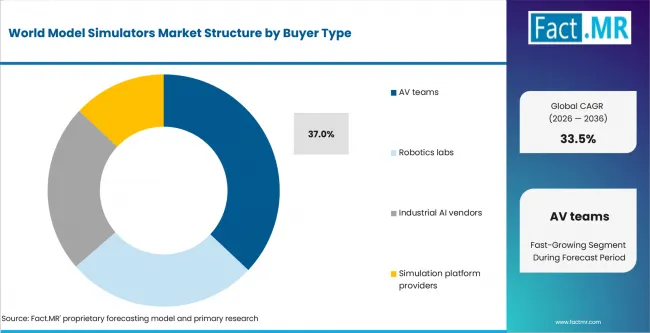
World Model Simulators Market Analysis By Buyer Type | Source: Fact.MR
AV teams lead because autonomous driving validation already uses simulation, sensor modeling and scenario generation at scale. The buyer type segment is projected to hold 37.0% share in 2026 as AV teams seek world models for safety testing and synthetic data creation. Robotics labs use task worlds for policy learning. Industrial AI vendors use factory and warehouse worlds to test automation. Simulation platform providers integrate model-based and physics-based workflows into commercial products. Unity’s 2025 robotics digital twin guidance highlights simulated camera frames, synthetic data annotation and vision AI training for robotics systems.
What is accelerating World Model Simulators Market adoption, and what is holding it back?
Physical AI investment and AV safety testing drive it; sim-to-real gap and compute cost restrain it.
Drivers Impact Analysis
| DRIVER | (~) % IMPACT ON CAGR | GEOGRAPHIC RELEVANCE | IMPACT TIMELINE |
|---|---|---|---|
| Physical AI investment moving simulation toward world foundation models | +3.2% | United States, China, Japan, Germany | Short term (≤ 2 years) |
| AV safety testing requiring rare-event scenario generation | +2.7% | United States, Germany, China, South Korea | Medium term (2–4 years) |
| Robotics labs using task worlds for policy training | +2.4% | United States, Japan, South Korea, Europe | Medium term (2–4 years) |
| Synthetic sensor streams supporting perception validation | +2.1% | Global, strongest in AV and robotics teams | Short term (≤ 2 years) |
| Cloud APIs making simulator access easier for developers | +1.8% | North America, Europe, East Asia | Long term (≥ 4 years) |
Source: Fact.MR analysis. Updated Jul 4, 2026
- Physical AI investment
- Physical AI investment is the strongest driver because robotics and autonomous systems need training environments before real-world deployment. World foundation models can create diverse scenarios faster than manual scene design. This reduces the cost of generating training and evaluation data. The driver is strongest where AI infrastructure and AV programs overlap.
- AV safety testing
- AV safety testing supports demand because rare driving events are difficult to collect in real traffic. Simulated driving worlds help teams repeat edge cases, vary conditions and test perception outputs. This driver favors platforms that combine physics and scenario controls. Automotive teams will keep using world simulators as validation workloads expand.
- Robot task worlds
- Robot task worlds are gaining attention because hardware testing is costly and slow. Simulators allow teams to train policies for picking, navigation, assembly and warehouse movement before deploying robots. This driver is strongest in robotics labs and industrial AI vendors. It also supports developer APIs that allow rapid iteration.
- Synthetic sensor streams
- Synthetic sensor streams matter because perception models need camera, lidar, radar and multimodal input diversity. A simulator that can create labeled sensor streams helps teams validate models against unusual conditions. This driver favors Ansys, NVIDIA, Unity and specialized simulation providers. It also supports cloud rendering and batch evaluation workloads.
- Cloud developer access
- Cloud developer access expands adoption because smaller robotics and AI teams may not run full simulation infrastructure in-house. APIs can expose world generation, physics simulation and evaluation tools as services. This makes the market easier to scale beyond large automotive enterprises. Long-term growth will depend on pricing, latency and workflow integration.
Opportunity Impact Analysis
| OPPORTUNITY | (~) % IMPACT ON CAGR | GEOGRAPHIC RELEVANCE | IMPACT TIMELINE |
|---|---|---|---|
| Factory worlds for industrial robot planning | +2.2% | Germany, Japan, United States, South Korea | Medium term (2–4 years) |
| Warehouse worlds for logistics automation training | +1.9% | United States, China, India, Europe | Medium term (2–4 years) |
| Generative video worlds for perception model evaluation | +1.7% | North America, East Asia, Western Europe | Short term (≤ 2 years) |
| Enterprise licenses for regulated AV validation workflows | +1.5% | United States, Germany, Japan | Long term (≥ 4 years) |
Source: Fact.MR analysis. Updated Jul 4, 2026
- Factory worlds
- Factory worlds create opportunity because industrial robots need task planning inside constrained environments. Simulated factories can model workcells, conveyors, tools and human-robot interaction zones. These worlds can reduce downtime during automation design. Germany, Japan and the United States are expected to be early adoption centers.
- Warehouse worlds
- Warehouse worlds create opportunity because mobile robots need route planning, obstacle handling and fleet coordination. Simulated warehouses allow logistics teams to test layouts and robot behavior before deployment. The opportunity is strongest where e-commerce, fulfillment automation and labor constraints overlap. Cloud simulation can support faster scenario scaling.
- Generative video worlds
- Generative video worlds create opportunity by reducing manual visual asset creation. They can help perception teams test model behavior under different lighting, weather and camera viewpoints. This supports both robotics and AV validation. The strongest opportunity sits in hybrid platforms that combine generative video with physics constraints.
- Enterprise validation licenses
- Enterprise validation licenses create opportunity because regulated and safety-critical teams need controlled workflows. AV and robotics vendors may need audit trails, version control and reproducible scenarios. This supports higher-value licenses and professional services. Simulation platform providers that align with engineering workflows can capture stronger enterprise demand.
Restraints Impact Analysis
| RESTRAINT | (~) % IMPACT ON CAGR | GEOGRAPHIC RELEVANCE | IMPACT TIMELINE |
|---|---|---|---|
| Sim-to-real gap limiting confidence in generated worlds | -2.3% | Global | Short term (≤ 2 years) |
| High compute cost for world generation and sensor rendering | -1.9% | Global, strongest in cloud-heavy deployments | Medium term (2–4 years) |
| Validation burden for safety-critical AI systems | -1.6% | United States, Europe, Japan | Medium term (2–4 years) |
| Fragmented toolchains across physics, game engines and AI platforms | -1.3% | Global | Long term (≥ 4 years) |
Source: Fact.MR analysis. Updated Jul 4, 2026
- Sim-to-real gap
- The sim-to-real gap is the main restraint because models trained in simulated worlds may behave differently in physical environments. Teams need proof that synthetic scenes improve real-world performance. Weak transfer can limit trust and slow enterprise adoption. Vendors need benchmarking, real-world calibration and closed-loop validation.
- Compute cost
- Compute cost can slow adoption because world generation and sensor simulation require large infrastructure. Smaller robotics teams may struggle with GPU cost and data storage. Cloud access helps, but pricing must match training budgets. This restraint is strongest in generative video and high-fidelity sensor simulation.
- Safety validation burden
- Safety validation burden affects AV and industrial robotics workflows. Teams need repeatable scenarios and explainable simulation outputs. Generative worlds can be difficult to qualify if outputs change unpredictably. This creates demand for governance features but can slow commercial rollout.
- Fragmented toolchains
- Fragmented toolchains make adoption difficult because physics engines, game engines, robotics middleware and AI training stacks do not always connect smoothly. Teams may need custom integration. This creates delays and service costs. Vendors that provide APIs, connectors and standard scenario formats will reduce friction.
Which countries are scaling world model simulators fastest?
United States 36.5%; China 34.8%; Germany 33.2%; Japan 31.8%; South Korea 30.5%.
Based on regional analysis, the world model simulators market is segmented into North America, Western Europe, East Asia, South Asia, Latin America, and the Middle East & Africa.
| Country | CAGR |
|---|---|
| United States | 36.5% |
| China | 34.8% |
| Germany | 33.2% |
| Japan | 31.8% |
| South Korea | 30.5% |
Source: Fact.MR analysis. Updated Jul 4, 2026
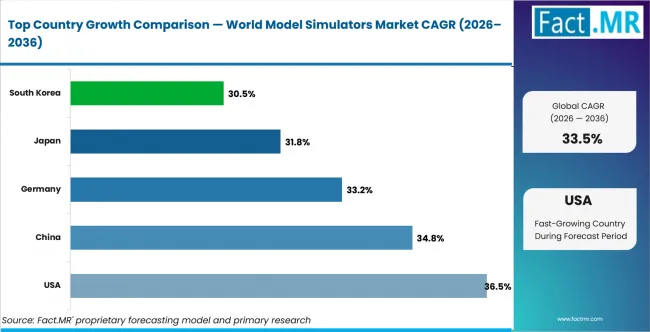
World Model Simulators Market Cagr Analysis By Country | Source: Fact.MR
What is powering the United States lead?
36.5% CAGR, driven by NVIDIA and physical AI platform investment.
The United States is projected to record 36.5% CAGR from 2026 to 2036 as NVIDIA, Microsoft, Meta and Applied Intuition expand world model, simulation and AV validation ecosystems. Growth will favor cloud platforms, developer APIs and enterprise licenses that support robotics and autonomous system testing.
How is China scaling world model simulator demand?
China is at 34.8%, scaling through autonomous driving, warehouse automation and synthetic data demand.
China is expected to post 34.8% CAGR through 2036 as AV teams and industrial AI vendors use simulated worlds to speed training and validation. Growth will favor driving worlds, warehouse worlds and synthetic sensor streams. Local deployment control and edge simulation will matter for enterprise adoption.
What supports Germany’s outlook?
33.2% CAGR, driven by industrial automation and AV validation workflows.
Germany is likely to record 33.2% CAGR by 2036 as automotive and manufacturing teams adopt high-fidelity world simulation for validation. Factory worlds will gain traction because industrial robot planning needs safe test environments. Enterprise licensing will be important where auditability and engineering controls matter.
What underpins Japan’s growth?
Japan is at 31.8%, scaling through robotics labs and compact factory automation.
Japan is forecast to advance at 31.8% CAGR through 2036 as robotics labs and manufacturing AI vendors use robot task worlds for manipulation, navigation and planning. Growth will favor physics simulation and synthetic camera streams. Compact, high-precision robot workflows will shape adoption.
How is South Korea scaling world model simulator adoption?
30.5% CAGR, driven by industrial robotics and synthetic video workflows.
South Korea is set to record 30.5% CAGR through 2036 as electronics manufacturing, robotics and smart factory programs adopt simulation for policy training and perception validation. Growth will favor cloud platforms and enterprise simulation licenses. Developer API access will support faster experimentation.
Who leads the world model simulators market?
NVIDIA and Google DeepMind lead the world-model signal, while Applied Intuition and Ansys lead commercial validation pathways.
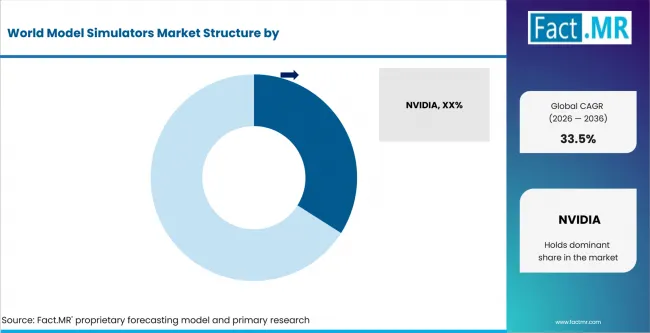
World Model Simulators Market Analysis By Company | Source: Fact.MR
World model simulators are supplied by AI foundation model companies, simulation software vendors, game-engine providers and autonomous system platforms. NVIDIA is central through Cosmos and Omniverse. Google DeepMind shapes the foundation world model conversation through Genie. Microsoft supports interactive world modeling through Muse. Meta contributes through V-JEPA and physical reasoning research.
Unity and Epic Games provide real-time 3D environments that can support simulation, synthetic data and robotics workflows. Ansys supports physics and sensor simulation for autonomous vehicle development. Applied Intuition supports physical AI, AV simulation and validation workflows. Competition through 2036 will be shaped by realism, controllability, developer access, enterprise governance and sim-to-real proof.
Which companies are the key providers?
NVIDIA and Google DeepMind are key providers. Microsoft and Meta are also profiled. Unity, Epic Games, Ansys and Applied Intuition complete the company set.
- NVIDIA
- Google DeepMind
- Microsoft
- Meta
- Unity
- Epic Games
- Ansys
- Applied Intuition
Bibliography
- NVIDIA. (2025, January 6). NVIDIA launches Cosmos world foundation model platform to accelerate physical AI development. NVIDIA Newsroom.
- Google DeepMind. (2024, December 4). Genie 2: A large-scale foundation world model. Google DeepMind.
- Meta AI. (2025, June 11). Introducing the V-JEPA 2 world model and new benchmarks for physical reasoning. Meta AI.
- Microsoft Research. (2025, February 19). Introducing Muse: Our first generative AI model designed for gameplay ideation. Microsoft Research.
- Unity Technologies. (2025, January 16). Digital twins in the machinery and robotics industry. Unity.
- Ansys. (2024, May 23). Ansys AVxcelerate Sensors leverages NI-RDMA for HiL testing. Ansys.
- Epic Games. (2026, April 8). UE5 is becoming the platform of choice for robotics simulation. Unreal Engine.
- Applied Intuition. (2026). ADAS & autonomous vehicle simulation. Applied Intuition. f
This Report Addresses
- Strategic intelligence on world model simulators across world type and technology.
- Segment analysis covering Driving Worlds and Physics Simulation.
- Regional outlook covering the United States, China, Germany, Japan and South Korea.
- Competitive analysis of NVIDIA, Google DeepMind, Microsoft, Meta, Unity, Epic Games, Ansys and Applied Intuition.
- Technology assessment covering physics simulation, generative video, reinforcement learning environments and synthetic sensor streams.
- Use case assessment covering policy training, safety testing, perception validation and robot planning.
- Primary interviews, provider checks and official source review support the forecast.
What does the world model simulators market cover?
Interactive AI simulators that generate or model physical worlds for training and planning.
The world model simulators market covers factory worlds and synthetic video worlds. These systems support policy training and robot planning.
The market differs from broad digital twin software because it focuses on AI training and validation environments. It excludes ordinary CAD visualization, conventional game engines without AI simulation workflows and basic sensor replay tools that do not support physical AI training or validation.
What is included in the scope?
AI simulation platforms that create controllable physical or synthetic environments.
The scope includes physics simulation, generative video, reinforcement learning environments and synthetic sensor streams. Deployment coverage includes cloud platforms and enterprise licenses. Warehouse operators can also use warehouse simulation tools when generated environments are tied to layout testing or automation validation.
Buyer type coverage includes robotics labs and simulation platform providers. The scope also includes world foundation model platforms when they are used to generate training data, simulate physical behavior or validate embodied AI systems.
What is excluded from the scope?
Ordinary game environments and non-AI visualization software are outside the scope.
The scope excludes entertainment-only game engines and generic data-labeling tools. It also excludes full autonomous vehicle stacks unless the revenue is tied to simulation, synthetic data generation or validation workflows.
How was the analysis built?
100+ sources, 40+ company portfolios, 25+ countries, 20+ interviews.
- Primary Research: Primary research includes interviews with robotics simulation leads, AV validation teams and industrial AI platform managers. It includes input from synthetic data vendors, simulation platform providers and enterprise AI infrastructure teams.
- Desk Research: Desk research reviews official company announcements, research model releases, simulation platform documentation, robotics training workflows and autonomous system validation use cases.
- Market-Sizing and Forecasting: Forecasting uses physical AI adoption, robot policy training demand, AV simulation workloads, synthetic sensor stream use and enterprise platform licensing.
- Data Validation and Update Cycle: Forecasts are validated through provider checks and technical interviews. Platform roadmaps, developer access models and enterprise licensing signals help confirm market direction.
Segmentation
What is the report’s scope and coverage?
| Attribute | Details |
|---|---|
| Quantitative Units | USD Million in 2026 to USD Million by 2036 at CAGR |
| Market Definition | Interactive AI simulators that generate or model physical worlds for training, testing and planning |
| World Type | Factory worlds; driving worlds; warehouse worlds; robot task worlds; synthetic video worlds |
| Use Case | Policy training; safety testing; perception validation; robot planning |
| Technology | Physics simulation; generative video; reinforcement learning environments; synthetic sensor streams |
| Deployment | Cloud platform; developer API; edge simulation; enterprise license |
| Buyer Type | Robotics labs; AV teams; industrial AI vendors; simulation platform providers |
| Regions Covered | North America; Western Europe; East Asia; South Asia; Latin America; Middle East and Africa |
| Countries Covered | United States; China; Germany; Japan; South Korea |
| Key Companies Profiled | NVIDIA; Google DeepMind; Microsoft; Meta; Unity; Epic Games; Ansys; Applied Intuition |
| Forecast Period | 2026 to 2036 |
| Approach | Hybrid top-down and bottom-up approach using platform roadmaps, simulation adoption, AI infrastructure demand and provider validation |
Source: Fact.MR analysis. Updated Jul 4, 2026
How is the market segmented?
-
By World Type:
- Factory worlds
- Driving worlds
- Warehouse worlds
- Robot task worlds
- Synthetic video worlds
-
By Use Case:
- Policy training
- Safety testing
- Perception validation
- Robot planning
-
By Technology:
- Physics simulation
- Generative video
- Reinforcement learning environments
- Synthetic sensor streams
-
By Deployment:
- Cloud platform
- Developer API
- Edge simulation
- Enterprise license
-
By Buyer Type:
- Robotics labs
- AV teams
- Industrial AI vendors
- Simulation platform providers
-
Region:
- North America
- United States
- Canada
- Mexico
- Western Europe
- Germany
- United Kingdom
- France
- Netherlands
- Sweden
- East Asia
- China
- Japan
- South Korea
- South Asia
- India
- Singapore
- Thailand
- Latin America
- Brazil
- Chile
- Middle East & Africa
- UAE
- Saudi Arabia
- South Africa
- North America
Frequently Asked Questions
Which world type leads the World Model Simulators Market?
Which use case leads the World Model Simulators Market?
Which technology leads the World Model Simulators Market?
Which deployment leads the World Model Simulators Market?
Which buyer type leads the World Model Simulators Market?
Which country expands fastest in the World Model Simulators Market?
How does China perform in the World Model Simulators Market?
How does Germany perform in the World Model Simulators Market?
How does Japan perform in the World Model Simulators Market?
How does South Korea perform in the World Model Simulators Market?
What is the primary driver in the World Model Simulators Market?
What is the main restraint in the World Model Simulators Market?
Why are driving worlds important?
Why do cloud platforms dominate demand?
Who worked on this report


Preview the report firsthand - request a free sample
Free SampleGet the brochure for pricing and purchase details
Download PDF