- Market Value (2025): USD 3.4 Bn
- Estimated Value (2026): USD 3.8 Bn
- Forecast Value (2036): USD 12.9 Bn
- CAGR (2026-2036): 13.0%
What is the High Speed and Low Loss Printed Circuit Board Market forecast to be worth by 2036?
The market is projected to grow from USD 3.8 billion in 2026 to USD 12.9 billion by 2036, registering a CAGR of 13.0%.
- The High Speed and Low Loss Printed Circuit Board market reached USD 3.4 billion in 2025.
- Demand is forecast to increase from USD 3.8 billion in 2026 to USD 12.9 billion by 2036.
- The market is forecast to record 13.0% CAGR from 2026 to 2036
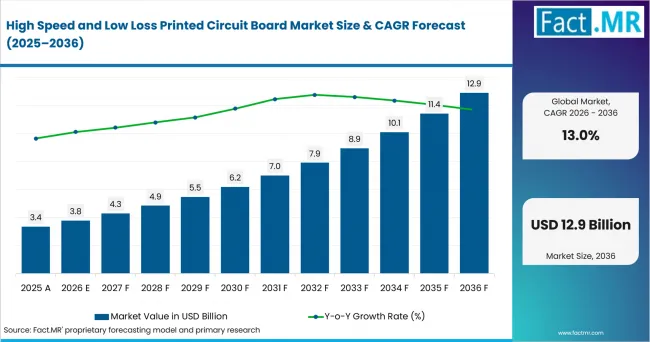
High Speed And Low Loss Printed Circuit Board Market Value Analysis | Source: Fact.MR
What are the defining numbers behind High Speed and Low Loss Printed Circuit Board Market growth?
An absolute dollar opportunity of USD 9.1 billion is expected between 2026 and 2036.
- Demand Drivers in the Market
- AI servers and high-performance computing systems are increasing the number of high-speed connections between processors and memory components. Serial interfaces operating at 112 Gbps and 224 Gbps leave smaller signal-loss margins, increasing demand for printed circuit boards made with low-loss dielectric materials and controlled transmission paths.
- Data-centre investment is raising demand for server boards, accelerator boards and network switches that must transmit large data volumes without excessive attenuation. SEMI expects worldwide 300 mm fab-equipment spending to reach USD 133 billion in 2026 and USD 151 billion in 2027, driven partly by AI chips for data centres and edge devices. Higher production of these systems supports PCB demand across computing and networking equipment.
- Faster communication standards are increasing signal-integrity requirements in routers, base stations and optical-network equipment. At higher frequencies, dielectric loss and conductor loss weaken signals across PCB traces, encouraging manufacturers to use materials with lower dissipation factors and tighter impedance control.
- Advanced driver-assistance systems and connected-vehicle electronics are expanding the use of high-speed data links inside vehicles. Cameras and radar modules generate data that must move reliably between sensors and central processors, creating demand for PCBs that maintain signal integrity under temperature variation and electromagnetic interference.
- Higher component density is making PCB design more sensitive to crosstalk and routing loss. IPC reports that high-density interconnect usage increased from 37.5% to slightly more than 49% over five years. Denser layouts increase the value of controlled stack-ups and materials that reduce transmission loss between closely spaced signal paths.
- PCB manufacturers are applying more rigorous electrical testing as operating frequencies rise. IPC provides dedicated test methods for high-frequency signal loss and propagation, together with dielectric constant and loss-tangent measurement. Buyers therefore require boards with verified impedance and material performance rather than relying only on nominal laminate specifications.
- Key Segments Analyzed
- High Speed Printed Circuit Boards account for 56.0% of Product Type in 2026, supported by demand for stable signal transmission across servers, networking systems and advanced electronic equipment.
- Data Centers & Servers represent 34.0% of Application in 2026 as AI computing and high-bandwidth workloads increase requirements for low-latency board architectures.
- Telecommunications Equipment Manufacturers account for 38.0% of End User in 2026 because routers, base stations and optical-network systems require controlled impedance and limited transmission loss.
- Direct Sales hold 54.0% of Distribution Channel in 2026, reflecting the need for technical qualification and board designs tailored to equipment-specific performance requirements.
- Low-loss Laminates represent 47.0% of Material Type in 2026 because they reduce dielectric loss and help maintain signal integrity at higher operating frequencies.
- Analyst Opinion at Fact.MR
- Shambhu Nath Jha, Principal Consultant, Fact.MR says “The enterprise software landscape is experiencing a generational shift as AI, cloud computing, and composable architectures redefine how organizations operate. Markets tied to HR technology, governance platforms, and sustainability software are particularly well-positioned. Companies that deliver integrated, AI-enhanced solutions with strong compliance capabilities will capture disproportionate value in this evolving market.”
- Strategic Implications
- PCB manufacturers should expand their capability to process low-loss laminates and low-roughness copper foils. IPC testing shows that lower dielectric constant and dissipation factor improve insertion-loss performance, while smoother copper surfaces reduce conductor loss at higher frequencies.
- Engineering teams should work with equipment manufacturers during stack-up development rather than compete through standard board catalogues. Trace geometry and dielectric thickness influence signal performance, while vias and layer transitions can introduce reflections that require simulation and physical testing.
- Suppliers serving AI servers and data-centre equipment should align capacity with higher-bandwidth interconnect requirements. The Open Compute Project identifies high-speed interconnects as a constraint on AI-cluster efficiency, with insertion loss and transmission distance becoming important design considerations.
- Manufacturers should invest in S-parameter measurement and eye-pattern analysis to support customer qualification. IPC notes that original equipment manufacturers conduct additional electrical testing before approving PCB substrate materials for high-speed designs.
- Commercial teams should use direct technical engagement for complex programmes. Early collaboration on material selection and impedance requirements can reduce redesign risk before the customer moves from prototype boards to volume production.
Country-level growth outlook: China at 14.2% CAGR; Taiwan at 13.8% CAGR; USA at 13.4% CAGR; South Korea at 13.0% CAGR; Japan at 12.5% CAGR; Germany at 12.0% CAGR; India at 11.5% CAGR.
How does the High Speed and Low Loss Printed Circuit Board Market break down by segment?
High Speed Printed Circuit Boards are expected to lead Product Type at 56.0% share in 2026. Data Centers & Servers are projected to lead Application at 34.0% share.
Why do High Speed Printed Circuit Boards lead Product Type?
High Speed Printed Circuit Boards are projected to account for 56.0% share in 2026.
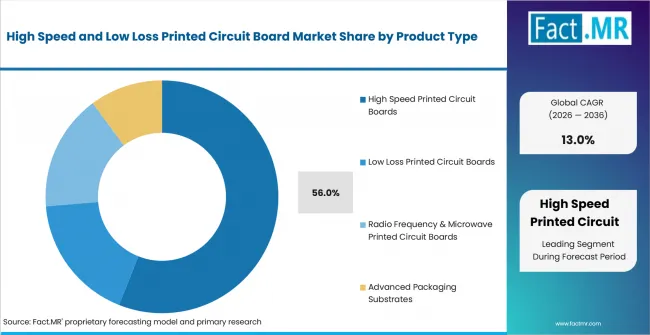
High Speed And Low Loss Printed Circuit Board Market Analysis By Product Type | Source: Fact.MR
These boards are used where processors and network components exchange data at rates that make ordinary interconnect behaviour a design constraint. Reflections and crosstalk can narrow signal margins, while conductor and dielectric losses increase with operating frequency.
Demand therefore extends across servers and telecommunications equipment. Buyers specify controlled impedance and acceptable insertion-loss limits according to the complete channel rather than purchasing boards solely by layer count or physical dimensions.
Why do Data Centers & Servers lead Application?
Data Centers & Servers are projected to account for 34.0% share in 2026.
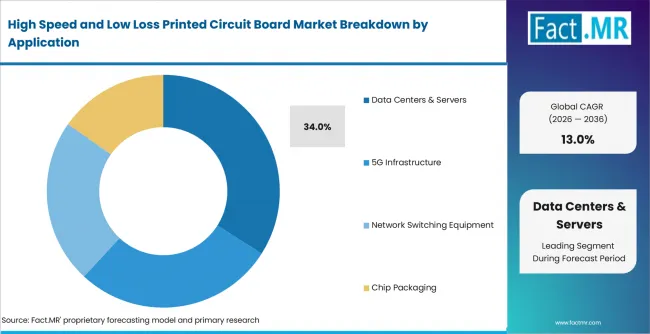
High Speed And Low Loss Printed Circuit Board Market Analysis By Application | Source: Fact.MR
AI servers connect processors with memory and networking components through dense, high-bandwidth links. The Open Compute Project identifies high-speed interconnects as a central requirement for coordinating CPUs and accelerators within large AI systems.
Higher server throughput increases the number of board channels that must remain within defined loss budgets. This supports demand for multilayer PCBs made with low-loss materials and designed around short routing paths, controlled vias and stable impedance.
Why do Telecommunications Equipment Manufacturers lead End User?
Telecommunications Equipment Manufacturers are projected to account for 38.0% share in 2026.
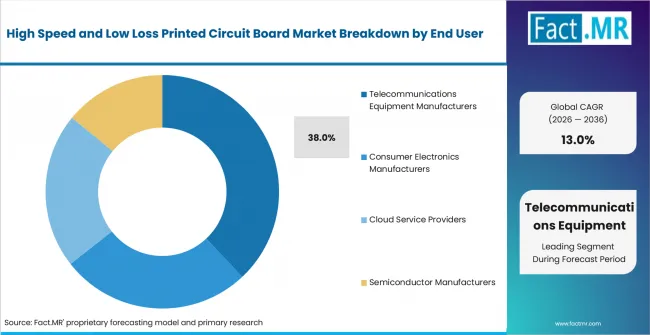
High Speed And Low Loss Printed Circuit Board Market Analysis By End User | Source: Fact.MR
Routers and base stations depend on high-speed backplanes and line cards to move data between processing and transmission modules. At higher frequencies, PCB traces behave as lossy transmission lines, making dielectric selection and impedance continuity important to system performance.
Telecommunications buyers also require repeatable electrical performance across production batches. Suppliers must therefore control laminate properties and copper treatment while verifying finished boards against the customer’s channel specifications.
Why do Direct Sales lead Distribution Channel?
Direct Sales are projected to account for 54.0% share in 2026.
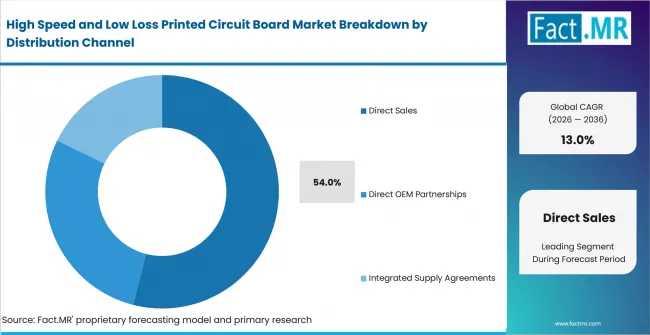
High Speed And Low Loss Printed Circuit Board Market Analysis By Distribution Channel | Source: Fact.MR
High-speed PCBs are commonly developed against equipment-specific stack-ups and signal-loss limits. The fabricator must review the customer’s layer structure and material requirements before confirming that the design can be produced consistently.
Direct engagement also supports prototype testing and design correction before volume production. IPC notes that equipment manufacturers conduct electrical tests such as eye-pattern and S-parameter analysis before approving substrate performance, which makes engineering support an important part of the purchasing process.
Why do Low-loss Laminates lead Material Type?
Low-loss Laminates are projected to account for 47.0% share in 2026.
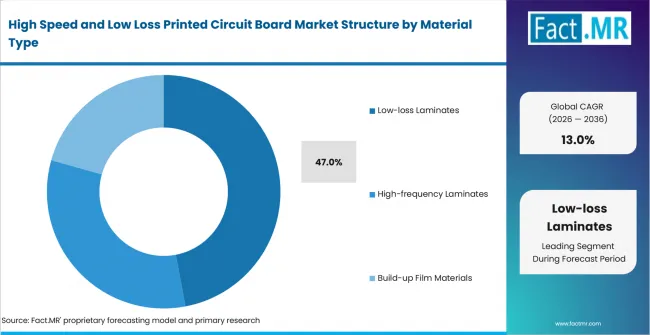
High Speed And Low Loss Printed Circuit Board Market Analysis By Material Type | Source: Fact.MR
Low-loss laminates reduce the amount of signal energy absorbed by the dielectric as data moves through the board. IPC identifies lower dielectric constant and dissipation factor as important for improving insertion-loss performance in high-speed and high-frequency transmission lines.
Material selection also affects the usable length of a PCB channel. Buyers therefore evaluate measured loss tangent and finished-board performance before approving a laminate, particularly for server and telecommunications designs operating at higher data rates.
What is accelerating High Speed and Low Loss Printed Circuit Board Market adoption, and what is holding it back?
Drivers Impact Analysis
| Driver | % Impact on CAGR | Geographic Relevance | Impact Timeline |
|---|---|---|---|
| Technology Innovation & R&D | High | Global | 2026-2036 |
| Regulatory & Policy Drivers | Medium-High | North America, Europe | 2026-2032 |
| End-User Industry Expansion | High | Asia Pacific, MEA | 2026-2036 |
| Operational & Cost Efficiency | Medium | Global | 2026-2036 |
Source: Fact.MR analysis. Updated Aug 11, 2026
Restraints Impact Analysis
| Restraint | % Impact on CAGR | Geographic Relevance | Impact Timeline |
|---|---|---|---|
| Capital Intensity & Investment | Medium | Developing Markets | 2026-2030 |
| Supply Chain & Raw Material | Medium | Global | 2026-2028 |
| Workforce & Capability Gaps | Low-Medium | Africa, Latin America | 2026-2036 |
Source: Fact.MR analysis. Updated Aug 11, 2026
Which countries are scaling the High Speed and Low Loss Printed Circuit Board Market fastest?
- Taiwan is projected to register a 13.8% CAGR through 2036. Its concentration of semiconductor and electronics manufacturers is increasing demand for enterprise software that can coordinate production planning, supplier management and financial operations across complex supply chains.
- The USA is forecast to expand at a 13.4% CAGR from 2026 to 2036. Growth is supported by its large enterprise-software market and established cloud-computing ecosystem. Companies are investing in platforms that consolidate operational data and automate workflows across distributed business functions.
- South Korea is projected to grow at a 13.0% CAGR through 2036. Large electronics, automotive and manufacturing groups are modernizing enterprise systems to support connected production and international operations. Demand is also increasing for cloud-based platforms that can integrate data across subsidiaries and supplier networks.
- Japan is forecast to register a 12.5% CAGR from 2026 to 2036. Enterprises are replacing older business systems as part of wider technology-modernization programmes. Labour constraints are also encouraging investment in software that automates administrative processes and improves information sharing across departments.
- Germany is projected to expand at a 12.0% CAGR through 2036. Industrial digitalization is increasing demand for enterprise platforms that connect production environments with procurement and financial systems. Manufacturers require software capable of supporting regulated operations and complex supplier relationships.
- India is forecast to grow at an 11.5% CAGR from 2026 to 2036. Expansion of IT services and digitally managed business operations is supporting adoption across large enterprises and growing mid-sized companies. Cloud deployment is lowering infrastructure requirements and allowing organizations to add users and functions as operations expand.
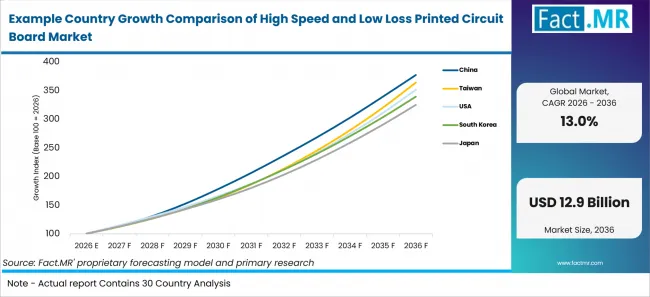
Example Country Growth Comparison Of High Speed And Low Loss Printed Circuit Board Market | Source: Fact.MR
Country-wise CAGR Forecast (2026-2036)
| Country | CAGR (%) |
|---|---|
| Taiwan | 13.8% |
| USA | 13.4% |
| South Korea | 13.0% |
| Japan | 12.5% |
| Germany | 12.0% |
Source: Fact.MR analysis. Updated Aug 11, 2026
What is driving the High Speed and Low Loss Printed Circuit Board Market in Taiwan?
Taiwan is projected to register a 13.8% CAGR through 2036.
Taiwan’s position in AI-server manufacturing and semiconductor hardware is increasing demand for high-layer-count PCBs and low-loss copper-clad laminates. The Taiwan Printed Circuit Association reports that rapid AI-server expansion is raising the PCB value used in each system, with the value per AI server projected to reach approximately USD 1,980 in 2026, compared with about USD 900 for the preceding server generation.
Local suppliers benefit from close coordination with server manufacturers and semiconductor companies. This allows PCB designs and laminate specifications to be adjusted around faster interfaces and denser accelerator configurations.
What is driving the High Speed and Low Loss Printed Circuit Board Market in the USA?
The USA is projected to register a 13.4% CAGR through 2036.
Growth is supported by investment in AI data centres and advanced networking infrastructure. These systems require server and switch boards that can carry high-speed signals across longer electrical paths without unacceptable attenuation or crosstalk.
Federal semiconductor programmes are also supporting photonic integration and advanced packaging used in faster computing and communication systems. A U.S. Department of Commerce award announced in 2025 included expanded packaging capabilities for photonic integrated circuits intended to enable faster networking.
Demand is therefore concentrated in boards using low-loss laminates and controlled-impedance structures for AI accelerators, high-speed switches and other data-centre equipment.
What is driving the High Speed and Low Loss Printed Circuit Board Market in South Korea?
South Korea is projected to register a 13.0% CAGR through 2036.
South Korea’s memory, semiconductor and electronics industries are increasing demand for high-speed boards used in AI servers and advanced computing systems. Expansion of high-bandwidth memory production supports the wider hardware ecosystem surrounding accelerators and server platforms.
The government allocated KRW 480 billion to industrial AI development and deployment in 2025. Wider adoption of AI across manufacturing is expected to increase investment in computing hardware and high-speed communication equipment, supporting demand for low-loss PCB materials.
Domestic electronics manufacturers also require boards that can maintain signal integrity across dense assemblies containing processors and high-speed memory interfaces.
What is driving the High Speed and Low Loss Printed Circuit Board Market in Japan?
Japan is projected to register a 12.5% CAGR through 2036.
Japan is investing in an integrated ecosystem covering advanced semiconductors and data centres as generative AI increases computing demand. METI introduced measures supporting facilities for semiconductors designed to process large volumes of information at very high speeds.
This creates demand for high-speed PCBs used to connect processors and memory within servers and networking equipment. Japanese material suppliers also have established capabilities in copper-clad laminates and specialty resins, allowing them to serve applications where low dielectric loss and thermal stability are purchasing requirements.
Who leads the High Speed and Low Loss Printed Circuit Board Market?
TTM Technologies, Inc., Unimicron Technology Corporation and Compeq Manufacturing Co., Ltd. form the first group of companies in the market assessment. AT&S Austria Technologie & Systemtechnik AG and Shennan Circuits Co., Ltd. also compete for programmes requiring multilayer construction and controlled electrical performance.
Ibiden Co., Ltd. and Nan Ya PCB Corporation participate through advanced board and substrate capabilities. Tripod Technology Corporation and Zhen Ding Technology Holding Limited add manufacturing scale across Asian electronics supply chains. Kingboard Holdings Limited participates through its position in PCB materials and board manufacturing.
Competition depends on the ability to produce a customer-specific stack-up with stable impedance and acceptable insertion loss. Fabricators must control laminate thickness and copper characteristics while maintaining registration across multiple layers.
Qualification creates a further barrier. Server and telecommunications manufacturers test prototype boards before approving volume production. Suppliers that provide engineering support during routing and material selection can reduce redesign risk for the customer.
Manufacturing scale remains important after qualification because data-centre and networking programmes require consistent electrical performance across large production batches. Regional production capacity also affects delivery times and supply continuity.
Which companies are the key providers?
Key companies profiled include TTM Technologies, Inc.; Unimicron Technology Corporation; Compeq Manufacturing Co., Ltd.; AT&S Austria Technologie & Systemtechnik AG; Shennan Circuits Co., Ltd.; Ibiden Co., Ltd.; Tripod Technology Corporation; Nan Ya Printed Circuit Board Corporation; Kingboard Holdings Limited; and Zhen Ding Technology Holding Limited.
- TTM Technologies, Inc.
- Unimicron Technology Corporation
- Compeq Manufacturing Co., Ltd.
- AT&S Austria Technologie & Systemtechnik AG
- Shennan Circuits Co., Ltd.
- Ibiden Co., Ltd.
- Tripod Technology Corporation
- Nan Ya Printed Circuit Board Corporation
- Kingboard Holdings Limited
- Zhen Ding Technology Holding Limited
Bibliography
- Chen, A. (2013). Why Signal Always Be Loss in a High Speed High Frequency Transmission Line. IPC APEX EXPO.
- IPC International. (2023). IPC’s PCB Technology Trends Report Details How PCB Manufacturers Meet Current and Future Technology Demands. IPC.
- IPC International. (2026). IPC-TM-650 Test Methods Manual. IPC.
- Mirshafiei, S. S., & Enos, D. (2004). Signal Integrity Analysis Techniques Used to Characterize PCB Substrates. IPC APEX EXPO.
- Ministry of Industry and Information Technology, China. (2026). Operation of the Electronic Information Manufacturing Industry in 2025. Government of China.
- Ministry of Economic Affairs, Taiwan. (2024). Printed Circuit Board Industry Output Expected to Return to Growth in 2024. Government of Taiwan.
- Ministry of Trade, Industry and Energy, Republic of Korea. (2025). Korea’s ICT Exports Drop 0.4% in January. Government of the Republic of Korea.
- Ministry of Trade, Industry and Energy, Republic of Korea. (2024). Korean Government to Make Last Spurt Backing Chip Exports and Investment for 2024. Government of the Republic of Korea.
- Ministry of Economy, Trade and Industry, Japan. (2025). Cabinet Decision on the Bill for the Act for Partially Amending the Act on Facilitation of Information Processing and the Act on Special Accounts. Government of Japan.
- Ministry of Electronics and Information Technology, India. (2025). Electronics Component Manufacturing Scheme. Government of India.
- Open Compute Project Foundation. (2026). 2026 OCP China Day. Open Compute Project.
- SEMI. (2026). SEMI Projects Double-Digit Growth in Global 300 mm Fab Equipment Spending for 2026 and 2027. SEMI.
- U.S. Department of Commerce. (2025). U.S. Department of Commerce Announces CHIPS Incentives Awards with Corning, Edwards Vacuum, and Infinera to Increase Domestic Production Capacity of Chips and Equipment Critical for U.S. Technological Leadership. Government of the United States.
- ZVEI. (2026). Europe’s Semiconductor Business Case. German Electro and Digital Industry Association.
This Report Answers
- The report evaluates demand for high-speed and low-loss printed circuit boards across product types and material categories.
- Segment analysis identifies the leading categories and their shares within the 2026 market.
- Application analysis examines PCB requirements across data centres, telecommunications equipment, automotive electronics and aerospace systems.
- Country analysis compares growth across China, Taiwan, the USA, South Korea, Japan, Germany and India.
- Competitive analysis reviews manufacturers with capabilities in multilayer construction, impedance control and low-loss material processing.
What does the High Speed and Low Loss Printed Circuit Board Market cover?
The market covers printed circuit boards designed for electronic systems in which signal attenuation, impedance variation and crosstalk can affect data transmission.
The assessment includes boards used in servers, network switches, telecommunications equipment, automotive electronics and other systems that operate through high-speed digital or high-frequency signal channels.
The analysis examines Product Type, Application, End User, Distribution Channel and Material Type across major regional markets.
What is included in the scope?
The scope includes rigid and multilayer printed circuit boards engineered with controlled impedance and low-loss transmission characteristics.
It covers boards produced using low-loss laminates, PTFE-based materials, modified epoxy systems and hydrocarbon ceramic materials. High-speed boards used in servers, data-centre equipment, routers, base stations and advanced vehicle electronics are included.
The analysis includes demand from telecommunications equipment manufacturers and server-equipment producers. Automotive electronics manufacturers and aerospace contractors are also included where signal-integrity requirements justify the use of high-speed or low-loss boards.
Direct sales and distributor-led supply are assessed alongside engineering relationships involving electronics manufacturing service providers and design partners.
What is excluded from the scope?
The scope excludes conventional printed circuit boards used in applications where high-frequency transmission and signal-loss control are not purchasing requirements.
Flexible printed circuits are excluded unless supplied as part of a high-speed interconnect design covered by the stated segmentation.
Semiconductor substrates and integrated-circuit packaging substrates are outside the market unless classified and sold as printed circuit boards within the supplied product taxonomy.
Copper-clad laminates sold separately from completed PCB fabrication are excluded from market sizing. Connectors and cables are also excluded unless supplied as an integral part of a finished PCB assembly.
How was the analysis built?
The analysis draws on more than 120 sources, over 35 company portfolios and more than 20 industry interviews across at least 25 countries.
- Primary Research: Interviews with PCB manufacturers, laminate suppliers, server-equipment producers, telecommunications manufacturers and electronics engineering teams examine signal-loss requirements, qualification procedures and purchasing priorities.
- Desk Research: The review covers electronics-production data, AI-server investment, telecommunications infrastructure and PCB technology trends. Government publications and technical material from IPC, SEMI and industry associations are also assessed.
- Market Sizing and Forecasting: Estimates combine electronics-equipment production with average PCB content and the penetration of low-loss materials. The model also considers layer count, board complexity, application growth and country-level manufacturing activity.
- Data Validation and Update Cycle: Findings are cross-checked against company capacity, public investment announcements and technical standards. Updates account for changes in data-centre investment and material adoption.
Segmentation
What is the report’s scope and coverage?
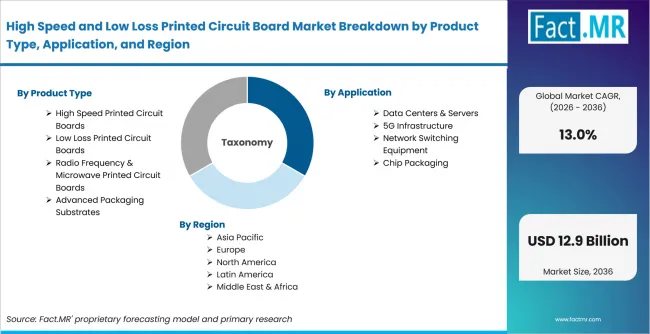
High Speed And Low Loss Printed Circuit Board Market Breakdown By Product Type, Application, And Region | Source: Fact.MR
| Attribute | Details |
|---|---|
| Quantitative Units | USD billion |
| Market Definition | Printed circuit boards engineered to transmit high-frequency and high-speed signals while limiting dielectric loss, conductor loss, impedance variation and signal distortion |
| Product Type | High Speed Printed Circuit Boards; High Frequency Printed Circuit Boards; High-density Interconnect Boards; High-layer-count Printed Circuit Boards |
| Application | Data Centers & Servers; Telecommunications Infrastructure; Automotive Electronics; Aerospace & Defense Electronics |
| End User | Telecommunications Equipment Manufacturers; Server & Data Center Equipment Manufacturers; Automotive Electronics Manufacturers; Aerospace & Defense Contractors |
| Distribution Channel | Direct Sales; Authorized Distributors; Electronics Manufacturing Service Providers; Design and Engineering Partners |
| Material Type | Low-loss Laminates; PTFE-based Materials; Modified Epoxy Materials; Hydrocarbon Ceramic Laminates |
| Regions Covered | North America; Latin America; Europe; East Asia; South Asia and Pacific; Middle East and Africa |
| Countries Covered | China; Taiwan; USA; South Korea; Japan; Germany; India |
| Key Companies Profiled | TTM Technologies, Inc.; Unimicron Technology Corporation; Compeq Manufacturing Co., Ltd.; AT&S Austria Technologie & Systemtechnik AG; Shennan Circuits Co., Ltd.; Ibiden Co., Ltd.; Tripod Technology Corporation; Nan Ya Printed Circuit Board Corporation; Kingboard Holdings Limited; Zhen Ding Technology Holding Limited |
| Forecast Period | 2026 to 2036 |
| Approach | Hybrid top-down and bottom-up analysis using equipment demand, PCB content, application growth, material mix, segment shares and country-level electronics production |
Source: Fact.MR analysis. Updated Aug 11, 2026
How is the market segmented?
-
By Product Type
- High Speed Printed Circuit Boards
- Multilayer High Speed Printed Circuit Boards
- High-density Interconnect Boards
- Low Loss Printed Circuit Boards
- Low Dielectric Loss Boards
- Ultra-low Loss Printed Circuit Boards
- Radio Frequency & Microwave Printed Circuit Boards
- Millimeter Wave Printed Circuit Boards
- Hybrid Printed Circuit Boards
- Advanced Packaging Substrates
- Integrated Circuit Substrates
- Glass Core Substrates
- High Speed Printed Circuit Boards
-
By Application
- Data Centers & Servers
- Artificial Intelligence Servers
- High-performance Computing Systems
- 5G Infrastructure
- Aerospace & Defense Electronics
- Automotive Electronics
- Network Switching Equipment
- Routers & Switches
- Base Stations
- Chip Packaging
- High-bandwidth Memory Packaging
- Chiplet Integration
- Data Centers & Servers
-
By End User
- Telecommunications Equipment Manufacturers
- Network Equipment Manufacturers
- Server Manufacturers
- Consumer Electronics Manufacturers
- Aerospace & Defense Contractors
- Automotive Original Equipment Manufacturers
- Cloud Service Providers
- Industrial Automation Companies
- Medical Device Manufacturers
- Semiconductor Manufacturers
- Advanced Packaging Companies
- High-performance Computing Chip Manufacturers
- Telecommunications Equipment Manufacturers
-
By Distribution Channel
- Direct Sales
- Original Equipment Manufacturer Supply
- Electronics Manufacturing Services
- Authorized Distributors
- Contract Manufacturing
- Regional Distributors
- Direct OEM Partnerships
- Global Electronics Supply Chains
- Value-added Resellers
- Integrated Supply Agreements
- Strategic Supply Contracts
- Long-term Procurement Agreements
- Direct Sales
-
By Material Type
- Low-loss Laminates
- Hydrocarbon Ceramic Laminates
- Modified Epoxy Resin
- Polyphenylene Ether Resin
- Polytetrafluoroethylene Laminates
- Polyimide Laminates
- High-frequency Laminates
- Ceramic-filled Polytetrafluoroethylene
- Liquid Crystal Polymer Laminates
- Build-up Film Materials
- Ajinomoto Build-up Film
- Glass Core Materials
- Low-loss Laminates
-
By Region
- North America
- Latin America
- Western Europe
- Eastern Europe
- East Asia
- South Asia and Pacific
- Middle East & Africa
Frequently Asked Questions
How big is the high speed and low loss printed circuit board market in 2026?
What is the CAGR of the high speed and low loss printed circuit board market from 2026 to 2036?
Which product type leads the high speed and low loss printed circuit board market?
Which application leads the high speed and low loss printed circuit board market?
Who are the leading companies in the high speed and low loss printed circuit board market?
Who worked on this report


Preview the report firsthand - request a free sample
Free SampleGet the brochure for pricing and purchase details
Download PDF