- Market Value (2025): USD 186.2 Mn
- Estimated Value (2026): USD 210.0 Mn
- Forecast Value (2036): USD 700.0 Mn
- CAGR (2026-2036): 12.8%
What is the Fluorine-Free Oil Repellents Market forecast to be worth by 2036?
USD 210.0 million in 2026 to USD 700.0 million by 2036, at a 12.8% CAGR.
- The market reached USD 186.2 million in 2025, with textile companies increasing trials of PFAS-free finishes for oil and stain protection.
- Demand is projected to rise from USD 210.0 million in 2026 to USD 700.0 million through 2036. Dendrimer-based finishes are expected to see wider use in workwear and other heavy-use fabrics.
- The market is forecast to grow at 12.8% CAGR. Companies are looking for finishes that meet water safety rules, provide lasting oil protection, and do not affect feel or production quality.
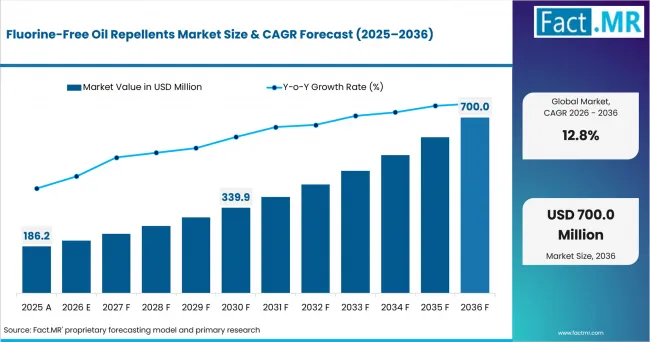
Fluorine Free Oil Repellents Market Market Value Analysis | Source: Fact.MR
What are the defining numbers behind Fluorine-Free Oil Repellents Market growth?
USD 490.0 million absolute opportunity by 2036.
- Demand Drivers in the Market
- Company checks are pushing textile mills to review fluorinated finishes and test safer options. Approval depends on clear proof that a new finish can stop oily stains, not only help the fabric release dirt during washing.
- Workwear needs finishes that last through rubbing, regular handling, and repeated washing. A product is more likely to gain approval when oil protection continues without changing the fabric color or comfort.
- Light oil protection gives mills a simple place to begin testing. It helps them see whether a fluorine-free finish works at a practical coating level before moving to stronger needs such as food-oil protection, repeated washing, or dry cleaning.
- Concerns about PFAS, chemical safety, and wastewater are keeping interest in replacement finishes high. Each product must work well with the other chemicals used during treatment and perform properly during drying and heating.
- Textile mills decide whether a product moves from a sample trial to regular orders. They check coating level and washing performance. Orders are more likely once the product gives consistent results without causing rejected batches or slowing production.
- Key Segments Analyzed
- By Chemistry: Dendrimer accounts for 32% share in 2026. It leads because it can provide oil protection without making the fabric feel heavy or changing its appearance.
- By Textile Type: Workwear holds 32% share in 2026. These fabrics need finishes that can handle regular washing, rubbing, and daily wear.
- By Performance Level: Light oil repellency represents 29% share in 2026. It is often the first level tested before companies move to stronger protection against food oils, repeated washing, or dry cleaning.
- By Application: Padding captures 34% share in 2026. It allows mills to apply the finish evenly and control how much product stays on the fabric.
- By End User: Mills contribute 34% share in 2026. They carry out production trials, check fabric quality, and manage any extra work when a finish does not perform well during regular production.
- Analyst Opinion at Fact.MR
- Shambhu Nath Jha, Senior Analyst at Fact.MR, states, “Textile companies are moving carefully when replacing fluorinated finishes. A new product must do more than help stains wash out; it also needs to stop oil from soaking into the fabric. Mills are more likely to approve finishes that give uniform results without changing the washing performance or normal production process.”
- Strategic Implications
- Dendrimer finishes should be tested on the exact fabric and stain type they are meant to handle. The test should use the same coating level, drying time, heat setting, and other treatment steps so the results show what caused the change.
- Oil protection and stain removal should be checked separately. A stain that washes out easily is not the same as a stain that never soaks into the fabric. Mixing these results can lead to the wrong product being approved.
- Mills should record how much finish is applied, how the fabric is dried, and how much heat is used. They should also check the color and feel of the fabric. Too much finish can make the fabric look or feel different, while too little heat can reduce oil protection.
- Workwear tests should reflect real use. Repeated washing and rubbing often show whether the finish can keep working over time. Companies need this proof before placing larger orders because problems found later can lead to wasted fabric and extra production costs.
China is projected to record a 17.3% CAGR through 2036. India is expected to grow at a 16.0% CAGR during the forecast period. Germany is anticipated to expand at a 14.7% CAGR through 2036. Brazil is forecast to register a 13.4% CAGR over the same period. The United States is expected to post a 12.2% CAGR by 2036.
How does the Fluorine-Free Oil Repellents Market break down by segment?
Dendrimer leads Chemistry with 32% share in 2026, while Light oil repellency leads Performance Level at 29%.
Why does Dendrimer lead the Chemistry segment?
Dendrimer holds 32% share in 2026.
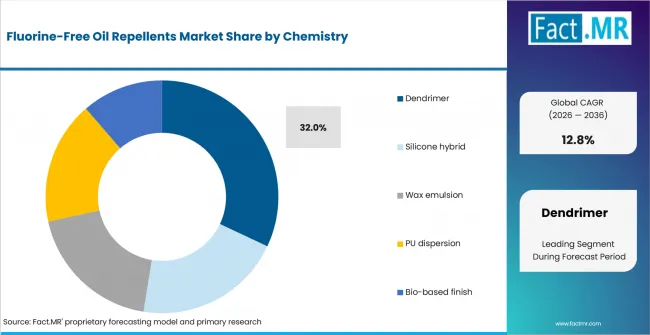
Fluorine Free Oil Repellents Market Analysis By Chemistry | Source: Fact.MR
Dendrimer leads because it can provide oil protection without making the fabric look or feel different. Mills test how much finish is needed, whether it mixes well with other treatment chemicals, and whether the fabric keeps its original color and feel.
Silicone hybrid, Wax emulsion, PU dispersion, and Bio-based finish make up the rest of the category. Each option must be checked after rubbing and repeated washing. Dendrimer is more likely to receive repeat orders when it gives the same result during regular production, not only during a small fabric test.
What keeps Workwear ahead in Textile Type?
Workwear accounts for 32% share in 2026.
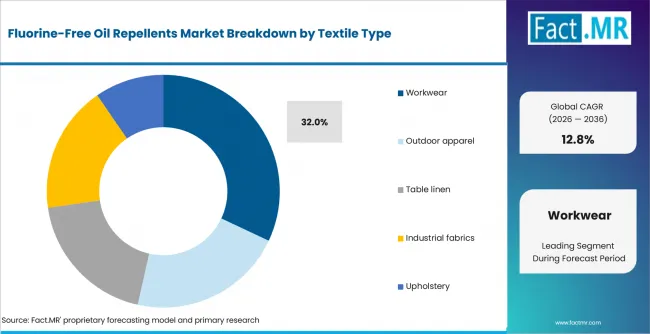
Fluorine Free Oil Repellents Market Analysis By Textile Type | Source: Fact.MR
Workwear needs strong oil protection because the fabric is washed often, handled every day, and exposed to heavy use. The finish must stay effective after repeated cleaning and rubbing. At the same time, the fabric should keep its normal color, feel, and comfort.
Outdoor apparel, Table linen, Industrial fabrics, and Upholstery form the remaining textile types. Workwear adoption increases when the finish performs well during regular production and does not require major changes to the existing treatment process.
How does Performance Level define the buying brief?
Light oil repellency leads with 29% share in 2026.
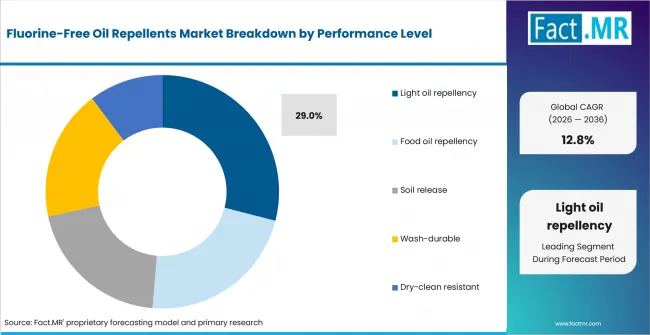
Fluorine Free Oil Repellents Market Analysis By Performance Level | Source: Fact.MR
This level is widely used for fabrics that need protection from small oil spills during normal use. Food oil repellency covers heavier stains, while Soil release looks at how easily marks come out during cleaning. Wash-durable and Dry-clean resistant finishes are judged by how well they continue to work after repeated care.
These results should not be treated as the same. A fabric may release stains during washing but still allow oil to soak in at first contact. Clear test rules help mills avoid choosing a finish that solves the wrong problem.
Why does Padding lead Application demand?
Padding holds 34% share in 2026.
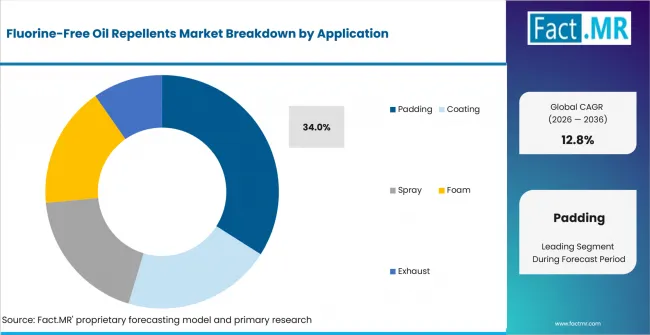
Fluorine Free Oil Repellents Market Analysis By Application | Source: Fact.MR
In this method, fabric is dipped into the treatment liquid and pressed between rollers. This helps spread the finish evenly and remove the extra liquid before drying. Mills can adjust the amount used according to the fabric and the level of oil protection needed.
Coating, Spray, Foam, and Exhaust account for the remaining share. Padding is commonly chosen for large fabric runs because it is easy to control and works well with standard production equipment. Its use depends on whether the treated fabric keeps the right color, softness, and protection after drying and heating.
Why do Mills lead the End User segment?
Mills lead with 34% share in 2026.
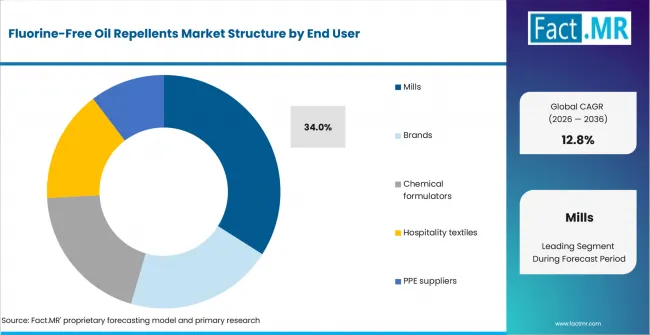
Fluorine Free Oil Repellents Market Analysis By End User | Source: Fact.MR
Mills lead because they turn the finish into a fabric that is ready for use. They prepare the treatment mix, apply the right amount, dry the fabric, and check its color, feel, oil protection, and strength after washing.
Brands, Chemical formulators, Hospitality textiles, and PPE suppliers make up the rest of the category. Mills carry the greatest production risk because any problem with the finish can lead to poor fabric quality, extra work, or rejected batches.
What is accelerating Fluorine-Free Oil Repellents Market adoption, and what is holding it back?
PFAS concerns and demand for fluorine-free finishes support market growth. Testing costs, oil protection limits, and changes to the fabric treatment process may slow adoption.
Drivers Impact Analysis
| DRIVER | (~) % IMPACT ON CAGR | GEOGRAPHIC RELEVANCE | IMPACT TIMELINE |
|---|---|---|---|
| Pfas persistence control in Dendrimer | +0.8% | China and export suppliers | Medium term (2-4 years) |
| Water discharge testing | +0.6% | Europe and North America | Short term (<= 2 years) |
| Workwear textiles approval programs | +0.5% | Asia Pacific | Medium term (2-4 years) |
| Local support near textile finishers | +0.4% | Global | Long term (>= 4 years) |
Source: Fact.MR analysis. Updated Jul 15, 2026
- PFAS controls in Dendrimer finishes: Stricter checks on PFAS are encouraging companies to test Dendrimer finishes. Approval depends on whether the finish can provide the required oil protection during normal fabric production.
- Water discharge testing: Mills also check how the finish affects wastewater. A product is more likely to move forward when it meets water safety needs and gives stable performance on the fabric.
- Workwear approval programs: Workwear finishes must pass tests for oil protection, washing, rubbing, color, and fabric feel. These checks help mills see whether the treatment can hold up during regular use.
- Local technical support: Nearby support helps mills solve trial problems more quickly. Staff can review the treatment mix, application method, heating process, and test goal before the next production run.
Opportunity Impact Analysis
| OPPORTUNITY | (~) % IMPACT ON CAGR | GEOGRAPHIC RELEVANCE | IMPACT TIMELINE |
|---|---|---|---|
| Grades tuned for Workwear textiles | +0.5% | Global | Medium term (2-4 years) |
| Application labs for Workwear | +0.4% | Asia Pacific and Europe | Short term (<= 2 years) |
| Rule-ready documentation | +0.4% | Europe and United Kingdom | Medium term (2-4 years) |
| Local trials with surface treatment buyers | +0.3% | India and Brazil | Long term (>= 4 years) |
Source: Fact.MR analysis. Updated Jul 15, 2026
- Finishes made for workwear: Workwear needs products designed for the exact fabric and level of oil protection required. Clear records should show how much finish was used, how the fabric was heated, and whether its color, feel, and strength stayed the same.
- Workwear testing labs: Early testing can show problems before a full production run begins. The best results come from using the same fabric, treatment steps, and heating conditions that will be used in the mill.
- Clear safety records: Complete records help companies finish chemical and product checks more quickly. These files should support the fabric test results, not replace proof that the finish provides the required oil protection.
- Local production trials: Local testing makes it easier to check the finish directly on production equipment. Repeat orders are more likely when changes to the mix, coating amount, or heating process give the same result in later runs.
Restraints Impact Analysis
| RESTRAINT | (~) % IMPACT ON CAGR | GEOGRAPHIC RELEVANCE | IMPACT TIMELINE |
|---|---|---|---|
| Qualification cost | -0.4% | Global processors | Medium term (2-4 years) |
| Fit limits in Workwear | -0.3% | Global | Short term (<= 2 years) |
| Documentation burden | -0.3% | Europe and North America | Medium term (2-4 years) |
| Scale-up risk | -0.2% | High-volume plants | Long term (>= 4 years) |
Source: Fact.MR analysis. Updated Jul 15, 2026
- Costly approval process: A new oil-repellent finish often needs several tests before it is approved. These tests use fabric, chemicals, staff time, and production space, so mills avoid long trials unless the product shows clear value.
- Workwear performance issues: A finish may work well on new fabric but lose its effect after washing or rubbing. Higher treatment levels or extra heat can also make the fabric look or feel different.
- Record requirements: Companies need clear information on chemical safety, water use, treatment steps, and fabric results. Any missing detail can delay approval and lead to more questions.
- Full-scale production risk: Results from a small test do not always carry over to regular production. Changes in mixing, heating, or fabric movement can cause uneven performance, wasted material, and extra work.
Which countries are scaling Fluorine-Free Oil Repellents Market fastest?
China 17.3%, India 16.0%, Germany 14.7%, Brazil 13.4%, United States 12.2%.
Regional analysis covers North America, Europe, Asia Pacific, Latin America, and the Middle East & Africa.
.webp "Top Country Growth Comparison Fluorine Free Oil Repellents Market Cagr (2026 2036)")
Top Country Growth Comparison Fluorine Free Oil Repellents Market Cagr (2026 2036) | Source: Fact.MR
| COUNTRY | CAGR |
|---|---|
| China | 17.3% |
| India | 16.0% |
| Germany | 14.7% |
| Brazil | 13.4% |
| United States | 12.2% |
Source: Fact.MR analysis. Updated Jul 15, 2026
Why does China record the fastest growth?
17.3% CAGR, driven by textile manufacturing and local product testing.
Strong textile production and regular testing of PFAS-free finishes support growth in China. Local testing helps mills check how a finish works on real fabric and make changes before full production begins. This is useful for oil protection, since a finish that works on a small sample may not give the same result on a large fabric run.
Repeat orders depend on steady results during normal production. Mills check the amount of finish used and washing performance before approving a product for regular use.
How is India converting trials into demand?
16.0% CAGR, supported by textile production and nearby testing support.
Growth comes from a strong textile base and wider testing of PFAS-free finishes. Nearby support helps mills compare different finish types, choose the right level of oil protection, and correct problems before another production run.
A finish is less likely to move forward when it needs too much product, changes the fabric color or makes the fabric feel different. Regular use begins only after the treatment gives steady results on the same fabric under normal mill conditions.
What makes Germany a disciplined qualification market?
14.7% CAGR, backed by strong textile testing and clear approval standards.
Textile companies in Germany carry out detailed tests before approving PFAS-free finishes. They check oil protection, stain removal, washing strength, and dry-cleaning performance separately. They also record how much finish is used and how the fabric is heated.
A product is more likely to gain approval when it keeps the right color, feel, and strength after rubbing and repeated cleaning. Clear test records also make it easier to repeat the same result during regular production.
Where does Brazil gain traction?
13.4% CAGR, supported by local textile production and practical fabric testing.
Local testing helps mills find out why a finish does not give the expected oil protection. The problem may come from the product, the amount applied, the drying process, or the way the test was carried out. A stain may wash out easily even after the oil has already soaked into the fabric, so both results need to be checked separately.
Demand increases when a finish protects the fabric without changing its look, feel, or washing performance. Mills also need to see the same result in more than one production run before placing regular orders.
How does the United States support approval work?
12.2% CAGR, driven by textile testing and clear product approval steps.
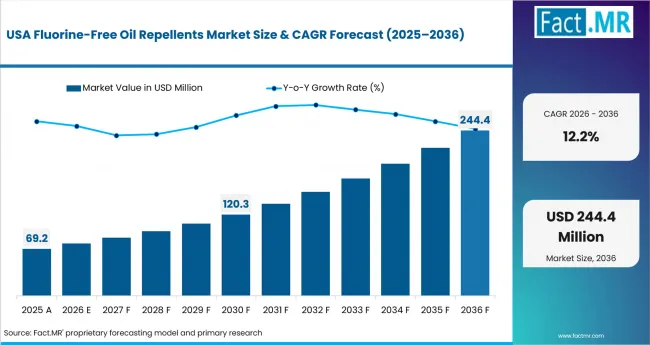
Fluorine Free Oil Repellents Market Country Value Analysis | Source: Fact.MR
Growth comes from wider testing of PFAS-free finishes and closer support during product approval. Mills review chemical safety, wastewater needs, and fabric performance together instead of treating them as separate checks.
Before testing starts, companies must clearly state whether the finish is meant for light oil protection, food-oil stains, easier cleaning, repeated washing, or dry cleaning. A clear test plan helps mills choose the right treatment steps and confirm that the fabric keeps its color, feel, and expected level of protection.
Who leads the Fluorine-Free Oil Repellents Market?
Rudolf Group and Archroma lead textile finish coverage, while CHT Germany GmbH, BT BIOTEX SDN BHD, and Tanatex strengthen PFAS-free and oil-repellent product support.
Companies compete through reliable fabric test results, quick technical help, and their ability to support mills from the first sample to regular production. For oil-repellent finishes, they must clearly show the level of protection, the treatment method, the heating steps, and how well the effect lasts after use and washing.
A strong market position depends on giving mills a product that works on existing equipment and comes with clear test records. Companies also need simple proof of oil protection and washing performance. Clear results carry more weight than broad product claims.
Which companies are the key providers?
Rudolf Group and Archroma are key providers. CHT Germany GmbH and BT BIOTEX SDN BHD are also profiled. Tanatex completes the company set.
- Rudolf Group
- Archroma
- CHT Germany GmbH
- BT BIOTEX SDN BHD
- Tanatex
Bibliography
- Brazilian Institute of Geography and Statistics. (2026, June 3). Brazilian industrial production changed 0.7% in April.
- Department of Chemicals and Petrochemicals. (2026, February 6). Annual report 2025–26. Ministry of Chemicals and Fertilizers, Government of India.
- European Commission, Directorate-General for Environment. (2025, June 18). Study highlights positive environmental impacts of increasing textile-to-textile recycling rates in the EU.
- European Commission, Directorate-General for Environment. (2025, October 16). Revised Waste Framework Directive enters into force to boost circularity of textile sector and slash food waste.
- Federal Statistical Office of Germany. (2026, July 6). New orders in manufacturing in May 2026: 1.9% on the previous month.
- National Bureau of Statistics of China. (2026, February 28). Statistical communiqué of the People’s Republic of China on the 2025 national economic and social development.
- National Institute for Public Health and the Environment. (2025, August 26). Next milestone in universal PFAS restriction process completed.
- U.S. Department of Energy. (2025, January 17). Scaling sustainable chemistry for an industrial transformation: Roundtable report.
- U.S. Environmental Protection Agency. (2025, May 14). EPA announces it will keep maximum contaminant levels for PFOA and PFOS.
This Report Addresses
- The report provides strategic intelligence on the market across Chemistry, Textile Type, Performance Level, Application, and End User choices.
- Regional outlook evaluates China and India, followed by Germany, Brazil, and the United States.
- Competitive analysis profiles Rudolf Group and Archroma, followed by CHT Germany GmbH, BT BIOTEX SDN BHD, and Tanatex.
- Product assessment covers Dendrimer finishes, Workwear textiles, Light oil repellency, Padding, and Mills.
- The market outlook considers PFAS concerns, oil protection, fabric testing, country growth, production needs, and approval requirements across key textile uses.
What does the Fluorine-Free Oil Repellents Market cover?
The market covers Dendrimer, Silicone hybrid, Wax emulsion, PU dispersion, and Bio-based finishes used to protect apparel and technical fabrics from oil.
It includes Workwear, Outdoor apparel, Table linen, Industrial fabrics, and Upholstery. Demand depends on oil protection, fabric feel, color, washing performance, and how well the finish works during regular production.
The scope excludes products used only for water protection or stain removal when oil repellency is not the main purpose.
What is included in the scope?
The scope includes fluorine-free finishes made to replace C6 and C8 fluorinated treatments in apparel and technical fabrics. Coverage includes Padding, Coating, Spray, Foam, and Exhaust applications.
The market includes product testing, mill trials, customer approval, and repeat orders. It also covers checks on the amount of finish used and oil protection.
What is excluded from the scope?
Products are excluded when they are not sold for oil protection on textiles. Application equipment, drying machines, and other machinery are also outside the scope.
General water-repellent treatments, basic raw materials, and unrelated textile chemicals are excluded unless they are sold as part of a fluorine-free oil-repellent finish.
How was the analysis built?
120+ sources, 35+ company portfolios, 25+ countries, and 20+ industry interviews.
- Primary Research: Primary research reflects discussions with formulators, mills, distributors, textile companies, and application staff working with fluorine-free oil repellents and PFAS-free textile finishes.
- Desk Research: Desk research reviews public policy, technical papers, government data, standards, chemical safety guidance, wastewater requirements, and textile-finishing information.
- Market-Sizing and Forecasting: The analysis combines the starting value, end value, growth rate, segment shares, company presence, country trends, product use, pricing, and approval barriers.
- Data Validation and Update Cycle: Validation checks compare company activity, policy changes, country developments, fabric testing, and production needs. Updates review whether finishes are moving from early trials to regular use while keeping washing strength and production results steady.
Segmentation
What is the report's scope and coverage?
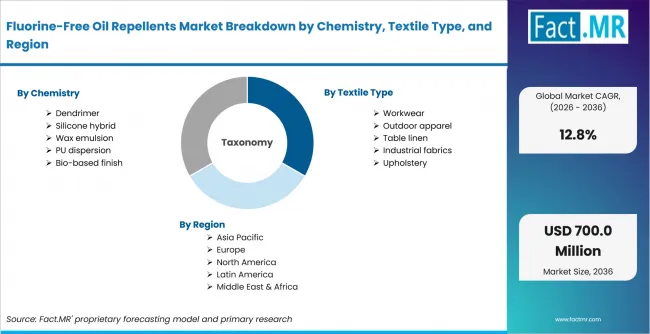
Fluorine Free Oil Repellents Market Breakdown By Chemistry, Textile Type, And Region | Source: Fact.MR
| Attribute | Details |
|---|---|
| Quantitative Units | USD Million in 2026 to USD Million by 2036 at CAGR |
| Market Definition | Non-fluorinated oil-repellent textile finishes intended to replace C6/C8 fluorochemicals in apparel and technical fabrics. |
| Chemistry | Dendrimer, Silicone hybrid, Wax emulsion, PU dispersion, Bio-based finish |
| Textile Type | Workwear, Outdoor apparel, Table linen, Industrial fabrics, Upholstery |
| Performance Level | Light oil repellency, Food oil repellency, Soil release, Wash-durable, Dry-clean resistant |
| Application | Padding, Coating, Spray, Foam, Exhaust |
| End User | Mills, Brands, Chemical formulators, Hospitality textiles, PPE suppliers |
| Regions Covered | North America, Europe, Asia Pacific, Central and South America, Middle East and Africa |
| Countries Covered | China, India, Germany, Brazil, United States |
| Key Companies Profiled | Rudolf Group, Archroma, CHT Germany GmbH, BT BIOTEX SDN BHD, Tanatex |
| Forecast Period | 2026 to 2036 |
| Approach | Hybrid top-down and bottom-up approach using Textile Repellents / PFAS-Free Finishes, segment shares, country growth, supplier mapping, and technical validation |
Source: Fact.MR analysis. Updated Jul 15, 2026
How is the market segmented?
-
By Chemistry:
- Dendrimer
- Silicone hybrid
- Wax emulsion
- PU dispersion
- Bio-based finish
-
By Textile Type:
- Workwear
- Outdoor apparel
- Table linen
- Industrial fabrics
- Upholstery
-
By Performance Level:
- Light oil repellency
- Food oil repellency
- Soil release
- Wash-durable
- Dry-clean resistant
-
By Application:
- Padding
- Coating
- Spray
- Foam
- Exhaust
-
By End User:
- Mills
- Brands
- Chemical formulators
- Hospitality textiles
- PPE suppliers
-
By Region:
- North America
- United States
- Canada
- Europe
- Germany
- United Kingdom
- France
- Italy
- Spain
- Asia Pacific
- China
- India
- Japan
- South Korea
- Australia
- Latin America
- Brazil
- Argentina
- Mexico
- Chile
- Middle East & Africa
- UAE
- Saudi Arabia
- South Africa
- North America
Frequently Asked Questions
Which Chemistry leads the Fluorine-Free Oil Repellents Market?
Which Textile Type leads the Fluorine-Free Oil Repellents Market?
Which country records the highest CAGR in the Fluorine-Free Oil Repellents Market?
What is the primary driver in the Fluorine-Free Oil Repellents Market?
What is the main restraint in the Fluorine-Free Oil Repellents Market?
Who worked on this report


Preview the report firsthand - request a free sample
Free SampleGet the brochure for pricing and purchase details
Download PDF