- Base Value(2025): 2.6 Bn
- Estimated Value(2026): 2.8 Bn
- Forecast Value (2036): 4.1 Bn
- CAGR (2026 - 2036): 4.0%
Foil Labels Market Forecast and Outlook By Fact.MR
In 2025, the global foil labels market was valued at USD 2.6 billion. Based on Fact.MR analysis, demand for foil labels is estimated to grow to USD 2.8 billion in 2026 and USD 4.1 billion by 2036. Fact.MR projects a CAGR of 4.0% during the forecast period.
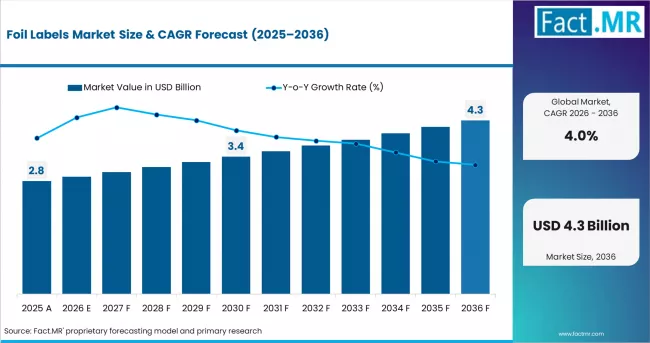
Foil Labels Market Market Value Analysis | Source: Fact.MR
Summary of Foil Labels Market
- Market Definition
- The market covers metallic and polymer foil labels applied via hot stamping, cold stamping, or transfer processes for brand identification, traceability, and compliance across automotive, construction, and logistics applications.
- Demand Drivers
- Automotive OEMs require traceability labels. This drives demand for hot stamping foil labels.
- E-commerce growth is increasing need for durable foil labels. Especially in China and Brazil.
- EU regulations are pushing certified labelling. This supports adoption in construction and consumer goods.
- Key Segments Analyzed
- By Material Type: Metal foils lead 51% in 2026. Driven by durability and premium finish needs.
- By Foil Type: Hot stamping leads 44%. Used in automotive and premium packaging.
- By End Use: Automotive leads in 2026. Supported by OEM identification requirements.
- Analyst Opinion at FACT.MR
- Shambhu Nath Jha, Senior Consultant at Fact.MR opnies, 'CXOs in the foil labels space will find that the strategic imperative is defending metal foil margin share against polymer substitution while capturing logistics and construction segment growth, where volume opportunity outpaces premium automotive procurement through 2036.'
- Strategic Implications
- Invest in polymer-based foil for cold stamping. Targets e-commerce and consumer durables demand.
- Develop automotive-grade hot stamping foils. Align with OEM standards in China and Germany.
- Expand local capacity or partnerships in Brazil and Southeast Asia. Reduces cost and improves supply reach.
- Methodology
- Based on converter revenues, volumes, and pricing. Validated with 2024–2025 data.
- Uses EU, US, and Brazil regulatory databases. Supports demand analysis.
- Forecasts include automotive output, logistics growth, and expert inputs.
| Metric | Value |
|---|---|
| Estimated Value in 2026 | USD 2.8 billion |
| Forecast Value in 2036 | USD 4.1 billion |
| Forecast CAGR (2026 to 2036) | 4.0% |
Source: Fact.MR analysis. Updated Apr 14, 2026
Between 2026 and 2036, the market is projected to generate USD 1.3 billion in absolute opportunity, reflecting incremental but structurally consistent growth. Demand is sustained by premium brand packaging requirements in automotive and consumer durables, expanding e-commerce logistics labelling volumes, and regulatory traceability mandates in construction and transport. Raw material cost volatility in aluminium and specialty polymer films, combined with growing pressure from digital and direct-print label alternatives in short-run packaging, constrains aggressive volume expansion.
Country growth reflects organized manufacturing sector depth, premium packaging regulatory compliance intensity, and e-commerce logistics infrastructure expansion. China leads at 5.6% CAGR through 2036 driven by the country's dominant position in consumer electronics and automotive manufacturing, where component identification and brand labelling drive high-volume foil label procurement. Brazil follows at 4.8% through expanding consumer durables and organized retail packaging compliance in South America's largest economy. The United States records 3.8% growth supported by automotive OEM traceability requirements and construction sector labelling standards. Germany posts 3.5% through premium industrial labelling in automotive and machinery manufacturing. Canada records 3.0%, sustained by replacement demand in construction and transport logistics labelling, constrained by limited domestic manufacturing growth.
Segmental Analysis
Foil Labels Market Analysis by Material Type
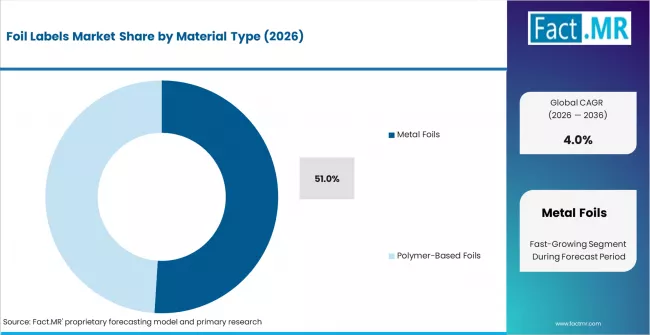
Foil Labels Market Analysis By Material Type | Source: Fact.MR
Based on FACT.MR's foil labels market report, consumption of metal foils is estimated to hold approximately 51% share in 2026 due to their superior durability, heat resistance, and premium metallic finish that automotive OEMs and consumer durables manufacturers specify for component identification and brand labelling where polymer alternatives cannot meet performance or aesthetic benchmarks.
- Avery Dennison Portfolio Expansion: In March 2024, Avery Dennison Corporation launched its AD Folia metallic label material range targeting automotive under-hood and premium durables applications, citing growing OEM demand for heat-resistant metallic foil identification labels compliant with ISO/TS 16949 automotive quality management standards across its European and North American converting operations. [1]
- 3M Polymer Foil Technology Development: In September 2024, 3M Company introduced its Scotchcal polymer-based foil film series for construction and transportation logistics labelling, offering improved UV resistance and cold-temperature adhesion over standard metal foil alternatives, targeting the growing demand for durable labels in outdoor construction component identification across North American and European markets. [2]
- Metal Foil Supply Chain Trend: The Aluminium Association reported in 2024 that specialty foil production for packaging and labelling applications reached approximately 420,000 metric tonnes globally, with automotive and consumer electronics label grades representing the highest-growth sub-categories, reflecting sustained industrial demand for metallic substrate foil labels across North America and Asia Pacific manufacturing channels. [3]
Foil Labels Market Analysis by Foil Type
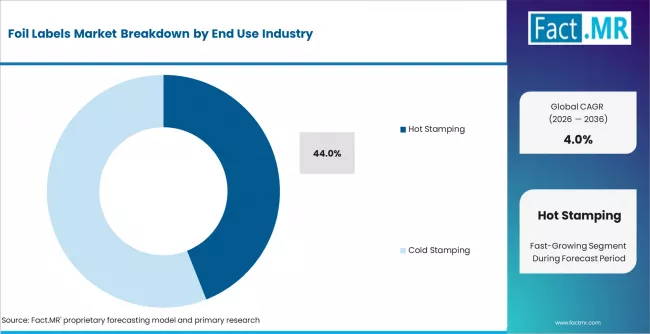
Foil Labels Market Analysis By Foil Type | Source: Fact.MR
Based on FACT.MR's foil labels market report, hot stamping foils are estimated to hold approximately 44% share in 2026 due to their permanent adhesion, high-definition metallic finish output, and compatibility with automated high-speed label application equipment used in automotive, premium packaging, and consumer durables manufacturing lines across all major production markets.
- Multi-Color Corporation Capacity Investment: In June 2024, Multi-Color Corporation announced the expansion of its hot stamping label converting capacity at its Batavia, Ohio facility, adding two Gietz hot stamping presses targeting automotive nameplate and premium spirits packaging customers, reflecting strong OEM demand for high-volume hot stamping foil label production in North American industrial and premium consumer brand segments. [4]
- UPM Raflatac Cold Foil Innovation: In November 2024, UPM Raflatac launched its RAFNXT+ cold foil label range incorporating 30% recycled polymer content, targeting food and beverage and consumer goods brand owners seeking sustainable foil label formats compliant with EU packaging sustainability regulations while maintaining premium metallic appearance across retail and gifting product categories. [5]
- Transfer Foil Logistics Adoption Trend: Brady Corporation's 2024 annual report noted growing adoption of transfer foil labels in transportation and logistics sector applications, including pallet identification, container marking, and hazardous material labelling, driven by regulatory requirements for durable, tamper-evident identification in cross-border freight and warehouse management operations across North America and Europe. [6]
Foil Labels Market Analysis by End Use
Based on FACT.MR's foil labels market report, automotive is estimated to lead the end-use segment in 2026 as OEM component traceability mandates, brand identification requirements, and regulatory compliance for under-hood, exterior, and interior labelling collectively create the highest-volume and most specification-driven demand channel for metal and hot stamping foil label procurement globally.
- Henkel Automotive Label Partnership: In April 2024, Henkel AG announced the extension of its pressure-sensitive label adhesive supply agreement with three major European automotive OEMs, supporting foil label integration in EV battery pack identification, chassis component marking, and exterior brand badge applications, reflecting the growing role of certified adhesive foil labels in electric vehicle manufacturing quality assurance programmes. [7]
- Construction Sector Compliance Labelling: In January 2025, the European Commission issued updated guidance under EU Construction Products Regulation requiring durable material identification labels on structural components exported across Member States, directly expanding procurement of metal foil and hot stamping labels by construction materials manufacturers in Germany, France, and Poland seeking CPR compliance for cross-border product certification. [8]
- E-Commerce Logistics Label Growth: Xerox Corporation's 2024 investor presentation reported accelerating demand for durable pressure-sensitive and foil-format labels in e-commerce fulfilment and third-party logistics operations, with label print volumes in North American warehouse operations growing at approximately 12% annually through 2024 as online retail order volumes expanded across domestic and cross-border channels. [9]
Drivers, Restraints, and Opportunities
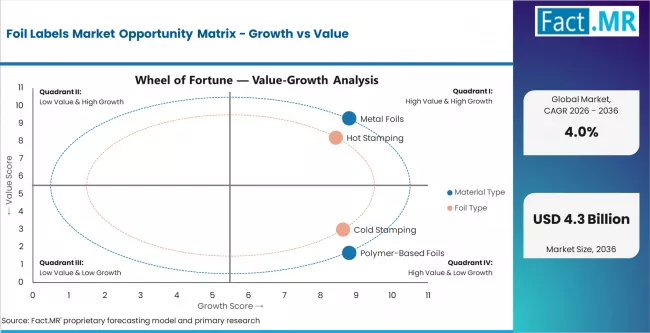
Foil Labels Market Opportunity Matrix Growth Vs Value | Source: Fact.MR
FACT.MR analysts observe that the global foil labels market has developed as a mature industrial labelling category, valued at USD 2.6 billion in 2025. Demand is shaped by the intersection of automotive OEM traceability compliance, premium consumer durables brand identification requirements, and growing e-commerce logistics labelling volumes across China, Brazil, and North America that collectively sustain positive volume growth across the forecast period.
The market is experiencing a material substitution dynamic. Metal foil labels face pricing pressure from polymer-based alternatives in logistics and construction end uses where metallic finish is not a specification requirement. However, premium automotive and consumer electronics labelling sustains metal foil volumes at higher price points, and hot stamping foil demand continues to grow in premium spirits, cosmetics, and gift packaging categories where visual differentiation drives purchasing decisions.
- EU Packaging Sustainability Regulation: The EU Packaging and Packaging Waste Regulation, revised in 2024 with mandatory recycled content requirements phased in from 2030, is compelling European label converters including UPM Raflatac and Avery Dennison to develop certified recycled polymer foil label formats, creating a product reformulation cycle that expands premium polymer foil market share relative to conventional metal foil across European food, beverage, and consumer goods applications.
- China Automotive Labelling Standards Expansion: China's GB/T 38588-2020 automotive labelling standard, with enforcement and compliance auditing intensified by SAMR from 2024, is requiring domestic and foreign automotive OEMs operating Chinese facilities to specify certified metal foil component identification labels meeting stringent temperature resistance and adhesion durability criteria, sustaining structured high-volume demand for metal foil label procurement through Chinese automotive supply chains.
- Brazil Organized Retail Packaging Growth: Brazil's ABNT NBR 15789 consumer product labelling standard updates, published in 2024 with expanded applicability to consumer durables and electronics packaging, are driving demand for certified foil label formats among Brazilian consumer goods manufacturers and importers seeking retail shelf compliance, reinforcing foil label procurement growth in South America's largest consumer market at a 4.8% CAGR trajectory through 2036.
Regional Analysis
The global foil labels market is analysed across Asia Pacific, North America, Europe, Latin America, and Middle East and Africa, covering key countries with distinct demand profiles shaped by manufacturing sector composition, regulatory labelling compliance requirements, e-commerce logistics growth, and premium packaging intensity. The full report offers market attractiveness analysis across manufacturing depth, regulatory compliance frameworks, and end-use sector procurement volumes.
.webp "Top Country Growth Comparison Foil Labels Market Cagr (2026 2036)")
Top Country Growth Comparison Foil Labels Market Cagr (2026 2036) | Source: Fact.MR
| Country | CAGR (2026 to 2036) |
| China | 5.6% |
| Brazil | 4.8% |
| USA | 3.8% |
| Germany | 3.5% |
| Canada | 3.0% |
Source: Fact.MR analysis. Updated Apr 14, 2026
Source: Fact.MR (FACT.MR) analysis, based on proprietary forecasting model and primary research
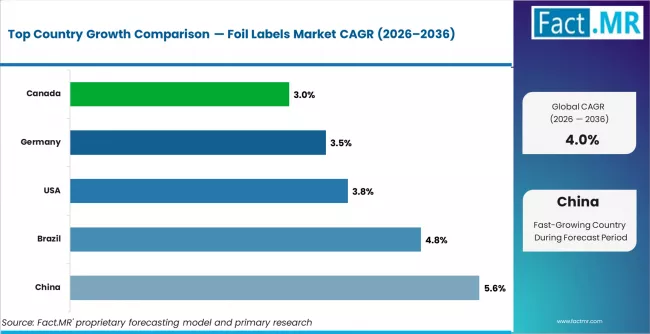
Foil Labels Market Cagr Analysis By Country | Source: Fact.MR
Asia Pacific Foil Labels Market
Asia Pacific is the largest volume region. Growth is supported by strong manufacturing output and expanding retail packaging demand. China remains the core market, while Southeast Asia adds incremental volume. Avery Dennison, UPM Raflatac, and local converters lead supply.
- China: The market is driven by large-scale industrial production. Growth is ~5.6% CAGR through 2036. Automotive and electronics sectors dominate demand. GB/T labelling standards require certified foil labels. Enforcement strengthened from 2024, increasing compliance-driven procurement. OEMs use long-term supplier contracts. E-commerce logistics further boosts polymer foil label demand.
- Brazil: The market is expanding through retail and consumer goods packaging. Growth is 4.8% CAGR through 2036. Updated ABNT standards increased compliance requirements in 2024. Demand is driven by organized retail and durables packaging. Supply remains fragmented with strong price competition. E-commerce platforms are increasing demand for logistics and return labels.
FACT.MR covers China, Japan, South Korea, India, ASEAN, and ANZ. Includes compliance benchmarks, logistics trends, and forecasts.
North America Foil Labels Market
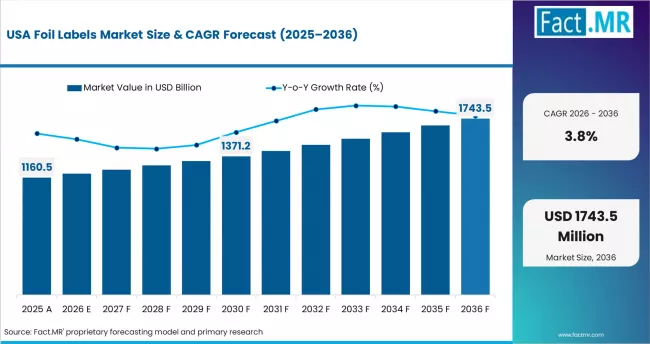
Foil Labels Market Country Value Analysis | Source: Fact.MR
North America is a high-value market. Growth is driven by automotive OEM demand and premium packaging applications. Construction and logistics add secondary demand. Multi-Color, Avery Dennison, and Brady lead supply.
- USA: The market is shaped by OEM-driven procurement. Growth is 3.8% CAGR through 2036. Automotive and premium packaging remain core segments. Investment in hot stamping capacity increased in 2024. Supplier selection is based on strict approval systems. Logistics and warehouse labelling provide additional growth support.
- Canada: The market shows stable and replacement-led demand. Growth is 3.0% CAGR through 2036. Construction materials and transport sectors drive usage. Standards-based compliance supports steady procurement. Supply flows through distributor networks. Limited manufacturing expansion keeps growth moderate.
FACT.MR covers the U.S., Canada, and Mexico. Includes OEM trends, compliance data, and forecasts.
Europe Foil Labels Market
Europe is highly regulation-driven. Sustainability and material compliance shape demand. Automotive and industrial applications dominate. Avery Dennison, UPM Raflatac, and Henkel lead supply.
- Germany: The market is supported by strong industrial demand. Growth is 3.5% CAGR through 2036. Automotive and machinery sectors are key drivers. EV production is creating new labelling needs. Procurement follows strict OEM standards and certifications. Long-term supplier relationships reduce switching and price volatility.
FACT.MR covers Germany, France, the UK, Italy, Spain, and Rest of Europe. Includes regulatory data, sustainability trends, and forecasts
Competitive Aligners for Market Players
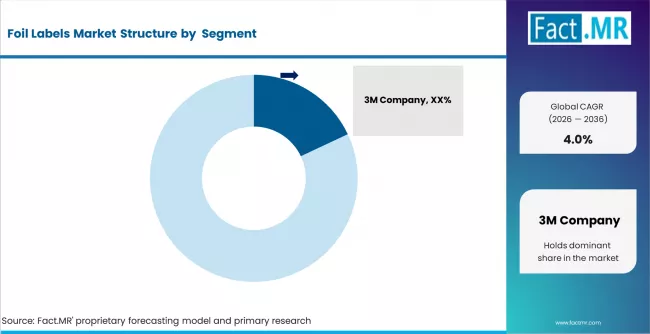
Foil Labels Market Analysis By Company | Source: Fact.MR
The global foil labels market is moderately fragmented. A few large players hold a strong share, but many regional converters remain active. Companies like Avery Dennison, 3M, UPM Raflatac, Multi-Color, and Brady lead the market. Together, they account for nearly half of global revenue.
Competition is not just about scale. It depends on converting capability and material range. Certification is also critical, especially for automotive and industrial use. Sustainability is becoming a key factor, particularly in Europe.
Avery Dennison and UPM Raflatac have a clear advantage. Their vertically integrated model gives them control over materials and quality. They manage substrates, adhesives, and label production under one system. This ensures consistent performance and compliance. Their approval from major automotive OEMs strengthens their position. These relationships often run for multiple years. Smaller players find it difficult to compete at this level.
Brady Corporation focuses on industrial and logistics labelling. Its strength lies in offering complete solutions. It combines labels, printers, and software into one system. This creates strong customer dependence and long-term contracts. Large buyers follow a dual-sourcing strategy. They work with global suppliers for critical applications. At the same time, they use regional converters for standard products. This limits pricing power in bulk segments like logistics and construction.
Automotive and electronics labelling require strict approvals. This creates high switching barriers. In Europe, sustainability rules are tightening. Recycled materials and compliance add cost pressure. Smaller converters may struggle to keep up.
Key Players
- 3M Company
- Avery Dennison Corporation
- UPM Raflatac
- Hub Labels
- Sappi Lanier
- Multi-Color Corporation
- E. I. du Pont de Nemours and Company
- Henkel AG and Company
- Brady Corporation Limited
- Cannon Inc.
- Xerox Corporation
- Cenveo Inc.
Scope of Report
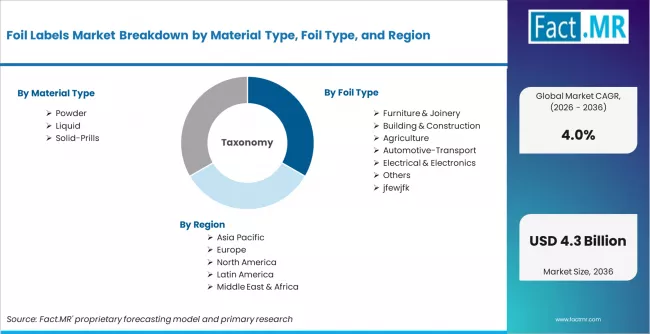
Foil Labels Market Breakdown By Material Type, Foil Type, And Region | Source: Fact.MR
| Quantitative Units | USD 2.8 billion (2026) to USD 4.1 billion (2036), at a CAGR of 4.0% |
|---|---|
| Market Definition | Metallic and polymer-based foil labels applied via hot stamping, cold stamping, or transfer processes for brand identification, component traceability, and regulatory compliance across automotive, construction, transport, and consumer durables end uses globally. |
| Material Type Segmentation | Metal Foils, Polymer-Based Foils |
| Foil Type Segmentation | Hot Stamping Foils, Cold Stamping Foils, Transfer Foils |
| End Use Segmentation | Automotive, Construction, Transportation and Logistics, Consumer Durables, Others |
| Regions Covered | North America, Europe, Asia Pacific, Latin America, Middle East and Africa |
| Countries Covered | USA, Canada, Mexico, Germany, UK, France, Italy, Spain, Nordic, BENELUX, China, Japan, South Korea, India, ASEAN, Australia and New Zealand, Brazil, Argentina, Chile, Saudi Arabia, GCC, Turkey, South Africa, Rest of MEA |
| Key Companies Profiled | 3M Company, Avery Dennison Corporation, UPM Raflatac, Hub Labels, Sappi Lanier, Multi-Color Corporation, E. I. du Pont de Nemours and Company, Henkel AG and Company, Brady Corporation Limited, Cannon Inc., Xerox Corporation, Cenveo Inc. |
| Forecast Period | 2026 to 2036 |
| Approach | Hybrid top-down and bottom-up model using label converter revenue disclosures, foil label volumes by material and format, automotive OEM procurement data, e-commerce logistics label demand benchmarks, and primary interviews with label converters and packaging procurement managers. |
Source: Fact.MR analysis. Updated Apr 14, 2026
Foil Labels Market by Segments
-
By Material Type:
- Metal Foils
- Polymer-Based Foils
-
By Foil Type:
- Hot Stamping Foils
- Cold Stamping Foils
- Transfer Foils
-
By End Use:
- Automotive
- Construction
- Transportation and Logistics
- Consumer Durables
- Others
-
By Region:
-
North America
- United States
- Canada
- Mexico
-
Latin America
- Brazil
- Mexico
- Argentina
- Chile
- Rest of Latin America
-
Western Europe
- Germany
- United Kingdom
- France
- Italy
- Spain
- Nordic Countries
- BENELUX
- Rest of Western Europe
-
Eastern Europe
- Russia
- Poland
- Hungary
- Balkan and Baltic
- Rest of Eastern Europe
-
East Asia
- China
- Japan
- South Korea
-
South Asia and Pacific
- India
- ASEAN
- Australia and New Zealand
- Rest of South Asia and Pacific
-
Middle East and Africa
- Kingdom of Saudi Arabia
- Other GCC Countries
- Turkey
- South Africa
- Rest of Middle East and Africa
-
Bibliography
- [1] Avery Dennison Corporation. (2024). Annual Report 2024: Pressure-Sensitive Materials Segment Performance and Industrial Label Demand Commentary. February 2024. averydennison.com
- [2] 3M Company. (2024). Scotchcal Polymer-Based Foil Film Series Launch for Construction and Transportation Logistics Labelling Applications. September 2024. 3m.com
- [3] The Aluminium Association. (2024). Aluminum Industry Outlook: Specialty Foil Production for Packaging and Labelling Applications Global Volume and End-Use Benchmarks 2024. aluminumassociation.org
- [4] Multi-Color Corporation. (2024). Batavia Ohio Facility Expansion: Gietz Hot Stamping Press Capacity Addition for Automotive Nameplate and Premium Spirits Packaging. June 2024. mcclabel.com
- [5] UPM Raflatac. (2024). RAFNXT+ Cold Foil Label Range Launch: 30% Recycled Polymer Content for EU Packaging Regulation Compliance. November 2024. upmraflatac.com
- [6] Brady Corporation. (2024). Annual Report 2024: Transportation and Logistics Sector Foil Label Adoption in Freight Identification and Warehouse Management Operations. brady.com
- [7] Henkel AG and Company KGaA. (2024). Automotive OEM Pressure-Sensitive Adhesive Supply Agreement Extension for EV Battery and Chassis Foil Label Integration. April 2024. henkel.com
- [8] European Commission. (2025). Updated Guidance on EU Construction Products Regulation: Durable Material Identification Labelling Requirements for Structural Components. January 2025. ec. europa.eu
- [9] Xerox Corporation. (2024). Investor Presentation: Industrial and E-Commerce Label Demand Growth in North American Warehouse and Fulfilment Operations. xerox.com
This Report Addresses
- Strategic intelligence on foil label demand across automotive OEM traceability, premium consumer durables packaging, construction compliance, and e-commerce logistics labelling categories globally.
- Market forecast from USD 2.8 billion in 2026 to USD 4.1 billion by 2036 at a CAGR of 4.0%.
- Growth opportunity mapping across hot stamping automotive foil labels, polymer-based cold foil logistics formats, and sustainable recycled-content foil labels under EU packaging regulation.
- Segment-wise analysis by material type (metal foils, polymer-based foils), foil type (hot stamping, cold stamping, transfer), and end use (automotive, construction, transport, consumer durables, others).
- Regional outlook covering Asia Pacific manufacturing-led volume growth, North America automotive specification demand, and European packaging sustainability regulation-driven reformulation.
- Competitive landscape of leading players including Avery Dennison Corporation, 3M Company, UPM Raflatac, Multi-Color Corporation, Brady Corporation, Henkel AG, and Cenveo Inc.
- Regulatory impact analysis covering EU Packaging and Packaging Waste Regulation recycled content mandates, China GB/T 38588-2020 automotive labelling standards, and US automotive IATF 16949 compliance requirements.
- Report delivery in PDF, Excel datasets, and presentation formats supported by primary interviews, regulatory databases, manufacturer revenue data, and automotive and logistics sector procurement benchmarks.
Foil Labels Market Definition
The foil labels market covers decorative and functional labels produced using metallic or polymer-based foil substrates, applied to products via hot stamping, cold stamping, or transfer processes. These labels serve brand identification, component traceability, and regulatory compliance functions across automotive, construction, consumer durables, and logistics end uses globally.
Foil Labels Market Inclusions
Includes global and regional market sizes from 2026 to 2036 by material type, foil type, and end use. Covers metal and polymer foil labels across hot stamping, cold stamping, and transfer formats used in automotive, construction, transport, consumer durables, and other industrial applications across major regions.
Foil Labels Market Exclusions
Excludes paper labels, digital printed labels, and RFID tags not integrated with foil substrates. Also excludes finished labelled products and label application equipment. Focus is strictly on foil label materials and converted label products supplied to end-use manufacturers and packaging converters.
Foil Labels Market Research Methodology
- Primary Research
- Interviews with label converters, packaging engineers, procurement managers at automotive OEMs, and construction materials distributors across key markets.
- Desk Research
- Analysis of Avery Dennison and 3M annual reports, EU packaging labelling regulations, US automotive traceability standards, and label industry trade data from 2024 to 2025.
- Market-Sizing and Forecasting
- Hybrid model integrating top-down revenue estimates from label company disclosures with bottom-up volume forecasts by material type, foil format, and end-use application.
- Data Validation and Update Cycle
- Validated through label manufacturer revenue data, end-use sector procurement volumes, and expert interviews with regular annual updates.
Frequently Asked Questions
How large is the global foil labels market in 2025?
What will the market size be in 2026?
What is the projected market size by 2036?
What is the expected CAGR from 2026 to 2036?
Which material type segment is poised to lead the foil labels market?
Which foil type segment dominates the market?
Which country shows the fastest growth in the foil labels market?
What is driving demand in the foil labels market?
Which material type dominates the market?
Why are polymer foil labels gaining traction?
Which end-use industry leads demand?
What is the key challenge for manufacturers?
Who worked on this report


Preview the report firsthand - request a free sample
Free SampleGet the brochure for pricing and purchase details
Download PDF