Fluorine-Free Oil and Grease Repellents Market
Fluorine-Free Oil and Grease Repellents Market Size and Share Forecast Outlook 2026 to 2036
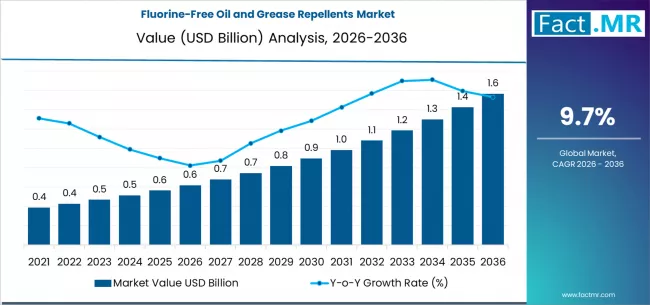
Fluorine-free oil and grease repellents market is projected to grow from USD 0.6 billion in 2026 to USD 1.6 billion by 2036, at a CAGR of 9.7%. Silicone-Based Repellents will dominate with a 30.0% market share, while food contact paper & packaging will lead the application segment with a 32.0% share.
Fluorine-Free Oil and Grease Repellents Market Forecast and Outlook 2026 to 2036
The global market for fluorine-free oil and grease repellents is accelerating rapidly, propelled by the urgent need to replace PFAS-based chemistries across multiple industries without sacrificing critical performance. Valued at USD 0.62 billion in 2026, the market is projected to reach USD 1.56 billion by 2036, expanding at a CAGR of 9.7% over the forecast period.
Key Takeaways from the Fluorine-Free Oil and Grease Repellents Market
- Market Value for 2026: USD 0.62 Billion
- Market Value for 2036: USD 1.56 Billion
- Forecast CAGR (2026-2036): 9.7%
- Leading Chemistry Type Share (2026): Silicone-Based Repellents (30%)
- Leading Application Share (2026): Food Contact Paper & Packaging (32%)
- Leading Functionality Share (2026): Oil Repellency (34%)
- Key Players in the Market: Chemours (Fluorine-Free Segment), Archroma, Huntsman Corporation, Dow Inc., Rudolf Group
Silicone-based repellents constitute the dominant chemistry, holding a 30% market share. Food contact paper and packaging represent the largest application segment, accounting for 32% of demand. The functionality of oil repellency is the primary driver, commanding a 34% share, as this characteristic is essential for preventing unsightly and unhygienic leaks and stains.
This robust growth is a direct consequence of stringent and expanding global regulations banning per- and polyfluoroalkyl substances (PFAS) in food packaging, textiles, and consumer goods. These regulations, coupled with strong consumer and brand demand for safer, sustainable products, have created an immediate and large-scale need for effective alternatives. Fluorine-free chemistries must now deliver the high-performance barrier properties once exclusive to fluorochemicals, protecting products from oils, greases, and aqueous stains while ensuring environmental safety and regulatory compliance.
Innovation is intensely focused on developing novel polymer architectures, from advanced silicones to bio-based waxes and polyurethane dispersions, that can replicate the low surface energy and durability of PFAS. The success of this market hinges on closing the performance gap for the most demanding applications, enabling industries to transition without compromising on quality or functionality.
Metric
| Metric | Value |
|---|---|
| Market Value (2026) | USD 0.62 Billion |
| Market Forecast Value (2036) | USD 1.56 Billion |
| Forecast CAGR (2026-2036) | 9.7% |
Category
| Category | Segments |
|---|---|
| Chemistry Type | Silicone-Based Repellents, Hydrocarbon & Paraffin-Based Coatings, Bio-Based & Enzymatic Repellents, Polyurethane Dispersions (PUDs), Other Fluorine-Free Repellent Chemistries |
| Application | Food Contact Paper & Packaging, Apparel & Textiles, Industrial & Technical Fabrics, Automotive Upholstery & Interiors, Medical & Hygiene Textiles |
| Functionality | Oil Repellency, Grease Resistance, Stain Protection, Waterproof & Breathable Coatings, Hybrid/Multi-Functional Coatings |
| Region | North America, Latin America, Western Europe, Eastern Europe, East Asia, South Asia & Pacific, MEA |
Segmental Analysis
By Chemistry Type, Which Alternative is Gaining the Broadest Adoption?
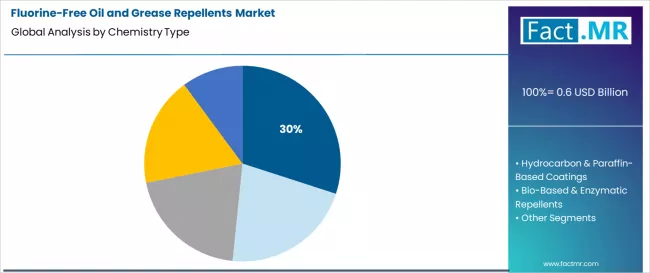
Silicone-based repellents lead the market with a 30% share. Their prominence is based on a strong ability to create an effective barrier against both water and low-surface-tension oils, though typically not matching the extreme grease resistance of long-chain PFAS. Silicone chemistry offers good durability, flexibility, and a more favorable environmental profile.
Continuous improvements in silicone-organic hybrids and cross-linking technologies are enhancing their oil repellency performance, making them the most versatile and widely applicable current alternative across packaging and textiles.
By Application, Which Sector Faces the Most Immediate Regulatory Deadline?
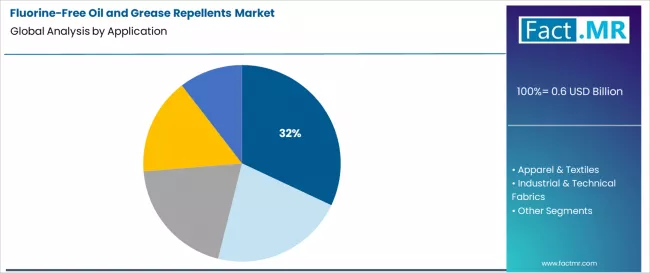
Food contact paper and packaging represents the largest application segment, holding a 32% share. This sector is under direct and immediate pressure from regulations like those in the EU and several states in the USA, which explicitly ban PFAS in food packaging due to leaching concerns.
The need for safe, effective grease barriers for items like fast-food wrappers, pizza boxes, and bakery paper is non-negotiable for food safety and brand integrity, creating an urgent and high-volume demand for certified fluorine-free solutions.
By Functionality, Which Performance Metric is the Hardest to Replicate?
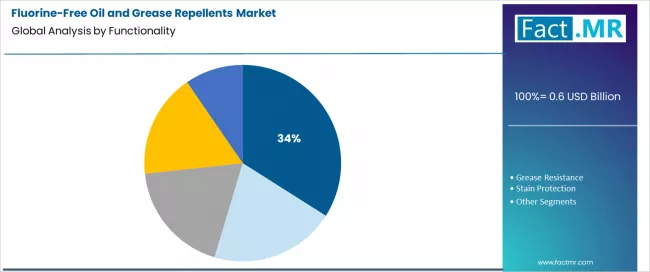
Oil repellency is the leading functionality, commanding a 34% share. Repelling low-surface-tension oils and greases is the most technically challenging performance characteristic to achieve without fluorochemistry.
Success in this area is the primary benchmark for any alternative. The development focus is on creating surface structures and chemistries that fundamentally resist wetting by oleophilic substances, a requirement critical not only for packaging but also for stain-resistant textiles and industrial fabrics.
What are the Drivers, Restraints, and Key Trends of the Fluorine-Free Repellents Market?
The primary market driver is the unprecedented wave of binding legislation and regulatory proposals targeting PFAS globally. Bans in food packaging, consumer textiles, and firefighting foam are creating clear, non-discretionary demand for alternatives. Simultaneously, major brands and retailers are making public commitments to eliminate PFAS from their products and supply chains, driven by consumer awareness and ESG goals. This regulatory and market pull is transforming the sector from niche to mainstream almost overnight.
A significant market restraint is the persistent performance gap, particularly in achieving high levels of grease resistance and durability equivalent to C8 PFAS. Some alternatives may also introduce new challenges, such as potential impacts on recyclability of treated paper or the need for higher application weights. The higher cost of some advanced alternatives and the capital required for manufacturers to reformulate products and retool application processes can also slow the transition, especially for small and medium-sized enterprises.
Key trends include the intensive development of bio-based and circular chemistries derived from renewable resources like plant oils, waxes, and chitosan, which offer enhanced sustainability credentials. There is a strong move toward multi-layer and hybrid coating systems that combine different chemistries to achieve synergistic performance. The market is also leveraging nanotechnology and surface structuring to create physically textured barriers that enhance repellency without relying solely on chemical surface energy modification.
Analysis of the Fluorine-Free Repellents Market by Key Countries
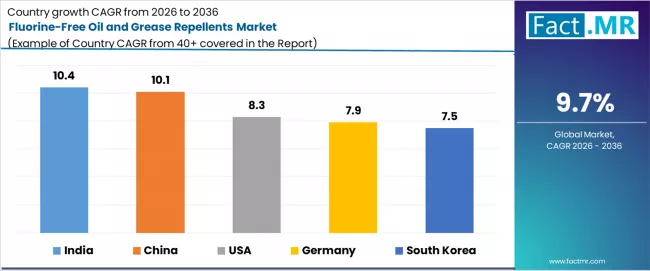
| Country | CAGR (2026-2036) |
|---|---|
| India | 10.40% |
| China | 10.10% |
| USA | 8.30% |
| Germany | 7.90% |
| South Korea | 7.50% |
How do India’s Manufacturing Base and Export Compliance Drive Growth?
India’s leading CAGR of 10.40% is fueled by its massive textile and packaging manufacturing sectors, which serve both domestic and export markets. Compliance with destination regulations in the EU and North America is mandatory for market access.
This, combined with growing domestic awareness, is compelling rapid adoption of certified fluorine-free alternatives. India’s strong chemical production capabilities position it to become a key supplier and consumer of cost-effective, high-performance replacement chemistries.
What is the Impact of China’s Regulatory Evolution and Supply Chain Dominance?
China’s 10.10% growth stems from its dual role as the world’s primary manufacturing hub and a jurisdiction developing its own chemical management policies. While producing for global brands with PFAS-free mandates, China is also implementing its own Action Plan for the Control of Persistent Organic Pollutants. This dual pressure drives substantial investment in R&D and production scaling for silicone-based, hydrocarbon, and bio-based alternatives within its integrated supply chain.
How does the USA’s State-Level Legislation and Market Leadership Shape Demand?
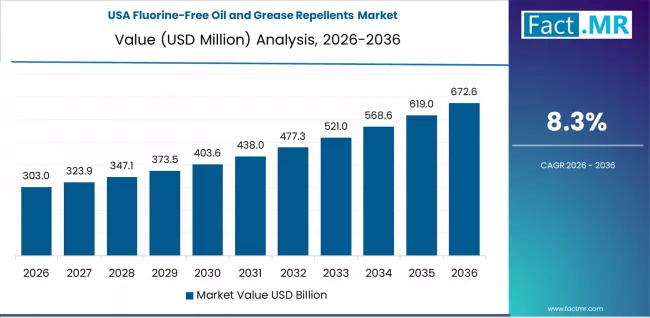
The USA’s 8.30% CAGR is propelled by pioneering state-level bans such as those in California, Maine, and New York, and the EPA’s strategic roadmap on PFAS. The country’s large food service and packaging industry requires immediate solutions.
The presence of innovative chemical companies and a proactive brand landscape fosters a dynamic environment for commercializing high-performance alternatives, setting de facto global standards for the sector.
Why is Germany a Hub for High-Performance, Sustainable Material Science?
Germany’s 7.90% growth reflects its leadership in chemical engineering and its central role in shaping EU regulations. German companies are at the forefront of developing advanced bio-based and high-durability non-fluorinated finishes.
The market demands solutions that excel in rigorous lifecycle assessments and align with the EU’s circular economy action plan, pushing innovation beyond mere drop-in replacements to holistic sustainable design.
What Role does South Korea’s Advanced Materials and Export Focus Play?
South Korea’s 7.50% growth is anchored in its advanced materials sector and export-oriented industries like automotive and electronics. The need for high-performance repellents in technical textiles and premium packaging for export, combined with global supply chain requirements, drives targeted R&D. South Korean firms are innovating in areas like advanced polyurethane dispersions and nanocomposite coatings for specialized applications.
Competitive Landscape of the Fluorine-Free Repellents Market
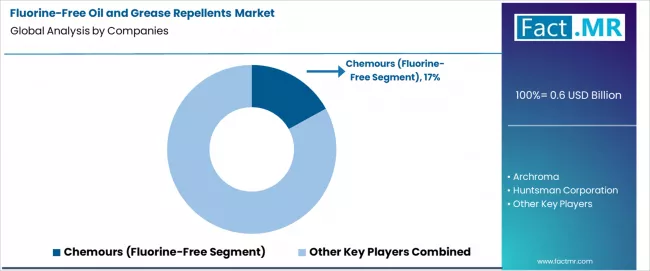
The competitive landscape features established specialty chemical companies, including former fluorochemical producers, aggressively pivoting their portfolios. Leaders like Chemours (with its non-fluorinated Capstone® products) and Archroma compete based on proprietary polymer technologies, deep application expertise, and the ability to secure crucial regulatory certifications.
Competition centers on demonstrating validated performance in end-use applications, providing comprehensive technical support for customer reformulation, and ensuring global supply chain consistency. A key differentiator is offering a complete portfolio of alternatives tailored to different performance tiers and applications, from cost-effective paraffins to high-end silicone hybrids.
Key Players in the Fluorine-Free Oil and Grease Repellents Market
- Chemours (Fluorine-Free Segment)
- Archroma
- Huntsman Corporation
- Dow Inc.
- Rudolf Group
Scope of Report
| Items | Values |
|---|---|
| Quantitative Units | USD Billion |
| Chemistry Type | Silicone-Based, Hydrocarbon/Paraffin, Bio-Based/Enzymatic, Polyurethane Dispersions (PUDs), Other Fluorine-Free |
| Application | Food Contact Packaging, Apparel/Textiles, Industrial Fabrics, Automotive Interiors, Medical/Hygiene Textiles |
| Functionality | Oil Repellency, Grease Resistance, Stain Protection, Waterproof/Breathable Coatings, Hybrid Performance |
| Key Countries | India, China, USA, Germany, South Korea |
| Key Companies | Chemours (Fluorine-Free Segment), Archroma, Huntsman Corporation, Dow Inc., Rudolf Group |
| Additional Analysis | Analysis of surface energy modification mechanisms; performance testing protocols (e.g., Kit Test, Cobb Test); impact on substrate recyclability and composability; regulatory compliance pathways (FDA, BfR, etc.); total cost-in-use analysis including application efficiency and durability. |
Market by Segments
-
Chemistry Type :
- Silicone-Based Repellents
- Hydrocarbon & Paraffin-Based Coatings
- Bio-Based & Enzymatic Repellents
- Polyurethane Dispersions (PUDs)
- Other Fluorine-Free Repellent Chemistries
-
Application :
- Food Contact Paper & Packaging
- Apparel & Textiles
- Industrial & Technical Fabrics
- Automotive Upholstery & Interiors
- Medical & Hygiene Textiles
-
Functionality :
- Oil Repellency
- Grease Resistance
- Stain Protection
- Waterproof & Breathable Coatings
- Hybrid/Multi-Functional Coatings
-
Region :
-
North America
- USA
- Canada
-
Latin America
- Brazil
- Mexico
- Argentina
- Rest of Latin America
-
Western Europe
- Germany
- UK
- France
- Spain
- Italy
- BENELUX
- Rest of Western Europe
-
Eastern Europe
- Russia
- Poland
- Czech Republic
- Rest of Eastern Europe
-
East Asia
- China
- Japan
- South Korea
- Rest of East Asia
-
South Asia & Pacific
- India
- ASEAN
- Australia
- Rest of South Asia & Pacific
-
MEA
- Saudi Arabia
- UAE
- Turkiye
- Rest of MEA
-
Table of Content
- Executive Summary
- Global Market Outlook
- Demand to side Trends
- Supply to side Trends
- Technology Roadmap Analysis
- Analysis and Recommendations
- Market Overview
- Market Coverage / Taxonomy
- Market Definition / Scope / Limitations
- Market Background
- Market Dynamics
- Drivers
- Restraints
- Opportunity
- Trends
- Scenario Forecast
- Demand in Optimistic Scenario
- Demand in Likely Scenario
- Demand in Conservative Scenario
- Opportunity Map Analysis
- Product Life Cycle Analysis
- Supply Chain Analysis
- Investment Feasibility Matrix
- Value Chain Analysis
- PESTLE and Porter’s Analysis
- Regulatory Landscape
- Regional Parent Market Outlook
- Production and Consumption Statistics
- Import and Export Statistics
- Market Dynamics
- Global Market Analysis 2021 to 2025 and Forecast, 2026 to 2036
- Historical Market Size Value (USD Million) Analysis, 2021 to 2025
- Current and Future Market Size Value (USD Million) Projections, 2026 to 2036
- Y to o to Y Growth Trend Analysis
- Absolute $ Opportunity Analysis
- Global Market Pricing Analysis 2021 to 2025 and Forecast 2026 to 2036
- Global Market Analysis 2021 to 2025 and Forecast 2026 to 2036, By Chemistry Type
- Introduction / Key Findings
- Historical Market Size Value (USD Million) Analysis By Chemistry Type, 2021 to 2025
- Current and Future Market Size Value (USD Million) Analysis and Forecast By Chemistry Type, 2026 to 2036
- Silicone-Based Repellents
- Hydrocarbon & Paraffin-Based Coatings
- Bio-Based & Enzymatic Repellents
- Polyurethane Dispersions (PUDs)
- Other Fluorine-Free Repellent Chemistries
- Silicone-Based Repellents
- Y to o to Y Growth Trend Analysis By Chemistry Type, 2021 to 2025
- Absolute $ Opportunity Analysis By Chemistry Type, 2026 to 2036
- Global Market Analysis 2021 to 2025 and Forecast 2026 to 2036, By Application
- Introduction / Key Findings
- Historical Market Size Value (USD Million) Analysis By Application, 2021 to 2025
- Current and Future Market Size Value (USD Million) Analysis and Forecast By Application, 2026 to 2036
- Food Contact Paper & Packaging
- Apparel & Textiles
- Industrial & Technical Fabrics
- Automotive Upholstery & Interiors
- Medical & Hygiene Textiles
- Food Contact Paper & Packaging
- Y to o to Y Growth Trend Analysis By Application, 2021 to 2025
- Absolute $ Opportunity Analysis By Application, 2026 to 2036
- Global Market Analysis 2021 to 2025 and Forecast 2026 to 2036, By Functionality
- Introduction / Key Findings
- Historical Market Size Value (USD Million) Analysis By Functionality, 2021 to 2025
- Current and Future Market Size Value (USD Million) Analysis and Forecast By Functionality, 2026 to 2036
- Oil Repellency
- Grease Resistance
- Stain Protection
- Waterproof & Breathable Coatings
- Hybrid/Multi-Functional Coatings
- Oil Repellency
- Y to o to Y Growth Trend Analysis By Functionality, 2021 to 2025
- Absolute $ Opportunity Analysis By Functionality, 2026 to 2036
- Global Market Analysis 2021 to 2025 and Forecast 2026 to 2036, By Region
- Introduction
- Historical Market Size Value (USD Million) Analysis By Region, 2021 to 2025
- Current Market Size Value (USD Million) Analysis and Forecast By Region, 2026 to 2036
- North America
- Latin America
- Western Europe
- Eastern Europe
- East Asia
- South Asia and Pacific
- Middle East & Africa
- Market Attractiveness Analysis By Region
- North America Market Analysis 2021 to 2025 and Forecast 2026 to 2036, By Country
- Historical Market Size Value (USD Million) Trend Analysis By Market Taxonomy, 2021 to 2025
- Market Size Value (USD Million) Forecast By Market Taxonomy, 2026 to 2036
- By Country
- USA
- Canada
- Mexico
- By Chemistry Type
- By Application
- By Functionality
- By Country
- Market Attractiveness Analysis
- By Country
- By Chemistry Type
- By Application
- By Functionality
- Key Takeaways
- Latin America Market Analysis 2021 to 2025 and Forecast 2026 to 2036, By Country
- Historical Market Size Value (USD Million) Trend Analysis By Market Taxonomy, 2021 to 2025
- Market Size Value (USD Million) Forecast By Market Taxonomy, 2026 to 2036
- By Country
- Brazil
- Chile
- Rest of Latin America
- By Chemistry Type
- By Application
- By Functionality
- By Country
- Market Attractiveness Analysis
- By Country
- By Chemistry Type
- By Application
- By Functionality
- Key Takeaways
- Western Europe Market Analysis 2021 to 2025 and Forecast 2026 to 2036, By Country
- Historical Market Size Value (USD Million) Trend Analysis By Market Taxonomy, 2021 to 2025
- Market Size Value (USD Million) Forecast By Market Taxonomy, 2026 to 2036
- By Country
- Germany
- UK
- Italy
- Spain
- France
- Nordic
- BENELUX
- Rest of Western Europe
- By Chemistry Type
- By Application
- By Functionality
- By Country
- Market Attractiveness Analysis
- By Country
- By Chemistry Type
- By Application
- By Functionality
- Key Takeaways
- Eastern Europe Market Analysis 2021 to 2025 and Forecast 2026 to 2036, By Country
- Historical Market Size Value (USD Million) Trend Analysis By Market Taxonomy, 2021 to 2025
- Market Size Value (USD Million) Forecast By Market Taxonomy, 2026 to 2036
- By Country
- Russia
- Poland
- Hungary
- Balkan & Baltic
- Rest of Eastern Europe
- By Chemistry Type
- By Application
- By Functionality
- By Country
- Market Attractiveness Analysis
- By Country
- By Chemistry Type
- By Application
- By Functionality
- Key Takeaways
- East Asia Market Analysis 2021 to 2025 and Forecast 2026 to 2036, By Country
- Historical Market Size Value (USD Million) Trend Analysis By Market Taxonomy, 2021 to 2025
- Market Size Value (USD Million) Forecast By Market Taxonomy, 2026 to 2036
- By Country
- China
- Japan
- South Korea
- By Chemistry Type
- By Application
- By Functionality
- By Country
- Market Attractiveness Analysis
- By Country
- By Chemistry Type
- By Application
- By Functionality
- Key Takeaways
- South Asia and Pacific Market Analysis 2021 to 2025 and Forecast 2026 to 2036, By Country
- Historical Market Size Value (USD Million) Trend Analysis By Market Taxonomy, 2021 to 2025
- Market Size Value (USD Million) Forecast By Market Taxonomy, 2026 to 2036
- By Country
- India
- ASEAN
- Australia & New Zealand
- Rest of South Asia and Pacific
- By Chemistry Type
- By Application
- By Functionality
- By Country
- Market Attractiveness Analysis
- By Country
- By Chemistry Type
- By Application
- By Functionality
- Key Takeaways
- Middle East & Africa Market Analysis 2021 to 2025 and Forecast 2026 to 2036, By Country
- Historical Market Size Value (USD Million) Trend Analysis By Market Taxonomy, 2021 to 2025
- Market Size Value (USD Million) Forecast By Market Taxonomy, 2026 to 2036
- By Country
- Kingdom of Saudi Arabia
- Other GCC Countries
- Turkiye
- South Africa
- Other African Union
- Rest of Middle East & Africa
- By Chemistry Type
- By Application
- By Functionality
- By Country
- Market Attractiveness Analysis
- By Country
- By Chemistry Type
- By Application
- By Functionality
- Key Takeaways
- Key Countries Market Analysis
- USA
- Pricing Analysis
- Market Share Analysis, 2025
- By Chemistry Type
- By Application
- By Functionality
- Canada
- Pricing Analysis
- Market Share Analysis, 2025
- By Chemistry Type
- By Application
- By Functionality
- Mexico
- Pricing Analysis
- Market Share Analysis, 2025
- By Chemistry Type
- By Application
- By Functionality
- Brazil
- Pricing Analysis
- Market Share Analysis, 2025
- By Chemistry Type
- By Application
- By Functionality
- Chile
- Pricing Analysis
- Market Share Analysis, 2025
- By Chemistry Type
- By Application
- By Functionality
- Germany
- Pricing Analysis
- Market Share Analysis, 2025
- By Chemistry Type
- By Application
- By Functionality
- UK
- Pricing Analysis
- Market Share Analysis, 2025
- By Chemistry Type
- By Application
- By Functionality
- Italy
- Pricing Analysis
- Market Share Analysis, 2025
- By Chemistry Type
- By Application
- By Functionality
- Spain
- Pricing Analysis
- Market Share Analysis, 2025
- By Chemistry Type
- By Application
- By Functionality
- France
- Pricing Analysis
- Market Share Analysis, 2025
- By Chemistry Type
- By Application
- By Functionality
- India
- Pricing Analysis
- Market Share Analysis, 2025
- By Chemistry Type
- By Application
- By Functionality
- ASEAN
- Pricing Analysis
- Market Share Analysis, 2025
- By Chemistry Type
- By Application
- By Functionality
- Australia & New Zealand
- Pricing Analysis
- Market Share Analysis, 2025
- By Chemistry Type
- By Application
- By Functionality
- China
- Pricing Analysis
- Market Share Analysis, 2025
- By Chemistry Type
- By Application
- By Functionality
- Japan
- Pricing Analysis
- Market Share Analysis, 2025
- By Chemistry Type
- By Application
- By Functionality
- South Korea
- Pricing Analysis
- Market Share Analysis, 2025
- By Chemistry Type
- By Application
- By Functionality
- Russia
- Pricing Analysis
- Market Share Analysis, 2025
- By Chemistry Type
- By Application
- By Functionality
- Poland
- Pricing Analysis
- Market Share Analysis, 2025
- By Chemistry Type
- By Application
- By Functionality
- Hungary
- Pricing Analysis
- Market Share Analysis, 2025
- By Chemistry Type
- By Application
- By Functionality
- Kingdom of Saudi Arabia
- Pricing Analysis
- Market Share Analysis, 2025
- By Chemistry Type
- By Application
- By Functionality
- Turkiye
- Pricing Analysis
- Market Share Analysis, 2025
- By Chemistry Type
- By Application
- By Functionality
- South Africa
- Pricing Analysis
- Market Share Analysis, 2025
- By Chemistry Type
- By Application
- By Functionality
- USA
- Market Structure Analysis
- Competition Dashboard
- Competition Benchmarking
- Market Share Analysis of Top Players
- By Regional
- By Chemistry Type
- By Application
- By Functionality
- Competition Analysis
- Competition Deep Dive
- Chemours (Fluorine-Free Segment)
- Overview
- Product Portfolio
- Profitability by Market Segments (Product/Age /Sales Channel/Region)
- Sales Footprint
- Strategy Overview
- Marketing Strategy
- Product Strategy
- Channel Strategy
- Archroma
- Huntsman Corporation
- Dow Inc.
- Rudolf Group
- Chemours (Fluorine-Free Segment)
- Competition Deep Dive
- Assumptions & Acronyms Used
- Research Methodology
List Of Table
- Table 1: Global Market Value (USD Million) Forecast by Region, 2021 to 2036
- Table 2: Global Market Value (USD Million) Forecast by Chemistry Type, 2021 to 2036
- Table 3: Global Market Value (USD Million) Forecast by Application, 2021 to 2036
- Table 4: Global Market Value (USD Million) Forecast by Functionality, 2021 to 2036
- Table 5: North America Market Value (USD Million) Forecast by Country, 2021 to 2036
- Table 6: North America Market Value (USD Million) Forecast by Chemistry Type, 2021 to 2036
- Table 7: North America Market Value (USD Million) Forecast by Application, 2021 to 2036
- Table 8: North America Market Value (USD Million) Forecast by Functionality, 2021 to 2036
- Table 9: Latin America Market Value (USD Million) Forecast by Country, 2021 to 2036
- Table 10: Latin America Market Value (USD Million) Forecast by Chemistry Type, 2021 to 2036
- Table 11: Latin America Market Value (USD Million) Forecast by Application, 2021 to 2036
- Table 12: Latin America Market Value (USD Million) Forecast by Functionality, 2021 to 2036
- Table 13: Western Europe Market Value (USD Million) Forecast by Country, 2021 to 2036
- Table 14: Western Europe Market Value (USD Million) Forecast by Chemistry Type, 2021 to 2036
- Table 15: Western Europe Market Value (USD Million) Forecast by Application, 2021 to 2036
- Table 16: Western Europe Market Value (USD Million) Forecast by Functionality, 2021 to 2036
- Table 17: Eastern Europe Market Value (USD Million) Forecast by Country, 2021 to 2036
- Table 18: Eastern Europe Market Value (USD Million) Forecast by Chemistry Type, 2021 to 2036
- Table 19: Eastern Europe Market Value (USD Million) Forecast by Application, 2021 to 2036
- Table 20: Eastern Europe Market Value (USD Million) Forecast by Functionality, 2021 to 2036
- Table 21: East Asia Market Value (USD Million) Forecast by Country, 2021 to 2036
- Table 22: East Asia Market Value (USD Million) Forecast by Chemistry Type, 2021 to 2036
- Table 23: East Asia Market Value (USD Million) Forecast by Application, 2021 to 2036
- Table 24: East Asia Market Value (USD Million) Forecast by Functionality, 2021 to 2036
- Table 25: South Asia and Pacific Market Value (USD Million) Forecast by Country, 2021 to 2036
- Table 26: South Asia and Pacific Market Value (USD Million) Forecast by Chemistry Type, 2021 to 2036
- Table 27: South Asia and Pacific Market Value (USD Million) Forecast by Application, 2021 to 2036
- Table 28: South Asia and Pacific Market Value (USD Million) Forecast by Functionality, 2021 to 2036
- Table 29: Middle East & Africa Market Value (USD Million) Forecast by Country, 2021 to 2036
- Table 30: Middle East & Africa Market Value (USD Million) Forecast by Chemistry Type, 2021 to 2036
- Table 31: Middle East & Africa Market Value (USD Million) Forecast by Application, 2021 to 2036
- Table 32: Middle East & Africa Market Value (USD Million) Forecast by Functionality, 2021 to 2036
List Of Figures
- Figure 1: Global Market Pricing Analysis
- Figure 2: Global Market Value (USD Million) Forecast 2021 to 2036
- Figure 3: Global Market Value Share and BPS Analysis by Chemistry Type, 2026 and 2036
- Figure 4: Global Market Y to o to Y Growth Comparison by Chemistry Type, 2026 to 2036
- Figure 5: Global Market Attractiveness Analysis by Chemistry Type
- Figure 6: Global Market Value Share and BPS Analysis by Application, 2026 and 2036
- Figure 7: Global Market Y to o to Y Growth Comparison by Application, 2026 to 2036
- Figure 8: Global Market Attractiveness Analysis by Application
- Figure 9: Global Market Value Share and BPS Analysis by Functionality, 2026 and 2036
- Figure 10: Global Market Y to o to Y Growth Comparison by Functionality, 2026 to 2036
- Figure 11: Global Market Attractiveness Analysis by Functionality
- Figure 12: Global Market Value (USD Million) Share and BPS Analysis by Region, 2026 and 2036
- Figure 13: Global Market Y to o to Y Growth Comparison by Region, 2026 to 2036
- Figure 14: Global Market Attractiveness Analysis by Region
- Figure 15: North America Market Incremental Dollar Opportunity, 2026 to 2036
- Figure 16: Latin America Market Incremental Dollar Opportunity, 2026 to 2036
- Figure 17: Western Europe Market Incremental Dollar Opportunity, 2026 to 2036
- Figure 18: Eastern Europe Market Incremental Dollar Opportunity, 2026 to 2036
- Figure 19: East Asia Market Incremental Dollar Opportunity, 2026 to 2036
- Figure 20: South Asia and Pacific Market Incremental Dollar Opportunity, 2026 to 2036
- Figure 21: Middle East & Africa Market Incremental Dollar Opportunity, 2026 to 2036
- Figure 22: North America Market Value Share and BPS Analysis by Country, 2026 and 2036
- Figure 23: North America Market Value Share and BPS Analysis by Chemistry Type, 2026 and 2036
- Figure 24: North America Market Y to o to Y Growth Comparison by Chemistry Type, 2026 to 2036
- Figure 25: North America Market Attractiveness Analysis by Chemistry Type
- Figure 26: North America Market Value Share and BPS Analysis by Application, 2026 and 2036
- Figure 27: North America Market Y to o to Y Growth Comparison by Application, 2026 to 2036
- Figure 28: North America Market Attractiveness Analysis by Application
- Figure 29: North America Market Value Share and BPS Analysis by Functionality, 2026 and 2036
- Figure 30: North America Market Y to o to Y Growth Comparison by Functionality, 2026 to 2036
- Figure 31: North America Market Attractiveness Analysis by Functionality
- Figure 32: Latin America Market Value Share and BPS Analysis by Country, 2026 and 2036
- Figure 33: Latin America Market Value Share and BPS Analysis by Chemistry Type, 2026 and 2036
- Figure 34: Latin America Market Y to o to Y Growth Comparison by Chemistry Type, 2026 to 2036
- Figure 35: Latin America Market Attractiveness Analysis by Chemistry Type
- Figure 36: Latin America Market Value Share and BPS Analysis by Application, 2026 and 2036
- Figure 37: Latin America Market Y to o to Y Growth Comparison by Application, 2026 to 2036
- Figure 38: Latin America Market Attractiveness Analysis by Application
- Figure 39: Latin America Market Value Share and BPS Analysis by Functionality, 2026 and 2036
- Figure 40: Latin America Market Y to o to Y Growth Comparison by Functionality, 2026 to 2036
- Figure 41: Latin America Market Attractiveness Analysis by Functionality
- Figure 42: Western Europe Market Value Share and BPS Analysis by Country, 2026 and 2036
- Figure 43: Western Europe Market Value Share and BPS Analysis by Chemistry Type, 2026 and 2036
- Figure 44: Western Europe Market Y to o to Y Growth Comparison by Chemistry Type, 2026 to 2036
- Figure 45: Western Europe Market Attractiveness Analysis by Chemistry Type
- Figure 46: Western Europe Market Value Share and BPS Analysis by Application, 2026 and 2036
- Figure 47: Western Europe Market Y to o to Y Growth Comparison by Application, 2026 to 2036
- Figure 48: Western Europe Market Attractiveness Analysis by Application
- Figure 49: Western Europe Market Value Share and BPS Analysis by Functionality, 2026 and 2036
- Figure 50: Western Europe Market Y to o to Y Growth Comparison by Functionality, 2026 to 2036
- Figure 51: Western Europe Market Attractiveness Analysis by Functionality
- Figure 52: Eastern Europe Market Value Share and BPS Analysis by Country, 2026 and 2036
- Figure 53: Eastern Europe Market Value Share and BPS Analysis by Chemistry Type, 2026 and 2036
- Figure 54: Eastern Europe Market Y to o to Y Growth Comparison by Chemistry Type, 2026 to 2036
- Figure 55: Eastern Europe Market Attractiveness Analysis by Chemistry Type
- Figure 56: Eastern Europe Market Value Share and BPS Analysis by Application, 2026 and 2036
- Figure 57: Eastern Europe Market Y to o to Y Growth Comparison by Application, 2026 to 2036
- Figure 58: Eastern Europe Market Attractiveness Analysis by Application
- Figure 59: Eastern Europe Market Value Share and BPS Analysis by Functionality, 2026 and 2036
- Figure 60: Eastern Europe Market Y to o to Y Growth Comparison by Functionality, 2026 to 2036
- Figure 61: Eastern Europe Market Attractiveness Analysis by Functionality
- Figure 62: East Asia Market Value Share and BPS Analysis by Country, 2026 and 2036
- Figure 63: East Asia Market Value Share and BPS Analysis by Chemistry Type, 2026 and 2036
- Figure 64: East Asia Market Y to o to Y Growth Comparison by Chemistry Type, 2026 to 2036
- Figure 65: East Asia Market Attractiveness Analysis by Chemistry Type
- Figure 66: East Asia Market Value Share and BPS Analysis by Application, 2026 and 2036
- Figure 67: East Asia Market Y to o to Y Growth Comparison by Application, 2026 to 2036
- Figure 68: East Asia Market Attractiveness Analysis by Application
- Figure 69: East Asia Market Value Share and BPS Analysis by Functionality, 2026 and 2036
- Figure 70: East Asia Market Y to o to Y Growth Comparison by Functionality, 2026 to 2036
- Figure 71: East Asia Market Attractiveness Analysis by Functionality
- Figure 72: South Asia and Pacific Market Value Share and BPS Analysis by Country, 2026 and 2036
- Figure 73: South Asia and Pacific Market Value Share and BPS Analysis by Chemistry Type, 2026 and 2036
- Figure 74: South Asia and Pacific Market Y to o to Y Growth Comparison by Chemistry Type, 2026 to 2036
- Figure 75: South Asia and Pacific Market Attractiveness Analysis by Chemistry Type
- Figure 76: South Asia and Pacific Market Value Share and BPS Analysis by Application, 2026 and 2036
- Figure 77: South Asia and Pacific Market Y to o to Y Growth Comparison by Application, 2026 to 2036
- Figure 78: South Asia and Pacific Market Attractiveness Analysis by Application
- Figure 79: South Asia and Pacific Market Value Share and BPS Analysis by Functionality, 2026 and 2036
- Figure 80: South Asia and Pacific Market Y to o to Y Growth Comparison by Functionality, 2026 to 2036
- Figure 81: South Asia and Pacific Market Attractiveness Analysis by Functionality
- Figure 82: Middle East & Africa Market Value Share and BPS Analysis by Country, 2026 and 2036
- Figure 83: Middle East & Africa Market Value Share and BPS Analysis by Chemistry Type, 2026 and 2036
- Figure 84: Middle East & Africa Market Y to o to Y Growth Comparison by Chemistry Type, 2026 to 2036
- Figure 85: Middle East & Africa Market Attractiveness Analysis by Chemistry Type
- Figure 86: Middle East & Africa Market Value Share and BPS Analysis by Application, 2026 and 2036
- Figure 87: Middle East & Africa Market Y to o to Y Growth Comparison by Application, 2026 to 2036
- Figure 88: Middle East & Africa Market Attractiveness Analysis by Application
- Figure 89: Middle East & Africa Market Value Share and BPS Analysis by Functionality, 2026 and 2036
- Figure 90: Middle East & Africa Market Y to o to Y Growth Comparison by Functionality, 2026 to 2036
- Figure 91: Middle East & Africa Market Attractiveness Analysis by Functionality
- Figure 92: Global Market - Tier Structure Analysis
- Figure 93: Global Market - Company Share Analysis
- FAQs -
How big is the fluorine-free oil and grease repellents market in 2026?
The global fluorine-free oil and grease repellents market is estimated to be valued at USD 0.6 billion in 2026.
What will be the size of fluorine-free oil and grease repellents market in 2036?
The market size for the fluorine-free oil and grease repellents market is projected to reach USD 1.6 billion by 2036.
How much will be the fluorine-free oil and grease repellents market growth between 2026 and 2036?
The fluorine-free oil and grease repellents market is expected to grow at a 9.7% CAGR between 2026 and 2036.
What are the key product types in the fluorine-free oil and grease repellents market?
The key product types in fluorine-free oil and grease repellents market are silicone-based repellents, hydrocarbon & paraffin-based coatings, bio-based & enzymatic repellents, polyurethane dispersions (puds) and other fluorine-free repellent chemistries.
Which application segment to contribute significant share in the fluorine-free oil and grease repellents market in 2026?
In terms of application, food contact paper & packaging segment to command 32.0% share in the fluorine-free oil and grease repellents market in 2026.