- Market Value (2025): USD 239.2 Mn
- Estimated Value (2026): USD 272.0 Mn
- Forecast Value (2036): USD 985.0 Mn
- CAGR (2026-2036): 13.7%
What is the Fluxless Attach Systems Market forecast to be worth by 2036?
USD 272.0 million in 2026 to USD 985.0 million by 2036, at a 13.7% CAGR.
- The Fluxless Attach Systems Market crossed a valuation of USD 239.2 million in 2025, supported by demand from OSAT providers serving Die-to-substrate workflows that require removing surface oxides and forming low-void joints without flux residue, cleaning steps or corrosion risk.
- Demand is projected to increase from USD 272.0 million in 2026 to USD 985.0 million by 2036.
- The market is forecast to record a 13.7% CAGR from 2026 to 2036 as reaction mechanism (documented), why fluxless: the two named failure drivers and safety/atmosphere trade-offs remain central purchase reasons.
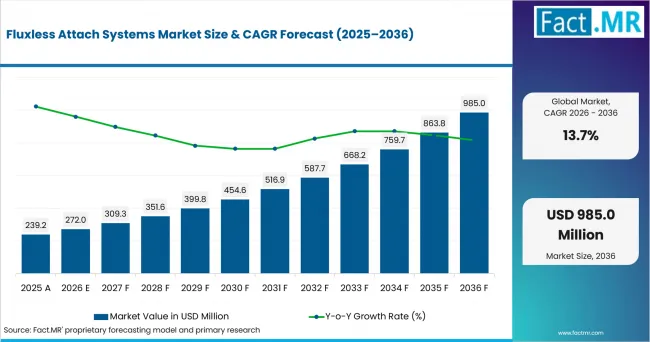
Fluxless Attach Systems Market Value Analysis | Source: Fact.MR
What are the defining numbers behind Fluxless Attach Systems Market growth?
USD 713.0 million absolute opportunity is expected by 2036.
- Demand Drivers in the Market
- Reaction mechanism (documented): Demand for formic-acid-vapor systems is grounded in well-characterized chemistry: formic acid vapor reacts with metal oxides at 150-160 degrees C to form metal formates and water, and on further heating those formates decompose into clean metal, CO2, and H2, with nitrogen-rich atmospheres activating around 180-250 degrees C and byproducts removed by vacuum - a documented, repeatable mechanism buyers can qualify against. [1][2]
- Why fluxless: the two named failure drivers: Fluxless equipment demand traces to a specific, named failure mode: flux outgasses during reflow and traps gas, and in die attach those voids create localized hot spots that progress to stress and fatigue cracks - a risk vacuum helps but does not eliminate when flux is still present. [1]
- Safety/atmosphere trade-offs: Atmosphere choice is a direct equipment-selection driver: 100% hydrogen works but requires ATEX-rated equipment, forming gas (90/10 nitrogen/hydrogen) is safer but only effective above roughly 350 degrees C, which rules it out for low-melting solders, while formic acid achieves oxide reduction at far lower temperature without explosion risk, explaining formic acid's pull in the market. [1]
- Contamination control: Contamination-control demand is rising as flip-chip standoff shrinks, because that makes flux-residue cleaning difficult and can cause dendritic growth and poor underfill compatibility; documented work shows fine-pitch attach achieved in a formic-acid environment using a low-residue paste for larger components and a novel formic-acid adhesive for fine-pitch flip chips, with reported post-reflow residue, SIR performance, and joint cross-sections. [3]
- Key Segments Analyzed
- By Fluxless Technology: Formic acid reflow is projected to hold 33.0% share in 2026, supported by a clear process advantage: Formic acid reflow reduces metal oxides inside the chamber and allows solder joints to form without leaving flux residues beneath the die. That is valuable where post-reflow cleaning is difficult or impossible.
- By Joint Material: Solder alloys (SnAg) is projected to hold 49.9% share in 2026, supported by a clear process advantage: SnAg solder alloys have a large installed materials, reflow and reliability base and work with formic-acid oxide reduction. They therefore represent the broadest attach workload for fluxless systems.
- By Attach Format: Die-to-substrate is projected to hold 43.2% share in 2026, supported by a clear process advantage: Die-to-substrate attach spans power devices, RF components, photonics and advanced packages and therefore provides the largest range of flux-sensitive assemblies. The open package geometry also fits chamber-based vacuum or reducing-atmosphere reflow.
- By Void Requirement: <1% voiding is projected to hold 48.3% share in 2026, supported by a clear process advantage: A void level below 1 percent is the practical benchmark for high-reliability thermal and electrical joints because voids concentrate current and heat and reduce effective bond area. Achieving it consistently is a system-level chamber, paste and profile problem.
- By End User: OSAT providers are projected to hold 30.4% share in 2026, supported by a clear process advantage: OSAT providers need residue-free attach across a wide product mix and often cannot redesign incoming die or substrate finishes. This allows OSAT providers to qualify several package types while avoiding an additional wet-cleaning stage in the assembly flow.
- Analyst Opinion at Fact.MR
- Shambu Nath Jha, Sr. Consultant at Fact.MR, states, 'Buyers should evaluate whether the process removes surface oxides consistently across the selected alloy, substrate and thermal profile. Qualification should compare residue levels, void performance, atmosphere control, throughput and repeatability on production-representative assemblies. Suppliers that document these results alongside equipment integration and service requirements will give engineering and procurement teams a stronger basis for selection.'
- Strategic Implications
- Buyers should validate oxide-removal chemistry, voiding, atmosphere safety and residue performance on the actual joint metallurgy.
- Equipment suppliers should document how their systems address the challenge of removing surface oxides and forming low-void joints without flux residue, cleaning steps or corrosion risk across production-representative wafers, panels, dies or packages.
- Procurement teams should compare oxide-removal performance, achievable void levels, atmosphere and vacuum requirements, material compatibility, cycle time and service support before selecting a fluxless attach platform.
Germany is projected to record a 13.4% CAGR as precision equipment, materials engineering and automotive and power-semiconductor demand supports relevant capital spending; Japan is projected to record a 14.7% CAGR as semiconductor equipment, materials, inspection and memory-process expertise supports relevant capital spending; USA is projected to record a 15.2% CAGR as leading-edge logic, high-performance computing, federally supported semiconductor R&D and a large domestic equipment base supports relevant capital spending; Taiwan is projected to record a 14.5% CAGR as leading foundry production, advanced packaging and a dense OSAT and substrate supply chain supports relevant capital spending; while South Korea is projected to record a 14.2% CAGR as high-volume memory, HBM and vertically integrated semiconductor manufacturing supports relevant capital spending through 2036.
How does the Fluxless Attach Systems Market break down by segment?
Formic acid reflow leads Fluxless Technology with a 33.0% share, while Solder alloys (SnAg) accounts for 49.9% of Joint Material in 2026.
Why does Formic acid reflow lead Fluxless Technology?
Formic acid reflow is projected to account for 33.0% share in 2026.
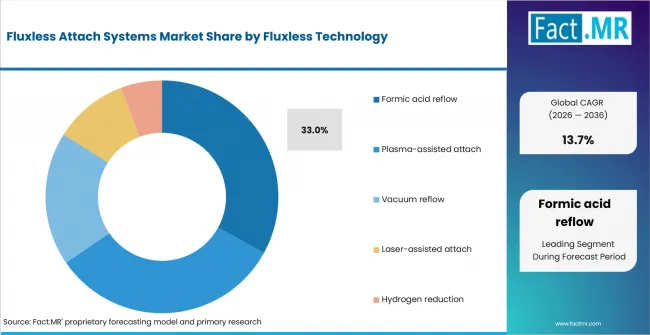
Fluxless Attach Systems Market Analysis By Fluxless Technology | Source: Fact.MR
Formic acid reflow reduces metal oxides inside the chamber and allows solder joints to form without leaving flux residues beneath the die. That is valuable where post-reflow cleaning is difficult or impossible. Plasma-assisted attach can clean surfaces effectively, but the reduction step and reflow atmosphere are less directly combined than in a formic-acid process. Indium's FAST (Formic Acid Soldering Technology) suite: flux-free pastes whose binder fully evaporates during reflow (virtually zero residue), ultra-low voiding especially with vacuum, usable for die-attach, clip-attach, pin and thermistor soldering; equipment note: not all reflow ovens are capable of formic acid reflow... for most, an investment in purpose-built reflow systems will be necessary. [5][6] For buyers, formic acid reflow is strongest where residue-free processing and low voiding justify investment in purpose-built atmosphere and vacuum controls.
Why does Solder alloys (SnAg) lead Joint Material?
Solder alloys (SnAg) is projected to account for 49.9% share in 2026.
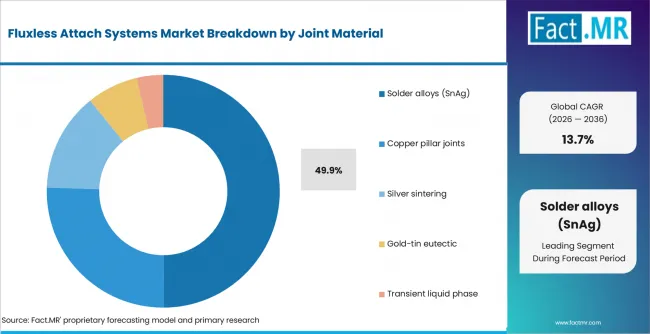
Fluxless Attach Systems Market Analysis By Joint Material | Source: Fact.MR
SnAg solder alloys have a large installed materials, reflow and reliability base and work with formic-acid oxide reduction. They therefore represent the broadest attach workload for fluxless systems. Copper pillar joints support finer pitch and lower standoff, but they often require a more specialized bonding and metallurgy sequence. Decreasing flip-chip standoff makes flux-residue cleaning difficult to dendritic growth + poor underfill compatibility; the study demonstrates fine-pitch attach in a formic-acid environment using a low-residue paste for large components and a novel formic-acid adhesive for fine-pitch flip chips, reporting post-reflow residue, SIR performance, and joint cross-sections. [3] SnAg alloys remain central to qualification because material selection must balance wetting, joint reliability and compatibility with the selected formic-acid reflow profile.
Why does Die-to-substrate lead Attach Format?
Die-to-substrate is projected to account for 43.2% share in 2026.
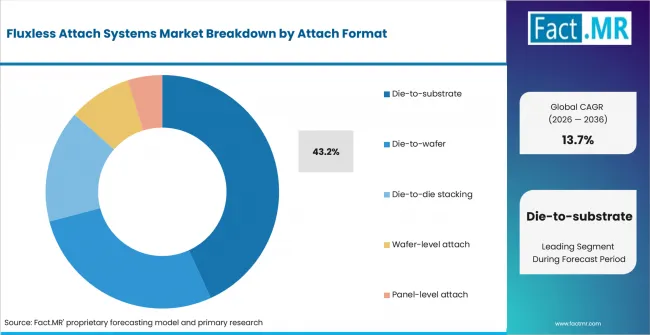
Fluxless Attach Systems Market Analysis By Attach Format | Source: Fact.MR
Die-to-substrate attach spans power devices, RF components, photonics and advanced packages and therefore provides the largest range of flux-sensitive assemblies. The open package geometry also fits chamber-based vacuum or reducing-atmosphere reflow. Die-to-wafer is strategically important for chiplets, but its installed volume and equipment flow are more specialized. (1) Voiding - flux outgasses during reflow, trapping gas; in die attach, voids create localized hot spots to stress to fatigue cracks. Vacuum helps but isn't ideal with flux. [1] Die-to-substrate programs depend on stable placement, controlled oxide removal and a low-void thermal path, making process integration more important than nominal tool capability alone.
Why does <1% voiding lead Void Requirement?
<1% voiding is projected to account for 48.3% share in 2026.
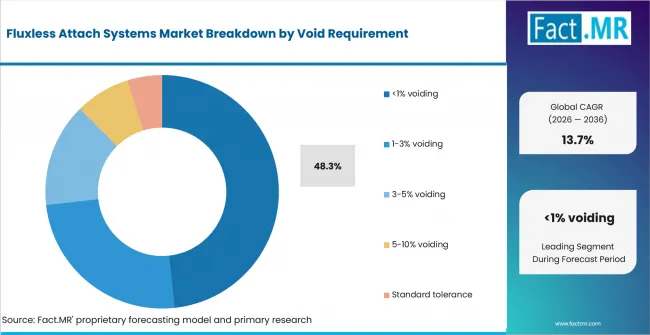
Fluxless Attach Systems Market Analysis By Void Requirement | Source: Fact.MR
A void level below 1 percent is the practical benchmark for high-reliability thermal and electrical joints because voids concentrate current and heat and reduce effective bond area. Achieving it consistently is a system-level chamber, paste and profile problem. The 1-3 percent class is acceptable in less demanding products but provides less margin for power cycling and thermal resistance. University pilot line (U. Arkansas HiDEC): flux- and void-free vacuum soldering with <1% voiding for 80Au20Sn and <10% for 95Pb5Sn recipes, vacuum to 50 mTorr, forming-gas and formic-acid clean steps installed; die attach placement ±0.5 µm. [4] A <1% voiding requirement raises the importance of vacuum control, thermal uniformity and repeatable material handling during process qualification.
Why do OSAT providers lead End User?
OSAT providers are projected to account for 30.4% share in 2026.
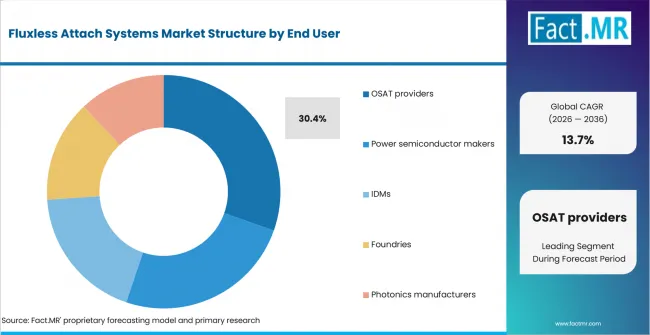
Fluxless Attach Systems Market Analysis By End User | Source: Fact.MR
OSAT providers need residue-free attach across a wide product mix and often cannot redesign incoming die or substrate finishes. A flexible reducing-atmosphere system lets them meet cleanliness and void targets without adding a wet-clean step. Power-semiconductor manufacturers have stringent needs, but their processes are more concentrated around a narrower device portfolio. Formic acid vapor reacts with metal oxides at 150-160 °C forming metal formates + water; on further heating formates decompose to clean metal + CO2 + H2. In N2-rich atmospheres activation runs ~180-250 °C; byproducts are removed by vacuum. [1][2] OSAT providers favor platforms that can support several package formats while maintaining documented atmosphere, recipe and void-control performance across customer programs.
What is accelerating Fluxless Attach Systems Market adoption, and what is holding it back?
The strongest accelerator is documented oxide-reduction performance, while the main restraint is the need for controlled atmospheres, safety measures, compatible materials and purpose-designed equipment.
Drivers Impact Analysis
| DRIVER | (~) % IMPACT ON CAGR | GEOGRAPHIC RELEVANCE | IMPACT TIMELINE |
|---|---|---|---|
| Reaction mechanism (documented) | +3.8% | Global leading-edge fabs | Medium term (2-4 years) |
| Why fluxless: the two named failure drivers | +3.2% | Global leading-edge fabs | Medium term (2-4 years) |
| Safety/atmosphere trade-offs | +2.6% | Global leading-edge fabs | Short term (<=2 years) |
| Contamination control | +2.1% | Global leading-edge fabs | Medium term (2-4 years) |
Source: Fact.MR analysis. Updated Jul 22, 2026
- Reaction mechanism (documented): Formic acid vapor reacts with metal oxides at 150-160 °C forming metal formates + water; on further heating formates decompose to clean metal + CO2 + H2. In N2-rich atmospheres activation runs ~180-250 °C; byproducts are removed by vacuum. [1][2]
- Why fluxless: the two named failure drivers: (1) Voiding - flux outgasses during reflow, trapping gas; in die attach, voids create localized hot spots to stress to fatigue cracks. Vacuum helps but isn't ideal with flux. [1]
- Safety/atmosphere trade-offs: 100% H2 works but needs ATEX-rated equipment; forming gas (90/10 N2/H2) is safer but only effective at least 350 °C - incompatible with low-melting solders. Formic acid achieves oxide reduction at far lower temperature without explosion risk. [1]
- Contamination control: Decreasing flip-chip standoff makes flux-residue cleaning difficult to dendritic growth + poor underfill compatibility; the study demonstrates fine-pitch attach in a formic-acid environment using a low-residue paste for large components and a novel formic-acid adhesive for fine-pitch flip chips, reporting post-reflow residue, SIR performance, and joint cross-sections. [3]
Opportunity Impact Analysis
| OPPORTUNITY | (~) % IMPACT ON CAGR | GEOGRAPHIC RELEVANCE | IMPACT TIMELINE |
|---|---|---|---|
| Power-electronics pull | +2.3% | Global leading-edge fabs | Short term (<=2 years) |
| Vacuum + formic acid combination | +1.8% | Global leading-edge fabs | Medium term (2-4 years) |
| Purpose-built equipment wave | +1.4% | Global leading-edge fabs | Medium term (2-4 years) |
Source: Fact.MR analysis. Updated Jul 22, 2026
- Power-electronics pull: EV, renewable, and AI-server power devices are the volume driver; formic-acid soldering framed as enabling the next generation of power devices (eePower/Bodo's Power, 2025).
- Vacuum + formic acid combination: Becoming the reference configuration for ultra-low-void large-area joints (substrate-to-baseplate).
- Purpose-built equipment wave: Indium explicitly notes most installed ovens need replacement - a capital-equipment refresh cycle (Heller, Rehm-class vacuum reflow with FA injection).
Restraints Impact Analysis
| RESTRAINT | (~) % IMPACT ON CAGR | GEOGRAPHIC RELEVANCE | IMPACT TIMELINE |
|---|---|---|---|
| Primary qualification constraint | -2.1% | Global leading-edge fabs | Medium term (2-4 years) |
| Contamination and defect risk | -1.6% | Global leading-edge fabs | Medium term (2-4 years) |
| Surface-state degradation | -1.2% | Global leading-edge fabs | Medium term (2-4 years) |
Source: Fact.MR analysis. Updated Jul 22, 2026
- Primary qualification constraint: Formic-acid and vacuum sequences require controlled atmospheres, suitable safety measures and compatible thermal profiles; some materials may require purpose-designed equipment and process development. [1][6]
- Contamination and defect risk: (1) Voiding - flux outgasses during reflow, trapping gas; in die attach, voids create localized hot spots to stress to fatigue cracks. (2) Flux residue - requires cleaning; residue + water vapor forms acidic surface films harming long-term reliability; downstream wire bonding needs residue-free surfaces. [1]
- Surface-state degradation: Formic acid achieves oxide reduction at far lower temperature without explosion risk. [1]
Which countries are scaling Fluxless Attach Systems Market fastest?
For Fluxless Attach Systems Market, South Korea's 14.2% CAGR reflects high-volume memory, HBM and vertically integrated semiconductor manufacturing.
- Countries differ less by the headline CAGR than by the type of semiconductor work creating demand for the Fluxless Attach Systems Market.
- China follows a pathway shaped by rapid domestic capacity build-out, local-equipment substitution and tighter access to controlled foreign tools. USA takes a different path through leading-edge logic, high-performance computing, federally supported semiconductor R&D and a large domestic equipment base.
- Japan and Taiwan remain aligned through distinct combinations of device production, equipment development and advanced packaging investment.
- South Korea develops through high-volume memory, HBM and vertically integrated semiconductor manufacturing, while Germany relies on precision equipment, materials engineering and automotive and power-semiconductor demand.
- Comparable growth rates can still produce different adoption patterns because each country has a different mix of semiconductor packaging, power-device manufacturing, equipment capability and qualification requirements.
The full report compares the six named country markets within the wider regional coverage of North America, Latin America, Europe, East Asia, South Asia & Oceania, and the Middle East & Africa.
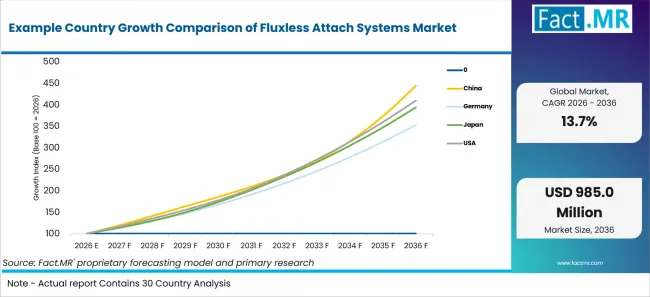
Example Country Growth Comparison Of Fluxless Attach Systems Market | Source: Fact.MR
| COUNTRY | CAGR 2026 to 2036 |
|---|---|
| USA | 15.2% |
| Japan | 14.7% |
| Taiwan | 14.5% |
| South Korea | 14.2% |
| Germany | 13.4% |
Source: Fact.MR analysis. Updated Jul 22, 2026
What is driving USA's growth through 2036?
15.2% CAGR, supported by leading-edge logic, high-performance computing, federally supported semiconductor R&D and a large domestic equipment base.
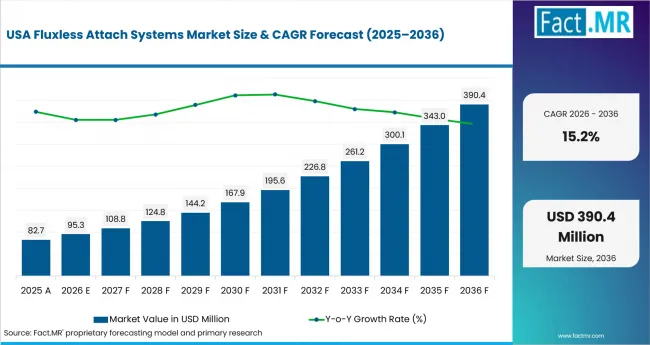
Fluxless Attach Systems Market Country Value Analysis | Source: Fact.MR
Heller Industries' co-authored SMTA study, Indium Corporation's materials work and university pilot-line capabilities give US buyers several routes to evaluate residue-free, low-void soldering before production scale-up. [3][4][5][6]
What is driving Japan's growth through 2036?
14.7% CAGR, supported by semiconductor equipment, materials, inspection and memory-process expertise.
Japan's semiconductor equipment and power-module ecosystem creates demand for formic-acid reflow processes that can demonstrate low voiding, surface cleanliness and material compatibility during qualification.
What is driving Taiwan's growth through 2036?
14.5% CAGR, supported by leading foundry production, advanced packaging and a dense OSAT and substrate supply chain.
Taiwan's foundry, OSAT and substrate ecosystem gives suppliers a clear route to qualify fluxless attach processes for advanced packaging, where residue control, fine-pitch compatibility and repeatable throughput are central purchasing criteria.
What is driving South Korea's growth through 2036?
14.2% CAGR, supported by high-volume memory, HBM and vertically integrated semiconductor manufacturing.
South Korea's memory and HBM production base favors fluxless attach systems that can support high-volume qualification while controlling residues, voiding and thermal-process repeatability.
What is driving Germany's growth through 2036?
13.4% CAGR, supported by precision equipment, materials engineering and automotive and power-semiconductor demand.
Germany's vacuum-reflow equipment and power-electronics base supports qualification of formic-acid processes where atmosphere control, low voiding and repeatability are central to production adoption.
Who leads the Fluxless Attach Systems Market?
PINK GmbH and BESI lead the competitive landscape, followed by ASMPT and Palomar Technologies as the next tier of challengers.
PINK GmbH participates through vacuum and formic-acid reflow systems, positioning it for programs that require controlled atmospheres and low-void soldering. [7] BESI participates through high-accuracy die placement and hybrid-bonding assembly, with relevance in programs where placement precision and integration with downstream attach processes determine yield. [8] ASMPT participates through die placement, thermocompression bonding and packaging automation, giving it relevance where buyers want coordinated handling, bonding and production-scale process control. [9] Palomar Technologies participates through precision die attach and photonics or specialty packaging, serving applications that require flexible process development and accurate component placement. [10]
SST Vacuum Reflow holds a more specialized role through vacuum reflow and low-void attach, particularly where custom integration and service coverage affect qualification. Amtech Systems holds a more specialized role through thermal processing and semiconductor manufacturing equipment, particularly where custom integration and service coverage affect qualification.
Competition is expected to center on repeatable process performance, integration with adjacent modules, installed-base service and documented capability to address the challenge of removing surface oxides and forming low-void joints without flux residue, cleaning steps or corrosion risk. Buyers are likely to compare oxide-reduction uniformity, void control, atmosphere safety, thermal-profile stability, throughput and integration with handling and inspection modules.
Which companies are the key providers?
Key companies include PINK GmbH; BESI; ASMPT; Palomar Technologies; SST Vacuum Reflow; Amtech Systems.
- PINK GmbH
- BESI
- ASMPT
- Palomar Technologies
- SST Vacuum Reflow
- Amtech Systems
Bibliography
- [1] Inseto. (2017). Solder Reflow Using Formic Acid for Oxide Reduction (IKB-017). https://www.inseto.com/solder-reflow-using-formic-acid-for-oxide-reduction-ikb-017/
- [2] EEPower. (2025). Formic Acid Soldering: Enabling the Next Generation of Power Devices, Part 1. https://eepower.com/technical-articles/formic-acid-soldering-enabling-the-next-generation-of-power-devices-part-1/
- [3] CircuitInsight. (2024). Fluxless Reflow Technology for Combination Fine-Pitch and SMT-Level Component Attach. https://www.circuitinsight.com/programs/56483.html
- [4] University of Arkansas High Density Electronics Center. (n.d.). Die Attach. https://high-density-electronics.uark.edu/services/die-attach-2/
- [5] Indium Corporation. (n.d.). Formic Acid Soldering Technology (FAST) Paste: The New Frontier in Fluxless Soldering. https://www.indium.com/blog/formic-acid-soldering-technology-fast-paste-the-new-frontier-in-fluxless-soldering/
- [6] Indium Corporation. (n.d.). Formic Acid Reflow Soldering: The New Technology that is Clean, Reliable, and Power Ready. https://www.indium.com/blog/formic-acid-reflow-soldering-the-new-technology-that-is-clean-reliable-and-power-ready/
- [7] PINK GmbH Thermosysteme. (n.d.). Soldering Technology. https://pink.de/en/soldering-technology/
- [8] BE Semiconductor Industries N.V. (n.d.). Products & Services. https://www.besi.com/company/company-profile/products-services/
- [9] ASMPT. (n.d.). Advanced Packaging Solutions. https://semi.asmpt.com/en/products/ap/
- [10] Palomar Technologies. (n.d.). Optoelectronic Packaging Solutions. https://www.palomartechnologies.com/applications/industries/optoelectronic
This Report Addresses
- The report provides strategic intelligence on Fluxless Attach Systems Market across Fluxless Technology and Joint Material choices that shape purchasing decisions.
- Segment analysis covers Formic acid reflow as the share leader within the 2026 market structure.
- Regional outlook evaluates Germany alongside Japan and USA, while Taiwan and South Korea complete the growth comparison.
- Competitive analysis profiles PINK GmbH and BESI alongside ASMPT and Palomar Technologies, followed by additional active providers.
- Use-case assessment covers the categories and applications that shape demand in the Fluxless Attach Systems Market across the forecast period.
What does the Fluxless Attach Systems Market cover?
The market covers equipment and process systems configured to address the challenge of removing surface oxides and forming low-void joints without flux residue, cleaning steps or corrosion risk.
Fluxless attach systems are reflow/die-attach platforms that join solder without liquid flux - predominantly formic-acid-vapor reflow (often under vacuum), with hydrogen/forming-gas and plasma-activation variants - eliminating flux residue and flux-outgassing voids. Primary demand: power semiconductors (die attach, clip attach), fine-pitch flip-chip, and photonics/sensor assembly where residue is disqualifying.
Commercial value arises from the complete configured system, including process control, handling, software and integrated modules required for repeatable operation. Finished semiconductor devices, package value and unrelated parent-market equipment are excluded.
What is included in the scope?
The scope includes systems used by osat providers and the other end-user groups listed in the segmentation.
The market is segmented by Fluxless Technology, including Formic acid reflow, Plasma-assisted attach, Vacuum reflow, Laser-assisted attach, Hydrogen reduction; Joint Material, including Solder alloys (SnAg), Copper pillar joints, Silver sintering, Gold-tin eutectic, Transient liquid phase; Attach Format, including Die-to-substrate, Die-to-wafer, Die-to-die stacking, Wafer-level attach, Panel-level attach; Void Requirement, including <1% voiding, 1-3% voiding, 3-5% voiding, 5-10% voiding, Standard tolerance; End User, including OSAT providers, Power semiconductor makers, IDMs, Foundries, Photonics manufacturers.
Integrated handling, metrology, cleaning, activation, process-control or support modules are included when delivered as part of the configured market system.
What is excluded from the scope?
The scope excludes unrelated semiconductor equipment, standalone materials and components sold independently of the configured system.
It also excludes facility construction, cleanroom infrastructure, the value of processed wafers or packages, and adjacent process steps that are not part of the defined equipment category.
How Was the Analysis Built?
Fact.MR is of the opinion that this assessment combines structured market analysis with a review of public information and industry evidence relevant to the market.
- Market Assessment: The analysis considers demand patterns, supply conditions, segment mix, country activity, company participation, and adoption trends.
- Evidence Review: Public company disclosures, government and regulatory publications, trade information, technical literature, and industry records inform the assessment.
- Validation and Updates: Findings are cross-checked against available market indicators and reviewed when material market developments emerge.
Segmentation
What is the report's scope and coverage?
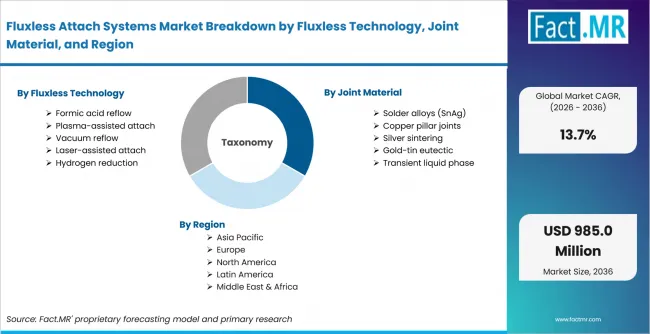
Fluxless Attach Systems Market Breakdown By Fluxless Technology, Joint Material, And Region | Source: Fact.MR
| Attribute | Details |
|---|---|
| Quantitative Units | USD 272.0 million in 2026 to USD 985.0 million by 2036 at a 13.7% CAGR |
| Market Definition | Fluxless attach systems are reflow/die-attach platforms that join solder without liquid flux - predominantly formic-acid-vapor reflow (often under vacuum), with hydrogen/forming-gas and plasma-activation variants - eliminating flux residue and flux-outgassing voids. Primary demand: power semiconductors (die attach, clip attach), fine-pitch flip-chip, and photonics/sensor assembly where residue is disqualifying. |
| Fluxless Technology | Formic acid reflow; Plasma-assisted attach; Vacuum reflow; Laser-assisted attach; Hydrogen reduction |
| Joint Material | Solder alloys (SnAg); Copper pillar joints; Silver sintering; Gold-tin eutectic; Transient liquid phase |
| Attach Format | Die-to-substrate; Die-to-wafer; Die-to-die stacking; Wafer-level attach; Panel-level attach |
| Void Requirement | <1% voiding; 1-3% voiding; 3-5% voiding; 5-10% voiding; Standard tolerance |
| End User | OSAT providers; Power semiconductor makers; IDMs; Foundries; Photonics manufacturers |
| Regions Covered | North America; Latin America; Europe; East Asia; South Asia & Oceania; Middle East & Africa |
| Countries Covered | Germany; Japan; USA; Taiwan; South Korea |
| Key Companies Profiled | PINK GmbH; BESI; ASMPT; Palomar Technologies; SST Vacuum Reflow; Amtech Systems |
| Forecast Period | 2026 to 2036 |
| Approach | Hybrid top-down and bottom-up approach using demand indicators across Fluxless Technology; Joint Material; Attach Format; Void Requirement; End User; country-level growth; company participation and adoption trends |
Source: Fact.MR analysis. Updated Jul 22, 2026
How is the market segmented?
-
By Fluxless Technology:
- Formic acid reflow
- Plasma-assisted attach
- Vacuum reflow
- Laser-assisted attach
- Hydrogen reduction
-
By Joint Material:
- Solder alloys (SnAg)
- Copper pillar joints
- Silver sintering
- Gold-tin eutectic
- Transient liquid phase
-
By Attach Format:
- Die-to-substrate
- Die-to-wafer
- Die-to-die stacking
- Wafer-level attach
- Panel-level attach
-
By Void Requirement:
- <1% voiding
- 1-3% voiding
- 3-5% voiding
- 5-10% voiding
- Standard tolerance
-
By End User:
- OSAT providers
- Power semiconductor makers
- IDMs
- Foundries
- Photonics manufacturers
-
By Region:
- North America
- Latin America
- Europe
- East Asia
- South Asia & Oceania
- Middle East & Africa
Frequently Asked Questions
Which Fluxless Technology leads the Fluxless Attach Systems Market?
Which Joint Material leads the Fluxless Attach Systems Market?
Which Attach Format leads the Fluxless Attach Systems Market?
Which Void Requirement leads the Fluxless Attach Systems Market?
Which End User leads the Fluxless Attach Systems Market?
What CAGR is projected for China in the Fluxless Attach Systems Market?
What CAGR is projected for USA in the Fluxless Attach Systems Market?
What CAGR is projected for Japan in the Fluxless Attach Systems Market?
What CAGR is projected for Taiwan in the Fluxless Attach Systems Market?
What CAGR is projected for South Korea in the Fluxless Attach Systems Market?
What CAGR is projected for Germany in the Fluxless Attach Systems Market?
What is the primary driver of the Fluxless Attach Systems Market?
What is the main restraint in the Fluxless Attach Systems Market?
Who worked on this report


Preview the report firsthand - request a free sample
Free SampleGet the brochure for pricing and purchase details
Download PDF