- Market Value (2025): USD 8.6 Bn
- Estimated Value (2026): USD 9.4 Bn
- Forecast Value (2036): USD 22.7 Bn
- CAGR (2026-2036): 9.2%
What is the Food-Contact Mono-Material Films Market forecast to be worth by 2036?
USD 9.4 billion in 2026 to USD 22.7 billion by 2036 at a 9.2% CAGR.
- The Food-Contact Mono-Material Films Market crossed a valuation of USD 8.6 billion in 2025.
- Demand is projected to increase from USD 9.4 billion in 2026 to USD 22.7 billion by 2036.
- The market is forecast to record a 9.2% CAGR from 2026 to 2036.
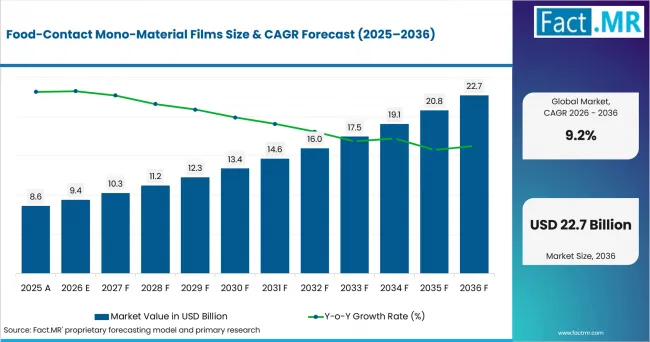
Food Contact Mono Material Films Value Analysis | Source: Fact.MR
What are the defining numbers behind Food-Contact Mono-Material Films Market growth?
An absolute opportunity of USD 13.3 billion is expected between 2026 and 2036.
- Demand Drivers in the Market
- Food brands need barrier films that protect shelf life while simplifying polymer structure. The USDA Economic Research Service reported in June 2026 that inflation-adjusted U.S. food spending reached USD 2.51 trillion in 2025.
- Flexible-packaging converters need mono-material webs that run on established printing and sealing equipment because line changes add qualification time.
- Retail and foodservice packers need pouches and rollstock that satisfy food-contact controls while offering a clearer route into mechanical recycling streams built around polyolefins.
- Pet-food and snack producers need puncture resistance and dependable seals. Film design is therefore expected to balance stiffness with heat resistance and barrier quality within a single polymer platform. The film must protect the food while running reliably on the packing line.
- Key Segments Analyzed
- By Polymer Platform: PE mono-material is expected to hold 36.0% share in 2026 due to broad flexible-film use and its fit with PE recycling streams.
- By Barrier Technology: EVOH-compatible barrier is projected to account for 31.0% share in 2026. Converters seek oxygen protection without returning to complex multi-polymer structures.
- By Format: Printed rollstock is anticipated to capture 29.0% share in 2026 because it supports high-throughput converting and automated food packing.
- By End-use: Snacks are estimated to represent 33.0% share in 2026. High film use across pillow packs, flow wraps and stand-up pouches supports the segment.
- Analyst Opinion at Fact.MR
- Shambhu Nath Jha, Principal Consultant at Fact.MR states, “Mono-material food film must do more than meet a recycling target. It must protect food while sealing consistently at plant line speeds. Suppliers that combine polymer design with barrier expertise and line validation are expected to build durable converter relationships.”
- Strategic Implications
- Film producers should document seal windows and barrier quality by food use so converters can compare mono-material replacements with current laminates.
- Converters should qualify inks, coatings and adhesives as part of the complete structure because recycling claims depend on the behavior of the finished package.
- Food brands should separate moisture, oxygen and grease needs by product instead of applying the same barrier specification across every pack.
- Recycling-oriented suppliers should align film design with local collection and reprocessing routes so mono-material claims correspond with the infrastructure serving the target market.
China is projected to record 10.0% CAGR through 2036 as packaging-design standards support material redesign. The USA is anticipated to reach 9.5% through packaged-food demand. Japan is estimated at 9.5% under resource-reuse programs. Germany is forecast at 9.3% under PPWR needs, while France is expected to advance at 8.8%.
How does the Food-Contact Mono-Material Films Market break down by segment?
PE mono-material leads Polymer Platform at 36.0%; Snacks lead End-use at 33.0%.
Which Polymer Platform dominates?
PE mono-material is expected to hold 36.0% share in 2026.
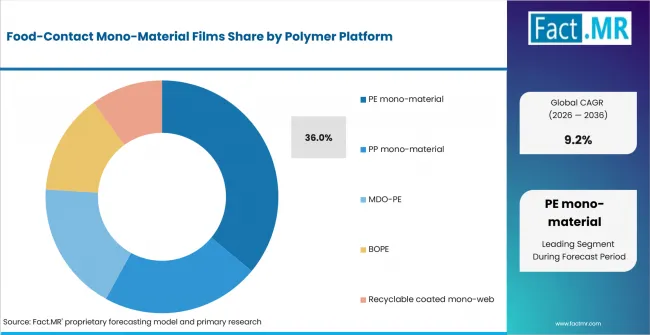
Food Contact Mono Material Films Analysis By Polymer Platform | Source: Fact.MR
PE mono-material is expected to remain the primary polymer platform because converters can combine oriented and sealant-grade polyethylene within one family. MDO-PE improves web stiffness for printing and handling. PP and BOPE remain credible alternatives where heat resistance or stiffness favors polypropylene. Film converters therefore retain more than one route when planning a food-pack change, while the same resin family can help keep the film build clear during redesign.
What leads the Barrier Technology segment?
EVOH-compatible barrier is projected to account for 31.0% share in 2026.
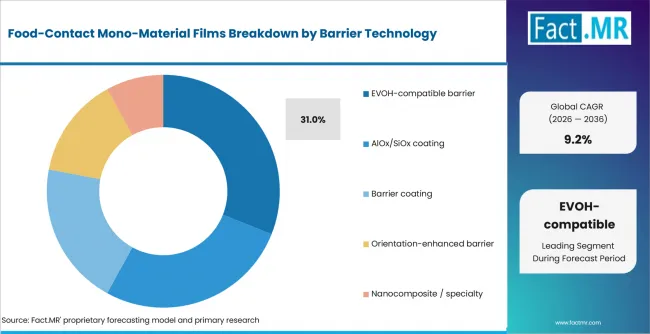
Food Contact Mono Material Films Analysis By Barrier Technology | Source: Fact.MR
EVOH-compatible structures provide oxygen protection through a thin barrier component within polyolefin packaging. AlOx and SiOx serve transparent-barrier uses while other coatings target moisture or grease resistance. Orientation is expected to improve film stiffness during converting and filling. Nanocomposite and specialty options remain use-specific because food-contact rules and recycling needs require separate checks.
How does Format shape demand?
Printed rollstock is anticipated to capture 29.0% share in 2026.
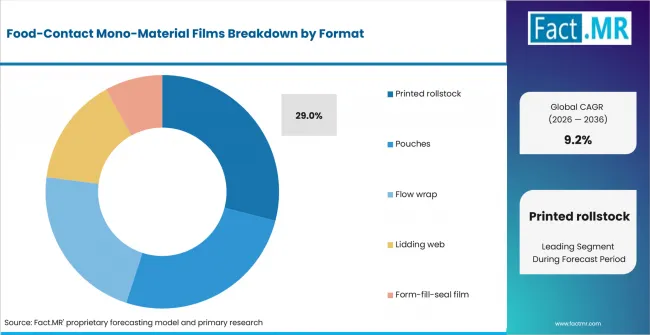
Food Contact Mono Material Films Analysis By Format | Source: Fact.MR
Printed rollstock supports continuous converting and preprinted brand graphics. BOPP packaging films remain relevant where polypropylene stiffness and printability fit the pack. CPP packaging films support sealant and flexible-film uses. Pouches and lidding formats expand the range of food-contact applications. A good web must stay flat and seal well as line speed rises. Print quality is expected to remain a basic pass-or-fail test before a new web reaches a food line.
What supports Snacks within End-use?
Snacks are estimated to represent 33.0% share in 2026.
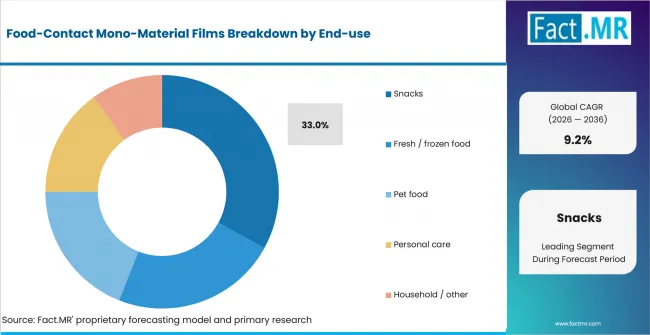
Food Contact Mono Material Films Analysis By End Use | Source: Fact.MR
Fresh and frozen foods need seal integrity across temperature changes while lidding formats must peel or reseal as designed. Pet-food packaging requires durable seals that tolerate handling and storage. Ready meals and meat or seafood applications create additional demand where barrier performance and food-contact compliance can be maintained within PE or PP film structures.
What is accelerating Food-Contact Mono-Material Films Market adoption, and what is holding it back?
Recyclability-focused redesign and converter testing support adoption; barrier trade-offs and uneven recycling systems restrain it.
Drivers Impact Analysis
| DRIVER | (~) % IMPACT ON CAGR | GEOGRAPHIC RELEVANCE | IMPACT TIMELINE |
|---|---|---|---|
| Design-for-recycling rules | +1.4% | Europe, North America | Short term (<= 2 years) |
| Mono-PE and mono-PP line gains | +1.1% | Global | Medium term (2-4 years) |
| Food-brand pack redesign | +0.9% | North America, Europe, East Asia | Medium term (2-4 years) |
| Barrier coating and film orientation | +0.7% | Global | Long term (>= 4 years) |
Opportunity Impact Analysis
| OPPORTUNITY | (~) % IMPACT ON CAGR | GEOGRAPHIC RELEVANCE | IMPACT TIMELINE |
|---|---|---|---|
| High-barrier mono-PE food pouches | +1.0% | North America, Europe | Medium term (2-4 years) |
| Mono-PP retort and hot-fill formats | +0.8% | Europe, East Asia | Long term (>= 4 years) |
| MDO-PE printed rollstock | +0.7% | Global | Short term (<= 2 years) |
| Recyclable lidding and thermoform webs | +0.5% | Europe, North America | Medium term (2-4 years) |
Restraints Impact Analysis
| RESTRAINT | (~) % IMPACT ON CAGR | GEOGRAPHIC RELEVANCE | IMPACT TIMELINE |
|---|---|---|---|
| Barrier-performance trade-offs | -0.8% | Global | Short term (<= 2 years) |
| Food-contact test burden | -0.6% | Global | Medium term (2-4 years) |
| Uneven collection and recycling | -0.5% | North America, East Asia | Long term (>= 4 years) |
| Line-specific seal windows | -0.4% | Global | Medium term (2-4 years) |
Which countries are scaling the Food-Contact Mono-Material Films Market through 2036?
- China leads the displayed country set at 10.0% CAGR as food processing activity and recyclable-packaging standards create a broad redesign base.
- The USA and Japan each post 9.5% CAGR, although the USA is shaped by packaged-food scale while Japan emphasizes plastic resource reuse.
- Germany records 9.3% CAGR as EU packaging rules and domestic recycling systems place greater weight on pack recycling.
- France reaches 8.8% CAGR as food production and household-packaging recovery create a large use base for recyclable flexible films.
- The displayed country range spans 1.2 percentage points, showing relatively close growth rates despite different rule-based and packaging systems.
Comparable CAGRs create different entry conditions because food-contact rules and recycling systems vary by country. Coverage spans North America, Latin America, Western Europe, Eastern Europe, East Asia, South Asia & Pacific, and Middle East & Africa.
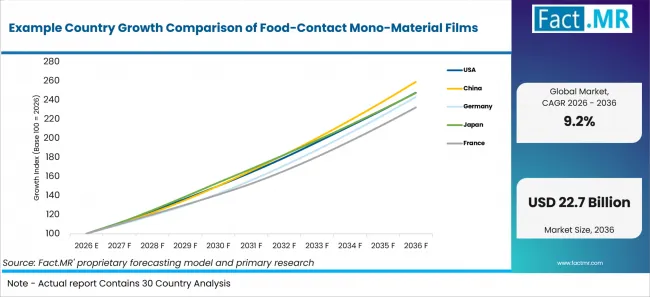
Example Country Growth Comparison Of Food Contact Mono Material Films | Source: Fact.MR
| Country | CAGR (2026-2036) |
|---|---|
| United States | 9.5% |
| China | 10.0% |
| Germany | 9.3% |
| Japan | 9.5% |
| France | 8.8% |
What supports USA adoption?
9.5% CAGR, supported by food-contact testing and packaged-food demand.
U.S. food packers use flexible films across snacks and frozen foods while foodservice uses keep barrier and seal quality central. On September 30 2025, the U.S. FDA listed recycled polypropylene record 418 for articles contacting all food types under Conditions A through H when the stated feedstock needs are met. That food-contact pathway supports further testing of polypropylene-centered structures while keeping resin history and line results central to converter decisions. A clear resin trail is expected to speed review and reduce repeated line tests. Food brands are expected to keep pack trials close to the real filling process so seal results stay useful.
How is China scaling demand?
10.0% CAGR, shaped by food-processing output and recyclable packaging design.
China combines a large food-processing base with ongoing packaging redesign around easier collection and recycling. The National Bureau of Statistics reported in January 2026 that the value added of processing of food from agricultural and sideline products increased 3.2% year over year in December 2025. The category covers agricultural and sideline products. That production base supports demand for printed rollstock and pouches while converters continue to qualify seals, barriers and food-contact performance for each use. Pack firms gain when one film can meet seal needs across more food lines.
What supports Germany’s adoption?
9.3% CAGR, led by packaging recovery systems and EU recycling rules.
Germany offers a mature recovery system that gives mono-PE and mono-PP designs a clear market context. The German Environment Agency and the Central Agency Packaging Register reported in January 2026 that around 5.5 million tonnes of packaging waste collected by dual systems were recycled in 2024. Food-packaging converters are expected to favor structures that combine barrier quality with resin fit. Clear recycling data also matters under the evolving EU framework. A simpler pack structure is expected to support cleaner PE and PP sorting streams.
How does Japan perform?
9.5% CAGR, reinforced by plastic resource reuse and food-packaging use.
Japan is expanding separate collection while food manufacturers continue to protect shelf life and pack integrity across flexible formats. Japan’s Ministry of the Environment reported in March 2026 that 82.4% of municipalities were expected to conduct separate collection of plastic containers and packaging in fiscal 2026. Mono-PE and mono-PP films are expected to gain attention when converters preserve low-temperature toughness and seal consistency. The films must also provide the barrier profile required by the packed food. This gives film firms a clear test path for new mono-PE and mono-PP packs.
What is supporting France’s growth?
8.8% CAGR, backed by food-production scale and packaging redesign.
France has a large food-production base that creates steady demand for food-contact films across snack, fresh-food and frozen-food uses. INSEE reported in July 2026 that the value of production in France’s food, beverage, and tobacco manufacturing industry reached EUR 207 billion in 2025. Mono-material conversion is expected to progress where PE or PP structures meet required barrier levels and run reliably on existing pouch, rollstock and lidding equipment. Brands can shift formats in steps while keeping the same pack line and core resin.
Who leads the Food-Contact Mono-Material Films Market?
Amcor is active in mono-material flexible packaging for food applications through its AmPrima platform. The portfolio includes PE-based and other mono-material structures for applications such as meat, dairy, snacks and foodservice. AmPrima solutions combine barrier performance, seal strength, recycle-ready design and compatibility with commercial packing lines.
Mondi supplies mono-PE and mono-PP barrier packaging for food, snacks and pet food. Its portfolio includes stand-up pouches, thermoformable structures and compatible lidding films. These solutions provide oxygen and moisture barriers while being designed or certified for recycling in relevant PE or PP streams.
Coveris offers MonoFlex monomaterial packaging for a range of food applications. Its portfolio includes PE- and PP-based laminates with barrier and sealing options, while MonoFlexBP addresses refrigerated products such as processed meat, sausage and cheese. Coveris also offers thermoformable bottom films and high-barrier lidding options for chilled-food applications.
Constantia Flexibles offers mono-PE EcoLam and mono-PP EcoVer structures for food applications including snacks, confectionery, dairy, processed foods and pet food. The portfolio provides different barrier levels, printing capabilities and structures designed for recycling in applicable polymer streams.
ProAmpac supplies recyclable flexible-packaging solutions for dry foods, snacks, frozen foods and pet food. Its ProActive Recyclable and QUADFLEX ranges include polyethylene-based films and pouches developed for sealing performance, barrier requirements and compatibility with conventional filling equipment.
Which companies are the key providers?
Key companies include Amcor; Mondi; Coveris; Constantia Flexibles; and ProAmpac.
- Amcor
- Mondi
- Coveris
- Constantia Flexibles
- ProAmpac
Bibliography
- Zeballos, E., & Sinclair, W. (2026, June 11). Total U.S. food spending reached $2.51 trillion in 2025. U.S. Department of Agriculture, Economic Research Service.
- Directorate-General for Environment. (2026, August 11). New EU packaging rules start to apply, including restrictions on PFAS in food-contact packaging. European Commission.
- U.S. Food and Drug Administration. (2025, July 10). Submissions on post-consumer recycled (PCR) plastics for food-contact articles [Recycle No. 400, PureCycle Technologies LLC, polypropylene].
- U.S. Food and Drug Administration. (2025, September 30). Submissions on post-consumer recycled (PCR) plastics for food-contact articles [Recycle No. 418, PureCycle Technologies LLC, polypropylene].
- National Bureau of Statistics of China. (2026, January 20). Industrial production operation in December 2025.
- German Environment Agency, & Central Agency Packaging Register. (2026, January 27). Facts against myths: Packaging waste recycling in Germany is working.
- Institut national de la statistique et des études économiques. (2026, July 21). Indicateurs macroéconomiques de l’industrie manufacturière : Données annuelles de 2010 à 2025.
- Amcor. (2025, June 21). Introducing Liquiflex® AmPrima® for Foodservice in Europe: Recycle-Ready, Space-Saving, Game-Changing.
This Report Answers
- The report explains where food-contact mono-material films are used across polymer platform and barrier technology. It also covers format and end use, together with regional demand conditions.
- Segment analysis identifies the leading subsegments and explains the operational reasons converters prioritize PE-based structures, compatible barriers, printed rollstock, and high-volume food-packaging applications.
- Country analysis examines the United States, China, Germany, Japan, and France. It also considers food-processing activity, packaging rules, recycling systems, and resource-reuse programs shaping mono-material film adoption.
- Competitive analysis reviews Amcor, Mondi, Coveris, Constantia Flexibles, and ProAmpac across mono-PE and mono-PP packaging. It also covers barrier films, recyclable pouches, lidding structures, and related flexible-packaging approaches.
- Application analysis assesses how barrier performance, seal integrity, printability, and line compatibility influence film selection. It also considers food-contact requirements, recyclability, collection systems, and the ability to run mono-material structures on existing packaging equipment.
What does the Food-Contact Mono-Material Films Market cover?
The market covers PE- and PP-centered flexible films for food-contact packaging. It includes printed films, pouches, flow wrap, lidding and form-fill-seal films designed to simplify polymer composition while preserving barrier and sealing performance. Related sustainable food packaging provides adjacent context for recyclable food-pack design.
Adjacent coverage includes high-recyclability mono-material flexible packaging and plastic lidding films where these categories intersect with food-contact flexible structures.
What is included in the scope?
The scope includes PE mono-material, PP mono-material, MDO-PE, BOPE and recyclable coated mono-web structures. EVOH-compatible and coated barriers are included when the package remains designed around one principal polymer family.
Food applications include snacks, fresh and frozen foods and pet food. Related fresh food packaging analysis helps frame short-shelf-life applications. micro-perforated films provide adjacent context where controlled gas or moisture exchange is part of pack design.
What is excluded from the scope?
The scope excludes rigid packs without a flexible-film component, paper-only packaging and foil structures without a mono-material film proposition. Conventional mixed laminates that depend on substantial incompatible polymer layers are also excluded.
General plastic film without a food-contact use is outside the boundary. Resin production is excluded unless linked to an identified mono-material film platform.
How Was the Analysis Built?
The analysis draws on 120+ sources, 35+ company portfolios, 25+ countries, and more than 20 industry interviews.
- Primary Research: Primary research includes discussions with manufacturers, service providers, technology developers, distributors, end users, and subject-matter experts. These conversations examine purchasing priorities, product adoption, operational challenges, approval requirements, competitive positioning, and the factors that influence wider market acceptance.
- Desk Research: Desk research covers government statistics, regulatory publications, company filings, trade data, technical studies, industry associations, standards, public policy, and other authoritative sources. Every source used in the analysis is documented in the bibliography.
- Market Sizing and Forecasting: Market estimates combine historical performance, demand indicators, pricing and volume trends, segment shares, company participation, country-level growth, adoption patterns, investment activity, and barriers to market expansion.
- Data Validation and Update Cycle: Findings are validated by comparing primary interviews with public data, company activity, regulatory changes, trade patterns, and industry developments. Regular updates review new product launches, capacity changes, partnerships, approvals, and shifts in commercial adoption.
What is the report’s scope and coverage?
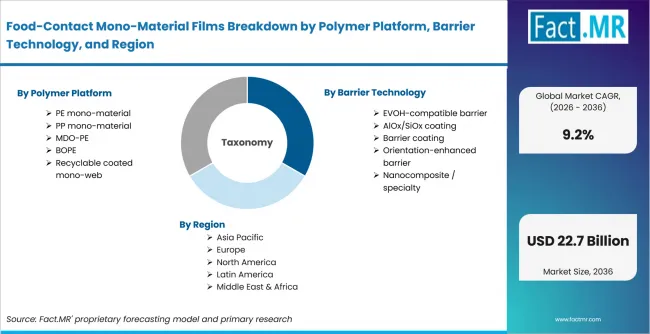
Food Contact Mono Material Films Breakdown By Polymer Platform, Barrier Technology, And Region | Source: Fact.MR
| Attribute | Details |
|---|---|
| Quantitative Units | USD billion in 2026 to USD billion by 2036 at a CAGR |
| Market Definition | Food-contact flexible films designed primarily around one polymer family, including PE and PP structures, used for direct or indirect food packaging while meeting functional and food-contact requirements. |
| Polymer Platform | PE mono-material; PP mono-material; MDO-PE; BOPE; Recyclable coated mono-web |
| Barrier Technology | EVOH-compatible barrier; AlOx/SiOx coating; Barrier coating; Orientation-enhanced barrier; Nanocomposite/specialty |
| Format | Printed rollstock; Pouches; Flow wrap; Lidding web; Form-fill-seal film |
| End-use | Snacks; Fresh/frozen food; Pet food; Ready meals; Meat/seafood |
| Regions Covered | North America; Latin America; Western Europe; Eastern Europe; East Asia; South Asia & Pacific; Middle East & Africa |
| Countries Covered | United States; China; Germany; Japan; France |
| Key Companies Profiled | Amcor; Mondi; Coveris; Constantia Flexibles; ProAmpac |
| Forecast Period | 2026 to 2036 |
| Approach | Hybrid top-down and bottom-up approach using food-pack demand, film uses, polymer mix, packaging rules, country uptake and provider review. |
How is the market segmented?
-
By Polymer Platform
- PE mono-material
- PP mono-material
- MDO-PE
- BOPE
- Recyclable coated mono-web
-
By Barrier Technology
- EVOH-compatible barrier
- AlOx/SiOx coating
- Barrier coating
- Orientation-enhanced barrier
- Nanocomposite/specialty
-
By Format
- Printed rollstock
- Pouches
- Flow wrap
- Lidding web
- Form-fill-seal film
-
By End-use
- Snacks
- Fresh / frozen food
- Pet food
- Ready meals
- Meat / seafood
-
By Region
- North America
- Latin America
- Western Europe
- Eastern Europe
- East Asia
- South Asia & Pacific
- Middle East & Africa