- Market Value (2025): USD 218.2 Mn
- Estimated Value (2026): USD 240.0 Mn
- Forecast Value (2036): USD 622.5 Mn
- CAGR (2026-2036): 10.0%
Embedded Vision Modules Market Forecast and Outlook 2026 to 2036
The global embedded vision modules market was valued at USD 218.2 million in 2025 and reached USD 240.0 million in 2026. The market is anticipated to reach USD 622.5 million by 2036, expanding at a CAGR of 10.0% during the forecast period.
Embedded vision modules are finding wider use in industrial automation, mobile robotics and smart inspection systems because manufacturers are integrating image capture and processing closer to the equipment rather than relying on external computers. Product development is moving towards compact 3D stereo cameras, high-speed GMSL and 10 GigE interfaces, integrated lighting and lens connectivity, and processor-compatible vision software.
In November 2026, Basler introduced new imaging solutions, including a 3D stereo camera for mobile robots and a vision simulator built on NVIDIA Omniverse. The company also reported nine-month 2026 revenue of EUR 227.4 million, up 35%, while incoming orders increased 62%. These results indicate stronger investment in machine vision hardware and related integration services.
Key Takeaways from the Embedded Vision Modules Market
- Sales of embedded vision modules stood at USD 218.2 million in 2025
- Embedded Vision Modules Market Value (2026): USD 240.0 million
- Embedded Vision Modules Market Forecast Value (2036): USD 622.5 million
- Embedded Vision Modules Market Forecast CAGR (2026-2036): 10.0%
- Leading Product Type: CMOS vision module (23.3%)
- Key Market Participants: Basler, Sony Semiconductor Solutions, OmniVision, Teledyne, Allied Vision, e-con Systems
- Key Growth Regions: United Kingdom, Israel, South Korea, Taiwan, United States
The shift towards edge AI is encouraging manufacturers to combine cameras with on-device computing rather than send image data to remote servers. In November 2026, Advantech reported record third-quarter revenue of NT$32.44 billion, up 83%, and edge AI products contributed 24.5% of sales over the first nine months of 2026. This shift is opening opportunities for embedded vision module makers to offer camera systems that work directly with AI computing boards, particularly for factory inspection, robotics and smart equipment across major regional markets.
Embedded Vision Modules Market
| Metric | Value |
|---|---|
| Estimated Value in (2025) | USD 218.2 million |
| Estimated Value in (2026) | USD 240.0 million |
| Forecast Value in (2036) | USD 622.5 million |
| Forecast CAGR (2026 to 2036) | 10.0% |
Source: Fact.MR analysis. Updated Nov 23, 2026
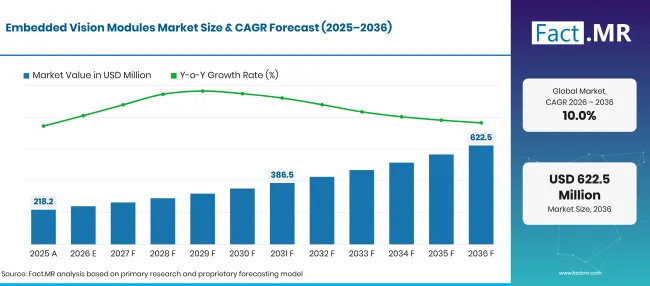
Embedded Vision Modules Forecast Global | Source: Fact.MR
Category
| Category | Segments |
|---|---|
| Product Type | CMOS vision module, ToF depth module, Event-based vision module, Multispectral vision module, Stereo vision module |
| Component Format | Pluggable assembly, Embedded subsystem, Discrete, Board module, Rugged standalone |
| Performance Class | High speed, Basic, High precision, Specialty and rugged, Mainstream industrial |
| End Use | Automotive, Industrial automation, Telecom and data center, Electronics, Aerospace and defense |
| Region | United Kingdom; Israel; South Korea; Taiwan; United States |
Source: Fact.MR analysis. Updated Nov 23, 2026
Segmental Analysis
Why do CMOS vision modules lead product demand in the Embedded Vision Modules Market?
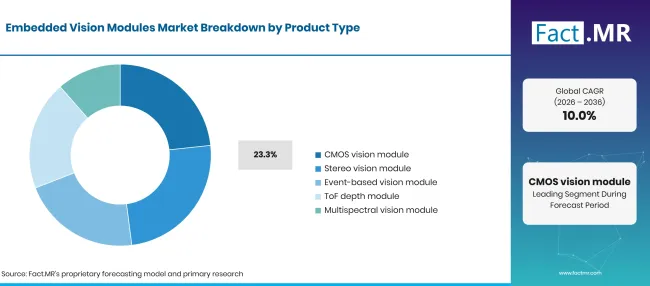
Embedded Vision Modules Breakdown Product Type | Source: Fact.MR
CMOS vision modules hold a 23.3% market share in 2026, valued at USD 55.9 million, as their low power consumption, image quality and compatibility with standard processing systems make them suitable for everyday machine vision tasks. Industrial inspection and barcode recognition continue to favour these sensors, while 3D and time-of-flight modules are gaining traction in depth sensing and robotic navigation. In September 2025, Sony announced its IMX927 global-shutter CMOS sensor, combining 105-megapixel resolution with output speeds of up to 100 fps for industrial inspection.
How are pluggable assemblies leading format demand in the Embedded Vision Modules Market?
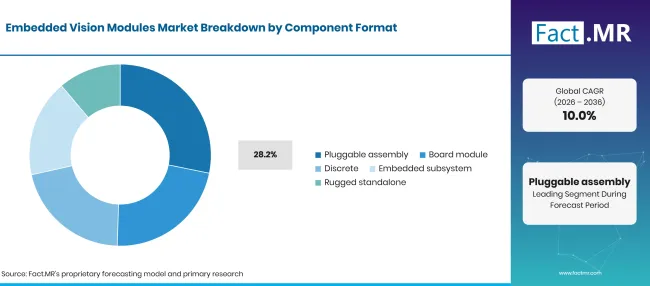
Embedded Vision Modules Breakdown Component Format | Source: Fact.MR
Pluggable assemblies lead the format segment with 28.2% of market revenue in 2026, equivalent to USD 67.7 million. Their appeal lies in straightforward installation, standardised connectors and easier replacement when camera specifications change. Custom-built assemblies are also finding buyers where equipment needs specialised dimensions or dedicated optical arrangements. Basler's embedded vision kits combine dart camera modules, processing boards, adapters, cables and system software, including configurations built around NXP i.MX8M Mini processors. Such ready-to-integrate packages reduce the engineering work involved in bringing cameras into compact equipment.
Why does the high-speed class lead performance demand in the Embedded Vision Modules Market?
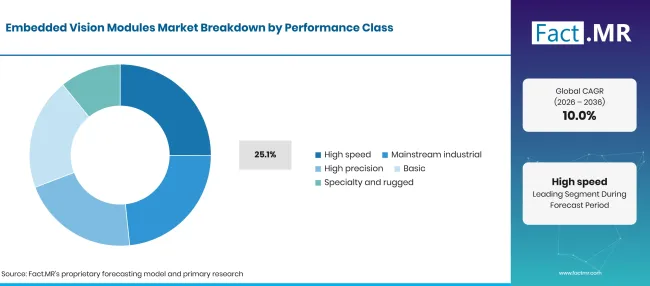
Embedded Vision Modules Breakdown Performance Class | Source: Fact.MR
High-speed modules contribute 25.1% of market revenue in 2026, worth USD 60.2 million, as automated production lines and moving robotic systems need clear images without motion distortion. Manufacturers are also investing in faster interfaces and global-shutter sensors to improve inspection accuracy. Standard-speed modules continue to attract buyers for barcode reading, access control and routine monitoring, where extreme frame rates are unnecessary. Sony's September 2025 IMX927 launch, with 105-megapixel resolution and up to 100 fps output, illustrates the push towards faster, more detailed industrial imaging.
How is automotive leading end-use demand in the Embedded Vision Modules Market?
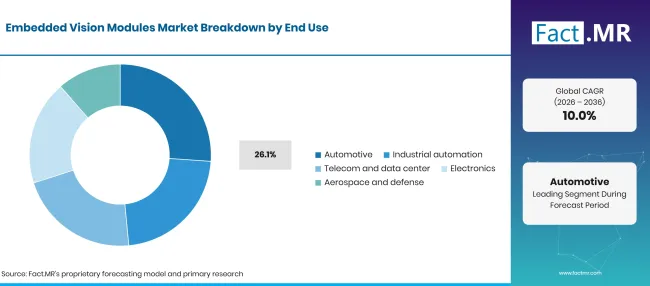
Embedded Vision Modules Breakdown End Use | Source: Fact.MR
Automotive contributes 26.1% of embedded vision modules revenue in 2026, valued at USD 62.6 million. Cameras now play an important role in parking assistance, driver monitoring, surround-view systems and advanced driver assistance. Industrial automation is another important buyer, while medical equipment manufacturers are adopting compact imaging modules for endoscopy and diagnostic devices. In October 2025, Sony announced its IMX828 automotive CMOS sensor with an integrated MIPI A-PHY interface, 8-megapixel resolution and high dynamic range. Its design removes the need for an external serializer chip, helping simplify automotive camera systems.
Embedded Vision Modules Market - Drivers, Restraints & Trends
Driver: Wider Use of Camera-Based Perception in Vehicles and Robotics
Camera-based perception is becoming central to modern vehicles and robots because machines need to recognise objects, interpret surroundings and respond without constant human input. This is creating more opportunities for embedded vision modules across automotive and industrial automation. Mobileye reported in October 2026 that its EyeQ shipments increased 11% during the first nine months of the year, while its acquisition of Mentee Robotics expanded its involvement in humanoid robotics. Wider use of autonomous systems is opening additional avenues for camera-based vision integration.
Restraint: Rising Component Costs and Platform Compatibility Issues
Rising component costs can make embedded vision modules harder to price competitively, particularly when manufacturers must balance image quality, processing performance and compact designs. Memory availability, dependence on specialised sensors and compatibility issues across processor platforms add further pressure. Higher component expenses can also delay product launches and reduce margins, while smaller manufacturers may struggle to absorb price increases without passing them on to customers.
Three-Dimensional and Event-Based Vision
Robots increasingly need to judge distance, recognise objects and respond to fast-moving surroundings, creating wider interest in depth-based and event-driven vision. Teledyne reported record quarterly sales in October 2026, with stronger performance across its industrial vision sensors and systems business. This creates room for further investment in 3D vision applications, particularly warehouse automation, autonomous navigation and industrial inspection. A related trend is the integration of machine vision with real-time robotic perception.
Trend: Physical AI and Intelligent Machine
Vision systems are becoming an important part of physical AI as factories and robotics move towards machines that can interpret their surroundings and act independently. In November 2026, NXP highlighted intelligent edge technologies at electronica, including applications combining sensing, motion, connectivity and AI. This creates opportunities for embedded vision adoption across smart factories, autonomous equipment and service robotics. A related trend is the expansion of edge AI infrastructure across industrial automation.
Embedded Vision Modules Market Analysis by Key Country
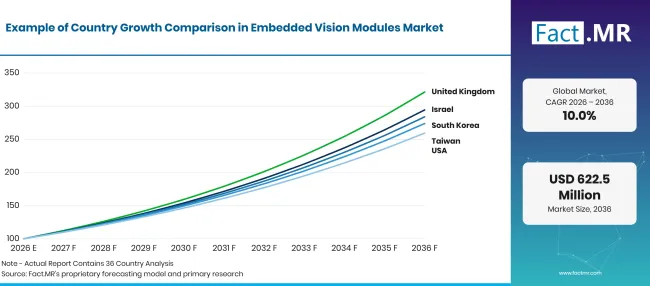
Embedded Vision Modules Growth Index | Source: Fact.MR
| Country | CAGR (2026-2036) |
|---|---|
| United Kingdom | 12.4% |
| Israel | 11.4% |
| South Korea | 11.0% |
| Taiwan | 10.6% |
| United States | 10.0% |
Source: Fact.MR analysis. Updated Nov 23, 2026
What is driving embedded vision modules demand in the United Kingdom?
The UK's push towards autonomous mobility and smart manufacturing is creating a favourable market for embedded vision modules. In May 2026, the UK government signed a partnership with Wayve to advance self-driving vehicle technology and strengthen domestic autonomous driving research.
This activity is creating opportunities for camera-based perception systems across automotive testing, robotics and industrial automation. Government backing for AI hardware and advanced manufacturing is also encouraging investment in connected imaging and machine vision applications.
How is automotive vision supporting embedded vision modules sales in Israel?
Israel's strong computer vision and autonomous technology ecosystem is creating a natural market for embedded vision modules.
The Israel Innovation Authority's 2026 AI strategy identified 61 domestic companies working in computer vision and sensing, highlighting the depth of its perception technology industry. Automotive safety, defence-related imaging, autonomous mobility and robotics are important sources of commercial activity. Further integration of sensors, software and AI in physical systems is creating opportunities for embedded camera technology across the country.
What is shaping embedded vision modules demand in South Korea?
South Korea's automotive and electronics industries are creating steady opportunities for embedded vision modules, particularly as manufacturers invest in autonomous driving and intelligent factory systems.
In February 2026, the industry ministry announced KRW 464.5 billion in automotive R&D and infrastructure investment, including funding for autonomous driving projects. Camera-based driver assistance, robotic inspection and AI-enabled manufacturing are contributing to sales, while domestic semiconductor capabilities encourage wider integration of vision systems with on-device computing.
How is edge computing shaping embedded vision modules sales in Taiwan?
Taiwan's semiconductor manufacturing base is creating opportunities for embedded vision modules as factories adopt automated inspection and AI-assisted production.
The Executive Yuan announced its Five Trusted Industry Sectors initiative in September 2024, placing semiconductors, AI and next-generation communications among its strategic priorities. In July 2025, it separately approved a NT$27 billion, six-year plan to boost next-generation communications. Investment in advanced chip production, electronics assembly and industrial automation is encouraging the use of camera-based inspection systems. The country's concentration of electronics manufacturers also creates a strong customer base for compact vision equipment.
Why is growth slower for embedded vision modules in the United States?
Factory automation and automotive production are keeping the United States an important market for embedded vision modules.
According to the International Federation of Robotics, industrial robot installations increased 11% to 38,000 units in 2025, with automotive manufacturers installing 13,500 units. These deployments create opportunities for cameras used in robotic guidance, component inspection and automated handling. Investment in flexible manufacturing and AI-enabled industrial systems is also widening the customer base for embedded imaging solutions.
Competitive Landscape for Embedded Vision Modules Market
The embedded vision modules market brings together companies with different strengths in camera design, image sensors and processing compatibility. Basler and Allied Vision focus on compact industrial cameras, embedded camera boards and software integration, while Sony Semiconductor Solutions and OmniVision compete through advanced CMOS imaging sensors. Teledyne serves applications such as factory inspection and scientific imaging, whereas e-con Systems develops camera modules compatible with platforms such as NVIDIA Jetson and NXP processors.
Competition is increasingly shaped by how easily these solutions fit into AI-enabled equipment. Manufacturers are placing greater emphasis on ready-to-integrate camera systems, reliable drivers, long-term product availability and image processing capabilities rather than competing on sensor specifications alone.
Recent Developments
- On March 25, 2026, Basler AG partnered with Orbbec to develop 3D vision solutions for logistics and factory automation. The partnership introduced the Basler Stereo mini camera for applications involving autonomous mobile robots and industrial automation.
- On July 22, 2026, Sony Semiconductor Solutions partnered with Mitsubishi Electric to establish a joint venture named Advanced Vision Solutions. The venture will develop AI-powered vision sensors for manufacturing automation using Sony's image sensor and edge AI technologies.
- On October 5, 2026, OMNIVISION launched the OG05D, a 5-megapixel global shutter HDR image sensor for industrial machine vision and robotics cameras. The sensor delivers up to 146 frames per second and supports applications such as factory automation and barcode scanning.
- On June 16, 2026, Teledyne DALSA launched the Linea HS2 8k backside-illuminated TDI camera for high-speed imaging in low-light conditions. The camera offers a maximum line rate of 1 MHz and targets semiconductor inspection and other industrial applications.
- On April 23, 2026, Allied Vision partnered with QDI Systems to advance short-wave infrared (SWIR) imaging using quantum dot sensors. The collaboration aims to develop more affordable, compact and lightweight imaging solutions for industrial and drone applications.
Key Players in Embedded Vision Modules Market
Key companies operating in the market include Basler, Sony Semiconductor Solutions, OmniVision, Teledyne, Allied Vision, and e-con Systems.
- Basler
- Sony Semiconductor Solutions
- OmniVision
- Teledyne
- Allied Vision
- e-con Systems
Bibliography
- Advantech Co., Ltd. (2026, October 29). Advantech reports 3Q26 EPS of NT$7.15; quarterly revenue and profit reach record highs.
- Basler AG. (2026). 9-month report 2026. https://www.baslerweb.com/
- Basler AG. (n.d.). daA4200-30mci-MX8MM-VAR embedded vision kit. Basler Product Documentation.
- Department for Business and Trade. (2026, May 12). Government and Wayve sign partnership to accelerate Britain's self-driving future. GOV.UK.
- Executive Yuan. (2024, September 16). Five Trusted Industry Sectors.
- Executive Yuan. (2025, July 10). NT$27 billion, six-year plan to boost next-gen communications.
- International Federation of Robotics. (2026, June 18). US robot industry returns to double digit growth.
- Israel Innovation Authority. (2026). AI strategy report.
- Ministry of Trade, Industry and Energy. (2024, October 28). Korea rolls out AI autonomous manufacturing anchor projects.
- Mobileye Global Inc. (2026, October 29). Mobileye releases third quarter 2026 results, updates guidance, and provides business overview.
- NXP Semiconductors. (2026, November 16). electronica 2026 highlights.
- Sony Semiconductor Solutions Corporation. (2025, September 29). Sony Semiconductor Solutions to release the industry-leading global shutter CMOS image sensor for industrial use that achieves both approximately 105-effective-megapixels and high-speed 100 FPS output.
- Sony Semiconductor Solutions Corporation. (2025, October 28). Sony Semiconductor Solutions to release industry's first CMOS image sensor for automotive applications with built-in MIPI A-PHY interface.
- Teledyne Technologies Incorporated. (2026, October 21). Teledyne Technologies reports third quarter results.
Segmentation
Scope of Report
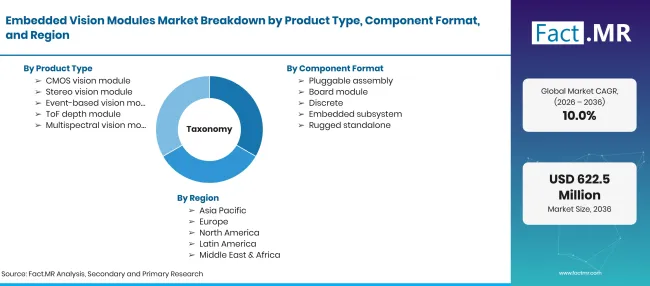
Embedded Vision Modules Taxonomy | Source: Fact.MR
| Items | Values |
|---|---|
| Quantitative Units (2026) | USD 240.0 Million |
| Product Type | CMOS vision module, ToF depth module, Event-based vision module, Multispectral vision module, Stereo vision module |
| Component Format | Pluggable assembly, Embedded subsystem, Discrete, Board module, Rugged standalone |
| Performance Class | High speed, Basic, High precision, Specialty and rugged, Mainstream industrial |
| End Use | Automotive, Industrial automation, Telecom and data center, Electronics, Aerospace and defense |
| Regions Covered | North America, Latin America, Europe, East Asia, South Asia and Pacific, Middle East & Africa |
| Countries Covered | United Kingdom, Israel, South Korea, Taiwan, United States, and other countries |
| Key Companies Profiled | Basler, Sony Semiconductor Solutions, OmniVision, Teledyne, Allied Vision, e-con Systems |
| Additional Attributes | Dollar revenue in the Embedded Vision Modules Market is segmented by product type (CMOS, ToF depth, event-based, multispectral, stereo vision module), component format, performance class, end use and region. |
Source: Fact.MR analysis. Updated Nov 23, 2026
Embedded Vision Modules Market by Segments
-
Product Type
- CMOS vision module
- ToF depth module
- Event-based vision module
- Multispectral vision module
- Stereo vision module
-
Component Format
- Pluggable assembly
- Embedded subsystem
- Discrete
- Board module
- Rugged standalone
-
Performance Class
- High speed
- Basic
- High precision
- Specialty and rugged
- Mainstream industrial
-
End Use
- Automotive
- Industrial automation
- Telecom and data center
- Electronics
- Aerospace and defense
-
Region
- North America
- United States
- Canada
- Mexico
- Europe
- Germany
- United Kingdom
- France
- Italy
- Spain
- Rest of Europe
- Asia Pacific
- China
- India
- Japan
- South Korea
- Australia
- Rest of Asia Pacific
- Latin America
- Brazil
- Mexico
- Argentina
- Rest of Latin America
- Middle East & Africa
- GCC Countries
- South Africa
- Rest of Middle East & Africa
- North America
Frequently Asked Questions
How big is the global Embedded Vision Modules Market in 2026?
What will be the size of the Embedded Vision Modules Market by 2036?
How fast will the Embedded Vision Modules Market grow during the forecast period?
Which product type segment holds the largest share of the Embedded Vision Modules Market?
Who worked on this report


Preview the report firsthand - request a free sample
Free SampleGet the brochure for pricing and purchase details
Download PDF