- Market Value (2025): USD 0.96 Bn
- Estimated Value (2026): USD 1.1 Bn
- Forecast Value (2036): USD 2.49 Bn
- CAGR (2026-2036): 9.0%
Power Management Controllers Market Forecast and Outlook 2026 to 2036
The global power management controllers market was valued at USD 0.96 billion in 2025 and reached USD 1.1 billion in 2026. The market is estimated to reach USD 2.49 billion by 2036, expanding at a CAGR of 9.0% during the 2026 to 2036 assessment period.
Power management controllers are gaining importance as advanced processors, sensors and communication chips need precise voltage regulation, faster response to changing loads and better energy efficiency. Manufacturers are expanding their portfolios across multi-rail power ICs, DC-DC controllers, sequencers and battery charging solutions to address these needs. In October 2026, Texas Instruments reported a 32% year-on-year increase in third-quarter analog revenue and 21% growth in embedded processing. This reflects stronger semiconductor activity, which also creates opportunities for power management controllers.
Key Takeaways from the Power Management Controllers Market
- Sales of power management controllers stood at USD 0.96 billion in 2025
- Power Management Controllers Market Value (2026): USD 1.1 billion
- Power Management Controllers Market Forecast Value (2036): USD 2.49 billion
- Power Management Controllers Market Forecast CAGR (2026-2036): 9.0%
- Leading Product Type: Multi-rail PMIC (28.3%)
- Key Market Participants: Texas Instruments, Analog Devices, Infineon, STMicroelectronics, onsemi, Renesas
- Key Growth Regions: United States, Belgium, United Kingdom, Germany, France
AI data centre expansion is creating new opportunities for power management controllers, particularly as high-performance servers need stable power delivery to processors handling heavy workloads. In November 2026, Infineon reported EUR 1.7 billion in fiscal 2026 revenue from AI data centre power supplies, with the figure expected to approach EUR 4 billion in fiscal 2027. This investment is encouraging suppliers to work on vertical power delivery and 48-volt architectures, particularly for AI infrastructure across North America and Europe.
Power Management Controllers Market
| Metric | Value |
|---|---|
| Estimated Value in (2025) | USD 0.96 billion |
| Estimated Value in (2026) | USD 1.1 billion |
| Forecast Value in (2036) | USD 2.49 billion |
| Forecast CAGR (2026 to 2036) | 9.0% |
Source: Fact.MR analysis. Updated Nov 24, 2026
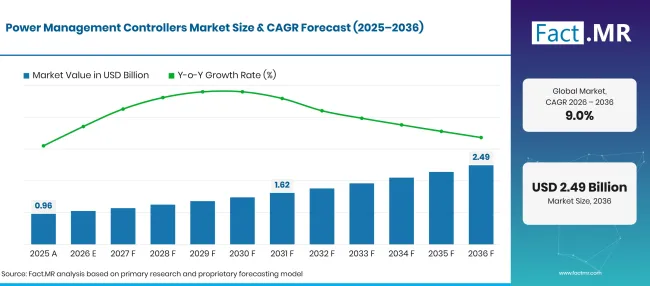
Power Management Controllers Forecast Global | Source: Fact.MR
Category
| Category | Segments |
|---|---|
| Product Type | Multi-rail PMIC, DC-DC controller, Power sequencer, Digital power controller, Battery charger controller |
| Component Format | Rugged standalone, Embedded subsystem, Discrete, Board module, Pluggable assembly |
| Performance Class | High speed, High precision, Specialty and rugged, Basic, Mainstream industrial |
| End Use | Industrial automation, Telecom and data center, Electronics, Aerospace and defense, Automotive |
| Region | United States; Belgium; United Kingdom; Germany; France |
Source: Fact.MR analysis. Updated Nov 24, 2026
Segmental Analysis
Why do multi-rail PMICs lead product demand in the Power Management Controllers Market?
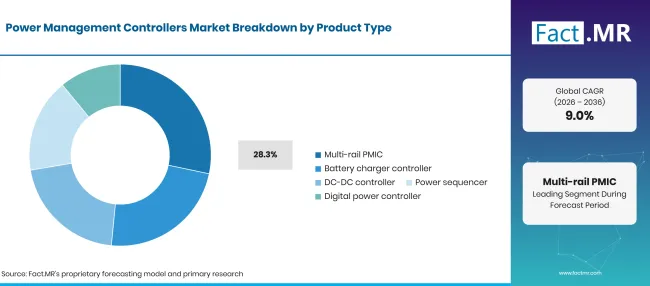
Power Management Controllers Breakdown Product Type | Source: Fact.MR
Multi-rail PMICs capture 28.3% of the power management controllers market in 2026, valued at USD 297.2 million. Their ability to regulate several voltage outputs, coordinate power sequencing and monitor connected components makes them suitable for processor-intensive systems with limited board space. In February 2025, Infineon introduced its OPTIREG TLF35585, an integrated multi-rail PMIC designed for AURIX microcontrollers and safety-related automotive applications. Single-output controllers are also gaining traction in simpler electronic designs, while programmable PMICs are finding applications in adaptable computing platforms.
How is the rugged standalone format leading demand in the Power Management Controllers Market?
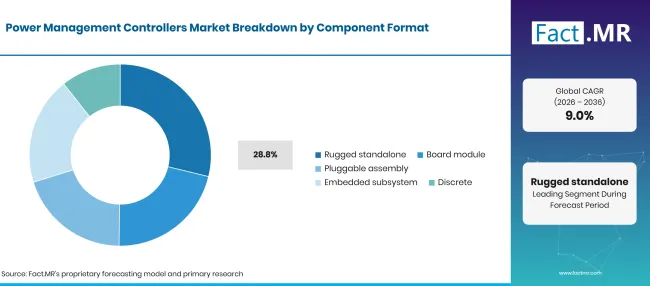
Power Management Controllers Breakdown Component Format | Source: Fact.MR
Rugged standalone controllers contribute 28.8% of market revenue in 2026, reaching USD 302.4 million. Industrial equipment, automotive electronics and defense systems favor these devices because individual power circuits can be positioned close to their loads and selected according to operating conditions. In January 2026, Texas Instruments revised its LM5125-Q1 documentation, highlighting automotive qualification, functional safety capabilities and operation across a -40°C to 125°C temperature range. Integrated modules are also gaining traction as compact designs help reduce component count, while configurable formats attract manufacturers seeking greater design flexibility.
Why does the high-speed class lead performance demand in the Power Management Controllers Market?
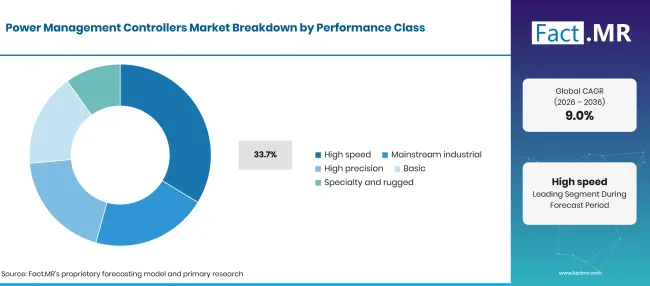
Power Management Controllers Breakdown Performance Class | Source: Fact.MR
Fast-changing processor workloads are strengthening the position of high-speed controllers, which capture 33.7% of market revenue in 2026, worth USD 353.9 million. These devices regulate voltage during sudden changes in processor current, particularly in AI accelerators, GPUs and networking equipment. In November 2025, Analog Devices published the MAX20816 controller datasheet, introducing a dual-output, 16-phase architecture with AVSBus support for rapid voltage transitions in high-current AI applications. Low-speed controllers continue to serve steady-load equipment, while precision-focused products are gaining traction in sensitive measurement and communication systems.
How is industrial automation leading end-use demand in the Power Management Controllers Market?
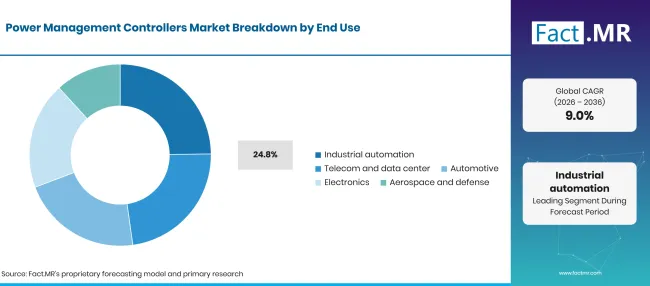
Power Management Controllers Breakdown End Use | Source: Fact.MR
Industrial automation contributes 24.8% of market revenue in 2026, reaching USD 260.4 million. Factory robots, programmable logic controllers, motor drives and industrial sensors operate across multiple voltage levels, creating regular requirements for reliable power regulation. The International Federation of Robotics reported in September 2025 that factories installed 542,000 industrial robots during 2024, with global operational installations reaching 4.66 million units. This expanding automation base strengthens controller requirements across factory equipment. Automotive electronics are also gaining traction through vehicle electrification, while telecommunications is attracting investment in power-efficient networking infrastructure.
Power Management Controllers Market-Drivers, Restraints & Trends
Drivers: Recovery in Analog Semiconductor Demand:
The recovery in analog semiconductors is creating a stronger order pipeline for power management controllers because industrial equipment, automotive electronics and connected devices rely on stable power regulation. As manufacturers resume production and replenish inventories, purchases of power control components are also improving. STMicroelectronics reported Q3 2026 revenue of USD 3.76 billion, up 17.9% year over year, while Analog Devices recorded USD 4.02 billion in Q3 2026 revenue, led by industrial and data centre activity.
Restraints: Price Competition and Design Integration:
Price pressure makes it difficult for controller manufacturers to protect margins, particularly when buyers compare alternatives across semiconductor suppliers. Long automotive qualification cycles also delay commercial adoption, while integrating power regulation into processors and compact modules can reduce opportunities for standalone controllers. Smaller manufacturers face additional pressure from high design and validation costs, component availability fluctuations and the need to maintain long-term product support.
Trend: Higher Power Requirements in AI Data Centres:
AI infrastructure is changing power management requirements as server processors consume more electricity and data centres move towards higher rack-level power densities. Infineon reported EUR 1.7 billion in AI data centre revenue for FY2026 in November 2026. This creates opportunities for controller manufacturers across multiphase power distribution, energy conversion and thermal-efficient infrastructure. Future investment in high-density computing facilities should widen the market beyond conventional server applications.
Trend: Software-Defined Vehicles and Zonal Power Architectures:
Vehicle electronics are moving towards centralized computing and zonal architectures because automakers want fewer control units, simpler wiring and more flexible electronic platforms. In October 2026, Volkswagen selected NXP as a strategic semiconductor partner for its future zonal software-defined vehicle architecture. This transition creates opportunities for power management controllers across vehicle computing, battery-powered subsystems and safety electronics. Wider adoption of electric and software-defined vehicles should open additional automotive applications.
Power Management Controllers Market by Analysis by Key Country
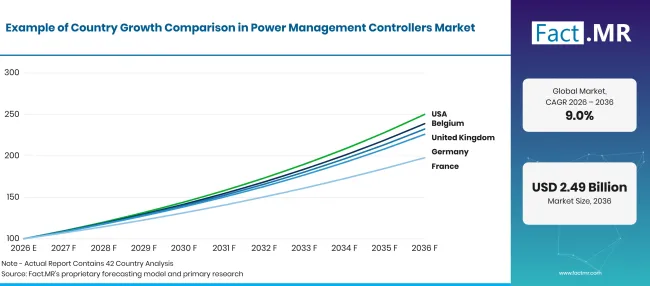
Power Management Controllers Growth Index | Source: Fact.MR
| Country | CAGR (2026-2036) |
|---|---|
| United States | 9.6% |
| Belgium | 9.1% |
| United Kingdom | 8.8% |
| Germany | 8.5% |
| France | 7.1% |
Source: Fact.MR analysis. Updated Nov 24, 2026
What is driving power management controllers demand in the United States?
The United States is set to record the fastest growth among the listed countries as investment in AI computing, semiconductor manufacturing and electric vehicles increases the need for efficient power regulation.
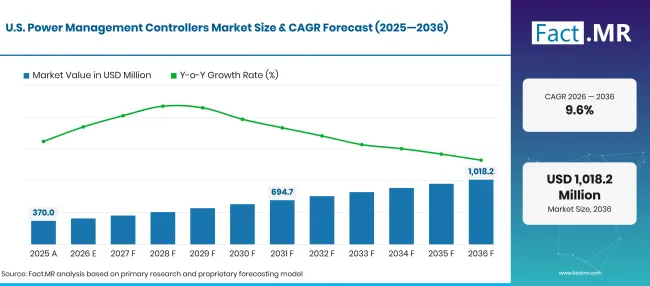
Power Management Controllers Forecast Usa | Source: Fact.MR
The Semiconductor Industry Association reported that US-headquartered semiconductor companies generated USD 425 billion in sales during 2025, with record R&D spending of USD 76.8 billion. Expanding domestic chip production and data centre infrastructure are creating additional opportunities for power management controller manufacturers.
How is chip research supporting power management controllers sales in Belgium?
Belgium's semiconductor research ecosystem is creating new opportunities for power management controllers, particularly as advanced computing and automotive electronics place greater emphasis on efficient energy delivery.
In February 2026, imec inaugurated a 2,000-square-metre cleanroom expansion at its Leuven headquarters for Europe's NanoIC pilot line. Further investment in chip research, advanced packaging and AI-related technologies is strengthening the country's semiconductor ecosystem and creating opportunities for power control applications.
What is shaping power management controllers demand in the United Kingdom?
Investment in domestic chip design and AI infrastructure is strengthening the UK's position in power management controller applications.
In June 2026, the UK government announced a £1.1 billion AI Hardware Plan, including £400 million for next-generation AI chips. This initiative is creating opportunities for power regulation across computing infrastructure, industrial electronics and advanced semiconductor systems. Automotive electrification and defence electronics are adding further avenues for controller adoption.
How is power semiconductor strength shaping power management controllers sales in Germany?
Germany's strong automotive and industrial manufacturing base continues to create a steady market for power management controllers.
A major industry milestone came in July 2026, when Infineon opened its EUR 5 billion Smart Power Fab in Dresden, adding manufacturing capacity for power semiconductors and analog technologies. Electric vehicle electronics, factory automation, renewable energy systems and AI data centre infrastructure are strengthening the need for reliable voltage regulation across German industries.
Why is growth slower for power management controllers in France?
France is strengthening its semiconductor manufacturing capabilities through public investment and industrial partnerships, creating opportunities for power management controller applications.
In May 2026, the French government announced an additional EUR 550 million investment in the semiconductor sector. The funding drive supports technological independence and strengthens the domestic electronics ecosystem. Automotive electronics, aerospace systems, industrial automation and energy-efficient computing are contributing to controller sales across the country.
Competitive Landscape for Power Management Controllers Market
Competition in the power management controllers market is shaped by semiconductor manufacturers expanding their portfolios for AI computing, automotive electronics and industrial applications. Texas Instruments offers multiphase controllers, smart power stages, PMICs and reference designs, while Analog Devices focuses on high-current regulation, power monitoring and integrated multiphase solutions.
Infineon serves automotive electronics through its OPTIREG safety-focused PMIC family, whereas STMicroelectronics and Renesas target embedded and industrial power applications. In September 2026, onsemi introduced its Embedded Power Platform for AI data centres, automotive and industrial systems, highlighting the shift towards integrated power delivery.
Recent Developments
- On March 23, 2026, Texas Instruments introduced new isolated power modules using its proprietary IsoShield technology, designed to improve power density and efficiency in data centres and electric vehicles.
- On May 19, 2026, Analog Devices announced an agreement to acquire Empower Semiconductor for USD 1.5 billion to expand its high-density power management solutions for AI computing applications.
- On August 24, 2026, Infineon Technologies announced the acquisition of C2i Semiconductors to strengthen its digital power management, multiphase controller and AI data centre power solutions.
- On February 2, 2026, STMicroelectronics completed the acquisition of NXP Semiconductors' MEMS sensor business to expand its sensor portfolio for automotive safety and industrial applications.
- On November 2, 2026, onsemi announced an agreement to acquire Ferric for USD 600 million to strengthen its integrated voltage regulator technology and power delivery solutions for next-generation AI processors.
Key Players in Power Management Controllers Market
Key companies operating in the market include Texas Instruments, Analog Devices, Infineon, STMicroelectronics, onsemi, and Renesas.
- Texas Instruments
- Analog Devices
- Infineon
- STMicroelectronics
- onsemi
- Renesas
Bibliography
- Analog Devices. (2025, November 20). MAX20816: Dual-output multiphase high-current PWMVID and AVSBus controller data sheet.
- Analog Devices. (2026, August 19). Analog Devices reports record fiscal third quarter 2026 financial results.
- Department for Science, Innovation and Technology. (2026, June 8). A decisive shift to power British AI: New £1.1 billion plan to back chip firms, boost computing power and skills for the AI revolution. GOV.UK.
- Gouvernement français. (2026, May 22). Souveraineté européenne : la France investit 550M€ dans les semi-conducteurs.
- Infineon Technologies AG. (2025, February 6). Infineon introduces new OPTIREG TLF35585 power management IC for demanding automotive applications.
- Infineon Technologies AG. (2026, November 10). Infineon closes FY 2026 with record quarter; expects revenue growth of more than 20 percent and a 5-percentage-point increase in profitability for FY 2027, driven by data centers, power infrastructure, and software-defined vehicles.
- International Federation of Robotics. (2025, September 25). Global robot demand in factories doubles over 10 years: World Robotics 2025 report.
- imec. (2026, February 9). Imec inaugurates NanoIC pilot line, accelerating innovation in sub-2nm systems-on-chip.
- Semiconductor Industry Association. (2026). 2026 state of the industry report: Historic growth amid intensifying global competition.
- STMicroelectronics. (2026, October 29). STMicroelectronics reports Q3 2026 financial results.
- Texas Instruments. (2026, January 28). LM5125-Q1: Wide-VIN, dual-phase automotive boost controller with VOUT tracking data sheet.
- Texas Instruments. (2026, October 21). TI reports third quarter 2026 financial results and shareholder returns.
- Volkswagen Group. (2026, October 26). Volkswagen Group strengthens its strategic semiconductor ecosystem through partnership with NXP.
Segmentation
Scope of Report
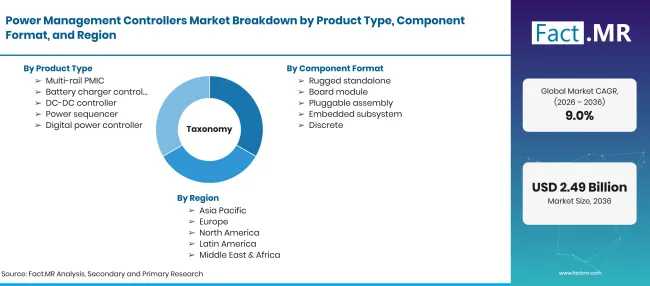
Power Management Controllers Taxonomy | Source: Fact.MR
| Items | Values |
|---|---|
| Quantitative Units (2026) | USD 1.1 Billion |
| Product Type | Multi-rail PMIC, DC-DC controller, Power sequencer, Digital power controller, Battery charger controller |
| Component Format | Rugged standalone, Embedded subsystem, Discrete, Board module, Pluggable assembly |
| Performance Class | High speed, High precision, Specialty and rugged, Basic, Mainstream industrial |
| End Use | Industrial automation, Telecom and data center, Electronics, Aerospace and defense, Automotive |
| Regions Covered | North America, Latin America, Europe, East Asia, South Asia and Pacific, Middle East & Africa |
| Countries Covered | United States, Belgium, United Kingdom, Germany, France, and other countries |
| Key Companies Profiled | Texas Instruments, Analog Devices, Infineon, STMicroelectronics, onsemi, Renesas |
| Additional Attributes | Dollar revenue in the Power Management Controllers Market is segmented by product type (multi-rail PMIC, DC-DC controller, power sequencer, digital power controller, battery charger controller), component format, performance class, end use and region. |
Source: Fact.MR analysis. Updated Nov 24, 2026
Power Management Controllers Market by Segments
-
Product Type
- Multi-rail PMIC
- DC-DC controller
- Power sequencer
- Digital power controller
- Battery charger controller
-
Component Format
- Rugged standalone
- Embedded subsystem
- Discrete
- Board module
- Pluggable assembly
-
Performance Class
- High speed
- High precision
- Specialty and rugged
- Basic
- Mainstream industrial
-
End Use
- Industrial automation
- Telecom and data center
- Electronics
- Aerospace and defense
- Automotive
-
Region:
- North America
- United States
- Canada
- Mexico
- Europe
- Germany
- United Kingdom
- France
- Italy
- Spain
- Rest of Europe
- Asia Pacific
- China
- India
- Japan
- South Korea
- Australia
- Rest of Asia Pacific
- Latin America
- Brazil
- Mexico
- Argentina
- Rest of Latin America
- Middle East & Africa
- GCC Countries
- South Africa
- Rest of Middle East & Africa
- North America
Frequently Asked Questions
How big is the global Power Management Controllers Market in 2026?
What will be the size of the Power Management Controllers Market by 2036?
How fast will the Power Management Controllers Market grow during the forecast period?
Which product type segment holds the largest share of the Power Management Controllers Market?
Who worked on this report


Preview the report firsthand - request a free sample
Free SampleGet the brochure for pricing and purchase details
Download PDF