Gas Turbine Market
Gas Turbine Market Size and Share Forecast Outlook 2025 to 2035
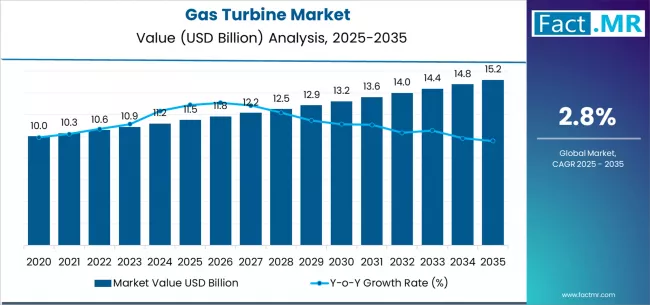
Gas turbine market is projected to grow from USD 11.5 billion in 2025 to USD 15.2 billion by 2035, at a CAGR of 2.8%. Combined Cycle will dominate with a 88.0% market share, while >200 mw will lead the capacity segment with a 75.3% share.
Gas Turbine Market Forecast and Outlook 2025 to 2035
The global gas turbine market is projected to reach USD 15.2 billion by 2035, recording an absolute increase of USD 3.7 billion over the forecast period. The market is valued at USD 11.5 billion in 2025 and is set to rise at a CAGR of 2.8% during the assessment period.
The gas turbine market’s size is expected to grow by approximately 1.3 times during the same period, supported by increasing demand for efficient power generation solutions in emerging economies worldwide, driving investments in combined cycle technologies and expanding natural gas infrastructure development across electricity generation and industrial applications globally.
Quick Stats for Gas Turbine Market
- Gas Turbine Market Value (2025): USD 11.5 billion
- Gas Turbine Market Forecast Value (2035): USD 15.2 billion
- Gas Turbine Market Forecast CAGR: 2.8%
- Leading Technology in Gas Turbine Market: Combined Cycle (88.0%)
- Key Growth Regions in Gas Turbine Market: Asia Pacific, North America, and Middle East & Africa
- Top Players in Gas Turbine Market: Siemens Energy, General Electric, Mitsubishi Power, Ansaldo Energia, OPRA Turbines, Bharat Heavy Electricals Ltd., MAN Energy Solutions, Solar Turbines Inc., Kawasaki Heavy Industries, Centrax Gas Turbines

Power utilities and industrial operators face mounting pressure to enhance grid reliability and reduce carbon emissions while addressing baseload capacity requirements and peak demand management, with modern gas turbine systems providing documented operational benefits including rapid startup capabilities, fuel flexibility advantages, and superior efficiency profiles compared to conventional coal-fired generation technologies alone.
Rising emphasis on gas-to-power transitions and expanding distributed generation models enabling flexible capacity deployment creates substantial opportunities for turbine manufacturers and energy infrastructure developers. However, intermittent renewable energy integration challenges and regulatory uncertainties across markets may pose obstacles to long-term capacity expansion planning.
The combined cycle segment dominates market activity, driven by extensive operational advantages supporting superior thermal efficiency and enhanced fuel utilization across diverse power generation applications worldwide. Utilities increasingly recognize the economic benefits of combined cycle configurations, with typical installations providing effective capacity optimization and emissions reduction at competitive levelized costs through established energy infrastructure networks.
The >200 MW capacity segment demonstrates robust presence, supported by large-scale power generation requirements and grid-scale deployment patterns integrating high-output turbine systems in centralized generation facilities. Power & utility applications emerge as the dominant end-use category, reflecting fundamental electricity generation requirements and baseload capacity provisioning in modern energy systems. Combined cycle technology represents the leading configuration approach, driven by proven efficiency metrics and established deployment frameworks enabling comprehensive heat recovery utilization.
Regional dynamics show India maintaining the fastest growth trajectory, supported by rapid gas infrastructure expansion and coal-to-gas transition policies across power generation sectors. China demonstrates strong development momentum driven by large-scale energy infrastructure investments and grid modernization initiatives, while USA emphasizes fleet replacement programs and shale gas integration, and Saudi Arabia focuses on domestic power generation optimization.
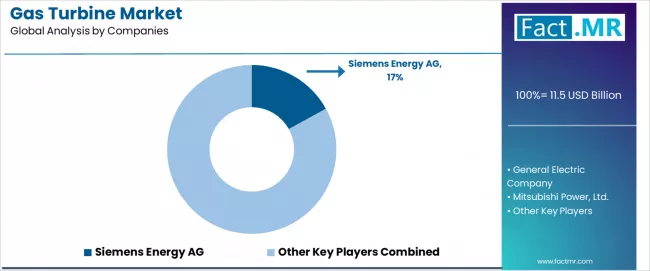
Germany advances hydrogen-ready turbine deployment programs, followed by Brazil supported by hybrid generation strategies and Japan emphasizing grid reliability enhancement. The competitive landscape features moderate concentration with Siemens Energy maintaining market leadership position, while established manufacturers including General Electric, Mitsubishi Power, and Ansaldo Energia compete through advanced turbine technologies and comprehensive service portfolios across diverse capacity applications.
Gas Turbine Market Year-over-Year Forecast 2025 to 2035
Between 2025 and 2029, the gas turbine market is projected to expand from USD 11.5 billion to USD 12.7 billion, resulting in a value increase of USD 1.2 billion, which represents 32.4% of the total forecast growth for the period. This phase of development will be shaped by rising demand for combined cycle installations and efficient power generation technologies addressing grid modernization requirements, product innovation in hydrogen-ready turbine designs and advanced materials with enhanced temperature tolerances and durability profiles, as well as expanding integration with renewable energy systems and energy storage solutions. Companies are establishing competitive positions through investment in digitalization initiatives, advanced combustion technologies, and strategic market expansion across utility partnerships, industrial facilities, and distributed generation deployment models.
From 2029 to 2035, the market is forecast to grow from USD 12.7 billion to USD 15.2 billion, adding another USD 2.5 billion, which constitutes 67.6% of the overall expansion. This period is expected to be characterized by the expansion of specialized capacity applications, including flexible peaking units and hydrogen co-firing capabilities tailored for decarbonization pathways, strategic collaborations between turbine manufacturers and energy transition stakeholders, and an enhanced focus on operational flexibility and emissions reduction standards. The growing emphasis on hybrid generation systems and rising adoption of digitally integrated predictive maintenance platforms will drive demand for advanced turbine solutions across diverse energy infrastructure requirements.
Gas Turbine Market Key Takeaways
| Metric | Value |
|---|---|
| Market Value (2025) | USD 11.5 billion |
| Market Forecast Value (2035) | USD 15.2 billion |
| Forecast CAGR (2025-2035) | 2.8% |
Why is the Gas Turbine Market Growing?
The gas turbine market grows by enabling power utilities and industrial operators to deliver reliable electricity generation and mechanical drive applications while addressing emissions reduction goals and operational flexibility requirements without exclusive reliance on renewable generation technologies.
Power generation facilities face mounting pressure to provide dispatchable baseload capacity and rapid response capabilities while managing fuel efficiency optimization, load following requirements, and environmental compliance standards, with modern turbine installations typically providing flexible generation dispatch including fast startup times for grid stabilization, fuel-flexible combustion systems for natural gas and hydrogen blending, and high-efficiency heat recovery for cogeneration applications compared to conventional generation alternatives alone, making gas turbine deployment essential for comprehensive energy transition strategies.
The power industry's need for reliable and flexible generation solutions creates demand for advanced turbine technologies that can provide grid stability enhancement, support renewable integration, and deliver cost-competitive electricity generation without compromising operational availability or emissions performance.
Utility endorsements and operational track records supporting turbine reliability drive adoption in power generation environments, industrial facilities, and distributed energy systems, where performance outcomes have direct impact on electricity costs and grid reliability metrics.
The increasing natural gas infrastructure development globally, supported by expanding pipeline networks and liquefied natural gas import facilities, creates growing fuel availability enabling turbine deployment expansion. Rising awareness about emission reduction pathways and fuel flexibility advantages enables informed technology selection and investment in gas-fired generation capacity.
Operational variability among turbine configurations and competitive pressure from renewable generation technologies may limit market penetration in regions prioritizing zero-carbon electricity sources and battery storage deployment among energy planning authorities with aggressive decarbonization targets.
Segmental Analysis
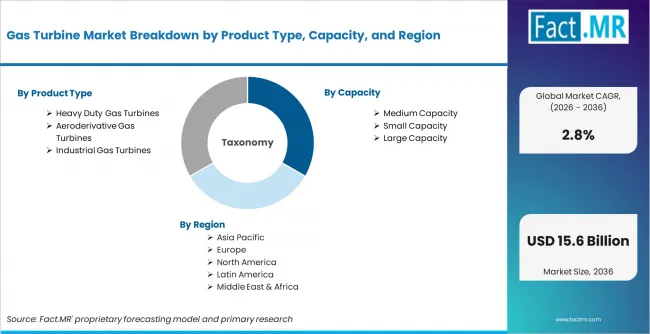
The market is segmented by technology, capacity, end use, and region. By technology, the market is divided into combined cycle and open cycle. Based on capacity, the market is categorized into >200 MW and ≤200 MW. By end use, the market includes power & utility and industrial. Regionally, the market is divided into Asia Pacific, Europe, North America, Latin America, and Middle East & Africa.
By Technology, Which Segment Accounts for the Dominant Market Share?

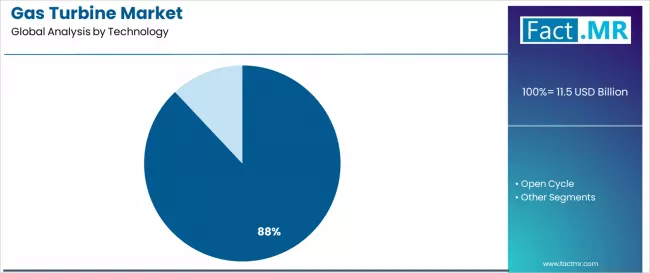
Combined cycle gas turbines represent the dominant force in the gas turbine market, capturing 88.0% of the total market share in 2025. This established technology category encompasses solutions featuring proven thermal efficiency optimization and integrated heat recovery capabilities, including advanced configurations combining gas turbine generators with steam cycle systems and waste heat utilization technologies that enable superior fuel-to-electricity conversion efficiency and reduced emissions profiles across power generation and cogeneration applications worldwide.
The combined cycle segment's market leadership stems from its superior economic performance characteristics, with installations capable of achieving thermal efficiencies exceeding 60% through sequential energy extraction from combustion gases while maintaining operational flexibility and load-following capabilities across diverse utility and industrial requirements.
The open cycle segment maintains a market share in the 12.0% range, serving applications requiring rapid deployment capabilities and peak demand management where simple cycle configurations provide sufficient operational characteristics including fast startup times under 10 minutes and compact installation footprints for emergency backup generation and seasonal peaking duty cycles.
These solutions offer straightforward mechanical design advantages for operators managing intermittent capacity requirements while providing adequate efficiency to support grid reliability objectives. The open cycle segment demonstrates stable baseline demand, driven by peaking capacity requirements and specialized applications where combined cycle complexity proves unnecessary.
Within the technology category, advanced combined cycle configurations including multi-shaft arrangements and supplementary firing options demonstrate growing adoption, driven by operational flexibility requirements and site-specific optimization opportunities. This sub-segment benefits from modular design capabilities and incremental efficiency improvements.
Key operational advantages driving the combined cycle segment include:
- Advanced efficiency performance mechanisms with documented thermal conversion rates achieving 60-63% efficiency levels across modern turbine installations and heat recovery steam generator integration
- Established fuel flexibility characteristics allowing natural gas combustion with hydrogen co-firing capabilities and alternative gaseous fuel utilization without extensive system modifications
- Enhanced environmental compliance features enabling nitrogen oxide reduction through selective catalytic reduction systems and carbon intensity minimization while maintaining operational reliability and dispatch flexibility
- Superior economic performance providing optimal lifecycle cost structures for baseload generation applications across various utility scale factors and market electricity price environments
By Capacity, Which Segment Accounts for the Largest Market Share?

The >200 MW capacity segment dominates the gas turbine capacity landscape with a 75.3% market share in 2025, reflecting the critical role of large-scale generation units in supporting baseload electricity demand, grid stability requirements, and centralized power station deployment strategies across utility networks worldwide.
The >200 MW segment's market leadership is reinforced by utility preferences for economies of scale in power generation operations, concentrated capacity deployment supporting transmission infrastructure optimization, and compatibility with combined cycle configurations that characterize modern efficient power generation facilities.
Within this segment, configurations in the 300-400 MW output range represent the preferred capacity class for many utilities, driven by optimal efficiency characteristics, proven operational reliability across diverse fuel specifications, and alignment with transmission grid capacity planning requirements. This sub-segment benefits from established technology maturity and extensive field experience across global installations.
The ≤200 MW segment represents a meaningful capacity category, demonstrating specialized applications through requirements for distributed generation projects, industrial cogeneration facilities, and smaller utility installations where site constraints, fuel availability patterns, or regional demand characteristics favor moderate capacity deployments. This segment benefits from shorter project development timelines and enhanced operational flexibility for load management.
Key market dynamics supporting capacity segment growth include:
- Large-scale turbine expansion driven by centralized generation strategies and transmission infrastructure planning, requiring advanced cooling systems and comprehensive auxiliary equipment integration
- Industrial capacity requirements emphasizing cogeneration applications and process steam integration enabling comprehensive energy efficiency optimization
- Integration of modular deployment approaches enabling phased capacity additions and scalable generation expansion aligned with demand growth trajectories
- Growing emphasis on hybrid generation configurations combining gas turbines with renewable energy systems and battery storage for grid flexibility enhancement
By End Use, Which Segment Accounts for a Significant Market Share?

Power & utility applications represent the dominant end-use segment in the gas turbine market with a 90.3% market share in 2025, reflecting the fundamental role of electric power generation in supporting grid operations and meeting electricity demand across residential, commercial, and industrial consumer segments.
The power & utility segment demonstrates consistent demand driven by the need to provide reliable baseload generation capacity, dispatch flexible intermediate load supply, and deliver peaking capacity for demand response across diverse electricity market structures and regulatory frameworks.
The industrial segment emerges as an important end-use category with specialized growth drivers, supported by process industry requirements for mechanical drive applications, cogeneration systems providing combined heat and power output, and on-site generation solutions ensuring energy security and cost management for manufacturing operations. Industrial facilities including refineries, chemical plants, and manufacturing complexes require dedicated turbine installations capable of supporting continuous process operations, steam production integration, and reliable power supply independent of grid availability constraints.
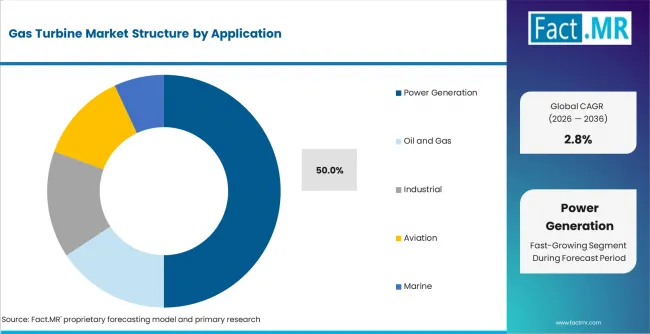
Within end-use applications, distributed power generation demonstrates emerging adoption patterns as industrial consumers and commercial facilities seek energy independence, demand charge management, and microgrid deployment opportunities. Oil and gas industry applications address remote power generation requirements and field compression duties where grid connectivity proves unavailable or economically impractical.
Key end-use dynamics include:
- Power generation requirements accelerating across emerging economies with emphasis on grid expansion and electrification programs supporting economic development
- Industrial cogeneration applications driving demand for customized turbine configurations and process integration engineering supporting operational efficiency objectives
- Mechanical drive deployments prioritizing compression duties and pipeline operations through specialized turbine designs optimized for torque characteristics
- Distributed generation emphasizing resilience enhancement and energy cost optimization through on-site generation capabilities and microgrid integration strategies
What are the Drivers, Restraints, and Key Trends of the Gas Turbine Market?
The market is driven by three concrete demand factors tied to energy infrastructure requirements. First, rising natural gas availability and expanding pipeline infrastructure create favorable fuel supply conditions enabling gas-fired generation expansion, with turbine deployment representing a critical technology pathway for transitioning away from coal-based power generation in comprehensive decarbonization strategies, requiring extensive equipment installation across utility networks. Second, growing grid flexibility requirements supporting renewable energy integration drive demand for dispatchable generation capacity, with gas turbines demonstrating rapid startup capabilities and load-following characteristics essential for balancing variable solar and wind output through reliable backup generation by 2030. Third, increasing efficiency standards and emissions regulations enable technology selection favoring advanced combined cycle installations that achieve superior thermal performance while reducing carbon intensity and meeting air quality compliance requirements.
Market restraints include renewable energy cost competitiveness and policy incentives favoring solar and wind deployment that can challenge long-term gas turbine utilization rates and capacity factor assumptions, particularly in regions where subsidized renewable generation and battery storage create economic pressure on gas-fired dispatch economics. Hydrogen infrastructure development requirements for achieving zero-carbon turbine operations pose another significant obstacle, as comprehensive fuel transition depends on dedicated hydrogen production facilities, pipeline networks, and storage systems, potentially affecting technology adoption timelines and investment confidence. Public opposition to fossil fuel infrastructure and financing constraints for gas-dependent generation assets create additional barriers for project development, demanding extensive stakeholder engagement and alternative fuel pathway demonstrations.
Key trends indicate accelerated hydrogen capability integration in developed markets, particularly Europe and Japan, where turbine manufacturers demonstrate willingness to invest in fuel-flexible combustion systems supporting hydrogen co-firing and eventual 100% hydrogen operation for decarbonization compliance. Digitalization adoption trends toward predictive maintenance platforms with sensor integration and artificial intelligence-driven performance optimization enable enhanced operational reliability that improves asset utilization and reduces unplanned outages. However, the market thesis could face disruption if significant advances in long-duration energy storage technologies or major policy shifts prioritizing renewable-only generation reduce structural demand for dispatchable gas-fired capacity.
Analysis of the Gas Turbine Market by Key Countries

| Country | CAGR (2025 to 2035) |
|---|---|
| India | 4.2% |
| China | 3.9% |
| USA | 3.5% |
| Saudi Arabia | 3.1% |
| Brazil | 2.7% |
| Germany | 2.4% |
| Japan | 2.2% |
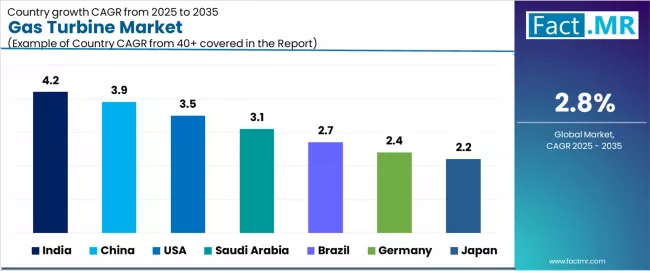
The global gas turbine market is expanding steadily, with India leading at a 4.2% CAGR through 2035, driven by rapid gas infrastructure development, coal-to-gas transition policies, and rising electricity demand supporting capacity expansion. China follows at 3.9%, supported by large-scale energy infrastructure investments, grid modernization programs, and natural gas consumption growth.
USA records 3.5%, reflecting fleet modernization initiatives, shale gas advantages, and replacement of aging generation assets. Saudi Arabia advances at 3.1%, leveraging domestic power generation optimization and gas-for-oil substitution strategies. Brazil posts 2.7%, focusing on hybrid renewable-gas systems and grid balancing requirements, while Germany grows at 2.4%, emphasizing hydrogen-ready turbine deployment and energy transition technologies. Japan demonstrates 2.2% growth, anchored by grid reliability enhancement and backup capacity requirements.
How is India Leading Global Market Expansion?
India demonstrates the strongest growth potential in the gas turbine market with a CAGR of 4.2% through 2035. The country's leadership position stems from rapidly expanding natural gas infrastructure, aggressive coal-to-gas transition targets, and rising electricity demand driven by economic growth and urbanization requiring substantial generation capacity additions.
Growth is concentrated in major power generation hubs and industrial regions, including Gujarat, Maharashtra, Tamil Nadu, and Uttar Pradesh, where utilities and independent power producers are implementing large-scale gas-fired projects to meet baseload demand and provide grid flexibility supporting renewable integration. Distribution channels through state electricity boards, central government power entities, and private sector developers expand capacity deployment across diverse ownership structures and regulatory frameworks.
The country's growing domestic gas production from offshore fields and expanding liquefied natural gas regasification terminals provide strong momentum for fuel-secure generation expansion, including comprehensive adoption across public and private sector investments seeking efficient and flexible generation technologies.
Key market factors:
- Power generation capacity concentrated in major electricity consumption centers and industrial zones with established transmission infrastructure connectivity
- Natural gas infrastructure growth through pipeline network expansion including national gas grid development enabling fuel supply reliability
- Comprehensive policy support ecosystem, including government initiatives promoting gas-based generation and renewable energy balancing through flexible capacity mechanisms
- Local manufacturing development featuring companies like Bharat Heavy Electricals Ltd. offering domestically produced turbines and comprehensive engineering capabilities
Why is China Emerging as a High-Growth Market?
In major industrial centers including Guangdong, Jiangsu, Zhejiang, and Shandong, the adoption of gas turbine solutions is accelerating across utility and industrial applications, driven by air quality improvement mandates and comprehensive energy infrastructure modernization initiatives.
The market demonstrates strong growth momentum with a CAGR of 3.9% through 2035, linked to government-directed coal capacity retirement programs and increasing natural gas supply from domestic production and pipeline imports. Chinese utilities are implementing combined cycle installations to enhance grid efficiency while meeting stringent emissions standards that align with national environmental objectives. The country's expanding natural gas distribution network creates ongoing demand for gas-fired generation capacity, while increasing emphasis on grid flexibility drives adoption of fast-ramping turbine configurations supporting renewable energy integration.
Key development areas:
- State-owned utilities leading turbine deployment with emphasis on large-scale combined cycle installations and centralized generation planning
- Infrastructure expansion through comprehensive pipeline development and liquefied natural gas import terminal construction
- Technology advancement enabling domestic turbine manufacturing capabilities and international technology transfer partnerships
- Growing integration with renewable energy systems and grid modernization initiatives addressing intermittency management and load balancing requirements
What drives USA’s Market Resilience?

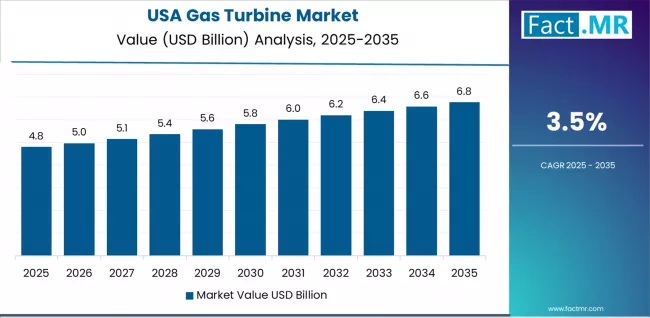
USA’s market expansion is driven by diverse generation requirements, including baseload replacement in retiring coal regions and peaking capacity in renewable-heavy markets implementing reliability mandates. The country demonstrates steady growth potential with a CAGR of 3.5% through 2035, supported by abundant shale gas resources providing cost-competitive fuel supply and established turbine manufacturing expertise from domestic suppliers.
American utilities face implementation considerations related to competitive wholesale electricity markets and renewable integration planning, requiring flexible generation assets that can provide reliable capacity while managing dispatch economics. However, established natural gas infrastructure and regulatory frameworks supporting gas-fired generation create stable baseline demand for turbine installations, particularly among power producers managing reliability obligations where fast-response capacity drives primary investment decisions.
Market characteristics:
- Electric utilities and independent power producers showing robust turbine adoption with substantial annual capacity additions across diverse market regions
- Regional preferences varying between combined cycle baseload installations in competitive markets and simple cycle peaking units in capacity-constrained regions
- Future projections indicate continued fleet modernization with emphasis on hydrogen-capable turbine configurations and emissions reduction technologies
- Growing emphasis on hybrid generation projects combining gas turbines with renewable energy and battery storage supporting comprehensive grid services
How does Saudi Arabia Demonstrate Domestic Generation Leadership?
The Saudi Arabia market leads in domestic power generation optimization based on gas-for-oil substitution strategies and comprehensive electricity demand growth serving industrial development and population expansion. The country shows strong potential with a CAGR of 3.1% through 2035, driven by energy sector transformation initiatives and domestic gas production expansion in major regions, including Eastern Province, Riyadh Region, and emerging industrial cities.
Utility providers are adopting gas turbine installations to replace liquid fuel-based generation for domestic electricity supply, preserving crude oil volumes for export while meeting rising cooling demand and desalination requirements through efficient generation technologies. Distribution channels through national utility companies and water-electricity coproduction facilities expand capacity deployment across integrated resource planning frameworks supporting comprehensive infrastructure development.
Leading market segments:
- Large-scale combined cycle adoption in major load centers implementing comprehensive efficiency optimization requirements
- Industrial cogeneration partnerships with petrochemical facilities achieving integrated steam and power generation
- Strategic government initiatives promoting domestic gas utilization and power sector efficiency improvement programs
- Focus on advanced turbine technologies and operational excellence supporting grid reliability and fuel optimization objectives
What positions Brazil for Hybrid Generation Leadership?
In major electricity markets including São Paulo, Rio de Janeiro, Minas Gerais, and Rio Grande do Sul, utilities are implementing gas turbine solutions through complementary renewable energy strategies, with documented operational experience showing substantial grid reliability improvement through dispatchable generation capacity. The market shows solid growth potential with a CAGR of 2.7% through 2035, linked to ongoing renewable energy expansion, natural gas infrastructure development, and emerging thermal capacity requirements in major consumption regions.
Brazilian generators are adopting flexible gas turbine installations to manage hydroelectric variability while maintaining system adequacy during drought conditions that characterize seasonal generation challenges. The country's expanding natural gas supply from pre-salt offshore production creates ongoing opportunities for gas-fired capacity additions that complement renewable generation through flexible dispatch capabilities.
Market development factors:
- Renewable-focused utilities leading flexible turbine adoption across Brazilian electricity market
- Infrastructure-led integration services providing growth opportunities in transmission-constrained regions
- Strategic partnerships between generation companies and gas suppliers expanding fuel supply reliability
- Emphasis on combined cycle efficiency and rapid response capabilities supporting grid balancing requirements across hydro-dominated systems
How does Germany show Hydrogen Transition Leadership?
Germany's gas turbine market demonstrates advanced hydrogen capability integration focused on decarbonization pathways and energy transition requirements, with documented technology demonstration projects achieving substantial progress in alternative fuel combustion across power generation applications.
The country maintains steady growth momentum with a CAGR of 2.4% through 2035, driven by ambitious climate targets emphasizing renewable energy dominance and hydrogen economy development that align with European Union policy frameworks applied to generation capacity planning.
Major industrial regions, including North Rhine-Westphalia, Bavaria, Baden-Württemberg, and Lower Saxony, showcase progressive adoption of hydrogen-ready turbine installations where fuel-flexible combustion systems integrate seamlessly with emerging hydrogen infrastructure and comprehensive decarbonization strategies.
Key market characteristics:
- Environmentally focused utilities driving demand for hydrogen-capable turbine configurations with emphasis on zero-carbon operation pathways
- Technology partnerships enabling advanced combustion system development with comprehensive fuel flexibility verification programs
- Research collaboration between German companies and international turbine manufacturers expanding hydrogen co-firing capabilities
- Emphasis on energy transition support and grid stability provision addressing renewable energy intermittency across electricity markets
What characterizes Japan's Market Development?

In major electricity markets including Tokyo, Kansai, Chubu, and Kyushu regions, the adoption of gas turbine solutions is advancing through grid reliability enhancement strategies, driven by nuclear capacity constraints and comprehensive liquefied natural gas supply infrastructure supporting fuel-secure generation. The market demonstrates steady growth potential with a CAGR of 2.2% through 2035, linked to ongoing capacity replacement requirements and increasing emphasis on operational flexibility supporting renewable integration in major consumption centers.
Japanese utilities are implementing advanced combined cycle installations to optimize fuel efficiency while maintaining strict reliability standards demanded by industrial consumers and grid operators managing frequency regulation. The country's extensive liquefied natural gas import infrastructure creates ongoing support for gas-fired generation expansion, while increasing focus on hydrogen co-firing drives adoption of fuel-flexible turbine configurations.
Key development areas:
- Quality-conscious utilities leading turbine deployment with emphasis on proven reliability and comprehensive maintenance protocols
- Efficiency partnerships enabling continuous performance improvement with comprehensive operational optimization programs
- Technology collaboration between Japanese utilities and international turbine suppliers expanding advanced generation capabilities
- Integration of grid services including frequency regulation and voltage support addressing renewable energy balancing requirements
Europe Market Split by Country

The gas turbine market in Europe is projected to grow from USD 2.8 billion in 2025 to USD 4.1 billion by 2035, registering a CAGR of 3.9% over the forecast period. Germany is expected to maintain its leadership position with a 28.5% market share in 2025, adjusting to 28.0% by 2035, supported by its hydrogen-ready turbine deployment initiatives, comprehensive energy transition programs, and established combined cycle installations serving major electricity markets.
UK follows with a 21.0% share in 2025, projected to reach 21.5% by 2035, driven by comprehensive gas-fired generation capacity and grid flexibility requirements in major electricity markets implementing renewable integration strategies. France holds a 19.0% share in 2025, expected to maintain 19.3% by 2035 through ongoing development of flexible generation capacity and natural gas infrastructure expansion.
Italy commands a 15.5% share, while Spain accounts for 12.0% in 2025. The rest of Europe region is anticipated to gain momentum, expanding its collective share from 4.0% to 4.2% by 2035, attributed to increasing gas turbine adoption in Nordic countries and emerging Eastern European markets implementing power generation modernization programs.
Competitive Landscape of the Gas Turbine Market

The gas turbine market features approximately 10-15 meaningful players with moderate concentration, where the top three companies control roughly 45-55% of global market share through established technology portfolios, extensive service networks, and comprehensive engineering capabilities. Competition centers on efficiency performance, operational reliability, and fuel flexibility rather than price competition alone.
Market leaders include Siemens Energy, General Electric, and Mitsubishi Power, which maintain competitive advantages through advanced combustion technologies, proven fleet reliability across global installations, and deep expertise in power generation equipment, creating high customer confidence among utilities seeking long-term generation assets.
These companies leverage comprehensive service organizations and ongoing technology development programs to defend market positions while expanding into hydrogen-ready turbine offerings and digital performance optimization platforms.
Challengers encompass established manufacturers including Ansaldo Energia, OPRA Turbines, and Bharat Heavy Electricals Ltd., which compete through specialized turbine configurations and regional manufacturing advantages.
Industrial turbine specialists, including Solar Turbines Inc., Kawasaki Heavy Industries, and MAN Energy Solutions, focus on specific capacity segments or application requirements, offering differentiated capabilities in distributed generation, mechanical drive systems, and compact installation footprints.
Emerging technology providers and service-focused competitors create competitive pressure through innovative maintenance approaches and performance upgrade solutions, particularly in mature markets including Europe and North America, where installed base management provides opportunities in life extension programs and efficiency enhancement retrofits.
Market dynamics favor companies that combine engineering excellence with comprehensive lifecycle support capabilities that address customer requirements from initial project development through decades of operational service. Strategic emphasis on fuel flexibility development, digitalization integration, and emissions reduction technologies enables differentiation in increasingly competitive power generation equipment markets across developed and emerging economies.
Global Gas Turbine Market - Stakeholder Contribution Framework
Gas turbines represent a critical power generation technology category that enables utilities and industrial operators to deliver reliable electricity supply and mechanical drive applications while addressing environmental compliance requirements and operational flexibility demands supporting renewable energy integration, typically providing dispatchable baseload capacity including rapid startup capabilities for grid stabilization, fuel-flexible combustion systems for natural gas and hydrogen blending, and high-efficiency heat recovery for cogeneration applications compared to conventional generation alternatives alone while ensuring grid reliability and comprehensive energy system optimization.
With the market projected to grow from USD 11.5 billion in 2025 to USD 15.2 billion by 2035 at a 2.8% CAGR, these solutions offer compelling advantages for combined cycle applications, large-scale generation deployments, and diverse utility populations seeking efficient and flexible generation technologies. Scaling market penetration and technological advancement requires coordinated action across energy policy frameworks, grid planning standards, turbine manufacturers, utility operators, and fuel infrastructure developers.
How Could Governments Spur Local Development and Adoption?
- Energy Infrastructure Programs: Include gas turbine deployment in national energy strategies, providing targeted support for grid modernization initiatives in transmission planning and supporting technology development through research grants and demonstration project funding.
- Tax Policy & Investment Support: Implement accelerated depreciation schedules for efficient generation assets, provide investment tax credits for hydrogen-capable turbine installations, and establish favorable financing structures that encourage advanced combined cycle deployment over conventional alternatives.
- Regulatory Framework Development: Create streamlined permitting processes for gas-fired generation projects across power sector applications, establish clear emissions standards and efficiency requirements for technology qualification, and develop grid integration protocols that facilitate flexible generation dispatch.
- Fuel Infrastructure & Supply Security: Fund natural gas pipeline expansion and hydrogen infrastructure development, invest in domestic gas production incentives that ensure fuel availability, and explore strategic gas reserve mechanisms for generation fuel security.
- Research & Innovation Support: Establish public-private partnerships for advanced turbine technology development, support academic-industry collaborations investigating hydrogen combustion and emissions reduction, and create regulatory environments that encourage innovation in fuel flexibility approaches.
How Could Industry Bodies Support Market Development?
- Technical Standards & Performance: Define standardized efficiency testing protocols for turbine performance verification across operational conditions, establish universal emissions measurement methodologies and reporting frameworks, and create performance databases that utilities can reference for technology selection.
- Market Education & Best Practices: Lead messaging that demonstrates gas turbine capabilities, emphasizing grid reliability contributions with renewable integration, fuel flexibility advantages, and operational characteristics compared to alternative generation technologies.
- Safety & Quality Standards: Develop guidelines for turbine installation, operation and maintenance excellence, comprehensive testing requirements, and equipment certification, ensuring reliability across manufacturing and deployment operations.
- Professional Development: Run certification programs for power plant operators, maintenance technicians, and engineering professionals on optimizing turbine performance, fuel management strategies, and emissions control in diverse operational environments.
How Could Manufacturers and Technology Players Strengthen the Ecosystem?
- Advanced Product Development: Develop next-generation gas turbine designs with enhanced efficiency characteristics, hydrogen combustion capabilities, and application-specific configurations that improve operational flexibility while reducing emissions footprint and improving fuel economy.
- Performance Validation Programs: Provide comprehensive operational data, efficiency testing results, and emissions verification studies that support utility confidence and informed technology selection decisions.
- Technical Support Initiatives: Offer comprehensive training programs about turbine operation, maintenance optimization, and performance troubleshooting that help operators maximize asset utilization aligned with grid requirements and economic dispatch objectives.
- Research & Development Networks: Build comprehensive engineering capabilities, collaborative technology development programs, and advanced materials testing systems that ensure gas turbines maintain high performance standards and reliability profiles across diverse operating conditions.
How Could Utilities and Operators Navigate the Market?
- Technology Integration Excellence: Incorporate gas turbines into comprehensive generation portfolios, with particular focus on combined cycle configurations, flexible dispatch strategies, and renewable integration support for grid stability enhancement.
- Operational Optimization Programs: Establish comprehensive performance monitoring systems addressing efficiency tracking, emissions management, and maintenance optimization through data-driven operational frameworks and predictive analytics platforms.
- Grid Services Development: Implement advanced dispatch capabilities combining frequency regulation, voltage support, and black start provisions that provide comprehensive grid services beyond baseload generation across system requirements.
- Asset Management Systems: Develop standardized performance tracking, maintenance scheduling protocols, and lifecycle cost assessments that enable continuous optimization and strategic investment planning.
How Could Investors and Financial Enablers Unlock Value?
- Technology Development Financing: Provide growth capital for established manufacturers like Siemens Energy, General Electric, and emerging technology companies to fund hydrogen combustion development and efficiency improvement initiatives that support decarbonization pathways.
- Project Finance Innovation: Back utility-scale generation projects with comprehensive financing structures, power purchase agreement support, and risk mitigation instruments that enable large-scale turbine deployments.
- Infrastructure Expansion Funding: Finance natural gas pipeline development and hydrogen infrastructure investments supporting fuel supply reliability in high-growth regions including India and China, enabling market expansion through fuel availability.
- Digital Integration Support: Support companies developing predictive maintenance platforms, artificial intelligence optimization systems, and remote monitoring solutions that enhance operational performance through technology-enabled asset management.
Key Players in the Gas Turbine Market
- Siemens Energy AG
- General Electric Company
- Mitsubishi Power, Ltd.
- Ansaldo Energia S.p.A.
- OPRA Turbines B.V.
- Bharat Heavy Electricals Limited
- MAN Energy Solutions SE
- Solar Turbines Incorporated
- Kawasaki Heavy Industries, Ltd.
- Centrax Ltd.
Scope of the Report
| Items | Values |
|---|---|
| Quantitative Units | USD 11.5 Billion |
| Technology | Combined Cycle, Open Cycle |
| Capacity | >200 MW, ≤200 MW |
| End Use | Power & Utility, Industrial |
| Regions Covered | Asia Pacific, Europe, North America, Latin America, Middle East & Africa |
| Country Covered | India, China, USA, Germany, UK, Japan, Brazil, Saudi Arabia, and 40+ countries |
| Key Companies Profiled | Siemens Energy, General Electric, Mitsubishi Power, Ansaldo Energia, OPRA Turbines, Bharat Heavy Electricals Ltd., MAN Energy Solutions, Solar Turbines Inc., Kawasaki Heavy Industries, Centrax Gas Turbines |
| Additional Attributes | Dollar sales by technology and capacity categories, regional adoption trends across Asia Pacific, Europe, and North America, competitive landscape with turbine manufacturers and power generation equipment companies, product specifications and performance requirements, integration with renewable energy systems and grid modernization programs, innovations in hydrogen combustion and emissions reduction technologies, and development of specialized applications with fuel flexibility and operational optimization capabilities. |
Gas Turbine Market by Segments
-
Technology :
- Combined Cycle
- Open Cycle
-
Capacity :
- >200 MW
- ≤200 MW
-
End Use :
- Power & Utility
- Industrial
-
Region :
- Asia Pacific
- China
- Japan
- South Korea
- India
- Australia
- Thailand
- Rest of Asia Pacific
- Europe
- Germany
- UK
- France
- Italy
- Spain
- Denmark
- Sweden
- Norway
- Rest of Europe
- North America
- USA
- Canada
- Mexico
- Latin America
- Brazil
- Argentina
- Rest of Latin America
- Middle East & Africa
- South Africa
- Saudi Arabia
- UAE
- Kuwait
- Rest of Middle East & Africa
- Asia Pacific
Table of Content
- Executive Summary
- Global Market Outlook
- Demand to side Trends
- Supply to side Trends
- Technology Roadmap Analysis
- Analysis and Recommendations
- Market Overview
- Market Coverage / Taxonomy
- Market Definition / Scope / Limitations
- Market Background
- Market Dynamics
- Drivers
- Restraints
- Opportunity
- Trends
- Scenario Forecast
- Demand in Optimistic Scenario
- Demand in Likely Scenario
- Demand in Conservative Scenario
- Opportunity Map Analysis
- Product Life Cycle Analysis
- Supply Chain Analysis
- Investment Feasibility Matrix
- Value Chain Analysis
- PESTLE and Porter’s Analysis
- Regulatory Landscape
- Regional Parent Market Outlook
- Production and Consumption Statistics
- Import and Export Statistics
- Market Dynamics
- Global Market Analysis 2020 to 2024 and Forecast, 2025 to 2035
- Historical Market Size Value (USD Million) Analysis, 2020 to 2024
- Current and Future Market Size Value (USD Million) Projections, 2025 to 2035
- Y to o to Y Growth Trend Analysis
- Absolute $ Opportunity Analysis
- Global Market Pricing Analysis 2020 to 2024 and Forecast 2025 to 2035
- Global Market Analysis 2020 to 2024 and Forecast 2025 to 2035, By Technology
- Introduction / Key Findings
- Historical Market Size Value (USD Million) Analysis By Technology, 2020 to 2024
- Current and Future Market Size Value (USD Million) Analysis and Forecast By Technology, 2025 to 2035
- Combined Cycle
- Open Cycle
- Y to o to Y Growth Trend Analysis By Technology, 2020 to 2024
- Absolute $ Opportunity Analysis By Technology, 2025 to 2035
- Global Market Analysis 2020 to 2024 and Forecast 2025 to 2035, By Capacity
- Introduction / Key Findings
- Historical Market Size Value (USD Million) Analysis By Capacity, 2020 to 2024
- Current and Future Market Size Value (USD Million) Analysis and Forecast By Capacity, 2025 to 2035
- >200 MW
- ≤200 MW
- Y to o to Y Growth Trend Analysis By Capacity, 2020 to 2024
- Absolute $ Opportunity Analysis By Capacity, 2025 to 2035
- Global Market Analysis 2020 to 2024 and Forecast 2025 to 2035, By End Use
- Introduction / Key Findings
- Historical Market Size Value (USD Million) Analysis By End Use, 2020 to 2024
- Current and Future Market Size Value (USD Million) Analysis and Forecast By End Use, 2025 to 2035
- Power & Utility
- Industrial
- Y to o to Y Growth Trend Analysis By End Use, 2020 to 2024
- Absolute $ Opportunity Analysis By End Use, 2025 to 2035
- Global Market Analysis 2020 to 2024 and Forecast 2025 to 2035, By Region
- Introduction
- Historical Market Size Value (USD Million) Analysis By Region, 2020 to 2024
- Current Market Size Value (USD Million) Analysis and Forecast By Region, 2025 to 2035
- North America
- Latin America
- Western Europe
- Eastern Europe
- East Asia
- South Asia and Pacific
- Middle East & Africa
- Market Attractiveness Analysis By Region
- North America Market Analysis 2020 to 2024 and Forecast 2025 to 2035, By Country
- Historical Market Size Value (USD Million) Trend Analysis By Market Taxonomy, 2020 to 2024
- Market Size Value (USD Million) Forecast By Market Taxonomy, 2025 to 2035
- By Country
- USA
- Canada
- Mexico
- By Technology
- By Capacity
- By End Use
- By Country
- Market Attractiveness Analysis
- By Country
- By Technology
- By Capacity
- By End Use
- Key Takeaways
- Latin America Market Analysis 2020 to 2024 and Forecast 2025 to 2035, By Country
- Historical Market Size Value (USD Million) Trend Analysis By Market Taxonomy, 2020 to 2024
- Market Size Value (USD Million) Forecast By Market Taxonomy, 2025 to 2035
- By Country
- Brazil
- Chile
- Rest of Latin America
- By Technology
- By Capacity
- By End Use
- By Country
- Market Attractiveness Analysis
- By Country
- By Technology
- By Capacity
- By End Use
- Key Takeaways
- Western Europe Market Analysis 2020 to 2024 and Forecast 2025 to 2035, By Country
- Historical Market Size Value (USD Million) Trend Analysis By Market Taxonomy, 2020 to 2024
- Market Size Value (USD Million) Forecast By Market Taxonomy, 2025 to 2035
- By Country
- Germany
- UK
- Italy
- Spain
- France
- Nordic
- BENELUX
- Rest of Western Europe
- By Technology
- By Capacity
- By End Use
- By Country
- Market Attractiveness Analysis
- By Country
- By Technology
- By Capacity
- By End Use
- Key Takeaways
- Eastern Europe Market Analysis 2020 to 2024 and Forecast 2025 to 2035, By Country
- Historical Market Size Value (USD Million) Trend Analysis By Market Taxonomy, 2020 to 2024
- Market Size Value (USD Million) Forecast By Market Taxonomy, 2025 to 2035
- By Country
- Russia
- Poland
- Hungary
- Balkan & Baltic
- Rest of Eastern Europe
- By Technology
- By Capacity
- By End Use
- By Country
- Market Attractiveness Analysis
- By Country
- By Technology
- By Capacity
- By End Use
- Key Takeaways
- East Asia Market Analysis 2020 to 2024 and Forecast 2025 to 2035, By Country
- Historical Market Size Value (USD Million) Trend Analysis By Market Taxonomy, 2020 to 2024
- Market Size Value (USD Million) Forecast By Market Taxonomy, 2025 to 2035
- By Country
- China
- Japan
- South Korea
- By Technology
- By Capacity
- By End Use
- By Country
- Market Attractiveness Analysis
- By Country
- By Technology
- By Capacity
- By End Use
- Key Takeaways
- South Asia and Pacific Market Analysis 2020 to 2024 and Forecast 2025 to 2035, By Country
- Historical Market Size Value (USD Million) Trend Analysis By Market Taxonomy, 2020 to 2024
- Market Size Value (USD Million) Forecast By Market Taxonomy, 2025 to 2035
- By Country
- India
- ASEAN
- Australia & New Zealand
- Rest of South Asia and Pacific
- By Technology
- By Capacity
- By End Use
- By Country
- Market Attractiveness Analysis
- By Country
- By Technology
- By Capacity
- By End Use
- Key Takeaways
- Middle East & Africa Market Analysis 2020 to 2024 and Forecast 2025 to 2035, By Country
- Historical Market Size Value (USD Million) Trend Analysis By Market Taxonomy, 2020 to 2024
- Market Size Value (USD Million) Forecast By Market Taxonomy, 2025 to 2035
- By Country
- Kingdom of Saudi Arabia
- Other GCC Countries
- Turkiye
- South Africa
- Other African Union
- Rest of Middle East & Africa
- By Technology
- By Capacity
- By End Use
- By Country
- Market Attractiveness Analysis
- By Country
- By Technology
- By Capacity
- By End Use
- Key Takeaways
- Key Countries Market Analysis
- USA
- Pricing Analysis
- Market Share Analysis, 2024
- By Technology
- By Capacity
- By End Use
- Canada
- Pricing Analysis
- Market Share Analysis, 2024
- By Technology
- By Capacity
- By End Use
- Mexico
- Pricing Analysis
- Market Share Analysis, 2024
- By Technology
- By Capacity
- By End Use
- Brazil
- Pricing Analysis
- Market Share Analysis, 2024
- By Technology
- By Capacity
- By End Use
- Chile
- Pricing Analysis
- Market Share Analysis, 2024
- By Technology
- By Capacity
- By End Use
- Germany
- Pricing Analysis
- Market Share Analysis, 2024
- By Technology
- By Capacity
- By End Use
- UK
- Pricing Analysis
- Market Share Analysis, 2024
- By Technology
- By Capacity
- By End Use
- Italy
- Pricing Analysis
- Market Share Analysis, 2024
- By Technology
- By Capacity
- By End Use
- Spain
- Pricing Analysis
- Market Share Analysis, 2024
- By Technology
- By Capacity
- By End Use
- France
- Pricing Analysis
- Market Share Analysis, 2024
- By Technology
- By Capacity
- By End Use
- India
- Pricing Analysis
- Market Share Analysis, 2024
- By Technology
- By Capacity
- By End Use
- ASEAN
- Pricing Analysis
- Market Share Analysis, 2024
- By Technology
- By Capacity
- By End Use
- Australia & New Zealand
- Pricing Analysis
- Market Share Analysis, 2024
- By Technology
- By Capacity
- By End Use
- China
- Pricing Analysis
- Market Share Analysis, 2024
- By Technology
- By Capacity
- By End Use
- Japan
- Pricing Analysis
- Market Share Analysis, 2024
- By Technology
- By Capacity
- By End Use
- South Korea
- Pricing Analysis
- Market Share Analysis, 2024
- By Technology
- By Capacity
- By End Use
- Russia
- Pricing Analysis
- Market Share Analysis, 2024
- By Technology
- By Capacity
- By End Use
- Poland
- Pricing Analysis
- Market Share Analysis, 2024
- By Technology
- By Capacity
- By End Use
- Hungary
- Pricing Analysis
- Market Share Analysis, 2024
- By Technology
- By Capacity
- By End Use
- Kingdom of Saudi Arabia
- Pricing Analysis
- Market Share Analysis, 2024
- By Technology
- By Capacity
- By End Use
- Turkiye
- Pricing Analysis
- Market Share Analysis, 2024
- By Technology
- By Capacity
- By End Use
- South Africa
- Pricing Analysis
- Market Share Analysis, 2024
- By Technology
- By Capacity
- By End Use
- USA
- Market Structure Analysis
- Competition Dashboard
- Competition Benchmarking
- Market Share Analysis of Top Players
- By Regional
- By Technology
- By Capacity
- By End Use
- Competition Analysis
- Competition Deep Dive
- Siemens Energy AG
- Overview
- Product Portfolio
- Profitability by Market Segments (Product/Age /Sales Channel/Region)
- Sales Footprint
- Strategy Overview
- Marketing Strategy
- Product Strategy
- Channel Strategy
- General Electric Company
- Mitsubishi Power, Ltd.
- Ansaldo Energia S.p.A.
- OPRA Turbines B.V.
- Bharat Heavy Electricals Limited
- MAN Energy Solutions SE
- Solar Turbines Incorporated
- Kawasaki Heavy Industries, Ltd.
- Centrax Ltd.
- Siemens Energy AG
- Competition Deep Dive
- Assumptions & Acronyms Used
- Research Methodology
List Of Table
- Table 1: Global Market Value (USD Million) Forecast by Region, 2020 to 2035
- Table 2: Global Market Value (USD Million) Forecast by Technology, 2020 to 2035
- Table 3: Global Market Value (USD Million) Forecast by Capacity, 2020 to 2035
- Table 4: Global Market Value (USD Million) Forecast by End Use, 2020 to 2035
- Table 5: North America Market Value (USD Million) Forecast by Country, 2020 to 2035
- Table 6: North America Market Value (USD Million) Forecast by Technology, 2020 to 2035
- Table 7: North America Market Value (USD Million) Forecast by Capacity, 2020 to 2035
- Table 8: North America Market Value (USD Million) Forecast by End Use, 2020 to 2035
- Table 9: Latin America Market Value (USD Million) Forecast by Country, 2020 to 2035
- Table 10: Latin America Market Value (USD Million) Forecast by Technology, 2020 to 2035
- Table 11: Latin America Market Value (USD Million) Forecast by Capacity, 2020 to 2035
- Table 12: Latin America Market Value (USD Million) Forecast by End Use, 2020 to 2035
- Table 13: Western Europe Market Value (USD Million) Forecast by Country, 2020 to 2035
- Table 14: Western Europe Market Value (USD Million) Forecast by Technology, 2020 to 2035
- Table 15: Western Europe Market Value (USD Million) Forecast by Capacity, 2020 to 2035
- Table 16: Western Europe Market Value (USD Million) Forecast by End Use, 2020 to 2035
- Table 17: Eastern Europe Market Value (USD Million) Forecast by Country, 2020 to 2035
- Table 18: Eastern Europe Market Value (USD Million) Forecast by Technology, 2020 to 2035
- Table 19: Eastern Europe Market Value (USD Million) Forecast by Capacity, 2020 to 2035
- Table 20: Eastern Europe Market Value (USD Million) Forecast by End Use, 2020 to 2035
- Table 21: East Asia Market Value (USD Million) Forecast by Country, 2020 to 2035
- Table 22: East Asia Market Value (USD Million) Forecast by Technology, 2020 to 2035
- Table 23: East Asia Market Value (USD Million) Forecast by Capacity, 2020 to 2035
- Table 24: East Asia Market Value (USD Million) Forecast by End Use, 2020 to 2035
- Table 25: South Asia and Pacific Market Value (USD Million) Forecast by Country, 2020 to 2035
- Table 26: South Asia and Pacific Market Value (USD Million) Forecast by Technology, 2020 to 2035
- Table 27: South Asia and Pacific Market Value (USD Million) Forecast by Capacity, 2020 to 2035
- Table 28: South Asia and Pacific Market Value (USD Million) Forecast by End Use, 2020 to 2035
- Table 29: Middle East & Africa Market Value (USD Million) Forecast by Country, 2020 to 2035
- Table 30: Middle East & Africa Market Value (USD Million) Forecast by Technology, 2020 to 2035
- Table 31: Middle East & Africa Market Value (USD Million) Forecast by Capacity, 2020 to 2035
- Table 32: Middle East & Africa Market Value (USD Million) Forecast by End Use, 2020 to 2035
List Of Figures
- Figure 1: Global Market Pricing Analysis
- Figure 2: Global Market Value (USD Million) Forecast 2020 to 2035
- Figure 3: Global Market Value Share and BPS Analysis by Technology, 2025 and 2035
- Figure 4: Global Market Y to o to Y Growth Comparison by Technology, 2025 to 2035
- Figure 5: Global Market Attractiveness Analysis by Technology
- Figure 6: Global Market Value Share and BPS Analysis by Capacity, 2025 and 2035
- Figure 7: Global Market Y to o to Y Growth Comparison by Capacity, 2025 to 2035
- Figure 8: Global Market Attractiveness Analysis by Capacity
- Figure 9: Global Market Value Share and BPS Analysis by End Use, 2025 and 2035
- Figure 10: Global Market Y to o to Y Growth Comparison by End Use, 2025 to 2035
- Figure 11: Global Market Attractiveness Analysis by End Use
- Figure 12: Global Market Value (USD Million) Share and BPS Analysis by Region, 2025 and 2035
- Figure 13: Global Market Y to o to Y Growth Comparison by Region, 2025 to 2035
- Figure 14: Global Market Attractiveness Analysis by Region
- Figure 15: North America Market Incremental Dollar Opportunity, 2025 to 2035
- Figure 16: Latin America Market Incremental Dollar Opportunity, 2025 to 2035
- Figure 17: Western Europe Market Incremental Dollar Opportunity, 2025 to 2035
- Figure 18: Eastern Europe Market Incremental Dollar Opportunity, 2025 to 2035
- Figure 19: East Asia Market Incremental Dollar Opportunity, 2025 to 2035
- Figure 20: South Asia and Pacific Market Incremental Dollar Opportunity, 2025 to 2035
- Figure 21: Middle East & Africa Market Incremental Dollar Opportunity, 2025 to 2035
- Figure 22: North America Market Value Share and BPS Analysis by Country, 2025 and 2035
- Figure 23: North America Market Value Share and BPS Analysis by Technology, 2025 and 2035
- Figure 24: North America Market Y to o to Y Growth Comparison by Technology, 2025 to 2035
- Figure 25: North America Market Attractiveness Analysis by Technology
- Figure 26: North America Market Value Share and BPS Analysis by Capacity, 2025 and 2035
- Figure 27: North America Market Y to o to Y Growth Comparison by Capacity, 2025 to 2035
- Figure 28: North America Market Attractiveness Analysis by Capacity
- Figure 29: North America Market Value Share and BPS Analysis by End Use, 2025 and 2035
- Figure 30: North America Market Y to o to Y Growth Comparison by End Use, 2025 to 2035
- Figure 31: North America Market Attractiveness Analysis by End Use
- Figure 32: Latin America Market Value Share and BPS Analysis by Country, 2025 and 2035
- Figure 33: Latin America Market Value Share and BPS Analysis by Technology, 2025 and 2035
- Figure 34: Latin America Market Y to o to Y Growth Comparison by Technology, 2025 to 2035
- Figure 35: Latin America Market Attractiveness Analysis by Technology
- Figure 36: Latin America Market Value Share and BPS Analysis by Capacity, 2025 and 2035
- Figure 37: Latin America Market Y to o to Y Growth Comparison by Capacity, 2025 to 2035
- Figure 38: Latin America Market Attractiveness Analysis by Capacity
- Figure 39: Latin America Market Value Share and BPS Analysis by End Use, 2025 and 2035
- Figure 40: Latin America Market Y to o to Y Growth Comparison by End Use, 2025 to 2035
- Figure 41: Latin America Market Attractiveness Analysis by End Use
- Figure 42: Western Europe Market Value Share and BPS Analysis by Country, 2025 and 2035
- Figure 43: Western Europe Market Value Share and BPS Analysis by Technology, 2025 and 2035
- Figure 44: Western Europe Market Y to o to Y Growth Comparison by Technology, 2025 to 2035
- Figure 45: Western Europe Market Attractiveness Analysis by Technology
- Figure 46: Western Europe Market Value Share and BPS Analysis by Capacity, 2025 and 2035
- Figure 47: Western Europe Market Y to o to Y Growth Comparison by Capacity, 2025 to 2035
- Figure 48: Western Europe Market Attractiveness Analysis by Capacity
- Figure 49: Western Europe Market Value Share and BPS Analysis by End Use, 2025 and 2035
- Figure 50: Western Europe Market Y to o to Y Growth Comparison by End Use, 2025 to 2035
- Figure 51: Western Europe Market Attractiveness Analysis by End Use
- Figure 52: Eastern Europe Market Value Share and BPS Analysis by Country, 2025 and 2035
- Figure 53: Eastern Europe Market Value Share and BPS Analysis by Technology, 2025 and 2035
- Figure 54: Eastern Europe Market Y to o to Y Growth Comparison by Technology, 2025 to 2035
- Figure 55: Eastern Europe Market Attractiveness Analysis by Technology
- Figure 56: Eastern Europe Market Value Share and BPS Analysis by Capacity, 2025 and 2035
- Figure 57: Eastern Europe Market Y to o to Y Growth Comparison by Capacity, 2025 to 2035
- Figure 58: Eastern Europe Market Attractiveness Analysis by Capacity
- Figure 59: Eastern Europe Market Value Share and BPS Analysis by End Use, 2025 and 2035
- Figure 60: Eastern Europe Market Y to o to Y Growth Comparison by End Use, 2025 to 2035
- Figure 61: Eastern Europe Market Attractiveness Analysis by End Use
- Figure 62: East Asia Market Value Share and BPS Analysis by Country, 2025 and 2035
- Figure 63: East Asia Market Value Share and BPS Analysis by Technology, 2025 and 2035
- Figure 64: East Asia Market Y to o to Y Growth Comparison by Technology, 2025 to 2035
- Figure 65: East Asia Market Attractiveness Analysis by Technology
- Figure 66: East Asia Market Value Share and BPS Analysis by Capacity, 2025 and 2035
- Figure 67: East Asia Market Y to o to Y Growth Comparison by Capacity, 2025 to 2035
- Figure 68: East Asia Market Attractiveness Analysis by Capacity
- Figure 69: East Asia Market Value Share and BPS Analysis by End Use, 2025 and 2035
- Figure 70: East Asia Market Y to o to Y Growth Comparison by End Use, 2025 to 2035
- Figure 71: East Asia Market Attractiveness Analysis by End Use
- Figure 72: South Asia and Pacific Market Value Share and BPS Analysis by Country, 2025 and 2035
- Figure 73: South Asia and Pacific Market Value Share and BPS Analysis by Technology, 2025 and 2035
- Figure 74: South Asia and Pacific Market Y to o to Y Growth Comparison by Technology, 2025 to 2035
- Figure 75: South Asia and Pacific Market Attractiveness Analysis by Technology
- Figure 76: South Asia and Pacific Market Value Share and BPS Analysis by Capacity, 2025 and 2035
- Figure 77: South Asia and Pacific Market Y to o to Y Growth Comparison by Capacity, 2025 to 2035
- Figure 78: South Asia and Pacific Market Attractiveness Analysis by Capacity
- Figure 79: South Asia and Pacific Market Value Share and BPS Analysis by End Use, 2025 and 2035
- Figure 80: South Asia and Pacific Market Y to o to Y Growth Comparison by End Use, 2025 to 2035
- Figure 81: South Asia and Pacific Market Attractiveness Analysis by End Use
- Figure 82: Middle East & Africa Market Value Share and BPS Analysis by Country, 2025 and 2035
- Figure 83: Middle East & Africa Market Value Share and BPS Analysis by Technology, 2025 and 2035
- Figure 84: Middle East & Africa Market Y to o to Y Growth Comparison by Technology, 2025 to 2035
- Figure 85: Middle East & Africa Market Attractiveness Analysis by Technology
- Figure 86: Middle East & Africa Market Value Share and BPS Analysis by Capacity, 2025 and 2035
- Figure 87: Middle East & Africa Market Y to o to Y Growth Comparison by Capacity, 2025 to 2035
- Figure 88: Middle East & Africa Market Attractiveness Analysis by Capacity
- Figure 89: Middle East & Africa Market Value Share and BPS Analysis by End Use, 2025 and 2035
- Figure 90: Middle East & Africa Market Y to o to Y Growth Comparison by End Use, 2025 to 2035
- Figure 91: Middle East & Africa Market Attractiveness Analysis by End Use
- Figure 92: Global Market - Tier Structure Analysis
- Figure 93: Global Market - Company Share Analysis
- FAQs -
How big is the gas turbine market in 2025?
The global gas turbine market is estimated to be valued at USD 11.5 billion in 2025.
What will be the size of gas turbine market in 2035?
The market size for the gas turbine market is projected to reach USD 15.2 billion by 2035.
How much will be the gas turbine market growth between 2025 and 2035?
The gas turbine market is expected to grow at a 2.8% CAGR between 2025 and 2035.
What are the key product types in the gas turbine market?
The key product types in gas turbine market are combined cycle and open cycle.
Which capacity segment to contribute significant share in the gas turbine market in 2025?
In terms of capacity, >200 mw segment to command 75.3% share in the gas turbine market in 2025.