Aeroderivative Gas Turbine Market Size, Share, Growth and Forecast (2026 - 2036)

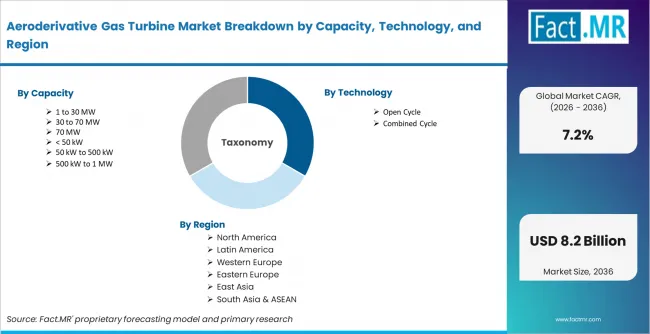
The Aeroderivative Gas Turbine Market is segmented by Capacity (< 50 kW, 50 kW to 500 kW, 500 kW to 1 MW, 1 to 30 MW, 30 to 70 MW, and > 70 MW), Technology (Open Cycle and Combined Cycle), Application (Power Plants, Oil & Gas, Process Plants, Aviation, Marine, and Others), End User (Utilities, Industrial, Commercial, and Defense), Service Type (New Installation, Maintenance & Repair, and Upgrades & Retrofits) and Region. Forecast for 2026 to 2036.

Aeroderivative Gas Turbine Market Forecast and Outlook By Fact.MR

  • The aeroderivative gas turbine market was valued at USD 3.8 billion in 2025.
  • Fact.MR estimates the market will grow to USD 4.1 billion in 2026 and reach USD 8.2 billion by 2036, expanding at a CAGR of 7.2% during the forecast period.
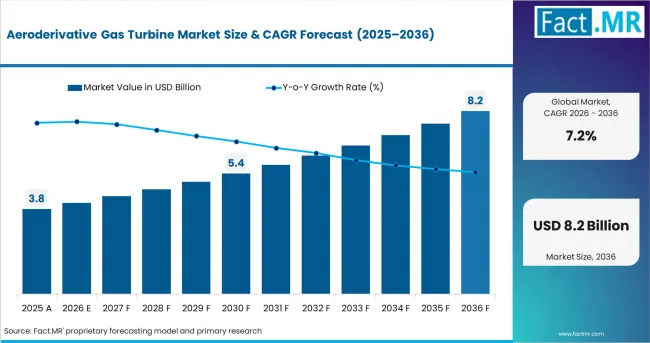
Aeroderivative Gas Turbine Market Value Analysis

Metric Value
Estimated Value in 2026 USD 4.1 billion
Forecast Value in 2036 USD 8.2 billion
Forecast CAGR (2026 to 2036) 7.2%

Summary of Aeroderivative Gas Turbine Market

  • Demand Drivers
    • Grid stability needs are raising demand for aeroderivative gas turbine. Utilities require fast ramping systems that can quickly balance renewable energy fluctuations and grid instability.
    • AI data center growth is creating a new demand channel for aeroderivative gas turbines. Operators are using on site turbine systems to secure reliable power where grid connections are delayed.
    • LNG projects continue to support long-term demand. Offshore platforms and LNG terminals prefer aeroderivative turbines because they are lighter and need less space.
  • Key Segments Analyzed
    • By Capacity: The 1 to 30 MW segment leads with 41% share in 2026 due to strong use across offshore and distributed power projects.
    • By Technology: Open cycle systems hold 62% share in 2026 because operators require fast start capability for peaking power demand.
    • By Application: Power plants account for 34% share in 2026 as utilities increase investment in fast ramping gas power generation.
    • By End User: Utilities hold 46% share in 2026 because grid operators need flexible power generation systems for load balancing and backup supply.
    • By Service Type: New installations hold 57% share in 2026 as utilities and industrial operators expands turbine capacity across new projects.
  • Analyst Opinion at Fact.MR
    • Shambhu Nath Jha, Principal Consultant at Fact.MR, opines, ' CXOs will find that aeroderivative gas turbines are becoming a core power infrastructure solution rather than a niche fast start asset. Rising data center demand, LNG expansion, and hydrogen fuel adoption are increasing long term market potential.’
  • Strategic Implications
    • Companies should build hydrogen-ready capability across 1 to 30 MW and 30 to 70 MW turbine segments. Utilities and regulators are giving more preference to low-emission turbine systems.
    • Manufacturers should offer modular turbines that can installed quickly for AI data centers and industrial parks. Fast installation timelines are becoming a key purchasing factor where grid connection delays remain high.
    • Companies should focus more on upgrade and retrofit services in North America and Europe. Aging turbine fleets are creating stable long term demand for inspection, efficiency improvement, and modernization projects.

The market is expected to create an additional revenue opportunity of around USD 4.1 billion between 2026 and 2036. Demand is rising as power networks need better grid stability and backup power for AI data centers. Long aero engine part delivery timelines and high offshore installation costs still slow faster expansion.

India leads growth at 8.4% CAGR by 2036 due to peaking power additions and captive power investment. China follows at 7.9%, supported by renewable integration and LNG infrastructure expansion. The United States grows at 6.8% because of AI data center demand and coal plant replacement projects. Saudi Arabia records 6.6% growth under Vision 2030 industrial and gas utility expansion plans. Brazil advances at 6.3% with rising offshore gas and processing infrastructure investment. European markets generate replacement demand, though growth remains slower due to strict approval and decarbonization policies.

Segmental Analysis

Aeroderivative Gas Turbine Market Analysis by Capacity
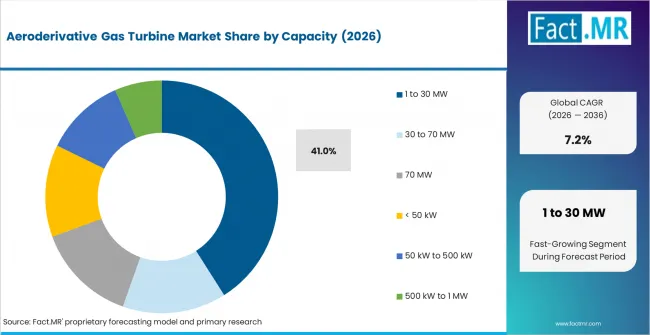
Aeroderivative Gas Turbine Market Analysis By Capacity

The 1 to 30 MW segment is expected to hold 41% of the aeroderivative gas turbine market in 2026. Growth is supported by increasing use in offshore platforms and distributed utility applications. Modular designs and lower installation complexity are further driving deployment across multiple industries.

  • Data Center Power Demand: AI data center operators are increasing purchase of modular aeroderivative turbines for fast on site power deployment. Quick installation timelines are becoming a major purchasing factor.
  • Industrial Site Expansion: Small and medium industrial facilities are increasing adoption of compact turbine control systems for captive and distributed power generation. Flexible output capability supports variable operating loads.
  • GE Vernova Launches 100% Hydrogen Aeroderivative Turbine: GE Vernova announced its first 100% hydrogen-capable aeroderivative gas turbine solution for the Whyalla hydrogen power plant in Australia. The project highlights rising adoption of hydrogen-ready turbine systems to support grid stability and low-emission power generation in the energy transition market. [1]

Aeroderivative Gas Turbine Market Analysis by Technology
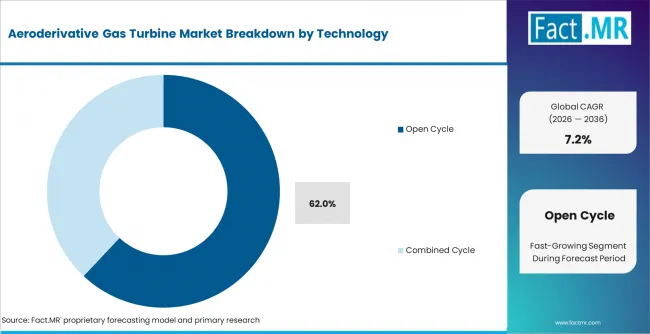
Aeroderivative Gas Turbine Market Analysis By Technology

Open cycle systems account for 62% share in 2026 because operators require fast startup and shutdown capability for peaking and backup power generation. Lower capital cost and easier installation also support wider adoption.

  • Renewable Grid Support: Utilities are increasing open cycle turbine deployment to stabilize renewable heavy electricity grids. Fast ramping capability remains a key advantage.
  • Hydrogen Ready Systems: Demand for hydrogen capable open cycle turbines is rising across energy transition projects. Operators are prioritizing lower emission generation systems.
  • Baker Hughes Secures Major Aeroderivative Turbine Order: Baker Hughes secured an order for 25 aeroderivative gas turbines from Dynamis Power Solutions to support mobile power generation across upstream, refining, and petrochemical operations. The deal strengthens demand for flexible and high-capacity turbine systems in remote and energy-intensive oil and gas applications. [2]

Aeroderivative Gas Turbine Market Analysis by Application
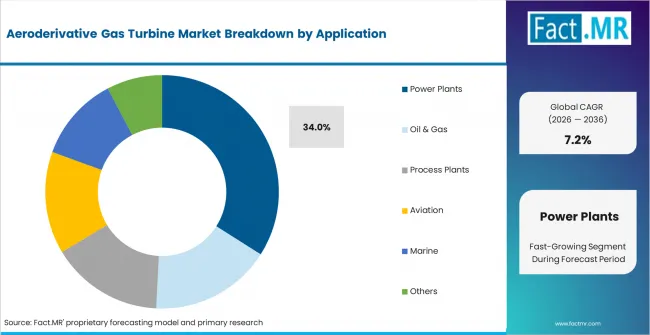
Aeroderivative Gas Turbine Market Analysis By Application

Power plants hold 34% share in 2026 as utilities expands fast ramping gas generation capacity for renewable heavy grids. Peaking power contracts are the leading purchase source for aeroderivative turbines.

  • Utility Peaking Demand: Grid operators are increasing investment in peaking power facilities to manage renewable energy fluctuations. Aeroderivative turbines are preferred for rapid response operations.
  • Mitsubishi Power Wins Major Saudi Gas Turbine Orders: Mitsubishi Power secured major gas turbine orders for the Rumah-1 and Al-Nairyah-1 power projects in Saudi Arabia to support the country’s expanding energy infrastructure and renewable integration goals. [3]
  • Marine and Defense Usage: Naval and marine applications supports steady turbine demand because of high power density and compact system design.

Aeroderivative Gas Turbine Market Analysis by End User
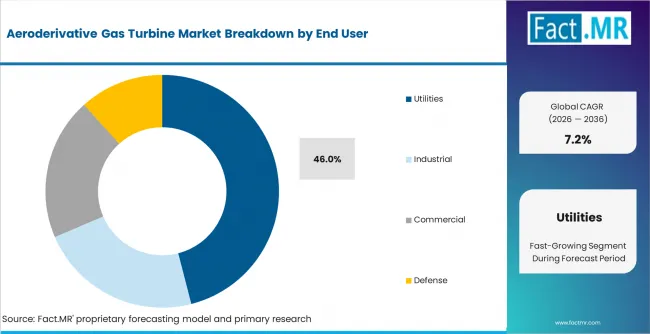
Aeroderivative Gas Turbine Market Analysis By End User

Utilities are projected to account for 46% of the aeroderivative gas turbine market in 2026. Growth is driven by rising demand for flexible and low-emission power generation systems.

  • Renewable Integration Need: Utilities are increasing turbine purchase to support renewable energy balancing and backup generation requirements.
  • Industrial Captive Power Growth: Industrial operators are adopting aeroderivative turbines to improve energy security and reduce dependence on unstable grid supply.
  • GE Vernova Advances 100% Hydrogen Turbine Technology: GE Vernova validated its 100% hydrogen-fueled DLN combustor technology for B- and E-class gas turbines with low NOx emissions and flexible fuel operation. The development supports growing adoption of hydrogen-ready gas turbine systems for decarbonized and flexible power generation applications. [4]

Aeroderivative Gas Turbine Market Analysis by Service Type
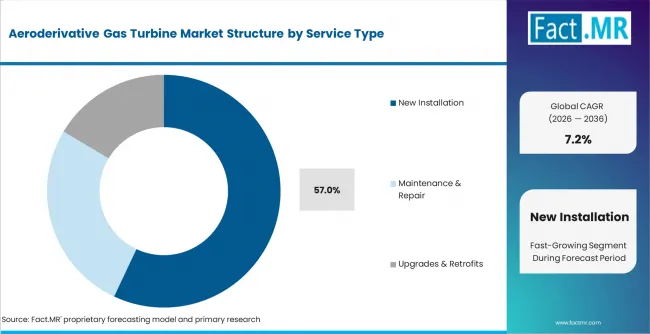
Aeroderivative Gas Turbine Market Analysis By Service Type

New installations are expected to hold 57% of the aeroderivative gas turbine market in 2026. Growth is rising from LNG projects and AI data centers along with renewable energy balancing facilities. Fast and flexible power supply is increasing the use of aeroderivative turbine technology.

  • Data Center Installation Demand: Hyperscale data center projects are creating strong demand for new turbine installation across North America and Asia.
  • Maintenance Revenue Expansion: Growing installed turbine fleets are increasing long term maintenance and inspection service demand.
  • Retrofit and Upgrade Activity: Operators are modernizing older turbine fleets with efficiency upgrades and emissions control systems to extend operational life.

Aeroderivative Gas Turbine Market Drivers, Restraints, and Opportunities

Aeroderivative Gas Turbine Market Opportunity Matrix Growth Vs Value

The aeroderivative gas turbine market is growing as utilities and industrial operators invest in fast and flexible power generation. Renewable energy integration and rising power demand from AI data centers are increasing the use of aeroderivative gas turbines.

Hydrogen-compatible turbine platforms are becoming an important competitive factor as energy companies focus on lower-emission power solutions for new energy projects.

  • Grid Stability Demand: Utilities are increasing investment in fast ramping power systems to balance renewable energy fluctuations. Aeroderivative turbines are gaining demand because of their quick startup capability and operational flexibility.
  • AI Data Center Expansion: Data center operators are adopting on site turbine systems to secure reliable electricity supply. Fast deployment timelines are becoming important where grid connectivity remains delayed.
  • TVA Orders GE Vernova Aeroderivative Turbine Packages: Tennessee Valley Authority selected 16 GE Vernova aeroderivative gas turbine packages for the Kingston replacement project. The deployment will support grid reliability and flexible power generation capacity. [5]

Regional Analysis

The aeroderivative gas turbine market is assessed across Asia Pacific, North America, Europe, Latin America, and the Middle East and Africa, covering 40+ country-level demand by application type, end user, fuel preference, and service requirement. The full report includes market attractiveness analysis by region and country.

Top Country Growth Comparison Aeroderivative Gas Turbine Market Cagr (2026 2036)

Country CAGR (2026 to 2036)
India 8.4%
China 7.9%
United States 6.8%
Saudi Arabia 6.6%
Brazil 6.3%

Source: Fact.MR analysis, based on proprietary forecasting model and primary research
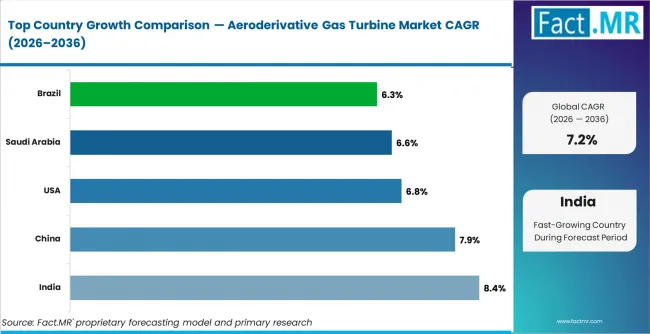
Aeroderivative Gas Turbine Market Cagr Analysis By Country

Asia Pacific Aeroderivative Gas Turbine Market Analysis

Rapid industrial expansion and renewable energy growth are strengthening aeroderivative gas turbine demand in Asia Pacific. Utilities and industrial operators are investing in flexible power systems that can support grid balancing and captive generation requirements.

  • India: India is expected to expand at a CAGR of 8.4% through 2036 due to strong industrial growth and rising demand for peaking power generation. Increasing development of captive power projects and manufacturing corridors is driving adoption of fast-response aeroderivative gas turbines across the country. Growing focus on energy reliability and flexible power infrastructure is further supporting market growth.
  • China: China is projected to witness a CAGR of 7.9% by 2036 as renewable energy integration increases demand for fast-response gas power systems. Expansion of LNG terminals and rising investment in industrial gas infrastructure are supporting turbine deployment across multiple sectors. Grid balancing requirements and the need for stable backup power are also contributing to long-term market demand.

Fact.MR analysis for Asia Pacific covers India, China, and other regional markets. The study includes renewable integration trends, LNG infrastructure growth, and industrial captive power investment.

North America Aeroderivative Gas Turbine Market Analysis
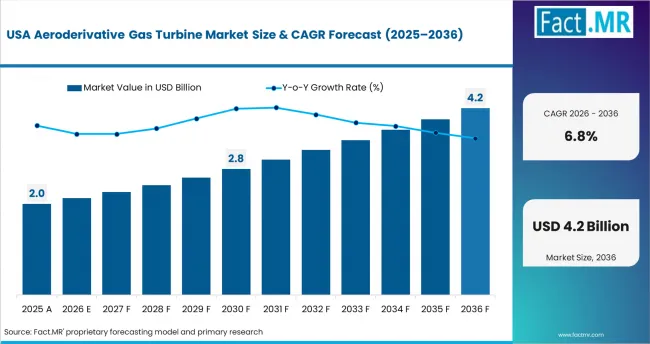
Aeroderivative Gas Turbine Market Country Value Analysis

Large scale data center expansion and coal power plant retirement supports aeroderivative turbine demand across North America. Utilities and private developers are increasing purchase of fast ramping gas generation systems to improve grid reliability and backup power availability.

  • United States: The United States may register 6.8% CAGR from 2026 to 2036 due to rapid AI data center construction and stricter emission standards for aging power plants. Utilities are also increasing investment in flexible gas generation capacity to support renewable heavy electricity grids and emergency backup power requirements.

Fact.MR analysis for North America includes the United States and other regional markets. The study covers data center power demand, emission regulations, and aging coal plant replacement activity.

Middle East Aeroderivative Gas Turbine Market Analysis

Natural gas infrastructure expansion and industrial diversification programs are increasing aeroderivative turbine deployment across the Middle East. Governments are investing heavily in utility scale gas power systems and hydrogen capable energy infrastructure.

  • Saudi Arabia: Saudi Arabia is projected to grow at a CAGR of 6.6% through 2036 due to rising investment in gas infrastructure and industrial diversification under Vision 2030. Utility-scale power projects and hydrogen-ready turbine systems are supporting demand for aeroderivative gas turbines. Flexible and lower-emission power technologies are increasing use across industrial and energy sectors.

Fact.MR analysis for the Middle East includes Saudi Arabia and other regional markets. The study covers industrial energy investment, gas infrastructure development, and long term turbine service agreements.

Latin America Aeroderivative Gas Turbine Market Analysis

Offshore oil and gas activity remains the main growth driver for aeroderivative gas turbines across Latin America. Industrial power generation investment and lower emission energy projects are also supporting steady market expansion.

  • Brazil: Brazil is expected to register a CAGR of 6.3% by 2036, supported by increasing offshore gas production and continued investments in energy infrastructure development. Growing exploration activity in offshore reserves and the expansion of gas-based power generation projects are driving demand for aeroderivative gas turbines across the country.

Fact.MR analysis for Latin America includes Brazil and other regional markets. The study covers offshore energy investment, industrial captive power demand, and gas infrastructure development trends.

Competitive Aligners for Market Players
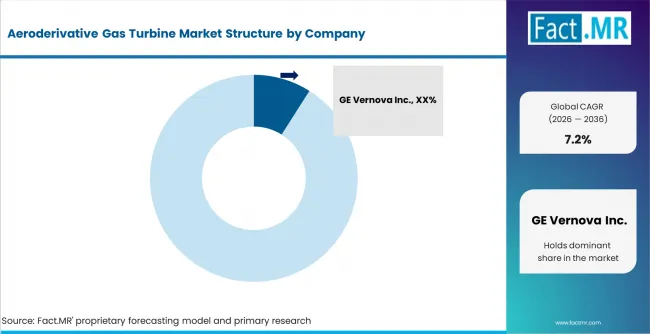
Aeroderivative Gas Turbine Market Analysis By Company

Competition in the aeroderivative gas turbine market is increasingly shaped by speed and fuel flexibility. Utilities, LNG operators and data center developers want turbines that start quickly and support lower emission power generation. Hydrogen readiness is becoming a major competitive factor in new purchase decisions. Companies that can prove high hydrogen fuel capability are improving their position in long term utility and industrial contracts. Operators are choosing turbine platforms that support future decarbonization goals without full equipment replacement.

Fast deployment capability is also becoming important across the market. AI data center operators and industrial facilities often face long grid connection delays. Manufacturers offering modular turbine packages with shorter installation timelines are gaining demand across North America and Asia Pacific. Aftermarket service is another important differentiator. Utilities and oil and gas operators prefer suppliers with reliable maintenance networks because turbine downtime can affect power supply and industrial productivity. Companies with established regional service support are improving customer retention and long term contract opportunities.

Digital monitoring and predictive maintenance technologies are also improving competitive positioning. Operators want better visibility into turbine performance and lower maintenance risk across critical power assets. Manufacturers investing in automotive remote diagnostics and efficiency optimization tools are strengthening long term service revenue across the expanding installed turbine base.

Key Players

  • GE Vernova Inc.
  • Baker Hughes Company
  • Siemens Energy AG
  • Rolls-Royce Holdings Plc
  • Mitsubishi Power Ltd.

Bibliography

  • [1] GE Vernova. (2024). GE Vernova announces its first 100 percent hydrogen-fueled aeroderivative gas turbine solution.
  • [2] World Oil. (2025). Baker Hughes secures major turbine order to power mobile oil and gas operations.
  • [3] Mitsubishi Power. (2025). Mitsubishi Power Secures Two Groundbreaking Gas Turbine Orders for Saudi Arabia's Rumah-1 and Al-Nairyah-1 Projects.
  • [4] GE Vernova. (2025). GE Vernova validates 100% hydrogen-fueled DLN combustor technology aiming to decarbonize its industrial B- and E-Class gas turbines.
  • [5] POWER Magazine. (2024). TVA secures 16 GE Vernova aeroderivative gas turbine packages for Kingston replacement.

This Report Addresses

  • Strategic analysis of aeroderivative gas turbine demand across grid peaking, LNG infrastructure, offshore platforms, AI data centers, and naval propulsion applications.
  • Market forecast from USD 4.1 billion in 2026 to USD 8.2 billion by 2036 at 7.2% CAGR, including segment level growth analysis.
  • Opportunity assessment across India, China, the United States, Saudi Arabia, and Brazil based on power infrastructure and gas investment trends.
  • Segment analysis by capacity, technology, application, end user, and service type with regional and country level forecasts through 2036.
  • Competitive analysis of GE Vernova, Baker Hughes, Siemens Energy, MAN Energy Solutions, Rolls-Royce, Ansaldo Energia, and Mitsubishi Power covering hydrogen readiness, turbine platforms, and service strategy.
  • Regulatory analysis covering emission standards, renewable grid balancing mandates, industrial energy policies, and fast dispatch power guidelines.
  • Report delivery in PDF, Excel, and presentation formats supported by OEM data, records, and industry interviews.

Aeroderivative Gas Turbine Market Definition

The aeroderivative gas turbine market covers lightweight, high-efficiency gas turbines derived from commercial aircraft jet engines, adapted for stationary power generation and mechanical drive. These units’ compress air using an aero-engine core, combust natural gas or alternative fuels, and extract energy to drive a generator or compressor.

Aeroderivative Gas Turbine Market Inclusions

Covers global and regional market forecasts from 2026 to 2036 by capacity, technology, application, end user, and service type. Includes open cycle and combined cycle configurations from sub-50 kW to above-70 MW ratings across power plants, oil and gas, process plants, aviation ground support, marine, and defense end users.

Aeroderivative Gas Turbine Market Exclusions

Excludes heavy-duty industrial gas turbines not derived from aviation platforms. Omits small gas microturbines below 30 kW used in residential or micro-CHP applications. Excludes aircraft engines in flight service and rocket propulsion systems. Omits downstream electricity retail and pipeline transmission infrastructure unless the aeroderivative turbine is the direct revenue-generating asset.

Aeroderivative Gas Turbine Market Research Methodology

  • Primary Research
    • Interviews with plant engineers at utility and independent power producer sites, purchase directors at LNG terminal operators, offshore platform operations managers, aeroderivative turbine OEM sales leads, and service contract managers across the United States, Saudi Arabia, India, China, and Brazil.
  • Desk Research
    • Analysis of GE Vernova, Baker Hughes, Siemens Energy, MAN Energy Solutions, and Rolls-Royce public filings, press releases, and earnings transcripts. Supplemented by IEA gas demand data, EIA natural gas power generation statistics, and regulatory filings from the U.S. Environmental Protection Agency and the European Environment Agency.
  • Market-Sizing and Forecasting
    • Hybrid model combining top-down OEM revenue estimates by turbine class with bottom-up capacity installation volumes by end use, cross-referenced with average selling prices by capacity band and service type. New installation, maintenance, and retrofit revenue streams are modelled independently and aggregated.
  • Data Validation and Update Cycle
    • Validated through OEM annual report revenue disclosures, national grid operator capacity purchase records, LNG project equipment databases, and regulatory capacity auction results. Updated annually with earnings data and project commissioning announcements.

Scope of the Report

Aeroderivative Gas Turbine Market Breakdown By Capacity, Technology, And Region

Attribute Details
Quantitative Units USD 4.1 billion (2026) to USD 8.2 billion (2036), at a CAGR of 7.2%
Market Definition Aeroderivative gas turbines derived from aircraft jet engine technology for stationary power generation and mechanical drive across utility, oil and gas, industrial, marine, and defense applications globally.
Capacity Segmentation < 50 kW, 50 kW to 500 kW, 500 kW to 1 MW, 1 to 30 MW, 30 to 70 MW, > 70 MW
Technology Segmentation Open Cycle, Combined Cycle
Application Segmentation Power Plants, Oil & Gas, Process Plants, Aviation, Marine, Others
End User Segmentation Utilities, Industrial, Commercial, Defense
Service Type Segmentation New Installation, Maintenance & Repair, Upgrades & Retrofits
Application Coverage Grid peaking, LNG mechanical drive, offshore platform power, distributed industrial generation, AI data center on-site power, naval propulsion, and remote upstream electrification.
Regions Covered North America, Europe, Asia Pacific, Latin America, Middle East and Africa
Countries Covered USA, Canada, Mexico, Germany, UK, France, Italy, Spain, Netherlands, Nordic, BENELUX, China, Japan, South Korea, India, ASEAN, Australia and New Zealand, Brazil, Argentina, Colombia, Saudi Arabia, GCC, Turkey, South Africa, Rest of MEA
Key Companies Profiled GE Vernova Inc., Baker Hughes Company, Siemens Energy AG, Rolls-Royce Holdings Plc, , , Mitsubishi Power Ltd., Capstone Green Energy Corporation, Harbin Electric Corporation, Nanjing Turbine & Electric Machinery Co. Ltd., OPRA Turbines BV
Forecast Period 2026 to 2036
Approach Hybrid top-down and bottom-up model using OEM revenue disclosures, project-level capacity installation databases, LNG terminal mechanical drive records, and primary interviews with plant engineers, directors, and aeroderivative OEM sales leads.

Aeroderivative Gas Turbine Market By Segment

  • By Capacity

    • < 50 kW
    • 50 kW to 500 kW
    • 500 kW to 1 MW
    • 1 to 30 MW
    • 30 to 70 MW
    • 70 MW
  • By Technology

    • Open Cycle
    • Combined Cycle
  • By Application

    • Power Plants
    • Oil & Gas
    • Process Plants
    • Aviation
    • Marine
    • Others
  • By End User

    • Utilities
    • Industrial
    • Commercial
    • Defense
  • By Service Type

    • New Installation
    • Maintenance & Repair
    • Upgrades & Retrofits
  • By Region

    • North America
      • United States
      • Canada
      • Mexico
    • Latin America
      • Brazil
      • Argentina
      • Colombia
      • Rest of Latin America
    • Western Europe
    • Germany
      • United Kingdom
      • France
      • Italy
      • Spain
      • Netherlands
      • Nordic Countries
      • BENELUX
      • Rest of Western Europe
    • Eastern Europe
      • Russia
      • Poland
      • Hungary
      • Balkan and Baltic
      • Rest of Eastern Europe
    • East Asia
      • China
      • Japan
      • South Korea
    • South Asia and Pacific
      • India
      • ASEAN
      • Australia and New Zealand
      • Rest of South Asia and Pacific
    • Middle East and Africa
      • Kingdom of Saudi Arabia
      • Other GCC Countries
      • Turkey
      • South Africa
      • Rest of Middle East and Africa

- Frequently Asked Questions -

How large is the global aeroderivative gas turbine market in 2025?

The global aeroderivative gas turbine market was valued at USD 3.8 billion in 2025.

What will the market size be in 2026?

Based on Fact.MR analysis, demand for aeroderivative gas turbines is estimated to grow to USD 4.1 billion in 2026.

What is the projected market size by 2036?

The market is projected to reach USD 8.2 billion by 2036, generating USD 4.1 billion in absolute dollar opportunity over the forecast period.

What is the expected CAGR from 2026 to 2036?

Fact.MR projects a CAGR of 7.2% for the global aeroderivative gas turbine market during the forecast period.

Which capacity segment is poised to lead the market?

The 1 to 30 MW capacity band leads with 41% share in 2026, driven by its alignment with oil and gas compression, offshore platform power, and distributed utility peaking specifications that represent the most frequent application type globally.

Which technology segment holds the largest share?

Open cycle configurations dominate with 62% share in 2026, preferred for fast-start peaking and mobile applications where combined cycle steam recovery adds capital cost without proportional efficiency benefit for intermittent duty cycles.

Which application segment leads the market?

Power plants lead with 34% share in 2026, supported by utility-scale gas peaking contracts as the largest single procurement volume channel by installed capacity for aeroderivative turbines.

Which country shows the fastest growth?

India leads at 8.4% CAGR through 2036, driven by National Electricity Plan peaking capacity requirements, Ministry of Power fast-dispatch tender specifications, and industrial captive power investment under the 2024 Electricity Amendment framework.

Table of Content

  1. Executive Summary
    • Global Market Outlook
    • Demand to side Trends
    • Supply to side Trends
    • Technology Roadmap Analysis
    • Analysis and Recommendations
  2. Market Overview
    • Market Coverage / Taxonomy
    • Market Definition / Scope / Limitations
  3. Research Methodology
    • Chapter Orientation
    • Analytical Lens and Working Hypotheses
      • Market Structure, Signals, and Trend Drivers
      • Benchmarking and Cross-market Comparability
      • Market Sizing, Forecasting, and Opportunity Mapping
    • Research Design and Evidence Framework
      • Desk Research Programme (Secondary Evidence)
        • Company Annual and Sustainability Reports
        • Peer-reviewed Journals and Academic Literature
        • Corporate Websites, Product Literature, and Technical Notes
        • Earnings Decks and Investor Briefings
        • Statutory Filings and Regulatory Disclosures
        • Technical White Papers and Standards Notes
        • Trade Journals, Industry Magazines, and Analyst Briefs
        • Conference Proceedings, Webinars, and Seminar Materials
        • Government Statistics Portals and Public Data Releases
        • Press Releases and Reputable Media Coverage
        • Specialist Newsletters and Curated Briefings
        • Sector Databases and Reference Repositories
        • Fact.MR Internal Proprietary Databases and Historical Market Datasets
        • Subscription Datasets and Paid Sources
        • Social Channels, Communities, and Digital Listening Inputs
        • Additional Desk Sources
      • Expert Input and Fieldwork (Primary Evidence)
        • Primary Modes
          • Qualitative Interviews and Expert Elicitation
          • Quantitative Surveys and Structured Data Capture
          • Blended Approach
        • Why Primary Evidence is Used
        • Field Techniques
          • Interviews
          • Surveys
          • Focus Groups
          • Observational and In-context Research
          • Social and Community Interactions
        • Stakeholder Universe Engaged
          • C-suite Leaders
          • Board Members
          • Presidents and Vice Presidents
          • R&D and Innovation Heads
          • Technical Specialists
          • Domain Subject-matter Experts
          • Scientists
          • Physicians and Other Healthcare Professionals
        • Governance, Ethics, and Data Stewardship
          • Research Ethics
          • Data Integrity and Handling
      • Tooling, Models, and Reference Databases
    • Data Engineering and Model Build
      • Data Acquisition and Ingestion
      • Cleaning, Normalisation, and Verification
      • Synthesis, Triangulation, and Analysis
    • Quality Assurance and Audit Trail
  4. Market Background
    • Market Dynamics
      • Drivers
      • Restraints
      • Opportunity
      • Trends
    • Scenario Forecast
      • Demand in Optimistic Scenario
      • Demand in Likely Scenario
      • Demand in Conservative Scenario
    • Opportunity Map Analysis
    • Product Life Cycle Analysis
    • Supply Chain Analysis
    • Investment Feasibility Matrix
    • Value Chain Analysis
    • PESTLE and Porter’s Analysis
    • Regulatory Landscape
    • Regional Parent Market Outlook
    • Production and Consumption Statistics
    • Import and Export Statistics
  5. Global Market Analysis 2021 to 2025 and Forecast, 2026 to 2036
    • Historical Market Size Value (USD Million) Analysis, 2021 to 2025
    • Current and Future Market Size Value (USD Million) Projections, 2026 to 2036
      • Y to o to Y Growth Trend Analysis
      • Absolute $ Opportunity Analysis
  6. Global Market Pricing Analysis 2021 to 2025 and Forecast 2026 to 2036
  7. Global Market Analysis 2021 to 2025 and Forecast 2026 to 2036, By Capacity
    • Introduction / Key Findings
    • Historical Market Size Value (USD Million) Analysis By Capacity , 2021 to 2025
    • Current and Future Market Size Value (USD Million) Analysis and Forecast By Capacity , 2026 to 2036
      • 1 to 30 MW
      • 30 to 70 MW
      • 70 MW
      • < 50 kW
      • 50 kW to 500 kW
      • 500 kW to 1 MW
    • Y to o to Y Growth Trend Analysis By Capacity , 2021 to 2025
    • Absolute $ Opportunity Analysis By Capacity , 2026 to 2036
  8. Global Market Analysis 2021 to 2025 and Forecast 2026 to 2036, By Technology
    • Introduction / Key Findings
    • Historical Market Size Value (USD Million) Analysis By Technology, 2021 to 2025
    • Current and Future Market Size Value (USD Million) Analysis and Forecast By Technology, 2026 to 2036
      • Open Cycle
      • Combined Cycle
    • Y to o to Y Growth Trend Analysis By Technology, 2021 to 2025
    • Absolute $ Opportunity Analysis By Technology, 2026 to 2036
  9. Global Market Analysis 2021 to 2025 and Forecast 2026 to 2036, By Application
    • Introduction / Key Findings
    • Historical Market Size Value (USD Million) Analysis By Application, 2021 to 2025
    • Current and Future Market Size Value (USD Million) Analysis and Forecast By Application, 2026 to 2036
      • Power Plants
      • Oil & Gas
      • Process Plants
      • Aviation
      • Marine
      • Others
    • Y to o to Y Growth Trend Analysis By Application, 2021 to 2025
    • Absolute $ Opportunity Analysis By Application, 2026 to 2036
  10. Global Market Analysis 2021 to 2025 and Forecast 2026 to 2036, By End User
    • Introduction / Key Findings
    • Historical Market Size Value (USD Million) Analysis By End User, 2021 to 2025
    • Current and Future Market Size Value (USD Million) Analysis and Forecast By End User, 2026 to 2036
      • Utilities
      • Industrial
      • Commercial
      • Defense
    • Y to o to Y Growth Trend Analysis By End User, 2021 to 2025
    • Absolute $ Opportunity Analysis By End User, 2026 to 2036
  11. Global Market Analysis 2021 to 2025 and Forecast 2026 to 2036, By Service Type
    • Introduction / Key Findings
    • Historical Market Size Value (USD Million) Analysis By Service Type, 2021 to 2025
    • Current and Future Market Size Value (USD Million) Analysis and Forecast By Service Type, 2026 to 2036
      • New Installation
      • Maintenance & Repair
      • Upgrades & Retrofits
    • Y to o to Y Growth Trend Analysis By Service Type, 2021 to 2025
    • Absolute $ Opportunity Analysis By Service Type, 2026 to 2036
  12. Global Market Analysis 2021 to 2025 and Forecast 2026 to 2036, By Region
    • Introduction
    • Historical Market Size Value (USD Million) Analysis By Region, 2021 to 2025
    • Current Market Size Value (USD Million) Analysis and Forecast By Region, 2026 to 2036
      • North America
      • Latin America
      • Western Europe
      • Eastern Europe
      • East Asia
      • South Asia and Pacific
      • Middle East & Africa
    • Market Attractiveness Analysis By Region
  13. North America Market Analysis 2021 to 2025 and Forecast 2026 to 2036, By Country
    • Historical Market Size Value (USD Million) Trend Analysis By Market Taxonomy, 2021 to 2025
    • Market Size Value (USD Million) Forecast By Market Taxonomy, 2026 to 2036
      • By Country
        • USA
        • Canada
        • Mexico
      • By Capacity
      • By Technology
      • By Application
      • By End User
      • By Service Type
    • Market Attractiveness Analysis
      • By Country
      • By Capacity
      • By Technology
      • By Application
      • By End User
      • By Service Type
    • Key Takeaways
  14. Latin America Market Analysis 2021 to 2025 and Forecast 2026 to 2036, By Country
    • Historical Market Size Value (USD Million) Trend Analysis By Market Taxonomy, 2021 to 2025
    • Market Size Value (USD Million) Forecast By Market Taxonomy, 2026 to 2036
      • By Country
        • Brazil
        • Chile
        • Rest of Latin America
      • By Capacity
      • By Technology
      • By Application
      • By End User
      • By Service Type
    • Market Attractiveness Analysis
      • By Country
      • By Capacity
      • By Technology
      • By Application
      • By End User
      • By Service Type
    • Key Takeaways
  15. Western Europe Market Analysis 2021 to 2025 and Forecast 2026 to 2036, By Country
    • Historical Market Size Value (USD Million) Trend Analysis By Market Taxonomy, 2021 to 2025
    • Market Size Value (USD Million) Forecast By Market Taxonomy, 2026 to 2036
      • By Country
        • Germany
        • UK
        • Italy
        • Spain
        • France
        • Nordic
        • BENELUX
        • Rest of Western Europe
      • By Capacity
      • By Technology
      • By Application
      • By End User
      • By Service Type
    • Market Attractiveness Analysis
      • By Country
      • By Capacity
      • By Technology
      • By Application
      • By End User
      • By Service Type
    • Key Takeaways
  16. Eastern Europe Market Analysis 2021 to 2025 and Forecast 2026 to 2036, By Country
    • Historical Market Size Value (USD Million) Trend Analysis By Market Taxonomy, 2021 to 2025
    • Market Size Value (USD Million) Forecast By Market Taxonomy, 2026 to 2036
      • By Country
        • Russia
        • Poland
        • Hungary
        • Balkan & Baltic
        • Rest of Eastern Europe
      • By Capacity
      • By Technology
      • By Application
      • By End User
      • By Service Type
    • Market Attractiveness Analysis
      • By Country
      • By Capacity
      • By Technology
      • By Application
      • By End User
      • By Service Type
    • Key Takeaways
  17. East Asia Market Analysis 2021 to 2025 and Forecast 2026 to 2036, By Country
    • Historical Market Size Value (USD Million) Trend Analysis By Market Taxonomy, 2021 to 2025
    • Market Size Value (USD Million) Forecast By Market Taxonomy, 2026 to 2036
      • By Country
        • China
        • Japan
        • South Korea
      • By Capacity
      • By Technology
      • By Application
      • By End User
      • By Service Type
    • Market Attractiveness Analysis
      • By Country
      • By Capacity
      • By Technology
      • By Application
      • By End User
      • By Service Type
    • Key Takeaways
  18. South Asia and Pacific Market Analysis 2021 to 2025 and Forecast 2026 to 2036, By Country
    • Historical Market Size Value (USD Million) Trend Analysis By Market Taxonomy, 2021 to 2025
    • Market Size Value (USD Million) Forecast By Market Taxonomy, 2026 to 2036
      • By Country
        • India
        • ASEAN
        • Australia & New Zealand
        • Rest of South Asia and Pacific
      • By Capacity
      • By Technology
      • By Application
      • By End User
      • By Service Type
    • Market Attractiveness Analysis
      • By Country
      • By Capacity
      • By Technology
      • By Application
      • By End User
      • By Service Type
    • Key Takeaways
  19. Middle East & Africa Market Analysis 2021 to 2025 and Forecast 2026 to 2036, By Country
    • Historical Market Size Value (USD Million) Trend Analysis By Market Taxonomy, 2021 to 2025
    • Market Size Value (USD Million) Forecast By Market Taxonomy, 2026 to 2036
      • By Country
        • Kingdom of Saudi Arabia
        • Other GCC Countries
        • Turkiye
        • South Africa
        • Other African Union
        • Rest of Middle East & Africa
      • By Capacity
      • By Technology
      • By Application
      • By End User
      • By Service Type
    • Market Attractiveness Analysis
      • By Country
      • By Capacity
      • By Technology
      • By Application
      • By End User
      • By Service Type
    • Key Takeaways
  20. Key Countries Market Analysis
    • USA
      • Pricing Analysis
      • Market Share Analysis, 2025
        • By Capacity
        • By Technology
        • By Application
        • By End User
        • By Service Type
    • Canada
      • Pricing Analysis
      • Market Share Analysis, 2025
        • By Capacity
        • By Technology
        • By Application
        • By End User
        • By Service Type
    • Mexico
      • Pricing Analysis
      • Market Share Analysis, 2025
        • By Capacity
        • By Technology
        • By Application
        • By End User
        • By Service Type
    • Brazil
      • Pricing Analysis
      • Market Share Analysis, 2025
        • By Capacity
        • By Technology
        • By Application
        • By End User
        • By Service Type
    • Chile
      • Pricing Analysis
      • Market Share Analysis, 2025
        • By Capacity
        • By Technology
        • By Application
        • By End User
        • By Service Type
    • Germany
      • Pricing Analysis
      • Market Share Analysis, 2025
        • By Capacity
        • By Technology
        • By Application
        • By End User
        • By Service Type
    • UK
      • Pricing Analysis
      • Market Share Analysis, 2025
        • By Capacity
        • By Technology
        • By Application
        • By End User
        • By Service Type
    • Italy
      • Pricing Analysis
      • Market Share Analysis, 2025
        • By Capacity
        • By Technology
        • By Application
        • By End User
        • By Service Type
    • Spain
      • Pricing Analysis
      • Market Share Analysis, 2025
        • By Capacity
        • By Technology
        • By Application
        • By End User
        • By Service Type
    • France
      • Pricing Analysis
      • Market Share Analysis, 2025
        • By Capacity
        • By Technology
        • By Application
        • By End User
        • By Service Type
    • India
      • Pricing Analysis
      • Market Share Analysis, 2025
        • By Capacity
        • By Technology
        • By Application
        • By End User
        • By Service Type
    • ASEAN
      • Pricing Analysis
      • Market Share Analysis, 2025
        • By Capacity
        • By Technology
        • By Application
        • By End User
        • By Service Type
    • Australia & New Zealand
      • Pricing Analysis
      • Market Share Analysis, 2025
        • By Capacity
        • By Technology
        • By Application
        • By End User
        • By Service Type
    • China
      • Pricing Analysis
      • Market Share Analysis, 2025
        • By Capacity
        • By Technology
        • By Application
        • By End User
        • By Service Type
    • Japan
      • Pricing Analysis
      • Market Share Analysis, 2025
        • By Capacity
        • By Technology
        • By Application
        • By End User
        • By Service Type
    • South Korea
      • Pricing Analysis
      • Market Share Analysis, 2025
        • By Capacity
        • By Technology
        • By Application
        • By End User
        • By Service Type
    • Russia
      • Pricing Analysis
      • Market Share Analysis, 2025
        • By Capacity
        • By Technology
        • By Application
        • By End User
        • By Service Type
    • Poland
      • Pricing Analysis
      • Market Share Analysis, 2025
        • By Capacity
        • By Technology
        • By Application
        • By End User
        • By Service Type
    • Hungary
      • Pricing Analysis
      • Market Share Analysis, 2025
        • By Capacity
        • By Technology
        • By Application
        • By End User
        • By Service Type
    • Kingdom of Saudi Arabia
      • Pricing Analysis
      • Market Share Analysis, 2025
        • By Capacity
        • By Technology
        • By Application
        • By End User
        • By Service Type
    • Turkiye
      • Pricing Analysis
      • Market Share Analysis, 2025
        • By Capacity
        • By Technology
        • By Application
        • By End User
        • By Service Type
    • South Africa
      • Pricing Analysis
      • Market Share Analysis, 2025
        • By Capacity
        • By Technology
        • By Application
        • By End User
        • By Service Type
  21. Market Structure Analysis
    • Competition Dashboard
    • Competition Benchmarking
    • Market Share Analysis of Top Players
      • By Regional
      • By Capacity
      • By Technology
      • By Application
      • By End User
      • By Service Type
  22. Competition Analysis
    • Competition Deep Dive
      • GE Vernova Inc.
        • Overview
        • Product Portfolio
        • Profitability by Market Segments (Product/Age /Sales Channel/Region)
        • Sales Footprint
        • Strategy Overview
          • Marketing Strategy
          • Product Strategy
          • Channel Strategy
      • Baker Hughes Company
      • Siemens Energy AG
      • Rolls-Royce Holdings Plc
      • Mitsubishi Power Ltd.
  23. Assumptions & Acronyms Used

List Of Table

  • Table 1: Global Market Value (USD Million) Forecast by Region, 2021 to 2036
  • Table 2: Global Market Value (USD Million) Forecast by Capacity, 2021 to 2036
  • Table 3: Global Market Value (USD Million) Forecast by Technology, 2021 to 2036
  • Table 4: Global Market Value (USD Million) Forecast by Application, 2021 to 2036
  • Table 5: Global Market Value (USD Million) Forecast by End User, 2021 to 2036
  • Table 6: Global Market Value (USD Million) Forecast by Service Type, 2021 to 2036
  • Table 7: North America Market Value (USD Million) Forecast by Country, 2021 to 2036
  • Table 8: North America Market Value (USD Million) Forecast by Capacity, 2021 to 2036
  • Table 9: North America Market Value (USD Million) Forecast by Technology, 2021 to 2036
  • Table 10: North America Market Value (USD Million) Forecast by Application, 2021 to 2036
  • Table 11: North America Market Value (USD Million) Forecast by End User, 2021 to 2036
  • Table 12: North America Market Value (USD Million) Forecast by Service Type, 2021 to 2036
  • Table 13: Latin America Market Value (USD Million) Forecast by Country, 2021 to 2036
  • Table 14: Latin America Market Value (USD Million) Forecast by Capacity, 2021 to 2036
  • Table 15: Latin America Market Value (USD Million) Forecast by Technology, 2021 to 2036
  • Table 16: Latin America Market Value (USD Million) Forecast by Application, 2021 to 2036
  • Table 17: Latin America Market Value (USD Million) Forecast by End User, 2021 to 2036
  • Table 18: Latin America Market Value (USD Million) Forecast by Service Type, 2021 to 2036
  • Table 19: Western Europe Market Value (USD Million) Forecast by Country, 2021 to 2036
  • Table 20: Western Europe Market Value (USD Million) Forecast by Capacity, 2021 to 2036
  • Table 21: Western Europe Market Value (USD Million) Forecast by Technology, 2021 to 2036
  • Table 22: Western Europe Market Value (USD Million) Forecast by Application, 2021 to 2036
  • Table 23: Western Europe Market Value (USD Million) Forecast by End User, 2021 to 2036
  • Table 24: Western Europe Market Value (USD Million) Forecast by Service Type, 2021 to 2036
  • Table 25: Eastern Europe Market Value (USD Million) Forecast by Country, 2021 to 2036
  • Table 26: Eastern Europe Market Value (USD Million) Forecast by Capacity, 2021 to 2036
  • Table 27: Eastern Europe Market Value (USD Million) Forecast by Technology, 2021 to 2036
  • Table 28: Eastern Europe Market Value (USD Million) Forecast by Application, 2021 to 2036
  • Table 29: Eastern Europe Market Value (USD Million) Forecast by End User, 2021 to 2036
  • Table 30: Eastern Europe Market Value (USD Million) Forecast by Service Type, 2021 to 2036
  • Table 31: East Asia Market Value (USD Million) Forecast by Country, 2021 to 2036
  • Table 32: East Asia Market Value (USD Million) Forecast by Capacity, 2021 to 2036
  • Table 33: East Asia Market Value (USD Million) Forecast by Technology, 2021 to 2036
  • Table 34: East Asia Market Value (USD Million) Forecast by Application, 2021 to 2036
  • Table 35: East Asia Market Value (USD Million) Forecast by End User, 2021 to 2036
  • Table 36: East Asia Market Value (USD Million) Forecast by Service Type, 2021 to 2036
  • Table 37: South Asia and Pacific Market Value (USD Million) Forecast by Country, 2021 to 2036
  • Table 38: South Asia and Pacific Market Value (USD Million) Forecast by Capacity, 2021 to 2036
  • Table 39: South Asia and Pacific Market Value (USD Million) Forecast by Technology, 2021 to 2036
  • Table 40: South Asia and Pacific Market Value (USD Million) Forecast by Application, 2021 to 2036
  • Table 41: South Asia and Pacific Market Value (USD Million) Forecast by End User, 2021 to 2036
  • Table 42: South Asia and Pacific Market Value (USD Million) Forecast by Service Type, 2021 to 2036
  • Table 43: Middle East & Africa Market Value (USD Million) Forecast by Country, 2021 to 2036
  • Table 44: Middle East & Africa Market Value (USD Million) Forecast by Capacity, 2021 to 2036
  • Table 45: Middle East & Africa Market Value (USD Million) Forecast by Technology, 2021 to 2036
  • Table 46: Middle East & Africa Market Value (USD Million) Forecast by Application, 2021 to 2036
  • Table 47: Middle East & Africa Market Value (USD Million) Forecast by End User, 2021 to 2036
  • Table 48: Middle East & Africa Market Value (USD Million) Forecast by Service Type, 2021 to 2036

List Of Figures

  • Figure 1: Global Market Pricing Analysis
  • Figure 2: Global Market Value (USD Million) Forecast 2021-2036
  • Figure 3: Global Market Value Share and BPS Analysis by Capacity, 2026 and 2036
  • Figure 4: Global Market Y-o-Y Growth Comparison by Capacity, 2026 to 2036
  • Figure 5: Global Market Attractiveness Analysis by Capacity
  • Figure 6: Global Market Value Share and BPS Analysis by Technology, 2026 and 2036
  • Figure 7: Global Market Y-o-Y Growth Comparison by Technology, 2026 to 2036
  • Figure 8: Global Market Attractiveness Analysis by Technology
  • Figure 9: Global Market Value Share and BPS Analysis by Application, 2026 and 2036
  • Figure 10: Global Market Y-o-Y Growth Comparison by Application, 2026 to 2036
  • Figure 11: Global Market Attractiveness Analysis by Application
  • Figure 12: Global Market Value Share and BPS Analysis by End User, 2026 and 2036
  • Figure 13: Global Market Y-o-Y Growth Comparison by End User, 2026 to 2036
  • Figure 14: Global Market Attractiveness Analysis by End User
  • Figure 15: Global Market Value Share and BPS Analysis by Service Type, 2026 and 2036
  • Figure 16: Global Market Y-o-Y Growth Comparison by Service Type, 2026 to 2036
  • Figure 17: Global Market Attractiveness Analysis by Service Type
  • Figure 18: Global Market Value (USD Million) Share and BPS Analysis by Region, 2026 and 2036
  • Figure 19: Global Market Y-o-Y Growth Comparison by Region, 2026 to 2036
  • Figure 20: Global Market Attractiveness Analysis by Region
  • Figure 21: North America Market Incremental Dollar Opportunity, 2026 to 2036
  • Figure 22: Latin America Market Incremental Dollar Opportunity, 2026 to 2036
  • Figure 23: Western Europe Market Incremental Dollar Opportunity, 2026 to 2036
  • Figure 24: Eastern Europe Market Incremental Dollar Opportunity, 2026 to 2036
  • Figure 25: East Asia Market Incremental Dollar Opportunity, 2026 to 2036
  • Figure 26: South Asia and Pacific Market Incremental Dollar Opportunity, 2026 to 2036
  • Figure 27: Middle East & Africa Market Incremental Dollar Opportunity, 2026 to 2036
  • Figure 28: North America Market Value Share and BPS Analysis by Country, 2026 and 2036
  • Figure 29: North America Market Value Share and BPS Analysis by Capacity, 2026 and 2036
  • Figure 30: North America Market Y-o-Y Growth Comparison by Capacity, 2026 to 2036
  • Figure 31: North America Market Attractiveness Analysis by Capacity
  • Figure 32: North America Market Value Share and BPS Analysis by Technology, 2026 and 2036
  • Figure 33: North America Market Y-o-Y Growth Comparison by Technology, 2026 to 2036
  • Figure 34: North America Market Attractiveness Analysis by Technology
  • Figure 35: North America Market Value Share and BPS Analysis by Application, 2026 and 2036
  • Figure 36: North America Market Y-o-Y Growth Comparison by Application, 2026 to 2036
  • Figure 37: North America Market Attractiveness Analysis by Application
  • Figure 38: North America Market Value Share and BPS Analysis by End User, 2026 and 2036
  • Figure 39: North America Market Y-o-Y Growth Comparison by End User, 2026 to 2036
  • Figure 40: North America Market Attractiveness Analysis by End User
  • Figure 41: North America Market Value Share and BPS Analysis by Service Type, 2026 and 2036
  • Figure 42: North America Market Y-o-Y Growth Comparison by Service Type, 2026 to 2036
  • Figure 43: North America Market Attractiveness Analysis by Service Type
  • Figure 44: Latin America Market Value Share and BPS Analysis by Country, 2026 and 2036
  • Figure 45: Latin America Market Value Share and BPS Analysis by Capacity, 2026 and 2036
  • Figure 46: Latin America Market Y-o-Y Growth Comparison by Capacity, 2026 to 2036
  • Figure 47: Latin America Market Attractiveness Analysis by Capacity
  • Figure 48: Latin America Market Value Share and BPS Analysis by Technology, 2026 and 2036
  • Figure 49: Latin America Market Y-o-Y Growth Comparison by Technology, 2026 to 2036
  • Figure 50: Latin America Market Attractiveness Analysis by Technology
  • Figure 51: Latin America Market Value Share and BPS Analysis by Application, 2026 and 2036
  • Figure 52: Latin America Market Y-o-Y Growth Comparison by Application, 2026 to 2036
  • Figure 53: Latin America Market Attractiveness Analysis by Application
  • Figure 54: Latin America Market Value Share and BPS Analysis by End User, 2026 and 2036
  • Figure 55: Latin America Market Y-o-Y Growth Comparison by End User, 2026 to 2036
  • Figure 56: Latin America Market Attractiveness Analysis by End User
  • Figure 57: Latin America Market Value Share and BPS Analysis by Service Type, 2026 and 2036
  • Figure 58: Latin America Market Y-o-Y Growth Comparison by Service Type, 2026 to 2036
  • Figure 59: Latin America Market Attractiveness Analysis by Service Type
  • Figure 60: Western Europe Market Value Share and BPS Analysis by Country, 2026 and 2036
  • Figure 61: Western Europe Market Value Share and BPS Analysis by Capacity, 2026 and 2036
  • Figure 62: Western Europe Market Y-o-Y Growth Comparison by Capacity, 2026 to 2036
  • Figure 63: Western Europe Market Attractiveness Analysis by Capacity
  • Figure 64: Western Europe Market Value Share and BPS Analysis by Technology, 2026 and 2036
  • Figure 65: Western Europe Market Y-o-Y Growth Comparison by Technology, 2026 to 2036
  • Figure 66: Western Europe Market Attractiveness Analysis by Technology
  • Figure 67: Western Europe Market Value Share and BPS Analysis by Application, 2026 and 2036
  • Figure 68: Western Europe Market Y-o-Y Growth Comparison by Application, 2026 to 2036
  • Figure 69: Western Europe Market Attractiveness Analysis by Application
  • Figure 70: Western Europe Market Value Share and BPS Analysis by End User, 2026 and 2036
  • Figure 71: Western Europe Market Y-o-Y Growth Comparison by End User, 2026 to 2036
  • Figure 72: Western Europe Market Attractiveness Analysis by End User
  • Figure 73: Western Europe Market Value Share and BPS Analysis by Service Type, 2026 and 2036
  • Figure 74: Western Europe Market Y-o-Y Growth Comparison by Service Type, 2026 to 2036
  • Figure 75: Western Europe Market Attractiveness Analysis by Service Type
  • Figure 76: Eastern Europe Market Value Share and BPS Analysis by Country, 2026 and 2036
  • Figure 77: Eastern Europe Market Value Share and BPS Analysis by Capacity, 2026 and 2036
  • Figure 78: Eastern Europe Market Y-o-Y Growth Comparison by Capacity, 2026 to 2036
  • Figure 79: Eastern Europe Market Attractiveness Analysis by Capacity
  • Figure 80: Eastern Europe Market Value Share and BPS Analysis by Technology, 2026 and 2036
  • Figure 81: Eastern Europe Market Y-o-Y Growth Comparison by Technology, 2026 to 2036
  • Figure 82: Eastern Europe Market Attractiveness Analysis by Technology
  • Figure 83: Eastern Europe Market Value Share and BPS Analysis by Application, 2026 and 2036
  • Figure 84: Eastern Europe Market Y-o-Y Growth Comparison by Application, 2026 to 2036
  • Figure 85: Eastern Europe Market Attractiveness Analysis by Application
  • Figure 86: Eastern Europe Market Value Share and BPS Analysis by End User, 2026 and 2036
  • Figure 87: Eastern Europe Market Y-o-Y Growth Comparison by End User, 2026 to 2036
  • Figure 88: Eastern Europe Market Attractiveness Analysis by End User
  • Figure 89: Eastern Europe Market Value Share and BPS Analysis by Service Type, 2026 and 2036
  • Figure 90: Eastern Europe Market Y-o-Y Growth Comparison by Service Type, 2026 to 2036
  • Figure 91: Eastern Europe Market Attractiveness Analysis by Service Type
  • Figure 92: East Asia Market Value Share and BPS Analysis by Country, 2026 and 2036
  • Figure 93: East Asia Market Value Share and BPS Analysis by Capacity, 2026 and 2036
  • Figure 94: East Asia Market Y-o-Y Growth Comparison by Capacity, 2026 to 2036
  • Figure 95: East Asia Market Attractiveness Analysis by Capacity
  • Figure 96: East Asia Market Value Share and BPS Analysis by Technology, 2026 and 2036
  • Figure 97: East Asia Market Y-o-Y Growth Comparison by Technology, 2026 to 2036
  • Figure 98: East Asia Market Attractiveness Analysis by Technology
  • Figure 99: East Asia Market Value Share and BPS Analysis by Application, 2026 and 2036
  • Figure 100: East Asia Market Y-o-Y Growth Comparison by Application, 2026 to 2036
  • Figure 101: East Asia Market Attractiveness Analysis by Application
  • Figure 102: East Asia Market Value Share and BPS Analysis by End User, 2026 and 2036
  • Figure 103: East Asia Market Y-o-Y Growth Comparison by End User, 2026 to 2036
  • Figure 104: East Asia Market Attractiveness Analysis by End User
  • Figure 105: East Asia Market Value Share and BPS Analysis by Service Type, 2026 and 2036
  • Figure 106: East Asia Market Y-o-Y Growth Comparison by Service Type, 2026 to 2036
  • Figure 107: East Asia Market Attractiveness Analysis by Service Type
  • Figure 108: South Asia and Pacific Market Value Share and BPS Analysis by Country, 2026 and 2036
  • Figure 109: South Asia and Pacific Market Value Share and BPS Analysis by Capacity, 2026 and 2036
  • Figure 110: South Asia and Pacific Market Y-o-Y Growth Comparison by Capacity, 2026 to 2036
  • Figure 111: South Asia and Pacific Market Attractiveness Analysis by Capacity
  • Figure 112: South Asia and Pacific Market Value Share and BPS Analysis by Technology, 2026 and 2036
  • Figure 113: South Asia and Pacific Market Y-o-Y Growth Comparison by Technology, 2026 to 2036
  • Figure 114: South Asia and Pacific Market Attractiveness Analysis by Technology
  • Figure 115: South Asia and Pacific Market Value Share and BPS Analysis by Application, 2026 and 2036
  • Figure 116: South Asia and Pacific Market Y-o-Y Growth Comparison by Application, 2026 to 2036
  • Figure 117: South Asia and Pacific Market Attractiveness Analysis by Application
  • Figure 118: South Asia and Pacific Market Value Share and BPS Analysis by End User, 2026 and 2036
  • Figure 119: South Asia and Pacific Market Y-o-Y Growth Comparison by End User, 2026 to 2036
  • Figure 120: South Asia and Pacific Market Attractiveness Analysis by End User
  • Figure 121: South Asia and Pacific Market Value Share and BPS Analysis by Service Type, 2026 and 2036
  • Figure 122: South Asia and Pacific Market Y-o-Y Growth Comparison by Service Type, 2026 to 2036
  • Figure 123: South Asia and Pacific Market Attractiveness Analysis by Service Type
  • Figure 124: Middle East & Africa Market Value Share and BPS Analysis by Country, 2026 and 2036
  • Figure 125: Middle East & Africa Market Value Share and BPS Analysis by Capacity, 2026 and 2036
  • Figure 126: Middle East & Africa Market Y-o-Y Growth Comparison by Capacity, 2026 to 2036
  • Figure 127: Middle East & Africa Market Attractiveness Analysis by Capacity
  • Figure 128: Middle East & Africa Market Value Share and BPS Analysis by Technology, 2026 and 2036
  • Figure 129: Middle East & Africa Market Y-o-Y Growth Comparison by Technology, 2026 to 2036
  • Figure 130: Middle East & Africa Market Attractiveness Analysis by Technology
  • Figure 131: Middle East & Africa Market Value Share and BPS Analysis by Application, 2026 and 2036
  • Figure 132: Middle East & Africa Market Y-o-Y Growth Comparison by Application, 2026 to 2036
  • Figure 133: Middle East & Africa Market Attractiveness Analysis by Application
  • Figure 134: Middle East & Africa Market Value Share and BPS Analysis by End User, 2026 and 2036
  • Figure 135: Middle East & Africa Market Y-o-Y Growth Comparison by End User, 2026 to 2036
  • Figure 136: Middle East & Africa Market Attractiveness Analysis by End User
  • Figure 137: Middle East & Africa Market Value Share and BPS Analysis by Service Type, 2026 and 2036
  • Figure 138: Middle East & Africa Market Y-o-Y Growth Comparison by Service Type, 2026 to 2036
  • Figure 139: Middle East & Africa Market Attractiveness Analysis by Service Type
  • Figure 140: Global Market - Tier Structure Analysis
  • Figure 141: Global Market - Company Share Analysis

Aeroderivative Gas Turbine Market